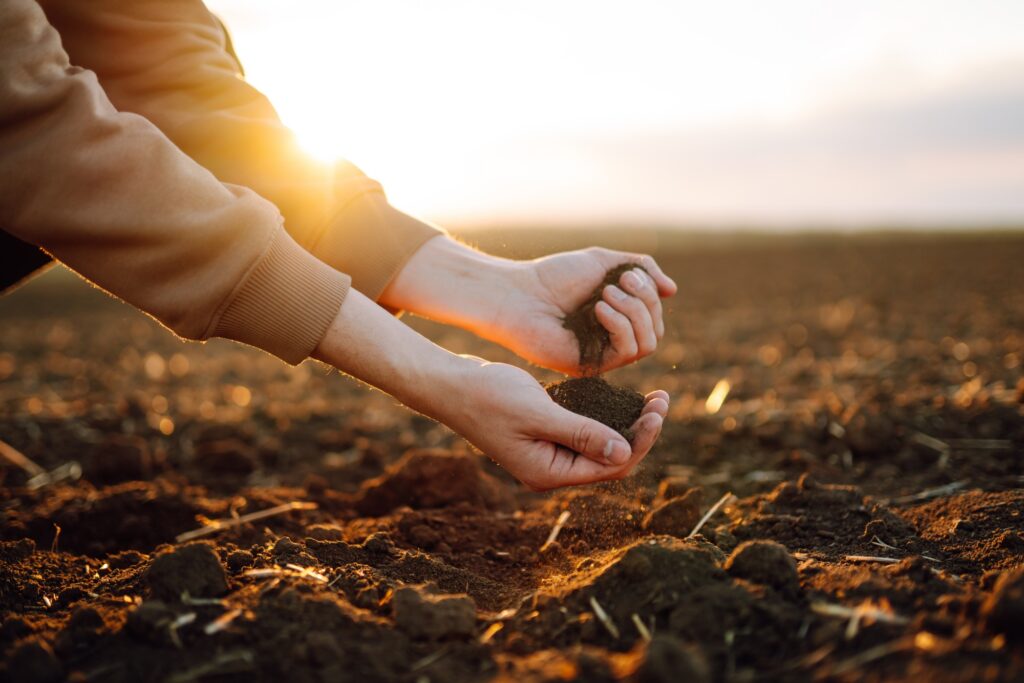
Healthy plants begin below the surface.
Gardeners spend a great deal of time thinking about flowers, vegetables, sunlight, watering, fertilizer, and pests, but soil quietly affects nearly everything those plants experience. It stores water, supplies mineral nutrients, holds roots in place, provides air spaces, supports enormous communities of organisms, and determines how easily excess rainfall can drain away.
Good garden soil is not simply “dirt with fertilizer added.”
It is a living, structured environment made from mineral particles, organic matter, water, air, plant roots, fungi, bacteria, insects, and countless other organisms interacting with one another.
Understanding your soil does not require becoming a soil scientist. For most home gardeners, a few basic concepts make an enormous difference: know whether the soil is sandy, silty, clay-rich, or loamy; understand how well it drains; avoid unnecessary compaction; add organic matter thoughtfully; test the soil before making major pH or fertilizer changes; and keep the surface protected whenever possible.
You do not need perfect soil before you can garden.
You need to understand the soil you have and improve it gradually.
⚡ Garden Soil Quick Guide
Soil texture: Determined primarily by the proportions of sand, silt, and clay.
Loam: A useful balance of sand, silt, and clay rather than a separate soil particle.
Best garden soil: Well-drained, adequately aerated, biologically active, and capable of holding enough water and nutrients for the plants being grown.
Soil pH: A measure of acidity or alkalinity.
Best pH: Depends on the plant; many vegetables and ornamentals perform well in mildly acidic to approximately neutral soil.
Soil testing: The best way to determine pH and many nutrient levels before adding fertilizers or pH-changing amendments.
Organic matter: Helps support soil structure, biological activity, water management, and nutrient cycling.
Compost: A useful soil amendment, but not something that should be added in unlimited quantities.
Compaction: Reduces pore space, restricting air, water movement, and root growth.
Best long-term strategy: Protect soil, minimize unnecessary disturbance, maintain living roots where practical, add appropriate organic matter, and make amendment decisions based on actual conditions.
🌎 What Is Garden Soil Made Of?
Healthy garden soil contains much more than mineral particles.
The solid mineral portion develops from weathered rock and consists mainly of particles classified as sand, silt, and clay according to size.
Between those particles are pore spaces containing air and water.
The soil also contains organic matter from decomposed plants, roots, animals, fungi, bacteria, and other living and formerly living material.
A productive garden depends on all of these parts working together.
Roots need moisture, but they also need oxygen.
Soil must hold nutrients, but excess water still needs somewhere to go.
Microorganisms need organic material and appropriate environmental conditions.
Thinking about soil as an ecosystem rather than an inert substance makes many gardening practices easier to understand.
🪨 Understanding Sand, Silt, and Clay
Soil texture is determined by the relative proportions of three mineral particle sizes:
- Sand
- Silt
- Clay
Those proportions strongly influence how the soil holds water and nutrients, how quickly it drains, how easily roots penetrate it, and how vulnerable it is to compaction.
You cannot realistically transform a clay soil into a sandy soil simply by adding a few bags of material.
Soil texture is fundamentally determined by its mineral particles.
What gardeners can improve is soil structure—the way those particles organize into aggregates and pore spaces.
That distinction is important.
🏖️ Sandy Soil
Sand contains the largest of the three basic soil particles.
Sandy soil usually feels gritty when rubbed between your fingers.
Large pore spaces allow water to move through it relatively quickly, which creates excellent drainage and aeration.
That can be helpful for plants that dislike wet roots.
The disadvantage is that sandy soil may dry rapidly and can have a lower ability to hold nutrients than soil containing more clay and organic matter.
Gardeners with sandy soil often need to pay more attention to irrigation and maintaining organic matter.
Adding finished compost and other appropriate organic materials can improve water-holding capacity and support biological activity without trying to change the fundamental texture of the soil.
🧱 Clay Soil
Clay particles are extremely small.
Clay-rich soil can hold substantial amounts of water and nutrients, but the small pore spaces and dense structure can make drainage and aeration difficult when the soil becomes compacted.
Wet clay soil may feel sticky and can often be rolled or shaped easily.
When dry, heavily compacted clay can become extremely hard.
This does not mean clay soil is bad soil.
Clay can be very fertile.
The challenge is managing its physical structure.
Organic matter, living roots, reduced compaction, appropriate mulch, and careful timing of soil work can gradually make clay-rich garden soil much easier to manage.
🌾 Silty Soil
Silt particles are intermediate in size between sand and clay.
Silty soil often feels smooth or flour-like rather than gritty or sticky.
It can hold more moisture than sandy soil while remaining easier to work than heavy clay.
However, silt-rich soil can compact and erode easily if left bare or heavily disturbed.
Mulch, plant roots, and other soil-protection practices become particularly valuable.
🌱 What Is Loam?
Gardeners often talk about loam as though it were a magical fourth kind of soil.
Loam is actually a mixture containing useful proportions of sand, silt, and clay.
A good loam combines some of the advantages of each.
It can hold useful moisture and nutrients while still providing enough drainage and air space for roots.
Not every productive garden needs textbook-perfect loam.
Clay loam, sandy loam, and silt loam can all support excellent gardens when managed appropriately.
Instead of trying to recreate an idealized soil recipe, learn how your own soil behaves and work with its strengths.
✋ How to Get a Basic Feel for Your Soil Texture
A simple hand test can give you useful clues.
Take a small amount of moist—but not dripping wet—soil from below the surface organic layer.
Rub it between your fingers.
Sandy soil feels noticeably gritty.
Silty soil tends to feel smooth.
Clay-rich soil feels sticky when wet and may form a ribbon when pressed between your thumb and finger.
This simple test will not replace laboratory analysis, but it helps you begin understanding why your garden behaves the way it does.
If water disappears immediately after irrigation, sandy texture may be involved.
If the ground remains sticky for days and becomes brick-hard during drought, clay may dominate.
🧱 Soil Texture Is Not the Same as Soil Structure
These two terms are often confused.
Texture refers to the proportions of sand, silt, and clay.
Structure refers to the way those particles and organic materials are arranged into aggregates.
Good soil structure creates a mixture of pore sizes.
Larger pores help air and water move through the soil, while smaller pores can retain moisture.
Roots, fungi, organic matter, earthworms, and microbial activity can all contribute to aggregate formation.
This means gardeners may not be able to change the soil’s texture dramatically, but they can often improve its structure over time.
💨 Roots Need Air
Plant roots respire.
They require oxygen.
That is why drainage and soil structure matter so much.
A waterlogged soil may contain plenty of moisture yet still stress plants because water has displaced much of the air from the pore spaces.
This is one reason plants can wilt in saturated soil even though water is clearly available.
Damaged roots cannot function normally.
When evaluating a struggling plant, do not automatically assume the solution is more water.
Check whether the soil is actually draining.
💧 Soil Needs to Hold Water Too
Excellent drainage does not mean water should disappear instantly.
Plants need a reservoir of moisture between rainfall or irrigation.
Sandy soils may drain so quickly that plants become drought stressed soon after watering.
Clay soils may retain moisture much longer.
Organic matter can help both extremes.
In sandy soil, it can improve moisture retention.
In clay-rich soil, organic matter and biological activity can contribute to improved aggregation and pore structure.
The goal is a soil that holds enough water for plants while still allowing excess water to move away.
🌧️ How to Check Garden Drainage
One of the easiest ways to understand drainage is simply to observe the garden after substantial rain.
Look for places where:
- Water ponds
- Soil remains saturated for several days
- Plants repeatedly develop root problems
- Grass becomes sparse
- Moss thrives
- Soil smells sour or anaerobic
- Water runs across the surface instead of soaking in
Some low areas may naturally be wetter than others.
You do not necessarily need to force every part of the landscape into identical conditions.
Instead, you might improve drainage where practical or grow plants naturally adapted to wetter soil.
Successful gardening often means matching the plant to the site rather than endlessly trying to change the site.
🪴 Raised Beds Can Help With Difficult Soil
If your native soil is extremely rocky, heavily compacted, contaminated, or poorly drained, raised beds can provide a more manageable growing environment.
Raised beds allow gardeners to control much of the growing medium while keeping feet out of the cultivated soil.
They can be especially useful for vegetable gardens.
However, raised beds are not automatically necessary just because your soil contains clay.
Many clay soils can become productive garden soils through good long-term management.
Raised beds also require soil, construction materials, irrigation, and ongoing maintenance.
Before building them, decide whether you genuinely need an elevated growing system.
Our Raised Bed Gardening for Beginners guide covers bed construction, dimensions, soil, irrigation, and planting in detail.
🧪 Why Test Your Garden Soil?
Soil testing removes much of the guesswork from gardening.
A laboratory soil test can provide information about:
- Soil pH
- Phosphorus
- Potassium
- Organic matter
- Certain additional nutrients depending on the laboratory
- Soluble salts where requested
- Contaminants such as lead through appropriate specialized testing
More importantly, a good soil-testing program can provide recommendations for fertilizer or lime based on actual conditions.
This can save money and prevent unnecessary nutrient applications.
Without testing, gardeners sometimes respond to every struggling plant by adding fertilizer.
That can make the problem worse when the soil already contains excessive nutrients.
📅 How Often Should You Test Garden Soil?
For an established home garden, testing roughly every few years is usually sufficient unless you are actively correcting a problem.
Testing is particularly useful when:
- Starting a new garden
- Converting lawn into vegetable beds
- Creating permanent flower beds
- Plants repeatedly perform poorly
- You have been adding compost or manure for many years
- You want to change soil pH
- You suspect nutrient excesses or deficiencies
- You are concerned about contamination
Testing every year is usually unnecessary for an ordinary stable garden.
University Extension guidance commonly recommends periodic testing rather than annual testing for typical home landscapes.
🧺 How to Collect a Soil Sample
A soil test is only as useful as the sample you submit.
Do not scoop one handful from a convenient corner and assume it represents the entire garden.
Instead, collect small samples from several locations within the area you want to test.
Mix those samples together in a clean container.
Remove obvious stones and large plant debris.
Follow the testing laboratory’s instructions for depth, quantity, drying, and packaging.
Keep areas with significantly different histories separate.
For example, do not combine samples from a heavily fertilized vegetable bed with samples from an unfertilized lawn.
Those soils may have very different nutrient profiles.
🥕 Test Vegetable Beds Separately
Intensively managed vegetable gardens can develop nutrient levels very different from the surrounding landscape.
Years of compost, manure, fertilizer, mulch, and crop production change soil chemistry.
If you garden in raised beds, collect the sample from the raised-bed soil rather than from nearby paths or native ground.
If different beds have received dramatically different amendments, consider testing them separately.
Our Vegetable Gardening hub covers the broader needs of food-growing areas.
⚗️ What Is Soil pH?
Soil pH describes how acidic or alkaline the soil is.
The scale runs from 0 to 14.
A pH of 7 is neutral.
Values below 7 are acidic.
Values above 7 are alkaline or basic.
pH matters because it influences chemical reactions in the soil and therefore affects how available certain nutrients are to plants.
A nutrient can technically be present in the soil while being less available to roots because the pH is unsuitable.
That is why blindly adding more fertilizer does not always correct an apparent nutrient problem.
🌱 What Soil pH Is Best for a Garden?
There is no single ideal pH for every plant.
Many common vegetables, flowers, lawns, and landscape plants perform well in mildly acidic to approximately neutral conditions.
A range around pH 5.5 to 7.0 is suitable for many common garden plants.
However, some plants prefer distinctly more acidic soil.
Blueberries, azaleas, rhododendrons, and other acid-loving plants often perform best at lower pH values than ordinary vegetables.
This is another reason you should know what you intend to grow before trying to alter soil pH.
🫐 Acid-Loving Plants Need Different Soil
Blueberries are a classic example of why gardeners should not apply one soil rule everywhere.
A soil perfectly suitable for tomatoes may be too alkaline for healthy blueberries.
Azaleas, rhododendrons, and several related plants also prefer acidic conditions.
Trying to force acid-loving plants into highly alkaline soil can become an ongoing maintenance challenge.
In some locations, containers or specially prepared beds are more practical than repeatedly trying to alter a large volume of native soil.
Choose the right strategy for the plant and the site.
🪨 How to Raise Soil pH
When soil is too acidic for the intended plants, agricultural lime is commonly used to raise the pH.
How much lime is needed depends on more than the starting pH.
Soil texture and buffering capacity also influence the amount required.
That is why a laboratory recommendation is so useful.
Do not apply lime simply because someone told you vegetables “like lime.”
If the soil is already near the appropriate pH, unnecessary liming can make nutrient availability worse.
🌲 How to Lower Soil pH
Sulfur-containing amendments may be recommended when soil needs to become more acidic.
Again, the amount depends on existing conditions and soil characteristics.
Changing soil pH can take time.
Do not expect a large permanent garden bed to shift instantly because one product was applied.
And do not attempt dramatic pH changes without testing.
For acid-loving plants in naturally alkaline regions, choosing an adapted planting strategy may be easier than constantly fighting the native soil chemistry.
🌿 What Is Organic Matter?
Organic matter includes plant and animal materials at various stages of decomposition.
In garden soil, it influences:
- Soil structure
- Water retention
- Nutrient cycling
- Biological activity
- Aggregate stability
- Workability
Dead leaves, decomposed roots, compost, plant residues, and microbial material all contribute to the organic component of soil.
Organic matter is constantly being broken down.
That means maintaining healthy garden soil is an ongoing process rather than something completed by adding one bag of compost during the first year.
♻️ Compost Is a Soil Amendment
Finished compost is one of the most useful materials available to home gardeners.
It can contribute organic matter, support soil organisms, and improve the physical characteristics of many soils.
But compost is not identical to soil.
And it should not automatically be applied in huge amounts every year.
Compost can contain substantial levels of nutrients, particularly phosphorus and soluble salts depending on the ingredients.
Repeated excessive applications can eventually create nutrient imbalances.
Use compost thoughtfully rather than assuming more is always better.
🌱 How Much Compost Should You Add?
The appropriate amount depends on the garden and existing soil.
A new bed with extremely low organic matter may benefit from more compost than a mature vegetable garden that has received annual applications for a decade.
Established beds may need only a relatively thin layer periodically.
A soil test can help determine whether organic matter and nutrients are already high.
This is particularly important in vegetable gardens where gardeners often add manure or compost every year.
If phosphorus is already excessive, continuing to add phosphorus-rich compost simply because it is “organic” does not improve the soil.
🌿 What Should Finished Compost Look Like?
Good finished compost is generally dark, crumbly, and earthy smelling.
You should not be able to identify large amounts of the original material.
A strong ammonia, sulfur, sewage, or rotting odor can indicate that material is immature or poorly composted.
Mature compost should smell more like forest soil.
When purchasing bulk compost, ask what ingredients were used and whether the supplier tests the finished product.
The word “compost” alone does not tell you everything about quality.
🐄 What About Manure?
Properly composted manure can be a useful garden amendment, but it should be treated thoughtfully.
Manures vary considerably in nutrient concentration and soluble salts.
Fresh manure may contain excessive nutrients, pathogens, weed seeds, or ammonia and is generally inappropriate for immediate application around food crops.
Follow current food-safety and Extension recommendations when using manure in vegetable gardens.
Also consider testing soil regularly when manure has been applied for several years because phosphorus can accumulate.
⚠️ Watch for Herbicide Residues in Compost and Manure
Some herbicides used on pasture and hay crops can persist through animal digestion and composting.
Contaminated manure, hay, straw, or compost can injure sensitive garden plants.
Tomatoes, beans, peas, and other broadleaf vegetables can be especially vulnerable.
If you are purchasing bulk compost or manure, ask the supplier about feedstocks and herbicide risk.
When the source is uncertain, testing the material on a few sensitive plants before spreading it across an entire vegetable garden can prevent a serious problem.
🍂 Use Leaves to Build Soil
Leaves are one of the best free organic materials available to gardeners.
Instead of sending all autumn leaves away, use them where appropriate.
Shredded leaves can serve as mulch around flowers, shrubs, and vegetables.
They eventually decompose and contribute organic matter to the soil.
Leaves can also be composted.
Avoid burying the garden under an extremely thick mat of intact leaves, which can reduce airflow and water penetration.
Shredding them first helps create a more manageable mulch.
Our October Gardening and November Gardening guides cover practical ways to use fall leaves.
🌾 Cover Crops Can Improve Garden Soil
Vegetable beds do not need to remain bare between crops.
Cover crops can help:
- Protect soil from erosion
- Maintain living roots
- Add organic residues
- Improve soil aggregation
- Suppress some weeds
- Capture nutrients
- Support soil organisms
Possible cover crops include grasses, legumes, and mixtures.
The best choice depends on climate, season, and what you intend to grow next.
Timing matters.
A cover crop that becomes a difficult weed is not helping the garden.
Use regional guidance before selecting and planting one.
🌱 Living Roots Help Build Soil
Plants influence the soil even when you are not harvesting anything.
Living roots interact with microorganisms and release compounds that help support the soil food web.
Root systems also create channels through the soil as they grow and later decompose.
This is one reason leaving soil planted where practical can be beneficial.
A garden is not simply a place where soil supports plants.
Plants also help influence and develop the soil.
🪱 What Do Earthworms Tell You?
Earthworms are often seen as a sign of biologically active soil, and they can contribute to decomposition and soil structure.
However, the situation is more complicated in natural ecosystems because some introduced earthworm species can negatively affect forest soils in regions where native earthworms were historically absent.
In a managed vegetable or flower garden, gardeners commonly appreciate their role in breaking down organic material.
Do not treat earthworm numbers as the only measure of soil health.
A healthy soil community contains bacteria, fungi, protozoa, nematodes, arthropods, roots, and many other organisms.
🍄 Fungi Are Part of Healthy Soil
Not every fungus in the garden is a disease.
Soil fungi play important roles in decomposition, nutrient cycling, and relationships with plant roots.
Mycorrhizal fungi form associations with the roots of many plant species and can help plants obtain water and nutrients.
A healthy garden soil contains complex biological communities.
That is one reason constantly sterilizing, fumigating, or heavily disturbing soil can have unintended consequences.
The goal is not to eliminate microorganisms.
It is to create conditions that support a functioning soil ecosystem.
🧱 What Is Soil Compaction?
Compacted soil has fewer large pore spaces.
This reduces air movement, water infiltration, and the ability of roots to penetrate the soil.
Compaction can result from:
- Walking on garden beds
- Heavy equipment
- Working wet soil
- Repeated traffic
- Construction activity
- Poor soil structure
Clay-rich soils are particularly vulnerable when worked wet.
Once compressed, the soil may remain dense long after the surface looks dry.
🚶 Keep Feet Out of Garden Beds
One of the simplest soil improvements costs nothing:
Stop walking on the soil where plants grow.
Create permanent paths.
Use stepping stones where necessary.
Build beds narrow enough to reach from the outside.
This is one reason raised beds are so effective. The defined boundaries make it obvious where feet belong.
Protecting the soil from repeated foot traffic preserves pore spaces and makes the soil easier for roots to explore.
🌧️ Don’t Work Wet Soil
Digging or tilling saturated soil can damage its structure, particularly when clay content is high.
If a handful of soil forms a sticky lump that refuses to crumble, it may still be too wet to work.
Wait until conditions improve.
Gardeners are often impatient in spring, but one afternoon spent working excessively wet soil can create compaction that causes problems for months.
Patience is sometimes a soil-management technique.
🚜 Should You Till Garden Soil?
Tilling can be useful in certain situations, particularly when establishing a completely new garden or incorporating material into heavily disturbed soil.
But annual deep tilling is not always necessary.
Repeated disturbance breaks soil aggregates, disrupts fungal networks, brings buried weed seeds to the surface, and can create compacted layers beneath the tilled zone.
Many gardeners gradually reduce tillage once beds are established.
Broadforks, garden forks, surface cultivation, mulch, cover crops, and living roots can help maintain productive beds with less disturbance.
Think of tillage as a tool rather than an annual ritual.
Dig Only When There Is a Reason
Garden soil does not need to be turned upside down every spring simply because the growing season is beginning.
If the bed already has good structure, adding compost to the surface and allowing roots, organisms, rainfall, and mulch to integrate organic matter may be enough.
Digging is useful when planting, dividing perennials, removing difficult weeds, correcting severe compaction, or establishing beds.
Unnecessary disturbance is not automatically beneficial.
Good gardeners learn not only how to dig but when not to.
🍂 Mulch Protects the Soil Surface
Bare soil is vulnerable.
Heavy rain can break apart surface aggregates.
Wind can move dry particles.
Sunlight can heat and dry the upper soil layer.
Weed seeds also find exposed soil very convenient.
Mulch provides a protective layer.
Depending on the garden, useful organic mulches include:
- Shredded leaves
- Wood chips
- Bark
- Clean straw
- Other suitable plant materials
Different mulches fit different areas.
Wood chips are excellent around woody plants and pathways.
Straw or shredded leaves may be more convenient in vegetable beds.
⚠️ Don’t Pile Mulch Against Plant Stems
Mulch belongs over the soil.
It should not be piled into volcanoes around tree trunks or buried against perennial crowns.
Keep material slightly away from stems and trunks.
Excessively deep mulch can retain too much moisture, interfere with gas exchange, and encourage roots to grow in inappropriate locations.
A reasonable layer is enough to provide the benefits.
More is not automatically better.
🌳 Trees Need Healthy Soil Too
Much of a tree’s active root system occupies soil relatively close to the surface and spreads well beyond the trunk.
Treating the area beneath a tree as unimportant compacted ground can affect long-term health.
Avoid driving or parking heavy equipment repeatedly over root zones.
Do not pile new soil deeply over existing roots.
Mulch can protect the soil surface and reduce competition from turf when used properly.
Our How to Plant a Tree guide covers planting depth, root flare, watering, and mulch in more detail.
🥕 Vegetable Garden Soil
Vegetable gardens are often managed more intensively than ornamental beds.
Crops are planted, harvested, removed, and replaced repeatedly.
This can make soil protection especially important.
A productive vegetable bed should have:
- Adequate drainage
- Appropriate pH
- Enough organic matter
- Good structure
- Appropriate nutrient levels
- Consistent moisture
- Minimal compaction
Use soil testing to guide fertilizer decisions.
Rotate crops when possible.
Add mulch between plants.
Use cover crops during appropriate fallow periods.
Visit Vegetable Gardening for more complete crop-growing guidance.
🌸 Flower Garden Soil
Most flowering plants benefit from healthy, well-drained soil, but their needs vary tremendously.
Coneflowers and black-eyed Susans tolerate relatively lean conditions.
Roses appreciate fertile soil but still demand good drainage.
Some woodland flowers prefer moisture-retentive soil rich in organic matter.
The lesson is simple:
There is no single perfect flower-garden soil for every species.
Match plants to conditions wherever possible.
Our Flower Gardening hub can help you choose plants for different garden situations.
🌹 Rose Garden Soil
Roses generally perform best in fertile, well-drained soil with adequate moisture.
Before establishing a new rose bed, testing the soil is worthwhile.
A soil test can tell you whether pH adjustment or particular nutrients are actually necessary.
Avoid creating planting holes filled with an extremely rich mixture that differs dramatically from surrounding soil.
Roots need to expand outward.
For complete rose guidance, visit How to Grow a New Rose Garden.
🌿 Herb Garden Soil
Many culinary herbs are native to regions where soils are not exceptionally rich.
Mediterranean herbs such as rosemary, thyme, oregano, and lavender often perform better in well-drained soil than in constantly wet, heavily fertilized beds.
Other herbs prefer more moisture and fertility.
Do not treat every herb identically.
If you continually fertilize a drought-adapted herb simply because it looks smaller than your basil, you may actually make the plant weaker.
The Herbs & Fruit hub covers individual edible plants in more detail.
🪴 Don’t Use Garden Soil in Containers
Container growing creates very different conditions from in-ground gardening.
Ordinary garden soil can become dense and poorly aerated when placed in a pot.
Containers need a potting medium specifically designed to hold water while maintaining adequate air space and drainage.
Good container mixes may contain materials such as bark, peat or substitutes, coconut coir, perlite, and other components depending on the formulation.
Do not assume filling pots with soil dug from the yard will provide the same conditions as an in-ground bed.
For houseplant and indoor-container guidance, visit Indoor Plants.
🪴 What Is Potting Mix?
Commercial potting mixes are engineered growing media.
Many contain little or no actual field soil.
Their purpose is to create the physical conditions roots need inside the confined environment of a container.
A good mix balances moisture retention and drainage while remaining porous enough to hold air.
Different plants may need different formulations.
Cacti and succulents require different moisture management from ferns or tropical foliage plants.
Choose the growing medium based on the plant rather than assuming one bag works perfectly for everything.
🏗️ What Soil Should Go in a Raised Bed?
Raised beds generally perform best when filled with a mixture containing real mineral soil plus appropriate organic matter.
Do not fill an entire raised bed with pure compost.
Compost decomposes and settles, and excessive quantities can result in extremely high nutrient levels.
A raised-bed mix dominated by appropriate topsoil and supplemented with finished compost is more stable for long-term gardening.
The exact ratio depends on available materials and local conditions.
If buying bulk soil, ask the supplier what is actually in the mixture.
Labels such as “garden mix” or “raised bed mix” are marketing terms and do not guarantee identical composition.
🧮 Calculate Soil Before Filling Raised Beds
The volume required can surprise new gardeners.
To calculate the volume of a rectangular raised bed:
Length × Width × Depth = cubic volume
For measurements in feet, the result is cubic feet.
There are 27 cubic feet in one cubic yard.
Calculating first prevents ordering far too much—or discovering halfway through filling the bed that you need another truckload.
Our Raised Bed Gardening for Beginners article provides more examples.
🏡 What Is Topsoil?
Topsoil refers broadly to the upper mineral layer of soil.
Commercial products labeled “topsoil” can vary tremendously.
One supplier may offer excellent screened local soil.
Another bag may contain material with a very different texture and organic-matter content.
Do not assume that anything labeled topsoil is automatically suitable for a vegetable garden.
For large projects, inspect the material if possible.
Ask about its source and composition.
If you are filling several raised beds or changing large portions of the landscape, testing purchased soil can be worthwhile.
⚠️ Don’t Try to Fix Clay by Adding a Little Sand
A common gardening myth suggests that adding sand will automatically loosen clay soil.
Small or poorly calculated quantities of sand mixed into clay can actually produce an even denser material rather than beautifully loose loam.
Changing the texture of a large volume of soil requires enormous amounts of mineral material.
For most home gardeners, adding organic matter, protecting the soil, encouraging roots, reducing compaction, and improving drainage are far more practical strategies.
Work with the clay rather than trying to manufacture a different geological soil type.
🧱 How to Improve Clay Soil
Clay improvement takes time.
Useful strategies include:
- Add appropriate organic matter
- Use compost thoughtfully
- Mulch the soil surface
- Grow cover crops
- Maintain living roots
- Avoid working soil when wet
- Reduce foot traffic
- Minimize unnecessary tillage
- Create permanent paths
- Use raised beds where genuinely helpful
Expect gradual improvement.
One application of compost will not permanently transform a compacted clay yard.
Years of better management can make a substantial difference.
🏖️ How to Improve Sandy Soil
Sandy soil presents the opposite challenge.
It often drains quickly and may lose moisture and nutrients faster.
Organic matter becomes particularly important because it helps increase water and nutrient retention.
Useful practices include:
- Add finished compost as appropriate
- Keep soil mulched
- Irrigate more deeply and appropriately
- Use cover crops
- Maintain living roots
- Avoid excessive fertilizer applications that may leach
- Test periodically
Sandy soil can warm quickly in spring and is often easy to work, so it has advantages as well.
🧱 How to Improve Compacted Soil
First identify why compaction occurred.
If people continually walk across a bed, loosening it once will not solve the problem.
Redirect traffic.
Create pathways.
For relatively small areas, a garden fork or broadfork can sometimes loosen soil without completely inverting the layers.
Adding organic matter and growing deep-rooted plants or cover crops can contribute to longer-term structural improvement.
Avoid repeated aggressive rototilling, which may create a temporary fluffy surface without correcting deeper compaction.
🌧️ How to Improve Poor Drainage
Drainage problems have several possible causes.
The soil may be heavily compacted.
The site may be naturally low.
A downspout may direct water toward the bed.
Heavy clay may slow infiltration.
Construction may have altered the grade.
Before adding amendments, identify where the water is coming from.
Sometimes the solution is improving soil structure.
Sometimes it is redirecting runoff.
Sometimes a raised bed is appropriate.
And sometimes the smartest solution is simply growing moisture-loving plants in that location.
🌵 What About Very Dry Soil?
A garden that constantly dries out may have:
- Sandy texture
- Low organic matter
- Excessive sun or wind
- Dense plant competition
- Poor irrigation practices
- Exposed bare soil
Mulch is often one of the simplest improvements.
Adding appropriate organic matter can increase water retention.
Water more deeply rather than repeatedly wetting only the upper inch.
Group plants with similar water needs.
A garden should be designed around its moisture conditions rather than forcing drought-sensitive plants into the driest location.
💦 Soil and Watering Work Together
The same watering schedule will not work in every garden.
Clay soil may remain moist for days after irrigation.
Sandy soil may dry much faster.
Mulched soil loses moisture more slowly than bare soil.
Raised beds may dry faster than surrounding ground.
Containers can dry even faster.
Before deciding that a plant needs watering every Monday and Thursday, learn how its root zone behaves.
Dig a few inches down.
Feel the soil.
Observe the plant.
Good watering decisions begin with understanding the soil.
🌾 What Are Soil Aggregates?
Healthy soil often contains small clumps called aggregates.
These are groups of mineral particles held together by organic compounds, roots, fungal activity, and other biological processes.
Stable aggregates create a more complex pore system.
This can improve water infiltration, aeration, and resistance to erosion.
Practices that support aggregation include maintaining organic matter, keeping living roots, reducing unnecessary disturbance, and protecting the soil surface.
Soil health is therefore not simply a question of how many nutrients are present.
Physical structure matters too.
🧬 Soil Biology Matters
A teaspoon of healthy soil can contain vast numbers of microorganisms.
Bacteria and fungi decompose organic material and cycle nutrients.
Protozoa and nematodes participate in complex food webs.
Plant roots release compounds into the surrounding soil.
Insects and other organisms move organic material and alter soil structure.
Gardeners do not need to identify every organism.
The useful principle is simpler:
Create conditions where a diverse soil community can function.
Feed the soil with appropriate organic matter.
Avoid unnecessary disturbance.
Maintain living roots where practical.
Do not treat all microorganisms as enemies.
🧫 Do You Need to Buy Soil Microbes?
Commercial products are sometimes marketed as though ordinary garden soil is biologically empty until microbes are purchased and added.
In most functioning outdoor soils, microorganisms are already present.
The more important task is creating suitable conditions for them.
Organic matter, roots, moisture, oxygen, moderate disturbance, and appropriate soil chemistry influence biological communities much more fundamentally than repeatedly pouring bottled organisms into unhealthy soil.
There are specialized situations where microbial inoculants may have value, but they are not a substitute for basic soil management.
🍄 Do You Need Mycorrhizal Inoculants?
Many garden plants naturally form relationships with mycorrhizal fungi.
Commercial inoculants are widely sold.
Whether they provide meaningful benefits depends on the plant, soil, product, existing fungal community, and growing conditions.
In an established outdoor garden with functioning soil biology, adding inoculant is not automatically necessary.
If your garden already supports healthy plant growth, focus first on protecting soil structure and organic matter.
A product should solve an actual problem rather than simply sound biologically sophisticated.
🧂 What Are Soluble Salts?
Soil salts can accumulate from fertilizers, manure, compost, irrigation water, or other sources.
At high levels, salts interfere with the ability of roots to absorb water.
Symptoms can include poor germination, leaf-edge burn, stunted growth, or plant decline.
Raised beds and greenhouses can be particularly vulnerable when gardeners repeatedly add fertilizers and compost without testing.
A specialized soil test can measure soluble salts when this is suspected.
This is another example of why adding more fertilizer to a struggling plant can make the situation worse.
🧪 What Do N, P, and K Mean?
Fertilizer labels commonly show three numbers representing:
N — Nitrogen
P — Phosphorus
K — Potassium
Plants need all three, along with many other nutrients.
Nitrogen strongly influences leafy growth.
Phosphorus plays roles in energy transfer, roots, and reproduction.
Potassium supports many physiological processes.
But plants do not benefit from nutrients simply because they are added.
If the soil already contains adequate phosphorus, adding more does not improve plant performance.
Use soil testing to guide fertilizer decisions.
🌱 More Fertilizer Is Not Better Soil
A heavily fertilized soil can still have poor structure, poor drainage, low biological activity, compaction, or inappropriate pH.
Fertility is only one component of soil health.
This is why gardeners should resist the tendency to treat fertilizer as a universal solution.
If a plant is struggling, ask several questions:
Does it receive enough sun?
Is the soil too wet?
Is it too dry?
Are roots compacted?
Is the plant suited to the climate?
Is disease present?
Are nutrients actually deficient?
Good diagnosis comes before treatment.
💚 Organic Fertilizer vs. Synthetic Fertilizer
Plants absorb nutrients in chemical forms that roots can use regardless of whether those nutrients originated in an organic or synthetic product.
Organic fertilizers often release nutrients more gradually because biological processes must break down some of their components.
Synthetic fertilizers can supply nutrients in readily available forms.
Neither category should be treated as automatically perfect or automatically harmful.
The important questions are:
- Does the soil need the nutrient?
- Is the rate appropriate?
- Is the product suitable for the plant?
- Could nutrients move into waterways?
- Are you following label directions?
Apply what is needed—not what marketing convinces you to buy.
🌱 Why Soil Health Matters for Plant Disease
Healthy soil cannot prevent every plant disease.
Pathogens still exist, and susceptible plants can still become infected.
But appropriate soil conditions help plants establish strong root systems and avoid stress associated with poor drainage, nutrient imbalance, or compaction.
A plant already struggling with damaged roots is less capable of dealing with additional challenges.
Think of soil health as creating the best possible growing environment rather than as a miracle cure for disease.
🐛 Soil Pests and Problems
Some garden problems originate below ground.
Potential issues include:
- Root-feeding insects
- Nematodes
- Grubs
- Root rots
- Voles and other burrowing animals
- Soilborne pathogens
Do not assume every wilted plant has a soil pest.
Drought, excess water, root damage, transplant shock, or vascular disease can produce similar symptoms.
Digging up one severely affected plant and examining the root system can provide valuable clues.
⚠️ Consider Soil Contamination
Garden soil can sometimes contain contaminants, particularly in older urban areas, former industrial properties, locations near heavily trafficked roads, or sites with a history of peeling lead-based paint.
Lead is one of the better-known concerns.
If you have reason to suspect contamination, use an appropriate laboratory test.
Do not rely on an ordinary nutrient soil test unless it specifically includes the contaminant you are concerned about.
Where contamination is confirmed, management may include raised beds with clean soil, mulch, barriers, hand-washing practices, and other recommendations based on the contaminant and exposure risk.
🏙️ Soil in Older Urban Gardens
Older properties deserve a little extra investigation before establishing food gardens.
Consider the site’s history.
Was there an old building?
Were there painted structures?
Did the property have industrial use?
Has fill soil been imported?
You do not need to assume every urban yard is unsafe.
The point is simply that soil history matters.
When uncertainty is significant, laboratory testing can replace speculation with information.
🌱 Protect Soil With Plants
One of the best ways to protect garden soil is simply to grow something in it.
Roots help stabilize soil and support organisms.
Plant canopies reduce the direct impact of heavy rainfall.
Living plants use nutrients that might otherwise be lost.
Even during periods when vegetables are not being grown, cover crops can serve this function.
In ornamental gardens, groundcovers and dense perennial plantings can protect soil while reducing open space available to weeds.
♻️ Build Soil Gradually
The most important word in soil improvement may be gradually.
A compacted clay yard will not become beautiful crumbly garden soil after one bag of compost.
A sandy bed will not permanently hold moisture because you amended it once.
Healthy soil develops through repeated good management:
- Add organic matter appropriately
- Keep the surface protected
- Avoid compaction
- Use living roots
- Minimize unnecessary disturbance
- Manage water wisely
- Test before making major chemical changes
Each growing season contributes to the next.
🚫 Common Garden Soil Mistakes
Several soil mistakes appear repeatedly in home gardens.
Adding Fertilizer Without Testing
Plants can struggle from excessive nutrients as well as deficiencies.
Adding Lime Automatically
Not every garden soil is too acidic.
Adding Sand to Clay Without Understanding the Consequences
Small quantities rarely create loam.
Using Garden Soil in Containers
Container roots need a more porous growing medium.
Filling Raised Beds Entirely With Compost
Compost is an amendment, not a stable replacement for mineral soil.
Walking Through Cultivated Beds
Foot traffic creates compaction.
Tilling Every Year Without a Reason
Repeated disturbance can damage structure.
Working Clay Soil While Wet
This can create severe compaction.
Leaving Soil Bare
Mulch and plants protect the soil surface.
Assuming Organic Products Cannot Be Overused
Compost, manure, and organic fertilizers can still create nutrient excesses.
🪴 A Simple Soil Improvement Plan for Beginners
If you have just started gardening, you do not need to solve everything immediately.
Begin with these steps:
- Observe drainage. See what happens after heavy rain.
- Identify the general texture. Is the soil sandy, silty, clay-rich, or loamy?
- Get a laboratory soil test. Learn the pH and nutrient situation.
- Add compost only where appropriate.
- Use mulch to protect exposed soil.
- Avoid walking in growing beds.
- Do not work saturated soil.
- Grow plants suited to the conditions.
- Use cover crops where they make sense.
- Retest periodically rather than guessing.
That simple approach solves more soil problems than continually buying new amendments.
🌻 Good Soil Doesn’t Have to Look Perfect
Garden photographs sometimes create the impression that successful soil should always be dark, fluffy, loose, and identical everywhere.
Real soil does not work that way.
A clay-rich soil can support an extraordinary flower garden.
A sandy soil can grow excellent vegetables with appropriate water and organic matter management.
A rocky soil can support plants adapted to those conditions.
The goal is not to turn every garden into the same handful of black material.
The goal is to create a soil environment where the plants you choose can develop healthy roots.
🌱 Work With the Soil You Have
Learning about soil changes the way you garden.
You stop asking which fertilizer will fix every problem.
You notice where water collects after storms.
You understand why one bed dries twice as fast as another.
You recognize that digging wet clay does more harm than good.
You stop throwing away every fallen leaf and begin seeing organic material as part of a cycle.
You test before changing pH.
You put paths where people walk and plants where roots can grow undisturbed.
Most importantly, you begin treating soil as something worth protecting.
Flowers and vegetables may be the visible reward, but much of their success is determined underground.
Build healthier soil gradually, and the garden above it becomes easier to grow.
🔗 Related Articles
- Gardening Basics
- Vegetable Gardening
- Flower Gardening
- Eco-Friendly Gardening
- Herbs & Fruit
- Seasonal Gardening
- Garden Tools & Products
- Raised Bed Gardening for Beginners
- 10 Essential Gardening Plants for Beginners
- How to Grow a New Rose Garden
- October Gardening: Your Complete Guide to Fall Success
- November Gardening: Winter Preparation and Late-Season Success
📚 Sources & Further Reading
- University of Minnesota Extension — Soil Testing for Lawns and Gardens
- Oregon State University Extension — Garden Soil and Compost
- Oregon State University Extension — Understanding Soil Texture Is Key to Better Gardening
- Oregon State University Extension — How Do I Test My Garden Soil?
- Oregon State University Extension — How to Use Compost in Gardens and Landscapes
- Oregon State University Extension — Understanding Soil Health and Biota for Farms and Gardens
- University of Maryland Extension — Soil Testing
- University of Maryland Extension — Understanding Your Soil Test Report
- University of Maryland Extension — Soil, Compost, and Fertilizer for the Home Garden