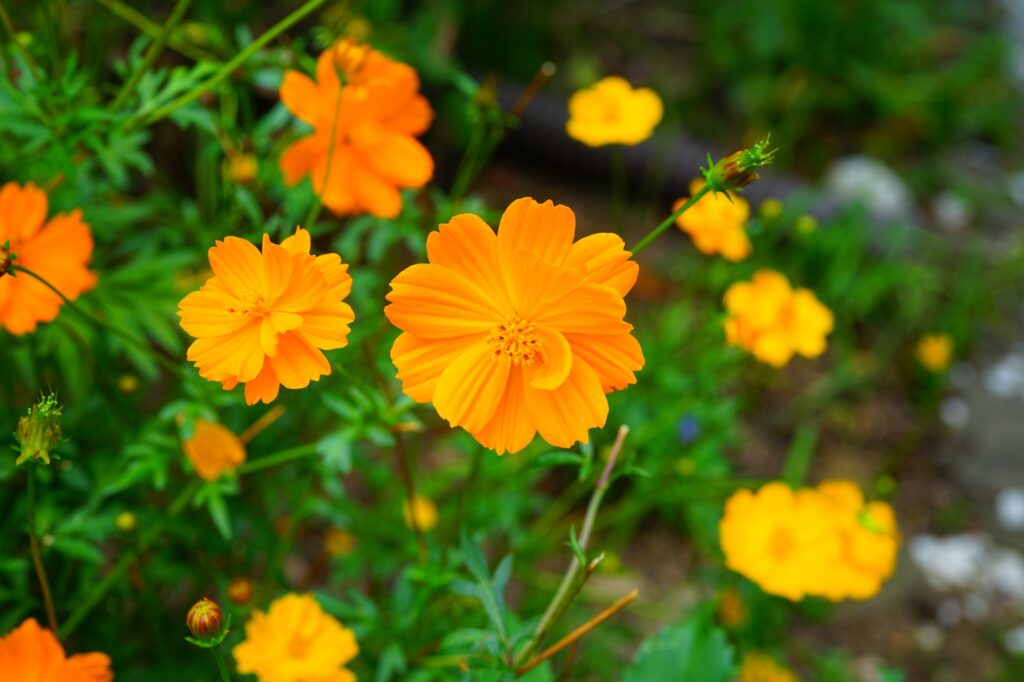
Cosmos sulphureus, commonly called sulphur cosmos, yellow cosmos, orange cosmos, or Klondike cosmos, is a warm-season annual known for brilliant flowers in shades of lemon yellow, golden yellow, orange, and red-orange. Native from Mexico through Central America, it is one of the most colorful wild species in the genus Cosmos and the source of numerous popular garden cultivars and compact series.
At first glance, Cosmos sulphureus resembles the familiar garden cosmos, Cosmos bipinnatus. Both produce finely divided foliage and daisy-like flower heads on branching annual plants. Look more closely, however, and the differences become obvious. C. sulphureus has foliage with broader leaf segments, thrives in intense summer heat, and naturally produces warm yellow-to-orange flowers rather than the white, pink, and crimson colors typical of C. bipinnatus.
Plants vary enormously in size. Compact cultivars can remain only about 12 inches tall, while vigorous species-type plants may reach 4 feet or more, occasionally approaching 6 feet under favorable conditions. Flowers may be single, semi-double, or double depending on the selection.
Easy seed culture, tolerance of hot weather, long flowering, abundant seed production, and pollinator-friendly blooms make Cosmos sulphureus one of the easiest annual flowers for sunny summer gardens.
☀️ Cosmos sulphureus Quick Guide
| Feature | Cosmos sulphureus |
|---|---|
| Common names | Sulphur cosmos, yellow cosmos, orange cosmos, Klondike cosmos |
| Family | Asteraceae |
| Plant type | Annual |
| Native range | Mexico through Central America |
| Natural habitat | Seasonally dry tropical environments, disturbed ground and open sites |
| Flower colors | Sulphur yellow, lemon yellow, gold, orange, red-orange |
| Flower form | Single naturally; semi-double and double cultivars available |
| Typical height | About 1–4 feet, depending on selection |
| Maximum height | Vigorous plants may approach 6 feet |
| Dwarf cultivars | Some remain around 12–18 inches |
| Bloom season | Summer until frost |
| Light | Full sun |
| Soil | Average, porous, well-drained soil |
| Water needs | Moderate while establishing; relatively drought tolerant later |
| Direct sowing | After frost when soil reaches about 65°F |
| Germination | Approximately 7–21 days |
| Seed depth | Sow shallowly; deep planting can reduce germination |
| Deadheading | Helpful but not essential for every planting |
| Self-seeding | Often prolific |
| Best uses | Pollinator gardens, cottage gardens, borders, meadow-style plantings, cutting |
| Heat tolerance | Excellent |
🌼 What Is Cosmos sulphureus?
Cosmos sulphureus is an accepted species in the sunflower family, Asteraceae.
Royal Botanic Gardens, Kew recognizes the accepted botanical name as:
Cosmos sulphureus Cav.
The species was formally published in 1791.
Its native range extends from Mexico through Central America, including Guatemala, Honduras, El Salvador, Nicaragua, Costa Rica, and Panama.
Today, the plant has spread far beyond that original range. It has been cultivated and introduced throughout many warm-temperate and tropical regions of the world.
Its ability to grow rapidly, flower heavily, and produce abundant seed has helped it naturalize in many places outside its native distribution.
🇲🇽 Where Is Cosmos sulphureus Native?
Kew currently identifies the native range as Mexico to Central America.
That distinguishes it from making the overly broad statement that all cosmos come only from Mexico.
The genus itself has a wider distribution, and different species occupy different geographic regions.
Cosmos sulphureus naturally occurs in warm climates and is strongly associated with seasonally dry tropical environments.
Its natural ecology helps explain many of its garden characteristics:
- Strong heat tolerance
- Good performance in sunny locations
- Ability to grow in relatively lean soils
- Rapid annual development
- Tolerance of short dry periods once established
🌞 Why Is It Called Sulphur Cosmos?
The species name sulphureus refers to the sulfur-yellow color associated with many of its flowers.
Wild-type and cultivated plants can produce a broader range than yellow alone.
Depending on the selection, flowers may be:
- Pale lemon yellow
- Sulfur yellow
- Golden yellow
- Yellow-orange
- Tangerine
- Deep orange
- Scarlet-orange
- Red-orange
Modern cultivars have intensified this range considerably.
🌸 What Do Cosmos sulphureus Flowers Look Like?
The species produces composite flower heads typical of the daisy family.
What appears to be one flower is actually an arrangement of many small florets.
The outer colored structures are ray florets, while the central portion contains disc florets.
Wild-type flowers commonly have approximately seven to ten broad ray florets surrounding an orange-yellow center.
Garden cultivars may be:
- Single
- Semi-double
- Double
This provides much more structural variety than the wild species alone would suggest.
🎨 What Colors Does Cosmos sulphureus Come In?
Warm colors dominate.
Expect shades such as:
- Lemon
- Sulfur yellow
- Gold
- Tangerine
- Orange
- Vermilion
- Scarlet-orange
- Red-orange
There are no naturally blue flowers.
Likewise, the white, soft blush, lavender, and burgundy shades associated with many Cosmos bipinnatus cultivars belong primarily to a different species.
If you want a traditional pink-and-white cosmos garden, choose C. bipinnatus.
If you want blazing yellow and orange color in summer heat, C. sulphureus is the better species.
🌿 What Does Cosmos sulphureus Foliage Look Like?
The foliage is deeply divided and fern-like, but it differs noticeably from Cosmos bipinnatus.
Cosmos bipinnatus often has extremely fine, almost thread-like leaf segments.
The leaf divisions of Cosmos sulphureus are generally broader and somewhat coarser.
This distinction can help identify the species even before flowers appear.
The foliage is usually medium to bright green and provides a light background beneath the brightly colored blooms.
📏 How Tall Does Cosmos sulphureus Grow?
The answer depends heavily on cultivar and environment.
Botanical descriptions place many plants at approximately 1 to 4 feet tall.
North Carolina Extension notes that vigorous plants can grow as tall as 6 feet.
Garden breeding has also produced very compact forms.
Some modern cultivars remain only:
12–18 inches tall.
This means you cannot determine mature size from the species name alone.
Always check the specific cultivar when purchasing seed.
🌿 Tall vs. Dwarf Cosmos sulphureus
The species offers useful choices for different garden situations.
Tall Forms
Tall selections are useful for:
- Cottage gardens
- Meadow plantings
- Cutting gardens
- Back borders
- Naturalistic gardens
Compact Forms
Dwarf varieties are excellent for:
- Containers
- Border fronts
- Small gardens
- Mass bedding
- Patio plantings
The compact Cosmic Series, for example, generally remains around 12 to 18 inches tall while producing abundant semi-double and double flowers.
📅 When Does Cosmos sulphureus Bloom?
Expect flowers from summer until frost.
Plants grow particularly rapidly after temperatures become consistently warm.
Once flowering begins, new buds can continue developing for months.
In climates with long warm autumns, flowering may remain strong surprisingly late into the season.
A hard frost ends the annual plant’s life.
❄️ Is Cosmos sulphureus an Annual or Perennial?
Cosmos sulphureus is an annual.
Kew specifically classifies it as an annual species.
The plant completes its life cycle within one growing season:
- Seeds germinate.
- Plants grow rapidly.
- Flowers open.
- Pollination occurs.
- Seeds mature.
- Plants die after frost or at the end of their seasonal life cycle.
This differs from Cosmos atrosanguineus, which is a tuberous perennial.
☀️ How Much Sun Does Cosmos sulphureus Need?
Full sun provides the best flowering.
The RHS recommends full sun, while North Carolina Extension advises a site receiving at least half a day of direct sunlight.
For the strongest performance, aim for six or more hours of direct sun.
Plants grown in full sun tend to produce:
- More flowers
- Sturdier growth
- More compact branching
- Better color
Too much shade can encourage stretching and reduce flowering.
🌡️ Is Cosmos sulphureus Heat Tolerant?
Yes. Heat tolerance is one of its greatest strengths.
This species is especially valuable in gardens where many cool-season annual flowers begin struggling once midsummer temperatures arrive.
Warm weather encourages rapid growth.
Established plants can continue flowering through periods of significant summer heat, particularly when their roots have reasonable access to moisture.
This makes sulphur cosmos particularly useful in hot, sunny landscapes.
🌵 Is Cosmos sulphureus Drought Tolerant?
Established plants tolerate relatively dry conditions.
North Carolina Extension recommends moist-to-dry porous soils and identifies the plant as tolerant of dry conditions.
Young seedlings still require moisture while establishing.
Once plants are mature, avoid automatically watering every day.
Deep occasional watering is generally better than constantly saturated soil.
During severe or prolonged drought, supplemental water helps maintain stronger flowering.
🌱 Best Soil for Cosmos sulphureus
Average, porous, well-drained soil works well.
The species is not particularly demanding.
The RHS lists suitability for:
- Chalk
- Loam
- Sand
Some cultivars also perform well in clay where drainage remains adequate.
The plant tolerates a broad pH range.
The most important requirements are:
- Reasonable drainage
- Plenty of sunlight
- Avoiding permanently saturated soil
Rich garden soil is unnecessary.
🚫 Don’t Overfertilize Sulphur Cosmos
Like other cosmos, C. sulphureus generally does not require heavy feeding.
Excessive nitrogen can encourage:
- Lots of foliage
- Tall soft stems
- Fewer flowers
- Increased flopping
If your soil already supports ordinary annual plants successfully, additional fertilizer may not be necessary.
A modestly fertile bed often produces a better balance between growth and flowering than heavily enriched soil.
💧 How Much Water Does Cosmos sulphureus Need?
Keep the soil consistently moist during germination and early seedling establishment.
North Carolina Extension recommends maintaining moisture during approximately the first 5 to 10 days after seeding.
Once plants develop strong roots, their water requirements become less demanding.
Water during extended drought.
Allow excess moisture to drain freely.
Avoid treating sulphur cosmos like a plant that requires constant irrigation.
🌱 How to Grow Cosmos sulphureus From Seed
Growing sulphur cosmos from seed is remarkably easy.
Direct sowing is usually the simplest method.
Because the plants germinate and develop rapidly in warm conditions, there is often little advantage to starting them extremely early indoors.
You can either:
- Direct sow after frost, or
- Start indoors several weeks before transplanting for earlier flowers
Both approaches work.
🌱 When to Direct Sow Cosmos sulphureus
Wait until:
- Danger of frost has passed.
- Soil has warmed.
- Spring weather has become reliably mild.
North Carolina Extension specifically recommends sowing once the soil has reached approximately 65°F.
Warm soil encourages faster, more consistent germination.
📏 How Deep Should Cosmos sulphureus Seeds Be Planted?
Sow the seeds shallowly.
North Carolina Extension specifically warns that planting too deeply can interfere with germination.
Scatter or place seeds in prepared loose soil and rake them lightly into the surface.
A covering of roughly ⅛ to ¼ inch is generally sufficient for garden sowing.
The key is good seed-to-soil contact without deep burial.
⏱️ How Long Does Cosmos sulphureus Take to Germinate?
North Carolina Extension gives approximately 7 to 21 days.
Warm soil generally produces faster emergence than cool soil.
During germination:
- Keep the surface moist.
- Avoid flooding the seedbed.
- Prevent the soil from crusting excessively.
- Keep competing weeds under control.
Once seedlings establish, they become much tougher.
🪴 Can Cosmos sulphureus Be Started Indoors?
Yes.
Start seeds several weeks before your anticipated outdoor planting date if you want earlier flowers.
Use individual cells or small pots and provide strong light immediately after germination.
Avoid holding seedlings indoors for months.
Cosmos grow rapidly and can become:
- Leggy
- Root-bound
- Difficult to transplant
A young vigorous transplant is preferable to an oversized one.
🌤️ Hardening Off Sulphur Cosmos
Seedlings grown indoors should be acclimated gradually before planting into full outdoor conditions.
Over approximately a week:
- Introduce them to brighter sunlight.
- Increase wind exposure gradually.
- Allow them to experience outdoor temperature fluctuations.
Once frost danger has passed and plants are hardened, transplant them into their final location.
📐 How Far Apart Should Cosmos sulphureus Be Planted?
Spacing depends on cultivar size.
For medium and tall plants, approximately 12 to 18 inches apart is a useful general range.
Compact varieties can often be planted somewhat closer.
Always check the seed supplier’s recommendation for dwarf selections.
Wider spacing generally produces:
- Broader plants
- More branching
- Better airflow
Closer spacing can create a denser mass planting.
✂️ Should Cosmos sulphureus Be Pinched?
Pinching is optional but useful for taller cultivars.
Removing the main growing tip from a young established plant encourages additional side branches.
This can produce:
- Bushier growth
- Additional flowering stems
- More cut flowers
Compact cultivars are often naturally well branched and may not require pinching.
✂️ Should Cosmos sulphureus Be Deadheaded?
Deadheading encourages a cleaner appearance and can prolong flower production.
Remove spent blooms before large quantities of seed develop if your goal is continuous flowering.
However, deadheading is not always necessary in naturalistic plantings.
If you want:
- Self-sowing
- Seed for birds
- Seed saving
allow at least some flowers to mature.
You can deadhead early in the season and allow later flowers to produce seed.
🌺 How to Get More Sulphur Cosmos Flowers
For strong flowering:
- Grow in full sun.
- Avoid excess nitrogen.
- Water during severe drought.
- Deadhead regularly if continuous bloom is the goal.
- Choose a cultivar appropriate to your garden.
- Avoid overcrowding.
Sulphur cosmos is naturally floriferous, so complicated feeding programs are unnecessary.
💐 Is Cosmos sulphureus a Good Cut Flower?
Yes.
The RHS specifically recommends some Cosmos sulphureus selections, including Polidor Mixed, for cut flowers.
The warm colors are particularly useful in late-summer and autumn arrangements.
Sulphur cosmos combines well with:
- Sunflowers
- Zinnias
- Dahlias
- Amaranth
- Celosia
- Ornamental grasses
- White cosmos
The delicate stems and foliage help soften heavier flowers.
✂️ When to Cut Sulphur Cosmos
Harvest flowers while they are fresh and newly opened.
Cut during the cooler part of the day when the plants are well hydrated.
Use clean snips and place stems into fresh water promptly.
Remove leaves that would remain below the waterline.
Frequent harvesting encourages additional flower production.
🐝 Does Cosmos sulphureus Attract Pollinators?
Yes.
Open-flowered selections are readily visited by flower-feeding insects.
The RHS includes several C. sulphureus cultivars among its Plants for Pollinators selections.
Depending on location, visitors may include:
- Native bees
- Honeybees
- Butterflies
- Hoverflies
- Other beneficial insects
Single and semi-double flowers generally provide easier access to the central florets than extremely dense double forms.
🦋 Best Sulphur Cosmos for Pollinator Gardens
Choose cultivars with open centers.
A mixture containing single and semi-double flowers provides both ornamental variety and good floral accessibility.
For a pollinator-focused garden, combine sulphur cosmos with other species that flower at different times.
That creates a longer season of food resources rather than relying on one annual flower alone.
🌱 Does Cosmos sulphureus Self-Seed?
Yes—often enthusiastically.
One plant can produce many seeds if flowers are allowed to mature.
Those seeds may fall into surrounding soil and germinate the following growing season.
In warm regions, self-seeding can be particularly successful.
This quality makes the species excellent for naturalistic gardens but also means gardeners should monitor its spread.
⚠️ Can Cosmos sulphureus Spread Too Much?
It can become prolific under favorable conditions.
Kew records Cosmos sulphureus as introduced in many regions around the world, demonstrating its ability to establish beyond cultivation.
That does not mean the species is officially invasive everywhere.
Local ecological behavior varies.
If you garden near natural areas or live somewhere the species readily escapes cultivation, check regional invasive-plant guidance before allowing extensive seed production.
Deadheading prevents most unwanted spread.
🌱 How to Save Cosmos sulphureus Seeds
Allow selected flower heads to remain after blooming.
As seeds mature, they become:
- Long
- Narrow
- Dark
- Pointed
Collect them before they scatter.
Dry the seeds thoroughly indoors and store them in a labeled paper envelope in a cool, dry location.
If several Cosmos sulphureus cultivars are growing together, saved seedlings may show variation because cross-pollination can occur.
🍂 What Happens to Cosmos sulphureus After Frost?
A hard frost generally kills the plants.
Once the stems and foliage are dead:
- Remove them if you want a tidy bed.
- Compost healthy material.
- Leave some seed heads if you want volunteers.
There is no underground tuber to protect.
The next generation starts from seed.
🌼 Cosmos sulphureus vs. Cosmos bipinnatus
These are the two most common annual cosmos species in gardens, but they are not interchangeable.
| Feature | Cosmos sulphureus | Cosmos bipinnatus |
|---|---|---|
| Life cycle | Annual | Annual |
| Typical colors | Yellow, gold, orange, red-orange | White, pink, crimson, burgundy |
| Modern exceptions | Many warm-colored cultivars | Pale-yellow and apricot cultivars now exist |
| Foliage | Divided but relatively broader segments | Very fine, thread-like foliage |
| Heat tolerance | Excellent | Very good |
| Flower form | Single; many semi-double/double cultivars | Single; many specialty forms |
| Height | Dwarf to very tall | Dwarf to very tall |
| Self-seeding | Often prolific | Also common |
| Native range | Mexico through Central America | Different and broader distribution |
The easiest visual distinction is usually foliage and flower color.
🌸 Cosmos sulphureus vs. Sensation Mix Cosmos
Sensation Mix Cosmos is a classic Cosmos bipinnatus selection.
Sensation Mix produces:
- White
- Pink
- Rose
- Magenta
- Crimson
Cosmos sulphureus produces:
- Yellow
- Gold
- Orange
- Red-orange
Both are annuals and easy to grow from seed.
Planting the two species together can create an exceptionally broad cosmos color range.
🍫 Cosmos sulphureus vs. Chocolate Cosmos
Cosmos atrosanguineus differs dramatically.
Cosmos sulphureus
- Annual
- Seed grown
- Yellow to orange flowers
- Excellent heat tolerance
- Frequently self-sows
- No underground perennial storage roots
Cosmos atrosanguineus
- Tuberous perennial
- Dark maroon flowers
- Chocolate fragrance
- Requires winter protection in cold climates
- Commonly propagated vegetatively
They share a genus but have very different garden uses.
🌿 Cosmos sulphureus vs. Cosmos longipetiolatus
Cosmos longipetiolatus is another very different species.
It is:
- Perennial
- Tuberous rooted
- Native to Jalisco
- Purple to reddish-purple flowered
- Rare in horticulture
Sulphur cosmos is:
- Annual
- Yellow-to-orange flowered
- Native from Mexico through Central America
- Widely cultivated
- Easily grown from seed
For an ordinary flower garden, C. sulphureus is far easier to obtain and manage.
🍋 Cosmos sulphureus vs. Cosmos Xanthos
Cosmos Xanthos can create some confusion because it also has yellow flowers.
Xanthos is not Cosmos sulphureus.
It is a cultivated Cosmos bipinnatus.
Xanthos
- C. bipinnatus
- Pale lemon-yellow
- Compact
- Fine feathery foliage
- Modern bred cultivar
Cosmos sulphureus
- Separate species
- Naturally yellow/orange
- Often stronger, warmer colors
- Broader leaf divisions
- Many wild and cultivated forms
Xanthos is notable precisely because pale yellow was unusual within C. bipinnatus.
🍑 Cosmos sulphureus vs. Apricot Lemonade
Apricot Lemonade Cosmos is another warm-colored C. bipinnatus cultivar.
Its flowers combine:
- Apricot
- Cream
- Pale lemon
- Mauve
- Pink
Sulphur cosmos generally produces stronger yellow, gold, and orange tones.
Apricot Lemonade creates a muted pastel effect.
Cosmos sulphureus creates a much brighter hot-summer palette.
🍑 Cosmos sulphureus vs. Cosmos Apricotta
Cosmos Apricotta produces peach, apricot, blush, and rose flowers.
Again, it belongs to C. bipinnatus.
Sulphur cosmos is usually:
- Brighter
- More orange
- More strongly yellow
- Less pink
Growing them together can create a beautiful transition from pale peach to saturated orange.
🌱 Popular Cosmos sulphureus Varieties
The species has produced numerous useful garden selections.
Klondike Mixed
The RHS describes Klondike Mixed as a half-hardy annual reaching around 3 feet tall.
Its finely divided foliage carries semi-double flowers in:
- Yellow
- Gold
- Orange
It is a good choice when you want traditional taller sulphur cosmos.
Cosmic Series
The Cosmic Series is much more compact.
North Carolina Extension describes plants around 12–18 inches tall with well-branched growth and bright approximately 2-inch blooms.
Colors include:
- Yellow
- Orange
- Red
Flowers may be semi-double or double.
This is an excellent group for containers and smaller gardens.
Brightness Mixed
RHS describes Brightness Mixed as compact, bushy plants around 12 inches tall.
Flowers may be:
- Lemon
- Gold
- Orange
- Red
The semi-double blooms make it useful for compact mass plantings.
Polidor Mixed
Polidor Mixed is another RHS-recognized selection.
It produces single and semi-double flowers in orange and yellow on bushy annual plants.
The RHS specifically recommends it for:
- Borders
- Cut flowers
Ladybird Series
Ladybird selections are compact sulphur cosmos commonly grown where gardeners want the intense warm colors of the species without tall stems.
The RHS includes Ladybird Mixed among its Plants for Pollinators selections.
🪴 Is Cosmos sulphureus Good for Containers?
Yes—particularly compact varieties.
Choose dwarf selections such as:
- Cosmic
- Brightness
- Ladybird
Use a container with:
- Drainage holes
- Full sun
- Good-quality potting mix
- Enough width for branching
Tall species-type plants are less convenient in containers because they can become top-heavy.
🏡 Cosmos sulphureus in a Cottage Garden
Sulphur cosmos creates a more energetic cottage-garden palette than pink-and-white Cosmos bipinnatus.
Combine it with:
- Zinnias
- Sunflowers
- Dahlias
- Salvia
- Verbena
- Amaranth
- Ornamental grasses
Its loose branching habit keeps strong orange flowers from appearing too formal.
🌾 Cosmos sulphureus in a Meadow-Style Garden
This species works particularly well in informal seed-grown plantings.
Its advantages include:
- Rapid growth
- Excellent heat tolerance
- Long flowering
- Easy direct sowing
- Prolific seed production
Allowing some seed to mature can help maintain the planting from year to year.
However, monitor unwanted spread where the species is capable of naturalizing.
🤍 Sulphur Cosmos With White Flowers
White provides strong contrast with orange.
Try:
- Cosmos Double Click Snowpuff
- White zinnias
- White snapdragons
- Ammi
- White dahlias
This creates a bright but balanced summer border.
💗 Sulphur Cosmos With Pink Flowers
Pink and orange produce a lively cottage-garden combination.
Possible companions include:
Use white flowers between them if you want a softer transition.
❤️ Sulphur Cosmos With Crimson Flowers
Red-orange sulphur cosmos works naturally beside rich crimson flowers.
Try:
- Cosmos Dazzler
- Cosmos Rubenza
- Dark zinnias
- Crimson dahlias
- Red celosia
The result is a strong hot-color border.
💜 Sulphur Cosmos With Purple and Blue Flowers
Orange and purple are especially dramatic together.
Good companions include:
- Purple verbena
- Blue salvia
- Bachelor’s buttons
- Purple basil
- Violet gomphrena
This color combination makes both flowers appear more intense.
🌿 Best Companion Plants for Cosmos sulphureus
Excellent companions include:
- Zinnias
- Dahlias
- Sunflowers
- Celosia
- Amaranth
- Salvia
- Verbena
- Gomphrena
- Ornamental grasses
- Other cosmos species
Choose neighboring plants that also tolerate heat and sun.
🐌 Common Cosmos sulphureus Pests
Sulphur cosmos is generally easy to grow.
Possible pests include:
- Aphids
- Slugs on young seedlings
- Caterpillars
- Other occasional leaf-feeding insects
Mature plants can usually tolerate minor feeding.
Avoid unnecessary broad-spectrum insecticides when flowers are being grown for pollinators.
🦠 Common Cosmos sulphureus Diseases
Disease problems are usually limited when plants receive sun and airflow.
Potential problems can include fungal diseases when plants are:
- Overcrowded
- Constantly wet
- Growing in shade
- Poorly ventilated
Good spacing and drainage are generally more useful than preventative chemical treatments.
🌿 Why Is My Sulphur Cosmos Huge but Not Flowering?
Excess nitrogen is a likely cause.
Other possibilities include:
- Insufficient sun
- Excessive water
- Plants that have not yet reached flowering maturity
Avoid responding by applying more fertilizer.
Move future plantings into stronger sunlight and reduce nitrogen if vegetative growth is excessive.
🌱 Why Is Cosmos sulphureus Taking Over My Garden?
The species can produce enormous numbers of seeds.
If spent flowers are left to mature, volunteers may appear throughout the surrounding garden.
To control spread:
- Deadhead before seeds mature.
- Pull unwanted seedlings while small.
- Collect seed intentionally rather than allowing every flower to scatter.
The species’ ability to reproduce easily is useful when you want a naturalized annual display but frustrating when you do not.
🌸 Why Doesn’t My Cosmos sulphureus Look Like Pink Cosmos?
Because they are different species.
Pink garden cosmos is usually Cosmos bipinnatus.
Sulphur cosmos is Cosmos sulphureus.
Besides color, the two differ in:
- Leaf structure
- Flower palette
- Overall appearance
- Natural distribution
A yellow-orange sulphur cosmos has not somehow changed from pink cosmos—it belongs to a different species.
❓ Cosmos sulphureus FAQ
What is Cosmos sulphureus?
It is an annual species of Cosmos native from Mexico through Central America, known for yellow, orange, and red-orange flowers.
What is the common name for Cosmos sulphureus?
Common names include sulphur cosmos, sulfur cosmos, yellow cosmos, orange cosmos, and Klondike cosmos.
Why is it called sulphur cosmos?
The name refers to the sulfur-yellow flower color characteristic of many plants.
What colors does Cosmos sulphureus produce?
Flowers range from lemon yellow through gold and orange to red-orange.
Is Cosmos sulphureus an annual?
Yes.
Where is Cosmos sulphureus native?
Kew lists its native range from Mexico through Central America.
How tall does Cosmos sulphureus grow?
Many plants reach approximately 1–4 feet, although vigorous forms can approach 6 feet and dwarf cultivars may remain only 12–18 inches tall.
When does Cosmos sulphureus bloom?
From summer until frost.
Does sulphur cosmos need full sun?
Yes. Full sun produces the best flowering.
Is Cosmos sulphureus heat tolerant?
Yes. Heat tolerance is one of its strongest garden qualities.
Is Cosmos sulphureus drought tolerant?
Established plants tolerate short dry periods, although prolonged drought can reduce flowering.
What soil does sulphur cosmos need?
Average, porous, well-drained soil works well.
Does sulphur cosmos need fertilizer?
Usually very little. Excess nitrogen may promote leaves rather than flowers.
Can Cosmos sulphureus be direct sown?
Yes. Direct sowing is one of the easiest ways to grow it.
When should sulphur cosmos be sown outdoors?
After frost once soil has warmed to approximately 65°F.
How deep should the seeds be planted?
Sow shallowly, generally around ⅛–¼ inch deep. Deep planting can hinder germination.
How long does sulphur cosmos take to germinate?
North Carolina Extension gives approximately 7–21 days.
Can Cosmos sulphureus be started indoors?
Yes, although direct sowing is often simpler.
How far apart should sulphur cosmos be planted?
Around 12–18 inches works for many medium and tall forms. Compact cultivars may have different recommendations.
Should Cosmos sulphureus be pinched?
Tall cultivars can benefit from pinching. Compact cultivars may not need it.
Should sulphur cosmos be deadheaded?
Deadheading encourages continued flowering and prevents excessive self-seeding.
Does Cosmos sulphureus self-seed?
Yes, often prolifically.
Can sulphur cosmos become invasive?
It has naturalized outside its native range in many parts of the world. Whether it is considered invasive depends on location, so local guidance should be checked.
Does sulphur cosmos attract pollinators?
Yes. Open flowers are visited by bees, butterflies, hoverflies, and other flower-visiting insects.
Is Cosmos sulphureus a good cut flower?
Yes. Several cultivars are recommended for cutting.
Can Cosmos sulphureus grow in containers?
Yes, especially dwarf varieties such as Cosmic, Brightness, and Ladybird.
Can I save sulphur cosmos seeds?
Yes. Seeds are easy to collect once flower heads mature.
What is the difference between Cosmos sulphureus and Cosmos bipinnatus?
Sulphur cosmos naturally produces yellow-to-orange flowers and has broader leaf divisions. C. bipinnatus typically produces white-to-pink or crimson flowers with finer foliage.
Is Cosmos Xanthos a sulphur cosmos?
No. Cosmos Xanthos is a pale-yellow cultivar of Cosmos bipinnatus.
Is chocolate cosmos a form of Cosmos sulphureus?
No. Cosmos atrosanguineus is a separate tuberous perennial species with dark chocolate-scented flowers.
🌼 Is Cosmos sulphureus Worth Growing?
Cosmos sulphureus is one of the best annual cosmos species for gardeners who want intense summer color, excellent heat tolerance, easy seed growing, and a long flowering season.
Its strengths are different from those of the familiar pink-and-white Cosmos bipinnatus.
Sulphur cosmos thrives visually in a hot-color garden. Lemon, gold, orange, and red-orange flowers can cover the plants from summer until frost, while their open centers provide accessible flowers for visiting insects.
The species is also remarkably flexible.
Tall forms can reach several feet and mingle naturally with zinnias, sunflowers, and dahlias in cottage or meadow gardens. Compact selections such as Cosmic, Brightness, and Ladybird bring the same warm colors to containers and small borders.
It also fills an important role within a broader cosmos collection.
Sensation Mix Cosmos provides traditional white, pink, magenta, and crimson. Cosmos Xanthos supplies an unusual pale lemon within C. bipinnatus. Apricot Lemonade Cosmos adds cream and apricot, while Cosmos Apricotta contributes peach and blush.
Cosmos sulphureus provides the true yellow-orange foundation.
Unlike Cosmos atrosanguineus or Cosmos longipetiolatus, there are no perennial tubers to overwinter. Sow the seeds after frost, give the plants full sun and well-drained soil, keep them watered while they establish, and let summer warmth do most of the remaining work.
The only trait that may require restraint is its enthusiasm for producing seed. If you want flowers without seedlings appearing throughout the garden next year, deadhead before mature seeds scatter.
For an uncomplicated annual capable of thriving through hot weather while producing months of yellow, gold, and orange flowers, Cosmos sulphureus is difficult to beat.
🔗 Related Articles
- Cosmos atrosanguineus
- Cosmos longipetiolatus
- Sensation Mix Cosmos
- Apricot Lemonade Cosmos
- Cosmos Xanthos
- Cosmos Apricotta
- Cosmos Dazzler
- Cosmos Radiance
- Cosmos Care
- Cosmos Flower Types
- Discover the Stunning Diversity of Cosmos Flower Varieties
📚 Sources & Further Reading
- Kew Plants of the World Online — Cosmos sulphureus
- Royal Horticultural Society — Cosmos sulphureus
- Royal Horticultural Society — Cosmos Growing Guide
- North Carolina Extension Gardener Plant Toolbox — Cosmos sulphureus
- Royal Horticultural Society — Cosmos sulphureus Klondike Mixed
- Royal Horticultural Society — Cosmos sulphureus Polidor Mixed
- Royal Horticultural Society — Cosmos sulphureus Brightness Mixed