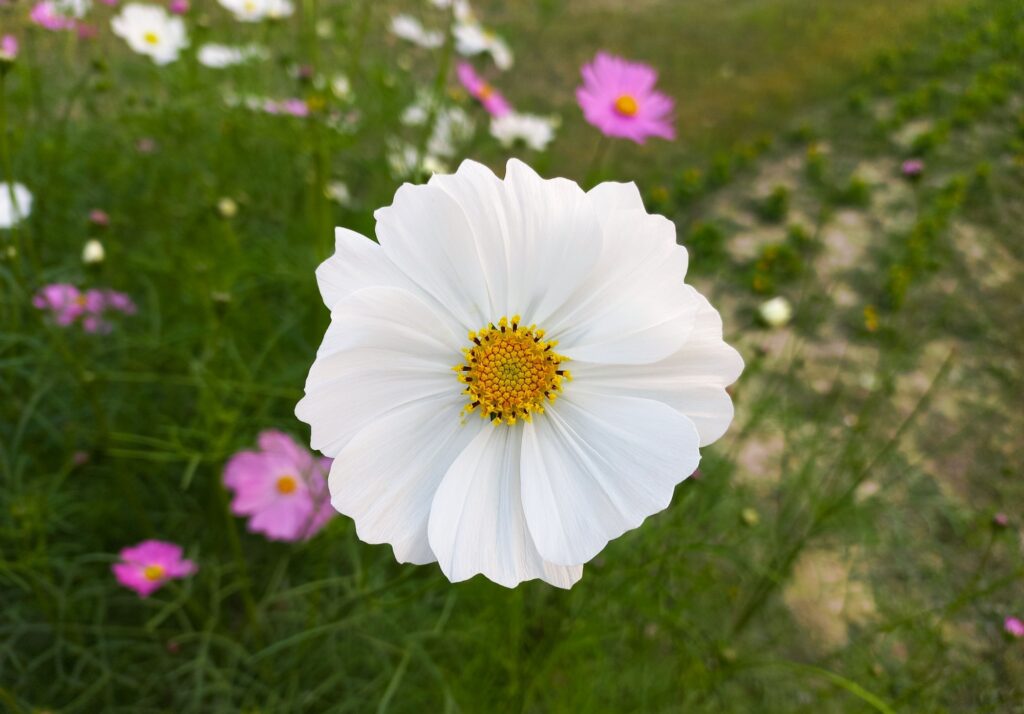
Cosmos ‘Apollo’ is a compact series of Cosmos bipinnatus developed to combine the large, airy flowers of traditional garden cosmos with a shorter, bushier plant that fits easily into borders, containers, cottage gardens, and smaller cutting gardens.
The flowers are exceptionally large for a compact cosmos, reaching approximately 4 inches across, with broad overlapping petals surrounding golden-yellow centers. Depending on the selection, Apollo flowers may be white, pink, deep carmine, rose, or attractively bicolored.
Plants generally grow around 18 to 26 inches tall, considerably shorter than many traditional cosmos varieties that can easily exceed 4 feet. They also branch freely, producing a broad canopy of flowers instead of relying on a few very tall stems.
The result is a cosmos that looks substantial without becoming difficult to manage.
Apollo is particularly useful for gardeners who like Cosmos Sonata but want a slightly fuller, bushier plant with larger flowers. It also provides a very different garden effect from patterned varieties such as Cosmos Capriola and Cosmos Velouette.
🌸 Cosmos Apollo Quick Guide
| Feature | Cosmos Apollo |
|---|---|
| Botanical name | Cosmos bipinnatus Apollo Series |
| Family | Asteraceae |
| Plant type | Annual |
| Typical height | About 18–26 inches |
| Typical spread | About 20–24 inches |
| Flower size | Up to about 4 inches |
| Flower form | Large single flowers with overlapping petals |
| Colors | White, pink, carmine, rose and bicolors |
| Bloom season | Late spring or summer through fall, depending on climate and sowing time |
| Light | Full sun |
| Soil | Average, well-drained soil |
| Indoor sowing | Roughly 4–6 weeks before outdoor planting |
| Direct sowing | After frost danger has passed |
| Spacing | About 12–18 inches |
| Deadheading | Recommended |
| Staking | Usually unnecessary |
| Best uses | Containers, borders, cottage gardens, cutting gardens, pollinator gardens |
🌺 What Is Cosmos Apollo?
Apollo is a compact series of Cosmos bipinnatus, commonly known as garden cosmos or Mexican aster.
The species normally produces finely divided, feathery foliage and large daisy-like flowers on branching stems.
Apollo was selected for several improvements over many older cosmos types.
These include:
- A naturally compact habit
- Shorter spaces between leaves and branches
- Strong branching
- Large flowers
- Broad overlapping petals
- A long flowering period
- Good container performance
Although the plants are relatively short, they do not have miniature flowers.
In fact, the large blooms are one of Apollo’s defining features.
That combination makes the series particularly attractive in containers because the flowers remain large enough to create visual impact while the plant itself stays manageable.
🌿 What Does Cosmos Apollo Look Like?
Apollo retains the characteristic foliage of Cosmos bipinnatus.
Leaves are divided into extremely narrow, almost thread-like segments, giving the entire plant a soft, feathery appearance.
The flowers rise above that foliage on branching stems.
Compared with many traditional single cosmos, Apollo flowers tend to have broad petals that overlap one another rather than leaving obvious gaps.
This gives the flower a fuller outline even though it remains a single-flowered cosmos.
The yellow center remains clearly visible.
That classic open-centered form gives Apollo the familiar appearance of garden cosmos while the larger petals make each bloom seem more substantial.
🎨 What Colors Does Cosmos Apollo Come In?
Apollo is a series, not a single flower color.
Current and historical selections include:
- Apollo White
- Apollo Pink
- Apollo Carmine
- Apollo Bright Carmine
- Apollo Lovesong
- Apollo Rose with Eye
- Apollo Mix
Availability varies by country and seed supplier, and newer colors may gradually replace older selections.
The original White, Pink, and Carmine forms became especially well known and all received the Royal Horticultural Society Award of Garden Merit.
🤍 Cosmos Apollo White
Apollo White produces large, pure white flowers with bright yellow centers.
The flowers can reach approximately 4 inches across and face upward above the feathery foliage.
White cosmos are extremely versatile in garden design.
Apollo White can be paired with nearly any color, including:
- Burgundy
- Pink
- Red
- Purple
- Blue
- Yellow
Its shorter growth also makes it practical for containers and border fronts where a taller white cosmos might overwhelm neighboring plants.
The current commercial series also includes an improved Apollo White selection designed to maintain the compact Apollo habit and large flowers.
💗 Cosmos Apollo Pink
Apollo Pink produces large rose-pink flowers with golden centers.
The RHS describes plants growing to approximately 65 centimeters, or about 26 inches, with flowers reaching around 10 centimeters across.
The color is strong enough to stand out in a mixed border without becoming as dark as carmine or burgundy cosmos.
Apollo Pink works particularly well with:
- White cosmos
- Purple salvia
- Lavender verbena
- Pink dahlias
- White zinnias
- Snapdragons
Its tidy stature makes it one of the easiest pink cosmos varieties to place near paths or patios.
❤️ Cosmos Apollo Carmine
Apollo Carmine provides a deeper color than Apollo Pink.
The flowers range from rich red to deep carmine or purple-red, surrounding a golden-yellow center.
The RHS recognizes Apollo Carmine as an Award of Garden Merit cultivar.
Its darker coloring works especially well with white flowers, which make the carmine petals appear even richer.
Try combining it with:
- Apollo White
- White zinnias
- White snapdragons
- Ammi
- Pale pink cosmos
- Silvery foliage
It can also be combined with burgundy flowers for a dramatic late-summer palette.
❤️ Cosmos Apollo Bright Carmine
Apollo Bright Carmine is part of the current commercial Apollo range.
It keeps the compact branching habit associated with the series but provides strong red-carmine coloring.
This is a good choice for gardeners who want a vivid focal flower without planting a towering annual.
The red flowers can be particularly effective in containers because they remain visible from across a patio or yard.
Pair Bright Carmine with white for sharp contrast or pink for a softer progression of color.
💕 Cosmos Apollo Lovesong
Apollo Lovesong is one of the most distinctive members of the series.
Unlike the relatively solid-colored Apollo varieties, Lovesong is a bicolor selection.
Its flowers combine contrasting pink, rose, and pale tones in a pattern that gives each bloom considerably more visual interest.
The breeder specifically highlights Lovesong as the unusual bicolor within the Apollo series.
This makes it especially useful for gardeners who like patterned cosmos but prefer a compact plant.
If Cosmos Capriola appeals to you because of its markings, Apollo Lovesong offers another interesting option with a different overall flower pattern and plant habit.
🌸 Cosmos Apollo Rose with Eye
Apollo Rose with Eye is another patterned selection in the modern Apollo series.
Instead of a completely solid flower, it combines rose coloring with a more pronounced central eye.
The plant retains the same basic Apollo characteristics:
- Compact growth
- Upright branching
- Large flowers
- Good container performance
This selection is particularly attractive when planted with Apollo White because the white flowers emphasize the patterned rose blooms.
🎨 Cosmos Apollo Mix
Apollo Mix combines several colors from the series.
This can include variations of:
- White
- Pink
- Carmine
- Rose
- Bicolors
Because the selections share a similar plant habit, the mixture generally produces a more coordinated planting than mixing unrelated tall and dwarf cosmos varieties.
Apollo Mix works particularly well in:
- Large containers
- Cottage gardens
- Border fronts
- Mass plantings
- Informal pollinator beds
It is also useful when you want several colors but do not want to purchase individual packets.
🏆 Is Cosmos Apollo an Award-Winning Variety?
Yes.
The original Apollo White, Apollo Pink, and Apollo Carmine selections have all received the Royal Horticultural Society’s Award of Garden Merit.
The AGM is given to plants considered particularly useful and reliable for garden cultivation under appropriate conditions.
The recognition is significant because Apollo was not selected simply for novelty.
Its compact habit, flower size, performance, and long bloom period have all contributed to its reputation as a high-quality garden cosmos.
📏 How Tall Does Cosmos Apollo Grow?
Apollo generally grows approximately 18 to 26 inches tall.
Current Syngenta information gives a garden height of approximately 55 to 65 centimeters, which translates to roughly 22 to 26 inches.
Older Apollo descriptions also use an 18- to 26-inch range.
Actual height depends on growing conditions.
Plants may become taller when grown with:
- Excessive nitrogen
- Very rich soil
- Too much water
- Partial shade
Full sun and moderate fertility help preserve the compact Apollo habit.
📐 How Wide Does Cosmos Apollo Grow?
Apollo can become surprisingly broad for a compact cosmos.
Plants may spread approximately 20 to 24 inches when fully developed.
Current European commercial listings sometimes give a somewhat narrower spread of roughly 16 to 20 inches, so final width should be treated as a range rather than an exact measurement.
The important point is that Apollo is bushy rather than narrow.
Although it is short, it still needs enough room to branch.
🌸 How Large Are Apollo Cosmos Flowers?
Apollo is particularly notable for its flower size.
Blooms can reach approximately 4 inches across.
That is large for a cosmos that may remain close to 2 feet tall.
The petals also overlap more fully than those of many older single cosmos varieties.
As a result, an Apollo flower often looks almost oversized compared with the foliage beneath it.
This is one reason the series works so well in patio containers.
You get large visible flowers without needing an enormous plant.
🌿 Is Cosmos Apollo a Dwarf Cosmos?
Apollo is generally described as compact, dwarf, or naturally short compared with traditional Cosmos bipinnatus.
However, it is not an extremely tiny bedding plant.
At roughly 18 to 26 inches tall and potentially close to 2 feet wide, Apollo still forms a substantial annual.
The compact description is relative to standard cosmos that may grow 4 or 5 feet tall.
A better mental picture is:
full-sized flowers on a knee-high to slightly taller bushy plant.
📅 When Does Cosmos Apollo Bloom?
Flowering time depends on climate and when the seeds are started.
Commercial production information lists Apollo as flowering from mid-spring into summer under controlled growing schedules.
In ordinary home gardens, expect the main flowering season from summer into fall, particularly when plants are started after winter frost.
With regular deadheading, healthy plants can continue producing flowers until cold weather ends the season.
Some seed-industry references place first flowering approximately 65 to 75 days after sowing under suitable conditions.
Actual garden timing can vary considerably.
❄️ Is Cosmos Apollo an Annual?
Yes.
Apollo is an annual cosmos.
It completes its life cycle in a single growing season.
The plant:
- Germinates.
- Develops foliage.
- Flowers.
- Produces seed.
- Dies when the season ends.
Frost usually kills the plants.
They do not produce a permanent underground crown that survives winter.
New plants are started from seed the following year.
☀️ How Much Sun Does Cosmos Apollo Need?
Full sun is best.
The RHS recommends full sun for Apollo White, Pink, and Carmine.
Strong sunlight encourages:
- More compact growth
- Stronger stems
- Better flowering
- More branching
Commercial Apollo listings sometimes indicate tolerance of sun to partial shade, but for home gardens, full sun is the safest recommendation if abundant flowering is your goal.
Plants grown in significant shade may stretch and produce fewer flowers.
🌱 Best Soil for Cosmos Apollo
Apollo does not require luxurious soil.
Average, reasonably well-drained garden soil is ideal.
Like other Cosmos bipinnatus cultivars, it can grow in a range of soil textures, including:
- Loam
- Sand
- Clay with adequate drainage
- Chalky soils
The RHS recommends moist but well-drained soil.
Cosmos are quite adaptable to soil pH and generally tolerate acidic, neutral, and alkaline conditions.
🚫 Don’t Overfertilize Apollo Cosmos
One of the most common cosmos mistakes is applying too much fertilizer.
Apollo is naturally compact, but excessive nitrogen can interfere with that habit.
Overfed plants may develop:
- Too much foliage
- Longer stems
- Fewer flowers
- Softer growth
- Increased flopping
If your soil already supports ordinary annual flowers, additional fertilizer may be unnecessary.
A lightly fed Apollo often flowers more heavily than one grown in extremely rich garden soil.
💧 How Much Water Does Cosmos Apollo Need?
Maintain adequate moisture while seeds germinate and young plants establish.
Once mature, cosmos tolerate short periods of dryness reasonably well.
Water deeply during prolonged dry weather, then allow the surface soil to begin drying before watering again.
Avoid keeping plants constantly saturated.
Excessive watering can encourage lush foliage and weaker stems.
Containers dry more quickly than garden beds, so potted Apollo plants require closer monitoring during hot weather.
🌱 Growing Cosmos Apollo From Seed
Apollo can be grown from seed much like other garden cosmos.
You can either:
- Start the seed indoors before the last frost, or
- Sow directly outdoors after frost danger passes
Starting indoors gives the plants a head start.
Direct sowing is simpler and avoids transplanting.
Because cosmos grow rapidly, either method works well.
🪴 When to Start Apollo Cosmos Indoors
Start seed approximately 4 to 6 weeks before your expected outdoor planting date.
Do not start excessively early.
Cosmos develop quickly and can become oversized indoors long before outdoor conditions are suitable.
Use a light seed-starting mix and provide warm but not excessively hot conditions.
Once seedlings emerge, move them into strong light immediately.
🌡️ Cosmos Apollo Germination
Commercial Apollo propagation guidance uses soil temperatures around 61–65°F and reports germination in only a few days under controlled greenhouse conditions.
Home gardeners should not be concerned if germination takes somewhat longer.
A practical expectation under ordinary seed-starting conditions is roughly several days to about a week or more, depending on temperature and moisture.
Keep the seed-starting medium evenly damp but not waterlogged.
📏 How Deep Should Apollo Cosmos Seeds Be Planted?
Cosmos seed requires only a light covering.
Sow the seeds approximately ⅛ to ¼ inch deep.
There is no reason to bury them deeply.
Good seed-to-soil contact and consistent moisture matter more than depth.
When sowing indoors, cover with a fine layer of seed-starting mix or vermiculite.
Outdoors, a shallow furrow is sufficient.
🌱 Can Cosmos Apollo Be Direct Sown?
Yes.
Direct sowing works very well for cosmos.
Wait until frost danger has passed and spring soil has warmed.
Sow the seeds shallowly and maintain moisture until seedlings are established.
Once plants begin growing rapidly, thin them so they have adequate room to branch.
Direct-sown plants may flower somewhat later than indoor transplants, but they often develop into sturdy plants because their roots are never disturbed.
📐 How Far Apart Should Cosmos Apollo Be Planted?
Because Apollo can become close to 2 feet wide, do not crowd mature plants unnecessarily.
A spacing of approximately 12 to 18 inches works well for most garden plantings.
Use closer spacing for:
- Dense border displays
- Mass plantings
- Cutting rows
Use wider spacing for:
- Containers
- Humid climates
- Maximum branching
- Better airflow
Even though Apollo seedlings look tiny, they can develop into surprisingly broad plants.
✂️ Should You Pinch Cosmos Apollo?
Pinching can encourage additional branching, although Apollo is naturally bushier than many traditional tall cosmos.
Once plants are established, removing the central growing tip can promote side shoots.
That can result in:
- More branches
- Additional flowers
- Fuller plants
- More potential cut stems
Pinching is optional rather than essential.
If purchased nursery plants already have multiple strong branches, they may not need additional pinching.
🌿 Does Cosmos Apollo Need Staking?
Usually not.
This is one of Apollo’s major advantages.
Its naturally short internodes and compact growth reduce the amount of leverage wind can exert on the stems.
Apollo was specifically developed to be bushier and more compact than many older cosmos varieties.
Most plants grown in full sun and moderate soil should remain self-supporting.
Support may still be helpful in:
- Extremely windy gardens
- Very rich soil
- Partial shade
- Areas with severe thunderstorms
But under ordinary conditions, Apollo generally requires much less staking than tall cosmos.
🌬️ Is Apollo Good for Windy Gardens?
Apollo is a better choice for exposed gardens than many towering Cosmos bipinnatus varieties.
Its shorter stems and bushier habit make it less likely to bend or topple.
That does not make it storm-proof.
A severe thunderstorm can damage almost any summer annual.
Still, if previous tall cosmos have repeatedly fallen over in your garden, Apollo is worth trying.
🪴 Is Cosmos Apollo Good for Containers?
Yes. Containers are one of Apollo’s strongest uses.
The series was specifically developed with compact, bushy growth that fills pots effectively.
A mature plant produces a surprisingly large canopy of flowers without becoming excessively tall.
Use a container with:
- Drainage holes
- Quality potting mix
- Full sun
- Adequate room for roots
Because the plant can spread close to 2 feet, avoid using an extremely small pot.
Several Apollo plants can also be combined in a large patio container for a fuller display.
🌸 Apollo Cosmos in Garden Borders
Apollo works well toward the front or middle of a sunny flower border.
Its compact height allows you to place it where traditional cosmos would block shorter plants.
Use it beside:
- Zinnias
- Salvia
- Verbena
- Coreopsis
- Gomphrena
- Compact dahlias
- Snapdragons
- Black-eyed Susans
The feathery foliage contrasts particularly well with broad-leaved plants.
🏡 Apollo Cosmos in a Cottage Garden
Although Apollo is compact, it still has the light informal appearance associated with classic cottage-garden cosmos.
Plant groups among:
- Zinnias
- Dahlias
- Snapdragons
- Coneflowers
- Salvias
- Verbena
Avoid creating an overly rigid row if you want a relaxed cottage effect.
Allow the branches and flowers to mingle slightly with neighboring plants.
The large blooms create strong color while the fine foliage keeps the combination airy.
💐 Is Cosmos Apollo a Good Cut Flower?
Yes.
The RHS lists Apollo cultivars as suitable for cut-flower gardens.
Its flowers are large and attractive in arrangements, although stems are naturally shorter than those of tall professional cutting varieties.
Apollo is particularly good for:
- Small bouquets
- Table arrangements
- Mason jars
- Cottage-style arrangements
If your only goal is extremely long stems for florist work, a tall cutting cosmos may be more suitable.
For gardeners who want attractive landscape plants that also provide flowers for the house, Apollo offers an excellent balance.
✂️ When to Cut Apollo Cosmos
Harvest flowers as they begin opening rather than waiting until they have been fully expanded for several days.
Cut during the cooler part of the morning or evening.
Use clean snips and place stems into clean water promptly.
Regular harvesting also encourages plants to produce more flowers.
Each bouquet effectively acts as a deadheading session.
🌺 How to Keep Apollo Cosmos Flowering
The most effective approach is simple:
- Give plants plenty of sunlight.
- Avoid excessive fertilizer.
- Water during prolonged drought.
- Remove faded blooms.
- Cut flowers regularly.
- Prevent all flowers from immediately maturing into seed.
Cosmos are highly responsive to deadheading.
As long as the plant continues trying to reproduce, it keeps producing additional flowers.
✂️ Should Apollo Cosmos Be Deadheaded?
Yes.
The RHS specifically recommends deadheading Apollo cultivars to prolong flowering.
When a bloom fades, cut the flowering stem back to a healthy branch or leaf.
Removing only the dry petals does not produce as tidy a plant.
Regular deadheading also prevents seed production from dominating the plant too early in the season.
Toward fall, you can leave selected blooms to mature if you want seeds.
🐝 Does Cosmos Apollo Attract Pollinators?
Yes.
Syngenta identifies Apollo as pollinator friendly, and the RHS includes Apollo selections among plants valued by pollinating insects.
The large flowers retain an open yellow central disk, which provides easy access for visiting insects.
Apollo can attract:
- Bees
- Butterflies
- Hoverflies
- Other flower-visiting insects
Single cosmos such as Apollo generally provide easier access to the central disk than very heavily doubled cultivars.
🦋 Apollo vs. Double Cosmos for Pollinators
Apollo produces large single flowers.
That means the central disk remains exposed.
By comparison, heavily doubled cosmos can contain extra petals that partially obscure the flower center.
This does not mean double cosmos should be avoided.
A garden containing Apollo plus Cosmos Double Click Rose Bon Bon gives you both open pollinator-accessible flowers and highly decorative doubles.
Diversity is generally more useful than relying on one cultivar.
🌸 Cosmos Apollo vs. Cosmos Sonata
Apollo and Cosmos Sonata are natural comparisons because both are compact Cosmos bipinnatus series.
Apollo was specifically promoted as having larger, fuller flowers and a more compact, bushy habit than Sonata.
| Feature | Apollo | Sonata |
|---|---|---|
| Typical height | About 18–26 in. | About 18–24 in. |
| Flower size | Up to about 4 in. | Around 3 in. or slightly larger |
| Flower form | Broad, overlapping petals | Classic single cosmos |
| Habit | Bushy and compact | Compact and upright |
| Containers | Excellent | Excellent |
| Staking | Usually unnecessary | Usually unnecessary |
| Colors | White, pink, carmine and bicolors | Broad solid-color range |
Both are excellent compact cosmos.
Choose Sonata for a classic dwarf cosmos look.
Choose Apollo if particularly large flowers and a fuller canopy are your priorities.
🌸 Cosmos Apollo vs. Cosmos Capriola
Cosmos Capriola offers more dramatic flower markings.
Capriola flowers are generally white with rose-red edging and a strong darker ring around the center.
Apollo selections tend to emphasize large flowers and compact growth rather than elaborate markings, although Lovesong and Rose with Eye provide bicolor options.
Capriola is ideal if flower pattern is your priority.
Apollo is excellent if plant habit and oversized blooms matter more.
🌸 Cosmos Apollo vs. Cosmos Sweet Sixteen
Cosmos Sweet Sixteen produces pale pink-to-white flowers with darker edging and a decorative frilled center.
Apollo flowers retain a simpler open form.
Sweet Sixteen generally grows taller than the most compact Apollo plants.
Choose Sweet Sixteen for unusual flower structure.
Choose Apollo for a shorter, bushier plant with particularly large flowers.
❤️ Cosmos Apollo vs. Cosmos Velouette
Cosmos Velouette produces dramatic burgundy-and-white striped flowers.
Its greatest appeal is variation.
Apollo is generally more uniform and compact.
Velouette works beautifully in cutting gardens where its unique patterns can be appreciated.
Apollo is better suited to gardeners wanting predictable container plants and tidy border masses.
🌹 Cosmos Apollo vs. Double Click Rose Bon Bon
Cosmos Double Click Rose Bon Bon produces fluffy, densely petaled rose-pink flowers.
Apollo produces simple open flowers.
Rose Bon Bon also grows much taller.
| Feature | Apollo | Double Click Rose Bon Bon |
|---|---|---|
| Height | 18–26 in. | About 3–4 ft. |
| Flower form | Single | Semi-double to fully double |
| Flower size | Up to about 4 in. | About 2–3 in. |
| Habit | Compact and bushy | Tall and branching |
| Containers | Excellent | Needs a large pot |
| Support | Rarely needed | May benefit from support |
The two provide almost opposite cosmos experiences.
🤍 Apollo White With Dark Flowers
Apollo White makes an excellent companion for darker summer flowers.
Try it with:
- Burgundy dahlias
- Cosmos Velouette
- Dark zinnias
- Purple basil
- Crimson celosia
The clean white petals brighten a planting while the yellow centers prevent the combination from feeling too stark.
💗 Apollo Pink With White Flowers
Apollo Pink and white annuals create a soft cottage-garden palette.
Good companions include:
- Apollo White
- White zinnias
- White snapdragons
- Ammi
- White dahlias
Add lavender or blue flowers for another layer of contrast.
❤️ Apollo Carmine With Pink Flowers
Carmine and pink work especially well together because they create a natural progression from pale to deep tones.
Try:
- Apollo Pink
- Cosmos Sweet Sixteen
- Cosmos Double Click Rose Bon Bon
- Pink zinnias
- Rose-colored snapdragons
Add white flowers to prevent the planting from becoming too dark.
🌿 Best Companion Plants for Cosmos Apollo
Good companions include:
- Zinnias
- Dahlias
- Snapdragons
- Verbena
- Salvia
- Gomphrena
- Coreopsis
- Black-eyed Susans
- Coneflowers
- Ammi
- Ornamental grasses
Choose plants that enjoy full sun and reasonable drainage.
Because cosmos do not need heavy feeding, avoid planting them where neighboring crops require repeated high-nitrogen fertilizer applications.
☀️ Is Cosmos Apollo Heat Tolerant?
Apollo performs well during warm summer conditions.
Current commercial descriptions specifically highlight the series for good heat tolerance.
Like other garden cosmos, established Apollo plants can also tolerate short dry spells once their root systems are developed.
Extreme heat and prolonged drought can still reduce flowering.
Provide water during extended dry weather rather than expecting plants to thrive indefinitely without moisture.
🌱 Does Cosmos Apollo Self-Seed?
Apollo can produce seed if flowers are allowed to mature.
Those seeds may fall into the surrounding soil and potentially germinate the following year.
However, seedlings grown from collected seed should not automatically be expected to reproduce every feature of the named Apollo selection.
Named cultivars may vary when grown from saved seed, particularly when other Cosmos bipinnatus varieties are flowering nearby.
Cross-pollination can introduce even more variation.
If you want a predictable Apollo display, fresh commercially produced seed is the safer choice.
🌱 How to Save Apollo Cosmos Seeds
Toward the end of summer, stop deadheading several healthy flowers.
Allow the seed heads to dry on the plant as much as weather permits.
Cosmos seeds are long, narrow, dark structures that develop around the center of the spent flower.
Harvest them before they scatter naturally.
Allow collected seeds to dry thoroughly indoors.
Store them in a paper envelope labeled with:
- Apollo variety
- Year collected
- Notes about other nearby cosmos
Saved seed can be fun to grow even when the offspring are not identical.
🍂 What Happens to Apollo After Frost?
Frost kills Apollo cosmos.
After the plants die, remove them from garden beds or containers.
Healthy material can generally be composted.
If you want volunteer seedlings, allow some seed heads to mature before removing the plants.
Otherwise, clean the bed and start again with fresh seed the following spring.
There is no bulb, tuber, or perennial crown to protect through winter.
🐌 Common Apollo Cosmos Pests
Apollo is generally easy to grow, but potential pests include:
- Aphids
- Slugs
- Snails
- Caterpillars
- Leafhoppers
Young seedlings are most vulnerable to slugs.
A mature bushy plant can generally tolerate modest insect feeding much more easily.
The RHS specifically notes aphids and slugs as possible problems on Apollo cultivars.
Check tender shoots periodically rather than waiting until damage becomes severe.
🦠 Common Apollo Cosmos Diseases
The RHS identifies gray molds as a possible problem.
Garden cosmos can also occasionally develop powdery mildew and other fungal diseases.
Risk increases when plants are:
- Overcrowded
- Overwatered
- Growing in shade
- Surrounded by poor airflow
Apollo’s compact habit does not mean plants should be packed tightly together.
Allow enough space for air to move through the foliage.
🌿 Why Is My Apollo Cosmos Tall Instead of Compact?
Apollo is genetically shorter than traditional cosmos, but the environment still affects height.
Plants may stretch because of:
- Too much nitrogen
- Insufficient sunlight
- Excess water
- Very close spacing
If your Apollo reaches well beyond its expected height and produces huge amounts of foliage, reconsider fertilizer and light levels.
More feeding is unlikely to solve the problem.
🌸 Why Isn’t My Apollo Cosmos Flowering?
Possible causes include:
Too Much Fertilizer
Excess nitrogen encourages foliage instead of flowers.
Too Little Sun
Full sun promotes stronger flowering.
Excessive Water
Constant moisture can produce overly lush plants.
Immaturity
Plants may simply not have reached flowering age.
Weather Stress
Extreme temperatures can temporarily slow growth and flower production.
Correct the environmental issue before adding additional fertilizer.
🌬️ Why Is My Apollo Cosmos Falling Over?
Apollo is naturally compact and usually sturdy.
If plants repeatedly collapse, consider:
- Excess fertilizer
- Partial shade
- Excessive watering
- Severe wind
- Storm damage
A stake can help in an unusually exposed site, but plants grown in full sun with moderate fertility should generally remain more self-supporting than tall cosmos varieties.
❓ Cosmos Apollo FAQ
What is Cosmos Apollo?
Apollo is a compact series of Cosmos bipinnatus with large single flowers and a naturally bushy habit.
How tall does Cosmos Apollo grow?
Approximately 18–26 inches, with current commercial descriptions generally giving about 22–26 inches.
How wide does Apollo cosmos grow?
Plants can spread roughly 20–24 inches, although some current selections are listed slightly narrower.
How large are Apollo flowers?
They can reach approximately 4 inches across.
What colors does Cosmos Apollo come in?
The series includes white, pink, carmine, rose, red and bicolored selections.
Is Apollo one cultivar or a series?
It is a series containing several color selections.
Which Apollo cosmos varieties have won awards?
Apollo White, Apollo Pink and Apollo Carmine hold RHS Awards of Garden Merit.
Is Cosmos Apollo a dwarf cosmos?
It is naturally compact or dwarf compared with traditional tall Cosmos bipinnatus, although mature plants can still reach around 2 feet tall and wide.
Is Cosmos Apollo an annual?
Yes. It completes its life cycle in one growing season.
When does Apollo bloom?
In home gardens, expect flowering mainly from summer into fall, depending on sowing date and climate.
How long does Apollo take to flower from seed?
Commercial seed references commonly give roughly 65–75 days to first flowers under suitable growing conditions.
Does Apollo need full sun?
Full sun is best for strong flowering and compact growth.
What soil does Apollo need?
Average, moist but well-drained soil works well.
Does Cosmos Apollo need fertilizer?
Usually very little. Excess nitrogen can encourage foliage at the expense of flowers.
When should Apollo seeds be started indoors?
Approximately four to six weeks before outdoor planting is a practical schedule.
How deep should Apollo cosmos seed be planted?
Cover it lightly, approximately ⅛–¼ inch deep.
Can Apollo cosmos be direct sown?
Yes. Sow after frost danger has passed and the soil has warmed.
How far apart should Apollo plants be spaced?
Approximately 12–18 inches works well in most garden beds.
Should Cosmos Apollo be pinched?
Pinching can encourage additional branching, but the series is naturally bushy and does not always require it.
Does Apollo need staking?
Usually not.
Is Apollo good for containers?
Yes. Its compact bushy habit makes containers one of its best uses.
Should Apollo cosmos be deadheaded?
Yes. Deadheading prolongs flowering.
Is Apollo a good cut flower?
Yes. Its large flowers work well in casual bouquets, although stems are shorter than those of tall cutting cosmos.
Does Apollo attract pollinators?
Yes. Its open single flowers are attractive and accessible to flower-visiting insects.
Does Apollo self-seed?
It may if mature seed heads remain on the plant.
Can I save Apollo cosmos seed?
You can collect it, but seedlings may not reproduce every characteristic of the named cultivar.
Is Apollo better than Sonata cosmos?
Neither is universally better. Apollo generally offers larger, fuller-looking flowers and a bushier habit, while Sonata provides a classic compact cosmos in a broad range of colors.
🌸 Is Cosmos Apollo Worth Growing?
Cosmos Apollo is one of the strongest choices for gardeners who want big cosmos flowers without big cosmos plants.
That combination is what separates it from many traditional varieties.
A typical tall Cosmos bipinnatus may eventually reach several feet above neighboring plants and require support after summer storms. Apollo usually remains around knee height while spreading into a substantial, well-branched plant filled with flowers.
The blooms themselves are impressive.
At approximately 4 inches across, they are disproportionately large for the size of the plant. Broad overlapping petals also produce a fuller outline than the widely spaced petals seen on some older cosmos.
The color range gives gardeners plenty of options. Apollo White is clean and versatile. Pink creates a softer cottage-garden effect. Carmine and Bright Carmine provide richer color, while Lovesong and Rose with Eye introduce more distinctive bicolor patterns.
Care is uncomplicated.
Plant Apollo in full sun and average, well-drained soil. Avoid excessive fertilizer and constant watering. Deadhead fading flowers regularly, and the plants can continue producing color for much of the warm season.
Within your cosmos collection, Apollo also fills a clear niche.
Cosmos Sonata is another excellent compact series, but Apollo emphasizes extra-large flowers and bushier growth. Cosmos Capriola and Cosmos Velouette are better choices when unusual flower markings are the main attraction. Cosmos Sweet Sixteen provides a decorative frilled center, while Cosmos Double Click Rose Bon Bon delivers fully ruffled double flowers.
Apollo’s strength is different.
It takes the classic open cosmos flower, makes it bigger, and puts it on a shorter, sturdier, container-friendly plant.
For many home gardens, that is an extremely useful combination.
🔗 Related Articles
- Cosmos Sonata
- Cosmos Capriola
- Cosmos Sweet Sixteen
- Cosmos Velouette
- Cosmos Double Click Rose Bon Bon
- Cosmos Care
- Cosmos Flower Types
- Discover the Stunning Diversity of Cosmos Flower Varieties
📚 Sources & Further Reading
- Syngenta Flowers — Cosmos Apollo Pink
- Syngenta Flowers — Cosmos Apollo White
- Syngenta Flowers — Cosmos Apollo White Improved
- Syngenta Flowers — Cosmos Apollo Bright Carmine
- Syngenta Flowers — Cosmos Apollo Lovesong
- Syngenta Flowers — Cosmos Apollo Rose with Eye
- Syngenta Flowers — Cosmos Apollo Mix
- Royal Horticultural Society — Cosmos bipinnatus ‘Apollo White’
- Royal Horticultural Society — Cosmos bipinnatus ‘Apollo Pink’
- Royal Horticultural Society — Cosmos bipinnatus ‘Apollo Carmine’
- Royal Horticultural Society — Cosmos