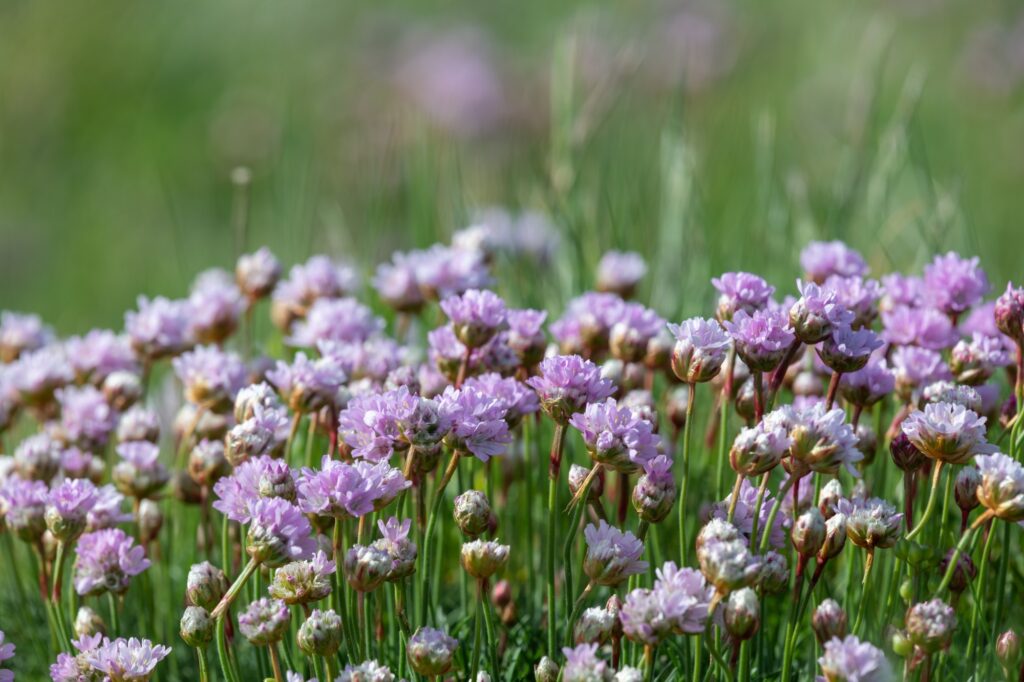
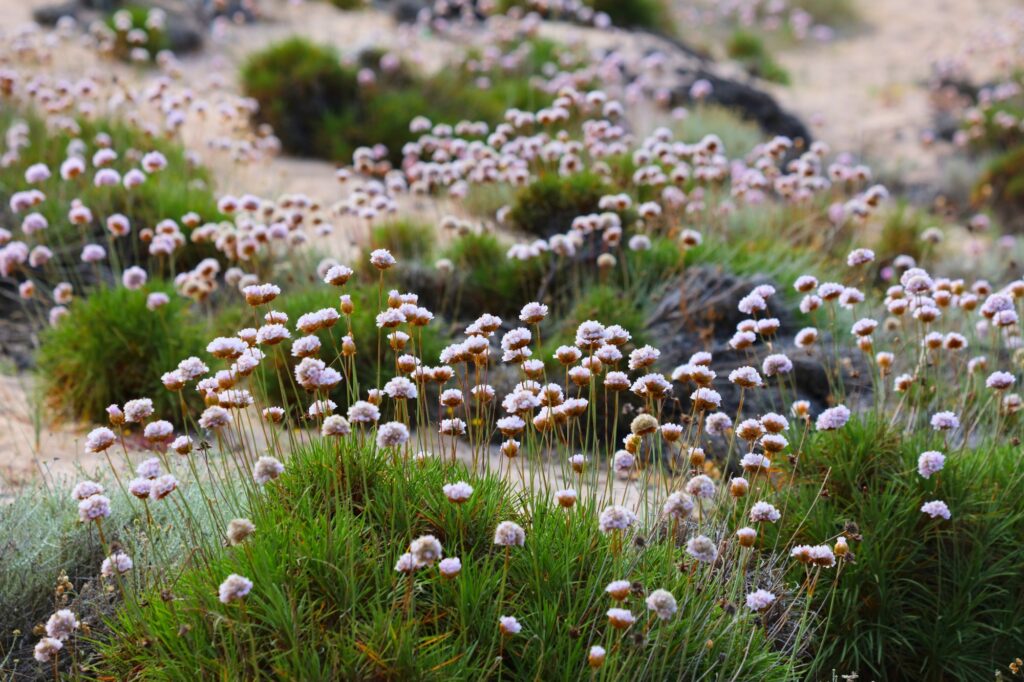
Thrift is a compact evergreen perennial prized for its tidy grassy foliage and rounded clusters of pink, rose, lavender, or white flowers. Botanically known as Armeria maritima, it is also commonly called sea thrift or sea pink and is naturally associated with coastal cliffs, sandy ground, rocky slopes, and other exposed places where drainage is excellent and soil fertility is relatively low.
This tough little perennial is particularly useful in rock gardens, gravel gardens, edging, containers, coastal landscapes, and sunny borders. It forms neat mounds of narrow evergreen leaves and sends up wiry flower stems in spring, often blooming again lightly later in the season when spent flowers are removed.
Thrift is easy to grow when gardeners resist the urge to pamper it. Rich soil, excessive fertilizer, and constant moisture can cause more problems than lean conditions. Give Armeria maritima plenty of sun, sharply drained soil, and only moderate water, and it can remain attractive for years.
🌸 Thrift at a Glance
- Botanical name: Armeria maritima
- Common names: Thrift, sea thrift, sea pink
- Plant family: Plumbaginaceae
- Plant type: Evergreen herbaceous perennial
- Mature height: About 6 to 12 inches, depending on cultivar
- Mature spread: About 8 to 12 inches
- Sun exposure: Full sun
- Soil: Sandy, gravelly, lean, well-drained soil
- Bloom time: Spring into early summer, with possible rebloom
- Flower colors: Pink, rose, lavender-pink, red-pink, or white
- Foliage: Evergreen to semi-evergreen
- Water needs: Low to moderate
- Drought tolerance: Good once established
- Salt tolerance: High
- Growth habit: Compact, clump-forming
- Wildlife value: Flowers attract bees and other pollinators
🌿 What Is Thrift?
Thrift is a low-growing perennial naturally found in coastal and exposed environments across parts of Europe and other northern regions.
Its narrow leaves form dense grassy clumps that remain attractive even when the plant is not flowering.
The flowers appear on slender upright stems held above the foliage.
Each stem carries a rounded cluster of many tiny flowers, creating a pom-pom-like appearance.
The species name maritima reflects the plant’s association with seaside habitats.
Its natural tolerance for wind, salt, lean soil, and dry conditions makes thrift especially useful in difficult sunny gardens.
🌸 Why Is Thrift Called Sea Pink?
The common name “sea pink” refers to the plant’s natural coastal habitat and its typically pink flowers.
Despite the name, flower color can range from pale pink to deep rose and white.
“Thrift” is another old common name that has long been used for Armeria maritima.
The plant has historically been associated with seaside cliffs and coastal turf, where it forms compact cushions among rocks and grasses.
☀️ How Much Sun Does Thrift Need?
Thrift grows best in full sun.
Aim for at least six hours of direct sunlight each day.
Abundant sun encourages:
- Dense foliage
- Strong flowering
- Compact growth
- Better disease resistance
- Less flopping
Plants grown in too much shade may become loose, produce fewer flowers, and hold excessive moisture around the crown.
In hot climates, some very light afternoon protection can be tolerated, but thrift generally performs best with abundant sunlight.
🌱 Best Soil for Thrift
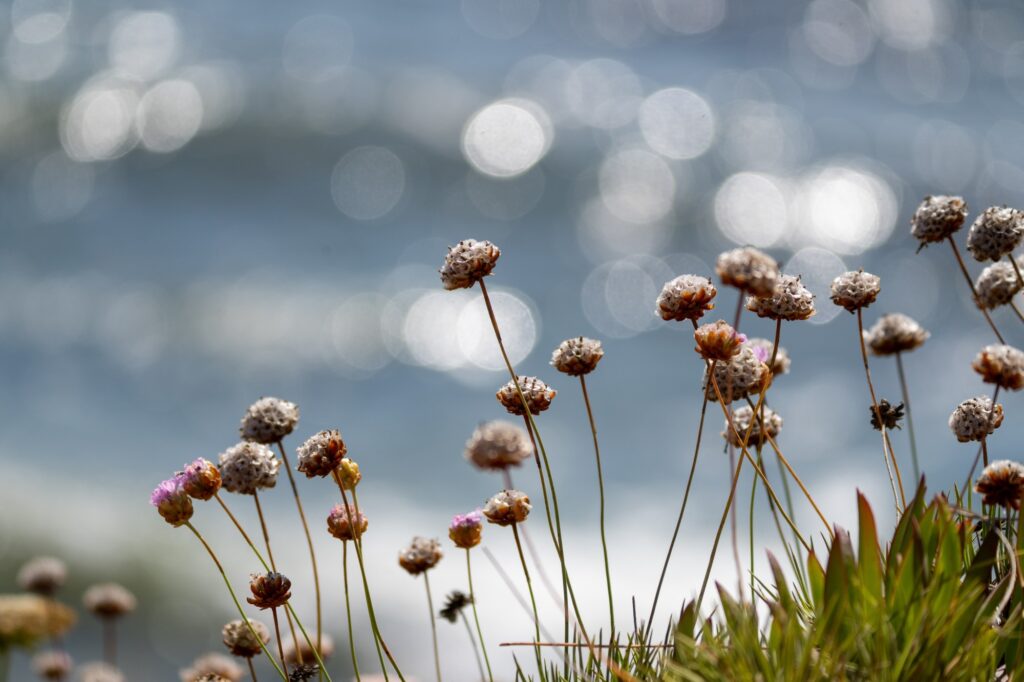
Thrift prefers lean, sharply drained soil.
Excellent options include:
- Sandy soil
- Gravelly soil
- Rocky soil
- Sandy loam
- Raised beds
- Rock-garden soil
- Coastal soil
The plant dislikes heavy, wet, nutrient-rich ground.
If your soil contains dense clay, improve drainage before planting or grow thrift in an elevated bed or container.
Adding grit or coarse sand around the planting area can help where soil is naturally heavy.
Drainage matters far more than fertility.
🧪 What Soil pH Does Thrift Prefer?
Thrift is adaptable to a fairly broad pH range.
It can grow in acidic, neutral, or alkaline soil as long as drainage is excellent.
This makes it especially useful in rocky or coastal landscapes where soil chemistry may be less predictable.
Do not attempt to heavily amend soil solely to alter pH unless testing shows an extreme problem.
In most cases, soil structure and drainage deserve much more attention.
💧 How Often Should You Water Thrift?
Newly planted thrift should be watered regularly while its roots become established.
Allow the soil surface to begin drying before watering again.
Once established, the plant becomes drought tolerant and generally needs relatively little supplemental irrigation.
During prolonged drought, occasional deep watering can help maintain healthy foliage and continued flowering.
Avoid keeping the soil constantly moist.
Thrift is much better adapted to slightly dry conditions than to waterlogged roots.
⚠️ Can You Overwater Thrift?
Yes.
Overwatering is one of the most common causes of thrift decline.
Constantly wet soil can lead to:
- Yellowing foliage
- Crown rot
- Root rot
- Soft or collapsing growth
- Reduced flowering
- Sudden plant death
If the center of the plant begins turning brown while the soil remains wet, excessive moisture may be part of the problem.
Improve drainage and reduce irrigation.
🌡️ Temperature and Climate
Thrift is cold hardy and well adapted to cool, exposed conditions.
It generally performs well in temperate climates and tolerates wind better than many flowering perennials.
The plant is particularly well suited to coastal regions.
It can also grow inland as long as the soil does not remain wet.
Hot, humid climates can be more challenging because prolonged summer moisture around the crown may encourage rot.
In these regions, excellent drainage and strong air circulation are especially important.
🌊 Is Thrift Good for Coastal Gardens?
Yes.
Thrift is one of the best perennials for coastal landscapes.
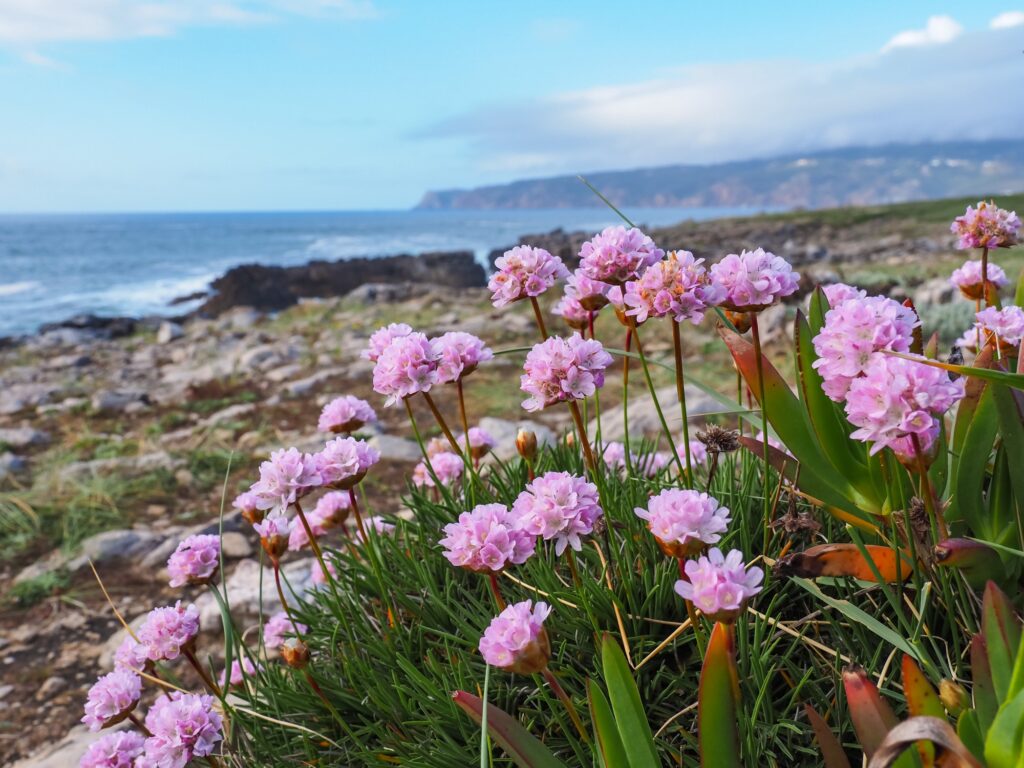
Its natural habitat includes seaside cliffs, dunes, and exposed rocky areas.
It tolerates:
- Salt spray
- Wind
- Lean soil
- Sandy conditions
- Drought
- Exposure
This makes it an excellent choice for seaside rock gardens, path edges, retaining walls, and exposed borders.
🌿 How to Plant Thrift
Spring and fall are both good planting times.
Choose a site with full sun and sharply drained soil.
Dig a hole roughly the same depth as the root ball and slightly wider.
Place the plant so the crown remains level with the surrounding soil.
Do not bury the crown deeply.
Backfill gently, water thoroughly, and then allow the soil to begin drying between waterings.
Avoid adding large amounts of compost or manure to the planting hole.
Thrift naturally prefers relatively lean conditions.
📏 How Far Apart Should You Plant Thrift?
Most thrift plants can be spaced about 8 to 12 inches apart.
For ground-cover or edging effects, plant toward the closer end of that range.
Individual plants gradually form rounded clumps that can grow together into a low continuous border.
Avoid overcrowding.
Good air circulation helps reduce moisture-related problems around the crowns.
🌱 How Fast Does Thrift Grow?
Thrift has a moderate growth rate.
Young plants usually establish steadily rather than spreading aggressively.
Over time, individual clumps become wider and denser.
Thrift does not generally behave like a rapidly spreading ground cover.
Instead, it forms relatively neat individual mounds that may eventually need division after several years.
🌸 When Does Thrift Bloom?
Thrift usually blooms most heavily from spring into early summer.
Flowering may begin in mid- to late spring depending on climate.
Many plants produce a second lighter flush later in the season if spent flowers are removed.
The exact bloom period varies somewhat among cultivars.
Cooler weather often extends the flowering season.
🌼 What Do Thrift Flowers Look Like?
Thrift produces rounded flower heads held on slender leafless stems above the foliage.
Each flower head contains numerous tiny individual blossoms.
Colors include:
- Pale pink
- Bright pink
- Rose
- Magenta-pink
- Lavender-pink
- White
The flower stems give the plant a light, airy appearance despite its compact foliage.
✂️ Should You Deadhead Thrift?
Yes.
Deadheading can encourage a neater appearance and may stimulate additional flowering.
Once a flower head fades, cut the entire flower stem down near the foliage.
Removing spent blooms prevents the plant from putting unnecessary energy into seed production.
Some cultivars respond particularly well and may produce scattered flowers later in summer.
✂️ Does Thrift Need Pruning?
Very little.
Thrift does not require conventional pruning.
Maintenance generally consists of:
- Removing faded flower stems
- Trimming dead foliage
- Cleaning out brown material from the center
- Dividing old crowded clumps
Avoid cutting healthy foliage severely unless the plant has become damaged or unsightly.
Its naturally compact shape generally requires little intervention.
🌿 Why Does the Center of Thrift Turn Brown?
Older thrift plants sometimes become woody or brown in the center.
This often happens when clumps become crowded.
Other contributing factors can include:
- Poor drainage
- Excessive moisture
- Heavy fertile soil
- Insufficient sunlight
Division can rejuvenate an aging plant.
Lift the clump, remove old or dead central portions, and replant vigorous outer sections.
🔄 When Should You Divide Thrift?
Thrift can be divided every few years when the clump becomes overcrowded or begins dying out in the center.
Spring or early fall are good times.
Cool weather reduces transplant stress and gives divisions time to establish.
Avoid dividing during extreme summer heat unless absolutely necessary.
✂️ How to Divide Thrift
Dig up the clump carefully and shake away enough soil to see the growth points.
Separate the plant into several healthy sections.
Each division should have:
- Healthy foliage
- A portion of crown
- A good root system
Discard dead or rotten central material.
Replant the divisions immediately at the same depth they were growing previously.
Water moderately until new growth indicates establishment.
🌾 Does Thrift Need Fertilizer?
Usually not.
Thrift naturally thrives in nutrient-poor ground.
Too much fertilizer can create:
- Excess leafy growth
- Weak stems
- Reduced flowering
- Greater susceptibility to rot
- Shorter-lived plants
If the soil is exceptionally poor and growth is clearly weak, a very light application of balanced fertilizer can be used in spring.
Otherwise, leave the plant relatively unfed.
🍂 Should You Mulch Thrift?
Heavy organic mulch is generally not ideal.
Mulch can hold too much moisture around the crown.
A better option is a gravel or fine stone mulch.
Gravel helps:
- Improve drainage
- Suppress weeds
- Keep the crown dry
- Complement rock-garden plantings
- Prevent soil from splashing onto foliage
If organic mulch is used elsewhere in the bed, keep it several inches away from the thrift crown.
🪨 Thrift in Rock Gardens
Rock gardens are one of the best places to grow thrift.
The plant’s low profile and grassy foliage fit naturally between stones.
Drainage is usually excellent, and the rounded spring flowers create bright points of color above the rock surface.
Good rock-garden companions include sedum, lavender, yarrow, low-growing ornamental grasses, and other drought-tolerant perennials.
🌿 Thrift as an Edging Plant
Thrift makes excellent edging along sunny paths and borders.
Its evergreen grassy foliage forms neat mounds that remain attractive even outside the flowering season.
Spacing plants approximately 8 to 10 inches apart creates a repeating pattern that gradually becomes more continuous.
Because the plant stays low, it does not obstruct walkways or hide taller plants behind it.
🌱 Can Thrift Be Used as Ground Cover?
Yes, although it is better described as a clumping ground cover rather than a rapidly spreading one.
Several plants can be grouped together to cover a sunny, dry area.
Thrift is particularly useful:
- Between rocks
- Along slopes
- Beside paths
- On retaining walls
- In gravel gardens
- In coastal beds
It is not suitable for areas receiving foot traffic.
🪴 Can Thrift Grow in Containers?
Yes.
Thrift is an excellent container plant.
Its compact size and low water requirements make it especially useful in:
- Alpine troughs
- Rock-garden containers
- Patio pots
- Window boxes
- Mixed succulent-style containers
Use a container with excellent drainage holes and a gritty potting mix.
Avoid heavy water-retentive soil.
Allow the mix to dry somewhat between waterings.
❄️ Overwintering Thrift in Containers
Container-grown thrift is more exposed to winter cold than plants growing in the ground.
Use a frost-resistant pot and choose a cultivar hardy enough for your climate.
During severe cold, move the container to a sheltered outdoor location.
Do not bring thrift into a heated house for winter.
The plant is cold hardy and benefits from its natural outdoor seasonal cycle.
Keep the pot from sitting in standing water during cold weather.
🌺 Popular Thrift Varieties
Several cultivars offer differences in flower color and size.
🌸 ‘Splendens’
‘Splendens’ is one of the classic sea thrift cultivars.
It produces deep pink to rosy flowers above compact evergreen foliage.
It works especially well in rock gardens and along sunny borders.
🤍 ‘Alba’
‘Alba’ produces white flowers.
Its pale blooms contrast nicely with dark stone, gravel, and surrounding green foliage.
💗 ‘Rubrifolia’
‘Rubrifolia’ is valued for both flowers and foliage.
The leaves can develop darker reddish or bronze tones, adding extra interest outside the bloom period.
🌸 ‘Düsseldorfer Stolz’
This cultivar produces bright pink flowers and forms compact clumps suitable for edging and rock gardens.
🌱 Is Thrift Evergreen?
Thrift is generally evergreen or semi-evergreen.
In mild climates, the grassy foliage can remain attractive throughout winter.
In colder areas, some leaves may brown or become weather-damaged.
Simply remove dead material in early spring.
Healthy new foliage usually develops as temperatures rise.
🐝 Does Thrift Attract Pollinators?
Yes.
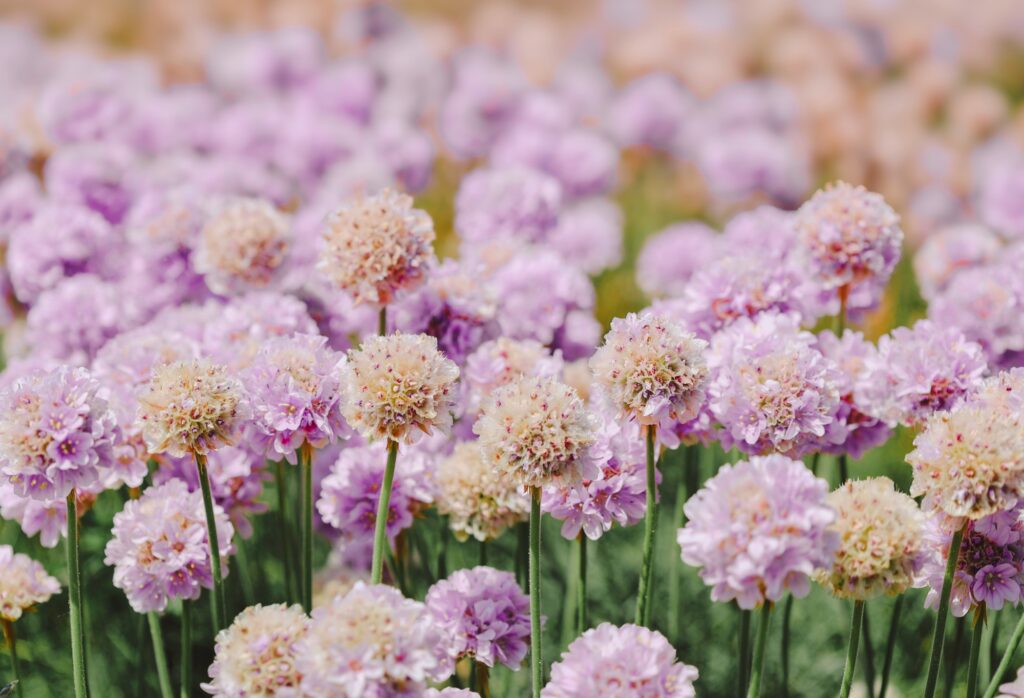
The rounded flower heads attract bees and other small pollinating insects.
Thrift’s spring bloom period can be particularly helpful as pollinator activity increases.
For a stronger pollinator garden, combine thrift with plants flowering later in summer and fall.
Good companions include Yarrow, Gaillardia, Coreopsis, and Sedum.
🌿 Best Companion Plants for Thrift
Thrift works best with plants that share its preference for sun and good drainage.
Good companions include:
- Lavender Care
- Sedum Care
- Yarrow Care
- Gaillardia Care
- Coreopsis Care
- Salvia Care
- Russian Sage Care
- Coneflower Care
- Blazing Star Care
- Butterfly Weed Care
Avoid pairing thrift with plants that require constantly moist soil.
The best companions thrive under similarly lean, dry conditions.
🐛 Common Thrift Pests
Thrift generally has relatively few serious pest problems.
Possible pests include:
- Aphids
- Spider mites
- Slugs
- Snails
Slugs and snails may chew foliage during wet weather.
Spider mites may appear during hot, dry conditions.
Healthy plants in full sun and well-drained soil usually tolerate minor pest activity without serious damage.
🍄 Common Thrift Diseases
The most important problems are associated with excessive moisture.
Potential diseases include:
- Crown rot
- Root rot
- Fungal leaf spots
- Rust
Poor airflow and wet soil increase disease risk.
Avoid overhead watering late in the day and keep the crown dry whenever possible.
If a section begins to rot, remove damaged material and improve drainage.
❓ Why Isn’t My Thrift Flowering?
Several conditions can reduce flowering.
Too Much Shade
Thrift flowers best in full sun.
Excess Fertilizer
Rich soil can encourage leaves rather than flowers.
Soil Is Too Wet
Waterlogged roots weaken the plant.
Old Crowded Clump
A mature plant may need division.
Recently Planted
Young thrift may need time to establish before producing a heavy display.
Improving sunlight and drainage usually helps more than adding fertilizer.
❓ Why Is My Thrift Turning Brown?
Brown foliage can result from:
- Poor drainage
- Crown rot
- Drought
- Natural winter damage
- Old crowded growth
Inspect the center of the plant.
If the middle is dry and woody but outer sections remain healthy, division may rejuvenate the clump.
If the crown is soft and the soil remains wet, rot is more likely.
❓ Why Is My Thrift Dying in the Middle?
This is common in older clumps.
As thrift matures, the center can become woody and unproductive while younger growth remains around the edges.
Lift and divide the plant.
Discard the dead center and replant healthy outer pieces.
Regular division every few years can keep thrift looking dense and vigorous.
❓ Why Is My Thrift Floppy?
Thrift should normally form a compact mound.
Floppy or overly lush growth can result from:
- Too much shade
- Excess fertilizer
- Rich soil
- Excessive water
Move the plant to a sunnier location if necessary and reduce feeding.
Lean conditions usually produce the best form.
❓ Why Are My Thrift Leaves Yellow?
Yellowing foliage can indicate:
- Excessive water
- Poor drainage
- Root stress
- Natural aging of older leaves
Check the soil first.
If it remains wet for long periods, improve drainage and reduce watering.
Older yellow leaves can simply be removed.
🦌 Is Thrift Deer Resistant?
Thrift is generally considered resistant to deer browsing.
Its narrow foliage and tough growing habit make it less attractive than many softer perennials.
However, no plant is completely deer-proof.
Severely hungry animals may sample unfamiliar plants.
Once established, thrift usually performs well in gardens with moderate deer pressure.
🐇 Is Thrift Rabbit Resistant?
Thrift is also relatively resistant to rabbits.
Its narrow evergreen leaves are not usually a preferred food source.
Young plants may occasionally be sampled, particularly where other vegetation is scarce.
Temporary protection can help newly planted thrift establish in areas with heavy rabbit activity.
🐾 Is Thrift Toxic to Dogs and Cats?
Thrift is not generally known as one of the major toxic ornamental perennials for pets.
Still, dogs and cats should be discouraged from eating large quantities of any ornamental plant material.
Eating unfamiliar vegetation can cause digestive upset even when severe toxicity is not expected.
If a pet consumes a substantial amount and develops symptoms, contact a veterinarian.
🏡 Where to Plant Thrift
Thrift works best in sunny locations where drainage is excellent.
Good uses include:
- Rock gardens
- Gravel gardens
- Coastal gardens
- Border edging
- Path edges
- Raised beds
- Retaining walls
- Sunny slopes
- Alpine gardens
- Pollinator gardens
- Containers
- Cottage gardens
Avoid:
- Boggy soil
- Heavy wet clay
- Deep shade
- Highly fertile beds
- Areas with frequent irrigation
A sunny, lean, somewhat dry planting site usually produces the strongest plants.
🌱 Is Thrift Easy to Grow?
Yes.
Thrift is easy to grow when the soil drains well.
Its essential care requirements are simple:
- Give it full sun.
- Plant in sandy, gravelly, or sharply drained soil.
- Water regularly only while young.
- Reduce watering after establishment.
- Avoid heavy fertilizer.
- Keep organic mulch away from the crown.
- Deadhead faded flowers.
- Divide old clumps when the center becomes woody.
- Use gravel mulch where appropriate.
- Expect good drought and salt tolerance.
- Avoid waterlogged soil.
The biggest mistake is usually giving thrift too much care rather than too little.
🌸 Final Thoughts
Thrift is an excellent perennial for gardeners who need a tough, compact plant for sunny, dry, or exposed locations. Its neat grassy foliage provides year-round structure, while rounded pink or white flower heads brighten the garden from spring into early summer.
Successful thrift care is largely about restraint. Give Armeria maritima abundant sunlight and sharply drained soil, then avoid overwatering, overfeeding, and smothering the crown beneath heavy mulch. Once established, the plant is remarkably tolerant of drought, wind, and coastal salt.
Older clumps may eventually become woody in the center, but division easily rejuvenates them. This gives gardeners a supply of new plants while maintaining a compact flowering display.
Combined with Lavender, Sedum, Yarrow, and Gaillardia, thrift can form part of a colorful, low-maintenance planting designed to thrive with sun, drainage, and relatively little water.
🔗 Related Articles
- Lavender Care
- Sedum Care
- Yarrow Care
- Gaillardia Care
- Coreopsis Care
- Salvia Care
- Russian Sage Care
- Coneflower Care
- Blazing Star Care
- Butterfly Weed Care