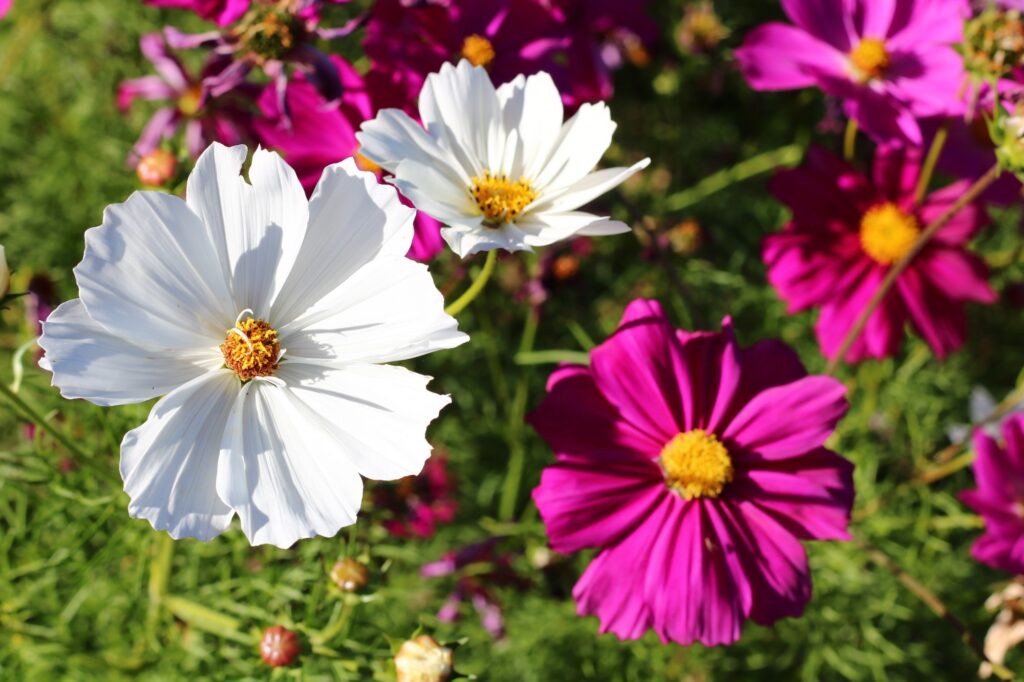
Cosmos bipinnatus is the species behind most of the familiar pink, white, crimson, burgundy, bicolor, double, and specialty cosmos flowers grown in gardens today. Commonly called garden cosmos, Mexican aster, tall cosmos, or cut-leaf cosmos, it is a fast-growing annual native to Mexico that has become one of the world’s most recognizable summer flowers.
The wild species produces airy plants with extremely fine, feathery green foliage and open daisy-like flowers, traditionally in shades of white and pink. Centuries of selection and modern breeding have dramatically expanded that simple palette. Gardeners can now grow Cosmos bipinnatus with lemon-yellow flowers, peach and apricot blooms, burgundy stripes, tubular petals, pleated cup-shaped flowers, and fluffy semi-double or fully double forms.
Cultivars can also differ enormously in size. Compact series may remain around 18 to 24 inches tall, while vigorous traditional forms can grow 4 to 6 feet or more under favorable conditions. The species itself is capable of even taller growth, particularly in rich soil.
Despite this diversity, most Cosmos bipinnatus varieties share the same easy-care nature. They prefer full sun, tolerate relatively lean soil, grow readily from seed, flower throughout summer and into fall, make excellent cut flowers, attract pollinating insects, and often self-seed when mature flower heads are allowed to remain.
For gardeners building a cosmos collection, Cosmos bipinnatus is the essential species to understand because cultivars such as Cosmos Apricotta, Cosmos Xanthos, Cosmos Double Click Snowpuff, Sea Shells Cosmos, and Cosmos Cupcakes Blush are all variations on this remarkably adaptable species.
🌸 Cosmos bipinnatus Quick Guide
| Feature | Cosmos bipinnatus |
|---|---|
| Common names | Garden cosmos, Mexican aster, tall cosmos, cut-leaf cosmos |
| Family | Asteraceae |
| Plant type | Annual |
| Native range | Mexico |
| Flower colors | Traditionally white and pink; cultivars extend into crimson, burgundy, pale yellow, apricot, peach and bicolors |
| Flower form | Single naturally; semi-double, double, tubular and cup-shaped cultivars available |
| Flower size | Commonly about 2–4 inches; some selections larger |
| Typical garden height | About 1½–5 feet depending on cultivar |
| Species potential | Can become considerably taller under vigorous conditions |
| Bloom season | Summer into fall, usually until frost |
| Light | Full sun |
| Soil | Average to lean, well-drained soil |
| Water | Moderate while establishing; relatively drought tolerant later |
| Indoor sowing | About 5–7 weeks before planting outside |
| Direct sowing | After frost once soil is above about 60–65°F |
| Germination | About 7–10 days at 68–72°F under commercial conditions |
| Spacing | About 9–12 inches for cutting; wider for ornamental plants |
| Pinching | Helpful for branching |
| Deadheading | Recommended for prolonged flowering |
| Self-seeding | Common |
| Best uses | Cutting gardens, cottage gardens, pollinator gardens, borders, containers, mass planting |
🌿 What Is Cosmos bipinnatus?
Cosmos bipinnatus is an annual flowering plant in the Asteraceae, the sunflower or daisy family.
Its scientific name was published by Spanish botanist Antonio José Cavanilles in 1791.
The species belongs to the genus Cosmos, a group containing both annual and perennial plants.
That distinction matters because gardeners sometimes assume that all cosmos behave in the same way.
They do not.
Examples include:
- Cosmos bipinnatus — annual garden cosmos
- Cosmos sulphureus — annual yellow and orange cosmos
- Cosmos atrosanguineus — tuberous perennial chocolate cosmos
- Cosmos longipetiolatus — rare Mexican perennial species
Of these, C. bipinnatus is by far the most extensively bred for ornamental gardens.
🇲🇽 Where Is Cosmos bipinnatus Native?
Royal Botanic Gardens, Kew currently recognizes the native range of Cosmos bipinnatus as Mexico.
The species has since been introduced across an enormous part of the world, including much of North America, Europe, Asia, Africa, South America, Australia, and numerous islands.
That broad introduced distribution demonstrates just how adaptable the plant can be.
Gardeners may encounter naturalized cosmos along:
- Roadsides
- Waste ground
- Field margins
- Disturbed soil
- Open sunny sites
Its tendency to produce abundant seed has helped it spread well beyond cultivation.
🌎 Why Is Mexico So Important to the Cosmos Genus?
Mexico contains exceptional diversity within Cosmos.
The familiar annual garden cosmos represents only one part of that diversity.
Other Mexican species differ dramatically in:
- Flower color
- Root structure
- Life cycle
- Habitat
- Geographic range
- Leaf structure
Chocolate cosmos, for example, is a tuberous perennial with dark scented flowers.
Cosmos longipetiolatus is a localized perennial from Jalisco.
Cosmos bipinnatus became the dominant ornamental species because it combines attractive flowers with rapid annual growth, easy seed production, and enormous potential for selection.
🌱 Is Cosmos bipinnatus an Annual or Perennial?
Cosmos bipinnatus is an annual.
Each plant completes its life cycle within one growing season.
It:
- Germinates from seed.
- Develops feathery foliage.
- Branches rapidly.
- Produces flowers.
- Develops mature seed.
- Dies at the end of its growing season, usually after frost.
The same individual plant does not return from a perennial crown or tuber the following year.
However, cosmos can appear perennial-like because it often self-seeds freely.
Those new plants are seedlings, not regrowth from the original plant.
❄️ What Happens to Cosmos bipinnatus After Frost?
A hard frost generally kills the plants.
Once the stems and foliage have died, they can be removed and composted if healthy.
If you want volunteers the following season, allow some mature flower heads to release their seeds before cleanup.
There is no bulb or root crown that needs winter protection.
In spring, any new plants develop from seed.
🌸 What Do Cosmos bipinnatus Flowers Look Like?
The traditional flower is simple and daisy-like.
A circle of broad outer ray florets surrounds a central disk made up of many tiny yellow disc florets.
Classic flowers are often:
- White
- Pale pink
- Rose
- Deep pink
- Crimson
The natural single form is relatively flat and open.
Modern breeding has transformed that basic structure into an extraordinary range of flower types.
🌺 How Large Are Cosmos bipinnatus Flowers?
The RHS describes the species as producing flowers up to approximately 8 centimeters, or just over 3 inches, across.
Many garden cultivars fall within a range of roughly 2 to 4 inches.
Some compact cultivars produce smaller flowers, while modern large-flowered selections can become noticeably broader.
Flower size is influenced by:
- Cultivar
- Plant vigor
- Moisture
- Temperature
- Soil fertility
A larger flower is not necessarily superior. Small-flowered cultivars can be exceptionally productive and useful for bouquets.
🌸 What Colors Does Cosmos bipinnatus Come In?
Traditional species colors concentrate mainly around:
- White
- Pink
- Rose
- Crimson
Modern breeding has expanded that range significantly.
Gardeners can now find cultivars in shades of:
- White
- Blush
- Shell pink
- Rose
- Carmine
- Crimson
- Cranberry
- Burgundy
- Wine red
- Pale lemon
- Cream
- Peach
- Apricot
- Mauve-pink
Patterned forms may combine several colors within one flower.
💛 Can Cosmos bipinnatus Really Be Yellow?
Yes.
Yellow was historically much more associated with Cosmos sulphureus.
Modern breeding changed that.
Cosmos Xanthos produces soft lemon-yellow flowers while remaining a genuine Cosmos bipinnatus cultivar.
Apricot Lemonade Cosmos also brings pale cream and lemon tones into the species.
These flowers are generally much paler than the strong golden-yellow or orange colors typical of C. sulphureus.
🍑 Can Cosmos bipinnatus Be Apricot or Peach?
Yes.
Modern varieties include genuinely warm-toned flowers.
Cosmos Apricotta produces a blend of:
- Apricot
- Peach
- Blush
- Rose
Apricot Lemonade Cosmos adds:
- Pale lemon
- Cream
- Apricot
- Mauve
- Pink
These cultivars have greatly expanded what gardeners can do with cosmos in pastel and warm-color planting schemes.
🌼 Are All Cosmos bipinnatus Flowers Single?
No.
The wild-type flower is single, but cultivated forms now include an extraordinary range.
Single Flowers
These retain the classic daisy-like shape.
Examples include:
Semi-Double and Double Flowers
Additional florets create a much fuller bloom.
Examples include:
Tubular Flowers
Sea Shells Cosmos rolls the outer petals into distinctive tubes.
Cup-Shaped Flowers
Cosmos Cupcakes Blush fuses the outer ray florets into a pleated bowl.
Collarette and Frilled Forms
Cosmos Sweet Sixteen produces an additional decorative inner frill.
Few annual flower species offer quite this much structural variation.
🍃 What Do Cosmos bipinnatus Leaves Look Like?
The foliage is one of the species’ most recognizable characteristics.
Leaves are repeatedly divided into extremely narrow segments, creating a:
- Fern-like
- Lacy
- Feathery
- Thread-like
appearance.
This fine foliage makes tall cosmos feel much lighter than many plants of similar height.
A 5-foot cosmos can still allow light and neighboring flowers to remain visible through its branches.
That quality is especially valuable in cottage gardens.
🌿 What Does “bipinnatus” Mean?
The specific name refers to the divided structure of the foliage.
Bipinnate describes a leaf divided in a feather-like pattern more than once.
The deeply cut leaves of Cosmos bipinnatus therefore inspired its botanical name.
The foliage is useful for distinguishing it from Cosmos sulphureus, whose divided leaf segments are generally broader.
📏 How Tall Does Cosmos bipinnatus Grow?
There is no single answer because the species has been bred into both dwarf and tall forms.
Compact cultivars may remain around:
18–24 inches.
Traditional garden varieties often reach:
3–5 feet.
Very vigorous species-type plants can become considerably taller.
The RHS notes that the species itself can reach approximately 1.5 to 2.5 meters, or roughly 5 to 8 feet.
Garden height depends heavily on both genetics and growing conditions.
🌿 Why Does Cosmos Height Vary So Much?
Several factors influence mature size.
Cultivar
A compact Cosmos Sonata is genetically very different in stature from tall Sensation-type plants.
Soil Fertility
High nitrogen encourages taller vegetative growth.
Water
Constant moisture can promote soft, vigorous stems.
Light
Insufficient sunlight can cause stretching.
Growing Season
Long warm seasons give plants more time to grow.
Pinching
Pinched plants become more branched and may appear shorter and fuller.
Before planting any cosmos, check the expected height of the specific cultivar rather than relying on the species alone.
🌿 Compact Cosmos bipinnatus Varieties
Compact forms are useful where ordinary tall cosmos would be overwhelming.
Examples include:
These are especially suitable for:
- Containers
- Small gardens
- Border fronts
- Patio plantings
🌿 Tall Cosmos bipinnatus Varieties
Taller cultivars are ideal for cut flowers and cottage gardens.
Examples include:
- Sensation Mix Cosmos
- Cosmos Dazzler
- Cosmos Radiance
- Cosmos Apricotta
- Cosmos Double Click Snowpuff
- Cosmos Double Click Rose Bon Bon
- Sea Shells Cosmos
- Picotee Cosmos
These provide longer stems and greater vertical presence.
📅 When Does Cosmos bipinnatus Bloom?
The species flowers from summer into autumn, generally continuing until frost when plants are kept healthy and spent flowers are removed.
In warm climates or with indoor-started plants, flowering may begin relatively early.
Direct-sown plants often begin somewhat later.
Bloom timing is affected by:
- Cultivar
- Sowing date
- Temperature
- Day length
- Soil fertility
- Sun exposure
Once flowering begins, a healthy plant can remain productive for months.
☀️ How Much Sun Does Cosmos bipinnatus Need?
Grow garden cosmos in full sun.
The RHS recommends full sunlight, and university extension guidance likewise considers full sun ideal.
Aim for at least six hours of direct sunlight each day.
Full sun encourages:
- Stronger stems
- More flowers
- Better branching
- Less stretching
Some plants tolerate partial sun, but heavy shade usually produces poorer flowering and weaker growth.
🌱 Best Soil for Cosmos bipinnatus
One of the biggest advantages of cosmos is its ability to grow in ordinary soil.
The species can tolerate:
- Clay
- Loam
- Sand
- Chalky soil
provided drainage is reasonable.
Garden cosmos does not need heavily enriched ground.
Illinois Extension specifically recommends well-drained, relatively low-fertility soil.
That surprises gardeners accustomed to enriching every flower bed heavily.
With cosmos, restraint is usually better.
🚫 Don’t Overfertilize Cosmos bipinnatus
Too much fertilizer—especially nitrogen—can create enormous plants with disappointing flowers.
Overfertilized cosmos may produce:
- Excess foliage
- Extremely long stems
- Weak growth
- Delayed flowering
- Fewer blooms
- Increased flopping
Illinois Extension specifically warns that overfertilization can reduce flowering.
If your garden soil already grows ordinary annuals successfully, cosmos may need no additional fertilizer at all.
💧 How Much Water Does Cosmos bipinnatus Need?
Seeds and young seedlings need consistent moisture while establishing.
Once mature, plants become more tolerant of occasional dry periods.
During prolonged drought, water deeply.
Then allow the upper soil to begin drying again.
Avoid keeping the roots permanently saturated.
Illinois Extension notes that overwatering as well as overfertilizing can lead to fewer flowers.
The goal is steady growth rather than the largest possible plant.
🌵 Is Cosmos bipinnatus Drought Tolerant?
Mature plants have useful drought tolerance.
North Carolina Extension specifically lists garden cosmos as tolerant of dry soil and drought once established.
However, drought tolerance does not mean that water never helps.
During long periods without rain, supplemental irrigation can improve:
- Flower production
- Stem length
- Plant vigor
Water deeply and less frequently rather than giving a small amount every day.
🌡️ Is Cosmos bipinnatus Heat Tolerant?
Yes.
Garden cosmos performs well during summer heat.
Healthy plants can continue blooming when many cooler-season annuals have already declined.
Very high temperatures combined with severe drought can slow flowering temporarily.
Adequate water during prolonged extreme heat helps, but constantly saturated ground is unnecessary.
🌱 Growing Cosmos bipinnatus From Seed
One reason the species became so popular is that it is exceptionally easy to grow from seed.
You can either:
- Start seeds indoors, or
- Direct sow outdoors
Neither method is difficult.
Direct sowing is especially successful because the plants grow rapidly once the soil warms.
Indoor sowing is useful when earlier flowers are desired.
🪴 When to Start Cosmos bipinnatus Seeds Indoors
Johnny’s Selected Seeds recommends starting cosmos approximately 5 to 7 weeks before planting outdoors.
Cover the seeds lightly.
After germination, provide bright light immediately.
Avoid sowing months ahead of the last frost.
Cosmos seedlings grow quickly and can become:
- Root-bound
- Leggy
- Difficult to support
- Harder to transplant
A young vigorous transplant usually performs better than an oversized indoor plant.
🌡️ Best Germination Temperature for Cosmos bipinnatus
Johnny’s recommends approximately 68–72°F.
Under those conditions, many cultivated cosmos germinate in approximately 7 to 10 days.
North Carolina Extension gives a broader outdoor germination window of approximately 7 to 21 days, reflecting the less controlled conditions found in garden soil.
Warm, evenly moist soil generally produces the fastest emergence.
💡 Preventing Leggy Cosmos Seedlings
Cosmos seedlings can stretch rapidly indoors.
To keep them compact:
- Provide strong grow lights.
- Keep the lights reasonably close.
- Do not sow excessively early.
- Avoid heavy fertilizer.
- Provide gentle airflow.
- Avoid unnecessarily hot conditions after emergence.
If seedlings become extremely tall indoors, transplanting becomes more difficult and stems are more likely to bend.
🌤️ Hardening Off Cosmos Seedlings
Plants started indoors need time to adjust to outdoor conditions.
Over about 7 to 10 days, gradually introduce them to:
- Direct sunlight
- Wind
- Cooler nights
- Wider temperature fluctuations
Start in a protected location.
Increase exposure each day.
Plant permanently after frost danger has passed and seedlings have adjusted.
🌱 Can Cosmos bipinnatus Be Direct Sown?
Yes. Direct sowing is one of the easiest ways to grow it.
Johnny’s recommends sowing after the last frost once soil temperature rises above approximately 60°F.
North Carolina Extension suggests waiting until the soil is around 65°F.
Both guidelines point to the same practical principle:
Wait until spring soil has genuinely warmed.
Sow shallowly and maintain moisture until seedlings establish.
📏 How Deep Should Cosmos Seeds Be Planted?
Cover seeds lightly.
Approximately ⅛ to ¼ inch is generally appropriate.
North Carolina Extension specifically warns that planting cosmos seed too deeply can reduce germination.
Indoors, press seed into moist mix and add a thin covering.
Outdoors, sow into a shallow furrow and lightly rake soil over the seed.
📐 How Far Apart Should Cosmos bipinnatus Be Planted?
Spacing depends on the cultivar and purpose.
Johnny’s recommends approximately 9 to 12 inches apart for cut-flower production and notes that wider spacing produces thicker stems.
For ornamental plantings, 12 to 18 inches is a useful general range for many medium and tall cultivars.
Very compact varieties may be planted differently.
Extremely tall or wide cultivars may benefit from additional room.
Always consider the mature size of the specific selection.
✂️ Should Cosmos bipinnatus Be Pinched?
Pinching is very useful for many cultivars.
Johnny’s specifically recommends pinching to encourage branching.
Once the young plant is established, remove the main growing tip above a healthy set of leaves.
The plant responds by developing several side branches.
This can produce:
- More flower stems
- Bushier plants
- Better cut-flower production
- Less dependence on one main central stem
Naturally compact branching cultivars may need less pinching than tall cutting varieties.
🌿 Does Cosmos bipinnatus Need Staking?
Tall varieties sometimes do.
Wind and thunderstorms can flatten plants that reach 4 feet or more.
Support is particularly useful when plants are:
- Tall cultivars
- Growing in rich soil
- Exposed to wind
- Widely spaced
- Being grown for straight cut stems
Johnny’s recommends horizontal support netting for tall varieties.
Other options include:
- Stakes
- Twine
- Plant rings
- Brushwood support
Install support before plants become difficult to manage.
🌬️ How to Keep Cosmos From Falling Over
The best solution is not simply more stakes.
Strong plants begin with good culture.
For sturdier cosmos:
- Grow in full sun.
- Avoid excessive nitrogen.
- Avoid constant watering.
- Pinch appropriate cultivars.
- Choose sensible spacing.
- Install support early if needed.
Plants grown in rich soil and shade often become exceptionally tall but weak.
✂️ Should Cosmos bipinnatus Be Deadheaded?
Yes.
Removing faded flowers prevents early seed formation and encourages continued bloom.
The RHS recommends deadheading to extend the flowering season, while Johnny’s considers regular deadheading important for flowers throughout summer.
Follow the flower stem back to a healthy branch or developing bud.
Cut there rather than simply pulling off the petals.
🌺 How to Get More Cosmos Flowers
For maximum flower production:
- Plant in full sun.
- Avoid excess fertilizer.
- Avoid overwatering.
- Pinch tall plants when young.
- Harvest regularly.
- Deadhead faded blooms.
- Water during serious drought.
Cosmos is a classic cut-and-come-again annual.
Regular harvesting encourages plants to replace removed flower stems.
💐 Is Cosmos bipinnatus a Good Cut Flower?
Yes. It is one of the classic easy annual cut flowers.
Many cultivars have been developed specifically for:
- Long stems
- Flower size
- Unusual color
- Double blooms
- Early flowering
- Stronger stems
Excellent cutting selections include:
- Sensation Mix Cosmos
- Cosmos Apricotta
- Cosmos Rubenza
- Cosmos Double Click Snowpuff
- Cosmos Double Click Rose Bon Bon
A small cutting bed can provide many stems throughout summer.
✂️ When Should Cosmos Be Cut for Bouquets?
Johnny’s recommends harvesting when the petals are just beginning to open but have not yet completely flattened.
Flowers cut at this stage are fresher than blooms left fully open outdoors for several days.
Harvest during a cool part of the day.
Place stems directly into clean water.
Remove any foliage that would sit below the waterline.
🏺 How Long Does Cosmos Last in a Vase?
Vase life varies with cultivar and harvest stage but is generally around five to ten days.
For better longevity:
- Cut fresh flowers.
- Use clean snips.
- Place stems in water promptly.
- Remove submerged leaves.
- Change water regularly.
- Keep arrangements away from strong heat.
Cosmos may not last as long as some commercial cut flowers, but the plants are productive enough to provide replacements frequently.
🐝 Does Cosmos bipinnatus Attract Pollinators?
Yes.
The RHS includes Cosmos bipinnatus among its Plants for Pollinators, and North Carolina Extension also identifies it as valuable for pollinating insects and butterflies.
Single open flowers provide easy access to the central disc.
Visitors may include:
- Native bees
- Honeybees
- Butterflies
- Hoverflies
- Other beneficial insects
A large planting can remain active with flower visitors throughout the main bloom season.
🦋 Are Double Cosmos as Good for Pollinators?
Not always.
Very double flowers contain extra florets that can partially obscure the central reproductive structures.
A cultivar such as Cosmos Double Click Snowpuff may therefore offer less convenient access than an open single flower.
This does not mean double flowers have no wildlife value.
A good solution is simply to grow both.
Combine double cultivars with open selections such as:
That provides both ornamental diversity and plenty of accessible flowers.
🐦 Does Cosmos bipinnatus Help Birds?
Yes.
North Carolina Extension notes wildlife value for birds as well as pollinating insects.
If some flower heads are allowed to mature instead of being deadheaded, seed-eating birds may investigate them.
For a wildlife garden, a useful compromise is to deadhead heavily through summer and leave more seed heads later in the season.
That preserves flowering while eventually providing seed.
🌱 Does Cosmos bipinnatus Self-Seed?
Yes, very readily.
Both RHS and university extension sources note the species’ ability to reseed.
If mature seed heads remain, the long dark seeds fall into surrounding soil.
Some may germinate the following growing season.
Self-seeding is especially welcome in:
- Cottage gardens
- Meadow-style beds
- Informal borders
It can be less convenient where precise plant placement is important.
🌱 How to Save Cosmos bipinnatus Seeds
Late in the season, stop deadheading several healthy flowers.
Allow the centers to mature fully.
The seeds become:
- Long
- Narrow
- Pointed
- Dark brown to blackish
Harvest them once dry but before they naturally scatter.
Allow them to finish drying indoors.
Store them in a labeled paper envelope somewhere cool and dry.
🌸 Will Saved Cosmos Seeds Come True?
Sometimes—but not always.
Many Cosmos bipinnatus varieties are open-pollinated, but compatible cultivars can cross with one another.
If your garden contains:
- Apricotta
- Rubenza
- Radiance
- Daydream
- Sea Shells
- Double Click
- Picotee
- Other C. bipinnatus cultivars
cross-pollination can produce seedlings that differ from their parent.
Differences may appear in:
- Color
- Flower shape
- Height
- Doubleness
- Patterning
For an informal garden, this can be fascinating.
For predictable cultivar traits, purchase fresh seed.
🌺 Popular Cosmos bipinnatus Varieties
One of the strongest reasons to grow this species is the enormous diversity of cultivars now available.
Sensation Mix
Sensation Mix Cosmos is a classic tall mixture of white, pink, magenta, and crimson flowers.
It represents the traditional cottage-garden appearance of C. bipinnatus.
Dazzler
Cosmos Dazzler produces rich carmine-crimson flowers with yellow centers.
It adds much stronger color than pale traditional pinks.
Radiance
Cosmos Radiance combines deep rose-pink outer petals with a pronounced crimson eye.
It is a classic bicolor selection.
Rubenza
Cosmos Rubenza opens dark cranberry or wine red before fading toward antique rose.
The dramatic color change is its defining feature.
Velouette
Cosmos Velouette produces variable burgundy-and-white stripes, splashes, and edging.
No two flowers need look exactly alike.
Picotee
Picotee Cosmos has pale petals edged in darker rose or crimson.
It retains a traditional single flower while introducing a distinctive border.
Daydream
Daydream Cosmos blends white and pale blush with a deeper rosy center.
It is one of the softer traditional single cultivars.
Apricotta
Cosmos Apricotta produces modern peach, apricot, blush, and rose flowers on tall cutting stems.
Apricot Lemonade
Apricot Lemonade Cosmos is a shorter cultivar combining pale lemon, cream, apricot, mauve, and pink.
Xanthos
Cosmos Xanthos produces soft lemon-yellow flowers on compact plants.
It represents an important breakthrough in C. bipinnatus breeding.
Capriola
Cosmos Capriola combines white petals with rose-red edging and pronounced central markings.
Sweet Sixteen
Cosmos Sweet Sixteen produces pale pink-and-white flowers with a distinctive frilled inner collar.
Sonata
Cosmos Sonata is a compact series useful for smaller gardens and containers.
Apollo
Cosmos Apollo combines relatively short plants with unusually large single flowers.
Sea Shells
Sea Shells Cosmos rolls its ray petals into tubes or fluted funnels.
Cupcakes Blush
Cosmos Cupcakes Blush fuses its outer petals together into a pleated floral cup.
Double Click Snowpuff
Cosmos Double Click Snowpuff produces fluffy white semi-double and double flowers.
Double Click Rose Bon Bon
Cosmos Double Click Rose Bon Bon provides the same fluffy flower structure in rose pink.
🌼 Cosmos bipinnatus vs. Cosmos sulphureus
These are the two annual species gardeners are most likely to encounter.
| Feature | Cosmos bipinnatus | Cosmos sulphureus |
|---|---|---|
| Life cycle | Annual | Annual |
| Native range | Mexico | Mexico through Central America |
| Traditional colors | White, pink, crimson | Yellow, gold, orange |
| Foliage | Extremely fine and thread-like | Divided but generally broader |
| Modern cultivars | Exceptional range of colors and forms | Many yellow-orange single and double forms |
| Heat tolerance | Very good | Excellent |
| Self-seeding | Common | Often prolific |
Both are easy summer annuals, but their traditional color palettes and foliage are quite different.
🍫 Cosmos bipinnatus vs. Chocolate Cosmos
Cosmos atrosanguineus is fundamentally different.
Cosmos bipinnatus
- Annual
- Usually grown from seed
- Extremely fine foliage
- Huge cultivar selection
- Flowers throughout one growing season
Cosmos atrosanguineus
- Tuberous perennial
- Dark maroon flowers
- Chocolate fragrance
- Often propagated vegetatively
- Requires winter protection in colder climates
Chocolate cosmos is not simply a dark-colored variety of C. bipinnatus.
It is a separate species.
🌿 Cosmos bipinnatus vs. Cosmos longipetiolatus
Cosmos longipetiolatus is another separate Mexican species.
It is:
- Perennial
- Tuberous rooted
- Native to Jalisco
- Purple to reddish-purple
- Rare in cultivation
Cosmos bipinnatus is:
- Annual
- Widely cultivated
- Exceptionally variable
- Readily grown from seed
The contrast illustrates how diverse the genus really is.
🪴 Can Cosmos bipinnatus Grow in Containers?
Yes.
Container suitability depends primarily on cultivar size.
For pots, compact selections are easiest.
Good choices include:
Tall 4-foot cultivars can also grow in containers, but they require a large, stable pot and may need support.
🏡 Cosmos bipinnatus in a Cottage Garden
Few annual flowers are better suited to cottage gardens.
Tall stems and feathery foliage allow cosmos to intermingle naturally with other flowers rather than forming rigid blocks.
Good companions include:
- Dahlias
- Zinnias
- Snapdragons
- Salvia
- Verbena
- Scabiosa
- Ammi
- Gomphrena
- Coneflowers
Mixing multiple cosmos cultivars can create an entire garden layer by itself.
🌺 Cosmos bipinnatus in a Cutting Garden
A dedicated cutting bed allows tall cultivars to reach their full potential.
For productive plants:
- Grow in full sun.
- Space roughly 9–12 inches apart.
- Pinch young plants.
- Install support netting.
- Harvest regularly.
- Deadhead unused flowers.
Different cultivars can provide nearly every bouquet role from pale filler to dark accent flowers.
🌾 Cosmos bipinnatus in a Meadow-Style Garden
The species also works beautifully in informal naturalistic planting.
Direct sow groups among other annual flowers and allow the stems to weave naturally.
If you want the planting to repeat itself, leave some late-season seed heads.
Keep in mind that self-sown offspring of named cultivars may not look identical to their parents.
That unpredictability suits a meadow-style garden particularly well.
🤍 White Cosmos in the Garden
White Cosmos bipinnatus is especially useful because it combines with virtually every color.
Good partners include:
- Burgundy
- Crimson
- Pink
- Peach
- Lavender
- Blue
- Yellow
For a highly textured white cultivar, Cosmos Double Click Snowpuff is a strong choice.
💗 Pink Cosmos in the Garden
Pink remains one of the defining colors of the species.
Possible shades range from:
- Nearly white blush
- Shell pink
- Clear rose
- Deep magenta
Combine several tones for a traditional cottage garden or use one cultivar for a more controlled planting.
Daydream Cosmos is excellent for pale pink, while Cosmos Double Click Rose Bon Bon provides deeper color and a fuller flower.
🍷 Dark Cosmos in the Garden
Modern cultivars provide surprisingly rich dark tones.
Good options include:
Use dark cosmos beside white, blush, apricot, or pale yellow flowers for maximum contrast.
🍑 Pastel Cosmos in the Garden
Breeders have greatly expanded the pastel range.
For softer plantings, consider:
These cultivars make C. bipinnatus useful in much more sophisticated color schemes than the traditional pink-and-white cottage garden.
🐌 Common Cosmos bipinnatus Pests
The species is generally easy to grow but can experience occasional pest problems.
The RHS lists:
- Aphids
- Slugs
North Carolina Extension additionally mentions:
- Aster leafhoppers
- Gray looper moth caterpillars
Young seedlings are often the most vulnerable stage.
Healthy established plants usually tolerate minor feeding without serious damage.
🦠 Common Cosmos bipinnatus Diseases
Potential problems include:
- Gray mold
- Powdery mildew
- Stem canker
Disease risk increases when plants are:
- Crowded
- Shaded
- Constantly wet
- Surrounded by poor airflow
Full sun, good drainage, and sensible spacing prevent many problems.
🌿 Why Is My Cosmos Huge but Not Flowering?
Overfertilization is one of the most common causes.
High nitrogen encourages foliage and stem growth rather than flowers.
Other possible causes include:
- Too much water
- Insufficient sunlight
- Plants that are not yet mature
- Unusual weather
Illinois Extension specifically warns that both overfertilization and overwatering can result in fewer flowers.
Do not automatically add more fertilizer to a nonflowering cosmos.
🌬️ Why Is My Cosmos Falling Over?
Tall cultivars may fall after wind or heavy rain.
Contributing factors include:
- Rich soil
- Excess fertilizer
- Too much water
- Partial shade
- Lack of support
Pinching while young and installing netting before plants become tall can prevent much of the problem.
🌱 Why Are My Cosmos Seedlings Leggy?
Weak light is usually responsible.
Cosmos seedlings grow quickly and stretch aggressively when indoor lighting is inadequate.
Other factors include:
- Excessive warmth
- Starting too early
- Overfertilization
Provide stronger light and avoid sowing months ahead of planting time.
🌺 Why Did My Cosmos Stop Flowering?
The most likely causes include:
- Too many mature seed heads
- Severe drought
- Excess nitrogen
- Heat stress
- Shortening seasonal conditions
Deadhead regularly.
If plants have produced a large amount of mature seed, cutting them back lightly can sometimes stimulate a fresh flush of growth where sufficient warm weather remains.
🌸 Why Doesn’t My Saved Cosmos Look Like the Parent?
Cross-pollination is a common reason.
When multiple Cosmos bipinnatus cultivars flower together, insects can transfer pollen among them.
The resulting seeds may contain new combinations of traits.
Seedlings may differ in:
- Color
- Height
- Petal shape
- Flower fullness
- Patterning
This does not necessarily mean anything went wrong.
It is normal genetic variation.
❓ Cosmos bipinnatus FAQ
What is Cosmos bipinnatus?
It is an annual flowering species native to Mexico and the parent species of most familiar pink, white, burgundy, double, tubular, and specialty garden cosmos.
What are its common names?
Garden cosmos, Mexican aster, tall cosmos, cut-leaf cosmos, and sometimes cosmea.
Where is Cosmos bipinnatus native?
Kew currently lists Mexico as its native range.
Is Cosmos bipinnatus an annual?
Yes.
Does Cosmos bipinnatus come back every year?
The original plant does not, but it may self-seed and produce new seedlings the following season.
How tall does Cosmos bipinnatus grow?
Cultivars range from roughly 18 inches to 5 feet or more. The species itself can become substantially taller under favorable conditions.
What colors does Cosmos bipinnatus come in?
Traditional colors are white, pink, rose, and crimson. Modern cultivars also include burgundy, pale yellow, cream, peach, apricot, and many bicolors.
Can Cosmos bipinnatus be yellow?
Yes. Cosmos Xanthos is a pale lemon-yellow cultivar.
Can Cosmos bipinnatus be apricot?
Yes. Cosmos Apricotta and Apricot Lemonade Cosmos provide apricot and peach tones.
Are all Cosmos bipinnatus flowers single?
No. Cultivars can be single, semi-double, fully double, tubular, frilled, or cup-shaped.
When does Cosmos bipinnatus bloom?
From summer through autumn, generally until frost.
Does Cosmos bipinnatus need full sun?
Yes. Full sun provides the strongest flowering and sturdier stems.
Can cosmos grow in poor soil?
Yes. It often performs very well in relatively lean soil.
Should cosmos be heavily fertilized?
No. Excess nitrogen can create huge plants with fewer flowers.
Is Cosmos bipinnatus drought tolerant?
Established plants tolerate short dry periods reasonably well.
When should cosmos seeds be started indoors?
Approximately five to seven weeks before outdoor planting.
What temperature is best for germinating cosmos?
Johnny’s recommends approximately 68–72°F.
How long do cosmos seeds take to germinate?
Approximately 7–10 days under controlled warm conditions, with outdoor germination sometimes taking as long as 21 days.
Can Cosmos bipinnatus be direct sown?
Yes. It is especially successful when direct sown after frost.
How warm should soil be before direct sowing?
Approximately 60–65°F is a useful range.
How deep should cosmos seeds be planted?
Cover them lightly, roughly ⅛–¼ inch deep.
How far apart should cosmos be planted?
About 9–12 inches works well for cutting gardens. Ornamental plants may be spaced 12–18 inches or farther depending on cultivar.
Should cosmos be pinched?
Pinching encourages branching and is especially useful for taller cutting varieties.
Does cosmos need staking?
Tall varieties may benefit from support in windy gardens.
Should cosmos be deadheaded?
Yes. Deadheading prolongs flowering.
Is Cosmos bipinnatus good for cut flowers?
Yes. It is one of the easiest annual cutting flowers.
When should cosmos be harvested?
Cut when the petals are beginning to open but before they have completely flattened.
Does Cosmos bipinnatus attract pollinators?
Yes. Open flowers provide nectar and pollen for many visiting insects.
Are double cosmos good for pollinators?
They can still receive visitors, but open single flowers generally provide easier access.
Does Cosmos bipinnatus self-seed?
Yes, readily.
Can I save cosmos seeds?
Yes.
Will saved cosmos seed produce identical plants?
Not necessarily, especially if several cultivars were flowering nearby.
Can Cosmos bipinnatus grow in pots?
Yes. Compact cultivars are particularly suitable for containers.
Is Cosmos bipinnatus the same as yellow cosmos?
Not usually. Traditional yellow-orange cosmos is Cosmos sulphureus, although modern C. bipinnatus cultivars such as Xanthos can be pale yellow.
Is chocolate cosmos a Cosmos bipinnatus cultivar?
No. Cosmos atrosanguineus is a separate perennial species.
🌸 Is Cosmos bipinnatus Worth Growing?
Cosmos bipinnatus is one of the most versatile annual flowers a gardener can grow.
The species succeeds partly because it asks for so little.
Seeds germinate readily. Plants thrive in sunshine. Ordinary soil is sufficient. Excess fertilizer is more likely to create problems than improve the display. Once flowering begins, regular cutting and deadheading can keep the plants productive until frost.
Its ornamental diversity is even more impressive.
A gardener interested in traditional flowers can grow Sensation Mix Cosmos for classic white, pink, magenta, and crimson blooms. Darker gardens can incorporate Cosmos Rubenza, Cosmos Dazzler, or Cosmos Velouette.
Pastel gardens now have Cosmos Apricotta, Apricot Lemonade Cosmos, Daydream Cosmos, and Cosmos Xanthos.
Gardeners interested in flower shape can choose Sea Shells Cosmos for tubular petals, Cosmos Cupcakes Blush for pleated cup-shaped blooms, or Double Click cultivars for semi-double and fully double flowers.
Few species offer that much diversity while remaining so simple to grow.
Cosmos bipinnatus also works simultaneously as a cottage-garden flower, cutting flower, pollinator plant, container annual, mass planting, and self-sowing meadow flower.
Give it full sun, average well-drained soil, moderate water while establishing, and very little unnecessary fertilizer. Pinch tall cutting cultivars, provide support where summer storms are common, and keep flowers harvested or deadheaded.
With those basic conditions, garden cosmos can provide months of flowers—and an almost endless choice of colors and forms.
🔗 Related Articles
- Cosmos sulphureus
- Cosmos atrosanguineus
- Cosmos longipetiolatus
- Sensation Mix Cosmos
- Cosmos Dazzler
- Picotee Cosmos
- Cosmos Cupcakes Blush
- Daydream Cosmos
- Sea Shells Cosmos
- Cosmos Double Click Snowpuff
- Cosmos Double Click Rose Bon Bon
- Cosmos Radiance
- Cosmos Rubenza
- Cosmos Apricotta
- Apricot Lemonade Cosmos
- Cosmos Velouette
- Cosmos Xanthos
- Cosmos Apollo
- Cosmos Sonata
- Cosmos Capriola
- Cosmos Sweet Sixteen
- Cosmos Care
- Cosmos Flower Types
- Discover the Stunning Diversity of Cosmos Flower Varieties
📚 Sources & Further Reading
- Kew Plants of the World Online — Cosmos bipinnatus
- Royal Horticultural Society — Cosmos bipinnatus
- Royal Horticultural Society — Cosmos Growing Guide
- North Carolina Extension Gardener Plant Toolbox — Cosmos bipinnatus
- University of Illinois Extension — Cosmos
- Johnny’s Selected Seeds — Growing Cosmos From Seed