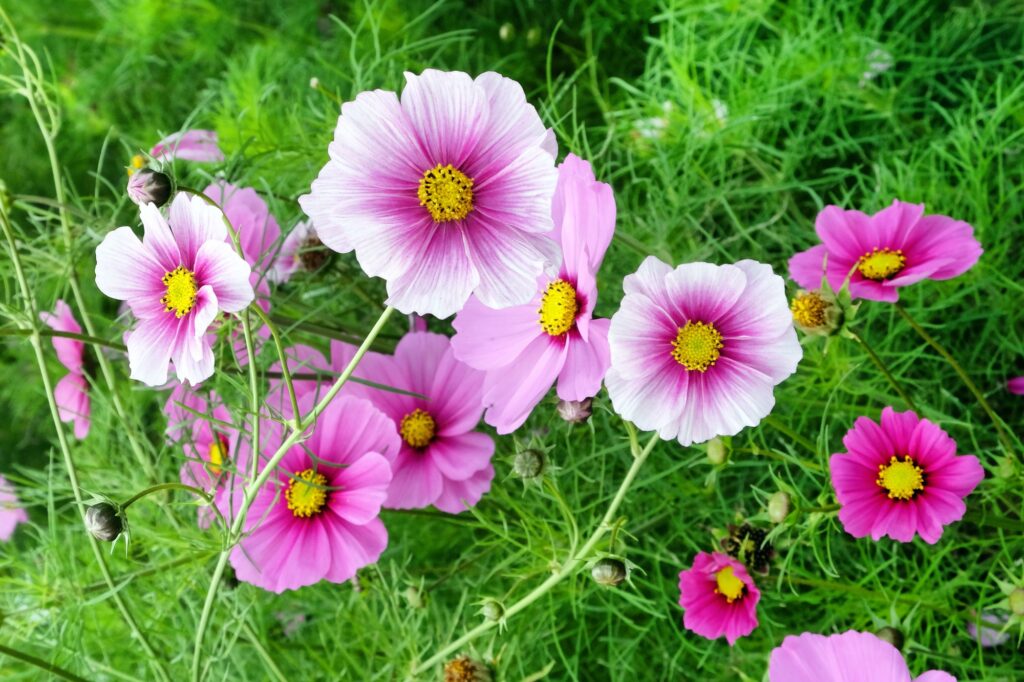
Daydream cosmos is a tall, romantic cultivar of Cosmos bipinnatus known for its delicate white-to-blush-pink flowers with a deeper rosy-pink ring surrounding the golden-yellow center. The petals create a soft watercolor effect, appearing almost white around their outer edges before gradually deepening toward the middle of the bloom.
Unlike heavily patterned cultivars such as Cosmos Velouette or densely doubled varieties such as Cosmos Double Click Snowpuff, Daydream retains the classic open, single-flowered form of traditional garden cosmos. Its beauty comes primarily from its subtle color gradient.
Plants are tall and airy, generally reaching around 3 to 4 feet, although particularly vigorous plants may grow closer to 5 feet. Long branching stems and large open flowers make Daydream an excellent choice for cutting gardens, cottage borders, pollinator plantings, and informal meadow-style gardens.
Like most Cosmos bipinnatus, Daydream is also remarkably undemanding. Give it full sun, well-drained soil, restrained fertilizer, and regular cutting or deadheading, and it can flower from summer until frost.
🌸 Daydream Cosmos Quick Guide
| Feature | Cosmos ‘Daydream’ |
|---|---|
| Botanical name | Cosmos bipinnatus ‘Daydream’ |
| Family | Asteraceae |
| Plant type | Annual |
| Flower color | White to pale blush pink with deeper rosy-pink center |
| Flower center | Golden yellow |
| Flower form | Single, daisy-like |
| Flower size | Roughly 2½–3 inches |
| Typical height | About 3–4 feet; sometimes taller |
| Bloom season | Summer through fall |
| Light | Full sun |
| Soil | Average to lean, well-drained soil |
| Indoor sowing | About 5–6 weeks before planting outside |
| Direct sowing | After danger of frost |
| Germination | About 10–14 days under suitable conditions |
| Spacing | About 12 inches for cutting; wider for ornamental plants |
| Pinching | Helpful |
| Deadheading | Recommended |
| Best uses | Cutting gardens, cottage gardens, pollinator gardens, borders |
| Seed saving | Possible, but nearby cosmos can cross-pollinate |
🌺 What Is Daydream Cosmos?
Daydream is a named cultivar of Cosmos bipinnatus, the species commonly called garden cosmos or Mexican aster.
Like other members of the species, it produces:
- Fine, feathery foliage
- Tall branching stems
- Open daisy-shaped flowers
- Prominent yellow central disks
Its defining feature is the coloration of the petals.
The Royal Horticultural Society describes Daydream as producing flowers ranging from soft pink to white, with each petal carrying a deeper pink flare near its base. That darker color fades through paler pink before reaching an almost white outer edge.
The effect is much softer than the clearly separated bands of color seen in some bicolor cultivars.
Instead of looking striped, the petals seem washed with pink watercolor.
🎨 What Color Is Daydream Cosmos?
The simplest description is white and blush pink with a rosy center.
Look closely, however, and the flowers often contain several subtle zones of color.
A typical bloom may show:
- White or nearly white petal tips
- Pale blush-pink middle sections
- Deeper rose-pink near the center
- A golden-yellow central disk
The transition between colors is often gradual.
That distinguishes Daydream from Cosmos Radiance, where the darker central coloring is usually more sharply defined.
Daydream has a much softer appearance.
🌸 What Do Daydream Cosmos Flowers Look Like?
Daydream produces traditional single cosmos flowers.
Broad petals surround an exposed yellow central disk, giving the bloom the familiar daisy-like structure associated with Cosmos bipinnatus.
The flowers are generally around 2½ to 3 inches across, although exact size varies according to growing conditions.
Because the petals become paler toward their edges, the flowers can appear almost luminous when backlit by morning or evening sunlight.
The darker pink center keeps the pale bloom from disappearing visually against surrounding foliage.
💗 Why Does Daydream Have a Dark Pink Center?
The deeper rose coloring near the center is a normal genetic characteristic of the cultivar.
Each petal becomes darker near its base.
When all of those darker petal bases meet around the central disk, they create the appearance of a pink or rose-colored ring.
This pattern is not caused by:
- Disease
- Sun damage
- Nutrient deficiency
- Aging
- Cold weather
It is precisely what distinguishes Daydream from ordinary pale-pink or white cosmos.
🌿 What Does the Daydream Plant Look Like?
Daydream has the characteristic foliage of Cosmos bipinnatus.
Leaves are divided repeatedly into narrow thread-like sections, producing a delicate, feathery texture.
Even when the plants become 4 feet tall, they rarely look heavy.
The open foliage allows light and neighboring plants to remain visible through the stems.
This makes Daydream particularly useful in cottage gardens, where the plants can mingle naturally with dahlias, zinnias, salvias, snapdragons, and other summer flowers.
📏 How Tall Does Daydream Cosmos Grow?
Published heights vary.
The RHS describes stems reaching approximately 1.2 meters, or about 4 feet.
William Dam Seeds also lists the cultivar at approximately 48 inches.
Some seed growers report plants reaching 5 to 6 feet under vigorous conditions.
For most home gardens, a realistic expectation is approximately:
3 to 4 feet tall, with the possibility of taller growth in rich soil and long growing seasons.
This is therefore a tall cosmos, not a compact bedding cultivar.
📐 How Wide Does Daydream Cosmos Grow?
Individual plants become branching and can spread considerably when given enough room.
For a cutting garden, plants can be grown roughly 12 inches apart.
If you want large individual specimens in an ornamental border, allow approximately 12 to 18 inches or more.
The RHS gives a much larger potential mature spread when plants are allowed unrestricted growth, which reflects how broadly tall cosmos can branch.
Spacing affects plant shape.
Closer plants generally grow more upright.
Wider plants tend to branch more broadly.
🌿 Is Daydream a Dwarf Cosmos?
No.
Daydream belongs firmly among the taller Cosmos bipinnatus cultivars.
If you need a shorter plant for containers or border fronts, consider:
Daydream is better suited to:
- Cutting gardens
- Middle and back borders
- Cottage gardens
- Large informal plantings
Its height is an advantage when long bouquet stems are the goal.
📅 When Does Daydream Cosmos Bloom?
Daydream flowers from summer into fall.
The RHS lists its flowering season from summer through autumn.
In warmer climates or when plants are started indoors, the first blooms may appear earlier.
The actual schedule depends on:
- Sowing date
- Spring temperatures
- Frost dates
- Sunlight
- Growing-season length
Once flowering begins, plants can continue producing new blooms until frost if spent flowers are regularly removed.
⏱️ Is Daydream an Early-Flowering Cosmos?
Daydream is often described by seed growers as relatively early flowering compared with some traditional tall cosmos.
Actual flowering time still varies enough that it is better not to rely on one exact number.
Under favorable conditions, cosmos generally move from seed to bloom within a few months.
If early flowers matter, start several plants indoors while also direct sowing additional seed outside.
This can extend the overall harvest season.
❄️ Is Daydream Cosmos an Annual?
Yes.
Daydream is a half-hardy annual.
It germinates, grows, flowers, produces seeds, and dies during one growing season.
A hard frost generally kills the plants.
There is no perennial root crown or tuber that needs to be protected through winter.
Gardeners can either sow fresh seed each year or save seed from mature flower heads.
☀️ How Much Sun Does Daydream Cosmos Need?
Full sun is best.
The RHS recommends a full-sun position.
Aim for at least six hours of direct sunlight per day.
Strong sunlight helps produce:
- More flowers
- Sturdier stems
- Better branching
- Less stretching
This is especially important with a tall cultivar.
Daydream plants grown in too much shade can become lanky and more vulnerable to wind or heavy rain.
🌱 Best Soil for Daydream Cosmos
Daydream grows well in ordinary garden soil as long as it drains adequately.
The RHS lists it as suitable for:
- Chalk
- Clay
- Loam
- Sand
The species adapts well to a range of soil conditions.
The bigger concern is fertility.
Cosmos generally do not need rich soil.
In fact, highly fertile ground can encourage large leafy plants at the expense of flowering.
🚫 Don’t Overfertilize Daydream Cosmos
Heavy feeding is one of the most common mistakes when growing cosmos.
Too much nitrogen can produce:
- Tall stems
- Huge amounts of feathery foliage
- Weak growth
- Delayed flowering
- Fewer flowers
- Greater risk of flopping
Daydream already has the potential to become tall.
Giving it excessive fertilizer can exaggerate that growth.
If ordinary annual flowers already grow well in your garden, additional fertilizer may not be necessary.
💧 How Much Water Does Daydream Cosmos Need?
Keep young seedlings adequately moist while their root systems establish.
Once mature, cosmos tolerate periods of relatively dry weather.
During extended drought, water deeply.
Then allow the upper soil to begin drying again.
Avoid keeping plants constantly saturated.
Too much water can encourage the same soft, leafy growth associated with excessive fertilizer.
Moderate watering generally produces sturdier plants.
🌡️ Does Daydream Cosmos Tolerate Heat?
Yes.
Like other Cosmos bipinnatus cultivars, Daydream performs well during normal summer warmth.
Established plants also tolerate short dry periods.
Extreme heat combined with drought can reduce flowering temporarily.
Provide water during prolonged dry weather but do not attempt to compensate by keeping the soil continuously wet.
Healthy plants can resume stronger flower production when weather becomes more moderate.
🌱 How to Grow Daydream Cosmos From Seed
Daydream is easy to grow from seed.
There are two basic approaches:
- Start seeds indoors before the final frost.
- Direct sow after frost danger has passed.
Both work well.
Cosmos grow quickly, so gardeners with long growing seasons may find direct sowing perfectly sufficient.
Starting indoors can provide earlier flowers in regions with shorter summers.
🪴 When to Start Daydream Seeds Indoors
Start Daydream approximately 5 to 6 weeks before your anticipated outdoor planting date.
Adaptive Seeds recommends indoor sowing around six weeks before the last frost.
Avoid beginning much earlier.
Tall cosmos grow rapidly and can become difficult to manage indoors.
An oversized seedling may become:
- Leggy
- Root-bound
- Floppy
- Difficult to transplant
A younger, sturdy seedling is usually preferable.
🌡️ Daydream Cosmos Germination
Adaptive Seeds recommends soil temperatures around 60–70°F and reports germination in approximately 10 to 14 days.
Other cosmos sources may give slightly warmer temperature ranges and somewhat faster germination.
For home gardeners, normal warm indoor seed-starting conditions are generally sufficient.
Keep the growing medium moist but not waterlogged.
Once seedlings emerge, provide strong light immediately.
💡 Preventing Leggy Daydream Seedlings
Because Daydream naturally wants to become tall, indoor seedlings can stretch rapidly.
To keep them sturdy:
- Use strong grow lights.
- Position lights reasonably close to seedlings.
- Avoid starting too early.
- Do not overfertilize.
- Provide gentle airflow.
- Avoid unnecessarily high temperatures after germination.
A small fan producing mild air movement can also help seedlings develop stronger stems.
🌱 Can Daydream Cosmos Be Direct Sown?
Yes.
Direct sowing is an excellent way to grow Daydream.
Wait until danger of frost has passed.
Prepare the soil, sow seeds shallowly, and keep the planting area moist until germination occurs.
Once seedlings become established, thin them to around 12 inches apart or farther if you want larger individual plants.
Direct-sown cosmos often become particularly sturdy because their roots never experience transplant disturbance.
📏 How Deep Should Daydream Cosmos Seeds Be Planted?
Adaptive Seeds recommends sowing approximately ½ inch deep.
Other cosmos growers commonly use a shallower depth of around ¼ inch.
In practical terms, the seeds do not need deep burial.
A light soil covering is sufficient.
Keep the area moist during germination but avoid waterlogged soil.
📐 How Far Apart Should Daydream Cosmos Be Planted?
Adaptive Seeds recommends thinning or transplanting to approximately 12 inches apart.
That is an excellent spacing for cut-flower production.
For ornamental gardens, you can allow approximately 12 to 18 inches or more.
Wider spacing gives each plant additional branching room.
It can also improve airflow in humid climates.
✂️ Should You Pinch Daydream Cosmos?
Pinching is useful, particularly when you are growing Daydream for bouquets.
Once plants are well established, remove the upper growing point above a healthy set of leaves.
This encourages lateral branches.
Benefits can include:
- More flowering stems
- Bushier plants
- Increased cutting production
- Less dependence on one main central stem
Pinching may delay the first flowers slightly, but the extra branching is often worthwhile.
🌿 Does Daydream Cosmos Need Staking?
Tall plants may benefit from support.
Daydream can reach approximately 4 feet or more, making it vulnerable to:
- Strong wind
- Thunderstorms
- Heavy rainfall
Support is especially helpful in cutting gardens.
Possible methods include:
- Horizontal flower netting
- Bamboo stakes
- Garden twine
- Plant support rings
Install support before the plants become fully grown.
🌬️ How to Keep Daydream Cosmos From Falling Over
Proper growing conditions can reduce the need for support.
For stronger stems:
- Plant in full sun.
- Avoid excessive nitrogen.
- Do not overwater.
- Pinch young plants.
- Do not crowd them excessively.
- Provide support in exposed gardens.
A tall cosmos grown in rich soil and partial shade can become impressive in size but frustratingly weak.
✂️ Should Daydream Cosmos Be Deadheaded?
Yes.
Regular deadheading encourages continued flowering.
When a flower begins fading, follow its stem back to a healthy branch or emerging bud and cut there.
Removing only the dried petals does little to improve the plant’s structure.
If you are cutting Daydream frequently for bouquets, much of your deadheading happens automatically.
Later in the season, allow selected flowers to remain if you want to save seed.
🌺 How to Get More Daydream Flowers
For the longest flowering season:
- Grow plants in full sun.
- Avoid excessive fertilizer.
- Pinch young plants.
- Harvest flowers regularly.
- Deadhead spent blooms.
- Water during prolonged drought.
- Do not let every early flower mature into seed.
Cosmos are classic cut-and-come-again flowers.
The more consistently you harvest, the more new flowering branches the plant can produce.
💐 Is Daydream Cosmos a Good Cut Flower?
Yes. Daydream is an excellent cut flower.
William Dam Seeds describes the cultivar specifically as an heirloom variety suitable for cutting and mass planting, while Adaptive Seeds also recommends it for bouquets.
Its appeal in arrangements comes from its soft coloration.
Instead of one flat shade, a Daydream flower provides:
- White
- Blush
- Rose pink
- Yellow
That makes it easy to combine with many different bouquet colors.
✂️ When to Cut Daydream Cosmos
Harvest flowers when petals are beginning to open rather than waiting until blooms have been fully expanded in the garden for several days.
Adaptive Seeds recommends picking flowers into water as their petals begin opening.
Cut during the cooler part of the day when plants are well hydrated.
Immediately place stems into clean water.
Frequent harvesting encourages the plant to replace those stems with new growth.
🏺 How Long Does Daydream Last in a Vase?
Freshly harvested Daydream cosmos can last about a week or potentially somewhat longer when cut at the correct stage and handled well.
For better vase life:
- Harvest freshly opening flowers.
- Use clean snips.
- Place stems directly in clean water.
- Remove foliage below the waterline.
- Change vase water regularly.
- Keep arrangements away from intense indoor heat.
Cosmos are not the longest-lasting cut flowers, but productive plants continually supply replacements during summer.
🐝 Does Daydream Cosmos Attract Pollinators?
Yes.
Daydream’s flowers retain the open central disk characteristic of single Cosmos bipinnatus.
That structure provides easy access for visiting insects.
Adaptive Seeds specifically notes strong pollinator activity around its Daydream plantings.
Visitors may include:
- Bees
- Butterflies
- Hoverflies
- Other beneficial insects
For stronger wildlife value, combine Daydream with a range of other flowers blooming before, during, and after the main cosmos season.
🦋 Daydream vs. Double Cosmos for Pollinators
Daydream’s open single flowers have an advantage over heavily doubled cosmos when floral accessibility is the priority.
The yellow center remains clearly exposed.
Cultivars such as Cosmos Double Click Snowpuff and Cosmos Double Click Rose Bon Bon contain many additional florets that may make parts of the center harder to reach.
You can easily grow both types.
Daydream provides open flowers while Double Click cultivars contribute extra texture.
🌸 Daydream Cosmos vs. Cosmos Radiance
Cosmos Radiance is one of the closest comparisons because both have darker coloring around the center.
They still look quite different.
| Feature | Daydream | Radiance |
|---|---|---|
| Outer petal color | White to pale blush | Deep rose pink |
| Center marking | Rose-pink halo | Strong crimson-red eye |
| Overall effect | Soft and watercolor-like | Bold and vivid |
| Flower form | Single | Single |
| Habit | Tall | Tall |
| Best use | Cutting, cottage gardens | Cutting, cottage gardens |
Choose Daydream for a light romantic palette.
Choose Radiance when you want stronger color contrast.
🌸 Daydream vs. Cosmos Sweet Sixteen
Cosmos Sweet Sixteen also produces pale pink and white flowers.
The biggest difference is flower structure.
Sweet Sixteen has a distinctive frilled inner collar of petals.
Daydream has a simple open center.
Sweet Sixteen therefore provides more texture.
Daydream provides a cleaner single-flowered appearance and a stronger watercolor gradient.
🌺 Daydream vs. Cosmos Capriola
Cosmos Capriola has much more sharply defined markings.
Capriola flowers are predominantly white with rosy-red edging and a dark reddish ring near their centers.
Daydream is softer.
Its pink coloring fades gradually through the petals instead of creating a strong graphic pattern.
Capriola is also generally shorter.
Choose Capriola for pattern and compactness.
Choose Daydream for height and subtle coloration.
❤️ Daydream vs. Cosmos Velouette
Cosmos Velouette is dramatically darker.
Velouette produces variable burgundy-and-white flowers that may be striped, edged, splashed, or almost solid.
Daydream is far more restrained.
Its pale pink and white coloring makes it easier to use in pastel gardens.
Growing both together creates a dramatic light-and-dark combination.
🍷 Daydream vs. Cosmos Rubenza
Cosmos Rubenza begins with dark cranberry or wine-red flowers that eventually fade to antique rose.
Daydream begins pale and remains pale.
Rubenza provides the dark end of a pink-and-red garden palette.
Daydream provides the light end.
The two are beautiful together because mature Rubenza flowers eventually move toward the rose tones found near Daydream’s center.
🍑 Daydream vs. Cosmos Apricotta
Cosmos Apricotta introduces warmer peach, apricot, blush, and rose tones.
Daydream is cooler and paler.
Both have an excellent cottage-garden quality and long stems suitable for cutting.
Planting them together can create a particularly sophisticated pastel border containing:
- White
- Blush
- Pink
- Peach
- Apricot
- Rose
🤍 Daydream vs. Double Click Snowpuff
Cosmos Double Click Snowpuff is primarily white but produces semi-double to fully double flowers.
Daydream produces single blooms.
Snowpuff provides fluffy texture.
Daydream provides delicate pink shading and an exposed yellow center.
The two work extremely well together in white-and-blush cutting gardens.
🌹 Daydream vs. Double Click Rose Bon Bon
Cosmos Double Click Rose Bon Bon is considerably pinker and much more densely petaled.
Rose Bon Bon has fluffy semi-double and double blooms.
Daydream has a simple airy form.
Together they provide excellent contrast between flower shape and color intensity.
🐚 Daydream vs. Sea Shells Cosmos
Sea Shells Cosmos is distinguished by tubular, rolled petals.
Daydream has conventional flat petals.
Sea Shells is the better choice when unusual flower shape is the goal.
Daydream is better when you want a classic cosmos flower with unusual soft coloring.
💛 Daydream vs. Cosmos Xanthos
Cosmos Xanthos produces soft lemon-yellow flowers on much shorter plants.
Daydream is tall and pink-white.
The two can create an exceptionally soft planting.
Use Xanthos toward the front and Daydream farther back.
Add white flowers between them for an almost watercolor-style border.
🌸 Daydream vs. Cosmos Sonata
Cosmos Sonata is substantially shorter.
Sonata usually stays around 18 to 24 inches tall.
Daydream may reach twice that height or more.
Choose Sonata for:
- Containers
- Border fronts
- Small gardens
Choose Daydream for:
- Cutting gardens
- Tall cottage borders
- Long stems
- Background planting
🌸 Daydream vs. Cosmos Apollo
Cosmos Apollo is another compact cosmos.
Apollo specializes in unusually large flowers on bushy plants roughly 2 feet tall.
Daydream grows much taller but retains a lighter flower form.
Apollo is easier for containers.
Daydream is more useful for long-stem cutting.
🤍 Daydream With White Flowers
White companions emphasize the pale edges of the petals.
Excellent choices include:
- White cosmos
- White zinnias
- White snapdragons
- Ammi
- White dahlias
- Cosmos Double Click Snowpuff
The pink centers prevent an all-white planting from becoming flat.
💗 Daydream With Pink Flowers
Pink companions emphasize the rosy halo.
Try:
- Cosmos Sweet Sixteen
- Cosmos Double Click Rose Bon Bon
- Pink zinnias
- Blush dahlias
- Rose snapdragons
Use several shades rather than trying to match Daydream precisely.
🍑 Daydream With Apricot and Peach
Soft peach works beautifully with the blush tones.
Cosmos Apricotta is an obvious companion.
Other possibilities include:
- Peach zinnias
- Apricot snapdragons
- Blush dahlias
- Pale coral celosia
This combination is particularly attractive in cutting gardens.
🍷 Daydream With Burgundy Flowers
Dark burgundy creates dramatic contrast.
Good companions include:
- Cosmos Rubenza
- Cosmos Velouette
- Burgundy dahlias
- Dark scabiosa
- Purple basil
Daydream prevents a dark planting from becoming visually heavy.
💜 Daydream With Purple and Blue Flowers
Purple and blue make the pink center appear warmer.
Consider:
- Blue salvia
- Purple verbena
- Bachelor’s buttons
- Violet gomphrena
- Purple scabiosa
The airy structure of all these flowers creates a particularly natural cottage-garden look.
🌿 Best Companion Plants for Daydream Cosmos
Good companions include:
- Zinnias
- Dahlias
- Snapdragons
- Ammi
- Verbena
- Salvia
- Scabiosa
- Gomphrena
- Celosia
- Ornamental grasses
Choose plants that enjoy full sun and well-drained soil.
Avoid repeatedly feeding the entire planting with high-nitrogen fertilizer simply because neighboring plants are heavy feeders.
🏡 Daydream Cosmos in a Cottage Garden
Daydream is particularly well suited to cottage-style gardens.
Its tall stems, pale flowers, and fern-like foliage create exactly the kind of loose, informal structure associated with traditional flower borders.
Plant several plants together toward the middle or back of the border.
Allow them to intermingle with shorter annuals and perennials.
The flowers are delicate enough that even a large planting does not feel visually overpowering.
🌺 Daydream in a Cutting Garden
Daydream is also an excellent cutting-garden cultivar.
For productive plants:
- Grow in full sun.
- Plant around 12 inches apart.
- Pinch young plants for branching.
- Add support if needed.
- Harvest frequently.
- Deadhead unused flowers.
A small group of plants can provide many stems over the course of the summer.
The soft white-and-pink coloring also makes Daydream easy to combine with almost any pastel bouquet palette.
🪴 Can Daydream Cosmos Grow in Containers?
Yes, but its height makes large containers preferable.
Use a substantial pot with good drainage.
A mature Daydream plant can reach 4 feet or more under favorable conditions, so small patio pots may become unstable.
Provide a stake if necessary.
For smaller containers, compact cosmos such as Cosmos Sonata, Cosmos Apollo, or Cosmos Xanthos are generally easier.
🌱 Does Daydream Cosmos Self-Seed?
Yes, it can.
Allow flowers to mature and the plants produce the characteristic long, narrow seeds of Cosmos bipinnatus.
Some may fall to the ground and germinate the following year.
Whether volunteers survive depends on local conditions.
Self-sown seedlings may also show variation if other Cosmos bipinnatus varieties were flowering nearby.
🌱 Can You Save Daydream Cosmos Seeds?
Yes.
Allow selected flower heads to dry fully on the plant.
Harvest the seed when it is mature and dry.
Adaptive Seeds recommends allowing the heads to become completely dry before collecting and finishing the seed with additional air drying if necessary.
Store dried seeds somewhere cool and dry.
Label the packet:
Cosmos ‘Daydream’ — year collected
🌸 Will Saved Daydream Seeds Come True?
Not necessarily if other cosmos cultivars are growing nearby.
Adaptive Seeds specifically warns that some cross-pollination can occur and recommends substantial isolation for seed production intended to remain true to type.
In an ordinary home garden, that means Daydream may cross with nearby cultivars such as:
- Radiance
- Rubenza
- Velouette
- Apricotta
- Double Click varieties
- Other Cosmos bipinnatus
Saved seed can still be fun to grow, but offspring may show new flower colors or patterns.
For a predictable Daydream display, fresh commercial seed is the simplest option.
🍂 What Happens to Daydream Cosmos After Frost?
A hard frost kills the plants.
After the stems and foliage die, remove them from the garden.
Healthy material can generally be composted.
If you want volunteer seedlings, allow some mature seed heads to scatter first.
There is no perennial root crown to protect through winter.
🐌 Common Daydream Cosmos Pests
Potential pests are similar to those affecting other Cosmos bipinnatus cultivars.
These may include:
- Aphids
- Slugs
- Snails
- Caterpillars
- Leafhoppers
Young seedlings are particularly vulnerable to slugs.
Established plants usually tolerate small amounts of insect damage.
Avoid unnecessary broad-spectrum insecticides if pollinator support is one reason you are growing cosmos.
🦠 Common Daydream Cosmos Diseases
Potential diseases include:
- Powdery mildew
- Gray mold
- Stem problems associated with excess moisture
Disease is more likely when plants are:
- Overcrowded
- Shaded
- Constantly wet
- Surrounded by stagnant air
Full sun, well-drained soil, and sensible spacing prevent many problems.
🌿 Why Is My Daydream Cosmos Huge but Not Flowering?
The most likely cause is excessive fertility.
Too much nitrogen encourages foliage and stems rather than flowers.
Other possible causes include:
- Too little sunlight
- Too much water
- Plants that are still young
- Unusual weather
Do not automatically add fertilizer when cosmos fail to bloom.
That can intensify the problem.
🌬️ Why Is My Daydream Cosmos Falling Over?
Tall growth naturally increases the risk of flopping.
Common causes include:
- Strong wind
- Heavy rain
- Rich soil
- Excessive nitrogen
- Partial shade
- Too much watering
Pinching young plants and providing discreet support can greatly improve stability.
🌸 Why Are My Daydream Flowers Nearly White?
That can be normal.
Daydream petals become extremely pale toward their outer edges.
Some flowers may also show less overall pink than others.
The darker rosy coloration should generally remain most obvious close to the yellow center.
The cultivar is intentionally pale rather than strongly pink.
💗 Why Are Some Daydream Flowers Pinker Than Others?
Some natural variation is expected.
Flower age, temperature, sunlight, and genetics can influence the apparent intensity of the pink.
A planting may therefore include some flowers that look nearly white and others with much stronger blush coloring.
The overall white-to-pink gradient should still remain recognizable.
❓ Daydream Cosmos FAQ
What is Daydream cosmos?
Daydream is a tall Cosmos bipinnatus cultivar with pale pink-to-white flowers and a deeper rosy-pink ring around the yellow center.
What color is Daydream cosmos?
Flowers blend from white or very pale pink at the petal edges to deeper rose-pink near the center.
Are Daydream flowers bicolored?
Yes, although the colors blend gradually rather than forming a sharply divided pattern.
How large are Daydream flowers?
They are generally around 2½–3 inches across.
Are Daydream flowers single or double?
They are single, open-centered flowers.
How tall does Daydream cosmos grow?
Approximately 3–4 feet is a useful expectation, although vigorous plants can grow taller.
Is Daydream a dwarf cosmos?
No. It is a tall cultivar.
Is Daydream cosmos an annual?
Yes.
When does Daydream bloom?
It flowers from summer into fall and can continue until frost when deadheaded.
Does Daydream need full sun?
Yes. Full sun produces the strongest flowering and sturdier stems.
What soil does Daydream need?
Average, well-drained soil works well. Avoid excessively fertile conditions.
Should Daydream cosmos be fertilized?
Usually very little fertilizer is necessary. Too much nitrogen can encourage foliage rather than flowers.
When should Daydream seeds be started indoors?
About five to six weeks before outdoor planting works well.
How long do Daydream seeds take to germinate?
Adaptive Seeds gives approximately 10–14 days under suitable conditions.
Can Daydream be direct sown?
Yes. Sow after danger of frost has passed.
How deep should Daydream seeds be planted?
A shallow covering is sufficient. Seed suppliers recommend depths ranging from about ¼ to ½ inch.
How far apart should Daydream plants be spaced?
Around 12 inches works well for cutting, with 12–18 inches or more suitable for ornamental plants.
Should Daydream cosmos be pinched?
Pinching is helpful for producing additional flowering branches.
Does Daydream need staking?
Tall plants may benefit from support, especially in windy gardens.
Should Daydream be deadheaded?
Yes. Deadheading encourages prolonged flowering.
Is Daydream a good cut flower?
Yes. Its long stems and white-to-blush flowers are excellent for bouquets.
Does Daydream attract pollinators?
Yes. Its open flowers are readily visited by pollinating insects.
Can Daydream grow in containers?
Yes, but use a large container because plants can become several feet tall.
Does Daydream self-seed?
It can when mature seed is allowed to fall.
Can I save Daydream seeds?
Yes, although nearby Cosmos bipinnatus cultivars can cross-pollinate with it.
What is the difference between Daydream and Radiance cosmos?
Daydream is primarily white to pale blush with a soft rosy center. Radiance is much darker, with deep rose-pink petals and a strongly defined crimson eye.
What is the difference between Daydream and Sweet Sixteen?
Daydream has simple single flowers with a blush gradient. Sweet Sixteen has pink-and-white flowers with a decorative frilled inner collar.
🌸 Is Daydream Cosmos Worth Growing?
Daydream cosmos is particularly worthwhile if you want the classic airy structure of traditional garden cosmos but prefer soft, romantic colors over bright summer shades.
The flowers are its greatest attraction.
Their white outer edges gradually deepen through blush pink toward a rosy ring around the golden center. There is no harsh division between colors, giving the petals an almost painted appearance.
That subtlety also makes Daydream exceptionally versatile.
It can soften the deep cranberry flowers of Cosmos Rubenza and the burgundy markings of Cosmos Velouette. It blends naturally with the peach and blush colors of Cosmos Apricotta and works beautifully beside Cosmos Double Click Snowpuff in a predominantly white garden.
Its open flower shape also provides a useful contrast with the fluffy blooms of Cosmos Double Click Rose Bon Bon and the unusual tubular petals of Sea Shells Cosmos.
Daydream does need more room than the compact Cosmos Sonata, Cosmos Apollo, or Cosmos Xanthos. Plants can reach around 4 feet and may benefit from support where summer storms are common.
In exchange, you get long cutting stems, abundant single flowers, excellent pollinator access, and one of the softest color combinations available among Cosmos bipinnatus cultivars.
Give Daydream full sun, modest soil fertility, regular cutting, and plenty of room to branch, and it can fill both the garden and the vase with pale pink-and-white flowers throughout the summer.
🔗 Related Articles
- Sea Shells Cosmos
- Cosmos Double Click Snowpuff
- Cosmos Radiance
- Cosmos Rubenza
- Cosmos Apricotta
- Cosmos Velouette
- Cosmos Xanthos
- Cosmos Apollo
- Cosmos Sonata
- Cosmos Capriola
- Cosmos Sweet Sixteen
- Cosmos Double Click Rose Bon Bon
- Cosmos Care
- Cosmos Flower Types
- Discover the Stunning Diversity of Cosmos Flower Varieties