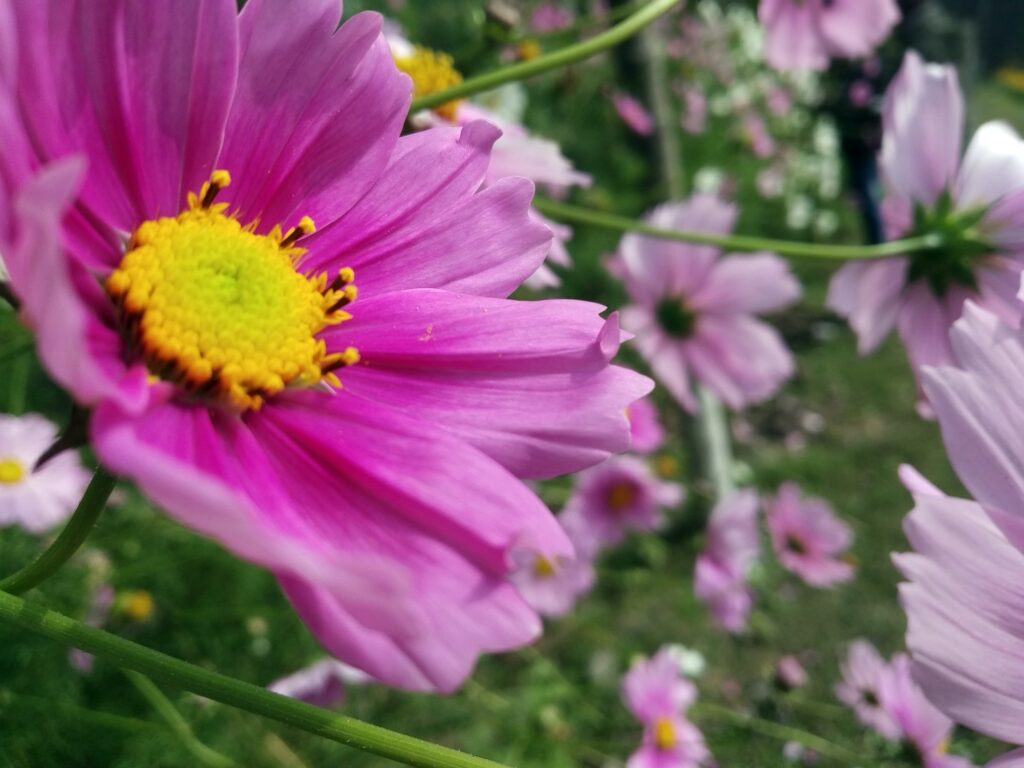
Cosmos ‘Radiance’ is a classic heirloom-style Cosmos bipinnatus cultivar with striking deep rose-pink flowers marked by a rich crimson-red eye around a bright yellow center. The two-tone pattern gives each flower considerably more depth than a solid pink cosmos while retaining the simple, open flower form that makes traditional garden cosmos so appealing.
This is not a modern compact variety. ‘Radiance’ is a tall, vigorous cosmos, generally reaching around 3 to 5 feet, with finely divided foliage and long branching stems that make it excellent for cottage gardens, pollinator plantings, meadow-style borders, and cutting gardens.
‘Radiance’ also has an unusually long history. It was an All-America Selections winner in 1948, when period seed catalogs promoted its dramatic combination of deep carmine-rose petals and a clearly defined crimson zone surrounding the center. More than three-quarters of a century later, the cultivar is still widely available from seed.
Its longevity makes sense. ‘Radiance’ is easy to grow, tolerates summer heat and relatively lean soil, attracts visiting pollinators, and can continue producing flowers from midsummer until frost when regularly harvested or deadheaded.
For gardeners building a collection of distinctive cosmos, ‘Radiance’ offers something many newer cultivars do not: a genuine vintage flower with decades of garden history behind it.
🌸 Cosmos Radiance Quick Guide
| Feature | Cosmos ‘Radiance’ |
|---|---|
| Botanical name | Cosmos bipinnatus ‘Radiance’ |
| Family | Asteraceae |
| Plant type | Annual |
| Flower color | Deep rose-pink with crimson-red eye |
| Flower center | Golden yellow |
| Flower form | Single |
| Flower size | About 3–4 inches |
| Typical height | About 3–5 feet |
| Bloom season | Summer until frost |
| Light | Full sun |
| Soil | Average to lean, well-drained soil |
| Water needs | Low to moderate once established |
| Indoor sowing | About 4–6 weeks before planting outside |
| Direct sowing | After danger of frost |
| Seed depth | About ⅛–¼ inch |
| Germination | Roughly 7–14 days under favorable conditions |
| Spacing | About 12–18 inches |
| Pinching | Helpful for branching |
| Deadheading | Recommended |
| Best uses | Cutting gardens, cottage gardens, pollinator gardens, borders |
| Seed type | Open-pollinated |
| Recognition | 1948 All-America Selections winner |
🌺 What Is Cosmos Radiance?
‘Radiance’ is a named cultivar of Cosmos bipinnatus, commonly called garden cosmos or Mexican aster.
The species produces the familiar feathery green foliage and open daisy-like flowers associated with cottage gardens and summer wildflower plantings.
What distinguishes ‘Radiance’ is its flower pattern.
Instead of a plain pink bloom, each flower generally has broad carmine-rose to deep rose-pink petals surrounding a much darker crimson zone.
Inside that crimson eye sits the yellow central disk.
The combination creates three distinct layers of color:
- Rose-pink outer petals
- Crimson-red central markings
- Golden-yellow center
Although the flower itself has a simple single form, the color pattern gives it much more visual complexity than a solid-color cosmos.
💗 What Color Is Cosmos Radiance?
The petals are best described as deep rose pink or carmine rose with a crimson eye.
Depending on light, flower age, and growing conditions, the outer petals may appear:
- Rose pink
- Deep pink
- Carmine pink
- Magenta-pink
- Pinkish red
Closer to the center, the coloring becomes noticeably darker.
That central ring may appear:
- Crimson
- Wine red
- Deep raspberry
- Burgundy-red
The yellow disk in the center provides a bright final contrast.
From a distance, a large planting can appear predominantly deep pink. Up close, the crimson eye becomes much more obvious.
🌸 What Does a Radiance Cosmos Flower Look Like?
‘Radiance’ produces classic single cosmos flowers, generally around 3 to 4 inches across.
Broad outer petals surround an exposed yellow disk.
The crimson coloring near the base of each petal joins visually with the neighboring petals to form a clear dark ring or eye.
This gives the flower a very different look from Cosmos Velouette, where burgundy and white appear in irregular stripes, or Cosmos Capriola, where white petals are marked with rosy edging and a dark center.
‘Radiance’ is more orderly.
Its bicolor pattern is concentrated toward the center while the outer portions of the petals remain rose pink.
🏆 Is Cosmos Radiance an Award-Winning Variety?
Yes.
‘Radiance’ was recognized by All-America Selections in 1948.
Historic seed catalogs from that period promoted it as a major new introduction within the large-flowered Sensation-type cosmos.
One 1948 description emphasized its combination of deep carmine-rose coloring and a well-defined crimson zone, along with vigorous growth and excellent cutting qualities.
That historical recognition is especially noteworthy because ‘Radiance’ is still sold today.
Many annual cultivars disappear from catalogs after only a few years.
A variety remaining in circulation for more than 75 years suggests that gardeners continue finding genuine value in it.
📜 A Vintage Cosmos From 1948
‘Radiance’ is an excellent choice for gardeners interested in heirloom-style flowers and historic garden varieties.
When it appeared in the late 1940s, the darker central color pattern was considered highly unusual.
Historic catalogs described ‘Radiance’ as part of the large-flowered Sensation cosmos group and emphasized its bicolor appearance.
That puts this cultivar into a very different category from recently introduced cosmos such as Cosmos Apricotta and Cosmos Xanthos.
Those varieties demonstrate what modern breeding has achieved.
‘Radiance’ demonstrates what gardeners were excited about generations ago—and why some older varieties never really disappear.
🌿 What Does the Plant Look Like?
The plant itself has the characteristic airy foliage of Cosmos bipinnatus.
Leaves are divided into narrow, thread-like segments that can look almost fern-like.
This fine foliage keeps even a tall mature plant from appearing heavy.
Above the foliage, branching stems carry individual flowers.
Because the stems are long and relatively slender, the blooms move gently in the wind.
A mature group of ‘Radiance’ can therefore create considerable height without forming the dense visual wall you might expect from another 4- or 5-foot annual.
📏 How Tall Does Cosmos Radiance Grow?
Expect approximately 3 to 5 feet.
Several current seed suppliers use this range, although individual plants may be somewhat shorter or taller.
Final height depends strongly on:
- Sun exposure
- Soil fertility
- Water
- Climate
- Growing-season length
- Plant spacing
Rich soil and abundant water can produce enormous cosmos.
That is not necessarily desirable.
Tall, heavily fed plants can become soft and floppy while producing more foliage than flowers.
For most garden planning, treat ‘Radiance’ as a tall background or cutting-garden cosmos rather than a compact bedding variety.
📐 How Wide Does Cosmos Radiance Grow?
A well-branched mature plant can spread considerably.
For ordinary garden planting, 12 to 18 inches between plants works well.
Plants given wider spacing can produce more lateral branches.
Closer spacing encourages more upright competition and may help plants form a dense floral display.
In a cutting garden, approximately 9 to 12 inches may be sufficient.
In a humid ornamental garden, slightly wider spacing can improve airflow.
🌿 Is Cosmos Radiance a Compact Variety?
No.
‘Radiance’ is almost the opposite of modern compact cosmos such as:
Those varieties generally remain around 2 feet tall.
Radiance may become twice that height.
Choose Radiance when you have room for a tall annual and want long stems, vertical movement, and a substantial cottage-garden presence.
For small patio pots or border fronts, a compact series will be easier.
📅 When Does Cosmos Radiance Bloom?
‘Radiance’ flowers during summer and fall, often continuing until frost.
Exact timing depends on when seeds are planted.
Direct-sown plants normally begin later than transplants started indoors.
In a warm climate with an early spring, flowers may begin by early or midsummer.
In shorter northern growing seasons, peak flowering may arrive somewhat later.
Once flowering begins, regular cutting and deadheading can keep the plant productive for many weeks.
⏱️ How Long Does Cosmos Radiance Take to Flower From Seed?
A practical expectation is roughly 75 to 90 days from seed to flowers, although weather and growing conditions can alter that schedule.
Some commercial seed references give maturity close to 90 days.
Warm soil, long sunny days, and healthy growth usually bring flowering sooner.
Cold spring weather delays development.
For earlier flowers, start a few plants indoors while direct sowing additional seed outside.
This can create a longer overall flowering season.
❄️ Is Cosmos Radiance an Annual?
Yes.
‘Radiance’ is an annual.
The plant completes its life cycle in one growing season.
It:
- Germinates.
- Develops foliage.
- Produces branches.
- Flowers.
- Forms seeds.
- Dies after frost.
There is no perennial crown or bulb to protect through winter.
New plants are grown from seed each year.
☀️ How Much Sun Does Cosmos Radiance Need?
Full sun is best.
Give the plants at least six hours of direct sunlight each day, preferably more.
Strong sunlight encourages:
- Abundant flowering
- Stronger stems
- Better branching
- Less stretching
Because ‘Radiance’ is already tall, growing it in too much shade can produce particularly weak plants.
Stems may stretch toward the light and become more likely to collapse in wind or rain.
🌱 Best Soil for Cosmos Radiance
Cosmos have a useful ability to perform well in ordinary and even relatively poor soils.
‘Radiance’ does not require heavily amended ground.
Choose soil that:
- Drains well
- Does not stay saturated
- Has low to moderate fertility
- Receives plenty of sunlight
Garden cosmos generally tolerate a broad range of soil types.
In fact, very rich soil may produce worse flowering than modest garden soil.
🚫 Don’t Overfertilize Cosmos Radiance
This is particularly important with a 3- to 5-foot cultivar.
Too much nitrogen can result in:
- Extremely tall growth
- Soft stems
- Huge amounts of foliage
- Delayed flowering
- Fewer flowers
- Plants that fall over
If your garden already grows ordinary annuals successfully, you may not need to fertilize Radiance at all.
A slightly lean planting bed is often preferable to rich vegetable-garden soil.
Cosmos are one of those flowers where restraint frequently produces better results.
💧 How Much Water Does Cosmos Radiance Need?
Water seeds and young seedlings consistently while they establish.
Mature plants become relatively tolerant of dry weather.
That does not mean they never need water.
During prolonged drought, deep watering helps maintain flower production.
Allow the soil surface to begin drying between waterings rather than keeping it constantly wet.
Overwatering can encourage excessive leafy growth and weaker stems.
🌡️ Is Cosmos Radiance Heat Tolerant?
Yes.
Radiance performs well in warm summer conditions.
Commercial seed suppliers commonly describe the cultivar as tolerant of heat and relatively dry soils once established.
During exceptionally hot weather, flowering may temporarily slow.
Maintain adequate moisture during serious drought, but avoid trying to compensate for heat by keeping the ground constantly saturated.
Healthy plants can continue flowering when more moderate conditions return.
🌱 Growing Cosmos Radiance From Seed
Radiance is very easy to grow from seed.
You have two basic options:
- Start seeds indoors.
- Direct sow in the garden.
Because cosmos germinate and grow quickly, direct sowing works particularly well.
Indoor sowing is useful when you want an earlier start to the season.
For a large garden, you can use both methods.
🪴 When to Start Radiance Cosmos Indoors
Start seeds approximately 4 to 6 weeks before your expected outdoor planting date.
Some growers use a slightly longer window, but cosmos do not benefit from being kept indoors for months.
They grow quickly.
Starting too early can produce seedlings that become:
- Leggy
- Root-bound
- Difficult to manage
- Too large for indoor lights
Aim for sturdy young transplants rather than enormous indoor plants.
🌱 Direct Sowing Cosmos Radiance
Direct sow after the danger of frost has passed.
The soil should be warming and spring weather reasonably settled.
Create a shallow furrow and sow the seeds lightly.
Maintain moisture until seedlings emerge.
Once seedlings are established, thin them to the desired spacing.
Direct-sown plants often develop sturdy root systems because they never experience transplanting.
📏 How Deep Should Radiance Cosmos Seeds Be Planted?
Seed suppliers generally recommend shallow sowing.
Approximately ⅛ to ¼ inch deep works well.
Cosmos seeds do not need to be buried deeply.
Press them into the soil and cover with only a fine layer.
Keep the surface moist until germination.
🌡️ How Long Does Radiance Seed Take to Germinate?
Under suitable warm conditions, expect germination in approximately 7 to 14 days.
Temperature strongly affects speed.
Cool soil can delay emergence.
Indoors, ordinary warm room temperatures combined with consistently moist seed-starting mix generally produce rapid germination.
Once seedlings emerge, strong light becomes essential.
💡 Preventing Leggy Radiance Seedlings
This is especially important because Radiance is naturally tall.
To produce sturdy transplants:
- Provide strong light immediately after germination.
- Avoid starting seeds excessively early.
- Do not overfertilize.
- Provide gentle air circulation.
- Avoid excessive warmth after emergence.
A tall cultivar grown under weak indoor light can become extremely stretched before planting time.
🌤️ Hardening Off Radiance Cosmos
Indoor-grown seedlings should be acclimated gradually before planting outside.
Over about a week, expose plants to progressively more:
- Sunlight
- Wind
- Outdoor temperature changes
Start in a sheltered position.
Increase outdoor exposure each day.
Once seedlings can tolerate a full day outside and frost danger has passed, transplant them into the garden.
📐 How Far Apart Should Cosmos Radiance Be Planted?
Approximately 12 to 18 inches apart works well in ornamental gardens.
Some seed suppliers suggest around 9 to 12 inches for denser plantings.
Closer spacing can be useful in a cutting garden.
Wider spacing can produce thicker stems and stronger individual branching.
In humid climates, the extra airflow provided by wider spacing may also reduce disease pressure.
✂️ Should You Pinch Cosmos Radiance?
Yes, particularly if you want a bushier plant with more cutting stems.
When plants are young and established, remove the central growing tip just above a healthy set of leaves.
The plant responds by developing lateral branches.
Pinching can provide:
- More flower stems
- Better branching
- A fuller shape
- Improved cutting production
Because ‘Radiance’ is naturally tall, pinching can also reduce dependence on one very long central stem.
🌿 Does Cosmos Radiance Need Staking?
It may.
Plants approaching 4 or 5 feet can become vulnerable to:
- Strong wind
- Heavy rain
- Thunderstorms
Support is particularly valuable in fertile soil where stems grow rapidly.
Possible methods include:
- Horizontal flower netting
- Bamboo stakes
- Garden twine
- Stakes surrounding a group of plants
Install support before the plants become tall and tangled.
🌬️ How to Keep Radiance Cosmos From Falling Over
Growing technique is just as important as stakes.
For stronger plants:
- Give them full sun.
- Avoid excessive nitrogen.
- Avoid excessive watering.
- Pinch young plants.
- Do not overcrowd them excessively.
- Add support in exposed sites.
Tall cosmos grown in partial shade and fertile soil may become impressive in size but frustratingly weak.
✂️ Should Cosmos Radiance Be Deadheaded?
Yes.
Removing spent flowers encourages continued blooming.
Cut faded stems back to a healthy branch rather than merely removing the dry flower head.
This encourages productive new growth lower on the plant.
If you harvest flowers frequently for bouquets, regular cutting automatically performs much of the deadheading.
Toward the end of the season, leave selected flower heads if you want to collect seed.
🌺 How to Get More Radiance Cosmos Flowers
For maximum flowering:
- Grow in full sun.
- Avoid rich fertilizer.
- Pinch young plants.
- Harvest flowers frequently.
- Deadhead faded flowers.
- Provide water during extended drought.
- Prevent all blooms from going to seed early.
Cosmos are classic cut-and-come-again annuals.
Removing flowers encourages the plant to keep producing additional blooms.
💐 Is Cosmos Radiance a Good Cut Flower?
Yes. Radiance has been valued as a cut flower since its introduction.
Historic descriptions emphasized its cutting qualities, and current seed suppliers continue recommending it for bouquets.
Its tall stems are a major advantage.
The flower color also works particularly well in arrangements because each bloom already contains multiple shades.
The rose-pink petals can coordinate with pale flowers, while the crimson center connects naturally with darker burgundy and red blooms.
✂️ When to Cut Cosmos Radiance
Harvest when flowers are just beginning to open rather than waiting until they have been fully expanded outdoors for days.
Cut during the cooler part of the morning or evening when plants are well hydrated.
Use clean snips and place stems into fresh water promptly.
For bouquets, remove foliage that would otherwise sit below the waterline.
Regular deep cutting encourages replacement stems from lower branches.
🏺 How Long Does Radiance Last in a Vase?
Freshly harvested cosmos generally provide approximately 5 to 9 days of vase life under good conditions.
Harvest stage matters.
Flowers cut as their petals begin opening generally last better than older flowers harvested at full maturity.
To improve vase life:
- Use a clean vase.
- Use fresh water.
- Remove underwater foliage.
- Change water regularly.
- Keep arrangements away from strong heat and direct indoor sunlight.
🐝 Does Cosmos Radiance Attract Pollinators?
Yes.
Its open flowers make the central disk accessible to visiting insects.
Radiance is commonly grown in pollinator gardens and may attract:
- Bees
- Butterflies
- Hoverflies
- Other beneficial insects
The open single flower form can be particularly useful compared with extremely dense double flowers where the central disk may be harder for insects to reach.
For best wildlife value, combine cosmos with other flowers that bloom at different times.
🦋 Radiance vs. Double Cosmos for Pollinators
Radiance maintains the simple open structure of traditional Cosmos bipinnatus.
That leaves its yellow central disk clearly exposed.
Very double cultivars such as Cosmos Double Click Rose Bon Bon provide much more decorative texture but can have less accessible centers.
You can easily grow both.
The combination provides different flower forms while increasing the ornamental diversity of the garden.
🌸 Cosmos Radiance vs. Cosmos Capriola
Cosmos Capriola is another bicolor cosmos, but the appearance is very different.
| Feature | Radiance | Capriola |
|---|---|---|
| Main color | Deep rose pink | Mostly white |
| Secondary color | Crimson-red eye | Rose-red edging and dark central markings |
| Height | About 3–5 ft. | About 24–30 in. |
| Flower form | Single | Primarily single |
| Best setting | Tall borders, cutting gardens | Smaller borders, containers |
| Overall effect | Rich and vibrant | Graphic and crisp |
Choose Radiance when you want height and deep pink color.
Choose Capriola for a shorter plant with stronger white contrast.
❤️ Cosmos Radiance vs. Cosmos Velouette
Cosmos Velouette is much darker and more unpredictable.
Velouette flowers vary from heavily burgundy to strongly white-striped.
Radiance has a more consistent pattern: rose-pink outer petals with a crimson eye.
Choose Radiance for a classic organized bicolor flower.
Choose Velouette for irregular striping and dramatic variation.
Both work beautifully in tall cutting gardens.
🍷 Cosmos Radiance vs. Cosmos Rubenza
Cosmos Rubenza shares Radiance’s rich red-pink palette but behaves very differently in color.
Rubenza begins dark cranberry or wine red and gradually fades to antique rose.
Radiance remains bicolored, with the darker pigment concentrated around the center.
Choose:
Radiance for distinct rose-and-crimson patterning.
Rubenza for flowers that visibly change color as they age.
Growing both together creates a particularly rich late-summer cosmos planting.
🍑 Cosmos Radiance vs. Cosmos Apricotta
Cosmos Apricotta sits at the softer end of the color spectrum.
Apricotta blends:
- Peach
- Apricot
- Blush
- Rose
Radiance provides stronger rose and crimson.
Both are tall enough to work well for cutting and can be planted together.
Apricotta softens the palette while Radiance provides the stronger accent.
🌸 Cosmos Radiance vs. Cosmos Sweet Sixteen
Cosmos Sweet Sixteen has pale pink-to-white flowers with darker edging and a decorative frilled center.
Radiance retains a simpler single form.
Sweet Sixteen is softer and more ornamental in structure.
Radiance is taller, bolder, and more traditional.
💛 Cosmos Radiance vs. Cosmos Xanthos
Cosmos Xanthos provides almost the opposite effect.
Xanthos is:
- Pale lemon yellow
- Compact
- Softly colored
Radiance is:
- Deep rose and crimson
- Tall
- Visually bold
Planting the two together creates dramatic light-and-dark contrast.
The yellow centers of Radiance also help visually connect the flowers to Xanthos.
🌸 Cosmos Radiance vs. Cosmos Sonata
Cosmos Sonata is much shorter.
Sonata generally stays around 18 to 24 inches tall and works well in patio containers.
Radiance may grow more than twice that height.
Choose Sonata for:
- Containers
- Small borders
- Compact growth
Choose Radiance for:
- Cutting gardens
- Background plantings
- Tall cottage borders
- Long stems
🌸 Cosmos Radiance vs. Cosmos Apollo
Cosmos Apollo is another compact option.
Apollo produces exceptionally large flowers on bushy plants usually around 2 feet tall.
Radiance is much taller and has a vintage bicolor flower pattern.
Apollo is easier in small gardens.
Radiance provides stronger vertical presence and longer cutting stems.
🤍 Radiance With White Flowers
White is one of the best companion colors.
Try:
- White cosmos
- White zinnias
- White snapdragons
- Ammi
- White dahlias
White makes the crimson center of Radiance appear particularly intense.
A border containing mostly white flowers with occasional Radiance plants creates a dramatic but elegant effect.
💗 Radiance With Pink Flowers
Pink produces a softer tonal garden.
Good companions include:
- Cosmos Sweet Sixteen
- Cosmos Double Click Rose Bon Bon
- Pink zinnias
- Pink dahlias
- Rose snapdragons
Use several shades of pink rather than trying to match Radiance exactly.
🍑 Radiance With Apricot and Peach
Warm peach softens the deep crimson eye.
Cosmos Apricotta is an especially useful companion.
You can also use:
- Peach zinnias
- Apricot snapdragons
- Blush dahlias
This combination works beautifully in vintage-style cutting gardens.
❤️ Radiance With Burgundy Flowers
For a richer dramatic palette, pair Radiance with:
- Cosmos Rubenza
- Cosmos Velouette
- Burgundy dahlias
- Dark amaranth
- Purple basil
- Crimson celosia
Add white flowers to keep the planting from becoming overwhelmingly dark.
💜 Radiance With Purple and Blue
Cool colors provide excellent contrast.
Consider:
- Blue salvia
- Purple verbena
- Bachelor’s buttons
- Purple basil
- Violet gomphrena
The rose-pink outer petals help bridge the transition between warm crimson and cool purple.
💛 Radiance With Yellow Flowers
Yellow repeats the flower’s own golden center.
Excellent options include:
- Cosmos Xanthos
- Yellow zinnias
- Coreopsis
- Black-eyed Susans
- Small sunflowers
The result is bright and cheerful rather than subtle.
🌿 Best Companion Plants for Cosmos Radiance
Useful companions include:
- Zinnias
- Dahlias
- Snapdragons
- Ammi
- Salvia
- Verbena
- Gomphrena
- Celosia
- Scabiosa
- Amaranth
- Ornamental grasses
Choose plants that enjoy full sun and reasonable drainage.
Because cosmos generally dislike heavy nitrogen feeding, avoid placing them where neighboring plants require constant fertilizer.
🏡 Cosmos Radiance in a Cottage Garden
Few settings suit Radiance better than a cottage garden.
Its height, feathery foliage, long stems, and simple flowers create the loose informal effect associated with traditional flower gardens.
Plant several plants together toward the middle or back of the border.
Let them mingle with:
- Dahlias
- Zinnias
- Snapdragons
- Coneflowers
- Salvias
- Verbena
A little movement and overlap looks more natural than rigid spacing.
🌺 Radiance in a Cutting Garden
Radiance is particularly valuable for cutting because of its height and long stems.
For productive plants:
- Grow in full sun.
- Space roughly 9–12 inches apart.
- Pinch while young.
- Add support before plants become tall.
- Harvest frequently.
- Deadhead anything you do not cut.
A small row can supply flowers repeatedly throughout summer.
The distinctive crimson eye gives even simple bouquets considerable visual interest.
🪴 Can Cosmos Radiance Grow in Containers?
Yes, but it is not the easiest cosmos for small pots.
A mature plant can reach 3 to 5 feet tall.
If you want to grow Radiance in a container, choose a large, heavy pot with excellent drainage.
You may also need a stake.
For ordinary patio containers, compact cultivars such as Cosmos Sonata, Cosmos Apollo, or Cosmos Xanthos are generally more convenient.
🌱 Is Cosmos Radiance Open-Pollinated?
Yes.
Current seed suppliers list Radiance as an open-pollinated cultivar.
That means the flowers can produce viable seed for gardeners who enjoy seed saving.
However, Cosmos bipinnatus cultivars growing together can cross-pollinate.
If several varieties are flowering nearby, seedlings raised from saved Radiance seed may not reproduce the exact parent pattern.
🌱 Does Cosmos Radiance Self-Seed?
Yes, it can.
Allow a few spent flowers to mature, and the plant can produce abundant seed.
Some seeds may fall and germinate the following season.
This can be useful in informal cottage gardens.
If you want the flower bed to remain carefully controlled, remove most seed heads before they scatter.
🌱 How to Save Cosmos Radiance Seeds
Toward the end of the growing season, stop deadheading several healthy flowers.
Allow their centers to mature.
The seeds become long, narrow, pointed, and dark.
Harvest them when dry but before they naturally fall.
Allow collected seed to dry thoroughly indoors.
Store it in a labeled paper envelope somewhere cool and dry.
Write:
Cosmos ‘Radiance’ — year collected
If other cosmos varieties grew nearby, note that as well.
🍂 What Happens to Cosmos Radiance After Frost?
A hard frost kills the plants.
Once the stems and foliage have died, remove them from the garden.
Healthy debris can usually be composted.
If you want self-sown plants, allow several seed heads to mature and scatter before cleanup.
There is no bulb, tuber, or perennial crown to overwinter.
🐌 Common Cosmos Radiance Pests
Garden cosmos are generally easy to grow, but possible pests include:
- Aphids
- Slugs
- Leafhoppers
- Caterpillars
Young seedlings are particularly vulnerable to slug damage.
Mature plants usually tolerate a modest amount of insect feeding.
Avoid unnecessary broad-spectrum pesticides when growing Radiance in a pollinator garden.
🦠 Common Cosmos Radiance Diseases
Potential diseases affecting Cosmos bipinnatus include:
- Powdery mildew
- Gray mold
- Stem canker
Disease pressure is more likely when plants are:
- Overcrowded
- Growing in shade
- Constantly wet
- Surrounded by poor airflow
Provide full sun, good drainage, and adequate spacing.
Those simple practices prevent many cosmos problems.
🌿 Why Is My Radiance Cosmos Huge but Not Flowering?
Excessive nitrogen is one of the most likely causes.
Cosmos can grow enormous in fertile soil while producing surprisingly few flowers.
Other possibilities include:
- Too little sunlight
- Excessive watering
- Young plant age
- Unusual temperature stress
Do not automatically apply fertilizer when flowers are slow to appear.
With cosmos, that can make the problem worse.
🌬️ Why Is My Cosmos Radiance Falling Over?
At 3 to 5 feet tall, Radiance can become vulnerable to wind.
Possible causes include:
- Strong storms
- Rich soil
- Excess nitrogen
- Too much water
- Partial shade
- Lack of support
Pinching young plants helps create better branching.
Installing horizontal support netting in a cutting garden is also effective.
🌸 Why Is My Radiance Mostly Pink?
That is normal.
The majority of each petal is typically deep rose or carmine pink.
The darker crimson coloring is concentrated around the flower center.
From a distance, the plant may therefore appear to be a solid deep-pink cosmos.
Move closer and the bicolor eye becomes much more obvious.
❤️ Why Is the Center So Dark?
The deep crimson ring is the defining characteristic of ‘Radiance’.
The zone is not disease, fading, or sun damage.
It is the cultivar’s natural pigmentation.
Historic descriptions specifically highlighted this sharply defined darker area when Radiance was introduced in 1948.
❓ Cosmos Radiance FAQ
What is Cosmos Radiance?
‘Radiance’ is a tall bicolor cultivar of Cosmos bipinnatus with deep rose-pink flowers and a crimson eye surrounding a yellow center.
What color is Cosmos Radiance?
The outer petals are rose pink or carmine rose, while the central zone is rich crimson.
Is Radiance a bicolor cosmos?
Yes. Its contrasting rose and crimson coloring is its defining feature.
How old is Cosmos Radiance?
The cultivar was already being introduced commercially in 1948.
Did Cosmos Radiance win an award?
Yes. It was recognized by All-America Selections in 1948.
How large are Radiance flowers?
Flowers generally reach around 3–4 inches across.
Are Radiance flowers single or double?
They are single flowers with open yellow centers.
How tall does Cosmos Radiance grow?
Approximately 3–5 feet is typical.
Is Radiance a dwarf cosmos?
No. It is a tall cultivar.
Is Cosmos Radiance an annual?
Yes.
When does Radiance bloom?
Expect flowering from summer into fall, continuing until frost when regularly deadheaded.
How long does Radiance take to flower from seed?
Roughly 75–90 days is a useful estimate.
Does Cosmos Radiance need full sun?
Yes. Full sun encourages the best flowering and sturdier growth.
What soil does Radiance need?
Average, well-drained soil is ideal. It can perform very well in relatively lean soil.
Does Radiance tolerate heat?
Yes. Established plants generally perform well in summer heat.
Is Cosmos Radiance drought tolerant?
Established plants tolerate short dry periods, although watering during extended drought helps maintain flowering.
Should Radiance be fertilized?
Usually very little fertilizer is necessary. Excess nitrogen can encourage foliage at the expense of flowers.
When should Radiance seeds be started indoors?
Approximately four to six weeks before planting outdoors works well.
Can Radiance be direct sown?
Yes. Sow after frost once the soil has warmed.
How deep should Radiance seed be planted?
Approximately ⅛–¼ inch deep.
How long does Radiance take to germinate?
Approximately 7–14 days under suitable warm conditions.
How far apart should Radiance plants be spaced?
About 12–18 inches works well in garden beds, with closer spacing possible for cutting.
Should Radiance cosmos be pinched?
Yes. Pinching can encourage additional branching and flower stems.
Does Radiance need staking?
Plants may benefit from support because they can grow several feet tall.
Should Cosmos Radiance be deadheaded?
Yes. Regular deadheading encourages prolonged flowering.
Is Radiance a good cut flower?
Yes. Long stems and dramatic bicolor flowers make it particularly useful for bouquets.
Does Radiance attract pollinators?
Yes. Its open flowers are accessible to bees, butterflies, and other flower-visiting insects.
Can Radiance grow in containers?
Yes, but use a large container because this is a tall cultivar.
Is Cosmos Radiance open-pollinated?
Yes.
Can I save Radiance seeds?
Yes, although nearby Cosmos bipinnatus cultivars may cross with it.
Does Radiance self-seed?
It can when mature seeds are allowed to fall.
What is the difference between Radiance and Velouette?
Radiance has a relatively consistent rose-pink flower with a dark crimson eye. Velouette has much more variable burgundy-and-white striping.
What is the difference between Radiance and Rubenza?
Radiance remains bicolored, while Rubenza begins dark cranberry and gradually fades to antique rose as the flower ages.
❤️ Is Cosmos Radiance Worth Growing?
Cosmos ‘Radiance’ is especially worth growing if you want a tall, old-fashioned cosmos with a richer color pattern than an ordinary solid pink flower.
Its combination of rose and crimson remains distinctive even after decades of plant breeding.
Modern cosmos have become increasingly elaborate. Gardeners can now choose pale-yellow Cosmos Xanthos, peach-toned Cosmos Apricotta, burgundy-striped Cosmos Velouette, color-changing Cosmos Rubenza, and fluffy Cosmos Double Click Rose Bon Bon.
Radiance comes from a much earlier generation.
Yet the flower still holds its own.
Broad rose-pink petals form a vivid frame around a crimson eye and yellow center. The plants grow tall enough for excellent cutting stems, the foliage remains light and feathery, and the open flowers fit naturally into cottage gardens and pollinator plantings.
The cultivar’s history gives it additional appeal. Radiance was already attracting national attention in 1948, and gardeners are still sowing the same named variety today.
Care could hardly be easier.
Plant it in full sun, avoid excessive fertilizer, water during prolonged dry periods, pinch young plants for branching, and provide support if summer storms are common. Once flowering begins, harvest and deadhead regularly.
For a flower that has survived more than 75 years of changing garden fashions, ‘Radiance’ still looks remarkably fresh.
🔗 Related Articles
- Cosmos Rubenza
- Cosmos Apricotta
- Cosmos Velouette
- Cosmos Xanthos
- Cosmos Apollo
- Cosmos Sonata
- Cosmos Capriola
- Cosmos Sweet Sixteen
- Cosmos Double Click Rose Bon Bon
- Cosmos Care
- Cosmos Flower Types
- Discover the Stunning Diversity of Cosmos Flower Varieties
📚 Sources & Further Reading
- All-America Selections — Award-Winning Garden Varieties
- University of Illinois Extension — Cosmos
- North Carolina Extension Gardener Plant Toolbox — Cosmos bipinnatus
- Royal Horticultural Society — Cosmos bipinnatus
- Applewood Seed Company — Cosmos ‘Radiance’
- Swallowtail Garden Seeds — Radiance Cosmos
- Urban Farmer — Radiance Cosmos
- Eden Brothers — Radiance Cosmos Seeds