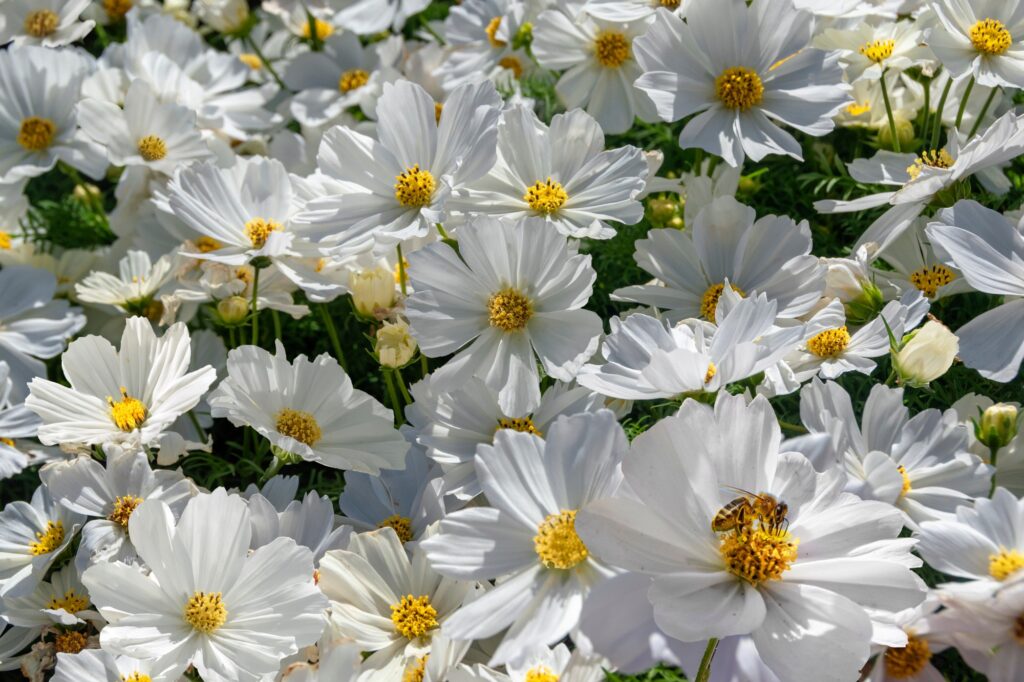
Cosmos ‘Sonata’ is a compact series of Cosmos bipinnatus developed for gardeners who love the airy foliage and daisy-like flowers of traditional cosmos but do not have room for plants that tower 4 or 5 feet above the garden.
Most modern Sonata cosmos grow to roughly 18 to 24 inches tall, making them excellent for flower beds, border fronts, cottage gardens, containers, pollinator plantings, and smaller cutting gardens. Their single flowers can reach around 3 inches across and appear in shades of white, pink, carmine, purple-pink, and red, all surrounding the familiar golden-yellow cosmos center.
Unlike many dwarf annuals, Sonata cosmos still retain the graceful appearance that makes Cosmos bipinnatus so appealing. The finely divided foliage remains light and feathery, while the flowers rise above it on branching stems.
The Sonata name actually refers to a series rather than one single flower color. Depending on the seed or plant supplier, you may encounter Sonata White, Sonata Pink, Sonata Pink Blush, Sonata Carmine, Sonata Purple Shades, Sonata Red Shades, or a mixed selection containing several colors.
For gardeners who want a cosmos that fits easily into a smaller landscape without sacrificing flower size, Sonata is one of the most useful series available.
🌸 Cosmos Sonata Quick Guide
| Feature | Cosmos Sonata Series |
|---|---|
| Botanical name | Cosmos bipinnatus Sonata Series |
| Family | Asteraceae |
| Plant type | Tender annual |
| Typical height | About 18–24 inches |
| Typical spread | About 12–14 inches |
| Flower size | Up to about 3 inches |
| Flower form | Single, daisy-like |
| Colors | White, pink, blush, carmine, purple-pink, red |
| Flower center | Golden yellow |
| Bloom season | Summer through fall |
| Light | Full sun |
| Soil | Average, well-drained soil |
| Indoor sowing | About 4–6 weeks before planting outdoors |
| Direct sowing | After frost once soil has warmed |
| Seed depth | About ⅛ inch indoors; cover lightly outdoors |
| Germination | About 7–15 days under warm conditions |
| Spacing | About 12–16 inches |
| Deadheading | Recommended |
| Best uses | Borders, containers, cottage gardens, cutting gardens, pollinator plantings |
🌺 What Is Cosmos Sonata?
Sonata is a compact series of Cosmos bipinnatus, the species commonly known as garden cosmos or Mexican aster.
Traditional Cosmos bipinnatus can become surprisingly tall. Many older varieties grow 3 to 5 feet high, and some can exceed that under rich growing conditions.
The Sonata series was selected for a much shorter, more manageable habit.
PanAmerican Seed, the commercial breeder and supplier of the modern Sonata series, lists plants at approximately 24 inches tall and 12 to 14 inches wide. Other horticultural references give a somewhat broader range, which is normal because climate, soil fertility, water, and growing conditions all influence cosmos height.
The result is essentially a full-sized cosmos flower carried on a considerably shorter plant.
That makes Sonata particularly useful where tall traditional cosmos would overwhelm neighboring plants.
🌿 What Does Cosmos Sonata Look Like?
The foliage looks much like other garden cosmos.
Leaves are divided into extremely narrow segments, producing a fine, feathery texture.
From that light green foliage rise branching stems carrying open daisy-like flower heads.
Each flower generally consists of a ring of broad ray florets surrounding a yellow central disk.
The single flower form is simple compared with densely double varieties such as Cosmos Double Click Rose Bon Bon, but that simplicity is one of Sonata’s strengths.
The open centers are attractive, easy to combine with other flowers, and accessible to visiting pollinating insects.
🎨 What Colors Does Cosmos Sonata Come In?
The modern Sonata series includes several colors.
Depending on availability, you may find:
- Sonata White
- Sonata Pink
- Sonata Pink Blush
- Sonata Carmine
- Sonata Purple Shades
- Sonata Red Shades
- Sonata Complete Mixture
Older seed catalogs and regional suppliers may offer slightly different combinations or simply sell Sonata Mixed.
This can create confusion if you search for “Cosmos Sonata” expecting one particular flower color.
Sonata is the name of the compact series.
The color name identifies the individual selection.
🤍 Cosmos Sonata White
Sonata White produces crisp white petals surrounding a golden-yellow center.
It is one of the most versatile members of the series.
White cosmos work beautifully with almost any summer color palette and are particularly effective with:
- Burgundy dahlias
- Pink zinnias
- Blue salvia
- Purple verbena
- Red cosmos
- Ornamental grasses
Because Sonata plants remain relatively compact, White can also be used along the front or middle of a border where taller white cosmos would become too dominant.
A group of Sonata White can create an elegant, airy effect without requiring a huge planting area.
💗 Cosmos Sonata Pink
Sonata Pink brings the classic pink color associated with garden cosmos to the shorter Sonata habit.
The petals are generally medium pink around a golden center.
Pink Sonata works particularly well in cottage gardens, where its soft color combines naturally with:
- White flowers
- Purple salvias
- Blue annuals
- Pink dahlias
- Zinnias
- Snapdragons
For gardeners who want a traditional pink cosmos but do not want a 4-foot plant, Sonata Pink is an excellent compromise.
🌸 Cosmos Sonata Pink Blush
Sonata Pink Blush offers a softer color effect.
The flowers combine pale pink and blush tones rather than the stronger color of Sonata Pink or Carmine.
It works particularly well in pastel borders and romantic cutting gardens.
Pair it with:
- White cosmos
- Pale pink zinnias
- White snapdragons
- Lavender flowers
- Silvery foliage
Pink Blush is especially useful when a strong magenta or red flower would overwhelm a softer planting scheme.
❤️ Cosmos Sonata Carmine
Sonata Carmine produces deeper rosy-red to carmine flowers with yellow centers.
It adds more intensity to the series while preserving the same compact habit.
Carmine works beautifully with white Sonata flowers because the plants share similar growth habits and flower heights.
It can also be paired with deep burgundy flowers for a richer summer palette.
Compared with Cosmos Velouette, which combines crimson with dramatic white streaking, Sonata Carmine provides a cleaner solid-color effect.
💜 Cosmos Sonata Purple Shades
Sonata Purple Shades extends the series into deeper rosy-purple and magenta tones.
PanAmerican Seed currently lists it as part of the Sonata collection, with plants around 24 inches tall and 12 to 14 inches wide.
The flowers remain open and daisy-like rather than double.
Purple Shades is especially useful with:
- White flowers
- Pale pink cosmos
- Blue salvia
- Silver foliage
- Dark-leaved plants
Despite the name, expect colors in the purple-pink or magenta spectrum rather than a true blue-purple.
❤️ Cosmos Sonata Red Shades
Sonata Red Shades is one of the newer additions to the series.
It brings brighter red coloring to a group historically dominated by white, pink, and carmine shades.
The plants maintain the compact Sonata habit, making Red Shades useful where a full-sized red cosmos would be too tall.
Red flowers can be particularly effective in containers because they remain highly visible from a distance.
Pair them with Sonata White for a crisp contrast or with Pink Blush for a softer red-to-pink progression.
🎨 Cosmos Sonata Complete Mixture
The Sonata Complete Mixture is the easiest choice when you want several Sonata colors without purchasing separate seed packets.
Modern mixtures can include a broad range of the series, potentially combining:
- White
- Pink
- Pink Blush
- Carmine
- Purple Shades
- Red Shades
The result is a compact multicolored cosmos planting with plants that remain relatively similar in height.
That makes the mix especially useful for:
- Large containers
- Mass plantings
- Cottage gardens
- Pollinator beds
- Informal borders
Unlike mixtures made from unrelated varieties, the Sonata colors generally share the same basic plant habit.
📏 How Tall Does Cosmos Sonata Grow?
Most modern Sonata plants grow approximately 24 inches tall.
Some horticultural references describe the series as shorter, particularly under certain growing conditions, while University of Illinois Extension places Sonata within a roughly 12- to 24-inch range.
For practical garden planning, expect about 18 to 24 inches, with 24 inches a good working estimate for healthy modern Sonata plants.
Height can increase when plants receive:
- Excessive nitrogen fertilizer
- Extremely rich soil
- Too much water
- Partial shade
Plants growing under leaner, sunnier conditions often remain more compact.
📐 How Wide Does Sonata Cosmos Grow?
PanAmerican Seed lists Sonata at approximately 12 to 14 inches wide.
Spacing plants roughly 12 to 16 inches apart gives them room to branch while still creating a full display.
For containers, one plant can fill a modest pot surprisingly well once it begins branching.
Several plants can be grouped in a larger patio container, but avoid packing them so tightly that airflow disappears.
🌸 How Large Are Sonata Cosmos Flowers?
The flowers are large relative to the compact plant.
The RHS describes Sonata flowers as approximately 8 centimeters across, or a little over 3 inches.
This is one reason the series works so well.
The plant may be substantially shorter than traditional cosmos, but the flowers do not look miniature.
Instead, the large blooms sit prominently above relatively compact foliage.
📅 When Does Cosmos Sonata Bloom?
Sonata flowers through the warm growing season.
For most home gardeners, expect blooms from summer into fall, continuing until frost if plants are regularly deadheaded.
PanAmerican Seed describes the series as capable of flowering from spring through late summer in professional production systems, where plants may be started earlier under controlled conditions.
In ordinary outdoor gardens, timing depends on:
- Local frost dates
- Sowing date
- Temperature
- Sunlight
- Growing-season length
Plants started indoors can generally flower earlier than those direct sown after frost.
❄️ Is Cosmos Sonata an Annual?
Yes.
Sonata cosmos is a tender annual.
It grows, flowers, produces seed, and dies within a single growing season.
Frost usually ends the plant.
There is no perennial root system to overwinter.
Cosmos can self-seed, however, so volunteer seedlings may appear the following year if mature seed heads are allowed to remain.
Seedlings arising naturally may show some variation rather than reproducing every feature of the original selected color.
☀️ How Much Sun Does Cosmos Sonata Need?
Grow Sonata in full sun.
At least six hours of direct sunlight is ideal.
Full sun encourages:
- Compact growth
- Strong branching
- More flowers
- Sturdier stems
Too much shade can cause even a compact cultivar to stretch.
Plants may become taller, thinner, and less floriferous.
A sunny patio, front border, raised bed, cottage garden, or cutting garden is ideal.
🌱 Best Soil for Cosmos Sonata
Like other Cosmos bipinnatus, Sonata does not need rich soil.
University of Illinois Extension recommends well-drained soil with relatively low fertility for garden cosmos.
Average garden soil is usually enough.
Cosmos can perform in:
- Sandy soil
- Loam
- Clay that drains adequately
- Moderately poor soil
The most important requirement is drainage.
Constantly wet ground is not ideal.
🚫 Don’t Overfertilize Sonata Cosmos
Compact growth does not mean Sonata needs extra fertilizer.
In fact, heavy feeding can work against the qualities that make the series useful.
Excess nitrogen can cause:
- Taller plants
- Excess foliage
- Softer stems
- Delayed flowering
- Fewer blooms
University of Illinois Extension specifically warns that overfertilizing cosmos can reduce flower production.
If your garden already grows annual flowers successfully, Sonata may require little or no added fertilizer.
💧 How Much Water Does Sonata Cosmos Need?
Keep seedlings and new transplants consistently moist until established.
Afterward, allow the upper soil to begin drying between deeper waterings.
Established cosmos tolerate occasional dryness reasonably well.
Avoid keeping the ground constantly saturated.
Too much water can encourage leafy growth and reduce flowering, just as excessive fertilizer can.
Plants in containers need more attention because potting mix dries rapidly during hot summer weather.
🌱 Growing Cosmos Sonata From Seed
Sonata is easily grown from seed.
You can either:
- Start seeds indoors before your final frost, or
- Direct sow them outdoors after frost
Both approaches work.
Indoor starting provides a head start.
Direct sowing eliminates transplanting and takes advantage of the naturally rapid growth of cosmos.
Because Sonata is compact and commercially used for container production, it is also easy to start in small individual cells or pots.
🪴 When to Start Sonata Cosmos Indoors
Start Sonata approximately 4 to 6 weeks before you expect to plant outdoors.
Professional Sonata production uses a plug stage of roughly four to five weeks, which fits well with this home-garden schedule.
There is little reason to start cosmos months in advance.
They grow rapidly.
Starting too early can leave you with root-bound or overly tall seedlings before outdoor temperatures are safe.
🌡️ Cosmos Sonata Germination
For Sonata seed, temperatures around 64–77°F work well.
Thompson & Morgan reports germination in approximately 7 to 15 days under suitable conditions.
Keep the seed-starting medium damp but not waterlogged.
Provide strong light once seedlings emerge.
Cosmos seedlings stretch quickly when grown in warm rooms without sufficient light.
📏 How Deep Should Sonata Cosmos Seeds Be Planted?
When starting indoors, sow Sonata seeds approximately ⅛ inch deep.
They need only a thin covering of seed-starting mix or vermiculite.
Light can assist germination, so avoid burying them deeply.
For direct sowing outdoors, cover seeds lightly.
The goal is good contact with moist soil without placing the seed far below the surface.
🌱 Direct Sowing Cosmos Sonata
Sonata can also be sown directly into its final garden location.
Wait until:
- Frost danger has passed
- The soil has warmed
- Spring weather has become reasonably settled
North Carolina Extension recommends waiting until soil reaches around 65°F for Cosmos bipinnatus.
Sow shallowly and keep the seedbed moist until seedlings emerge.
Thin crowded seedlings rather than allowing every seedling to mature on top of its neighbors.
📐 How Far Apart Should Cosmos Sonata Be Planted?
PanAmerican Seed recommends approximately 12 to 16 inches between Sonata plants.
That spacing works particularly well in ornamental beds and containers.
Closer spacing can create a denser display, while wider spacing improves airflow and allows individual plants to develop more fully.
Because Sonata remains shorter than traditional cosmos, it does not require the enormous amount of space some tall varieties eventually occupy.
✂️ Should Cosmos Sonata Be Pinched?
You can pinch Sonata, but it is less essential than with tall cutting varieties.
The series naturally develops a relatively compact, branching habit.
Pinching the growing tip can still encourage additional side shoots and create a fuller plant.
It is particularly useful if you want:
- More branching
- Additional flowers
- More cut stems
If you purchase a nursery-grown Sonata plant that is already well branched, additional pinching may not be necessary.
🌿 Does Cosmos Sonata Need Staking?
Usually not.
This is one of Sonata’s major advantages over tall cosmos.
Traditional Cosmos bipinnatus cultivars may require support where summer storms and wind are common.
At around 2 feet tall, Sonata is much less likely to collapse.
University of Illinois Extension notes that taller cosmos may need support, but Sonata’s compact habit largely avoids that problem.
Extremely lush plants grown in rich soil or heavy shade can still flop, so appropriate growing conditions remain important.
🌬️ Is Sonata Good for Windy Gardens?
Sonata is a much better choice for exposed sites than many 4-foot cosmos varieties.
Its shorter stems experience less leverage in strong wind.
Thompson & Morgan specifically describes Sonata Mixed as useful for exposed positions because of its compact form and strong stems.
That does not make the plants indestructible.
Severe thunderstorms can damage almost any flowering annual, but Sonata generally requires much less staking and tying than tall cosmos.
🌺 How to Get More Sonata Cosmos Flowers
The basic formula is simple:
- Grow plants in full sun.
- Avoid excessive fertilizer.
- Avoid excessive water.
- Deadhead fading blooms.
- Cut flowers regularly.
- Keep mature seed production from taking over too early.
Cosmos are classic cut-and-come-again annuals.
The more flowers you harvest, the more incentive the plant has to produce additional blooms.
✂️ Should Cosmos Sonata Be Deadheaded?
Yes.
Deadheading helps keep Sonata flowering throughout summer.
University of Illinois Extension recommends removing spent cosmos blooms for continued flowering.
Instead of removing only the dead flower head, follow its stem down to a healthy leaf or branching point and make your cut there.
This keeps the plant neat and encourages stronger replacement growth.
Toward the end of the season, leave several flowers if you want to collect seed.
💐 Is Cosmos Sonata a Good Cut Flower?
Yes, although its compact stature produces shorter stems than tall cutting cultivars.
The Sonata series is still recognized as useful for bouquets, and Thompson & Morgan describes its strong stems as suitable for cutting.
Sonata works especially well for:
- Small bouquets
- Mason-jar arrangements
- Informal cottage arrangements
- Table flowers
If your primary goal is extremely long florist stems, a taller cosmos such as Versailles or Double Click may be more suitable.
If you want flowers that work both in the landscape and in casual bouquets, Sonata is excellent.
✂️ When Should Sonata Cosmos Be Cut?
Harvest when petals are beginning to open but before the flower has been fully expanded for several days.
Cut during the cooler part of the morning or evening.
Place stems in clean water promptly.
Harvesting frequently accomplishes two jobs at once:
You get fresh flowers for the house, and the plant is encouraged to keep producing more.
🪴 Is Cosmos Sonata Good for Containers?
Containers are one of the best uses for Sonata cosmos.
PanAmerican Seed specifically recommends the series for pot production.
Its compact dimensions make it much easier to manage than tall Cosmos bipinnatus cultivars.
Use a container with:
- Drainage holes
- Quality potting mix
- Full sun
- Enough volume to prevent rapid drying
A single Sonata can make an attractive specimen in a smaller container, while several can fill a larger patio pot.
Mixed Sonata colors create a particularly easy summer container display.
🌸 Growing Sonata Cosmos Along a Border
Sonata is also ideal for the front or middle of a flower bed.
Traditional cosmos are often placed at the back because of their height.
Sonata can be placed much closer to paths and lawn edges.
Its relatively low foliage does not hide plants behind it.
Try alternating several Sonata colors or planting blocks of one shade.
White and Carmine provide particularly strong contrast.
🏡 Sonata Cosmos in a Cottage Garden
Although compact, Sonata still retains the loose informal appearance associated with traditional cosmos.
It combines beautifully with:
- Zinnias
- Snapdragons
- Salvias
- Verbena
- Coreopsis
- Black-eyed Susans
- Coneflowers
- Small dahlias
The fine foliage is especially useful beside plants with broad or coarse leaves.
Avoid lining Sonata up too rigidly if you want a true cottage-garden effect.
Loose groups look much more natural.
🐝 Does Cosmos Sonata Attract Pollinators?
Yes.
The RHS includes the Sonata series among its Plants for Pollinators.
The open single flowers expose their central disk florets, providing easy access for visiting insects.
Cosmos can attract:
- Bees
- Butterflies
- Hoverflies
- Other flower-visiting insects
This is one advantage Sonata has over some extremely double cultivars, where extra petals can make the flower center harder to reach.
For a strong pollinator garden, combine Sonata with other species that flower before and after it.
🦋 Sonata vs. Double Cosmos for Pollinators
A single Sonata flower has a clearly exposed yellow center.
That makes its floral resources relatively easy for visiting insects to access.
Highly double cosmos can still be beautiful and useful ornamental plants, but their extra petals sometimes reduce access to the central disk.
A mixed garden can easily contain both.
For example, combining Sonata with Cosmos Double Click Rose Bon Bon provides both simple pollinator-friendly flowers and dramatic double blooms.
🌸 Cosmos Sonata vs. Cosmos Capriola
Cosmos Capriola is another compact Cosmos bipinnatus, but its flowers are much more dramatically patterned.
| Feature | Sonata | Capriola |
|---|---|---|
| Typical height | About 18–24 in. | About 24–30 in. |
| Flower form | Single | Primarily single |
| Colors | White, pink, red, carmine, purple shades | White with rose-red and dark red markings |
| Pattern | Mostly solid colors | Strong bicolor pattern |
| Container use | Excellent | Excellent |
| Overall effect | Classic and uniform | Graphic and unusual |
Choose Sonata for a clean traditional cosmos look on a compact plant.
Choose Capriola when you want dramatic markings.
🌸 Cosmos Sonata vs. Cosmos Sweet Sixteen
Cosmos Sweet Sixteen is generally taller and has a much more elaborate flower.
Sweet Sixteen produces pale pink-to-white flowers with darker edging and a frilled center.
Sonata produces simpler single blooms.
Sonata is therefore better for gardeners who want:
- A shorter plant
- Simple open flowers
- Containers
- Consistent blocks of color
Sweet Sixteen is more appropriate when flower pattern and texture are the main priorities.
❤️ Cosmos Sonata vs. Cosmos Velouette
Cosmos Velouette is noticeably taller and dramatically patterned in burgundy-red and white.
Sonata is much more restrained.
Choose Sonata for compact, relatively uniform plants in classic solid colors.
Choose Velouette for variable striped flowers and a taller cutting-garden habit.
The two can also be used together, with Sonata White creating an attractive foreground for the dark flowers of Velouette.
🌹 Cosmos Sonata vs. Double Click Rose Bon Bon
Cosmos Double Click Rose Bon Bon represents almost the opposite end of the Cosmos bipinnatus spectrum.
Rose Bon Bon is tall, rose pink, and densely semi-double to double.
Sonata is short, open-centered, and single-flowered.
| Feature | Sonata | Double Click Rose Bon Bon |
|---|---|---|
| Height | About 18–24 in. | About 3–4 ft. |
| Flower form | Single | Semi-double to fully double |
| Colors | Several | Rose pink |
| Staking | Rarely needed | May benefit from support |
| Containers | Excellent | Requires a large pot |
| Pollinator access | Very good | More variable |
Growing both demonstrates how different two cultivars of the same species can look.
🪴 Best Sonata Cosmos for Containers
All members of the series can be grown in pots.
Your choice can simply depend on color.
Sonata White
Excellent for elegant or moon-garden-inspired containers.
Sonata Pink Blush
Ideal for pastel arrangements.
Sonata Carmine
Provides stronger contrast and richer color.
Sonata Red Shades
Best when you want a bright focal point.
Sonata Complete Mixture
The easiest choice for a colorful informal container.
Because their height is similar, different Sonata colors combine naturally in the same large pot.
🌱 Does Cosmos Sonata Self-Seed?
It can.
Like other Cosmos bipinnatus, Sonata can produce abundant seed if flowers are allowed to mature.
Those seeds may germinate naturally the following season.
However, offspring grown from saved or naturally scattered seed may not reproduce the exact color or compact habit of the parent plant, particularly where multiple cosmos cultivars were growing nearby.
For a predictable Sonata planting, fresh commercially produced seed is the safest choice.
🌱 How to Save Cosmos Sonata Seeds
Stop deadheading several healthy flowers toward the end of the season.
Allow the flower heads to dry.
Mature cosmos seeds are long, narrow, and dark.
Collect them before they naturally scatter.
Allow harvested seed to dry thoroughly indoors before storing it in a labeled paper envelope.
Include:
- Sonata color or mixture
- Collection year
- Notes about other nearby cosmos
If different Cosmos bipinnatus cultivars were flowering nearby, expect some surprises from saved seed.
🍂 What Happens to Sonata After Frost?
Frost kills Sonata cosmos.
Once plants have been damaged by freezing temperatures, remove them from containers or garden beds.
Healthy plant material can usually be composted.
If you want volunteers next year, allow some seed heads to mature before cleanup.
There is no need to protect the root system through winter because Sonata is an annual.
🐌 Common Cosmos Sonata Pests
Potential cosmos pests include:
- Aphids
- Caterpillars
- Leafhoppers
- Slugs around young seedlings
Healthy established plants generally tolerate minor insect damage.
Slugs can be more serious when seedlings first emerge because one night of feeding can remove much of a tiny plant.
Inspect new seedlings regularly during wet spring weather.
Avoid unnecessary broad-spectrum insecticides if you are growing Sonata partly for pollinators.
🦠 Common Cosmos Sonata Diseases
Potential problems include:
- Powdery mildew
- Gray mold
- Stem canker
- Wilting diseases
Most are less troublesome when plants receive:
- Full sun
- Good airflow
- Appropriate spacing
- Well-drained soil
- Moderate rather than excessive water
Compact plants still need airflow.
Do not pack containers or beds so tightly that leaves remain constantly damp.
🌿 Why Is My Sonata Cosmos Tall and Leafy?
The most likely causes are:
- Too much nitrogen fertilizer
- Very rich soil
- Too much water
- Insufficient sunlight
Sonata is genetically compact, but environmental conditions can still stretch the plants.
Do not add fertilizer simply because flowers are slow to appear.
Cosmos frequently flower better when grown a little lean.
🌸 Why Isn’t My Sonata Cosmos Flowering?
Possible causes include:
Excess Fertility
Too much nitrogen encourages stems and leaves rather than flowers.
Too Little Sun
Cosmos flower best in full sun.
Excessive Water
Constant irrigation can produce overly lush growth.
Plant Age
Young plants may simply need more time.
Extreme Weather
Very unusual heat, cool weather, or other stress can temporarily slow flower development.
Correct the growing environment rather than immediately reaching for fertilizer.
🌬️ Why Is My Sonata Cosmos Falling Over?
Sonata is less prone to lodging than tall cosmos, but it can still become floppy when grown in overly rich soil or partial shade.
Strong thunderstorms can also flatten plants.
If plants repeatedly become too tall:
- Reduce fertilizer.
- Make sure they receive full sun.
- Avoid excessive irrigation.
- Increase spacing slightly.
In very exposed areas, a small support ring can help.
❓ Cosmos Sonata FAQ
What is Cosmos Sonata?
Sonata is a compact series of Cosmos bipinnatus with large single flowers on plants typically around 18–24 inches tall.
Is Sonata one cosmos variety or a series?
It is a series containing several color selections.
What colors does Cosmos Sonata come in?
Current Sonata offerings include White, Pink, Pink Blush, Carmine, Purple Shades, Red Shades, and mixed selections.
How tall does Cosmos Sonata grow?
Approximately 18–24 inches is a useful garden estimate, with modern commercial Sonata plants commonly listed around 24 inches.
How wide does Sonata grow?
Approximately 12–14 inches is typical.
How large are Sonata flowers?
They can reach around 3 inches across.
Is Cosmos Sonata a dwarf variety?
It is generally considered compact or dwarf compared with traditional tall Cosmos bipinnatus.
Is Sonata cosmos an annual?
Yes. Frost kills the plants at the end of the season.
When does Sonata bloom?
Expect flowers through summer into fall, often continuing until frost when deadheaded.
Does Cosmos Sonata need full sun?
Yes. Full sun promotes the strongest flowering and most compact growth.
What soil does Sonata need?
Average, well-drained soil is ideal.
Should Sonata cosmos be fertilized?
Usually very little fertilizer is necessary. Excess nitrogen can reduce flowering.
When should Sonata seeds be started indoors?
About four to six weeks before outdoor planting is sufficient.
How deep should Sonata seeds be planted?
Approximately ⅛ inch indoors, with only a light covering when direct sown.
How long does Sonata take to germinate?
Approximately 7–15 days under suitable warm conditions.
Can Sonata be direct sown?
Yes. Sow after frost danger has passed and the soil has warmed.
How far apart should Sonata cosmos be planted?
Approximately 12–16 inches apart works well.
Should Sonata cosmos be pinched?
It can be pinched for additional branching, although its naturally compact habit makes pinching less important than with tall varieties.
Does Sonata need staking?
Usually not.
Is Sonata good for windy gardens?
Its shorter growth and stronger stems make it better suited to exposed conditions than many tall cosmos.
Should Sonata be deadheaded?
Yes. Deadheading encourages continued flowering.
Is Sonata a good cut flower?
Yes, particularly for smaller arrangements, although its stems are shorter than those of tall cutting cultivars.
Is Cosmos Sonata good for containers?
Yes. Container production is one of the series’ major strengths.
Does Sonata attract pollinators?
Yes. The RHS includes the Sonata series among plants useful to pollinating insects.
Does Sonata self-seed?
It can if mature flowers are allowed to produce seed.
Can I save Sonata seed?
Yes, but seedlings may vary from the named parent, especially when other cosmos cultivars grow nearby.
What is the difference between Sonata and regular cosmos?
Sonata is considerably shorter and more compact while still producing relatively large traditional single cosmos flowers.
🌸 Is Cosmos Sonata Worth Growing?
Cosmos Sonata is one of the best choices for gardeners who love traditional cosmos but do not want enormous plants.
That simple difference opens up many possibilities.
A traditional 4-foot cosmos may be too large for a patio container, the front of a border, or a small urban flower bed. Sonata provides the same feathery foliage and broad daisy-like flowers on a plant roughly half that height.
The range of colors makes the series even more useful. White provides a clean neutral flower, Pink and Pink Blush create softer combinations, Carmine and Red Shades add stronger color, and Purple Shades introduces richer magenta-purple tones. A mixed packet can provide all of those effects in one compact planting.
Care is also straightforward.
Give Sonata full sun, average well-drained soil, moderate water, and very little fertilizer. Deadhead faded flowers regularly or cut them for small bouquets, and the plants can continue flowering through summer and into fall.
Within a larger cosmos collection, Sonata fills a useful role. Cosmos Capriola offers dramatic markings. Cosmos Sweet Sixteen provides an unusual frilled center. Cosmos Velouette brings burgundy-and-white streaking, while Cosmos Double Click Rose Bon Bon produces tall, fluffy double blooms.
Sonata is the practical compact choice.
It gives you the classic cosmos look without requiring a tall stake, an enormous border, or a large cutting garden—which makes it one of the easiest Cosmos bipinnatus groups to fit almost anywhere.
🔗 Related Articles
- Cosmos Capriola
- Cosmos Sweet Sixteen
- Cosmos Velouette
- Cosmos Double Click Rose Bon Bon
- Cosmos Care
- Cosmos Flower Types
- Cosmos Flower Season
- Discover the Stunning Diversity of Cosmos Flower Varieties
📚 Sources & Further Reading
- PanAmerican Seed — Cosmos Sonata Purple Shades
- PanAmerican Seed — Cosmos Sonata Carmine
- Royal Horticultural Society — Cosmos bipinnatus Sonata Series
- Royal Horticultural Society — Cosmos
- University of Illinois Extension — Cosmos
- North Carolina Extension Gardener Plant Toolbox — Cosmos bipinnatus
- Thompson & Morgan — Cosmos bipinnatus Sonata Series Mixed
- Johnny’s Selected Seeds — Growing Cosmos From Seed