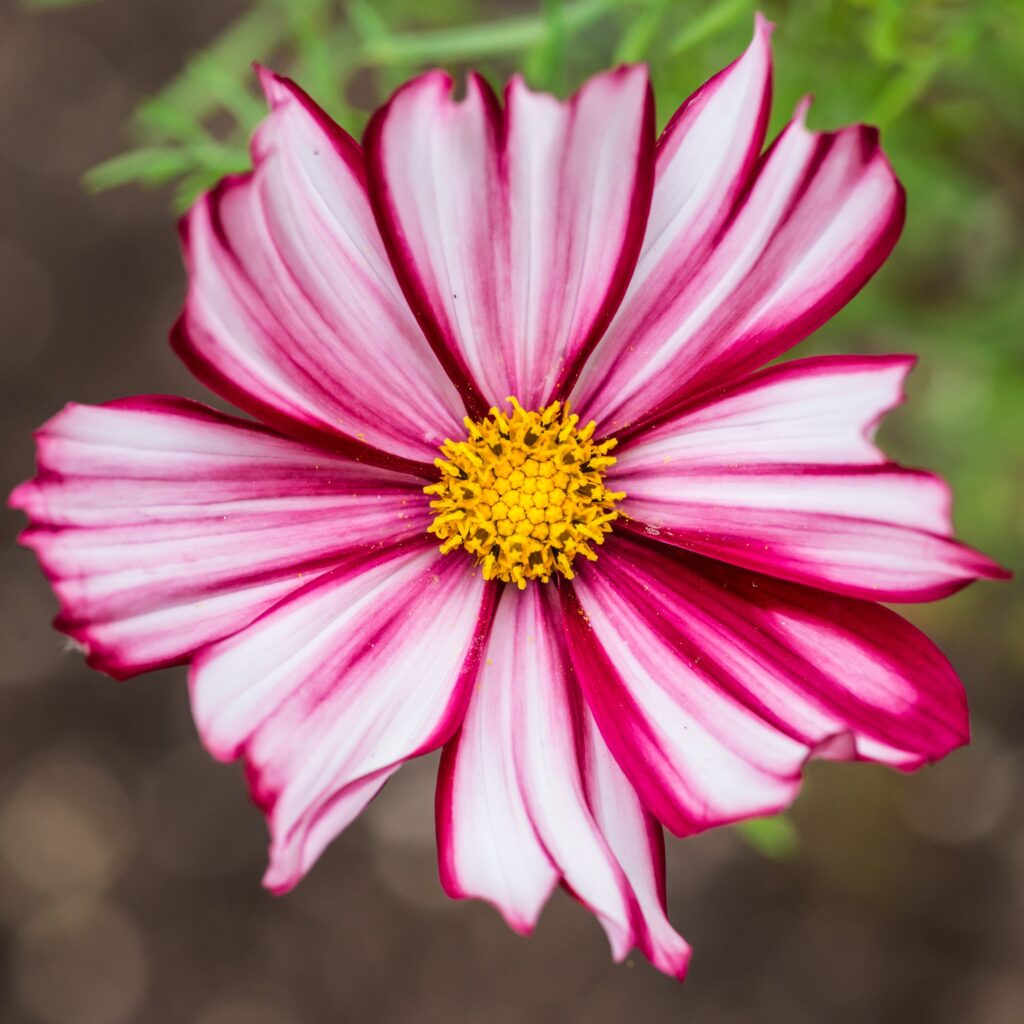
Cosmos ‘Velouette’ is one of the most striking bicolor varieties of Cosmos bipinnatus, producing flowers patterned in deep crimson, burgundy-red, and white. No two blooms necessarily look exactly alike. Some flowers are predominantly dark crimson with bold white stripes, while others are nearly white with narrow wine-red margins or splashes of color.
That variability is one of the cultivar’s greatest attractions.
Instead of creating a perfectly uniform flower bed, ‘Velouette’ produces an ever-changing mixture of striped, edged, streaked, and almost solid-colored blooms. Against the plant’s finely divided, feathery green foliage, the dark flowers can look almost velvety—an appearance reflected in the cultivar’s name.
‘Velouette’ is a relatively tall annual, generally reaching around 30 to 36 inches, although vigorous plants may grow taller under favorable conditions. Long stems and abundant flowers also make it an excellent choice for cutting gardens.
Best of all, it retains the easygoing nature of ordinary garden cosmos. Full sun, average well-drained soil, modest watering, and regular cutting or deadheading are usually enough to keep plants flowering through summer and well into fall.
🌸 Cosmos Velouette Quick Guide
| Feature | Cosmos ‘Velouette’ |
|---|---|
| Botanical name | Cosmos bipinnatus ‘Velouette’ |
| Family | Asteraceae |
| Plant type | Half-hardy annual |
| Typical height | About 30–36 inches, sometimes taller |
| Typical spread | Around 18–24 inches |
| Flower color | Deep crimson-red and white |
| Flower pattern | Striped, edged, splashed, or nearly solid |
| Flower form | Single, daisy-like |
| Center | Golden yellow |
| Bloom season | Summer through fall |
| Days to bloom | Roughly 70–85 days from seed under favorable conditions |
| Light | Full sun |
| Soil | Average, well-drained soil |
| Seed depth | About ⅛–¼ inch |
| Germination | Approximately 7–14 days |
| Spacing | About 12–18 inches |
| Pinching | Recommended for branching |
| Deadheading | Recommended |
| Best uses | Cutting gardens, cottage gardens, borders, pollinator gardens |
| Award | RHS Award of Garden Merit |
🌺 What Is Cosmos Velouette?
‘Velouette’ is a named cultivar of Cosmos bipinnatus, the familiar garden cosmos or Mexican aster.
The species is known for tall branching stems, delicate thread-like foliage, and broad daisy-shaped flowers surrounding yellow central disks.
‘Velouette’ keeps that classic cosmos flower form but introduces a far more dramatic color pattern.
The Royal Horticultural Society describes its flowers as a mixture of deep red and white. Some blooms are primarily crimson with clear white stripes, while others are mostly white with a red edge.
That means ‘Velouette’ is not simply a red-and-white striped cosmos.
The pattern can change significantly from flower to flower.
One plant may produce a bloom with broad white brushstrokes across dark burgundy petals followed by another flower that is mostly pale with only a narrow crimson margin.
For gardeners who enjoy flowers with personality and variation, this is one of the cultivar’s strongest features.
🎨 What Color Is Cosmos Velouette?
‘Velouette’ belongs to the darker end of the Cosmos bipinnatus color range.
Flowers may combine:
- Deep crimson
- Burgundy
- Wine red
- Dark rose
- Dusty rose
- White
- Creamy white
- Rosy-red edging
The center remains golden yellow, creating another point of contrast.
Some flowers can appear almost entirely deep crimson, particularly from a distance.
Others are dramatically striped.
Still others may appear largely white with only narrow reddish markings.
Because of this variation, a mass planting looks more like a coordinated mix than a bed containing one completely uniform cultivar.
🌸 Why Do Velouette Flowers Look Different From One Another?
Variation is normal for ‘Velouette’.
The cultivar was selected for its distinctive red-and-white patterning rather than for every flower to reproduce an identical arrangement of stripes.
Differences may include:
- Width of the white stripes
- Amount of burgundy coloring
- Darkness of the red
- Thickness of the petal margins
- Number of striped petals
- Nearly solid dark flowers
- Nearly white flowers
That variability should not automatically make you suspect that your seed packet was mixed incorrectly.
In fact, descriptions from both the RHS and specialty seed growers specifically mention a range of flower patterns within the cultivar.
For gardeners who prefer precise uniformity, ‘Velouette’ may feel unpredictable.
For gardeners who enjoy discovering a slightly different bloom every day, it can be exceptional.
🏆 Is Cosmos Velouette an Award-Winning Variety?
Yes.
Cosmos bipinnatus ‘Velouette’ has received the Royal Horticultural Society Award of Garden Merit, commonly abbreviated AGM.
The award identifies plants that have demonstrated strong ornamental garden value under appropriate growing conditions.
That makes ‘Velouette’ more than simply an unusual novelty cultivar.
Its combination of distinctive color, long flowering season, garden performance, and ornamental value has earned formal recognition.
📏 How Tall Does Cosmos Velouette Grow?
The RHS describes ‘Velouette’ as reaching approximately 90 centimeters, or just under 3 feet tall.
Burpee lists a mature height of approximately 25 to 32 inches.
Other specialty seed growers report plants around 3 to 4 feet, illustrating how dramatically cosmos height can respond to growing conditions.
For most home gardens, plan for roughly 30 to 36 inches, while allowing the possibility of taller plants.
Height depends on:
- Soil fertility
- Moisture
- Sunlight
- Temperature
- Growing-season length
- Spacing
- Whether plants are pinched
Very fertile soil can create particularly tall plants.
That is not always desirable, since excessively lush growth may become more vulnerable to wind and produce fewer flowers.
📐 How Wide Does Velouette Grow?
Expect an individual plant to spread approximately 18 to 24 inches when given enough space.
Burpee lists a mature spread of around 18 to 20 inches.
In a flower border, however, you do not necessarily need to leave the plant’s entire final width between seedlings.
Spacing of approximately 12 to 18 inches works well.
Closer spacing creates a denser cutting garden or cottage-style planting.
Wider spacing allows individual plants to branch more extensively and increases air movement.
🌿 What Does the Plant Look Like?
Even before flowering, ‘Velouette’ has attractive foliage.
Like other Cosmos bipinnatus cultivars, it produces finely divided leaves made up of narrow thread-like segments.
This foliage gives the plant an airy, almost fern-like appearance.
The effect is particularly useful with dark flowers.
Instead of the crimson-and-white blooms sitting on a heavy mound of leaves, they seem to float above a fine green haze.
The light foliage also allows ‘Velouette’ to mingle easily with neighboring annuals and perennials.
📅 When Does Cosmos Velouette Bloom?
‘Velouette’ flowers from summer into fall.
Under favorable conditions, expect the first blooms approximately 70 to 85 days from sowing, although climate and planting method can shift that timing.
Indoor-started transplants may begin sooner than directly sown plants.
Once flowering begins, plants can continue producing blooms until frost if flowers are regularly harvested or deadheaded.
In long-season climates, that can provide several months of color.
The RHS describes the cultivar as flowering from summer into autumn.
❄️ Is Cosmos Velouette an Annual or Perennial?
‘Velouette’ is an annual.
The plant germinates, grows, flowers, produces seed, and dies during one growing season.
Frost ends its growth.
You do not need to dig up roots or protect a crown through winter.
Instead, grow new plants from seed each spring.
Cosmos can sometimes self-seed where conditions are suitable, although volunteer seedlings may not reproduce the exact Velouette flower pattern.
☀️ How Much Sun Does Cosmos Velouette Need?
Grow ‘Velouette’ in full sun.
At least six hours of direct sunlight per day is a useful minimum, and an open sunny garden usually produces the best results.
Insufficient light can lead to:
- Tall, stretched stems
- Reduced branching
- Fewer flowers
- Floppy plants
- Increased need for staking
The combination of full sun and moderately lean soil helps keep cosmos sturdy and floriferous.
🌱 Best Soil for Cosmos Velouette
Cosmos do not require unusually rich soil.
Average garden soil with good drainage is usually ideal.
‘Velouette’ can grow in clay, loam, sandy, or chalky soils as long as drainage is suitable.
The RHS recommends moist but well-drained soil and indicates that the cultivar tolerates acidic, neutral, and alkaline conditions.
Do not interpret “moist” as constantly saturated.
The roots should have access to moisture while the plant is actively growing, but standing water is undesirable.
🚫 Avoid Overfertilizing Velouette Cosmos
One of the most useful rules for growing cosmos is:
Do not love them to death with fertilizer.
Rich soil and large amounts of nitrogen can encourage spectacular foliage growth without producing a corresponding increase in flowers.
Overfed plants may become:
- Extremely tall
- Soft-stemmed
- Top-heavy
- Floppy
- Slow to flower
- Excessively leafy
If ordinary annual flowers already grow well in your garden soil, cosmos usually need little additional feeding.
The goal is not to produce the biggest cosmos plant possible.
The goal is to produce lots of flowers.
💧 How Much Water Does Cosmos Velouette Need?
Keep seeds, seedlings, and newly transplanted plants consistently moist while they establish.
Once mature, Cosmos bipinnatus becomes reasonably tolerant of short dry periods.
Water deeply during prolonged drought and then allow the soil surface to begin drying.
Avoid keeping plants constantly saturated.
Too much water can encourage the same sort of lush, weak growth associated with excess fertilizer.
Container-grown plants naturally need more frequent watering because pots dry out much faster than garden beds.
🌱 Growing Cosmos Velouette From Seed
‘Velouette’ is easy to grow from seed.
Gardeners have two simple options:
- Start seeds indoors before the last frost.
- Direct sow after frost danger has passed.
Starting indoors may give you earlier flowers.
Direct sowing is easier and eliminates transplanting.
Because cosmos grow quickly, both methods are effective.
A useful strategy for a large cutting garden is to start a few early plants indoors while direct sowing additional seed outside.
🪴 When to Start Velouette Seeds Indoors
Start seeds roughly 4 to 6 weeks before the last expected frost.
Cosmos grow rapidly, so there is little advantage in beginning months too early.
Sow seeds in a light seed-starting mix and cover them shallowly.
Keep the mix moderately moist while seeds germinate.
Once seedlings emerge, move them into strong light immediately.
Young cosmos kept warm under weak light become leggy very quickly.
🌡️ Cosmos Velouette Germination
A soil temperature around 65–75°F works well for germination.
Under suitable conditions, seedlings commonly emerge within approximately 7 to 14 days.
Keep the growing medium moist but not waterlogged.
Once seedlings emerge, airflow and bright light become important.
The seedlings may look delicate because of their fine foliage, but cosmos grow rapidly once established.
🌱 Can You Direct Sow Cosmos Velouette?
Yes.
Direct sowing is one of the easiest ways to grow ‘Velouette’.
Wait until the danger of frost has passed and the soil has warmed.
Prepare a loose seedbed, sow seeds shallowly, and maintain moisture until germination.
Once seedlings emerge and begin developing true leaves, thin crowded plants to approximately 12 to 18 inches apart.
Direct-sown cosmos usually catch up remarkably quickly once warm summer weather arrives.
📏 How Deep Should Velouette Cosmos Seeds Be Planted?
Sow seeds approximately ⅛ to ¼ inch deep.
They need only a light covering of soil.
Avoid burying seeds deeply.
For indoor sowing, press seeds into damp seed-starting mix and cover them with a thin layer of mix or vermiculite.
For outdoor planting, a shallow furrow is sufficient.
Good seed-to-soil contact matters more than depth.
📐 How Far Apart Should Cosmos Velouette Be Planted?
A spacing of about 12 to 18 inches works well.
Specialty seed growers commonly recommend this range.
Choose closer spacing when:
- Growing for cutting
- Creating a dense annual border
- You want neighboring plants to provide some mutual support
Choose wider spacing when:
- Humidity is high
- Disease pressure is a concern
- You want large individually branched plants
- You need more airflow
Because ‘Velouette’ is a branching annual, tiny seedlings eventually become substantial plants.
✂️ Should You Pinch Cosmos Velouette?
Pinching is highly useful.
Once young plants reach approximately 10 to 12 inches tall, remove the central growing tip just above a healthy set of leaves.
This interrupts the dominant central stem and encourages side branches to develop.
The result can be:
- Bushier plants
- More flower stems
- Better structure
- More useful cutting stems
Uprising Seeds recommends pinching ‘Velouette’ at about 1 foot tall to encourage stronger branching.
If you are growing only for ornamental display, pinching is optional.
For cutting, it is particularly worthwhile.
🌿 Does Cosmos Velouette Need Staking?
Sometimes.
Its moderate height means it may support itself perfectly well in sheltered gardens.
However, support can be useful when plants are:
- Growing in exposed locations
- Subject to strong thunderstorms
- Growing in highly fertile soil
- Taller than expected
- Crowded with weak stems
You can use:
- Individual stakes
- Bamboo canes
- Garden twine
- Peony-style rings
- Horizontal flower netting
Install support before the plants collapse.
Trying to untangle mature cosmos after a summer storm is considerably more difficult.
🌬️ How to Prevent Velouette From Falling Over
Staking is only part of the solution.
Strong cosmos begin with appropriate growing conditions.
For sturdier plants:
- Give them full sun.
- Avoid excess nitrogen.
- Do not overwater.
- Pinch young plants.
- Avoid starting seeds too early indoors.
- Provide support in windy locations.
A plant grown in rich soil with too little sun will often become taller and weaker than one grown in leaner sunny conditions.
🌺 How to Get More Velouette Flowers
Cosmos produce flowers in response to favorable growing conditions and regular removal of blooms.
For the longest display:
- Grow in full sun.
- Avoid excessive fertilizer.
- Pinch young plants.
- Harvest stems often.
- Deadhead flowers you do not cut.
- Water during prolonged drought.
- Prevent the entire plant from setting mature seed too early.
Once a plant successfully produces large quantities of mature seed, its incentive to keep flowering begins to decline.
Regular cutting delays that process.
✂️ Deadheading Cosmos Velouette
Deadheading is strongly recommended.
When a flower begins fading, trace the stem back to the next healthy leaf, bud, or branch.
Make the cut there rather than simply pulling off the petals.
This improves the plant’s appearance and encourages replacement growth.
During peak summer flowering, you may need to deadhead every few days.
If you are harvesting bouquets regularly, you are effectively deadheading at the same time.
💐 Is Cosmos Velouette a Good Cut Flower?
Yes. Cutting is one of the best uses for ‘Velouette’.
Its long stems and highly variable patterned blooms make it particularly interesting in bouquets.
Burpee specifically describes it as producing repeated vases of cut flowers, and the RHS has included ‘Velouette’ in cut-flower garden recommendations.
The flowers work well with both pale and dark companions.
Try them with:
- White zinnias
- Dahlias
- Snapdragons
- Ammi
- Celosia
- Scabiosa
- Gomphrena
- Dark basil
- Ornamental grasses
A single stem can add considerably more visual interest than a solid-colored cosmos.
✂️ When to Harvest Cosmos Velouette for Cutting
Harvest when a flower is beginning to open rather than waiting until it has been fully expanded in the garden for several days.
Specialty cut-flower guidance recommends harvesting around bud break, when petals are beginning to unfold.
Additional buds on a branching stem may continue opening after harvest.
Cut during the cooler part of the day.
Place stems into clean water promptly.
For longer stems, cut deeply into the plant just above a branching point.
Deep harvesting encourages replacement growth lower on the plant.
🏺 How Long Does Velouette Last in a Vase?
Fresh cosmos are delicate cut flowers rather than extraordinarily long-lasting ones.
A typical vase life for properly harvested ‘Velouette’ is approximately 5 to 7 days, although actual longevity varies with harvest stage and indoor conditions.
To help cut flowers last:
- Use a clean vase.
- Start with clean water.
- Remove foliage below the waterline.
- Keep the arrangement away from direct hot sunlight.
- Change the water regularly.
- Recut stems if necessary.
Its relatively modest vase life is compensated for by the number of flowers a productive garden plant can generate.
🌸 Cosmos Velouette vs. Cosmos Capriola
Cosmos Capriola and ‘Velouette’ both produce white and red flowers, but they create very different effects.
| Feature | Velouette | Capriola |
|---|---|---|
| Primary colors | Crimson and white | White, rosy red and dark red |
| Pattern | Broad stripes, edging and variable splashes | More defined dark ring and picotee edging |
| Flower form | Single | Primarily single, sometimes collarette |
| Height | About 30–36 in. | About 24–30 in. |
| Overall effect | Bold and unpredictable | Graphic and more structured |
‘Capriola’ usually has a recognizable dark ring around its yellow center.
‘Velouette’ is much less predictable, sometimes producing heavily striped flowers and sometimes almost solid crimson blooms.
🌸 Cosmos Velouette vs. Cosmos Sweet Sixteen
Cosmos Sweet Sixteen is much softer in appearance.
‘Sweet Sixteen’ generally produces pale pink-to-white flowers with darker pink edging and a distinctive frilled center.
‘Velouette’ uses a considerably darker palette.
Choose Sweet Sixteen for a soft romantic pink garden.
Choose Velouette for burgundy, crimson, white, and dramatic contrast.
Planting the two together can create an interesting transition from blush pink into deep wine tones.
🌹 Cosmos Velouette vs. Double Click Rose Bon Bon
Cosmos Double Click Rose Bon Bon differs primarily in flower form.
Rose Bon Bon produces fluffy semi-double and double rose-pink flowers.
‘Velouette’ produces simpler open flowers with striking red-and-white patterns.
The comparison is almost one of texture versus pattern.
Rose Bon Bon provides the texture.
Velouette provides the graphic color variation.
Together they make an excellent cutting-garden pairing.
❤️ Cosmos Velouette vs. Rubenza
‘Rubenza’ is another excellent dark-toned Cosmos bipinnatus cultivar.
Its flowers begin deep ruby or burgundy-red and often fade toward softer rose tones as they age.
‘Velouette’ differs because its flowers combine dark red with clear white striping or edging.
Choose ‘Rubenza’ if you want a relatively consistent dark red cosmos.
Choose ‘Velouette’ if you prefer unpredictable striped and bicolor flowers.
Both have received the RHS Award of Garden Merit.
🤍 Velouette With White Flowers
White flowers highlight the pale striping in ‘Velouette’.
Good companions include:
- White cosmos
- White snapdragons
- White zinnias
- Ammi
- Orlaya
- White dahlias
A predominantly white garden with occasional ‘Velouette’ flowers creates dramatic dark accents without overwhelming the entire planting.
❤️ Velouette With Burgundy Flowers
Deep burgundy companions emphasize the darkest sections of the petals.
Try:
- Burgundy dahlias
- Dark celosia
- Dark scabiosa
- Burgundy amaranth
- Purple basil
- Dark snapdragons
This produces an especially rich late-summer cutting garden.
Use white flowers between the darker plants to prevent the composition from becoming visually heavy.
💗 Velouette With Pink Flowers
Pink softens the intense crimson.
Good combinations include:
- Cosmos Sweet Sixteen
- Cosmos Double Click Rose Bon Bon
- Pink zinnias
- Blush dahlias
- Rose snapdragons
Because ‘Velouette’ itself may occasionally produce dusty rose tones, the transition can look surprisingly natural.
💜 Velouette With Purple Flowers
Purple and crimson create a sophisticated darker palette.
Consider:
- Purple verbena
- Blue salvia
- Purple scabiosa
- Dark basil
- Gomphrena
- Purple asters later in the season
Add white flowers or pale ornamental grasses to lighten the design.
🌼 Velouette With Yellow Flowers
Yellow creates a much stronger contrast.
The golden centers of the cosmos already provide a tiny amount of yellow, so neighboring yellow flowers can repeat that color.
Try:
- Black-eyed Susans
- Yellow zinnias
- Coreopsis
- Small sunflowers
This creates a brighter and less formal garden than burgundy-and-white combinations.
🌿 Best Companion Plants for Cosmos Velouette
Useful companions include:
- Zinnias
- Dahlias
- Snapdragons
- Ammi
- Scabiosa
- Celosia
- Gomphrena
- Verbena
- Salvia
- Amaranth
- Ornamental grasses
The best companions share its preference for sunny conditions and reasonable drainage.
Cosmos are particularly useful among plants with heavier foliage because their thread-like leaves provide visual contrast.
🏡 Growing Velouette in a Cottage Garden
‘Velouette’ is almost made for cottage gardens.
Its flowers are dramatic, but the plant’s structure remains loose and informal.
Instead of creating a rigid mass of identical blooms, it sends patterned flowers through neighboring plants at different heights.
Plant several together among:
- Zinnias
- Dahlias
- Snapdragons
- Coneflowers
- Salvias
- Verbena
- Black-eyed Susans
Allow some intermingling.
The irregular flower patterns make the planting feel even more informal.
🌺 Using Velouette in a Cutting Garden
For cutting, plant several plants together rather than relying on one specimen.
Pinch the seedlings to encourage branching and install support while plants are still young if your garden is windy.
Then harvest aggressively.
A cutting garden works best when flowers are actually cut.
Leaving every beautiful bloom on the plant may seem tempting, but frequent harvesting stimulates continued production.
‘Velouette’ is especially useful because a handful of plants can produce many different-looking flowers from the same cultivar.
🪴 Can Cosmos Velouette Grow in Containers?
Yes, although it is taller than compact cultivars such as Cosmos Capriola.
Choose a substantial container with good drainage.
A mature plant may approach 3 feet tall and develop a broad branching structure.
Use a quality potting mix but avoid excessive feeding.
Place the container in full sun.
Container plants need more frequent watering than plants in garden soil, particularly during midsummer.
A discreet stake can help prevent wind from overturning tall stems.
🐝 Does Cosmos Velouette Attract Pollinators?
Yes.
Its open, single flowers expose the central disk florets, making them accessible to visiting insects.
Cosmos are commonly visited by:
- Bees
- Butterflies
- Hoverflies
- Other flower-feeding insects
RHS plant retailers also identify ‘Velouette’ as insect friendly.
For a truly pollinator-focused garden, use cosmos as one component of a broader planting containing flowers of different shapes and seasons.
No single annual can provide everything pollinators need throughout the year.
🦋 Velouette vs. Double Cosmos for Pollinators
Single-flowered cosmos such as ‘Velouette’ generally provide easier access to the central disk than heavily doubled cultivars.
This makes ‘Velouette’ a useful companion to highly double varieties.
You do not have to choose one or the other.
A garden combining ‘Velouette’ with Double Click Rose Bon Bon gives you both open flowers and elaborate doubles.
That mixture also creates much more visual variety.
☀️ Is Velouette Heat Tolerant?
As a Cosmos bipinnatus cultivar, ‘Velouette’ is well suited to warm summer weather.
Established plants tolerate heat and short dry spells reasonably well.
Very extreme heat can temporarily reduce flower production, particularly when accompanied by drought.
Water during prolonged dry weather, but resist the temptation to keep the soil saturated.
Once more moderate conditions return, healthy plants can resume abundant flowering.
🌱 Does Cosmos Velouette Self-Seed?
It can.
If spent flowers remain long enough to mature, seeds may fall into the surrounding soil.
Some may germinate the following year.
The important question is whether the resulting plants will look exactly like ‘Velouette’.
They may not.
Cross-pollination with nearby Cosmos bipinnatus cultivars can produce seedlings with different:
- Colors
- Stripe patterns
- Heights
- Flower shapes
Even saved seed from a patterned cultivar can produce some variation.
For the most predictable ‘Velouette’ display, use fresh seed from a reputable supplier.
🌱 How to Save Velouette Cosmos Seeds
Near the end of the season, stop deadheading several healthy flowers.
Allow the flower centers to mature and dry.
Cosmos seeds develop into narrow, pointed structures radiating outward from the center.
Collect them when they are dark and dry but before they scatter.
Let harvested seed finish drying indoors.
Store it in a paper envelope labeled:
Cosmos ‘Velouette’ — year collected
If other cosmos cultivars were flowering nearby, note that fact as well.
It will remind you that seedlings may show unexpected colors the following season.
🍂 What Happens to Velouette After Frost?
A hard frost kills the plant.
Once frost has ended the season, remove dead stems.
Healthy plant material can generally be composted.
If you want natural reseeding, allow some mature seed heads to scatter first.
If you prefer controlling the location and varieties of next year’s cosmos, remove plants before large quantities of seed fall.
There is nothing underground that needs to be stored for winter.
🐌 Common Cosmos Velouette Pests
Cosmos are generally trouble-free, but potential pests include:
- Aphids
- Slugs and snails
- Caterpillars
- Leafhoppers
Young seedlings are most vulnerable to slug and snail damage.
Aphids may gather around tender growing tips and buds.
Established healthy plants generally tolerate small amounts of insect feeding without difficulty.
Avoid spraying broad-spectrum insecticides unnecessarily, particularly if you are growing the flowers to support pollinators.
🦠 Common Cosmos Diseases
Potential problems include:
- Powdery mildew
- Gray mold
- Stem diseases
Disease pressure generally increases when plants are overcrowded or foliage remains wet for long periods.
Reduce problems by providing:
- Full sun
- Good airflow
- Appropriate spacing
- Well-drained soil
- Moderate watering
Do not crowd plants simply because the seedlings initially look small.
They expand quickly.
🌿 Why Is My Velouette Cosmos All Leaves and No Flowers?
The first thing to consider is fertility.
Too much nitrogen encourages vegetative growth.
A plant can become enormous and lush yet produce relatively few flowers.
Other possible reasons include:
- Insufficient sunlight
- Excessive watering
- Starting plants too early
- Extremely hot weather
- Immature plants
Do not automatically add fertilizer because flowering is slow.
With cosmos, that can make the problem worse.
🌬️ Why Is My Velouette Falling Over?
Flopping may result from:
- Excess nitrogen
- Rich soil
- Too little sun
- Heavy watering
- Wind
- Thunderstorms
- Lack of support
Pinching plants when young helps create more branched growth.
In exposed gardens, install stakes or horizontal netting before flowering begins.
Plants grown in full sun with moderate fertility tend to be sturdier than heavily fed plants in partial shade.
🎨 Why Is My Velouette Mostly Red?
That can be completely normal.
Some ‘Velouette’ flowers are predominantly deep red or crimson with only relatively small white markings.
Other flowers can be heavily striped.
The RHS specifically notes that the cultivar contains both dark flowers with white stripes and pale flowers edged in red.
The amount of white does not need to be equal on every bloom.
🤍 Why Is My Velouette Mostly White?
That can also occur.
Some flowers are predominantly white with crimson or red edging.
If the plant came from correctly labeled commercial seed and other characteristics match, pale flowers do not necessarily indicate an incorrect cultivar.
Watch the plant throughout the season.
Later blooms may display different proportions of red and white.
🌸 Why Doesn’t Every Flower Look the Same?
Because visual variation is part of ‘Velouette’.
This is not a cultivar selected to produce a row of genetically identical-looking flowers.
Its charm lies partly in the unpredictable placement of crimson and white.
Planting several together exaggerates the effect.
Instead of one bicolor pattern repeated dozens of times, you get a coordinated collection of related patterns.
❓ Cosmos Velouette FAQ
What is Cosmos Velouette?
‘Velouette’ is a cultivar of Cosmos bipinnatus known for variable deep crimson-and-white flowers.
What color is Cosmos Velouette?
Flowers range from deep crimson or burgundy with white stripes to mostly white with red edging.
Are all Velouette flowers striped?
No. Some are strongly striped, while others may be predominantly dark red or predominantly white.
How tall does Cosmos Velouette grow?
Around 30–36 inches is a useful expectation, although plants can vary according to growing conditions.
Is Velouette a dwarf cosmos?
No. It is moderately tall, although it is shorter than some traditional cosmos cultivars that can exceed 4 feet.
Is Cosmos Velouette an annual?
Yes. It completes its life cycle during one growing season.
When does Velouette bloom?
It flowers from summer into fall and can continue until frost.
How long does Velouette take to flower from seed?
Around 70–85 days under favorable conditions is a useful estimate.
Does Cosmos Velouette need full sun?
Yes. Full sun provides the strongest flowering and sturdier growth.
What soil does Velouette need?
Average, well-drained soil is ideal.
Should Velouette be fertilized?
Usually very little fertilizer is necessary. Excess nitrogen can encourage foliage instead of flowers.
When should Velouette seeds be started indoors?
About four to six weeks before the last expected frost is generally sufficient.
Can Velouette be direct sown?
Yes. Direct sow after frost danger has passed and the soil has warmed.
How deep should Velouette cosmos seeds be planted?
Approximately ⅛ to ¼ inch deep.
How long does seed germination take?
Roughly 7–14 days under suitable warm conditions.
How far apart should Velouette plants be spaced?
Approximately 12–18 inches works well.
Should Cosmos Velouette be pinched?
Yes, pinching at roughly 10–12 inches tall can encourage branching and stronger flowering stems.
Does Velouette need staking?
Not always, but taller plants in windy or exposed locations may need support.
Should Velouette be deadheaded?
Yes. Deadheading or frequent cutting encourages continued flowering.
Is Cosmos Velouette a good cut flower?
Yes. Its long stems and variable crimson-and-white flowers make it especially useful for bouquets.
How long does Velouette last in a vase?
Approximately five to seven days is a reasonable expectation with proper harvesting and care.
Does Velouette attract pollinators?
Its open single flowers are accessible to bees, butterflies, and other visiting insects.
Can Cosmos Velouette grow in containers?
Yes, but choose a large container because plants can approach 3 feet tall.
Does Velouette self-seed?
It can if mature seed is allowed to fall.
Can I save Velouette seeds?
Yes, although seedlings may vary from the original cultivar, particularly if other cosmos varieties were flowering nearby.
Is Cosmos Velouette frost hardy?
No. Frost kills the annual plants.
Has Cosmos Velouette won an award?
Yes. ‘Velouette’ has received the Royal Horticultural Society Award of Garden Merit.
❤️ Is Cosmos Velouette Worth Growing?
Cosmos ‘Velouette’ is especially worthwhile for gardeners who love unusual flowers and do not need every bloom to look identical.
Its color pattern is the main attraction. One flower may be rich burgundy with only a few white streaks. The next might be dramatically striped. Another may open almost entirely white with a fine wine-red edge.
That unpredictability gives a planting character.
‘Velouette’ is also more than a novelty. It has received the RHS Award of Garden Merit, produces excellent cutting stems, attracts visiting insects, and flowers for a long season when regularly deadheaded.
Care is straightforward.
Grow it in full sun and average well-drained soil. Avoid excessive fertilizer and water. Pinch young plants if you want additional branches, support them where wind is a problem, and keep cutting flowers once blooming begins.
For a cosmos collection, ‘Velouette’ also adds something your other varieties do not.
Cosmos Capriola gives you a more structured white-and-red pattern. Cosmos Sweet Sixteen provides delicate pink-and-white flowers with a frilled center. Cosmos Double Click Rose Bon Bon contributes fluffy double rose-pink blooms.
‘Velouette’ is the dramatic one—dark, streaked, unpredictable, and sometimes almost velvety in appearance.
For a flower grown from such a tiny, easy-to-sow seed, it can produce an extraordinary amount of personality from midsummer until frost.
🔗 Related Articles
- Cosmos Capriola
- Cosmos Sweet Sixteen
- Cosmos Double Click Rose Bon Bon
- Cosmos Care
- Cosmos Flower Types
- Discover the Stunning Diversity of Cosmos Flower Varieties
📚 Sources & Further Reading
- Royal Horticultural Society — Cosmos bipinnatus ‘Velouette’
- Royal Horticultural Society — Cosmos
- Royal Horticultural Society — Award of Garden Merit Ornamental Plants
- Burpee — Velouette Cosmos
- Uprising Seeds — Cosmos ‘Velouette’
- University of Illinois Extension — Cosmos
- North Carolina Extension Gardener Plant Toolbox — Cosmos bipinnatus
- Missouri Botanical Garden — Cosmos bipinnatus