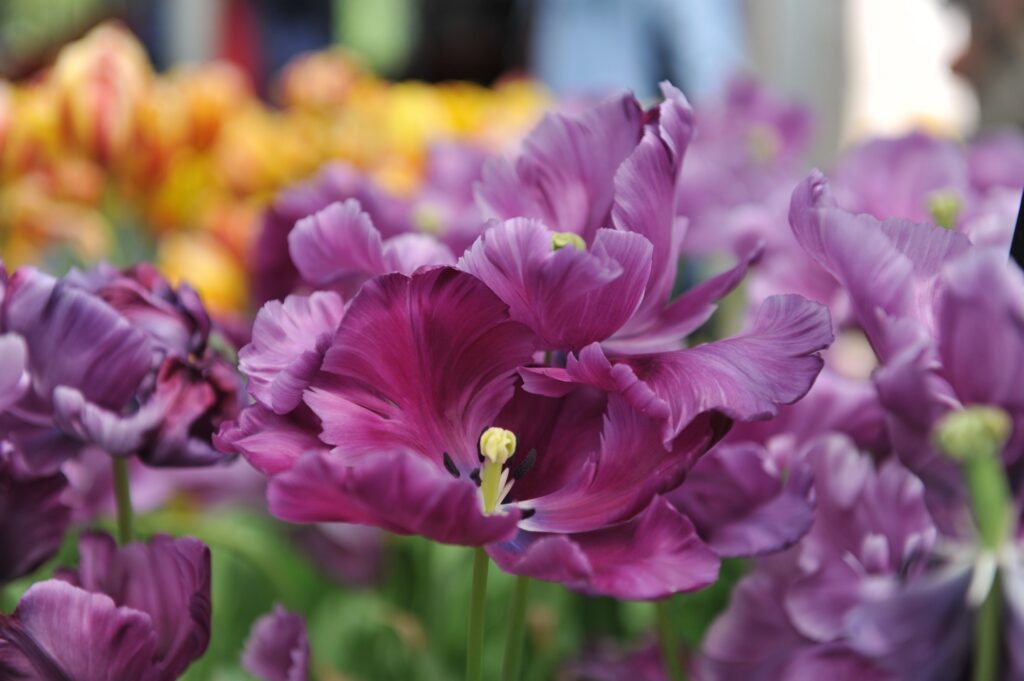
Blue Parrot tulips are dramatic late-spring flowers with enormous ruffled blooms in shades of violet, purple, and blue-purple. Despite their name, they are not truly blue. Their unusual coloring has a distinctly cool cast, however, and the heavily frilled petals can appear violet-blue, lavender-purple, or even slightly bronze-purple depending on the light.
Tulipa ‘Blue Parrot’ belongs to the Parrot Group, or Division 10. Plants reach roughly 22 to 24 inches tall and produce large, open flowers with curled and feathered petal margins. The blooms are especially impressive as they mature, when their irregular petals spread outward and reveal a deeper purple interior.
Blue Parrot is an excellent choice for borders, cottage gardens, containers, and cutting gardens. Its unusual coloring works beautifully with white, pale pink, lavender, near-black purple, and fresh green foliage.
💙 Blue Parrot Tulip Quick Guide
| Feature | Blue Parrot Tulip |
|---|---|
| Botanical name | Tulipa ‘Blue Parrot’ |
| Tulip group | Parrot |
| Classification | Division 10 |
| Flower color | Violet-blue to purple with deeper purple inside |
| Flower form | Large, open, frilled and feathered |
| Bloom time | Late spring |
| Typical height | About 22–24 inches |
| Light | Full sun |
| Soil | Fertile, well-drained soil |
| Planting time | Late fall |
| Planting depth | About 4–6 inches |
| Spacing | About 4–6 inches |
| Best uses | Borders, containers and cut flowers |
| Exposure | Sunny and sheltered |
| Perennial performance | Variable |
🌷 What Are Blue Parrot Tulips?
Blue Parrot is a Parrot tulip, placing it in Division 10 of the main horticultural tulip classification system.
Parrot tulips produce single flowers with unusually shaped petals. Instead of smooth, regular margins, their petals may be deeply cut, curled, waved, feathered, or twisted.
Blue Parrot combines this spectacular flower structure with an uncommon cool-purple color.
The Royal Horticultural Society describes the cultivar as producing bright violet-blue flowers with frilled margins and bronze-purple coloring inside.
The resulting flower can look surprisingly different depending on the light.
For more about this distinctive group, see our Parrot Tulips guide.
💙 Are Blue Parrot Tulips Really Blue?
No tulip currently produces the clear, true blue associated with flowers such as delphiniums, cornflowers, or forget-me-nots.
Blue Parrot is best described as violet-blue or blue-purple.
Its petals may show:
- Violet
- Lavender-purple
- Blue-purple
- Plum
- Mauve
- Bronze-purple tones
Cool, overcast light often brings out the bluer appearance.
Bright sunlight may reveal more obvious violet and purple.
The darker interior also creates additional depth and can make the outer petals appear cooler by comparison.
Gardeners looking specifically for a genuinely blue tulip may be disappointed, but anyone interested in unusual purple shades will find Blue Parrot extremely distinctive.
🌺 What Do Blue Parrot Tulips Look Like?
Blue Parrot produces enormous, irregular flowers with deeply frilled petal margins.
Young buds begin fairly compact.
As the flower matures, the petals expand and curl outward, gradually creating the loose, extravagant appearance associated with Parrot tulips.
The flowers are not perfectly symmetrical.
One petal may twist sharply outward while another develops softer waves or a feathered edge.
Fully open blooms can become extremely broad.
This irregularity is not a flaw. It is precisely what makes Parrot tulips different from traditional garden tulips.
📏 How Tall Do Blue Parrot Tulips Grow?
Blue Parrot generally reaches around 22 to 24 inches tall.
The Royal Horticultural Society lists the cultivar at up to approximately 60 centimeters, while specialist bulb growers commonly list it near 22 inches.
Growing conditions can influence final height.
Rich soil, large bulbs, mild temperatures, and adequate moisture during active growth may produce taller stems.
Because Blue Parrot carries very large flowers at the top of relatively long stems, protection from strong spring winds is especially helpful.
⏰ When Do Blue Parrot Tulips Bloom?
Blue Parrot flowers in late spring.
Specialist bulb growers commonly list its flowering period in May, although exact timing depends heavily on climate.
This places Blue Parrot near the end of the main tulip season.
It can bloom alongside other:
- Parrot tulips
- Single Late tulips
- Double Late tulips
- Lily-Flowered tulips
- Viridiflora tulips
Planting several tulip groups with different bloom periods can provide a much longer spring display than relying on one cultivar alone.
🦜 What Makes Blue Parrot a Parrot Tulip?
Blue Parrot’s classification is based primarily on its extravagant petal structure.
Parrot tulips produce flowers with petals that may be:
- Frilled
- Feathered
- Curled
- Twisted
- Waved
- Scalloped
- Deeply cut
The flowers generally open wider than conventional Triumph or Darwin Hybrid tulips.
Blue Parrot displays these traits particularly well.
Its frilled violet-blue petals create dramatic shadows as they fold and curl, adding even more depth to its already unusual coloring.
💜 Blue Parrot vs. Blue Spectacle Tulips
Blue Parrot and Blue Spectacle both have names that suggest blue flowers, but neither is truly blue.
Blue Spectacle Tulips belong to the Double Late Group.
They produce densely packed violet-purple flowers with a peony-like appearance.
Blue Parrot belongs to the Parrot Group.
Its flowers are single but heavily frilled, curled, and irregular.
Both flower late in spring and can be combined effectively.
Blue Spectacle provides a rounded, heavily double form, while Blue Parrot creates a looser and more feathered appearance.
🖤 Blue Parrot With Black Parrot Tulips
Black Parrot Tulips are natural companions for Blue Parrot because both belong to the same horticultural group.
Their flowers share similar ruffled and feathered shapes.
The difference is color.
Black Parrot produces extremely dark purple flowers with blackish interiors.
Blue Parrot is lighter and cooler, with violet-blue and purple tones.
Planting the two together creates a progression from blue-purple into near-black while maintaining a consistent flower form.
🌿 Blue Parrot With Green Wave Tulips
Green Wave Tulip Flowers offer a much softer Parrot combination.
Green Wave produces green, cream, and lilac-pink flowers.
Blue Parrot provides deeper violet-blue.
The shared purple undertones help connect the cultivars even though Green Wave is much lighter.
A planting containing both can create a sophisticated pastel-to-purple Parrot display.
White flowers make an excellent neutral companion between the two.
🔥 Blue Parrot With Texas Flame Tulips
For a much brighter combination, pair Blue Parrot with Texas Flame Tulips.
Texas Flame produces butter-yellow flowers covered with vivid red flames.
Blue Parrot produces cool violet-blue flowers.
The colors create strong contrast, while the shared Parrot flower form gives the planting some visual consistency.
Because both cultivars are already highly dramatic, plant them in distinct groups rather than alternating individual bulbs.
🔥 Blue Parrot With Flaming Parrot Tulips
Flaming Parrot Tulip provides another colorful option.
Flaming Parrot combines yellow with intense red flaming.
Blue Parrot brings violet and blue-purple into the same late-season display.
This combination is intentionally bold.
Gardeners who prefer a calmer border may want to use white or cream flowers between the cultivars to give the eye somewhere to rest.
🖤 Blue Parrot With Queen of Night Tulips
Blue Parrot also looks beautiful beside Queen of Night Tulips.
Queen of Night produces smooth Single Late flowers in extremely dark maroon-purple.
Blue Parrot is lighter, cooler, and much more ruffled.
Both bloom toward the end of the tulip season.
The result is an elegant dark-purple planting with two very different flower structures.
Adding pale lavender or white flowers can prevent the combination from becoming visually too dark.
🤍 Blue Parrot With White Tulips
White is one of the best companion colors for Blue Parrot.
Pure white flowers emphasize the cooler blue-purple tones in its petals.
They also create a clean background against which the frilled edges become much easier to see.
A simple planting might contain:
- Blue Parrot
- White Single Late tulips
- White alliums
- Silver foliage
- Fresh spring green
This restrained palette works particularly well in formal gardens and contemporary landscapes.
🌸 Blue Parrot With Pink Tulips
Pink creates a softer effect.
Blush, rose, and lavender-pink all work well with Blue Parrot.
Pink Diamond Tulips provide smooth rosy-pink Single Late flowers.
Angelique Tulips offer heavily double blush-pink flowers.
Both can flower during the later portion of the tulip season.
The combination of blue-purple and pale pink is particularly effective in cottage gardens and pastel spring borders.
💜 Creating a Blue-Purple Tulip Garden
Because truly blue tulips do not exist, a “blue tulip garden” is best created using flowers with lavender, violet, mauve, and blue-purple coloring.
Possible cultivars include:
- Blue Parrot
- Blue Spectacle
- Purple Flag
- Negrita
- Queen of Night
- Black Parrot
- Other lavender and violet tulips
The result will read visually as purple rather than true blue, but selecting cool-toned cultivars can push the palette closer to blue.
For additional options, see our Purple Tulips guide.
🌈 Designing With Blue Parrot Tulips
Blue Parrot is dramatic enough to become the focal point of a flower bed.
Excellent companion colors include:
- White
- Cream
- Pale pink
- Lavender
- Mauve
- Plum
- Near-black purple
- Soft yellow
For a calm garden, use pale pink, white, and lavender.
For a moodier display, combine Blue Parrot with Black Parrot and Queen of Night.
For high contrast, add soft yellow.
The cultivar’s elaborate flower form means simple neighboring flowers often produce the strongest overall design.
🌸 Companion Plants for Blue Parrot Tulips
Blue Parrot works with many late-spring plants.
Good choices include:
- Forget-me-nots
- Wallflowers
- Violas
- Pansies
- Late daffodils
- Alliums
- Single Late tulips
- Double Late tulips
- Other Parrot tulips
Later-growing perennials can help hide declining foliage.
Useful options include:
- Catmint
- Salvia
- Hardy geraniums
- Hostas
- Coreopsis
- Daylilies
Avoid companions requiring constantly saturated soil during summer if you intend to leave the bulbs in place.
☀️ How Much Sun Do Blue Parrot Tulips Need?
Blue Parrot performs best in full sun.
Choose a site receiving at least six hours of direct spring sunlight whenever possible.
Strong light supports healthy growth and flowering.
The RHS also recommends a sheltered location.
A little afternoon shade may be tolerated in warmer regions, particularly where late-spring temperatures rise rapidly.
However, deep shade can result in weaker growth.
Sunlight remains important after flowering because the foliage needs to replenish the bulb.
🌱 Best Soil for Blue Parrot Tulips
Blue Parrot grows best in fertile, well-drained soil.
The RHS lists chalk, loam, and sandy soils as suitable.
Acidic, neutral, and alkaline conditions can all work.
Drainage is far more important than exact soil pH.
Avoid locations where water collects after rainfall.
Bulbs left in persistently wet ground can rot.
Raised beds and containers are excellent alternatives where native soil remains heavy and poorly drained.
🍂 When to Plant Blue Parrot Tulip Bulbs
Plant Blue Parrot bulbs in late fall.
Tulips require prolonged winter chilling before they can grow and flower normally.
There is generally no advantage to planting them into warm soil early in fall.
Wait until temperatures cool but plant before the ground freezes solid.
Gardeners in mild-winter areas may need pre-chilled bulbs or may need to provide an artificial chilling period before planting.
🪴 How to Plant Blue Parrot Tulips
Choose firm, healthy bulbs without serious mold, softness, or decay.
Prepare a sunny, sheltered site with excellent drainage.
Plant bulbs around 4 to 6 inches deep, or approximately 10 to 15 centimeters, with their pointed ends facing upward.
Space them about 4 to 6 inches apart.
Some specialist bulb growers plant Parrot tulips closer to 6 to 8 inches deep, particularly in loose soil.
Either way, good drainage remains essential.
Water after planting.
💙 How Many Blue Parrot Tulips Should You Plant?
Five to seven bulbs can form an attractive small cluster.
Groups of 10, 15, or more provide considerably greater impact.
Because the flowers are large and unusual, Blue Parrot does not need to be planted by the hundreds to become noticeable.
In larger borders, repeat several groups rather than scattering individual bulbs.
This repetition makes the cool violet-blue color much easier to appreciate from a distance.
🌬️ Protecting Blue Parrot Tulips From Wind and Rain
Blue Parrot deserves a sheltered location.
The flowers are large, broad, and heavily frilled.
These characteristics make them more vulnerable to strong wind than smaller, simple-flowered tulips.
Rainwater can also collect within open blooms, temporarily increasing their weight.
Plant near a hedge, fence, wall, shrub border, or another structure that reduces severe wind without blocking too much sunlight.
Protection is especially useful once the flowers begin opening widely.
🪴 Growing Blue Parrot Tulips in Containers
Blue Parrot makes a spectacular container plant.
Growing it near a patio, entrance, or seating area allows the unusual flower color and petal structure to be viewed closely.
Use a substantial container with drainage holes.
Fill it with a freely draining growing medium and plant the bulbs in fall.
A pot devoted entirely to Blue Parrot can create a striking violet-purple display.
For a mixed container, white or pale-pink late tulips make excellent companions.
Very cold regions may require additional winter protection for container-grown bulbs.
✂️ Are Blue Parrot Tulips Good Cut Flowers?
Yes. Blue Parrot is an excellent cut flower.
The cultivar’s tall stems, unusual coloring, and enormous frilled blooms make it valuable for dramatic spring arrangements.
Cut the stems after the buds have developed obvious color but before the flowers open completely.
Tulips continue elongating and opening after they are placed in water.
Blue Parrot combines beautifully with:
- White
- Cream
- Blush pink
- Lavender
- Burgundy
- Fresh green foliage
A few stems can create substantial impact because each flower becomes so large.
💐 Blue Parrot in Flower Arrangements
Parrot tulips naturally become focal flowers.
Blue Parrot works especially well because its cool color is unusual among spring blooms.
For a romantic arrangement, combine it with blush pink and white.
For a dramatic arrangement, pair it with deep burgundy and plum.
For a more contemporary look, use Blue Parrot almost alone with simple green foliage.
Remember that tulip stems continue lengthening and curving after cutting, so leave room for the arrangement to change over the following days.
💧 How to Water Blue Parrot Tulips
Water thoroughly after planting.
Natural fall, winter, and spring precipitation may provide most of the moisture needed.
During prolonged dry periods in spring, provide supplemental irrigation.
The soil should remain adequately moist while the plant is actively growing but never waterlogged.
As foliage begins yellowing after flowering, gradually reduce supplemental watering.
Dormant tulip bulbs generally prefer relatively dry summer conditions.
🌿 Do Blue Parrot Tulips Need Fertilizer?
Blue Parrot generally requires little additional fertilizer when planted in reasonably fertile soil.
If your soil is poor, use a fertilizer intended for flowering bulbs according to label instructions.
Avoid excessive nitrogen.
Too much nitrogen can encourage foliage without necessarily improving flowers or bulbs.
If you intend to keep the bulbs, healthy post-bloom foliage is particularly important.
Allow the leaves to receive sunlight until they naturally turn yellow.
🌿 What to Do After Blue Parrot Tulips Bloom
Remove faded flowers after blooming if you plan to retain the bulbs.
Leave the green foliage intact.
The leaves continue photosynthesizing for several weeks after the flowers disappear.
This process replenishes stored energy inside the bulb.
Wait until foliage naturally turns yellow and begins dying before removing it.
Do not tie, braid, or cut healthy green tulip leaves.
Later-emerging perennial plants can gradually conceal declining foliage.
🔄 Do Blue Parrot Tulips Come Back Every Year?
Blue Parrot is botanically perennial and may return for several seasons.
However, Parrot tulips are generally grown primarily for their extraordinary flowers rather than exceptional long-term perennial performance.
You can improve the chance of repeat flowering by providing:
- Full sun
- Excellent drainage
- Natural foliage dieback
- Relatively dry summer soil
- Good air circulation
Even with appropriate care, the display may become less impressive over time.
Gardeners who want consistently enormous flowers may periodically add new bulbs.
For stronger repeat-flowering performance, Darwin Hybrid Tulips are generally a better choice.
🪴 Should You Dig Up Blue Parrot Tulip Bulbs?
Blue Parrot bulbs can be lifted after the foliage dies.
If you choose to lift them, carefully loosen the soil around each bulb rather than pulling it out by the stem.
Remove excess soil and inspect the bulbs.
Discard anything that is:
- Soft
- Rotten
- Seriously damaged
- Extensively moldy
Allow healthy bulbs to dry and store them in a cool, dry, well-ventilated location until fall.
In gardens with excellent drainage and relatively dry summers, bulbs can also be left in place and observed for repeat performance.
🌱 Propagating Blue Parrot Tulips
Blue Parrot can be propagated through bulb offsets.
Mature bulbs may develop smaller daughter bulbs around their base.
These offsets can be separated during summer dormancy.
Large bulbs can be replanted in fall.
Small offsets may require several growing seasons before they become large enough to flower.
Because Blue Parrot is a named cultivar, propagation through offsets is the practical way to retain its characteristic violet-blue flowers and Parrot petal form.
🐿️ Common Blue Parrot Tulip Pests
Blue Parrot can be affected by pests common to other tulips.
Potential problems include:
- Slugs
- Snails
- Aphids
- Stem and bulb eelworm
- Squirrels
Squirrels may dig recently planted bulbs.
Deer and other browsing animals can also damage foliage and flowers in some gardens.
Where digging is a recurring problem, protective mesh can help prevent access to the bulbs while still allowing shoots to emerge.
🦠 Common Blue Parrot Tulip Diseases
Blue Parrot may be susceptible to tulip fire and bulb rot.
Tulip fire can cause spotting, distorted growth, and damaged flowers.
Bulb rot becomes especially problematic in wet, poorly drained soil.
Start with healthy bulbs and avoid planting anything that is soft, heavily moldy, or obviously decayed.
Excellent drainage is one of the most important disease-prevention measures.
Remove severely affected plants rather than leaving them among healthy tulips.
⚠️ Are Blue Parrot Tulips Toxic?
Blue Parrot tulips should not be eaten.
Like other tulips, they contain compounds capable of causing irritation or illness when ingested, particularly in the bulbs.
Tulips can also cause skin irritation in sensitive people.
Keep unplanted bulbs away from children and pets likely to chew them.
Wearing gloves when planting, lifting, or dividing large numbers of bulbs is a sensible precaution.
❓ Blue Parrot Tulip FAQ
What type of tulip is Blue Parrot?
Blue Parrot belongs to the Parrot Group, or Division 10.
Are Blue Parrot tulips really blue?
No. They are violet-blue to blue-purple rather than a true clear blue.
What color are Blue Parrot tulips?
The RHS describes their flowers as bright violet-blue with bronze-purple interiors.
When do Blue Parrot tulips bloom?
They flower in late spring, commonly around May in temperate climates.
How tall do Blue Parrot tulips grow?
Plants generally reach around 22 to 24 inches tall.
What do Blue Parrot flowers look like?
They produce very large open flowers with frilled, feathered, and irregular violet-blue petals.
Do Blue Parrot tulips need full sun?
Yes. Full sun is best, along with shelter from strong winds.
How deep should Blue Parrot bulbs be planted?
The RHS recommends approximately 4 to 6 inches deep. Some specialist growers plant Parrot tulips somewhat deeper in loose soil.
Can Blue Parrot tulips grow in containers?
Yes. Their dramatic flowers make them excellent container plants, particularly in a sheltered location.
Are Blue Parrot tulips good cut flowers?
Yes. Their tall stems, unusual color, and ruffled flowers make them outstanding for spring arrangements.
Do Blue Parrot tulips return every year?
They may return for several seasons under favorable conditions, although Parrot tulips generally do not perennialize as reliably as Darwin Hybrid and Fosteriana tulips.
Is Blue Parrot the same as Blue Spectacle?
No. Blue Parrot is a Parrot tulip with heavily frilled single flowers. Blue Spectacle is a Double Late tulip with dense peony-like flowers.
Is Blue Parrot darker than Black Parrot?
No. Black Parrot is considerably darker and can appear nearly black. Blue Parrot is lighter and more violet-blue.
💙 Are Blue Parrot Tulip Flowers Worth Growing?
Blue Parrot is an excellent cultivar for gardeners searching for unusual color without sacrificing the extravagant flower shape that makes Parrot tulips so distinctive.
The blooms are not truly blue, but their violet-blue petals, deeper purple interiors, and occasional bronze tones create a cool color that stands apart from the reds, yellows, and pinks more commonly associated with tulips.
Blue Parrot is particularly effective in a late-spring purple garden. Pair it with Black Parrot for a dark Parrot combination, Blue Spectacle for contrasting flower texture, Green Wave for a softer pastel display, or Queen of Night for sleek near-black contrast.
Plant several bulbs together rather than relying on one isolated flower. Give them full sun, fertile well-drained soil, and shelter from severe wind and rain. Allow the foliage to yellow naturally after flowering if you hope to retain the bulbs.
For gardeners building a collection of distinctive Parrot tulips, Blue Parrot deserves a place alongside Black Parrot, Green Wave, Texas Flame, and Flaming Parrot as one of the group’s most memorable cultivars.
🔗 Related Articles
- Tulip Varieties: Types, Colors & Popular Cultivars
- Parrot Tulips
- Black Parrot Tulips
- Green Wave Tulip Flowers
- Texas Flame Tulips
- Flaming Parrot Tulip
- Blue Spectacle Tulips
- Queen of Night Tulips
- Purple Tulips
- Darwin Hybrid Tulips