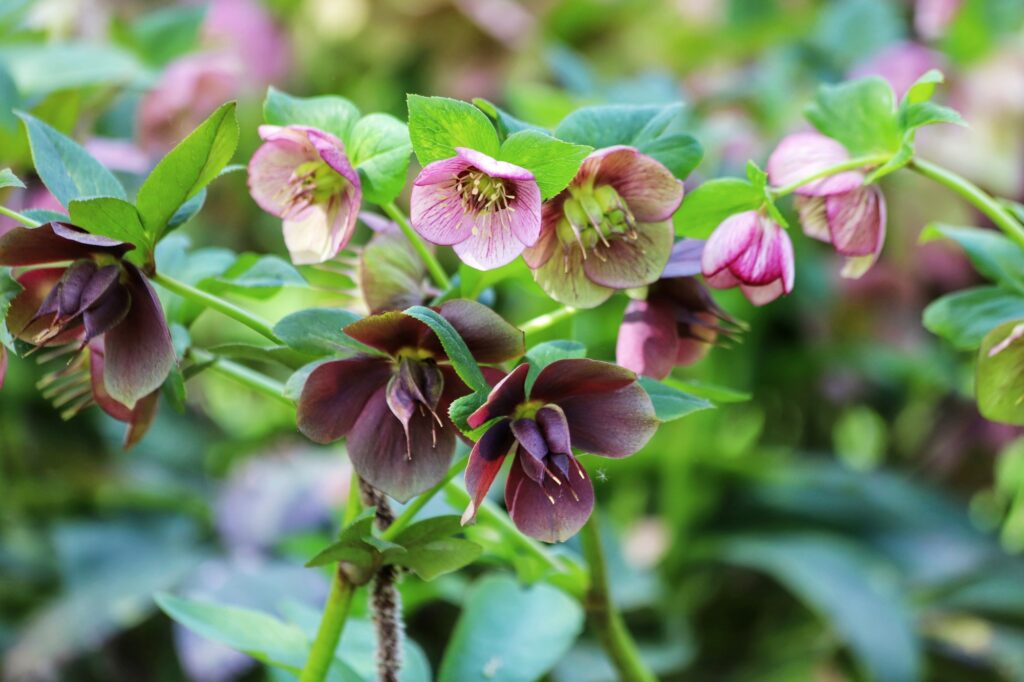
Lenten rose is one of the most valuable perennials for bringing flowers into the garden when winter has barely finished. While many plants are still dormant, mature hellebores can produce clusters of nodding flowers in white, cream, pink, rose, burgundy, purple, green, yellow, and almost-black shades.
Despite its common name, Lenten rose is not a rose at all.
It belongs to the genus Helleborus in the buttercup family, Ranunculaceae. Most plants sold today as Lenten roses are complex garden hybrids collectively known as Helleborus × hybridus. They were historically associated with Helleborus orientalis, and you will still see that name used on plant labels, but modern garden Lenten roses often contain genetics from several hellebore species.
These long-lived perennials are especially useful in partial shade, beneath deciduous trees, along woodland edges, and in protected borders where their evergreen or semi-evergreen foliage provides structure through much of the year.
Once established in a suitable location, Lenten roses need remarkably little attention. Give them rich, well-drained soil, consistent moisture without waterlogging, protection from excessive heat, and enough time to form mature clumps.
They can reward you with flowers for decades.
⚡ Lenten Rose Quick Care Guide
Botanical name: Helleborus × hybridus
Common names: Lenten rose, hybrid hellebore, hellebore
Plant type: Evergreen or semi-evergreen herbaceous perennial
Family: Ranunculaceae
Light: Partial shade or dappled shade; more sun is possible in cooler climates
Soil: Fertile, organic-rich, moist but well-drained soil
Soil pH: Generally neutral to alkaline
Bloom season: Late winter through early spring
Height: Approximately 18 to 24 inches
Width: Approximately 24 to 30 inches when mature
Flower colors: White, cream, yellow, green, pink, red, burgundy, purple, and near-black
Water: Consistent moisture while establishing; reasonably drought tolerant once established but performs best without prolonged drought
Maintenance: Low
Hardiness: Commonly USDA Zones 5–9, with some selections surviving colder conditions when protected
Best uses: Shade gardens, woodland borders, winter gardens, perennial borders, slopes, containers, and mass plantings
Important: Hellebores are toxic if eaten. Wear gloves if the sap irritates your skin and keep plant material away from children and pets.
🌸 What Is a Lenten Rose?
Lenten rose is the common garden name most often applied to the group known botanically as Helleborus × hybridus.
These are clump-forming perennials native in ancestry to hellebore species from Europe and western Asia.
The name Lenten rose comes from the plant’s tendency to flower around the Christian season of Lent in many climates.
It is not related to true roses in the genus Rosa.
Unlike woody rose shrubs, hellebores grow as herbaceous perennial clumps emerging from crowns close to the soil.
Their thick, leathery leaves can remain evergreen in mild winters and often persist beneath snow in colder regions, although winter foliage may become flattened, scorched, or tattered before spring.
🌿 Lenten Rose vs. Christmas Rose
These names are easy to confuse.
Lenten rose generally refers to Helleborus × hybridus and related garden hybrids.
Christmas rose usually refers to Helleborus niger.
Christmas rose often produces white flowers and can bloom earlier than typical Lenten roses, sometimes flowering during winter in mild climates.
Lenten roses generally offer a much broader range of flower colors, markings, and forms.
They are also among the hellebores most commonly sold for ordinary perennial gardens.
🌺 What Do Lenten Rose Flowers Look Like?
A mature Lenten rose produces flowers that can look surprisingly substantial for such an early season.
Flowers may be:
- Single
- Semi-double
- Fully double
- Spotted
- Speckled
- Veined
- Picotee-edged
- Solid colored
- Bicolored
Many older hellebores have downward-facing flowers.
Modern breeding has produced numerous selections with flowers held more outward or upward, making their interiors easier to see.
One of the most interesting botanical features is that what looks like the flower’s colorful petals are actually sepals.
True petals are reduced structures associated with the nectaries near the flower center.
Because the sepals remain after pollination, hellebore flowers can look attractive for an unusually long time.
🎨 Lenten Rose Colors
Few shade perennials offer such an extensive winter-to-spring color range.
Depending on the hybrid, flowers may be:
- Pure white
- Ivory
- Cream
- Soft yellow
- Apple green
- Blush pink
- Rose
- Wine red
- Burgundy
- Lavender
- Deep purple
- Almost black
Many become greener as they age.
That gradual transition means an established clump may contain fresh strongly colored flowers alongside older green-tinged blooms.
Rather than looking like the flowers simply die overnight, the entire display evolves over several weeks.
🌸 Single vs. Double Hellebores
Single Lenten roses usually have one prominent ring of petal-like sepals surrounding the flower center.
Double forms have additional layers, producing fuller flowers that can resemble small roses.
Both are attractive.
Single flowers often expose their stamens and nectaries more clearly and may be easier for early-season pollinators to use.
Double hellebores provide a more elaborate ornamental effect.
There is no need to choose only one form. A mixed shade garden can contain both.
🌱 How Large Does Lenten Rose Get?
Most mature Helleborus × hybridus plants reach approximately 18 to 24 inches tall and can gradually form clumps around 2 to 2½ feet wide.
Exact size varies by cultivar and growing conditions.
A small nursery plant may look insignificant during its first year.
Give it room.
Hellebores generally become more impressive as they mature, eventually producing many flowering stems from one established crown.
Avoid crowding them between aggressive perennials.
☀️ How Much Sun Does Lenten Rose Need?
Partial shade is an excellent starting point.
A location receiving morning sunlight followed by afternoon shade works particularly well in many climates.
Dappled light beneath deciduous trees is another excellent setting.
Lenten roses can tolerate more sun in cooler northern climates when the soil remains adequately moist.
In hotter regions, protection from intense afternoon sun becomes much more important.
Too much heat and direct sun can scorch foliage and stress the plants.
For more help understanding garden light, visit Gardening Basics.
🌳 Lenten Roses Under Deciduous Trees
Hellebores are particularly effective beneath deciduous trees and shrubs.
During late winter and early spring, the bare canopy allows substantial sunlight to reach the plants while they are flowering.
As spring progresses and tree leaves emerge, increasing shade protects the hellebore foliage from summer heat.
This seasonal light pattern closely matches what the plants need.
Tree-root competition can still be an issue, however.
Avoid sites directly beneath enormous surface roots where the soil becomes extremely dry.
🌞 Can Lenten Rose Grow in Full Sun?
Sometimes.
In cooler climates with reliable soil moisture, Lenten rose can tolerate considerably more direct sunlight than gardeners in the South might expect.
But full sun becomes increasingly stressful as summers grow hotter.
The combination of high temperatures, intense afternoon sunlight, and dry soil can lead to scorched foliage and reduced vigor.
If you live in a warm climate, choose partial or dappled shade.
If you live somewhere with mild summers, experiment with somewhat brighter conditions while monitoring soil moisture.
🌑 Can Lenten Rose Grow in Deep Shade?
Hellebores tolerate shade better than many flowering perennials.
They can grow in relatively shady woodland conditions, although flowering may be strongest where plants still receive some useful light.
Extremely dark sites beneath dense evergreen canopies can result in fewer flowers and weaker growth.
Think bright shade or dappled woodland light rather than a permanently dark corner whenever possible.
🌎 Best Soil for Lenten Rose
Lenten roses prefer fertile soil with plenty of organic matter and good drainage.
They appreciate moisture but are sensitive to waterlogged conditions.
An ideal soil is:
- Rich in organic matter
- Moist but not saturated
- Well drained
- Loose enough for healthy root growth
- Generally neutral to somewhat alkaline
They are not plants that require highly acidic soil.
If you are unsure about your soil pH or nutrient levels, a laboratory soil test is more useful than randomly adding lime or fertilizer.
Our Garden Soil Guide: Soil Types, Testing, pH & How to Improve It covers testing, drainage, organic matter, compost, and pH in greater detail.
💧 Good Drainage Is Essential
A Lenten rose may tolerate considerable shade.
It does not tolerate stagnant roots nearly as well.
Avoid planting where water remains pooled after ordinary rainfall.
Crown and root problems can develop when plants remain in soggy soil.
If your planting area contains heavy clay, improving soil structure across a broad bed can help.
Do not simply dig a small hole and fill it entirely with compost or loose potting soil.
The roots eventually need to move into the surrounding ground.
🍂 Add Organic Matter
Hellebores respond well to soil containing decomposed organic material.
Finished compost, leaf mold, and naturally decomposing woodland-type organic matter can help create favorable conditions.
This does not mean you need to add enormous amounts every year.
If the soil is already rich, maintain it rather than constantly piling on more nutrients.
A light topdressing of finished compost may be enough for an established bed.
📅 When Should You Plant Lenten Rose?
Spring and fall are both good times to plant.
Fall planting allows roots to begin establishing before the next flowering period.
Spring planting gives the plant a full growing season to settle before winter.
Container-grown hellebores can technically be planted during much of the growing season, but avoid extreme heat whenever possible.
Summer-planted hellebores require especially careful watering until their roots establish.
🌱 How to Plant Lenten Rose
Choose the permanent site carefully.
Hellebores can remain in the same place for many years and do not benefit from being moved repeatedly.
Dig a hole approximately as deep as the root ball and considerably wider.
Remove the plant from its pot.
If roots are circling tightly, loosen them gently.
Position the crown so it sits at approximately the same level it occupied in the container.
Do not bury it deeply.
Backfill with the surrounding soil and water thoroughly.
Apply a light organic mulch while keeping it away from direct contact with the crown.
📏 How Far Apart Should Lenten Roses Be Planted?
Allow approximately 2 feet or more between many standard Lenten rose plants.
Larger cultivars may need additional room.
When creating a mass planting, remember that individual clumps expand gradually.
Spacing may look sparse during the first year, but mature plants eventually fill much of the available ground.
Crowding them immediately makes long-term maintenance more difficult.
💦 How Often Should You Water Lenten Rose?
Newly planted hellebores require consistent moisture while establishing.
Do not allow new plants to remain severely dry for extended periods.
Established Lenten roses become more drought tolerant, but they generally perform best when soil does not remain bone dry for long periods.
Water needs depend on:
- Soil type
- Rainfall
- Shade
- Temperature
- Mulch
- Tree-root competition
- Plant size
Check the soil rather than following a rigid schedule.
🚿 Water Deeply
When irrigation is necessary, water the root zone thoroughly.
Frequent shallow splashes encourage moisture to remain concentrated near the surface.
Deep watering helps moisture reach the developing root system.
Avoid keeping the crown continuously wet.
Morning watering is helpful when foliage does become wet because leaves have time to dry.
🍂 Mulching Lenten Roses
A moderate organic mulch can help maintain the cool, evenly moist soil hellebores prefer.
Useful materials include:
- Shredded leaves
- Leaf mold
- Fine wood chips
- Shredded bark
Do not pile mulch directly over the crown.
Hellebores grow from crowns close to the soil surface, and burying them beneath a deep layer can retain excessive moisture.
Spread mulch across the surrounding soil instead.
🌱 Do Lenten Roses Need Fertilizer?
Hellebores are not particularly demanding feeders when grown in fertile soil.
A topdressing of finished compost can support established plants.
Where additional nutrients are genuinely needed, an appropriate fertilizer can be applied in early spring according to product and regional recommendations.
Avoid routine heavy fertilization without knowing what the soil requires.
Large amounts of nitrogen can encourage excessive foliage without necessarily improving flowering.
A soil test remains the best guide when fertility is uncertain.
❄️ When Do Lenten Roses Bloom?
Bloom season depends on climate and cultivar.
Flowers may begin appearing in late winter and continue into early or mid-spring.
In mild climates, some plants begin showing substantial flower development while winter is still underway.
In colder regions, snow may still surround emerging buds.
One of the joys of growing hellebores is seeing flower stems appear when very little else in the garden is active.
🌨️ Can Hellebore Flowers Survive Frost?
Hellebores are remarkably adapted to cold-season flowering.
Flower stems may droop during very cold weather and then recover as temperatures rise.
Established plants are generally capable of handling normal late-winter fluctuations within their hardiness range.
Severe or unusually prolonged cold can still damage open flowers.
A damaged bloom does not necessarily mean the entire plant has been injured.
Later buds may still open normally.
🍃 Are Lenten Roses Evergreen?
They can be evergreen or semi-evergreen depending on climate.
In mild climates, foliage may remain attractive through winter.
In colder regions, leaves can persist but become flattened, brown-edged, torn, or generally unattractive.
This aging winter foliage is normal.
New leaves emerge as the growing season advances.
Do not assume the plant is dying because last year’s leaves look terrible in February.
✂️ Should Old Hellebore Leaves Be Removed?
Yes, old damaged foliage can be removed as new flower stems begin emerging.
Late winter or very early spring is often the perfect time.
Cut old leaves close to the ground without damaging developing flower stems or new growth.
Removing tattered foliage accomplishes several things:
- Makes flowers easier to see
- Improves the appearance of the plant
- Removes some potentially diseased leaves
- Creates room for fresh foliage
You do not need to remove healthy leaves merely because the calendar says winter is ending.
Focus on foliage that has become old, damaged, or diseased.
✂️ Do Lenten Roses Need Deadheading?
Deadheading is optional.
Leaving spent flowers allows seed pods to develop.
That can be attractive and may result in seedlings appearing around the parent plant.
If you do not want self-seeding, remove aging flower stalks before seeds ripen.
Deadheading can also tidy the plant and redirect resources away from seed production.
Because the colored sepals remain attractive long after pollination, there is no need to rush.
Many gardeners leave the flowers until their color has faded substantially.
🌱 Do Lenten Roses Self-Seed?
Yes.
Established Lenten roses can produce seedlings around the parent clump.
If you allow seed pods to mature, small plants may eventually appear nearby.
Seedlings will not necessarily look identical to the parent.
Hellebores cross readily, and seed-grown offspring can display different flower colors and markings.
That unpredictability can be part of the fun.
If you want an exact copy of a named cultivar, division or vegetative nursery propagation is more reliable.
🌱 Growing Lenten Rose From Seed
Growing hellebores from seed requires patience.
Fresh seed performs better than old dried seed, and germination can be slow.
Even after germination, seedlings may require several years before reaching flowering size.
Wisconsin Extension notes that seedlings can take approximately four or five years to produce their first flowers.
For gardeners who enjoy experimentation, this is worthwhile.
For someone who wants flowers next spring, purchasing established nursery plants is much faster.
✂️ Dividing Lenten Rose
Established clumps can be divided, although hellebores usually prefer being left undisturbed.
A healthy plant may remain in one location for decades.
Division is most useful when you want to propagate a desirable plant or when a clump has become excessively large.
Wisconsin Extension recommends fall or flowering time for division and notes that plants may recover slowly afterward.
Each division should contain several crowns and healthy roots.
Replant promptly and provide reliable moisture while the divisions establish.
🌿 Don’t Divide Hellebores Unnecessarily
Perennials are often divided simply because gardeners have been taught that every perennial eventually requires it.
Hellebores are different.
An established clump does not automatically need division every three or four years.
If the plant is healthy and flowering well, leave it alone.
A mature hellebore often becomes more impressive with age.
🌺 Popular Lenten Rose Flower Forms
Modern hellebore breeding has transformed what gardeners can grow.
Selections are available with:
- Dark burgundy flowers
- Nearly black flowers
- Yellow flowers
- Apricot tones
- White flowers with red spotting
- Picotee edges
- Green flowers
- Double pink flowers
- Double white flowers
- Red-purple flowers
Named series also provide greater predictability than unnamed seed-grown plants.
💍 Wedding Party Hellebores
The Wedding Party series includes vigorous double-flowered hellebores in several colors.
Selections may include white, pink, mauve, yellow, and dark purple flowers.
Double hellebores create an especially dramatic display when positioned where the flowers can be viewed closely.
Plant them near paths, steps, or slightly elevated beds rather than hiding them in the distant background.
🍯 Honeymoon Hellebores
The Honeymoon series contains vigorous single-flowered plants in a broad color range.
Depending on the selection, flowers may be white, yellow, apricot, pink, mauve, or deep wine-red.
Single-flowered hellebores reveal the central stamens clearly and create a somewhat more naturalistic look than heavily doubled cultivars.
💎 Winter Jewels Hellebores
The Winter Jewels series includes both single and double forms in a broad assortment of colors and markings.
Like other modern hellebore breeding lines, these plants make it possible to build a shade garden with far more variety than the muted pink-purple hellebores that once dominated nursery offerings.
🌳 Growing Lenten Rose in a Woodland Garden
Woodland-style gardens are one of the best settings for Lenten roses.
The plants naturally fit beneath deciduous trees and among shade perennials.
Combine them with plants such as:
- Ferns
- Heucheras
- Hostas
- Epimediums
- Woodland anemones
- Spring bulbs
- Shade-tolerant groundcovers
The hellebores provide late-winter and early-spring flowers, while later foliage plants take over as the season progresses.
Our Heuchera Care guide covers one particularly useful companion.
🌷 Lenten Roses With Spring Bulbs
Hellebores combine beautifully with spring-flowering bulbs.
Good companions include:
- Daffodils
- Crocuses
- Glory of the snow
- Snowflake flowers
The hellebore forms a substantial evergreen or semi-evergreen clump while smaller bulbs emerge around it.
Blue Glory of the Snow looks particularly beautiful with pink or burgundy hellebores.
White Snowflake Flowers complement darker hybrids.
Yellow and white Daffodils can extend the display later into spring.
💜 Lenten Roses With Crocuses
Crocuses and hellebores occupy different height levels.
Crocus flowers remain close to the soil, while Lenten rose flowers rise above them.
Purple and blue crocuses can create a particularly attractive carpet around white, pink, or pale-yellow hellebores.
Both plants appreciate being left relatively undisturbed.
See Crocus Care for complete growing guidance.
🌿 Lenten Rose With Mahonia
Mahonia and Lenten rose can create an excellent cool-season shade combination.
Evergreen Mahonia provides woody structure and yellow flowers, while hellebores create lower clumps with a much broader color range.
Both can perform well in partially shaded woodland-style settings when drainage and moisture are appropriate.
Our Mahonia Care guide explains how to choose among Oregon grape, softer-leaved cultivars, and other Mahonia types.
🌼 Lenten Rose With Paperbush
In climates where paperbush is hardy, the two plants can create an exceptional late-winter garden.
Paperbush provides fragrant yellow-and-white flower clusters on bare branches above the lower-growing hellebores.
Both appreciate protection from extreme heat and can work in woodland-edge settings.
The combination demonstrates how a shade garden can become one of the most interesting parts of the landscape even before spring truly begins.
🏡 Lenten Rose Along a Path
Because many hellebore flowers nod downward, positioning matters.
A plant growing slightly above eye level on a bank or raised bed makes the interior of the flowers easier to see.
Steps and sloping paths are particularly useful.
If planting on flat ground, put Lenten roses close enough to the walkway that you can appreciate the flowers without stepping into the bed.
Modern outward-facing cultivars make viewing easier but still benefit from close placement.
⛰️ Lenten Roses on Slopes
Hellebores work well on shaded slopes.
A hillside viewed from below puts the nodding flowers at a much better angle.
Their clumping growth can also help fill difficult partially shaded areas where lawn struggles.
Combine them with groundcovers and woodland plants rather than leaving large stretches of bare soil between individual hellebores.
🪴 Can Lenten Rose Grow in Containers?
Yes.
Lenten roses can grow successfully in sufficiently large containers.
Use a pot with drainage holes and a high-quality container growing medium.
Never allow the container to remain permanently waterlogged.
Because hellebores are perennial, consider winter conditions carefully.
Roots in pots experience greater temperature fluctuations than roots in the ground.
Gardeners near the cold edge of the plant’s hardiness range may need to move containers into a protected but unheated location during severe winter weather.
🌸 Hellebores as Cut Flowers
Lenten rose flowers can be used in arrangements, but freshly opened blooms sometimes wilt quickly after cutting.
More mature flowers often perform better because their reproductive structures have developed and the sepals have become firmer.
Rather than cutting every new flower immediately, allow some blooms to mature on the plant before harvesting.
Because stems are relatively short compared with lilies or roses, hellebores work especially well in low arrangements and small seasonal bouquets.
🐝 Are Lenten Roses Good for Pollinators?
Hellebores can provide nectar and pollen for early-season insects.
That timing is particularly useful because relatively few garden flowers may be open in late winter and very early spring.
Bees can visit hellebore flowers during suitable weather.
Single flowers with accessible centers are especially easy for insects to use.
Hellebores should still be only one part of a larger pollinator garden.
Follow their bloom with spring, summer, and fall flowers to create a longer resource sequence.
Our Eco-Friendly Gardening hub contains more ideas for supporting pollinators and other garden wildlife.
🦌 Are Lenten Roses Deer Resistant?
Yes, hellebores are generally very resistant to deer browsing.
Their foliage contains toxic compounds that make the plants unpalatable.
This is one reason Lenten rose is so useful in shady landscapes where hostas and other perennials may suffer heavy deer damage.
No plant is absolutely deer-proof under every circumstance, but hellebores are among the more reliable choices.
🐇 Do Rabbits Eat Lenten Rose?
Rabbits usually avoid hellebores as well.
The tough foliage and toxic compounds make them less appealing than many other perennial plants.
Young leaves may occasionally receive incidental damage, but severe rabbit browsing is uncommon.
🐌 Slugs and Snails
Slugs and snails can sometimes damage hellebore flowers and tender growth.
This is particularly likely in cool, damp, shaded gardens—the same conditions hellebores often enjoy.
A little cosmetic damage does not necessarily require treatment.
If damage becomes severe, reduce unnecessary hiding places and inspect plants during damp evenings.
Use targeted control rather than automatically applying broad pesticide treatments.
🍃 Hellebore Leaf Spot
Fungal leaf spots can affect hellebores.
Symptoms may include dark brown or black lesions on leaves and stems.
Removing seriously affected foliage can reduce the amount of infected material around the plant.
Provide enough spacing for air movement.
Avoid repeatedly keeping the foliage wet when irrigation is necessary.
Old winter-damaged leaves should not be confused automatically with disease.
If the plant looks tattered only after months of snow, frost, and wind, normal winter injury may be the explanation.
🦠 Crown and Root Rot
Poor drainage can contribute to crown and root rot.
A plant may wilt, decline, or collapse even though the soil appears wet.
Adding additional water makes the problem worse.
Prevention is the best strategy.
Plant hellebores in soil that drains appropriately and avoid burying their crowns beneath heavy soil or deep mulch.
🍂 Why Are My Hellebore Leaves Brown?
Brown foliage can result from several causes.
Winter Damage
Old leaves commonly become battered during cold weather.
Excessive Sun
Hot afternoon sunlight can scorch leaves.
Drought
Prolonged dry conditions can brown foliage.
Disease
Leaf spot and other fungal problems can cause distinct lesions.
Natural Aging
Older leaves eventually decline as new foliage develops.
Consider the season and the pattern before deciding treatment is necessary.
🌿 Why Are My Hellebore Leaves Yellow?
Yellow leaves can indicate:
- Excessive moisture
- Poor drainage
- Nutrient problems
- Root stress
- Natural leaf aging
- Excessive heat
- Transplant shock
One or two older yellow leaves are rarely a crisis.
Widespread yellowing combined with wilting deserves closer investigation.
Check soil moisture before applying fertilizer.
🌸 Why Isn’t My Lenten Rose Blooming?
Several conditions can reduce flowering.
The Plant Is Young
Seedlings can require several years to mature.
Too Much Deep Shade
Hellebores tolerate shade but still need enough light to flower strongly.
Excessive Nitrogen
Very rich fertilization can encourage foliage.
Recent Division or Transplanting
Disturbed hellebores may need time to recover.
Poor Drainage
Root stress reduces overall performance.
Unfavorable Climate
A cultivar poorly suited to local conditions may struggle.
A healthy mature hellebore in suitable light should generally flower without complicated intervention.
🌱 Why Is My Lenten Rose Flopping?
Flower stems naturally lean or nod in many varieties.
That does not necessarily mean the plant needs staking.
Hellebore flowers evolved with a downward-facing habit that can protect reproductive structures from rain and harsh winter weather.
Entire plants that suddenly collapse may have a different problem, such as severe drought, crown damage, or root rot.
Distinguish natural nodding flowers from genuine wilting.
🌼 Why Are My Hellebore Flowers Turning Green?
This is usually normal.
The colorful sepals of many Lenten roses gradually become green as the flowers age.
Because those sepals persist much longer than ordinary flower petals, the green stage can remain attractive for weeks.
You do not need to remove a flower simply because its original color has faded.
Many gardeners consider the green phase part of the plant’s ornamental season.
🌿 Spring Lenten Rose Care
Late winter and early spring are the busiest hellebore seasons.
As flower stems emerge:
- Remove badly damaged old foliage
- Check mulch depth
- Inspect for leaf-spot problems
- Maintain appropriate moisture
- Enjoy the flowers
- Apply compost or appropriate fertilizer if genuinely needed
Avoid trampling around the crown while working among emerging stems.
Hellebores grow relatively close to the ground, and buds can be easy to damage accidentally during early spring cleanup.
☀️ Summer Lenten Rose Care
By summer, flowering is usually finished and foliage becomes the main attraction.
Focus on:
- Watering during drought
- Maintaining mulch
- Protecting plants from extreme afternoon heat
- Removing serious disease problems
- Allowing the foliage to remain
Hellebores do not need to be cut to the ground during summer.
Healthy leaves contribute to the plant’s energy reserves and form.
🍂 Fall Lenten Rose Care
Fall maintenance is minimal.
Continue watering during prolonged dry weather.
Refresh mulch if necessary while keeping crowns exposed.
Avoid severe late-season disturbance.
If you want to divide a mature clump, fall can be an appropriate time.
Otherwise, allow the plant to prepare naturally for winter.
❄️ Winter Lenten Rose Care
In cold climates, foliage may flatten or become damaged.
A modest layer of mulch helps moderate soil temperatures, especially around newer plants.
Protection from strong drying winds can be useful.
Do not panic when old leaves look poor.
Wait for the flower stems and new growth to reveal how well the plant came through winter.
The ability to transition from battered winter foliage to beautiful early-spring flowers is one of the plant’s defining characteristics.
🌱 Do Hellebores Need Winter Mulch?
A light protective mulch can be useful in colder parts of their range.
Established plants generally do not need an enormous protective covering.
Mulch should protect the root zone rather than bury the crown.
Snow itself can provide useful insulation during cold weather.
Choose cultivars that are appropriate to your USDA hardiness zone rather than relying on mulch to compensate for a plant that is fundamentally too tender for the climate.
🌎 Are Lenten Roses Native to North America?
No.
The species that contributed to garden hellebore hybrids are native to Europe and parts of Asia.
Lenten roses are grown in North America as ornamental perennials.
If you are creating a strictly native shade garden, choose appropriate regional woodland plants instead.
In a mixed ornamental garden, hellebores can provide exceptional winter and early-spring interest.
⚠️ Can Lenten Roses Spread?
Yes.
Lenten roses can self-seed and create colonies under favorable conditions.
In an ordinary garden, this may simply result in welcome seedlings around mature plants.
NC State notes that hellebores are regarded as potentially invasive by the North Carolina Invasive Plant Council, although the threat is considered low.
Gardeners near natural areas should monitor seedlings rather than assuming every self-sown plant must remain.
Removing seed heads prevents much of the spread.
☠️ Are Lenten Roses Poisonous?
Yes.
All hellebores should be treated as toxic ornamental plants.
Plant tissues contain compounds including glycosides and saponins that can cause illness when ingested.
Do not eat any part of the plant.
Keep plant material away from young children and animals inclined to chew garden plants.
Gardeners should also avoid confusing the historical medicinal use of hellebore with modern safety.
This is not an herb for home remedies.
🧤 Can Hellebores Irritate Skin?
They can.
Some people develop skin irritation after contact with hellebore sap or plant material.
Wearing gloves is sensible when:
- Cutting old leaves
- Dividing plants
- Removing flower stems
- Handling large quantities of foliage
Wash hands after gardening even when gloves are used.
🐕 Lenten Roses and Pets
Because hellebores contain toxic compounds, dogs, cats, and other pets should not be allowed to eat them.
Fortunately, the unpleasant compounds that make the plants toxic also help discourage many animals from browsing them.
If a pet consumes a significant amount of hellebore plant material, contact a veterinarian or animal poison-control service.
🎨 Designing With Lenten Roses
Lenten roses deserve to be placed where their flowers can actually be seen.
Excellent locations include:
- Beneath deciduous shrubs
- Along woodland paths
- At the front of shaded borders
- On slopes
- Near steps
- Beside winter seating areas
- Near frequently viewed windows
For maximum impact, plant several cultivars together rather than isolating one plant in a huge bed.
Repeated clumps can create a substantial late-winter display.
🌸 A Simple Hellebore Garden
A beautiful beginner hellebore bed does not require dozens of varieties.
Begin with three to five plants in complementary colors.
For example:
- One white
- Two blush pink
- One deep burgundy
- One spotted or picotee form
Add blue glory of the snow and pale crocuses underneath.
Place heucheras and ferns nearby for later foliage.
A small paperbush or appropriate Mahonia can provide woody winter structure behind the planting.
The result can offer flowers and texture long before most perennial borders have awakened.
⚠️ Common Lenten Rose Care Mistakes
Planting in Hot Full Sun
Hellebores often need afternoon shade in warm climates.
Allowing Soil to Stay Waterlogged
Moist soil is good; saturated roots are not.
Burying the Crown
Plant approximately at its existing soil level.
Dividing Plants Repeatedly
Mature hellebores often prefer to remain undisturbed.
Removing All Foliage Too Early
Only remove old or damaged foliage as appropriate.
Overfertilizing
Rich soil does not require constant feeding.
Expecting Seedlings to Match the Parent
Hellebore seedlings can produce entirely different flower colors.
Expecting Immediate Flowers From Seed
Seed-grown plants can take several years to bloom.
Mistaking Green Aging Flowers for a Problem
The sepals naturally become greener as flowers mature.
Assuming Lenten Rose Is a True Rose
It is a hellebore in the buttercup family, not a member of Rosa.
🌸 Is Lenten Rose Easy to Grow?
Yes, once it is planted in the right place.
The essential care routine is simple:
Give it partial shade.
Provide fertile, organic-rich soil with excellent drainage.
Water regularly while it establishes.
Mulch lightly.
Remove damaged old foliage as flower stems emerge.
Avoid unnecessary division.
Let mature plants settle in.
Once established, a Lenten rose can remain in the same garden for decades.
Few perennials provide so much interest at a time of year when gardeners are especially eager to see something bloom.
🌷 One of the Best Flowers for the End of Winter
Lenten roses do not shout for attention the way summer lilies or bright red roses do.
Their charm is quieter.
A flower stem pushes through cold soil.
One nodding bud begins opening beneath a bare tree.
Then another.
Before long, the garden contains white, pink, green, burgundy, or purple flowers at a time when winter still seems close enough to return.
Later, the flowers slowly turn green and the fresh foliage expands around them.
Summer perennials take over.
By the following winter, the hellebore is ready to begin the cycle again.
Plant one where you can see it from a path or window.
Give it several years.
A mature Lenten rose becomes less like a temporary flower and more like a permanent marker of the changing season—the plant that quietly tells you spring is on its way.
🔗 Related Articles
- Flower Gardening
- Gardening Basics
- Garden Soil Guide: Soil Types, Testing, pH & How to Improve It
- Seasonal Gardening
- Eco-Friendly Gardening
- Paperbush Care
- Mahonia Care
- Heuchera Care
- Daffodil Care: How to Plant, Grow & Care for Daffodils
- Crocus Care
- Glory of the Snow Care
- Snowflake Flower Care