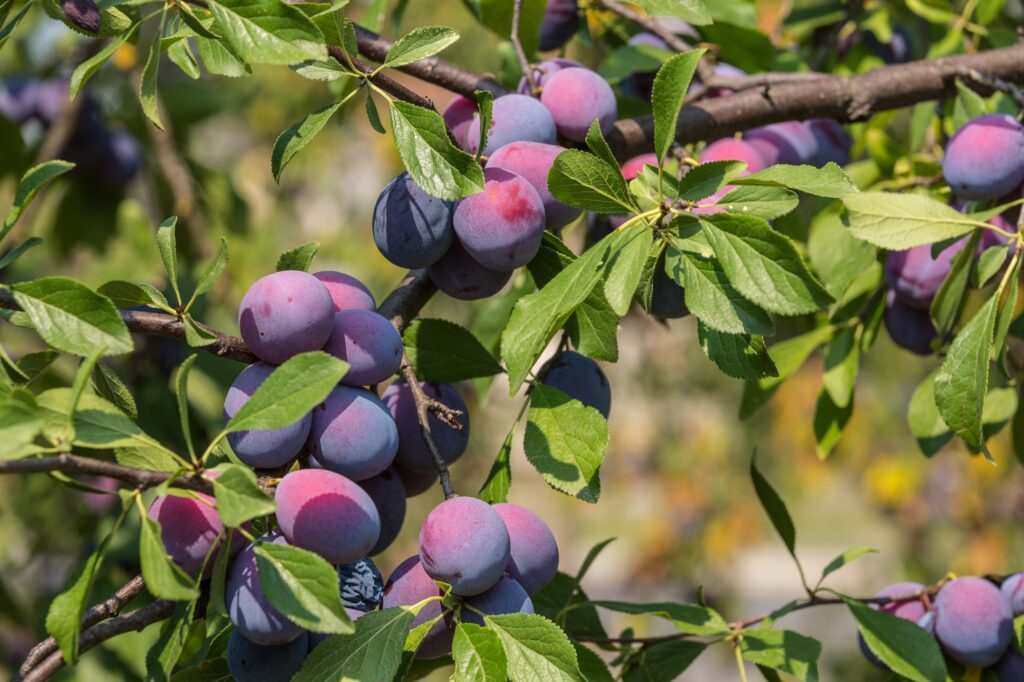
Plum trees bring together several qualities that make fruit trees so rewarding: fragrant spring blossoms, attractive foliage, summer shade, and baskets of sweet, juicy fruit. Depending on the variety, plums can be eaten fresh, baked into desserts, cooked into jams and preserves, dried into prunes, or used in sauces and savory dishes.
Growing a productive plum tree does require more planning than planting an ornamental shrub. The tree needs enough winter cold for its variety, a sunny location, well-drained soil, proper pruning, and — for many cultivars — a compatible pollination partner nearby.
It is also important to know which kind of plum you are growing. European plums, Japanese plums, and American or hybrid plums can differ in cold tolerance, bloom time, fruit characteristics, and pollination requirements. Choosing a tree suited to your climate is one of the most important steps toward long-term success.
Once established, however, a healthy plum tree can produce fruit for many years. With careful planting, annual pruning, fruit thinning, and attention to pests and disease, even a relatively small backyard can support a productive plum harvest.
🍑 Plum Trees at a Glance
- Botanical genus: Prunus
- Plant type: Deciduous fruit tree
- Family: Rosaceae
- Sun: Full sun
- Soil: Fertile, well-drained soil
- Soil pH: Generally about 6.0 to 7.0
- Mature size: Varies by rootstock and cultivar
- Bloom season: Early to mid-spring
- Harvest season: Summer through early fall, depending on variety
- Pollination: Some are self-fertile; others require a compatible second tree
- Water: Consistent moisture, especially while establishing and developing fruit
- Pruning: Usually annually
- Fruit thinning: Often beneficial
- Propagation: Usually grafted onto selected rootstocks
- Lifespan: Often several decades with good care
🌳 What Kind of Plum Tree Should You Grow?
Plums are not all the same.
Garden plums are generally grouped into several broad categories.
The three most useful for home gardeners are:
- European plums
- Japanese plums
- American and hybrid plums
Your climate, winter temperatures, available space, and intended use for the fruit should influence which type you choose.
🍇 European Plums
European plums are usually associated with Prunus domestica.
They tend to be:
- More cold-hardy than many Japanese plums
- Later blooming
- Suitable for fresh eating and cooking
- Commonly used for drying into prunes
Fruit may be:
- Purple
- Blue
- Red
- Yellow
- Green
Several European cultivars are self-fertile, making them useful where there is room for only one tree.
However, even self-fertile cultivars may sometimes produce heavier crops when another compatible plum blooms nearby.
🍑 Japanese Plums
Japanese plums are largely associated with Prunus salicina and its hybrids.
They commonly produce:
- Large fruit
- Juicy flesh
- Sweet-tart flavor
- Bright red, yellow, purple, or black skin
Japanese plums often bloom earlier than European plums.
That makes their flowers more vulnerable to late spring frost in some regions.
Many Japanese plum cultivars require another compatible Japanese or hybrid plum for effective pollination.
🌿 American Plums
American plum, Prunus americana, is native to much of North America.
It is generally:
- Cold hardy
- Adaptable
- Useful for wildlife
- Capable of forming thickets through suckering
The fruit is often smaller than that of modern commercial plums but can be excellent for:
- Preserves
- Jellies
- Cooking
- Wildlife plantings
American plum has also been used extensively in breeding hardy hybrid plums for colder climates.
❄️ Hybrid Plums
Hybrid plums combine genetics from different plum species.
Some were developed specifically for regions where ordinary European or Japanese cultivars struggle with winter cold.
Hardy hybrids can be particularly valuable in northern gardens.
Pollination can be complicated, though.
A cultivar may need another compatible hybrid or species blooming at the same time.
Always check the pollination requirements for the exact cultivar before purchasing.
☀️ How Much Sun Does a Plum Tree Need?
Plum trees grow and fruit best in full sun.
Aim for at least 6 to 8 hours of direct sunlight each day.
More sun generally supports:
- Better flowering
- Stronger fruit development
- Sweeter fruit
- Faster drying of wet foliage
- Lower disease pressure
Avoid planting where nearby buildings or large trees will shade the canopy for much of the day.
Good air movement is also beneficial, particularly in climates where fungal diseases are common.
🌱 Best Soil for Plum Trees
Plum trees prefer fertile, well-drained soil.
Ideal conditions include soil that is:
- Moderately rich in organic matter
- Moisture-retentive without remaining soggy
- Loose enough for healthy root growth
- Well drained after heavy rain
Plum trees can tolerate a range of soil textures, but prolonged waterlogging is dangerous.
Roots deprived of oxygen can decline rapidly and become vulnerable to rot.
🧪 What Soil pH Do Plum Trees Prefer?
A slightly acidic to neutral soil is generally suitable.
A pH of roughly 6.0 to 7.0 works well for most plums.
If your soil is far outside that range, test it before adding lime, sulfur, or fertilizer.
A soil test can also reveal whether phosphorus, potassium, or other nutrients are actually deficient.
Avoid making major amendments based entirely on guesswork.
💧 Plum Trees Need Good Drainage
Poor drainage is one of the fastest ways to lose a fruit tree.
Avoid planting in:
- Depressions where water collects
- Heavy clay that remains saturated for days
- Areas receiving roof runoff
- Sites with a persistently high water table
If drainage is marginal, consider planting on a broad berm or raised area rather than digging an excessively deep hole.
Never create a deep bowl that fills with water around the roots.
📅 When Is the Best Time to Plant a Plum Tree?
Early spring is often an excellent planting time in cold and temperate climates.
Bare-root plum trees are frequently planted while still dormant.
Container-grown trees can sometimes be planted later, but cooler spring weather reduces transplant stress.
Fall planting may work well in regions with mild winters, provided the tree has enough time to establish roots before severe cold or prolonged wet conditions.
Avoid planting during:
- Frozen soil
- Extreme heat
- Severe drought
- Waterlogged conditions
🌳 Bare-Root vs. Container-Grown Plum Trees
Both can work well.
Bare-Root Trees
Bare-root trees are usually:
- Less expensive
- Available while dormant
- Easy to inspect for root structure
- Convenient to plant in early spring
Keep roots moist until planting.
Do not allow them to dry out.
Container Trees
Container-grown trees offer more flexible planting times.
However, inspect roots carefully.
If they are circling tightly around the pot, loosen or correct them before planting.
A root system left spiraling inside the original pot shape may continue circling after planting.
🌱 How to Plant a Plum Tree
Planting depth is critical.
A plum tree should generally be planted with its root flare at or slightly above the surrounding soil level.
The graft union should remain clearly above the soil.
Do not bury the trunk deeply.
For detailed tree-planting fundamentals, see How to Plant a Tree.
🕳️ Step 1: Dig a Wide, Shallow Hole
The planting hole should be wider than the root system but not unnecessarily deep.
A hole roughly two to three times wider than the root spread is often appropriate.
The bottom should remain firm.
Do not loosen the soil deeply beneath the roots, because the tree may settle after planting and end up too deep.
🌳 Step 2: Find the Root Flare
The root flare is the point where the trunk broadens and transitions into the major roots.
Nursery trees are sometimes potted or packaged with soil covering this area.
Remove enough excess soil to locate the true flare before deciding how deep to plant.
Planting too deeply is a common long-term problem for fruit trees.
✂️ Step 3: Inspect the Roots
Before planting, remove:
- Broken roots
- Dead roots
- Severely damaged roots
For container trees, correct circling roots.
For bare-root trees, spread the roots naturally through the planting hole.
Do not force them into a cramped position.
🌱 Step 4: Position the Tree
Place the tree so the root flare sits at or slightly above grade.
Keep the graft union several inches above the soil.
This is important because if the grafted cultivar begins rooting above the intended rootstock, you may lose some of the rootstock’s size-control or disease-resistance benefits.
🌿 Step 5: Backfill With Native Soil
Backfill primarily with the soil removed from the hole.
Avoid filling the hole with rich potting soil or large quantities of compost.
Creating an isolated pocket of highly amended soil may discourage roots from expanding into surrounding ground.
Firm the soil gently as you work to remove large air pockets.
Do not compact it heavily.
💧 Step 6: Water Thoroughly
Water after planting.
This settles the soil around the roots and provides moisture during the tree’s first stage of establishment.
Check soil moisture regularly during the first growing season.
Young plum trees should not repeatedly dry out.
🍂 Step 7: Mulch the Root Zone
Spread approximately 2 to 3 inches of organic mulch over a broad area around the tree.
Good options include:
- Wood chips
- Shredded bark
- Shredded leaves
Keep mulch several inches away from the trunk.
Do not create a mulch volcano.
Mulch touching the bark continuously can encourage decay and pest problems.
📏 How Much Space Does a Plum Tree Need?
Spacing depends heavily on rootstock and training system.
A standard plum tree may eventually need roughly 15 to 20 feet or more of space.
Semi-dwarf trees can often fit within a smaller area.
Dwarf trees may require considerably less room.
Do not rely only on the tree’s size when purchased.
Check its expected mature spread.
The rootstock often influences final size just as much as the fruiting cultivar.
🌳 What Is a Plum Rootstock?
Most cultivated plum trees are grafted.
That means the upper fruit-producing cultivar grows on the root system of another plant called the rootstock.
Rootstock can influence:
- Mature size
- Soil tolerance
- Cold hardiness
- Disease resistance
- Suckering
- How quickly the tree begins bearing
When buying a tree, ask which rootstock it uses.
This information can be as important as the cultivar name.
❄️ Chill Hours Matter
Many plum varieties require a certain amount of winter chilling before they can flower normally.
Chill hours generally refer to accumulated time spent within a cool temperature range during winter.
Different cultivars can have dramatically different requirements.
A high-chill cultivar planted in a warm-winter climate may experience:
- Weak flowering
- Delayed bud break
- Irregular leafing
- Poor fruit production
Conversely, cultivars poorly adapted to very cold regions may suffer winter injury.
Choose a plum suited to your climate.
🌸 Protect Plum Blossoms From Frost
Plum flowers can be vulnerable to late freezes.
Japanese plums are particularly at risk because many bloom quite early.
A tree may survive winter perfectly but still produce no fruit if a hard freeze damages the blossoms.
When choosing a planting site, avoid low areas where cold air settles.
A gently elevated location with good air drainage can reduce frost risk.
Small trees can sometimes be protected temporarily with frost cloth during an unusual spring freeze.
🐝 Do Plum Trees Need Two Trees to Produce Fruit?
Sometimes.
Pollination requirements vary dramatically among plum cultivars.
Some are self-fertile, meaning a single tree can produce fruit.
Others are self-incompatible or only partly self-fertile and need pollen from another compatible cultivar.
This is especially common among Japanese and hybrid plums.
The second tree must:
- Be genetically compatible
- Bloom at approximately the same time
- Be close enough for pollinators to move between them
Do not assume any two plum trees will pollinate one another.
🌸 Can European and Japanese Plums Pollinate Each Other?
Usually, they should not be relied upon as pollination partners.
Their bloom timing and genetic compatibility may differ.
For dependable pollination:
- Pair European plums with compatible European cultivars.
- Pair Japanese plums with compatible Japanese or suitable hybrid cultivars.
Always check cultivar-specific recommendations.
🐝 Bees Are Important for Plum Pollination
Plum blossoms attract bees and other pollinating insects.
During bloom, avoid unnecessary insecticide applications.
Treating flowers while bees are actively visiting can harm pollinators.
A garden containing flowers before and after plum bloom can also provide a more continuous food supply for beneficial insects.
Plants such as Crocus can provide very early forage, while later flowers such as Bee Balm and Coneflower extend the season.
💧 How Often Should You Water Plum Trees?
Newly planted trees need consistent moisture while their roots establish.
Water deeply rather than applying tiny amounts every day.
The exact frequency depends on:
- Soil type
- Rainfall
- Heat
- Tree size
- Mulch
- Drainage
Check the root zone rather than watering automatically on a rigid calendar.
Established plum trees are more drought-tolerant than newly planted ones, but prolonged drought during fruit development can reduce fruit size and stress the tree.
🍑 Water Matters During Fruit Development
Consistent moisture is especially important while fruit is enlarging.
Severe drought followed by heavy watering can contribute to:
- Fruit splitting
- Irregular growth
- Fruit drop
The goal is relatively even moisture.
Do not keep the soil constantly saturated.
🌾 Do Plum Trees Need Fertilizer?
Not automatically.
Young trees growing vigorously may require little supplemental fertilizer.
Too much nitrogen can create:
- Excessive leafy growth
- Long weak shoots
- Reduced fruiting
- Greater disease susceptibility
Before fertilizing heavily, consider:
- Soil test results
- Shoot growth
- Leaf color
- Crop load
If the tree is producing strong annual growth and healthy foliage, it may already have sufficient nutrition.
🌱 How Fast Should a Young Plum Tree Grow?
Growth varies by cultivar and rootstock.
A young tree should generally produce healthy new shoots each season without becoming excessively vigorous.
Very little growth can indicate:
- Drought
- Root problems
- Poor soil
- Disease
- Competition from grass
Extremely long, lush shoots may indicate too much nitrogen.
The goal is balanced growth.
🌿 Keep Grass Away From the Trunk
Turfgrass competes aggressively with young fruit trees for:
- Water
- Nutrients
- Root space
Maintain a broad mulch circle around the tree.
A grass-free area several feet wide can significantly improve establishment.
Expand the mulch area as the tree grows.
✂️ Why Plum Trees Need Pruning
Pruning helps maintain:
- Strong branch structure
- Manageable height
- Airflow
- Light penetration
- Fruit quality
- Easier harvesting
A neglected tree can become crowded with crossing branches and produce much of its fruit high in the canopy.
Starting structural pruning while the tree is young is much easier than correcting major problems later.
🌳 Open-Center Training for Japanese Plums
Japanese plums are often trained to an open-center, or vase-shaped, form.
The goal is to develop several strong scaffold branches spreading outward from the trunk with a relatively open center.
This allows sunlight into the canopy and keeps fruit within easier reach.
A typical open-center tree may have three to five major scaffold limbs.
🌳 European Plum Training
European plums may be trained with a central leader or modified central leader, although practices vary.
The ideal system depends on:
- Cultivar
- Rootstock
- Climate
- Orchard tradition
- Available space
Whatever system you choose, the primary goals remain strong branch angles, adequate sunlight, and manageable height.
✂️ When Should You Prune Plum Trees?
Timing varies somewhat by climate.
Dormant-season pruning is common, but plum trees can be vulnerable to certain diseases entering pruning wounds.
In regions where diseases such as silver leaf are a concern, pruning during dry summer weather may be recommended instead.
Local Extension recommendations are especially useful here.
For routine pruning, avoid working during prolonged wet weather whenever possible.
✂️ What Should You Remove?
Annual pruning may include removing:
- Dead branches
- Diseased wood
- Broken branches
- Crossing limbs
- Inward-growing shoots
- Water sprouts
- Poorly positioned suckers
- Excessively upright growth
Do not remove huge amounts of healthy canopy at once.
Heavy pruning can trigger vigorous water-sprout growth.
🌱 What Are Plum Tree Suckers?
Suckers are shoots emerging from:
- Roots
- The base of the trunk
- Below the graft union
These often originate from the rootstock rather than the desired fruiting cultivar.
Remove them promptly.
If allowed to grow, they can compete with the grafted tree and may eventually become vigorous enough to dominate it.
🌿 What Are Water Sprouts?
Water sprouts are vigorous upright shoots that emerge from branches or the trunk.
They commonly develop after:
- Heavy pruning
- Injury
- Excess nitrogen
Most produce little useful fruit in their current orientation.
Remove unwanted water sprouts while they are young.
🍑 Should You Thin Plum Fruit?
Often, yes.
Plum trees can set more fruit than their branches can support.
Excessive crop loads can lead to:
- Small fruit
- Broken branches
- Reduced flowering the following year
- Biennial bearing
Thinning some fruit while it is still small helps the remaining plums grow larger and reduces strain on the tree.
📏 How Far Apart Should Plums Be Thinned?
A general target is to leave fruit several inches apart along the branches.
Around 3 to 4 inches between fruits is reasonable for many large-fruited cultivars.
Exact recommendations vary.
Remove:
- Damaged fruit
- Diseased fruit
- Small fruit
- Fruit touching or crowding neighboring plums
Then leave the healthiest fruits evenly distributed.
🍑 What Is June Drop?
Fruit trees naturally shed some young fruit.
This is commonly called June drop, although timing varies by climate.
The tree may set far more fruit initially than it can mature.
Some natural dropping is normal.
Wait until much of this natural shedding has occurred before making final thinning decisions.
🌳 Prevent Branches From Breaking
Heavy plum crops can put enormous weight on limbs.
Thinning is the best long-term approach.
Temporary branch supports can help during unusually heavy crops, but they should not replace sensible crop management.
Broken branches create large wounds and can permanently damage the tree’s structure.
🌸 When Will a Plum Tree Produce Fruit?
Most plum trees do not produce a meaningful crop immediately after planting.
Depending on:
- Tree age at planting
- Rootstock
- Cultivar
- Climate
- Care
a young tree may begin producing within approximately three to six years.
Dwarf trees sometimes bear earlier than standard trees.
Do not encourage an extremely young tree to carry a heavy crop before it develops a strong framework.
🍑 Why Is My Plum Tree Flowering but Not Producing Fruit?
Possible reasons include:
- Lack of a compatible pollinator
- Frost-damaged flowers
- Poor weather during bloom
- Low bee activity
- Excess nitrogen
- Young tree age
- Improper pruning
- Cultivar incompatibility
Pollination is one of the first things to investigate.
A beautifully flowering tree cannot produce a full crop if compatible pollen is unavailable.
❓ Why Doesn’t My Plum Tree Flower?
Possible causes include:
- Tree is still juvenile
- Excessive nitrogen
- Severe pruning
- Winter injury
- Insufficient winter chilling
- Too much shade
- Poor overall health
A young tree may simply need more time.
If an established tree suddenly stops flowering, investigate weather, pruning, and vigor.
🐛 Common Plum Tree Pests
Potential pests include:
- Plum curculio
- Aphids
- Scale insects
- Mites
- Borers
- Japanese beetles
- Caterpillars
- Fruit moths, depending on region
Regular inspection is extremely helpful.
Look at:
- Leaves
- Fruit
- Bark
- Branch unions
- Trunk base
Early detection makes many problems easier to manage.
🪲 Plum Curculio
Plum curculio is a major pest of stone fruits in parts of North America.
Adult weevils feed on fruit and lay eggs beneath the skin.
Damage may appear as distinctive crescent-shaped scars.
Infested fruit may:
- Become distorted
- Drop early
- Contain larvae
Remove fallen fruit promptly.
Good sanitation helps reduce the number of larvae completing their life cycle.
Regional management recommendations vary, so consult local Extension guidance where plum curculio is common.
🐛 Plum Tree Aphids
Aphids may cluster on tender shoots and leaf undersides.
Heavy infestations can cause:
- Curled leaves
- Distorted growth
- Sticky honeydew
Natural predators such as lady beetles and lacewing larvae often provide considerable control.
Before applying insecticides, determine whether the infestation is actually severe enough to justify treatment.
🪵 Borers
Borers can damage stressed stone-fruit trees.
Symptoms may include:
- Gum-like sap
- Sawdust-like material
- Bark injury
- Weak branches
- Dieback
Keeping trees vigorous and avoiding trunk injury helps reduce susceptibility.
Do not damage the bark with lawn equipment.
Maintain a mulch ring so mowers and string trimmers stay away from the trunk.
🍄 Common Plum Tree Diseases
Plums can be affected by several fungal and bacterial diseases.
Important problems may include:
- Brown rot
- Black knot
- Bacterial canker
- Leaf spot
- Rust
- Silver leaf in some regions
Disease pressure depends heavily on climate.
Wet, humid conditions often favor fungal problems.
🟤 Brown Rot
Brown rot is one of the most troublesome diseases of stone fruits.
Infected plums may develop:
- Soft brown areas
- Rapid decay
- Tan or gray spore masses
- Mummified fruit
Fruit can rot while still attached to the tree.
To reduce disease:
- Remove rotten fruit
- Remove mummified fruit
- Improve airflow
- Prune infected twigs when appropriate
- Avoid unnecessary fruit injuries
Do not leave diseased fruit hanging in the canopy over winter.
⚫ Black Knot
Black knot produces dark, swollen growths on plum and cherry branches.
The knots may begin as small swellings and eventually become hard, rough, black masses.
Prune infected branches well below visible symptoms.
Dispose of diseased wood rather than leaving it near susceptible trees.
Disinfect pruning tools when appropriate.
Wild or neglected plum and cherry trees nearby can also serve as infection sources.
🌧️ Bacterial Canker
Bacterial canker can cause:
- Sunken bark lesions
- Gumming
- Branch dieback
- Blossom blast
Stress can make trees more vulnerable.
Avoid unnecessary bark injuries and maintain good overall tree health.
Pruning recommendations vary depending on climate and disease conditions.
🟠 Why Is Sap Oozing From My Plum Tree?
Stone fruits commonly produce gummy sap in response to injury or stress.
This condition is often called gummosis.
Possible causes include:
- Insect borers
- Canker
- Winter injury
- Mechanical wounds
- Pruning injury
- Environmental stress
Gum itself is a symptom rather than a diagnosis.
Inspect the surrounding bark carefully to determine the cause.
🍃 Why Are My Plum Leaves Turning Yellow?
Possible causes include:
- Overwatering
- Drought
- Nutrient problems
- Root damage
- Disease
- Normal late-season aging
Look at timing and pattern.
A few yellow leaves near the end of summer may be normal.
Widespread yellowing during active spring growth deserves investigation.
🍃 Why Are Plum Leaves Curling?
Leaf curl may result from:
- Aphids
- Drought stress
- Herbicide injury
- Disease
- Environmental stress
Inspect curled leaves closely.
Aphids frequently hide inside distorted young foliage.
🌱 Why Is My Plum Tree Growing Too Many Shoots?
Excessive vegetative growth may be caused by:
- Too much nitrogen
- Heavy pruning
- Young tree vigor
Avoid repeatedly cutting the tree back severely.
This often stimulates even more upright growth.
Use selective pruning to guide structure rather than attempting to control size through annual topping.
🚫 Never Top a Plum Tree
Topping means cutting large branches indiscriminately to stubs.
This produces:
- Weakly attached shoots
- Large wounds
- Poor structure
- Dense regrowth
- Increased maintenance
If a tree has become too large for its location, gradual selective pruning is safer.
Choosing the correct rootstock and mature size before planting is even better.
🌸 Can Plum Trees Be Grown in Containers?
Dwarf plums can sometimes be grown in very large containers.
Choose a tree specifically grafted onto dwarfing rootstock.
Use:
- A large sturdy container
- Excellent drainage
- Quality potting mix
- Regular irrigation
Container trees dry out faster than in-ground trees and are more vulnerable to winter root damage.
Repotting or root maintenance may eventually be required.
For general container principles, see How to Repot a Plant.
🌳 Can You Espalier a Plum Tree?
Yes.
Plums can be trained against walls or along support systems.
Espalier and fan-trained forms can be useful where space is limited.
This requires regular pruning and training.
A warm wall may also encourage earlier flowering, so avoid creating a frost-prone situation in climates with late spring freezes.
🍑 When Are Plums Ready to Harvest?
Harvest timing depends on cultivar.
Signs of ripeness may include:
- Full mature skin color
- Slight softening
- Stronger fruit aroma
- Fruit releasing with a gentle twist
- Sweet flavor
Do not rely on skin color alone.
Some plums develop their final color before reaching ideal eating ripeness.
Taste is one of the best guides.
✋ How to Pick Plums
Handle ripe plums gently.
Hold the fruit in your hand and lift or twist lightly.
Avoid pulling hard enough to damage the fruiting spur or branch.
Harvest in several rounds because not every plum on a tree ripens simultaneously.
This is especially true with some Japanese varieties.
🍑 Will Plums Ripen After Picking?
Some plums will continue softening and developing flavor after harvest if picked mature but still firm.
However, fruit picked far too early will never develop the same quality as tree-ripened plums.
For fresh eating, harvest when the fruit is nearly ripe.
For short storage or transport, slightly firmer mature fruit may be preferable.
🧺 How to Store Fresh Plums
Ripe plums are relatively perishable.
If they need additional ripening, keep them at room temperature briefly.
Once ripe, refrigerate them.
Handle gently because bruised fruit deteriorates quickly.
Inspect stored plums and remove any showing rot before it spreads to neighboring fruit.
❄️ Can You Freeze Plums?
Yes.
Plums can be:
- Halved
- Pitted
- Sliced
- Frozen
They can also be preserved as:
- Jam
- Jelly
- Sauce
- Chutney
- Pie filling
Follow tested food-preservation recipes when canning.
Fruit acidity, sugar concentration, processing time, and jar size affect safety.
🍇 What Are Prunes?
Prunes are dried plums.
Certain European plum varieties are especially suitable for drying because they contain enough sugar and solids to dry well without fermenting around the pit.
Not every plum makes an equally good prune.
If drying is one of your goals, choose a cultivar traditionally grown for that purpose.
🌱 Can You Grow a Plum Tree From a Pit?
Yes, but the resulting tree may not resemble the fruit it came from.
Most named plum cultivars are propagated by grafting because seeds produce genetically variable offspring.
A seed-grown tree may differ in:
- Fruit size
- Flavor
- Color
- Disease resistance
- Tree size
- Bearing age
Growing from pits can be an interesting experiment.
It is not the best way to reproduce a favorite cultivar.
🌳 Why Are Plum Trees Grafted?
Grafting combines two plants.
The upper portion provides the desired fruit variety.
The rootstock contributes characteristics such as:
- Size control
- Soil adaptation
- Cold hardiness
- Pest resistance
- Disease tolerance
This allows growers to produce trees with predictable fruit.
Seed-grown trees cannot provide that same consistency.
🌿 Can You Propagate Plums From Cuttings?
Some plums can root from cuttings, but success varies considerably by species and cultivar.
Commercial fruit trees are generally propagated through:
- Grafting
- Budding
- Specialized rootstock propagation
For most home gardeners, purchasing a grafted nursery tree is faster and more dependable.
🍂 Plum Tree Care in Fall
After harvest:
- Remove diseased or mummified fruit.
- Rake or manage heavily infected fallen material.
- Continue watering during severe drought until dormancy.
- Inspect the trunk and branches.
- Protect young trunks from rodents if necessary.
- Avoid heavy late-season nitrogen fertilization.
Healthy trees should gradually enter dormancy as temperatures fall.
❄️ Plum Tree Care in Winter
Dormant trees require little routine care.
Winter is a good time to:
- Inspect structure
- Check tree guards
- Look for black knot
- Plan pruning
- Check for animal damage
In regions with rabbits, voles, or deer, protect young trunks.
Do not wrap materials tightly enough to trap moisture against the bark.
🦌 Do Deer Eat Plum Trees?
Yes.
Deer may browse:
- Young shoots
- Leaves
- Flower buds
- Fruit
They can also rub antlers against young trunks.
Physical protection is often necessary where deer pressure is high.
A sturdy fence or tree cage is more reliable than scent repellents.
🐇 Protect Young Trees From Rabbits and Rodents
Rabbits and rodents can remove bark around the trunk during winter.
If bark is removed completely around the circumference, the tree can be girdled and die.
Use an appropriate trunk guard extending high enough to account for snow depth.
Check guards periodically and remove or adjust them as the trunk expands.
🍑 Is a Plum Tree Easy to Grow?
Plum trees are moderately easy to grow when the right cultivar is matched to the right climate.
The basic process is:
- Choose a plum suited to your winter temperatures and chill hours.
- Check whether it needs a pollination partner.
- Plant in full sun.
- Choose well-drained soil.
- Keep the root flare at the correct depth.
- Keep the graft union above ground.
- Water consistently while establishing.
- Maintain a grass-free mulched root zone.
- Train the tree while young.
- Prune annually as needed.
- Thin excessive fruit crops.
- Watch for plum curculio and other pests.
- Remove diseased and mummified fruit.
- Harvest when the plums develop mature color, flavor, and softness.
The biggest mistakes are choosing an unsuitable cultivar, ignoring pollination requirements, planting too deeply, overfertilizing, and allowing disease problems to build up unchecked.
🍑 Final Thoughts
A plum tree can be one of the most rewarding edible plants in a home landscape.
In spring, it covers itself in delicate blossoms. By summer, those flowers can become branches heavy with red, purple, yellow, or blue-skinned fruit. And with thoughtful care, the tree can continue producing for many years.
Success begins before planting.
Choose a plum suited to your climate, make sure its winter-chill requirements can be met, and determine whether it needs a compatible pollinator. Give the tree full sun and well-drained soil, plant the root flare at the proper depth, and keep the graft union above ground.
During the early years, focus on developing a strong structure rather than forcing maximum fruit production. Water consistently, keep grass away from the roots, and avoid excessive nitrogen.
As the tree matures, annual pruning, fruit thinning, sanitation, and regular inspection become increasingly important. Removing diseased fruit and branches promptly can make a major difference in managing common problems such as brown rot and black knot.
When harvest finally arrives, pick the fruit gently and over several days as individual plums reach their best flavor.
Whether you grow a sweet Japanese plum for eating fresh, a European variety for drying and baking, or a cold-hardy hybrid for a northern garden, a well-chosen plum tree offers years of spring beauty followed by one of summer’s sweetest rewards.
🔗 Related Articles
📚 Sources & Further Reading
- University of Minnesota Extension — Growing Stone Fruits in the Home Garden
- Penn State Extension — Tree Fruit Production Guide
- University of Maine Cooperative Extension — Plums
- University of Wisconsin-Madison Extension — Growing Apricots, Cherries, Peaches and Plums in Wisconsin
- Missouri Botanical Garden — Prunus domestica