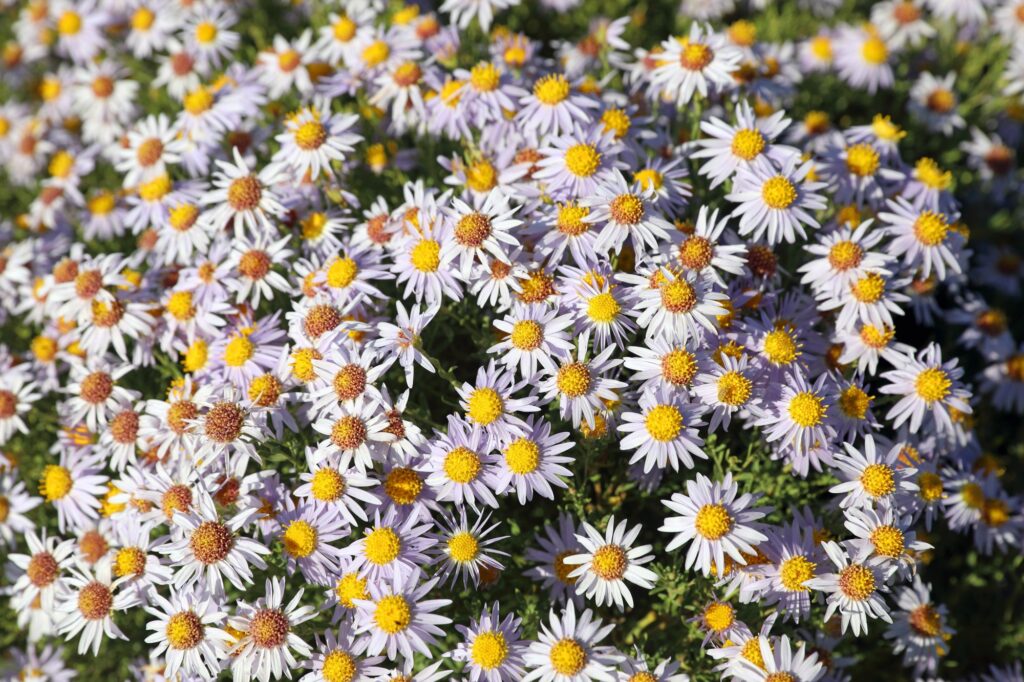
Boltonia is a tall, airy North American perennial that can cover itself with hundreds of small daisy-like flowers from late summer into fall. At a time when many summer flowers are beginning to fade, its branching stems create a cloud of white, pale pink, lavender, or violet blooms above blue-green foliage.
The species most commonly grown in gardens is Boltonia asteroides, often called false aster, white doll’s daisy, false chamomile, or eastern doll’s daisy. It belongs to the daisy family, Asteraceae, and is native across a broad portion of the eastern and central United States.
Boltonia is particularly useful in sunny perennial borders, native gardens, cottage gardens, meadow plantings, pollinator gardens, and areas with consistently moist soil. Established plants can become substantial, often reaching 4 to 6 feet tall, so this is usually a plant for the middle or back of a border rather than the very front.
Its size is also the main care challenge.
Boltonia growing in rich, moist soil or partial shade can become tall enough to flop. Fortunately, that problem is easy to manage. Give the plant full sun, avoid excessive fertilizer, choose a compact cultivar if space is limited, or cut the stems back by about one-third in late spring or early summer to encourage shorter, bushier growth.
Once established in a suitable location, Boltonia is otherwise an easy, cold-hardy perennial with few serious pest problems and valuable late-season flowers for pollinators.
⚡ Boltonia Quick Care Guide
Botanical name: Boltonia asteroides
Common names: Boltonia, false aster, false chamomile, white doll’s daisy, eastern doll’s daisy
Plant type: Herbaceous perennial
Family: Asteraceae
Native range: Eastern and central United States
Light: Full sun is best; partial shade is tolerated but can encourage flopping
Soil: Average to moist, well-drained soil
Soil tolerance: Clay, sandy soil, moderately dry conditions, and periodically wet sites
Height: Commonly about 4 to 6 feet for the species; compact cultivars can remain 18 inches to 4 feet tall
Spread: Approximately 2 to 4 feet
Bloom season: Late summer through fall, often August into October or until frost
Flower colors: White, pale pink, lavender, or violet with yellow centers
Water: Average moisture; performs especially well with consistent moisture
Hardiness: Very cold hardy, generally around USDA Zones 3–9 or 10 depending on selection and regional conditions
Pruning: Cut back by approximately one-third in late spring or early summer if shorter, sturdier growth is desired
Propagation: Division and seed
Best uses: Pollinator gardens, native plantings, cottage gardens, cutting gardens, moist borders, meadow gardens, rain-garden edges, and the back of perennial beds
🌿 What Is Boltonia?
Boltonia is a herbaceous perennial closely resembling an aster.
The resemblance is strong enough that one of its most common names is false aster and the species name asteroides means aster-like.
Like asters, Boltonia produces composite flower heads consisting of colorful ray florets surrounding a central group of yellow disk florets.
What looks like a single little daisy is therefore actually a collection of many small flowers organized into one flower head.
The plants grow from perennial crowns and underground rhizomes.
Stems emerge in spring, develop through summer, flower near the end of the growing season, and die back after frost.
New stems return from the root system the following spring.
🌼 What Do Boltonia Flowers Look Like?
Individual Boltonia flowers are relatively small, often around three-quarters of an inch to an inch across.
Their strength comes from quantity.
A mature plant produces highly branched flower stems carrying numerous blooms, giving the entire plant a soft, airy appearance from a distance.
Typical Boltonia asteroides flowers have white ray florets surrounding a yellow center.
Other forms can have pink, pale lavender, or violet rays.
When a mature plant is in peak bloom, the foliage may almost disappear beneath the mass of flowers.
🌸 Is Boltonia an Aster?
No, although the plants are closely related.
Boltonia and true asters belong to the same plant family, Asteraceae, but they belong to different genera.
Boltonia flowers strongly resemble asters and occupy a similar late-season role in the garden.
That makes them natural companions.
Asters may supply stronger blue and purple colors, while white Boltonia can brighten the planting and prevent a fall border from becoming too dark.
📏 How Tall Does Boltonia Grow?
The species Boltonia asteroides can become a large perennial.
Mature plants commonly reach approximately 4 to 6 feet tall, with favorable conditions sometimes producing even taller growth.
Plants may spread roughly 2 to 4 feet across.
This makes mature size important when choosing a location.
A Boltonia planted at the front of a small flower bed may eventually block everything behind it.
Place taller forms:
- At the back of perennial borders
- In large cottage gardens
- Among tall native perennials
- In meadow plantings
- Near pond or rain-garden margins
- Along fences
- In broad naturalized areas
Smaller cultivars provide alternatives for more compact gardens.
☀️ How Much Sun Does Boltonia Need?
Full sun is best.
Aim for at least six hours of direct sunlight when possible.
Strong light encourages sturdy growth and abundant flowering.
Boltonia can tolerate partial shade, but stems often become taller, weaker, and more prone to leaning or flopping.
This is especially likely when partial shade is combined with moist, fertile soil.
If your Boltonia repeatedly collapses late in the season, increasing sunlight may help more than staking it every year.
For more help evaluating garden light, visit Gardening Basics.
🌤️ Can Boltonia Grow in Partial Shade?
Yes, but expect a somewhat different plant.
Boltonia growing with only part-day sunlight may:
- Become taller
- Develop looser stems
- Lean toward available light
- Require staking
- Produce somewhat fewer flowers
If partial shade is your only option, choose one of the shorter cultivars or use an early-season cutback to control height.
Surrounding plants can also provide discreet structural support.
A Boltonia weaving among sturdy ornamental grasses or strong-stemmed perennials often looks more natural than one tied to an obvious stake.
🌎 Best Soil for Boltonia
Boltonia is fairly adaptable.
It grows well in average garden soil that drains reasonably well and has consistent moisture.
It also tolerates clay and some sandy soils.
In the wild, Boltonia asteroides occurs in moist habitats such as marsh margins, wet meadows, roadside ditches, lowlands, and other places where soil moisture can be relatively high.
That gives the plant more tolerance for damp conditions than many ordinary border perennials.
However, Boltonia does not require permanently wet soil.
An ordinary sunny perennial bed with average moisture can support it very well.
Our Garden Soil Guide: Soil Types, Testing, pH & How to Improve It covers drainage, soil texture, organic matter, and soil testing in greater detail.
💧 Boltonia Likes Moisture
Consistent moisture encourages vigorous growth and abundant flowers.
This makes Boltonia particularly useful in parts of the garden that stay somewhat damper than an ordinary flower border.
Potential locations include:
- Moist meadow gardens
- Pond margins
- Streamside plantings
- Low areas
- Rain-garden edges
- Moist native gardens
The plant can even tolerate occasional flooding.
That does not mean the crown should remain submerged indefinitely.
As with most garden perennials, roots still need oxygen.
🌧️ Boltonia in Wet Soil
Boltonia’s tolerance for wet soil is one of its most useful characteristics.
Many tall flowering perennials perform poorly where the ground remains moist for extended periods.
Boltonia is much more comfortable in these conditions.
There is a tradeoff, however.
Very moist, rich soil can produce enormous stems.
The healthier and more luxuriant the growth becomes, the more likely the plant is to need support.
This is one of those situations where excellent growing conditions can create a maintenance problem.
🏜️ Can Boltonia Tolerate Dry Soil?
Established plants tolerate moderately dry conditions.
They often respond by remaining shorter and sturdier.
That may sound beneficial, particularly if you are trying to avoid staking.
However, plants grown too dry may become less vigorous and produce a weaker flower display.
The goal is not to deliberately drought-stress Boltonia.
Provide normal garden moisture while avoiding unnecessary irrigation and excessive fertility that push the stems into oversized growth.
🧱 Can Boltonia Grow in Clay Soil?
Yes.
Boltonia tolerates clay well.
This makes it useful in native and meadow-style gardens where gardeners do not want to completely reconstruct the existing soil.
The important considerations are soil structure and drainage.
Compacted clay is different from healthy clay soil.
Avoid repeatedly walking through the planting area and do not work clay while it is saturated.
Organic mulch and plant roots can gradually help maintain a healthier soil structure.
📅 When Should You Plant Boltonia?
Spring and fall are both good planting times.
Spring planting gives the perennial an entire growing season to establish roots before winter.
Fall planting can also work well when plants are installed early enough for roots to establish before the ground freezes.
Container-grown Boltonia can be planted during summer if necessary, but newly transplanted plants require careful watering during hot weather.
Whenever possible, avoid planting during extreme heat.
🌱 How to Plant Boltonia
Choose the site with mature size in mind.
Dig a hole approximately as deep as the root ball and wider than the root system.
Remove the plant from its nursery container and loosen badly circling roots if necessary.
Set the crown at approximately the same depth it was growing in the pot.
Backfill with the existing garden soil and water thoroughly.
Apply a moderate layer of mulch over the surrounding soil without burying the crown.
Because mature Boltonia spreads through rhizomes, give the plant enough room from the beginning.
📏 How Far Apart Should Boltonia Be Planted?
For full-sized Boltonia asteroides, spacing of approximately 2 to 3 feet is reasonable in many perennial beds.
Very vigorous plants may eventually occupy even more room.
Compact cultivars can be spaced closer according to their mature dimensions.
Avoid packing young plants tightly together simply because the new bed looks empty.
By late summer, established Boltonia can create substantial masses of stems and flowers.
Good spacing also improves air circulation and makes powdery mildew less troublesome.
💦 How Often Should You Water Boltonia?
New plants need consistent watering until their root systems establish.
After establishment, Boltonia can tolerate ordinary fluctuations in garden moisture.
Plants growing in naturally damp soil may rarely need additional irrigation.
Those in conventional perennial beds should be watered during extended dry periods.
Check the soil rather than using a rigid schedule.
A plant growing in clay beneath mulch may remain moist much longer than one growing in sandy exposed soil.
🍂 Mulching Boltonia
Organic mulch helps conserve soil moisture, suppress weeds, and protect the soil surface.
Suitable materials include:
- Shredded leaves
- Wood chips
- Shredded bark
- Other appropriate organic mulches
Keep mulch from accumulating directly against the crown.
A broad layer over the surrounding soil is more useful than a mound touching the stems.
Because Boltonia is often grown among other large perennials, the mature foliage itself can eventually shade much of the ground and reduce weed growth.
🌱 Does Boltonia Need Fertilizer?
Usually very little.
Boltonia is naturally vigorous.
Excessive fertilizer—particularly nitrogen—can produce taller, softer growth that becomes much more likely to flop.
If your plant already reaches 6 feet and needs ropes to remain upright, feeding it heavily is unlikely to improve the situation.
In average garden soil, mulch and occasional organic matter may be enough.
Use a soil test when you suspect an actual nutrient deficiency rather than feeding automatically.
🌿 Why Does Boltonia Flop?
Flopping is the most common Boltonia complaint.
Several factors contribute.
Rich Soil
Highly fertile soil encourages fast, tall growth.
Excessive Moisture
Constant moisture can create very vigorous stems.
Partial Shade
Plants stretch toward sunlight and develop weaker growth.
Excessive Fertilizer
High nitrogen levels can exaggerate the problem.
Cultivar
The straight species naturally becomes much taller than compact selections.
Fortunately, several strategies can keep Boltonia upright without turning the plant into a bundle tied to stakes.
✂️ Cut Boltonia Back in Early Summer
One of the simplest ways to create a shorter, bushier Boltonia is to cut the stems back by approximately one-third in late spring or early summer.
This technique is similar to the method sometimes called the Chelsea chop when used with other late-flowering perennials.
The plant responds by branching.
Instead of producing several very tall stems, it creates more numerous shorter flowering stems.
Bloom may occur slightly later, but the finished plant is often denser and less likely to collapse.
Do not continue cutting stems late into summer because flower buds eventually need time to develop.
🌿 Pinching Young Boltonia
Young stems can also be pinched rather than cut dramatically all at once.
Removing growing tips encourages branching.
This works best while stems are still actively growing and long before flowering begins.
If you want a very natural appearance, you can even cut some stems and leave others untouched.
The resulting staggered heights can make the plant look less uniform while potentially extending the bloom period slightly.
🪵 Staking Boltonia
Full-size Boltonia growing in rich, moist soil may still need support.
Install support before the plant falls over.
Possible options include:
- Grow-through supports
- Peony rings
- Discreet stakes
- Twine supported between hidden stakes
- Surrounding sturdy perennials
Supports are easiest to hide when installed while spring growth is still relatively short.
By late summer, foliage can conceal much of the structure.
Trying to rescue a 6-foot plant after a thunderstorm has flattened it is considerably harder.
🌿 Let Neighboring Plants Support Boltonia
In naturalistic gardens, Boltonia does not necessarily need to stand completely alone.
It can grow among sturdy grasses and strong-stemmed perennials that help support one another.
This mimics the way tall plants grow in meadows and prairies.
Instead of an isolated plant exposed to wind from every direction, stems emerge through a matrix of surrounding vegetation.
Just avoid placing it beside weak plants that will simply be crushed when the Boltonia leans.
🌸 When Does Boltonia Bloom?
Boltonia is primarily a late-summer and fall flower.
Flowering commonly begins during August and continues through September.
In favorable climates and depending on the selection, bloom can continue into October or until frost.
That timing is a major reason to grow it.
Many spring and early-summer perennials have already finished.
Boltonia arrives just as asters, goldenrods, sedums, and other fall plants begin taking over the garden.
🐝 Boltonia and Pollinators
Boltonia flowers attract butterflies and other pollinating insects.
A large mature plant can produce hundreds of flower heads, creating a substantial late-season floral resource.
This is particularly valuable because insects need food throughout the growing season, not just during spring.
Pair Boltonia with plants that flower earlier so the garden offers a continuous sequence.
Our Eco-Friendly Gardening hub provides more ideas for creating pollinator-friendly plantings.
🦋 Is Boltonia Good for Butterflies?
Yes.
Both North Carolina Extension and the Morton Arboretum identify Boltonia as attractive to butterflies.
The abundant small flower heads make it useful in butterfly gardens, meadow plantings, and native borders.
For the strongest ecological value, avoid spraying flowering plants with broad-spectrum insecticides.
A plant cannot function effectively as pollinator habitat if visiting insects are exposed to unnecessary pesticide applications.
🐦 Does Boltonia Help Birds?
After flowering, Boltonia produces small dry fruits containing seeds.
Seed-eating wildlife may use mature plants, and NC State includes songbirds among wildlife attracted to the species.
If a perfectly tidy winter garden is not necessary, consider leaving some stems and seed heads standing after frost.
They add texture to the dormant garden and can provide habitat as well as potential food.
🌱 Should Boltonia Be Deadheaded?
Deadheading is optional.
Removing spent flowers can keep the plant looking tidier and may reduce self-seeding.
However, a large Boltonia produces so many small flower heads that meticulous deadheading may not be worth the effort.
If you want a more naturalized garden, leave the flowers alone and allow seeds to mature.
If unwanted seedlings become a problem, cut back the plant after flowering before large quantities of seed disperse.
🌿 Does Boltonia Spread?
Yes.
Boltonia can spread by both creeping rhizomes and seed.
In an informal meadow or large native border, this can be an advantage.
One plant gradually develops into a broader colony rather than remaining an isolated specimen.
In a small formal bed, spreading may require occasional control.
This is another reason to choose a compact cultivar when garden space is limited.
⚠️ Can Boltonia Become Weedy?
It can spread enthusiastically in favorable conditions.
NC State describes the species as potentially somewhat weedy and notes that compact cultivars such as ‘Snowbank’ can be less aggressive.
This does not mean Boltonia is automatically a problem plant.
Its behavior depends on the site and how much naturalizing you want.
A plant spreading gently through a meadow is desirable.
The same plant wandering into a tightly organized perennial border may become frustrating.
Choose the location accordingly.
✂️ When Should Boltonia Be Cut Down?
After frost kills the stems, you have two choices.
You can cut the plant back in fall for a tidy garden.
Or you can leave stems standing through winter.
Leaving them has several advantages:
- Adds winter structure
- Retains seed heads
- Provides habitat for overwintering insects
- Marks the plant’s location
- Delays garden disturbance until spring
If you prefer this approach, cut old stems down before new spring growth becomes tall enough to make cleanup difficult.
❄️ Boltonia in Winter
Boltonia is an herbaceous perennial.
The above-ground stems die after freezing weather.
The root system remains alive underground.
Do not worry when the entire plant appears dead in winter.
Fresh stems will emerge from the crown when spring conditions return.
A light organic mulch can protect the soil, although established plants are extremely cold hardy and generally require little special winter protection within their normal range.
🌱 Spring Boltonia Care
Spring is the time to:
- Remove old stems if they were left through winter
- Divide overcrowded clumps
- Remove unwanted rhizomes
- Refresh mulch
- Transplant divisions
- Begin planning any height-control pruning
As new stems develop, decide whether the plant needs its full natural height.
If not, plan to pinch or cut it back before early summer.
Waiting until flower buds are developing is too late for major height control.
☀️ Summer Boltonia Care
During early summer, full-size plants grow quickly.
This is the time to perform an optional one-third cutback.
Continue monitoring soil moisture during drought.
Avoid excessive fertilizer.
Install supports before they become necessary.
By late summer, flower buds should begin developing throughout the branching stems.
Once flowering begins, maintenance becomes minimal.
🍂 Fall Boltonia Care
Fall is Boltonia’s main season.
Enjoy the flowers and watch for pollinators.
Deadheading is optional.
Continue watering if exceptionally dry weather occurs while the plant is still actively growing.
Once frost kills the stems, either cut them down or leave them through winter.
Fall is generally not the best time for dividing in very cold regions when spring division is readily available.
🌱 Dividing Boltonia
Boltonia is easy to propagate by division.
The Morton Arboretum recommends dividing established plants in spring, approximately every three to four years when necessary.
You do not need to divide simply because the calendar says several years have passed.
Division is useful when:
- A clump has become too large
- The center loses vigor
- Spreading needs to be controlled
- You want more plants
- The planting needs rejuvenation
Dig the clump while spring growth is still manageable, separate healthy sections containing roots and shoots, and replant promptly.
🌱 Growing Boltonia From Seed
Boltonia can also be grown from seed.
This is particularly practical for naturalized or meadow-style plantings where small genetic differences among individual plants are not a problem.
Seed-grown plants may not exactly reproduce a named cultivar.
If you want another plant identical to ‘Snowbank’ or another selected form, division is the safer propagation method.
Allowing ordinary species plants to self-sow may gradually create a broader colony.
🌼 ‘Snowbank’ Boltonia
‘Snowbank’ is one of the most popular Boltonia cultivars.
It generally grows around 3 to 4 feet tall, making it substantially more compact than the species.
The plant produces masses of white daisy-like flowers and typically requires less staking.
That makes ‘Snowbank’ an excellent choice for conventional perennial borders where a 6-foot species plant would be difficult to accommodate.
It retains the airy late-season flower effect without quite as much height.
💜 ‘Jim Crockett’ Boltonia
‘Jim Crockett’ is an even smaller selection.
It can remain around 18 to 24 inches tall and wide and produces violet to lavender flower rays around yellow centers.
Its compact dimensions make it useful near the front or middle of perennial borders.
Gardeners who like Boltonia but do not have room for a large meadow-style plant should look for compact selections like this.
🌸 ‘Nana’ Boltonia
‘Nana’ is another dwarf form.
The Morton Arboretum describes it as approximately 18 to 24 inches tall and wide, with pale lavender flowers.
A dwarf Boltonia creates a very different landscape effect from the towering species.
Instead of functioning as a background plant, it can be integrated more easily among ordinary garden perennials.
🌿 Species or Cultivar?
Choose the species when you want:
- A tall native-style plant
- Large meadow effects
- Naturalizing
- Back-of-border height
- A substantial pollinator planting
Choose a compact cultivar when you want:
- Less staking
- Better behavior in small beds
- Shorter mature height
- A more controlled form
- Flowers closer to eye level
Neither approach is inherently better.
The right plant depends on the space.
🌸 Boltonia in a Cottage Garden
Boltonia looks completely at home in a cottage garden.
Its branching habit and numerous daisy-like flowers soften more structured plants.
Use it behind:
- Roses
- Coneflowers
- Black-eyed Susans
- Salvias
- Catmint
- Lower asters
- Ornamental grasses
Its pale flowers act almost like a mist around stronger-colored plants.
White Boltonia is especially good for preventing a mixed border from becoming visually heavy late in the season.
🌾 Boltonia in a Meadow Garden
Tall species Boltonia is even more natural in a meadow-style planting.
Its height fits among grasses, goldenrods, asters, Joe-Pye weeds, and other large native perennials.
In this setting, a little leaning does not look like failure.
Plants naturally weave through neighboring vegetation.
Allow enough space for the colony to spread and avoid trying to maintain every stem in a perfectly vertical position.
A meadow should move in the wind.
💧 Boltonia in a Rain Garden
Boltonia’s tolerance for moist soil and occasional flooding makes it potentially useful around rain gardens and drainage features.
Position it where water periodically reaches the roots but does not remain permanently deep.
Its tall late-season flowers can provide useful height among sedges and lower moisture-loving plants.
Remember that very rich, moist conditions may encourage especially tall stems.
Use neighboring plants for support or cut the Boltonia back earlier in summer.
🌊 Boltonia Near Ponds
Pond margins and damp lowland-style beds can also suit Boltonia.
The pale flowers reflect beautifully against water and provide late-season color after many aquatic-edge plants have finished flowering.
Plant above the permanent water line rather than placing the crown underwater.
Boltonia tolerates wet soil and occasional flooding, but it is not an aquatic plant.
🌻 Boltonia With Black-Eyed Susans
Black-Eyed Susans make excellent Boltonia companions.
Yellow Rudbeckia flowers create strong contrast with white or lavender Boltonia.
Both contribute valuable late-summer color, although their exact bloom periods vary.
Plant shorter black-eyed Susans toward the front and Boltonia behind them.
The result has the relaxed character of a meadow while remaining suitable for an ordinary flower border.
💜 Boltonia With Coneflowers
Coneflowers bring stronger pink, purple, white, yellow, and orange colors to a planting.
Their larger individual flowers contrast with Boltonia’s numerous small daisy-like blooms.
Both appreciate sun.
Coneflowers generally tolerate drier conditions especially well, while Boltonia is more comfortable with consistent moisture.
An average garden bed often provides a workable middle ground.
🌼 Boltonia With Helenium
Helenium is another excellent late-season companion.
Its warm yellow, orange, bronze, and red flowers contrast beautifully with white or lavender Boltonia.
Both can grow fairly tall and appreciate moisture.
Use shorter cultivars or strategic pruning if you do not want the combination to become a 5-foot wall of flowers.
In a large border, however, that height can be spectacular.
🌾 Boltonia With Ornamental Grasses
Ornamental grasses provide ideal structural contrast.
Boltonia contributes small pale flowers and branching stems.
Grasses provide strong vertical leaves and seed heads.
Together they create movement and texture.
Choose grasses appropriate to your region and available space.
Native grasses can increase the ecological value of a naturalistic planting.
💛 Boltonia With Goldenrod
White Boltonia and goldenrod create a classic late-season combination.
The colors are simple but effective: bright yellow against clouds of white.
Both groups also support pollinators.
Choose well-behaved goldenrod species or cultivars suited to garden conditions rather than assuming every goldenrod behaves the same way.
In a large native border, the combination can create a substantial fall pollinator display.
🌸 Boltonia in a Cutting Garden
Boltonia makes a useful cut flower.
The branching stems carry numerous small blooms, making them excellent filler material in mixed bouquets.
They combine particularly well with:
- Dahlias
- Zinnias
- Sunflowers
- Coneflowers
- Asters
- Rudbeckias
- Ornamental grasses
Cut stems when several flowers are open but many buds remain.
Use clean pruning shears and place stems in water promptly.
✂️ Cutting Boltonia Flowers
When harvesting stems, cut above healthy foliage or a branch point.
A mature plant generally tolerates substantial harvesting.
If you cut early enough, side branches may continue producing flowers.
Do not strip every flowering stem from a young or newly established plant.
Let the plant retain enough foliage and flowers to continue vigorous growth.
🦌 Is Boltonia Deer Resistant?
Boltonia is generally considered deer resistant.
Both NC State Extension and the Morton Arboretum list resistance to deer browsing.
The foliage is not typically among the first plants deer choose.
No perennial is completely deer-proof when animal pressure is extreme.
Still, Boltonia is a useful option for sunny perennial plantings where deer routinely damage more palatable flowers.
🐇 Do Rabbits Eat Boltonia?
The Morton Arboretum lists false aster as resistant to rabbits as well as deer.
That can make Boltonia particularly useful in naturalistic gardens where fencing every perennial is impractical.
New shoots can still be vulnerable to incidental damage.
Local wildlife preferences also vary, so monitor young plants during their first season.
🐛 Boltonia Pests
Boltonia has few serious insect problems.
This is another reason it works well in lower-maintenance perennial gardens.
Occasional insects may feed on leaves without causing meaningful damage.
Avoid reacting to every chewed leaf with an insecticide.
A plant grown partly for pollinators should be managed in a way that allows insects to use it.
Focus treatment only on pests that are genuinely threatening plant health.
🌫️ Powdery Mildew
Powdery mildew is one of the more commonly mentioned Boltonia diseases.
It can create a pale or powdery coating on foliage.
The disease often becomes more noticeable when plants are:
- Crowded
- Growing in reduced light
- Experiencing poor air circulation
- Stressed
Give plants appropriate spacing and adequate sunlight.
Powdery mildew late in the season is often primarily cosmetic and may not justify treatment on a plant that is about to enter winter dormancy.
🌿 Why Is My Boltonia Flopping Over?
Before adding stakes, look at the growing conditions.
A 6-foot Boltonia in rich soil receiving abundant moisture may simply be growing exactly as the species naturally does.
Possible solutions include:
- Move the plant to a sunnier location.
- Avoid high-nitrogen fertilizer.
- Cut stems back by about one-third in late spring or early summer.
- Install support early.
- Grow it among sturdy neighboring plants.
- Replace it with a compact cultivar such as ‘Snowbank’, ‘Nana’, or ‘Jim Crockett’.
The best answer depends on whether you want to preserve the plant’s full natural height.
🌱 Why Isn’t My Boltonia Blooming?
Poor flowering can result from several causes.
Too Much Shade
Partial shade is tolerated, but full sun generally produces stronger flowering.
Severe Drought
Very dry soil can reduce plant vigor and flower production.
Excessive Late Pruning
Cutting the stems back too late may remove developing flowering growth.
Recently Divided Plant
A newly transplanted division may devote energy to establishment.
Excess Nitrogen
Heavy fertilization can encourage leaves and stems at the expense of balanced flowering.
Give the plant appropriate light and time before assuming it needs more fertilizer.
🍃 Why Are Boltonia Leaves Turning Yellow?
Some yellowing late in the season is normal as the plant approaches dormancy.
Earlier yellowing can result from:
- Excessive moisture
- Severe drought
- Root stress
- Nutrient imbalance
- Disease
- Competition
- Natural aging of lower foliage
Check the timing and pattern.
A few yellow leaves near the base of a large healthy plant are very different from the entire plant suddenly becoming yellow and wilted.
🌱 Why Is My Boltonia Spreading?
Because spreading is part of its natural growth habit.
Boltonia asteroides can expand through creeping rhizomes and seed.
If it has exceeded its allotted space:
- Dig out unwanted rhizomes in spring
- Divide the clump
- Deadhead before seed matures
- Replant divisions elsewhere
- Switch to a less aggressive compact cultivar
Do not wait until the plant has taken over several square yards if you already know you want a tightly controlled clump.
🪴 Can Boltonia Grow in Containers?
Compact Boltonia cultivars can be grown in large containers.
Full-sized species plants are generally less practical because of their height and broad root system.
For container culture:
- Choose a compact cultivar
- Use a large pot with drainage holes
- Use quality container mix
- Water consistently
- Avoid excessive fertilizer
- Consider winter protection in very cold climates
A cultivar such as ‘Jim Crockett’ is much more realistic in a container than a 6-foot species plant.
🌎 Is Boltonia Native to North America?
Yes.
Boltonia asteroides is native to the United States, particularly across eastern and central regions.
Its natural habitats include wet meadows, marshes, ditches, shorelines, lowlands, and other open moist areas.
Native status still varies by location.
A plant native somewhere in the United States is not necessarily native to every state or county.
If you are building a strictly regional native garden, check whether Boltonia asteroides occurs naturally in your area.
🌿 Boltonia in a Native Garden
Within its native range, Boltonia can be an excellent addition to a wildlife-focused landscape.
It provides:
- Late-season flowers
- Pollinator resources
- Seeds
- Tall structural growth
- Cover within dense plantings
Combine it with native grasses and perennials that bloom during spring and early summer.
That creates a planting where different species take turns providing flowers rather than producing one short burst of color.
🌼 Boltonia in a Low-Maintenance Garden
Boltonia can be very low maintenance if you accept its natural form.
A tall species plant that is expected to remain 3 feet high without pruning will feel demanding.
The same plant growing among meadow perennials where a little leaning is welcome can require almost no intervention.
Choose the landscape style first.
Then select either the species or a compact cultivar that fits it.
Good plant selection eliminates much of the work gardeners otherwise create for themselves.
🎨 Designing With Boltonia
White Boltonia functions almost like baby’s breath on a much larger scale.
Its small flowers visually soften stronger forms.
Use it behind plants with:
- Large flowers
- Dark foliage
- Warm autumn colors
- Bold leaves
- Upright grasses
Lavender cultivars work particularly well with yellow and orange flowers.
Compact forms can be repeated through a border, while the species is usually strongest as a large background mass.
🌱 A Simple Boltonia Garden
For an easy late-summer pollinator border, combine:
Back: Boltonia and ornamental grasses
Middle: Coneflowers and Helenium
Front: Black-eyed Susans and lower-growing perennials
Add spring and early-summer flowers elsewhere in the same bed so pollinators have resources before Boltonia begins blooming.
Mulch while the planting is young.
As the perennials mature, allow them to knit together into a fuller planting.
The result can provide flowers from spring through frost while requiring less bare-soil maintenance.
⚠️ Common Boltonia Care Mistakes
Planting a Full-Size Boltonia in a Tiny Bed
The species can reach 5 or 6 feet tall.
Growing It in Too Much Shade
Lower light encourages lanky growth and flopping.
Overfertilizing
Boltonia rarely needs encouragement to grow taller.
Waiting Until the Plant Collapses Before Installing Support
Add supports while stems are still short.
Cutting It Back Too Late
Height-control pruning belongs in late spring or early summer, not immediately before flowering.
Assuming Wet Soil Means It Never Needs Drainage
The plant tolerates moisture and occasional flooding but is not an aquatic perennial.
Expecting It to Remain in One Perfect Clump
Boltonia can spread by rhizomes and seed.
Planting the Species When a Compact Cultivar Would Fit Better
‘Snowbank’, ‘Nana’, and ‘Jim Crockett’ provide smaller options.
Treating Every Powdery-Mildew Spot
Late-season mildew is often mostly cosmetic.
🌸 Is Boltonia Easy to Grow?
Yes.
Boltonia is an adaptable perennial when given adequate space.
For the simplest care:
Plant it in full sun.
Give it average to moist soil.
Avoid excessive fertilizer.
Water while new plants establish.
Cut stems back by about one-third in late spring or early summer if you want a shorter plant.
Divide older clumps when they become too large.
Allow some stems to remain through winter if you prefer a more wildlife-friendly garden.
Most importantly, choose the right size Boltonia for the space.
A compact cultivar can behave like a conventional border perennial.
The full species is better treated as a substantial native wildflower.
🌼 A Cloud of Flowers for the End of Summer
Boltonia does not attract much attention early in the season.
For months, it is largely a mass of green stems and narrow blue-green leaves.
Then late summer arrives.
The stems begin branching.
Small buds appear.
Suddenly, what looked like an ordinary tall perennial becomes covered with hundreds of tiny daisies.
White-flowered forms create a cloud-like effect above the garden. Lavender cultivars add softer color among goldenrods, grasses, coneflowers, and other fall plants.
Butterflies and other pollinators arrive just as many summer flowers are fading.
That timing is what makes Boltonia worth growing.
Give it enough sun, enough space, and just enough moisture to keep it vigorous without forcing excessive growth. Control the height early if necessary, or choose one of the smaller cultivars from the start.
Then let Boltonia do what it does best: carry the flower garden from the end of summer into fall.
🔗 Related Articles
- Flower Gardening
- Gardening Basics
- Garden Soil Guide: Soil Types, Testing, pH & How to Improve It
- Eco-Friendly Gardening
- Seasonal Gardening
- Coneflower Care: How to Grow Echinacea
- Black-Eyed Susan Care
- Helenium Care
- Heuchera Care