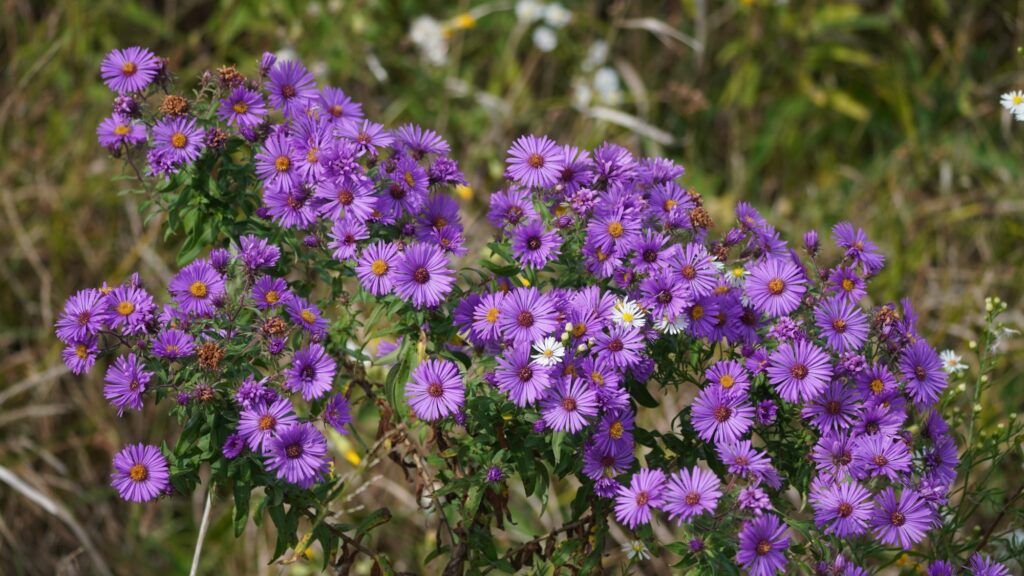
New England aster is one of the great flowers of the late-season garden. Just as summer begins giving way to fall, tall stems that have spent months quietly growing burst into masses of purple, violet, lavender, pink, or occasionally white daisy-like flowers with bright yellow centers.
The botanical name is Symphyotrichum novae-angliae. Older books and plant labels may still call it Aster novae-angliae, but botanists now place this North American species in the genus Symphyotrichum.
Whatever name you encounter, the plant is easy to recognize once it flowers.
Mature New England asters can reach 3 to 6 feet tall—or occasionally taller—and become covered with blooms from late summer into fall. Their timing is particularly valuable because bees, butterflies, and other pollinators are still searching for food while many earlier flowers have already finished.
New England aster is also a native perennial across a broad area of eastern and central North America. It naturally occurs in meadows, prairies, moist fields, streambanks, low areas, and other open habitats.
Its main garden challenges are size, occasional flopping, powdery mildew, and lower leaves that can become unattractive by flowering time. Fortunately, all of these are manageable through good placement, adequate spacing, and optional early-summer pruning.
Give New England aster full sun, average to moist soil, and enough room to develop, and it can become one of the most spectacular plants in the fall garden.
⚡ New England Aster Quick Care Guide
Botanical name: Symphyotrichum novae-angliae
Former botanical name: Aster novae-angliae
Common name: New England aster
Plant type: Herbaceous perennial
Family: Asteraceae
Native range: Eastern and central North America
Light: Full sun is best; partial shade is tolerated
Soil: Average to moist, well-drained soil
Soil tolerance: Clay and moderately dry conditions are tolerated once established
Height: Approximately 3 to 6 feet for the species; compact cultivars can stay around 18 inches to 3 feet
Spread: Approximately 2 to 3 feet or more
Bloom season: Late summer through fall, often August through October
Flower colors: Purple, violet, lavender, pink, rose, and occasionally white
Water: Average to consistently moist
Hardiness: Generally USDA Zones 3–9
Pruning: Pinch or cut back in late spring to early summer if shorter, bushier plants are desired
Propagation: Division and seed
Best uses: Pollinator gardens, native gardens, cottage gardens, rain gardens, meadow plantings, cutting gardens, perennial borders, and naturalized areas
💜 What Is New England Aster?
New England aster is a tall clump-forming perennial in the daisy family.
It grows from a perennial crown and underground rhizomes.
Fresh shoots emerge in spring and continue growing through summer. By late summer, the upper portions of the stems begin branching heavily and developing numerous flower buds.
When those buds open, the plant can appear almost completely covered with flowers.
After frost, the stems die back to the ground.
The root system survives underground and produces new growth the following spring.
That makes New England aster a true long-lived perennial rather than an annual flower that must be replanted every year.
🌼 What Do New England Aster Flowers Look Like?
The flowers resemble classic daisies.
Each flower head typically has numerous narrow ray florets—the colorful parts we usually think of as petals—surrounding a central disk of tiny yellow flowers.
The flower heads can reach roughly 1½ inches across.
Wild plants are typically purple to violet.
Garden cultivars expand the color range to include:
- Lavender
- Deep purple
- Rose pink
- Bright magenta-pink
- Red-purple
- Pale pink
- Occasionally white
The yellow centers may darken as the flowers age.
Because a mature plant carries so many flower heads, even a single specimen can create a substantial fall display.
🧬 Why Isn’t It Called Aster novae-angliae Anymore?
For many years, New England aster was known as Aster novae-angliae.
Botanical research eventually resulted in many North American asters being separated from the primarily Eurasian genus Aster.
New England aster is now classified as Symphyotrichum novae-angliae.
Older books, seed packets, websites, and nursery tags may still use the former name.
The change does not mean the plant itself has changed.
When researching care, you may encounter both names referring to the same species.
📏 How Tall Does New England Aster Grow?
The straight species is a substantial perennial.
Plants commonly reach approximately 3 to 6 feet tall and about 2 to 3 feet wide.
Under rich, moist conditions, stems can become even taller.
This is one reason New England aster works particularly well:
- At the back of perennial borders
- Along fences
- In meadow gardens
- In native plantings
- Behind shorter flowers
- In large rain gardens
- Along sunny woodland edges
If you have a small garden or want flowers closer to the front of a border, choose one of the compact cultivars rather than trying to keep a naturally 6-foot plant permanently miniature.
☀️ How Much Sun Does New England Aster Need?
Full sun is best.
Six or more hours of direct sunlight generally produces:
- Stronger stems
- Denser growth
- More flowers
- Better resistance to flopping
New England aster tolerates partial shade, but lower light can cause stems to stretch and lean.
Plants in shade may also produce fewer flowers.
For maximum fall color and the most compact growth, choose one of the sunnier areas of the garden.
For more help assessing garden light, visit Gardening Basics.
🌤️ Can New England Aster Grow in Partial Shade?
Yes.
A plant receiving several hours of sunlight can still grow and flower.
The tradeoff is usually greater height and weaker stems.
If your site receives only part-day sun, consider:
- Choosing a compact cultivar
- Pinching stems in early summer
- Planting among sturdy neighboring perennials
- Providing discreet support if needed
A little afternoon shade can be beneficial in extremely hot climates, but deep shade is not ideal.
🌎 Best Soil for New England Aster
New England aster prefers average to moist, fertile, well-drained soil.
It is also adaptable.
Established plants can tolerate:
- Clay
- Loam
- Moderately dry soil
- Seasonally moist locations
In nature, the species frequently occurs in meadows, lowlands, moist fields, and streamside habitats.
That makes it especially useful in parts of the garden that receive more moisture than a typical drought-tolerant perennial would prefer.
Good drainage still matters.
The plant tolerates moisture, but the crown does not need to remain permanently submerged.
Our Garden Soil Guide: Soil Types, Testing, pH & How to Improve It explains soil texture, drainage, organic matter, compost, and pH in more detail.
🧱 Can New England Aster Grow in Clay?
Yes.
New England aster performs well in clay and clay-loam soils when drainage and root conditions are reasonable.
That makes it an especially useful native perennial for gardeners who do not have light, fluffy loam.
Do not try to “fix” clay by adding a small amount of sand.
Instead:
- Protect the soil from compaction
- Avoid working it when saturated
- Add organic matter appropriately
- Mulch the surface
- Let plant roots gradually improve structure
Established asters can develop substantial root systems in clay soil.
💧 How Much Water Does New England Aster Need?
New England aster appreciates consistent moisture.
New plants should be watered regularly while their roots establish.
Mature plants are more adaptable and can tolerate occasional dry periods.
However, prolonged drought can cause:
- Lower-leaf browning
- Reduced flowering
- Smaller plants
- Earlier seasonal decline
If you want lush, tall plants with strong flowering, avoid allowing the soil to become severely dry for extended periods.
🌧️ New England Aster in Moist Soil
Moisture tolerance is one of this plant’s strongest features.
New England aster can perform well in areas such as:
- Moist perennial beds
- Rain-garden edges
- Low areas
- Streamside gardens
- Damp meadow plantings
Penn State includes it among useful rain-garden plants.
Very moist soil can encourage vigorous growth, however, so tall plants may benefit from early pruning or neighboring support.
🌧️ New England Aster in a Rain Garden
New England aster can make an excellent rain-garden perennial.
Its deep perennial root system, late flowers, and tolerance for clay and moist conditions make it useful where stormwater periodically collects.
Place it in a portion of the rain garden that becomes moist but is not continuously submerged.
Its mature height also gives a rain garden vertical structure.
Combine it with shorter moisture-tolerant native plants so the planting has multiple layers rather than a row of similarly tall stems.
For more lower-impact gardening ideas, visit Eco-Friendly Gardening.
📅 When Should You Plant New England Aster?
Spring and early fall are both good planting times.
Spring
Spring planting gives the root system an entire growing season to establish before winter.
Fall
Fall planting also works well when plants are installed early enough to establish roots before freezing weather.
Illinois Extension recommends allowing perennials such as asters at least several weeks in the ground before a hard freeze.
Avoid planting during extreme summer heat when possible.
If summer planting is unavoidable, keep the new plant consistently watered.
🌱 How to Plant New England Aster
Choose a site with enough room for the mature plant.
Dig a hole approximately as deep as the root ball and somewhat wider.
Remove the plant from its container.
Loosen severely circling roots if necessary.
Position the crown at approximately the same depth it was growing in the container.
Backfill with the surrounding soil.
Water thoroughly.
Add a moderate mulch layer around the root zone without burying the crown.
Because New England asters gradually enlarge through rhizomes, allow room for future expansion.
📏 How Far Apart Should New England Asters Be Planted?
Spacing depends on cultivar.
For large species-type plants, approximately 2 to 3 feet apart is a practical starting point.
Compact cultivars can be spaced more closely according to their mature width.
Proper spacing improves:
- Air circulation
- Flower visibility
- Access for maintenance
- Resistance to fungal problems
- Overall plant structure
Crowding several tall asters together immediately may look full during the first year but can create dense, mildew-prone growth later.
🍂 Mulching New England Aster
A moderate mulch layer helps maintain the consistent soil moisture asters prefer.
Suitable materials include:
- Shredded leaves
- Wood chips
- Shredded bark
- Other appropriate organic mulches
Keep mulch slightly away from the crown.
A broad layer over the soil helps suppress weeds and reduce evaporation.
As a mature perennial planting becomes denser, the plants themselves shade much of the ground and reduce weed pressure.
🌱 Does New England Aster Need Fertilizer?
Usually very little.
New England asters are naturally vigorous plants.
Excessive nitrogen can encourage tall, lush stems that flop.
In reasonably fertile garden soil, additional fertilizer may offer no advantage.
If plants are performing poorly, first consider:
- Sunlight
- Moisture
- Drainage
- Crowding
- Root competition
Use a soil test if nutrient deficiency is suspected.
Do not assume every tall flower benefits from annual heavy feeding.
🌿 Why Does New England Aster Flop?
Tall New England asters sometimes lean or collapse by late summer.
Common causes include:
Too Much Shade
Stems stretch toward available light.
Rich Soil
High fertility encourages excessive growth.
Excessive Nitrogen
Nitrogen promotes tall, soft stems.
Abundant Moisture
Excellent moisture can produce extremely vigorous growth.
Natural Genetics
The straight species simply grows tall.
Several techniques can reduce the problem.
✂️ Pinching New England Asters
Pinching is one of the easiest ways to keep tall asters shorter and bushier.
When stems are actively growing in late spring or early summer, remove several inches from the tips.
This encourages the plant to branch.
Instead of a few extremely tall stems, you get more numerous shorter flowering stems.
For larger plants, stems can be cut back by roughly one-third.
Pinching may delay bloom slightly, but the finished plant is often fuller and less likely to need staking.
📅 When Should You Stop Pinching New England Asters?
Stop height-control pruning by mid- to late summer so the plant has enough time to develop flower buds.
Missouri Botanical Garden recommends finishing repeated pinching before around mid-July, while Illinois Extension suggests stopping by late July.
Climate matters.
Gardeners in shorter northern growing seasons should stop earlier.
The important principle is not to continue cutting back stems once late-summer flowering growth needs to develop.
🌿 The Chelsea Chop and New England Asters
New England aster responds well to a technique similar to the Chelsea chop used on many late-flowering perennials.
Cut some or all stems back by approximately one-third around late spring to early summer.
You can even cut only the front half of a large clump.
Those stems will stay shorter and often bloom slightly later than untouched stems behind them.
The result can create:
- A layered shape
- Less flopping
- A slightly extended bloom period
- Flowers at several heights
This is optional, not required.
A New England aster in a meadow can simply be allowed to reach its natural height.
🪵 Does New England Aster Need Staking?
Not always.
Plants grown in full sun at moderate fertility may develop reasonably sturdy stems.
Tall specimens in rich or partly shaded gardens can benefit from support.
Install stakes or grow-through supports in spring before the stems become enormous.
Options include:
- Circular grow-through supports
- Peony rings
- Individual stakes
- Twine strung discreetly between stakes
- Strong neighboring plants
Avoid waiting until a storm has flattened a fully flowering 6-foot clump.
🌿 Use Other Plants as Natural Support
In a meadow or prairie-style garden, New England asters rarely grow as isolated specimens.
Their stems weave among grasses and neighboring wildflowers.
You can mimic that structure in the garden.
Suitable sturdy companions might include:
- Boltonia
- Goldenrods
- Ornamental grasses
- Ironweeds
- Joe-Pye weeds
- Coneflowers
A mixed planting can support itself more naturally than an isolated row of towering asters.
🌸 When Does New England Aster Bloom?
New England aster generally flowers from late summer into fall.
August through October is a typical bloom period.
Weather and climate influence exact timing.
This late season is one of the plant’s greatest strengths.
By the time New England aster opens, many summer perennials have finished flowering.
The asters help carry the garden toward frost.
🌙 New England Aster Flowers Can Close
New England aster flowers may close during cloudy conditions and at night.
That is a normal response rather than evidence that the flowers are dying.
When light and favorable conditions return, the blooms reopen.
The effect can make a colony look dramatically different from one part of the day to another.
🐝 New England Aster and Pollinators
New England aster is an outstanding late-season pollinator plant.
The flowers attract:
- Native bees
- Honey bees
- Butterflies
- Skippers
- Other nectar- and pollen-feeding insects
The late bloom period is especially important.
Pollinators still need food as autumn approaches, yet many summer plants have already stopped flowering.
A mature aster can provide hundreds of flower heads during this seasonal gap.
🦋 New England Aster and Monarch Butterflies
New England aster is particularly valuable as a nectar source for adult monarch butterflies during fall migration.
It is important to make a distinction:
Milkweed is the essential host plant for monarch caterpillars.
New England aster is valuable primarily as a nectar plant for adult butterflies.
A strong monarch garden can contain both.
Milkweeds support the caterpillar stage, while fall asters and other late flowers help fuel migrating adults.
🐛 Is New England Aster a Butterfly Host Plant?
Yes, asters also serve as host plants for the caterpillars of several other butterflies and moths.
Penn State identifies New England aster as a host for butterflies including pearl crescents and checkerspots.
That means its wildlife value extends beyond nectar.
Leaves that have been chewed by caterpillars are not necessarily damaged in a negative sense.
In a wildlife garden, some leaf consumption is evidence that the plant is participating in the food web.
🐦 Should You Leave New England Aster Standing in Winter?
There are good reasons to leave at least some stems standing after flowering.
Standing stems can:
- Provide winter structure
- Protect overwintering insects
- Hold seed
- Mark the plant’s location
- Add texture above snow
Penn State encourages leaving perennial stems through winter as part of wildlife-friendly gardening.
If you prefer a tidy landscape, you can still cut them down after frost.
A compromise is to leave the stems until late winter or early spring and clean them up shortly before new growth begins.
✂️ Should You Deadhead New England Aster?
Deadheading is optional.
Removing spent flowers can:
- Reduce self-seeding
- Keep formal beds looking tidier
- Occasionally prolong flowering somewhat
In large native plantings, deadheading hundreds of small flowers is unnecessary.
Leaving some seed heads also provides ecological and winter value.
Decide based on the style of the garden rather than assuming spent flowers must always be removed.
🌱 Does New England Aster Spread?
Yes.
New England aster gradually spreads through rhizomes and can also reproduce from seed.
It is generally clump-forming rather than wildly invasive, but a mature plant can increase substantially.
In a meadow or native border, spreading is usually welcome.
In a tightly organized formal garden, occasional division may be needed to keep the clump within bounds.
🌱 Does New England Aster Self-Seed?
It can.
Plants allowed to mature their seeds may produce seedlings in suitable nearby soil.
Seedlings may vary somewhat from cultivated parent plants.
If self-seeding is undesirable, remove flower heads before mature seed disperses.
If you are building a naturalistic meadow, self-sowing can help create a fuller planting.
✂️ Dividing New England Aster
New England aster benefits from periodic division when clumps become excessively dense.
Division can:
- Control plant size
- Improve airflow
- Renew crowded centers
- Provide new plants
- Reduce mildew pressure
Spring is an excellent time to divide asters as fresh shoots begin emerging.
Dig the clump, separate healthy vigorous sections, discard weak or dead center material, and replant promptly.
Water the divisions while their roots reestablish.
📅 How Often Should New England Aster Be Divided?
There is no universal calendar.
Illinois Extension recommends relatively frequent division where plants become dense and disease-prone.
For the ordinary home garden, dividing every few years as needed is a more practical rule.
Divide when:
- The clump becomes too large
- Air circulation becomes poor
- Flowering declines
- The center looks weak
- You want more plants
A healthy uncrowded aster does not need to be dug merely because a certain number of years has passed.
🌱 Growing New England Aster From Seed
New England aster can be grown from seed.
Seed propagation is particularly useful for:
- Native plantings
- Meadows
- Pollinator gardens
- Large naturalized areas
Seed-grown plants may show natural variation in height and flower color.
If you want an exact copy of a named cultivar, division is preferable.
Seeds can also spread naturally when flower heads are left standing.
💜 ‘Purple Dome’ New England Aster
‘Purple Dome’ is one of the most useful compact cultivars.
Instead of reaching 5 or 6 feet, it usually grows only about 18 to 24 inches tall and can spread approximately 3 feet wide.
It forms a dense mound covered with dark purple flowers from late summer into fall.
Its compact growth means:
- Little or no staking
- Easier placement in smaller gardens
- Flowers closer to eye level
- A neater border appearance
Gardeners who love New England aster flowers but do not want a towering plant should seriously consider ‘Purple Dome’.
💗 ‘Andenken an Alma Pötschke’
‘Andenken an Alma Pötschke’—often shortened in nursery listings—is known for vivid rose-pink to hot-pink flowers.
It grows taller and looser than ‘Purple Dome’ and works well in the middle or back of a sunny perennial border.
The saturated pink color stands out strongly among the more typical purple fall asters.
Pinching earlier in the season can help create a bushier plant.
🌸 Other New England Aster Cultivars
Gardeners may encounter additional selections with different heights and flower colors.
Look for cultivars chosen for traits such as:
- Compact growth
- Improved stem strength
- Deep purple flowers
- Pink flowers
- Longer bloom
- Disease performance
When shopping, pay as much attention to mature height as flower color.
A gorgeous purple flower on a 6-foot plant will not solve a 2-foot-space problem.
🌿 Why Are the Lower Leaves Turning Brown?
This is an extremely common New England aster complaint.
By the time plants reach full bloom, lower foliage may become:
- Brown
- Dry
- Yellow
- Sparse
- Generally unattractive
Illinois Extension notes that lower leaf browning during flowering can be normal.
Drought, shading within the dense plant, insects, and foliar diseases can make it worse.
This does not necessarily mean the whole plant is unhealthy.
One of the easiest solutions is design.
Put shorter perennials in front of the aster and let them hide the lower stems.
🌸 Hide Bare Aster Stems With Companion Plants
Instead of expecting a 6-foot New England aster to look perfect from soil level to flower tip, plant it as part of a layered border.
Good foreground companions can include:
- Black-eyed Susans
- Coneflowers
- Sedums
- Short ornamental grasses
- Compact goldenrods
- Lower asters
- Heucheras in suitable conditions
The companion foliage hides aging lower leaves while the aster flowers remain visible above.
This creates a much more natural and forgiving planting.
🌫️ Powdery Mildew on New England Aster
Powdery mildew can affect asters.
Leaves develop a pale or grayish powdery coating.
The disease can become more troublesome when:
- Plants are crowded
- Air circulation is poor
- Stems are very dense
- Plants receive too much shade
- Humidity remains high
New England aster is not always as severely affected as some other asters, but mildew is still worth watching.
Good spacing and full sun are the most useful starting points.
🌬️ Improve Air Circulation
Airflow can reduce the conditions that favor several foliage diseases.
Useful strategies include:
- Appropriate spacing
- Periodic division
- Avoiding severe crowding
- Keeping nearby plants from smothering the aster
- Growing in adequate sunlight
Do not create an unnaturally bare bed just for airflow.
The goal is simply to prevent one enormous solid wall of damp foliage.
💧 Avoid Drought Stress
Powdery mildew does not necessarily mean the foliage itself has been kept too wet.
In fact, drought-stressed plants can also become more vulnerable to problems.
Maintain appropriate root-zone moisture.
Water the soil rather than repeatedly misting the foliage.
Mulch can help maintain more stable moisture through hot weather.
🐛 New England Aster Pests
New England aster is generally resilient.
Possible pests include:
- Aphids
- Lace bugs
- Leafhoppers
- Mites
- Caterpillars
Minor feeding rarely threatens an established plant.
Remember that caterpillar feeding can be part of the ecological reason for growing a native aster.
Do not expect every leaf in a wildlife garden to remain untouched.
Use pest treatment only when damage genuinely threatens plant health.
🦌 Is New England Aster Deer Resistant?
New England aster is often described as relatively resistant to deer browsing, and Penn State lists it as deer resistant in rain-garden guidance.
However, deer behavior varies dramatically.
Penn State also notes that deer and rabbits may nibble flower buds and foliage under some circumstances.
The practical interpretation is:
New England aster is not usually a preferred deer food, but it is not absolutely deer-proof.
Young plants may need protection in areas with intense browsing pressure.
🐇 Do Rabbits Eat New England Aster?
Rabbits may occasionally nibble young growth.
Established plants can often tolerate moderate browsing.
Repeated heavy feeding on newly planted asters can delay establishment, so temporary protection may be worthwhile where rabbit pressure is severe.
Interestingly, light early browsing can have an effect similar to pinching by encouraging branching—although relying on rabbits as your pruning crew is not a particularly dependable gardening strategy.
🌻 New England Aster With Goldenrod
Few fall combinations are more natural than purple New England aster and yellow goldenrod.
The colors are complementary.
Both plants bloom late.
Both support pollinators.
Both occur together in natural landscapes.
The combination is especially effective in:
- Meadow gardens
- Native borders
- Pollinator gardens
- Large sunny perennial beds
Choose goldenrod species appropriate to your region and space because their growth habits vary considerably.
🌼 New England Aster With Boltonia
Boltonia makes another excellent companion.
New England aster provides stronger purple or pink color.
Boltonia contributes clouds of white or pale lavender flowers.
Both:
- Bloom late
- Prefer sun
- Tolerate moist soil
- Can become tall
- Support pollinators
In a large naturalistic planting, the two can create an impressive transition from late summer into autumn.
💜 New England Aster With Coneflowers
Coneflowers generally begin flowering earlier.
That makes them useful for extending the season.
Coneflowers dominate much of summer.
As their first flush declines and seed heads begin developing, New England asters start opening.
Leaving coneflower seed heads among blooming asters can create an attractive transition into fall.
💛 New England Aster With Black-Eyed Susans
Black-Eyed Susans provide bright yellow flowers that contrast with purple asters.
Depending on species and cultivar, their flowering seasons can overlap substantially.
Shorter Rudbeckias are also useful for disguising the New England aster’s lower stems.
This creates both a practical and ornamental partnership.
🍂 New England Aster With Helenium
Helenium provides warm yellow, orange, copper, and red flowers.
Purple New England asters provide cool contrast.
Both appreciate reliable moisture and can become substantial late-season perennials.
Use them together in large borders where their mature size will not overwhelm neighboring plants.
🌾 New England Aster With Ornamental Grasses
Grasses provide an ideal structural background.
By fall, many ornamental grasses are producing seed heads in shades of tan, bronze, silver, and gold.
Purple aster flowers stand out strongly against them.
Native grasses can also help create a more ecologically functional planting.
Possible combinations depend on region, soil moisture, and available space.
🦋 New England Aster in a Monarch Garden
A good monarch garden needs more than milkweed.
Milkweed is essential for caterpillars.
Adult monarchs also require nectar throughout their lives, particularly during migration.
New England aster is one of the strongest late-season nectar choices within its native range.
A useful planting sequence might include:
- Spring nectar plants
- Milkweeds
- Summer coneflowers and bee balms
- Late-summer blazing stars
- Fall New England asters and goldenrods
That keeps food available through much more of the monarch’s active season.
🌿 New England Aster in a Native Garden
Within its native range, New England aster is an excellent choice for ecological landscaping.
It provides:
- Late nectar
- Pollen
- Caterpillar host value
- Autumn color
- Perennial root structure
- Seed
- Cover within dense plantings
Remember that “native to North America” is broad.
If your goal is a strictly local native garden, confirm that Symphyotrichum novae-angliae occurs naturally in your region.
🌎 Is New England Aster Native Only to New England?
No.
The common name is misleading if interpreted too literally.
New England aster occurs across a much broader region than the six New England states.
Its native range extends through much of eastern and central North America.
It can be found in prairies, meadows, streambanks, low areas, fields, and other open habitats far beyond New England itself.
🌸 New England Aster in a Cottage Garden
New England aster works beautifully in a cottage-style border.
The tall stems and informal flowers create a relaxed appearance.
Place it behind roses and lower perennials where its fall flowers rise above the earlier-season planting.
Pinch the stems in early summer if you want a bushier, more controlled plant.
Allow them to grow naturally if a looser, taller effect suits the garden.
🌾 New England Aster in a Meadow Garden
A meadow is where tall New England aster can really behave like itself.
There is no need to force every stem into perfect vertical alignment.
Let it grow among:
- Goldenrods
- Native grasses
- Boltonia
- Ironweed
- Joe-Pye weed
- Milkweed
- Coneflowers
Neighboring vegetation provides natural support.
The plant’s large stature becomes an advantage rather than a problem.
🌧️ New England Aster Near a Pond
New England aster can work along the upper margins of ponds and streams where soil remains moist.
Plant above the permanent water line.
It is a moisture-loving perennial, not an aquatic plant.
Late-season purple flowers can look especially attractive reflected in water and combined with grasses or sedges.
💐 Is New England Aster a Good Cut Flower?
Yes.
The branching stems make useful late-season cut flowers.
Harvest when several flower heads are open but plenty of buds remain.
Use clean pruners and place stems in water promptly.
New England asters combine particularly well with:
- Sunflowers
- Goldenrod
- Boltonia
- Zinnias
- Dahlias
- Ornamental grasses
Tall unpinched plants can provide long stems, while pinched plants produce more branched filler stems.
🪴 Can New England Aster Grow in Containers?
Compact cultivars can.
The straight species is generally too large for ordinary containers.
For pot culture, choose a cultivar such as ‘Purple Dome’.
Use:
- A large container
- Drainage holes
- Quality potting medium
- Consistent watering
- Full sun
Containers dry much faster than garden soil, so moisture-loving asters require closer attention.
Winter hardiness is also reduced when roots are above ground.
🍂 Fall New England Aster Care
Fall is the season when all the summer growth finally pays off.
During bloom:
- Maintain moisture during drought
- Enjoy pollinator activity
- Cut flowers if desired
- Deadhead only if you want to limit seed
- Avoid unnecessary fertilizer
After a hard frost, decide whether to cut stems down or leave them for winter habitat.
Both approaches are valid.
❄️ Winter New England Aster Care
New England aster is dormant in winter.
The above-ground stems are dead after frost, while the perennial crown and roots remain alive underground.
No elaborate winter protection is normally necessary within its hardiness range.
A moderate mulch layer is sufficient.
If stems are left standing, they can remain until late winter or early spring.
🌱 Spring New England Aster Care
Spring is an excellent time for maintenance.
As new shoots appear:
- Remove old stems
- Divide oversized clumps
- Transplant divisions
- Remove unwanted spreading shoots
- Refresh mulch
- Check spacing
This is also the time to decide whether the plant needs eventual height control.
Once stems become tall in midsummer, it is harder to reshape them without affecting flowers.
☀️ Summer New England Aster Care
During summer:
- Maintain adequate moisture
- Avoid excessive fertilizer
- Pinch or cut back stems early if desired
- Watch for powdery mildew
- Install support before plants become huge
- Keep nearby plants from completely smothering the crown
By late summer, stop pruning and allow flower buds to develop.
⚠️ Common New England Aster Care Mistakes
Planting a Full-Size Aster in a Tiny Space
The species can reach 6 feet or more.
Giving It Too Much Shade
Plants become taller, weaker, and less floriferous.
Overfertilizing
Excess nitrogen contributes to floppy growth.
Waiting Too Long to Pinch
Late pruning can delay or reduce flowering.
Planting Too Densely
Poor airflow encourages foliage problems.
Panicking When Lower Leaves Turn Brown
Some late-season lower-leaf decline is common.
Allowing Severe Drought
New England aster prefers average to moist soil.
Treating Every Insect as a Pest
Native asters are meant to participate in the food web.
Assuming “New England” Means It Is Native Only to the Northeast
Its natural range is considerably broader.
💜 Is New England Aster Easy to Grow?
Yes.
Its basic care is straightforward.
Plant it in full sun.
Give it average to moist soil.
Allow enough space for its mature size.
Avoid excessive fertilizer.
Water while new plants establish.
Pinch stems in late spring or early summer if you want a shorter plant.
Divide crowded clumps when necessary.
Then allow it to flower.
Most of the perceived difficulty comes from trying to fit a naturally large meadow perennial into a space that is too small.
Give New England aster the room it deserves—or choose a compact cultivar—and it becomes considerably easier.
🍂 One of the Flowers That Defines Fall
A New England aster can spend most of summer unnoticed.
Its stems get taller.
Leaves fill in.
Other plants steal the attention.
Then the days shorten.
Hundreds of buds begin opening.
Suddenly, a green plant at the back of the garden becomes a wall of purple.
Bees move between the yellow flower centers.
Butterflies stop to feed.
Goldenrods glow nearby.
Grasses begin taking on their autumn color.
The plant that quietly occupied the background all summer becomes one of the defining flowers of fall.
That timing alone makes New England aster valuable.
But when you add its North American native status, pollinator value, rain-garden potential, cold hardiness, and ability to return year after year, it becomes much more than a seasonal decoration.
Give it sunshine, moisture, and room to grow.
Let shorter plants disguise the aging lower foliage.
Pinch it if you need a more compact shape—or let it tower over a naturalistic border.
Either way, New England aster can help make the end of the gardening season every bit as colorful as its beginning.
🔗 Related Articles
- Flower Gardening
- Gardening Basics
- Garden Soil Guide: Soil Types, Testing, pH & How to Improve It
- Eco-Friendly Gardening
- Seasonal Gardening
- Boltonia Care
- Coneflower Care: How to Grow Echinacea
- Black-Eyed Susan Care
- Helenium Care
📚 Sources & Further Reading
- NC State Extension — New England Aster (Symphyotrichum novae-angliae)
- Penn State Extension — Rain Garden Plants: New England Aster
- Penn State Extension — Native Herbs: A Benefit to Our Gardens and Our Pollinators
- Illinois Extension — Fall Flowering Asters
- Illinois Extension — Plant Asters for a Unique Display of Fall Color
- Missouri Botanical Garden — Native Plants to Attract Bees and Native Pollinators