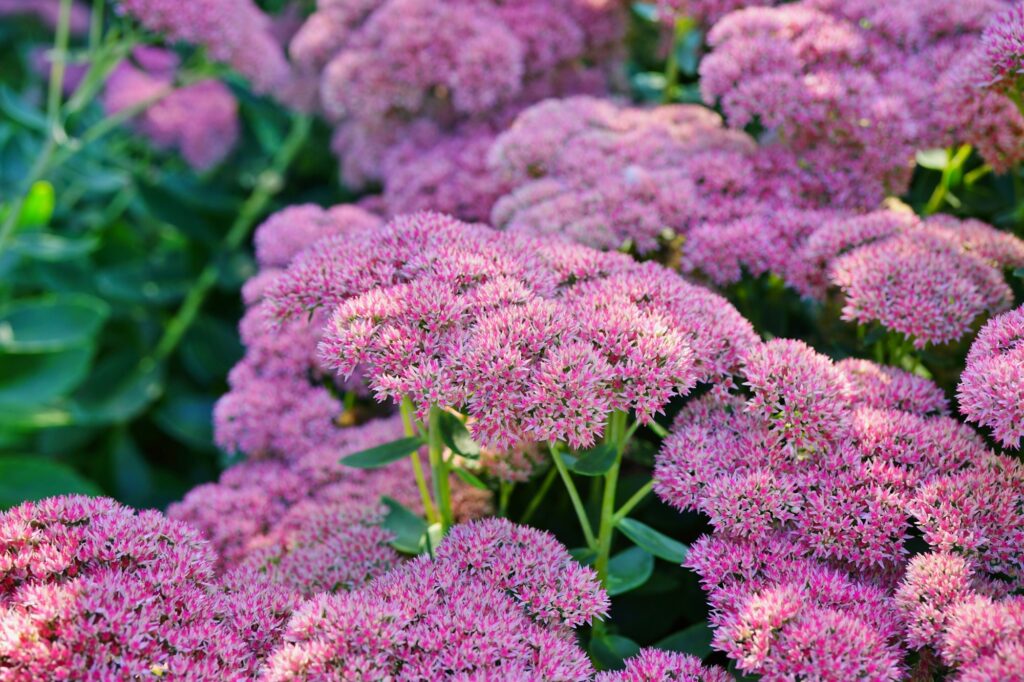
Autumn Joy sedum is one of the most dependable perennials for carrying a garden from summer into fall. Its sturdy stems and succulent green leaves form neat clumps through spring and summer, then broad clusters of tiny flowers begin changing from pale green to soft pink, deep rose, rusty red, and finally coppery brown as the season progresses.
The plant is widely known as Autumn Joy sedum, although modern botanical references often place it in the genus Hylotelephium rather than Sedum. You may see it labeled Hylotelephium ‘Herbstfreude’, Hylotelephium spectabile ‘Autumn Joy’, Sedum spectabile ‘Autumn Joy’, or simply Autumn Joy stonecrop.
For gardeners, the name change matters far less than the plant’s remarkably simple care.
Autumn Joy performs best in full sun and well-drained soil that is not excessively fertile. Once established, its fleshy leaves and stems give it excellent drought tolerance. In fact, gardeners are more likely to cause problems by giving Autumn Joy too much water or fertilizer than by neglecting it slightly.
The plant also has an unusually long season of interest. Fresh succulent foliage emerges in spring, flower buds develop through summer, pollinator-covered blooms dominate late summer and fall, and dried flower heads can remain standing through winter.
Give Autumn Joy sunshine, drainage, and relatively lean soil, and it can remain an easy, long-lived part of the garden for years.
⚡ Autumn Joy Sedum Quick Care Guide
Botanical name: Commonly listed as Hylotelephium ‘Herbstfreude’ or Hylotelephium spectabile ‘Autumn Joy’
Older name: Sedum spectabile ‘Autumn Joy’
Common names: Autumn Joy sedum, Autumn Joy stonecrop, showy stonecrop
Plant type: Herbaceous succulent perennial
Family: Crassulaceae
Height: Approximately 18 to 24 inches
Spread: Approximately 18 to 24 inches
Light: Full sun is best; light partial shade is tolerated
Soil: Average to lean, well-drained soil
Water: Low to moderate once established
Drought tolerance: High once established
Bloom season: Late summer through fall
Flower progression: Greenish buds to pink, rose-red, copper, and brown
Hardiness: Commonly grown in approximately USDA Zones 3–9
Pruning: Optional early-season pinching for shorter, bushier growth; cut old stems in late winter or early spring
Propagation: Division and stem cuttings
Best uses: Perennial borders, pollinator gardens, cottage gardens, rock gardens, xeric plantings, foundation beds, containers, and cutting gardens
Main problem: Excessive moisture, shade, or fertility can cause weak growth, flopping, and rot
🌿 Is Autumn Joy Really a Sedum?
Gardeners have called this plant Autumn Joy sedum for generations, and the name remains perfectly understandable.
Botanically, however, many of the tall, upright plants once included within the large genus Sedum have been moved into the genus Hylotelephium.
Modern sources therefore often call Autumn Joy Hylotelephium ‘Herbstfreude’.
“Herbstfreude” means approximately autumn joy in German.
You may encounter several names on plant labels, including:
- Hylotelephium ‘Herbstfreude’
- Hylotelephium spectabile ‘Autumn Joy’
- Sedum spectabile ‘Autumn Joy’
- Sedum ‘Autumn Joy’
They refer to the familiar upright fall-flowering perennial gardeners know as Autumn Joy.
🌱 What Does Autumn Joy Look Like?
Autumn Joy grows as a rounded clump of upright succulent stems.
In spring, fleshy blue-green to gray-green leaves emerge from the crown.
The leaves are thick because they store water, one of the characteristics that helps the plant tolerate drought.
Through early summer, the plant is primarily valued for its foliage and architectural form.
Large flattened flower clusters begin forming at the ends of the stems later in the season.
The buds often start pale green.
As they develop, the flower heads gradually become pink, then deepen into rose-red and eventually mature to rusty copper or brown.
Few perennials change appearance so gradually across such a long period.
🌸 When Does Autumn Joy Bloom?
Autumn Joy generally begins its main flower display in late summer and continues well into fall.
Depending on climate, flowering can begin around August and remain colorful through September and October.
The flowers do not simply open and disappear.
Their color evolves.
A typical progression may look something like:
Summer: Pale green flower clusters
Late summer: Soft pink
Early fall: Deep rose or reddish pink
Mid-fall: Darker red
Late fall: Copper, bronze, or rusty brown
The dried heads can remain attractive after frost.
This changing flower color gives Autumn Joy a much longer ornamental season than many perennials whose blooms last only a few weeks.
☀️ How Much Sun Does Autumn Joy Need?
Autumn Joy performs best in full sun.
Aim for at least six hours of direct sunlight each day.
Full sun helps produce:
- Stronger stems
- Denser growth
- Better flowering
- More intense flower color
- Lower risk of flopping
The plant can tolerate some partial shade, particularly in hot climates, but excessive shade tends to produce softer, more open growth.
If your Autumn Joy consistently falls outward or stretches toward the light, insufficient sun may be part of the problem.
For help evaluating your planting area’s light, visit Gardening Basics.
🌤️ Can Autumn Joy Grow in Partial Shade?
Yes, but it may not look quite as compact.
A few hours of shade usually causes little trouble, especially when the plant still receives plenty of direct sun during another part of the day.
In heavier shade, stems can become:
- Longer
- Softer
- More widely spaced
- More likely to flop
Flowering may also be reduced.
If you have a partly shaded garden, place Autumn Joy in the brightest section available rather than treating it as a shade perennial.
🌎 Best Soil for Autumn Joy Sedum
Autumn Joy prefers well-drained soil of average to relatively low fertility.
This is not a perennial that needs exceptionally rich soil.
In fact, overly fertile conditions can make it less attractive.
Plants grown in heavily amended, consistently moist soil may become lush and tall but develop weaker stems.
Autumn Joy performs well in:
- Loam
- Sandy soil
- Gravelly soil
- Rocky soil
- Moderately lean garden soil
Drainage matters much more than richness.
Our Garden Soil Guide: Soil Types, Testing, pH & How to Improve It explains soil texture, drainage, organic matter, and fertility in greater detail.
🪨 Autumn Joy Likes Lean Soil
Gardeners often assume every flowering perennial performs better when compost and fertilizer are added generously.
Autumn Joy is a good example of why that rule does not always work.
Lean soil often produces:
- Shorter growth
- Stronger stems
- Better structure
- Less flopping
If your soil already supports healthy perennial growth, there may be no reason to enrich the planting hole dramatically.
Save heavy compost applications for plants that actually need them.
💧 Drainage Is Essential
The fastest way to create problems for Autumn Joy is to plant it in persistently wet soil.
Its succulent stems and leaves are adapted to storing moisture.
Roots and crowns can rot when soil remains saturated.
Choose a site where excess water drains readily after rainfall.
Avoid:
- Low spots that remain waterlogged
- Heavy irrigation
- Permanently saturated clay
- Pots without drainage holes
- Thick wet mulch packed against the crown
If your garden naturally stays moist, choose a perennial adapted to those conditions rather than forcing Autumn Joy to tolerate them.
🧱 Can Autumn Joy Grow in Clay Soil?
Yes, provided the clay drains reasonably well.
Clay itself is not automatically unsuitable.
Compacted clay that remains saturated is the problem.
Avoid working clay soil while it is wet because this can damage structure.
Do not attempt to correct heavy clay by adding a small quantity of sand.
Instead, improve the broader bed gradually with appropriate organic matter, mulch, roots, and reduced compaction.
If water still pools for long periods, choose a raised area or different location for Autumn Joy.
🏜️ Can Autumn Joy Grow in Sandy Soil?
Yes.
Sandy and gravelly soils can suit Autumn Joy extremely well.
The plant’s succulent tissues help it tolerate soil that dries relatively quickly.
New plants still need moisture while establishing.
Once mature, however, Autumn Joy generally handles dry conditions much better than perennials requiring consistently moist soil.
A modest organic mulch can help prevent extremely rapid drying without turning the bed into rich, water-retentive soil.
💦 How Often Should You Water Autumn Joy?
Newly planted Autumn Joy should be watered regularly until roots establish.
After establishment, water much less frequently.
Allow the soil to dry somewhat between waterings.
Do not keep the plant constantly moist simply because it is flowering.
Signs that irrigation may be excessive include:
- Soft growth
- Stems collapsing outward
- Crown rot
- Yellowing foliage
- Blackened or rotting stems
A mature plant growing in the ground may need little supplemental water except during extended drought.
🌵 Is Autumn Joy Drought Tolerant?
Yes.
Drought tolerance is one of its strongest traits.
Its thick succulent leaves store moisture, allowing established plants to withstand dry periods that stress many conventional perennials.
Drought tolerant does not mean completely independent of water.
During prolonged severe drought, plants may still benefit from a thorough watering.
The goal is occasional deep moisture, not constant irrigation.
🌱 How to Plant Autumn Joy
Choose a sunny site with excellent drainage.
Dig a hole approximately as deep as the nursery root ball and somewhat wider.
Remove the plant from its container and loosen tightly circling roots if necessary.
Place the crown at approximately the same level it was growing in the container.
Backfill with the existing soil.
Water thoroughly to settle the soil around the roots.
Add a light mulch layer if desired, keeping it away from direct contact with the crown.
Do not bury the crown deeply.
📅 When Should You Plant Autumn Joy?
Spring is an excellent time.
Plants installed in spring have an entire growing season to establish before winter.
Early fall can also work well, particularly in moderate climates.
Plant early enough that roots have time to begin establishing before hard freezes.
Container-grown Autumn Joy can technically be installed during summer, but you will need to monitor moisture much more closely during hot weather.
Avoid transplanting during extreme heat whenever possible.
📏 How Far Apart Should Autumn Joy Be Planted?
Allow approximately 18 to 24 inches between plants in most borders.
A mature clump can reach roughly 2 feet across.
The spacing may look generous when plants are small.
Within a couple of seasons, established clumps become substantially broader.
Crowding creates unnecessary competition and can reduce airflow around the stems.
If planting Autumn Joy in a mass, stagger plants rather than arranging them in rigid rows for a softer appearance.
🌿 Why Is My Autumn Joy Flopping?
Flopping is probably the most common Autumn Joy complaint.
A well-grown plant should form a sturdy upright mound.
When stems fall outward and leave an open center, investigate the growing conditions.
Common causes include:
Too Much Shade
Weak stems stretch toward available light.
Excessive Fertility
Rich soil encourages soft, rapid growth.
Too Much Fertilizer
High nitrogen is particularly likely to produce oversized stems.
Excessive Moisture
Constant irrigation can create lush growth that lacks structural strength.
Overcrowding
Older dense clumps can lose their compact form.
Heavy Flower Heads
Even healthy stems can bend somewhat after heavy rain, especially when the plant has grown too tall.
Correct the growing conditions before resorting to permanent staking.
✂️ How to Keep Autumn Joy From Flopping
There are several effective strategies.
First, make sure it receives enough sun.
Second, stop fertilizing unnecessarily.
Third, avoid keeping the soil constantly wet.
If the plant still grows taller than you want, pinch or cut the stems back earlier in the growing season.
Shorter stems develop additional branching and often become much sturdier by flowering time.
✂️ Pinching Autumn Joy Sedum
Autumn Joy responds well to pinching.
When stems are developing during spring, remove the growing tips to encourage branching.
You can also cut stems back more substantially in late spring or early summer.
The result is usually:
- Shorter plants
- More branching
- Additional flower heads
- Stronger overall structure
Flowering may occur somewhat later.
Stop cutting once summer progresses enough that flower development needs to begin.
🌿 Can You Do a Chelsea Chop on Autumn Joy?
Yes.
Autumn Joy can respond well to a Chelsea-chop-style cutback.
Cut stems back by roughly one-third around late spring.
For a more natural appearance, cut only some stems.
Those pruned stems will remain shorter and may flower somewhat later than untouched stems.
This can create several heights and slightly extend the overall display.
A cutback is optional.
Autumn Joy growing in full sun and lean soil may remain perfectly sturdy without it.
🌱 Does Autumn Joy Need Fertilizer?
Usually not much.
Autumn Joy often performs better when gardeners resist feeding it.
If your garden soil is reasonably fertile, additional fertilizer may simply cause:
- Excessive stem growth
- Flopping
- Reduced structural quality
A light spring application may be appropriate in genuinely poor soil, but use fertilizer according to actual need rather than routine.
Do not fertilize merely because the flowers look smaller than you expected.
Cultivar genetics, sunlight, and plant maturity also affect flower size.
🍂 Should You Mulch Autumn Joy?
A light mulch layer is useful for weed suppression and soil protection.
Avoid thick moisture-retentive mulch piled against the crown.
Autumn Joy appreciates an environment where the crown can remain relatively dry and well ventilated.
In rock gardens or xeric-style plantings, gravel mulch can also work well.
The important point is to avoid burying the plant beneath layers of wet organic material.
🌸 How Do Autumn Joy Flowers Change Color?
This gradual transformation is one of the plant’s signature features.
Early flower clusters appear green.
As tiny individual flowers begin opening, the clusters become pale pink.
Color then deepens toward:
- Rose
- Dusty red
- Brick red
- Copper
- Rust
- Brown
Weather influences exact coloring.
Cool nights and autumn temperatures often intensify the mature shades.
Because the same flower heads remain attractive throughout the transition, the plant can provide months of visual interest.
🐝 Autumn Joy and Pollinators
Autumn Joy is an excellent late-season pollinator plant.
The broad flower clusters attract:
- Bees
- Bumble bees
- Butterflies
- Other nectar-feeding insects
Large flower heads create convenient landing platforms where insects can move easily among dozens of small flowers.
The late bloom period is particularly useful because many summer perennials have begun fading.
For a stronger pollinator garden, combine Autumn Joy with earlier flowers so food remains available throughout the growing season.
Our Eco-Friendly Gardening hub covers broader strategies for supporting pollinators and other wildlife.
🦋 Is Autumn Joy Good for Butterflies?
Yes.
Butterflies readily visit the flowers.
On warm fall days, a mature clump may attract several butterflies at once.
The flat flower clusters are particularly accessible.
Pair Autumn Joy with native fall flowers such as New England Aster to create a stronger late-season nectar planting.
💜 Autumn Joy With New England Aster
This is an outstanding autumn combination.
Autumn Joy provides:
- Broad rose-red flower clusters
- Thick succulent foliage
- A rounded 2-foot form
New England Aster provides:
- Tall branching stems
- Purple, violet, or pink daisy-like flowers
- A lighter, airier texture
The plants also attract many of the same late-season pollinators.
Place the taller aster behind Autumn Joy.
🤍 Autumn Joy With Boltonia
Boltonia provides clouds of white or lavender daisy-like flowers while Autumn Joy contributes dense rose-colored heads.
The difference in flower size and plant structure creates strong contrast.
Both flower late, but their soil preferences differ somewhat.
Boltonia is comfortable with considerably more moisture.
Autumn Joy needs better drainage and generally prefers drier conditions.
Use them in different moisture zones of the same sunny border rather than forcing them into identical soil.
💛 Autumn Joy With Black-Eyed Susans
Black-Eyed Susans add bright yellow flowers to the autumn palette.
The contrast between golden Rudbeckia and pink-red Autumn Joy can be particularly strong.
Shorter black-eyed Susans can be planted in front or woven around the sedum.
Their flower timing varies by species and cultivar, but substantial overlap is possible.
💜 Autumn Joy With Coneflowers
Coneflowers and Autumn Joy share several practical qualities.
Both:
- Prefer abundant sunlight
- Tolerate dry conditions
- Need good drainage
- Attract pollinators
- Work well in naturalistic perennial borders
Coneflowers usually begin blooming earlier.
Their seed heads remain attractive as Autumn Joy enters its peak season.
That helps the same bed transition smoothly from summer into fall.
🍂 Autumn Joy With Helenium
Helenium contributes yellow, orange, red, and bronze flowers.
Those warmer colors work beautifully with deepening Autumn Joy flowers.
Helenium generally prefers more consistent moisture, so provide a site where each plant’s needs can be met.
A sunny border with moderate drainage often works well.
🌾 Autumn Joy With Ornamental Grasses
Few combinations are more effective in fall.
Ornamental grasses provide:
- Vertical foliage
- Movement
- Tan or silver seed heads
- Winter texture
Autumn Joy provides broad flower heads in pink, red, and rust.
As fall progresses, both plants take on increasingly muted colors.
Leave the dried structures standing through winter for an especially attractive cold-season display.
💐 Is Autumn Joy a Good Cut Flower?
Yes.
The flower heads make excellent cut flowers.
They can be harvested at several stages.
Green Bud Stage
Useful for fresh green texture.
Pink Stage
Provides softer color.
Deep Rose Stage
Creates stronger fall arrangements.
Dried Stage
Mature brown flower heads can be used in dried arrangements.
Cut sturdy stems with clean pruning shears and place them in water promptly.
Because the flower heads are large, a few stems can fill a vase.
✂️ Should You Deadhead Autumn Joy?
You can, but there is little reason to rush.
The flower heads remain ornamental long after the bright color fades.
By late fall, they become rusty or brown and can add structure to the winter garden.
Leaving them also avoids unnecessary fall cleanup.
If you want to prevent any seed production or prefer an exceptionally tidy garden, cut the stems after flowering.
Otherwise, leave them standing.
❄️ Leave Autumn Joy Standing Through Winter
Autumn Joy is particularly attractive after frost.
The dried flower heads remain upright above the dormant garden.
Snow can collect on them, creating dramatic winter shapes.
Standing stems also provide:
- Habitat
- Structure
- Visual interest
- A marker showing where the plant’s crown is located
Cut the old stems down in late winter or early spring before new shoots become tall.
This is often more useful than clearing the plant immediately after the first frost.
✂️ When Should You Cut Autumn Joy Back?
The simplest schedule is:
Late winter or early spring: Cut last year’s dead stems close to the ground.
New shoots will emerge from the crown.
If you want a more manicured garden, stems can be removed in late fall after they die.
Leaving them through winter does not harm the plant.
Avoid accidentally cutting new spring shoots while removing old growth.
🌱 What Does Autumn Joy Look Like in Spring?
Spring growth begins as clusters of compact shoots emerging directly from the crown.
At first, they may resemble small succulent rosettes.
As stems lengthen, fleshy leaves develop in opposite or whorled arrangements along them.
The rounded spring growth is ornamental enough that Autumn Joy contributes to the garden long before flowers appear.
This makes it more useful than perennials that remain visually insignificant until bloom.
☀️ Summer Autumn Joy Care
During summer, maintenance is minimal.
Focus on:
- Keeping the plant in full sun
- Watering only when genuinely needed
- Avoiding excessive fertilizer
- Pinching early enough if height control is desired
- Watching for signs of rot
- Removing weeds
Flower clusters become increasingly obvious as summer progresses.
Once buds are well developed, stop pinching and allow flowering to continue naturally.
🍂 Fall Autumn Joy Care
Fall is peak season.
There is very little to do.
Enjoy the color progression.
Watch bees and butterflies use the flowers.
Water only if a severe prolonged drought occurs.
Avoid major fertilizer applications.
Leave flower heads standing as they darken.
The plant naturally begins preparing for dormancy after frost.
❄️ Winter Autumn Joy Care
The living crown remains underground or close to soil level.
Dead stems and dried flower heads can stay in place.
Established plants generally need no elaborate winter protection within their hardiness range.
Avoid allowing water to accumulate around the dormant crown.
Winter wetness is usually a greater threat than winter cold.
🌱 Does Autumn Joy Spread?
Autumn Joy is a clump-forming perennial rather than an aggressive running plant.
The crown gradually broadens over time.
A mature clump can reach roughly 2 feet across.
It may occasionally produce seedlings, but uncontrolled spreading is generally not a major concern.
This makes Autumn Joy relatively easy to integrate into a structured perennial border.
✂️ Dividing Autumn Joy
Autumn Joy is easy to divide.
Spring is an excellent time, just as new shoots begin emerging.
Division is useful when:
- The clump becomes very large
- The center begins opening
- Stems repeatedly flop outward
- You want additional plants
- The plant has outgrown its location
Dig the entire clump or remove a section.
Separate it into healthy pieces containing roots and shoots.
Replant promptly and water while the divisions establish.
📅 How Often Should Autumn Joy Be Divided?
There is no need to divide on a strict schedule.
Many clumps remain attractive for years without intervention.
Consider division approximately every few years if the plant shows that it needs it.
Signs include:
- A hollow center
- Crowding
- Reduced vigor
- Excessive size
- Persistent flopping caused by an overgrown crown
Healthy compact clumps can simply be left alone.
🌱 Propagating Autumn Joy From Cuttings
Autumn Joy is also relatively easy to propagate from stem cuttings.
Take healthy non-flowering stem sections during active growth.
Remove the lower leaves and place the stems into a well-drained propagation medium.
Keep the medium lightly moist rather than saturated.
Roots can develop from the stem nodes.
Division remains the easiest method when you already have a large established clump, but cuttings are useful when you want several smaller plants.
🍃 Can Autumn Joy Be Propagated From Leaves?
Like many succulent relatives, pieces of Autumn Joy can sometimes root readily.
Stem cuttings are generally more dependable than individual leaves for ordinary home propagation.
If experimenting, allow cut material to remain healthy and avoid keeping it excessively wet.
Succulent material is especially vulnerable to rot in saturated propagation media.
🪴 Can Autumn Joy Grow in Containers?
Yes.
Its modest mature size and drought tolerance make Autumn Joy an excellent container perennial.
Choose:
- A pot with drainage holes
- A well-drained container mix
- A sunny location
- Enough room for a roughly 2-foot plant
Do not use dense garden soil in the container.
Container-grown plants need somewhat more frequent watering than those in the ground because the root zone dries faster.
Avoid leaving the pot sitting in a saucer full of water.
🪨 Autumn Joy in a Rock Garden
Autumn Joy is naturally suited to rock and gravel gardens.
Its succulent foliage and tolerance for lean, well-drained soil allow it to thrive in conditions that would be too dry for many perennials.
Give the plant enough space.
At approximately 2 feet tall and wide, Autumn Joy is much larger than creeping stonecrops.
Use it as an upright focal point rather than expecting it to form a low groundcover.
🌵 Autumn Joy in a Drought-Tolerant Garden
Autumn Joy works beautifully in water-wise landscapes once established.
Combine it with other sun-loving plants adapted to good drainage and moderate drought.
Potential companions include:
- Coneflowers
- Black-eyed Susans
- Catmint
- Lavender where climate and soil permit
- Ornamental grasses
- Other upright and creeping sedums
Group plants according to water needs.
This makes irrigation much easier and avoids overwatering drought-tolerant species simply because moisture-loving plants are growing nearby.
🏡 Autumn Joy Along a Foundation
Autumn Joy’s tidy rounded form makes it useful near foundations.
Choose a location with enough sunlight and good drainage.
Avoid planting directly beneath a roofline that pours concentrated water onto the crown.
The mature plant is relatively compact, so it does not create the same long-term size problems as a large shrub.
Its winter flower heads also add interest to foundation beds after annuals and other perennials have disappeared.
🧱 Autumn Joy Along Walkways
Autumn Joy works particularly well beside paths.
Its form stays compact enough that it generally does not overwhelm a walkway.
The late flowers also attract butterflies where they can be observed closely.
Give the plant enough clearance that mature stems do not flop into the path.
Full sun and lean soil are particularly useful when a tidy upright form is important.
🌿 Why Is My Autumn Joy Opening in the Middle?
An older clump can sometimes develop an open or hollow center.
Several factors may contribute:
- Overcrowding
- Excessive fertility
- Too much moisture
- Shade
- A mature crown that needs division
If cultural conditions are appropriate but the center continues collapsing, divide the plant in spring.
Replant vigorous outer sections and discard weak central material.
This can restore a tighter clump.
🍃 Why Are Autumn Joy Leaves Turning Yellow?
Several conditions can cause yellow foliage.
Excessive Water
Wet soil is one of the most common concerns.
Poor Drainage
Roots cannot function normally when deprived of oxygen.
Crown or Root Rot
More serious decline may begin near the base.
Natural Seasonal Aging
Leaves yellow and die as winter dormancy approaches.
Transplant Stress
Recently planted divisions can temporarily lose older foliage.
Check soil moisture first.
Do not automatically apply fertilizer to a yellowing succulent perennial.
🖤 Why Are Autumn Joy Stems Turning Black?
Dark, soft, collapsing stems near the base can indicate rot.
Inspect the crown and soil.
If the planting remains wet for long periods, improve drainage immediately.
Remove badly affected material.
Severe crown rot can kill sections of the plant.
Healthy surviving portions may be divided and moved to a better-drained location.
🐛 Autumn Joy Pests
Autumn Joy usually has few serious pest problems.
Potential pests include:
- Aphids
- Mealybugs
- Scale
- Slugs
- Weevils
- Certain nematodes
Minor infestations often have little impact on established plants.
Inspect the problem before applying pesticides.
A plant valued for attracting bees and butterflies should not be sprayed indiscriminately during flowering.
🐌 Slugs and Snails
Slugs may occasionally feed on young succulent growth.
Damage tends to matter most during spring when stems are still small.
Once the plant becomes larger, limited chewing generally does little harm.
If damage becomes serious, reduce excessive moisture and hiding places around the plant and use targeted control where appropriate.
🌧️ Crown and Root Rot
Rot is the disease concern most directly connected to Autumn Joy’s basic care.
The plant wants drainage.
When the root zone stays saturated, crowns and roots can deteriorate.
Prevention is much easier than treatment.
Do not compensate for poor drainage by adding more fertilizer or repeatedly replacing dead plants in the same unsuitable hole.
Move Autumn Joy to higher, drier ground.
🦌 Is Autumn Joy Deer Resistant?
Deer resistance can vary, and Autumn Joy should not be considered completely deer-proof.
Succulent foliage may occasionally be browsed.
Local deer populations differ dramatically in what they are willing to eat.
If deer pressure is severe, young plants may need protection until you learn how local animals respond.
🐇 Do Rabbits Eat Autumn Joy?
Autumn Joy is generally considered resistant to rabbit browsing.
North Carolina Extension lists rabbit resistance among the cultivar’s useful traits.
No plant is immune to every hungry animal, but rabbit damage is usually not one of Autumn Joy’s primary problems.
🐝 Should You Spray Autumn Joy for Insects?
Usually not.
Seeing insects on flower heads is normally a good thing.
Bees, butterflies, flies, and other pollinators frequently visit Autumn Joy.
Do not mistake normal pollinator activity for infestation.
Treat only when you have correctly identified a harmful pest and the damage genuinely warrants intervention.
🌎 Is Autumn Joy Native to North America?
No.
The upright Hylotelephium plants associated with Autumn Joy originate from Eurasian species.
Autumn Joy is grown in North America as an ornamental perennial.
If your goal is a strictly native garden, choose locally native alternatives.
In a mixed ornamental landscape, however, Autumn Joy still provides useful late-season nectar for pollinating insects and is valued for its durability and long ornamental season.
🌸 Autumn Joy vs. Creeping Sedum
Not all sedums look alike.
Autumn Joy is an upright clump-forming perennial approximately 2 feet tall.
Many other plants still called Sedum are low-growing groundcovers that creep over rocks, walls, and dry soil.
Both groups share succulent characteristics and generally prefer good drainage.
But they serve very different landscape purposes.
Do not purchase Autumn Joy expecting it to form a low mat.
Likewise, a 4-inch creeping stonecrop will not replace the vertical structure of Autumn Joy.
🌿 Autumn Joy vs. Other Upright Hylotelephiums
Many modern cultivars have expanded the selection of upright stonecrops.
Some offer:
- Dark purple foliage
- Variegated leaves
- Deeper red flowers
- More compact growth
- Stronger stems
- Different mature heights
Autumn Joy remains a classic because it is dependable and widely adapted.
Newer cultivars may be worthwhile when you want a specific foliage color or more compact form.
🎨 Designing With Autumn Joy
Autumn Joy works particularly well when surrounded by contrasting textures.
Its broad flattened flower heads and thick succulent leaves look good beside:
- Fine ornamental grasses
- Daisy-shaped flowers
- Narrow foliage
- Upright spikes
- Airy branching perennials
Color combinations can also change with the season.
Soft pink flowers work with purple and blue summer plants.
Deep rose-red flowers pair beautifully with yellow and gold in early fall.
Rusty late-season heads blend with bronze grasses and autumn foliage.
🌱 A Simple Autumn Joy Garden
For a low-maintenance sunny border, try:
Back layer: New England asters and ornamental grasses
Middle layer: Autumn Joy sedum and coneflowers
Front layer: Black-eyed Susans or lower drought-tolerant perennials
This combination provides:
- Summer flowers
- Late-season flowers
- Pollinator resources
- Strong autumn color
- Winter seed-head structure
Keep the soil well drained and avoid excessive fertilizer.
That simple approach can create a border that looks increasingly interesting as summer turns into fall.
⚠️ Common Autumn Joy Sedum Care Mistakes
Planting in Too Much Shade
Full sun produces stronger, more compact growth.
Overwatering
Autumn Joy is drought tolerant and dislikes persistently wet soil.
Planting in Poorly Drained Ground
Crown and root rot can follow.
Overfertilizing
Rich soil creates soft, floppy stems.
Adding Too Much Compost
This plant does not need extremely fertile soil.
Staking Instead of Fixing the Growing Conditions
Repeated flopping often points to shade, water, or fertility problems.
Cutting Back Too Late
If using a Chelsea chop or pinching, do it before flower development is advanced.
Removing Flower Heads Immediately After Bloom
The dried heads can provide excellent winter interest.
Confusing Autumn Joy With Creeping Sedums
It is an upright perennial rather than a low groundcover.
Watering It Like a Moisture-Loving Perennial
Group Autumn Joy with plants that prefer similar dry-to-average conditions.
🌸 Is Autumn Joy Sedum Easy to Grow?
Very.
It is one of those plants that often performs best when gardeners do less.
Give it full sun.
Provide well-drained soil.
Water while it establishes.
Reduce irrigation once mature.
Avoid heavy fertilizer.
Divide it when the clump genuinely becomes crowded.
Leave the flower heads through winter if you like their appearance.
That is most of the care Autumn Joy requires.
When problems do occur, they are frequently caused not by neglect but by excessive attention—too much water, too much fertilizer, too much compost, or too little sunlight.
🍂 A Perennial That Gets Better as Summer Ends
Autumn Joy is easy to ignore in spring.
The succulent shoots emerge neatly from the soil and form a pleasant mound of green.
Through early summer, they remain quiet while roses, lilies, and other flowers take center stage.
Then broad clusters of buds begin forming.
They start green.
They turn pink.
Bees arrive.
The flowers deepen to rose and red as the nights become cooler.
By late autumn, the same flower heads have become rusty copper.
After frost, they turn brown but remain standing.
Snow collects on them.
Then, just as new spring shoots begin appearing at the base, the old stems can finally be removed.
That long progression is why Autumn Joy has remained a garden favorite for decades.
It does not need perfect soil, constant irrigation, or complicated pruning.
It needs sun.
It needs drainage.
And, perhaps most importantly, it needs gardeners to resist loving it to death.
Give Autumn Joy slightly lean conditions and room to grow, and it can provide interest from the first spring shoots until the final snow of winter.
🔗 Related Articles
- Flower Gardening
- Gardening Basics
- Garden Soil Guide: Soil Types, Testing, pH & How to Improve It
- Eco-Friendly Gardening
- Seasonal Gardening
- New England Aster Care
- Boltonia Care
- Coneflower Care: How to Grow Echinacea
- Black-Eyed Susan Care
- Helenium Care