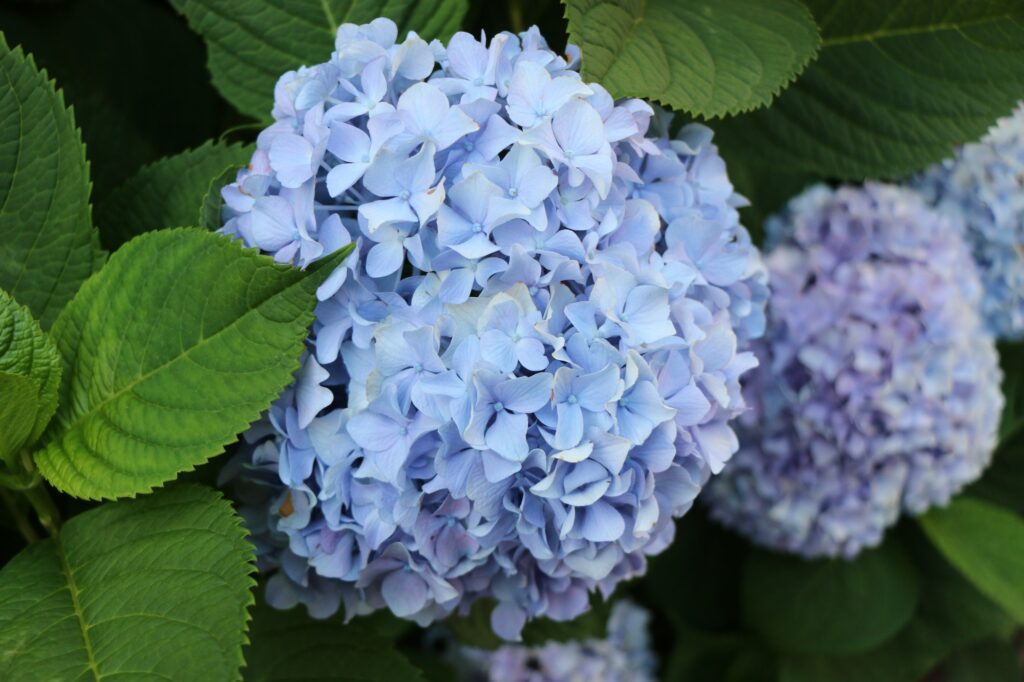
Coffee grounds are frequently recommended as a natural amendment for hydrangeas. One of the most persistent pieces of gardening advice claims that spreading used coffee grounds around a hydrangea will acidify the soil and turn its flowers blue.
The reality is more complicated.
Used coffee grounds can be a useful addition to compost because they contribute organic material and nutrients as they decompose. But they are not a dependable way to lower soil pH, and sprinkling them around a hydrangea is unlikely to provide enough predictable change in soil chemistry to control flower color.
Blue hydrangeas require more than simply acidic soil. Certain hydrangeas can produce blue flowers when aluminum is available to their roots under sufficiently acidic conditions. Raise the pH or reduce aluminum availability, and those same cultivars may become pink or purple instead.
Other hydrangeas will remain white, cream, green, or another genetically determined color regardless of how many coffee grounds you add.
So you can certainly save your morning coffee grounds for the garden. Just use them for what they genuinely do well — preferably as part of compost — rather than treating them as a magic hydrangea-color treatment.
☕ Are Coffee Grounds Good for Hydrangeas?
They can contribute indirectly to a healthy garden when composted appropriately.
Used coffee grounds contain organic material along with small amounts of plant nutrients. As they decompose, they can become part of the organic matter that improves soil structure and supports nutrient cycling.
However, coffee grounds are not:
- A complete hydrangea fertilizer
- A reliable soil acidifier
- A guaranteed way to make flowers blue
- A substitute for a soil test
- A dependable pest-control treatment
The best way to use them is as one ingredient in a varied compost pile.
Once that material has decomposed into finished compost, it can be applied around hydrangeas where additional organic matter is beneficial.
For complete growing instructions, see Hydrangea Care.
🌸 Do Coffee Grounds Turn Hydrangeas Blue?
Not reliably.
This is the main myth worth correcting.
Used coffee grounds may have a mildly acidic pH in some circumstances, but their pH is variable and often much closer to neutral after brewing than many gardeners assume.
Even if the grounds did lower soil pH slightly, that alone would not guarantee blue flowers.
Hydrangea flower color depends on:
- Hydrangea species and cultivar
- Soil pH
- Aluminum availability
- Root access to that aluminum
- Existing soil chemistry
Coffee grounds provide no precise control over those factors.
If your goal is intentionally changing hydrangea color, test the soil and use amendments designed for predictable soil-pH management rather than applying random quantities of coffee grounds.
💙 Why Do Some Hydrangeas Turn Blue?
Certain hydrangeas can absorb aluminum from acidic soil.
When that aluminum becomes available to the plant, pigments in the flowers interact with it, producing blue or blue-purple colors.
This effect is particularly associated with some cultivars of:
- Bigleaf hydrangea (Hydrangea macrophylla)
- Mountain hydrangea (Hydrangea serrata)
A simplified rule is:
More acidic soil + available aluminum = greater potential for blue flowers.
But genetics still matter.
A cultivar must already have the ability to change color.
🩷 Why Do Some Hydrangeas Turn Pink?
As soil pH rises, aluminum becomes less readily available to hydrangea roots.
Certain color-changing hydrangeas therefore shift toward:
- Pink
- Rose
- Mauve
- Purple
A simplified rule is:
Less acidic soil + reduced aluminum availability = greater potential for pink flowers.
Again, this applies only to hydrangeas genetically capable of changing flower color.
🤍 Can White Hydrangeas Turn Blue With Coffee Grounds?
Generally, no.
White hydrangeas do not become blue simply because the soil becomes acidic.
Their color is largely genetically determined.
White-flowering cultivars may develop:
- Green tones
- Pink blushes
- Burgundy aging colors
depending on cultivar and flower age, but coffee grounds will not turn a white hydrangea into a blue one.
This is one reason identifying the hydrangea before trying to manipulate flower color is so important.
🌿 Which Hydrangeas Change Color?
The most familiar color-changing hydrangeas are varieties of bigleaf hydrangea and mountain hydrangea.
These may shift among:
- Blue
- Purple
- Mauve
- Pink
depending partly on soil chemistry.
Many other hydrangeas do not behave this way.
For example, flower color in species such as panicle hydrangea and smooth hydrangea is determined primarily by genetics and flower maturity rather than soil pH.
Do not apply acidifying amendments to every hydrangea simply because you want a different flower color.
☕ Are Used Coffee Grounds Acidic?
Not predictably enough to use as a soil-pH treatment.
This misconception probably exists because brewed coffee itself is acidic.
During brewing, however, many water-soluble acids move from the grounds into the beverage.
The material remaining afterward can have a pH much closer to neutral.
Used coffee grounds therefore should not be treated like elemental sulfur or another amendment specifically used to reduce soil pH.
If you need to know whether the soil is acidic enough for blue hydrangeas, measure it.
🧪 What Soil pH Makes Hydrangeas Blue?
For color-changing bigleaf and mountain hydrangeas, blue flowers are generally favored in acidic soil where aluminum is available.
A soil pH around 5.0 to 5.5 often favors blue coloring.
As soil pH approaches neutral, aluminum becomes less available.
Pink coloring is more likely at higher pH levels, often around 6.0 to 6.5 or higher, depending on soil conditions and cultivar.
These are broad guidelines rather than exact color switches.
A hydrangea does not instantly change from pink to blue when the soil crosses one precise number.
🌈 Why Is My Hydrangea Purple Instead of Blue?
Purple flowers often appear when soil conditions fall somewhere between those favoring strong blue and strong pink.
The plant may be receiving some aluminum but not enough to produce fully blue flowers.
You may also see:
- Lavender
- Mauve
- Violet
- Blue-purple
- Pink-purple
The exact shade depends partly on cultivar genetics.
A purple hydrangea is not necessarily unhealthy.
It may simply reflect the particular combination of pigments and soil chemistry.
🧪 Test the Soil Before Trying to Change Flower Color
This is the most useful first step.
A soil test can tell you:
- Existing pH
- Nutrient levels
- Whether amendments are needed
Without this information, adding acidic or alkaline materials becomes guesswork.
If the soil is already strongly acidic, adding more acidifying material may harm the plant or interfere with nutrient availability.
If the soil is very alkaline, a few spoonfuls of coffee grounds will not meaningfully correct it.
Testing replaces garden folklore with useful information.
💙 How Do You Actually Make a Hydrangea Blue?
First, confirm that the plant is a color-changing cultivar.
Then test the soil.
If the soil needs acidification and the cultivar can produce blue flowers, soil amendments intended for this purpose may be used according to soil-test recommendations and product directions.
Gardeners often use products containing aluminum sulfate for blue hydrangeas, although care is required because excessive applications can damage roots.
Elemental sulfur can also be used to gradually reduce soil pH where appropriate.
Do not apply large amounts impulsively.
Changing soil chemistry is a gradual process.
🩷 How Do You Make a Hydrangea Pink?
For a color-changing hydrangea, raising soil pH makes aluminum less available and encourages pinker flowers.
Ground limestone is commonly used where soil actually needs to become less acidic.
Again, test first.
Repeatedly adding lime without knowing the existing pH can push the soil too far toward alkalinity and create nutrient deficiencies.
Color manipulation should never come at the expense of plant health.
⏳ How Long Does It Take to Change Hydrangea Color?
Do not expect an overnight transformation.
Soil amendments need time to alter the root-zone chemistry.
Existing flower buds may also have developed under previous conditions.
A meaningful color change may take:
- Several months
- An entire growing season
- Occasionally more than one season
Results can also vary within the same shrub.
You may even see blue, purple, and pink flowers simultaneously when soil conditions vary across the root zone.
🌱 Can Coffee Grounds Lower Soil pH Over Time?
Not reliably enough to recommend them for this purpose.
Organic materials change chemically as they decompose.
Even if coffee grounds begin somewhat acidic, their eventual effect on soil pH is not predictable enough for precise hydrangea-color manipulation.
Think of them as compost material, not a pH-management product.
If you genuinely need to lower soil pH, use a tested horticultural approach designed to accomplish that goal.
☕ Should You Put Fresh Coffee Grounds Directly Around Hydrangeas?
I would not recommend making this a regular practice.
Fresh spent coffee grounds may contain compounds that affect plant growth before decomposition is complete.
They are also very fine in texture.
When repeatedly spread in thick layers, they can compact into a dense surface that interferes with:
- Water infiltration
- Air movement
- Normal gas exchange
There is little advantage to creating that risk when the grounds can simply be composted first.
♻️ The Best Way to Use Coffee Grounds for Hydrangeas
The safest method is straightforward:
Add the grounds to your compost pile.
Combine them with materials such as:
- Dry leaves
- Garden debris
- Vegetable scraps
- Shredded cardboard
- Other compostable plant material
Allow everything to decompose fully.
Then apply the finished compost around hydrangeas as you would any appropriate organic soil amendment.
This provides the genuine benefits of organic matter without trying to make raw coffee grounds perform a job they were never designed to do.
🍂 Are Coffee Grounds a Green Compost Material?
Yes.
Despite their brown appearance, used coffee grounds are normally treated as a nitrogen-rich or “green” compost material.
Combine them with carbon-rich materials such as:
- Dry leaves
- Straw
- Shredded cardboard
- Paper
- Fine woody material
A balanced compost pile works much better than a pile consisting primarily of coffee grounds.
📏 How Much Coffee Should You Put in Compost?
Coffee grounds should remain only one portion of the pile.
A useful guideline is to keep them to approximately 20% or less of the total compost volume.
Do not fill a compost bin primarily with coffee.
Too much of any one ingredient can interfere with healthy decomposition.
Diversity produces better compost.
🌿 What Does Finished Compost Do for Hydrangeas?
Mature compost can help improve:
- Soil structure
- Moisture retention
- Drainage in appropriate soils
- Nutrient cycling
- Microbial activity
- Organic matter content
These benefits can support healthy hydrangeas.
But they are not unique to coffee grounds.
A diverse compost made from many different materials is generally more useful than one dominated by coffee.
💧 Can Coffee Grounds Help Hydrangeas Hold Moisture?
Composted organic matter can improve soil moisture management.
That can be useful because hydrangeas generally appreciate consistent moisture.
However, a thick layer of fresh grounds on the surface is not the same as finished compost incorporated into a healthy soil system.
Fresh grounds can compact and create a barrier.
For moisture conservation, an appropriate mulch is more reliable.
🍂 What Is the Best Mulch for Hydrangeas?
Good organic mulch options include:
- Shredded bark
- Wood chips
- Shredded leaves
- Leaf mold
Apply roughly 2 to 3 inches over the root zone.
Keep mulch several inches away from the base of the stems.
A broad mulch layer helps:
- Conserve moisture
- Moderate soil temperature
- Suppress weeds
- Add organic matter as it decomposes
This is much better than building a thick ring of coffee grounds around the shrub.
🚫 Don’t Create a Coffee-Ground Mulch
Coffee grounds should not be spread several inches deep around a hydrangea.
Their fine particles can bind together as they dry.
This dense layer may interfere with water reaching the roots.
If you choose to use a very small amount of composted grounds directly, keep the layer thin and combine it with other organic materials.
Better yet, let them become part of finished compost first.
🌿 Are Coffee Grounds Fertilizer for Hydrangeas?
Not in the conventional sense.
Used coffee grounds contain nutrients, but those nutrients are not all immediately available to plants.
They require microbial decomposition.
Coffee grounds also do not contain the complete, predictable nutrient balance provided by a properly formulated fertilizer.
Hydrangeas may need:
- Nitrogen
- Phosphorus
- Potassium
- Micronutrients
in amounts determined by the soil and plant.
Adding coffee grounds does not reveal what the soil actually lacks.
🌱 Do Hydrangeas Need Fertilizer?
Sometimes.
A healthy hydrangea growing in fertile soil may require little supplemental feeding.
Excessive fertilizer can cause problems, particularly excessive nitrogen.
Too much nitrogen may encourage:
- Lush foliage
- Long weak shoots
- Reduced flowering
Soil testing is particularly helpful if the plant has poor growth or repeated flowering problems.
Do not automatically fertilize simply because a shrub exists.
🌸 Why Isn’t My Hydrangea Flowering?
Coffee grounds are unlikely to solve this problem.
Poor flowering can result from:
- Incorrect pruning
- Winter damage to flower buds
- Too much shade
- Too much nitrogen
- Drought
- A young plant
- Pruning at the wrong time
- Variety characteristics
Pruning is particularly important because different hydrangeas flower on different types of wood.
Some bloom on old growth, some on new growth, and some modern cultivars flower on both.
Before pruning, identify the hydrangea.
See Hydrangea Care for a complete explanation.
☕ Will Coffee Grounds Make Hydrangeas Bloom More?
There is no good evidence that sprinkling coffee grounds around a hydrangea will increase flowering.
Bloom production depends much more on:
- Cultivar
- Light
- Pruning
- Plant maturity
- Winter conditions
- Moisture
- Balanced fertility
If a hydrangea has lots of leaves but few flowers, adding another nitrogen-containing organic material may be especially unhelpful.
Investigate the real cause.
🐌 Do Coffee Grounds Repel Slugs Around Hydrangeas?
Do not rely on them.
Coffee grounds are frequently promoted as a slug barrier, but ordinary spent grounds are not a dependable slug-control method.
If slugs are damaging young hydrangea foliage, use established management approaches.
These may include:
- Removing hiding places
- Hand-picking
- Managing excessive moisture
- Appropriate barriers or controls
Coffee grounds should remain a compost ingredient rather than being turned into an improvised pesticide.
🐜 Do Coffee Grounds Repel Ants?
There is little reason to depend on coffee grounds for ant control.
Ants themselves often cause little direct damage to hydrangeas.
If unusually large numbers of ants are crawling through a plant, inspect the stems and leaves for aphids or scale insects.
Ants may be attracted to the honeydew produced by these sap-feeding pests.
Treating the underlying problem is more useful than scattering coffee.
🦌 Do Coffee Grounds Repel Deer?
No dependable evidence supports this as a deer-control strategy.
Deer pressure varies widely, and hungry deer can ignore many supposed scent repellents.
Where browsing is severe, physical exclusion is generally the most reliable solution.
Do not count on coffee grounds to protect valuable hydrangeas.
🐿️ Will Coffee Grounds Keep Squirrels Away?
Again, not reliably.
Squirrels may investigate or temporarily avoid unfamiliar odors, but coffee grounds are not a dependable wildlife barrier.
If squirrels are digging around young plants, physical protection works much better.
🪱 Do Coffee Grounds Attract Earthworms?
Earthworms consume decomposing organic material, and coffee residues can become part of that material.
But you do not need to sprinkle grounds around hydrangeas to attract worms.
A healthy soil environment containing:
- Organic matter
- Moisture
- Plant residues
- Minimal disturbance
does far more to support earthworm populations.
Coffee grounds are simply one possible organic input.
🪴 Can You Use Coffee Grounds on Potted Hydrangeas?
Be even more cautious with containers.
A pot has a much smaller soil volume than an open garden bed.
Fresh grounds can:
- Alter drainage
- Remain wet
- Compact
- Encourage fungal growth
Container hydrangeas need a well-drained growing medium, reliable moisture, and appropriate fertilization.
If you want to incorporate coffee into their care, use a modest amount of finished compost containing coffee grounds, not repeated layers of fresh grounds.
☕ Can Decaf Coffee Grounds Be Used?
Yes.
Decaffeinated coffee grounds can go into compost just like ordinary coffee grounds.
They still contain organic material and nutrients.
There is no particular reason to apply them directly around hydrangeas.
The same compost-first approach applies.
🚫 What About Unused Coffee Grounds?
Do not deliberately add unbrewed ground coffee around hydrangeas.
Fresh coffee contains higher concentrations of compounds that would normally be extracted during brewing.
It is also unnecessarily expensive as a garden amendment.
Drink the coffee.
Compost the used grounds.
🌱 Coffee Grounds vs. Pine Needles
Pine needles are another material frequently promoted as a way to acidify soil.
Like coffee grounds, they are often misunderstood.
Pine needles can make an excellent mulch, but they generally do not dramatically acidify established garden soil simply because they started out acidic.
If your hydrangea needs a lower soil pH, test the soil and use an appropriate amendment.
Do not depend on mulch chemistry to make major pH changes.
🌳 Coffee Grounds vs. Oak Leaves
Oak leaves can be composted or used as part of leaf mulch.
Again, their greatest value comes from organic matter and soil protection rather than serving as a precise soil-acidification treatment.
Decomposed leaves can make excellent material around hydrangeas.
There is no need to choose between coffee grounds, pine needles, and leaves according to which one seems “most acidic.”
Use appropriate organic materials for mulch and compost, and manage pH separately.
🧪 Why Soil pH Matters Beyond Flower Color
Soil pH affects much more than whether some hydrangeas flower blue or pink.
It influences the availability of important nutrients.
If pH becomes too high or too low, plants may struggle to absorb nutrients even when those nutrients exist in the soil.
Symptoms can include:
- Yellow leaves
- Stunted growth
- Poor flowering
- Weak shoots
That is why intentionally changing soil pH should be done carefully.
Flower color is not worth creating an unhealthy root environment.
🍃 Why Are My Hydrangea Leaves Yellow?
One possible cause is iron chlorosis, particularly in soils with a high pH.
Leaves may become yellow while veins remain greener.
Other causes include:
- Overwatering
- Poor drainage
- Root damage
- Nutrient deficiencies
- Drought
- Natural aging
Do not automatically add coffee grounds.
Test the soil if pH-related chlorosis is suspected.
Correcting the actual cause produces much better results.
💧 Hydrangeas Need Consistent Moisture
Coffee grounds receive enormous attention, but water management is far more important to hydrangea health.
Hydrangeas have relatively high water needs, particularly during:
- Establishment
- Hot weather
- Flowering
- Drought
Their large leaves lose substantial moisture.
Wilting during hot afternoons does not always mean the plant is dying, but repeated severe drought can weaken the shrub and reduce flowering.
A broad layer of proper organic mulch can help maintain more consistent soil moisture.
🌤️ Give Hydrangeas the Right Amount of Sun
Most hydrangeas perform best with a balance of light and protection from extreme heat.
Morning sun with some afternoon shade is ideal for many varieties, particularly in hot climates.
Too little light can reduce flowering.
Too much intense afternoon sun can cause:
- Wilt
- Leaf scorch
- Faster soil drying
Coffee grounds cannot compensate for the wrong location.
Proper site selection matters much more.
🌿 Healthy Hydrangea Care Beats Garden Hacks
If you want beautiful hydrangeas, concentrate on the fundamentals:
- Choose the correct species for your climate.
- Give it appropriate sunlight.
- Plant in well-drained soil.
- Water consistently.
- Mulch the root zone.
- Prune according to the hydrangea type.
- Fertilize only when necessary.
- Test soil before changing pH.
These practices produce healthier shrubs than any kitchen-scrap shortcut.
☕ Coffee Grounds for Hydrangeas: Myth vs. Reality
| Claim | Reality |
|---|---|
| Coffee grounds turn hydrangeas blue | Not reliably |
| Coffee grounds strongly acidify soil | Used grounds are not a dependable acidifier |
| All hydrangeas change color with pH | No |
| White hydrangeas can become blue | Generally no |
| Coffee grounds fertilize hydrangeas | They contain nutrients but are not a complete fertilizer |
| Coffee grounds make hydrangeas bloom more | Not established |
| Coffee grounds repel slugs | Not dependable |
| Coffee grounds repel deer | Not dependable |
| Coffee grounds are useful in compost | Yes |
| Thick coffee-ground mulch is beneficial | No |
| Soil testing is useful before changing flower color | Yes |
✅ Safest Way to Use Coffee Grounds Around Hydrangeas
If you want to recycle coffee grounds in a hydrangea garden, use this approach:
- Save the spent grounds.
- Add them to a mixed compost pile.
- Keep them to a minority of the total compost volume.
- Combine them with carbon-rich materials such as dry leaves.
- Allow the compost to mature completely.
- Test the hydrangea soil if pH is a concern.
- Apply finished compost according to the needs of the soil.
- Use a coarse organic mulch for moisture conservation.
- Keep mulch away from the shrub’s stems.
- Manage flower color separately with tested soil amendments when appropriate.
This gives you the genuine value of coffee grounds without relying on questionable claims.
❓ Do Hydrangeas Like Coffee Grounds?
Hydrangeas do not have a special need for coffee grounds.
They like healthy soil, appropriate moisture, and balanced nutrition.
Finished compost containing coffee grounds can contribute to that environment.
Fresh coffee grounds are not necessary.
❓ Can I Put Coffee Grounds Around My Hydrangea Every Day?
No.
Repeated daily applications can quickly create an excessive layer.
Put the grounds in compost instead.
Your garden does not need to receive the entire output of your coffee maker directly beneath one shrub.
❓ How Often Should I Add Coffee Grounds?
There is no recommended application schedule because direct application is unnecessary.
Compost them.
Then use the finished compost according to the garden’s normal needs.
❓ Will Coffee Grounds Turn a Pink Hydrangea Blue?
Do not expect them to.
If the hydrangea is a color-changing cultivar, blue flowers require sufficiently acidic soil and available aluminum.
Test the soil and use a controlled amendment program if you want to change color.
❓ Why Did My Blue Hydrangea Turn Pink?
Possible explanations include:
- Soil pH increased.
- Aluminum became less available.
- The plant was moved to different soil.
- Garden amendments altered soil chemistry.
- Irrigation water gradually affected pH.
A soil test can reveal whether pH has changed.
❓ Why Did My Pink Hydrangea Turn Blue?
The plant may be growing in more acidic soil with greater aluminum availability.
This often happens when a color-changing hydrangea is planted into naturally acidic garden soil.
There may be no reason to correct it unless you specifically prefer pink flowers.
❓ Can One Hydrangea Have Blue and Pink Flowers at the Same Time?
Yes.
Soil chemistry can vary across the root zone.
You may sometimes see a shrub with combinations of:
- Pink
- Purple
- Lavender
- Blue
This can be particularly striking.
The plant is not necessarily unhealthy.
❓ Do Coffee Grounds Help Hydrangeas Grow Faster?
There is no good reason to expect fresh coffee grounds to accelerate growth.
Healthy growth comes from suitable:
- Soil
- Light
- Moisture
- Temperature
- Nutrition
Finished compost can contribute to healthy soil, but coffee itself is not a growth stimulant.
🌸 Final Thoughts
Coffee grounds can be useful in a hydrangea garden, but not for the reason most people have heard.
They do not reliably turn hydrangeas blue.
Used grounds are not a predictable soil acidifier, and flower color is controlled by much more than acidity alone. For certain bigleaf and mountain hydrangeas, blue flowers develop when soil conditions allow the roots to absorb aluminum. Higher soil pH reduces that aluminum availability and tends to encourage pink flowers.
White hydrangeas and many other hydrangea species will not change from white to blue simply because the soil becomes acidic.
If you want to change the color of a suitable hydrangea, identify the plant first, test the soil, and use amendments designed for controlled pH management.
As for your coffee grounds, keep saving them.
Add them to a varied compost pile, allow them to decompose fully, and eventually return that finished organic matter to the garden.
That may not be as dramatic as turning a pink hydrangea blue with yesterday’s coffee — but it is a much more reliable way to help build healthy soil and healthy plants.
🔗 Related Articles
- Hydrangea Care
- Coffee Grounds for Tomato Plants: Benefits, Risks & How to Use Them Safely
- How to Plant a Tree
- Rose Care
- Forsythia Care
- Viburnum Care
📚 Sources & Further Reading
- Oregon State University Extension — Coffee Grounds Boost Soil Health
- Washington State University Extension — Using Coffee Grounds in Gardens and Landscapes
- University of Georgia Extension — Growing Hydrangeas
- University of Massachusetts Amherst — Growing Hydrangeas
- Missouri Botanical Garden — Hydrangea