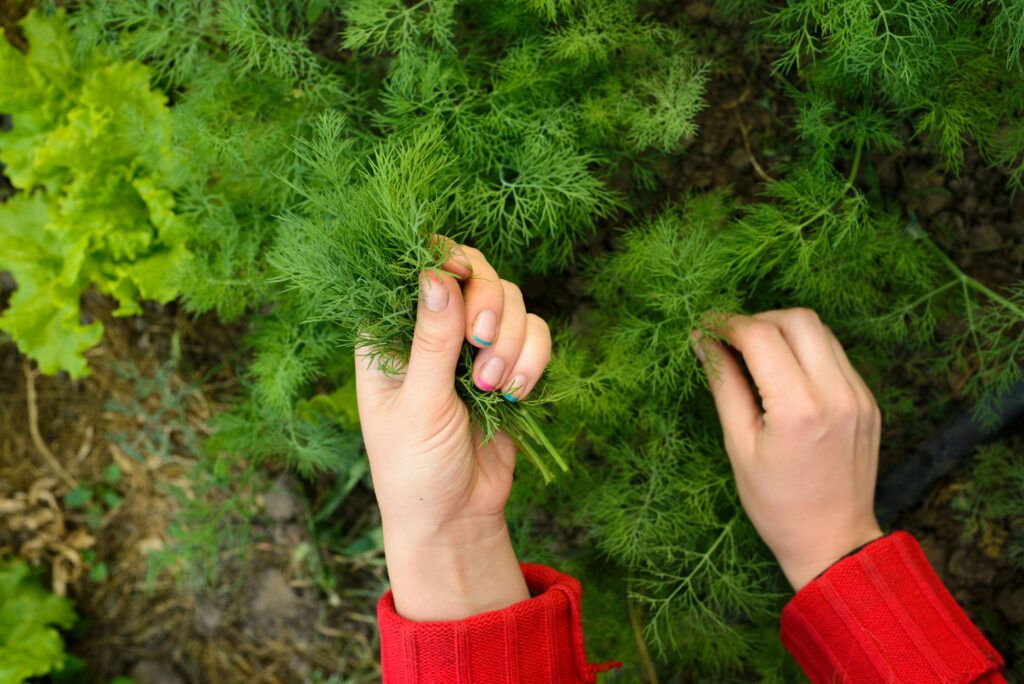
Dill is a fast-growing annual herb prized for its feathery foliage, yellow flower umbels, aromatic seeds, and unmistakable fresh flavor. Botanically known as Anethum graveolens, dill is easy to grow from seed and can provide both fresh leaves and mature seeds from a relatively small garden space.
Unlike many perennial herbs, dill completes its life cycle in a single growing season. Plants grow rapidly during cool to moderate weather, eventually producing tall flower stalks and umbrella-shaped clusters of tiny yellow blossoms. After flowering, the seed heads mature and provide a second harvest for pickling, baking, spice blends, and future planting.
Dill grows best in full sun and loose, well-drained soil. It develops a substantial taproot and generally prefers to be direct-sown rather than repeatedly transplanted. Because individual plants eventually flower and decline, succession sowing every few weeks is one of the easiest ways to maintain a steady supply of tender fresh dill through the growing season.
🌿 Dill at a Glance
- Botanical name: Anethum graveolens
- Common name: Dill
- Plant family: Apiaceae
- Plant type: Annual herb
- Mature height: About 2 to 5 feet, depending on variety and conditions
- Mature spread: About 1 to 2 feet
- Sun exposure: Full sun
- Soil: Loose, moderately fertile, well-drained soil
- Soil pH: Slightly acidic to neutral is ideal
- Bloom time: Summer
- Flower color: Yellow
- Water needs: Moderate
- Growth rate: Fast
- Harvest: Leaves, flowers, and seeds
- Wildlife value: Flowers attract pollinators and beneficial insects
- Life cycle: Annual, but it readily self-seeds
🌱 What Is Dill?
Dill is an aromatic herb in the carrot family, making it related to parsley, cilantro, fennel, celery, and carrots.
Its narrow, finely divided leaves give the plant a soft, feathery appearance. The flavor is fresh, grassy, slightly citrusy, and distinctly aromatic.
As the plant matures, it sends up increasingly tall stems topped with flat or slightly rounded umbels of tiny yellow flowers.
Those flowers eventually develop into flattened brown seeds.
Both the leaves and seeds are edible, but they taste somewhat different. Fresh foliage has the classic bright “dill weed” flavor, while the seeds are warmer and more concentrated.
☀️ How Much Sun Does Dill Need?
Dill grows best in full sun.
Aim for at least 6 hours of direct sunlight per day, with 8 hours providing even stronger growth where temperatures are moderate.
Plants grown in insufficient light may become:
- Thin
- Leggy
- Weak-stemmed
- Less flavorful
- More likely to flop
In extremely hot climates, some light afternoon shade can help slow stress during the hottest part of summer.
However, too much shade generally produces weaker plants.
🌱 Best Soil for Dill
Dill prefers loose, well-drained soil.
A moderately fertile garden loam works well, but the herb does not require extremely rich ground.
Ideal soil should allow the long taproot to grow freely.
Heavy compacted clay can restrict root development and retain too much water.
Before sowing, loosen the planting area and remove large stones.
A modest amount of compost can improve poor soil, but avoid excessive manure or high-nitrogen amendments.
Overly fertile conditions may produce lush foliage with weak stems.
🧪 What Soil pH Does Dill Prefer?
Dill is fairly adaptable but generally grows best in slightly acidic to neutral soil.
A pH around 5.5 to 7.5 is suitable for most gardens.
There is usually no reason to adjust soil pH if dill is growing normally.
Good drainage and adequate sunlight have a greater impact on success than small differences in pH.
🌿 Should You Direct Sow Dill?
Yes.
Direct sowing is usually the easiest way to grow dill.
The plant develops a taproot and does not especially enjoy having its roots disturbed.
Transplants can work when they are young and carefully handled, but direct-sown plants generally establish more naturally.
Sow seeds directly where you want the plants to grow.
This is particularly useful in:
- Herb gardens
- Vegetable beds
- Raised beds
- Pollinator gardens
- Cottage gardens
🌰 How to Plant Dill Seeds
Dill seed can be planted outdoors after the danger of severe frost has passed and the soil has begun warming.
Prepare a loose seedbed and sow the seeds approximately ¼ inch deep.
Space seeds fairly closely at first, then thin seedlings after germination.
Keep the soil moderately moist while the seeds germinate.
Dill seeds often sprout within about 7 to 21 days, depending on soil temperature and growing conditions.
Once seedlings become established, gradually reduce the frequency of watering.
📏 How Far Apart Should You Plant Dill?
Thin dill plants to approximately 12 to 18 inches apart.
Crowded plants compete for sunlight and nutrients and are more likely to develop weak stems.
Adequate spacing also improves airflow.
If you are growing compact dill varieties in containers, somewhat closer spacing may be possible.
Large varieties intended for seed production should receive more room.
🔄 Succession Planting Dill
Succession sowing is one of the best techniques for keeping fresh dill available.
Individual plants eventually flower, set seed, and decline.
Instead of planting all your dill at once, sow a small amount every 2 to 3 weeks during suitable weather.
This creates plants at different stages of maturity.
While older plants begin flowering, younger plants continue producing tender foliage.
Succession sowing is especially useful for cooks who regularly use fresh dill.
💧 How Often Should You Water Dill?
Dill prefers reasonably consistent moisture while young.
Water seedlings whenever the upper portion of the soil begins to dry.
Once established, dill tolerates short dry periods but generally produces better foliage when it does not experience repeated severe drought.
Water deeply rather than sprinkling lightly every day.
Deep watering encourages stronger roots.
Container-grown dill needs more frequent monitoring because pots dry out faster than garden beds.
⚠️ Can You Overwater Dill?
Yes.
Dill does not like constantly waterlogged soil.
Excessive moisture can contribute to:
- Yellow leaves
- Weak growth
- Root problems
- Fungal disease
- Stem collapse
Check the soil before watering.
If it remains wet beneath the surface, wait.
A container or raised bed with good drainage is often easier for dill than a low area where water collects.
🌡️ What Temperature Does Dill Prefer?
Dill grows particularly well during cool to moderately warm weather.
Seeds can germinate in cool spring soil, and young plants generally thrive before intense summer heat arrives.
Very hot temperatures encourage dill to flower and set seed more quickly.
This process is called bolting.
Bolting is not necessarily bad — flowering plants produce useful flowers and seeds — but gardeners primarily interested in foliage generally want to delay it.
Succession planting helps maintain younger leafy plants even after the first crop begins flowering.
🌼 Why Is My Dill Flowering?
Flowering is a normal stage in dill’s life cycle.
Dill is an annual.
Once a plant reaches maturity, it naturally produces flowers and seeds.
Heat and long summer days can accelerate flowering.
If you want fresh leaves for as long as possible:
- Sow successively.
- Keep plants adequately watered.
- Harvest regularly.
- Grow during cooler parts of the season.
Pinching flower stalks may delay seed production briefly, but it will not stop a mature dill plant from eventually flowering.
🌼 What Do Dill Flowers Look Like?
Dill produces tiny yellow flowers arranged in broad umbrella-shaped clusters known as umbels.
These flowers rise above the feathery foliage on tall stems.
Although usually grown as an herb, flowering dill is also attractive in ornamental and pollinator gardens.
The yellow umbels combine particularly well with cottage-garden flowers and airy ornamental grasses.
🐝 Does Dill Attract Pollinators?
Yes.
Flowering dill attracts numerous beneficial insects.
Visitors may include:
- Bees
- Hoverflies
- Small wasps
- Butterflies
- Other beneficial insects
Many tiny beneficial insects can easily access the shallow flowers.
Allowing at least a few plants to flower is therefore useful even when most of your dill is being grown for culinary leaves.
🦋 Dill and Black Swallowtail Butterflies
Dill is a host plant for black swallowtail caterpillars.
The caterpillars may feed heavily on the foliage.
Although this can look alarming, it is a normal ecological relationship rather than simply a garden pest problem.
If you grow dill for butterflies, consider planting extra.
That allows caterpillars to feed while leaving enough foliage for kitchen use.
Parsley and other members of the carrot family can also serve as host plants.
🌿 When Can You Start Harvesting Dill?
Fresh leaves can be harvested once the plant has developed several healthy sets of foliage.
You do not need to wait for dill to reach full size.
Young leaves are tender and flavorful.
For the strongest foliage harvest, begin cutting before the plant produces a large flower stalk.
Do not remove all the foliage from a very young plant.
Leaving enough leaves allows it to continue photosynthesizing and producing new growth.
✂️ How to Harvest Fresh Dill
Use clean scissors or garden snips.
Cut individual leafy stems near the outside of the plant.
For a larger harvest, remove several stems while leaving enough foliage for continued growth.
Harvesting regularly can encourage branching while the plant remains in its leafy stage.
Morning is an excellent harvesting time after dew has dried but before afternoon heat becomes intense.
🌿 What Part of Dill Do You Eat?
Nearly the entire aboveground plant can be useful.
Gardeners commonly harvest:
- Tender leaves
- Young stems
- Flower heads
- Immature seed heads
- Mature seeds
The roots are not normally used as a culinary crop.
Leaves are the familiar herb sold as fresh dill or dill weed.
Flower heads are often used in pickling.
Mature seeds become dill seed, which has its own distinctive flavor.
🧊 How Long Does Fresh Dill Last?
Fresh dill is delicate and begins losing quality relatively quickly after harvest.
For short-term storage, place freshly cut stems in the refrigerator.
They can be wrapped lightly in a damp paper towel and stored in a container or bag.
Another option is to place the cut stems in a small glass of water, similar to a bouquet, and refrigerate them.
Use fresh dill as soon as practical for the strongest aroma and flavor.
❄️ Can You Freeze Fresh Dill?
Yes.
Freezing is one of the easiest ways to preserve dill while retaining much of its flavor.
Wash the dill gently and dry it thoroughly.
Leaves can be:
- Frozen whole
- Chopped and frozen
- Frozen in small portions
- Added to ice cube trays with water or broth
Frozen dill becomes softer after thawing, so it works best in cooked foods, sauces, soups, and dressings rather than as a decorative garnish.
🌿 Can You Dry Dill?
Yes, although dried dill generally has a milder flavor than fresh or frozen dill.
Harvest healthy stems and dry them using gentle heat or good air circulation.
Once fully dry, remove the leaves from the stems and store them in an airtight container away from heat and direct sunlight.
Because dried herbs gradually lose potency, replacing them periodically provides better flavor.
🌰 When Are Dill Seeds Ready to Harvest?
Allow the yellow flowers to mature naturally.
After flowering, green seed heads begin developing.
Eventually the seeds become tan to brown and dry.
Harvest before large quantities begin falling to the ground.
Cut the mature seed heads and place them upside down inside a paper bag.
As the seed heads continue drying, seeds fall into the bag.
🌰 How to Harvest Dill Seeds
Wait until most of the seeds have turned brown.
Cut the flower heads with several inches of stem attached.
Place them in a paper bag and keep the bag in a warm, dry, well-ventilated location.
After the seed heads dry thoroughly, shake or rub them gently to release the seeds.
Remove plant debris before storage.
Make sure the seeds are completely dry before placing them in an airtight container.
Moisture trapped during storage can cause mold.
🌱 Saving Dill Seed for Next Year
Dill is easy to grow from saved seed.
Choose healthy plants and allow some flower heads to mature completely.
Harvest and dry the seeds as described above.
Store them in a cool, dark, dry place.
Label the container with the variety and year.
Seed viability gradually declines over time, so relatively fresh seed generally provides the best germination.
🌱 Does Dill Self-Seed?
Yes.
Dill can self-seed enthusiastically when mature flower heads are left in the garden.
Seeds drop around the parent plant and may germinate the following season.
This can be useful in informal herb or cottage gardens.
If you do not want volunteer seedlings, remove seed heads before the seeds mature and scatter.
Volunteer plants can easily be thinned or transplanted very young if they appear in unwanted places.
🪴 Can Dill Grow in Containers?
Yes.
Dill grows well in containers provided the pot is deep enough for its taproot.
Choose a container approximately 12 inches deep or deeper.
Larger pots are easier to keep evenly watered.
Make sure drainage holes remain unobstructed.
Use a loose, good-quality potting mix rather than dense garden soil.
Position the container in full sun.
Compact varieties are particularly useful for container gardening.
🌿 Best Dill Varieties
Several varieties have been developed for different purposes.
🌱 ‘Bouquet’
‘Bouquet’ is one of the most widely grown varieties.
It produces abundant foliage followed by large flower heads.
It is useful for:
- Fresh leaves
- Pickling
- Seed production
- Pollinator gardens
Its relatively early flowering is useful for pickling but means succession sowing is worthwhile if you primarily want leaves.
🌿 ‘Fernleaf’
‘Fernleaf’ is a compact dill variety particularly well suited to containers.
It tends to remain shorter than traditional varieties.
Its slower or more compact growth makes it convenient for small gardens and patios.
🌿 ‘Dukat’
‘Dukat’ is often grown for abundant leafy growth and strong flavor.
It can be a good choice for gardeners primarily interested in fresh dill weed.
🌿 ‘Mammoth’
Mammoth dill develops into a large plant and is commonly used for pickling and seed production.
Give it plenty of space and full sun.
Its tall stems may benefit from some wind protection.
🌾 Does Dill Need Fertilizer?
Usually very little.
Dill grows successfully in moderately fertile soil.
Excess fertilizer, particularly nitrogen, can result in overly lush weak growth.
If your soil is reasonably healthy, compost incorporated before planting may be sufficient.
Container plants can be fed lightly with diluted balanced fertilizer if growth becomes weak.
Avoid repeated heavy feeding.
🍂 Should You Mulch Dill?
A light mulch can help maintain soil moisture and suppress weeds.
Suitable materials include:
- Shredded leaves
- Fine compost
- Straw
- Fine bark around larger plants
Keep heavy mulch away from very young stems.
In cool spring weather, allowing the soil to warm before applying a thick mulch can encourage stronger early growth.
🌬️ Does Dill Need Staking?
Tall dill can sometimes flop or break in wind.
Plants grown in full sun with adequate spacing usually develop stronger stems.
However, tall varieties may benefit from support in exposed gardens.
Options include:
- Small stakes
- Plant supports
- Growing near a low fence
- Planting in groups that support one another
Avoid tying stems tightly.
🌱 Can You Transplant Dill?
Young dill can be transplanted carefully, but the plant generally prefers direct sowing.
Its taproot makes mature plants less tolerant of root disturbance.
If starting dill indoors, use individual biodegradable or deep pots so seedlings can be moved with minimal root disruption.
Transplant while seedlings are still relatively young.
Do not allow them to become severely root-bound before planting.
🐛 Common Dill Pests
Dill generally has relatively few serious pest problems.
Potential visitors include:
- Aphids
- Spider mites
- Caterpillars
Aphids may gather on tender stems and flower clusters.
Small infestations can often be washed away with water.
Black swallowtail caterpillars may consume substantial foliage but are desirable visitors for many gardeners.
Consider planting extra dill rather than using insecticides when butterfly caterpillars appear.
🍄 Common Dill Diseases
Dill can experience several fungal diseases, especially in crowded or overly wet conditions.
Potential problems include:
- Powdery mildew
- Downy mildew
- Leaf spots
- Root rot
- Damping-off in seedlings
Provide good spacing and airflow.
Water at soil level when practical.
Avoid keeping the soil saturated.
Crop rotation can also help when dill or related plants have experienced repeated soilborne disease problems.
❓ Why Is My Dill Turning Yellow?
Yellow foliage can result from:
- Overwatering
- Poor drainage
- Natural aging
- Root stress
- Nutrient problems
Older lower leaves may naturally yellow as the plant matures.
If the entire plant turns yellow while the soil remains wet, excessive moisture is more likely.
Check soil conditions before adding fertilizer.
❓ Why Is My Dill Turning Brown?
Brown foliage may indicate:
- Drought
- Extreme heat
- Natural end-of-season decline
- Root damage
- Disease
Remember that dill is an annual.
Once the plant flowers and finishes producing seed, it naturally declines and eventually dies.
A mature dill plant browning at the end of its life cycle does not necessarily need treatment.
❓ Why Is My Dill Flopping Over?
Several conditions can contribute to flopping.
Possible causes include:
- Too much shade
- Excess nitrogen
- Crowding
- Strong wind
- Very tall mature stems
- Weak growth from overwatering
Provide full sun and adequate spacing.
Tall varieties can be supported if necessary.
Avoid excessive fertilizer.
❓ Why Is My Dill So Tall?
Tall growth is normal for many varieties.
Dill can easily reach several feet in height once flowering begins.
If you want a smaller plant, choose a compact variety such as ‘Fernleaf.’
Do not repeatedly cut a tall mature plant back expecting it to remain in a leafy juvenile stage indefinitely.
Succession sowing provides a more reliable supply of compact young plants.
❓ Why Is My Dill Bolting?
Bolting simply means the plant is shifting from leafy growth into flowering and seed production.
It is normal for dill.
Heat and long days accelerate the process.
To maintain fresh foliage:
- Plant early.
- Sow new seed every few weeks.
- Maintain adequate moisture.
- Grow again during cooler late-season weather where climate permits.
Dill is not a long-lived leafy herb like parsley.
Its annual flowering cycle should be expected.
❓ Why Didn’t My Dill Germinate?
Poor germination can result from:
- Old seed
- Soil drying during germination
- Planting too deeply
- Very cold soil
- Waterlogged soil
- Crusted soil surface
Sow fresh seed shallowly and maintain consistent moisture.
Do not bury seeds deeply.
Be patient, as emergence may take a couple of weeks under cooler conditions.
🦌 Is Dill Deer Resistant?
Dill’s aromatic foliage can make it less appealing than many garden vegetables, but it is not completely deer-proof.
Browsing varies dramatically according to local deer pressure.
Young plants can still be eaten.
If deer populations are high, physical protection may be more reliable than depending on the herb’s aroma.
🐇 Do Rabbits Eat Dill?
Rabbits may eat dill, especially young tender plants.
In gardens with heavy rabbit activity, protect seedlings with fencing or mesh.
Once plants become taller, they may experience less severe browsing, although this is not guaranteed.
🌿 What Can You Use Fresh Dill For?
Fresh dill is exceptionally versatile in the kitchen.
It pairs particularly well with:
- Potatoes
- Cucumbers
- Yogurt
- Sour cream
- Eggs
- Salmon
- Other fish
- Chicken
- Green beans
- Peas
- Carrots
- Soups
- Salads
- Pickles
Because heat gradually reduces dill’s delicate fresh flavor, add chopped foliage toward the end of cooking when possible.
🥒 Using Dill for Pickling
Dill is perhaps most famous for pickles.
Fresh flower heads, leafy stems, or seeds can all contribute flavor.
Traditional dill pickles often use mature or nearly mature flower heads because they provide strong aroma.
If you plan to pickle cucumbers from your own garden, time dill sowings so some plants reach the flowering stage around the same period your cucumber crop is ready.
Succession planting makes this timing easier.
🌱 Using Dill Leaves vs. Dill Seeds
Leaves and seeds have different culinary qualities.
Fresh dill leaves have a light, grassy, aromatic flavor and are excellent in fresh dishes.
Dill seeds are stronger, warmer, and slightly more pungent.
They work well in:
- Pickles
- Bread
- Spice blends
- Soups
- Braised dishes
Using both parts of the plant allows you to extend the harvest well beyond the leafy stage.
🌿 Best Companion Plants for Dill
Dill works well in herb, vegetable, and pollinator gardens.
Flowering dill can be especially useful among plants that benefit from abundant beneficial insects.
Good ornamental companions include:
- Marigold Care
- Sunflower Care
- Cosmos Care
- Zinnia Care
- Coreopsis Care
- Yarrow Care
- Salvia Care
- Coneflower Care
In vegetable gardens, dill is commonly grown around cucumbers and brassicas, where its flowers help attract beneficial insects.
🌼 Dill in a Pollinator Garden
Dill may begin as a kitchen herb, but mature flowering plants can become excellent pollinator-garden additions.
The broad umbels create easy landing platforms for numerous small insects.
Allow several plants to complete their entire life cycle.
This provides:
- Fresh foliage for cooking
- Host foliage for caterpillars
- Nectar and pollen
- Seeds for harvesting
- Seed for next year’s crop
Few annual herbs provide so many uses from one relatively easy plant.
🏡 Where to Plant Dill
Good locations include:
- Herb gardens
- Vegetable gardens
- Raised beds
- Cottage gardens
- Pollinator gardens
- Containers
- Sunny border edges
- Cutting gardens
Choose a spot receiving abundant sunlight.
Because mature dill becomes fairly tall, position it where it will not shade smaller sun-loving crops.
It also works well toward the back of an herb bed.
🌱 Is Dill Easy to Grow?
Yes.
Dill is one of the easier culinary herbs to grow directly from seed.
Its main care requirements are simple:
- Provide full sun.
- Use loose, well-drained soil.
- Direct sow whenever practical.
- Keep seeds and young seedlings consistently moist.
- Space plants adequately.
- Avoid heavy fertilization.
- Sow every few weeks for a steady leaf harvest.
- Expect mature plants to flower.
- Allow some plants to develop flowers for pollinators.
- Harvest seeds once they turn brown and dry.
- Let a few seeds fall if you want volunteer plants next year.
Understanding that flowering is a normal part of dill’s annual life cycle makes the plant much easier to manage.
🌿 Final Thoughts
Dill is an ideal herb for gardeners who want a plant that provides several useful harvests from one growing season. Tender foliage supplies fresh flavor early, yellow flowers support pollinators and beneficial insects, and mature seed heads provide both a kitchen spice and seed for future planting.
Successful dill care begins with full sun, loose soil, and direct sowing. Keep seedlings consistently moist, but avoid waterlogged soil and excessive fertilizer. As plants mature, expect them to grow tall and eventually flower rather than trying to keep a single plant producing tender foliage indefinitely.
For a continuous supply of fresh dill, the most effective technique is succession sowing. Plant a small new crop every few weeks so young leafy plants are always coming along behind older flowering ones.
Whether you grow it for fresh sauces, potatoes, fish, homemade pickles, pollinators, or seed, Anethum graveolens earns its place as one of the most useful annual herbs in the garden.
🔗 Related Articles
- Marigold Care
- Sunflower Care
- Cosmos Care
- Zinnia Care
- Coreopsis Care
- Yarrow Care
- Salvia Care
- Coneflower Care