Few flowers communicate happiness as instantly as a sunflower. With brilliant yellow petals surrounding a dark center and tall stems that seem to reach toward the sky, sunflowers have become widely associated with optimism, warmth, friendship, loyalty, resilience, and the simple pleasure of turning toward the light.
Yet sunflower symbolism is richer than the familiar idea of happiness alone. Across different periods and contexts, sunflowers have represented devotion, gratitude, abundance, admiration, vitality, friendship, and the cycle of life. Their seeds have sustained people for thousands of years, their flower heads support wildlife, and their appearance in art — most famously in Vincent van Gogh’s paintings — has helped make them one of the world’s most recognizable flowers.
Some popular stories about sunflower symbolism blur mythology, botany, and later European traditions. The common sunflower, Helianthus annuus, is native to North America and was domesticated there long before Europeans encountered it. Even the familiar claim that every sunflower follows the sun all day needs a little clarification: young plants track the sun as they grow, while mature flower heads generally settle facing east.
Understanding what sunflowers represent therefore means looking at both the symbolism people have attached to them and the fascinating history of the plant itself.
🌻 What Do Sunflowers Symbolize?
Sunflowers commonly symbolize:
- Happiness
- Optimism
- Warmth
- Loyalty
- Devotion
- Friendship
- Admiration
- Gratitude
- Resilience
- Strength
- Vitality
- Abundance
- Hope
- Longevity
- Positive energy
These meanings are not universal rules. Flowers do not come with a single fixed symbolic vocabulary that applies across every culture and historical period.
Instead, their meanings develop from appearance, behavior, cultural traditions, literature, art, religion, and personal associations.
With sunflowers, several of the strongest modern meanings are easy to understand. Their golden coloring evokes sunlight, their tall stems suggest strength, and their apparent relationship with the sun naturally lends itself to ideas of hope, faithfulness, and turning toward something positive.
☀️ Sunflowers as a Symbol of Happiness
Happiness is probably the most familiar sunflower meaning today.
Much of that association comes directly from the flower’s appearance. Golden yellow petals radiating around a large circular center resemble the rays of the sun, creating an image that feels naturally cheerful.
Yellow itself is frequently associated with:
- Sunshine
- Energy
- Cheerfulness
- Warmth
- Summer
- Celebration
A field of sunflowers can therefore communicate exuberance in a way few other flowers can.
Vincent van Gogh’s famous sunflower paintings strengthened this association considerably. For Van Gogh, yellow could represent warmth and happiness, and the National Gallery describes his Sunflowers as having associations with happiness, friendship, gratitude, and the brilliant sunlight of Provence.
Today, sunflower bouquets are often chosen when the message is simply: you make life brighter.
🌞 Sunflowers as a Symbol of Optimism
Sunflowers are also powerful symbols of optimism.
Their bright flowers seem visually oriented toward light, and young sunflower plants actually do track the sun across the sky during development.
This behavior has made the flower a natural metaphor for looking toward brighter possibilities.
A sunflower can therefore represent the idea of:
- Finding light during difficult circumstances
- Remaining hopeful
- Looking forward instead of backward
- Expecting renewal
- Choosing positivity
- Continuing to grow
This symbolism works particularly well because it is rooted partly in actual plant behavior rather than purely in imagination.
🧭 Do Sunflowers Really Follow the Sun?
Yes — but not throughout the entire life of the flower.
Young developing sunflowers display heliotropism. During the day, growing stems move so that the developing flower heads track the sun from east to west. Overnight, they reposition toward the east in anticipation of sunrise.
This movement is connected to the plant’s internal circadian clock and uneven growth on opposite sides of the stem.
Once a sunflower matures and its stem becomes stiffer, the dramatic daily tracking largely stops.
Mature flower heads generally remain facing east.
Research has shown that this eastward orientation has practical benefits. Morning sunlight warms east-facing flowers more quickly, which can increase visits from bees and contribute to successful pollination and seed development.
So the familiar image of a mature sunflower continuously following the sun all day is not quite accurate. It is the young developing plant that performs the most obvious solar tracking.
💛 Sunflowers as a Symbol of Loyalty and Devotion
The flower’s association with the sun also led to symbolism involving loyalty and devotion.
A plant that continually turns toward a source of light provides an obvious metaphor for steadfast attention.
In European symbolism, the sunflower became associated with ideas such as:
- Faithfulness
- Devotion
- Loyalty
- Constancy
- Admiration
The metaphor can work romantically, spiritually, or platonically.
A sunflower given to a friend might communicate steadfast friendship. Given to a romantic partner, it might represent admiration and devotion. In a religious context, the image of a flower turning toward the sun has also been used as an analogy for a believer turning toward divine light.
🤝 Sunflowers and Friendship
Sunflowers make particularly natural friendship flowers.
Unlike roses, which carry strong romantic associations, sunflowers can express affection without necessarily implying romance.
A sunflower bouquet can communicate:
- Appreciation
- Happiness
- Encouragement
- Loyalty
- Warmth
- Gratitude
- Celebration of someone’s personality
Their cheerful appearance also makes them appropriate when congratulating a friend, celebrating a milestone, welcoming someone into a new home, or simply reminding someone that they are valued.
Vincent van Gogh’s own use of sunflowers gives this meaning an interesting historical connection. Some of his sunflower paintings were created while he prepared for fellow artist Paul Gauguin to join him in Arles, and the works have been interpreted in connection with friendship, welcome, artistic partnership, and gratitude.
🙏 Sunflowers as a Symbol of Gratitude
Sunflowers can also represent gratitude.
This meaning works especially well because the flower combines warmth with admiration.
Giving someone sunflowers can suggest:
Thank you for bringing light into my life.
Van Gogh himself appears to have associated his sunflower paintings with gratitude. In 1890, he suggested that works from the series could express an idea of thankfulness.
That historical association makes sunflowers especially appropriate for:
- Thank-you bouquets
- Teacher gifts
- Appreciation gifts
- Host gifts
- Celebrating mentors
- Recognizing someone who has offered support
🌱 Sunflowers as a Symbol of Resilience
Sunflowers are frequently associated with resilience and strength.
A mature sunflower can grow remarkably tall, withstand full summer sun, and produce a substantial flower head filled with hundreds of individual florets.
The plant’s life cycle makes it an appealing metaphor for continuing to grow despite difficult circumstances.
Symbolically, a sunflower can communicate:
- Keep going.
- Stand tall.
- Look toward the light.
- Growth can follow difficulty.
- Strength does not require hardness.
- Something beautiful can emerge from challenging conditions.
This is why sunflower imagery frequently appears in messages of encouragement, recovery, remembrance, and personal transformation.
🌻 Sunflowers as a Symbol of Strength
The physical appearance of a sunflower contributes heavily to its association with strength.
Many varieties grow several feet tall, while giant cultivars can tower well above a person.
Their stems must support large flower heads that later become heavy with seeds.
This combination of height, sturdiness, and brightness creates a flower that can symbolize strength without seeming severe.
Sunflowers therefore work well as symbols of confident, joyful strength — resilience combined with warmth rather than toughness alone.
🌾 Sunflowers as a Symbol of Abundance
A sunflower head contains far more than one flower.
What appears to be a single giant blossom is actually a composite structure made up of numerous individual florets.
Many of the central florets can eventually develop seeds.
That extraordinary seed production has helped give sunflowers associations with:
- Abundance
- Fertility
- Harvest
- Prosperity
- Nourishment
- Generosity
These meanings become even more understandable when considering the sunflower’s history as an important food crop.
For thousands of years, people have valued sunflowers not merely because they are beautiful but because they produce nutritious seeds and oil.
🌱 Sunflowers as a Symbol of Growth
Few garden plants show growth as dramatically as a sunflower.
A small seed can produce a plant several feet tall within a single growing season.
That transformation makes the sunflower a natural symbol for:
- Personal development
- New opportunities
- Education
- Reaching one’s potential
- Starting over
- Becoming stronger
Sunflower imagery therefore works particularly well for graduations, new jobs, career changes, moving to a new home, and other occasions associated with moving into a new stage of life.
🌅 Sunflowers as a Symbol of Hope
The connection between sunflowers and sunlight makes hope another natural interpretation.
The flower can represent the idea that darkness is temporary and light will return.
That meaning can be especially powerful during difficult periods.
Sunflowers are frequently used in messages connected with:
- Recovery
- Encouragement
- Grief support
- New beginnings
- Perseverance
- Mental and emotional renewal
Unlike a message that ignores hardship, the sunflower can symbolize actively turning toward something brighter despite difficulty.
❤️ What Do Sunflowers Mean in Love?
Sunflowers can represent love, but usually in a somewhat different way from red roses.
Rather than intense passion alone, sunflower symbolism often suggests:
- Loyalty
- Admiration
- Happiness
- Devotion
- Warmth
- Long-lasting affection
This makes them suitable for established relationships as well as new romances.
A sunflower can effectively say, I admire you, I am happy with you, and you brighten my life.
Their association with devotion also makes them meaningful in wedding arrangements, particularly for couples who prefer bright, informal, rustic, or late-summer flowers.
💐 What Does It Mean When Someone Gives You Sunflowers?
Context matters, but a gift of sunflowers is usually positive.
The giver may be expressing:
- Friendship
- Admiration
- Gratitude
- Encouragement
- Affection
- Loyalty
- Happiness
- Congratulations
Sunflowers are especially useful when someone wants to give flowers without the strong romantic message attached to red roses.
A bouquet could mean anything from “I’m proud of you” to “thank you” or “you make me happy.”
🎂 What Do Sunflowers Mean as a Birthday Gift?
For birthdays, sunflowers typically represent happiness, energy, optimism, and good wishes for the year ahead.
Their connection with growth can make them particularly appropriate for milestone birthdays.
A sunflower birthday arrangement may communicate a wish for:
- Joy
- Confidence
- New experiences
- Continued growth
- Prosperity
- A bright year ahead
Their informality also makes them appropriate for friends, relatives, partners, coworkers, and neighbors.
🎓 What Do Sunflowers Mean for Graduation?
Sunflowers work exceptionally well for graduation because their symbolism overlaps with many themes associated with education.
They can represent:
- Growth
- Accomplishment
- Confidence
- Future possibilities
- Optimism
- Reaching toward something greater
A small seed becoming a towering flowering plant is an easy metaphor for a student’s development.
The sunflower’s association with looking toward light also fits the idea of looking toward the future.
🏡 What Do Sunflowers Mean as a Housewarming Gift?
Sunflowers can symbolize warmth, happiness, abundance, and a bright beginning in a new home.
That makes them an excellent housewarming flower.
They can communicate wishes for:
- Happiness in the home
- Prosperity
- Friendship
- Warmth
- Positive new memories
Potted sunflowers can also be appropriate when the recipient has outdoor space and enjoys gardening.
🕊️ Can Sunflowers Represent Remembrance?
Yes.
Although sunflowers are cheerful, they can also be meaningful flowers of remembrance.
Their life cycle — from seed to towering flower, followed by mature seed heads and eventual decline — naturally reflects themes of life, mortality, continuity, and renewal.
In remembrance arrangements, sunflowers can express appreciation for a life characterized by:
- Warmth
- Generosity
- Optimism
- Strength
- Loyalty
They can also represent the decision to remember someone’s light rather than focusing solely on loss.
🌻 Sunflower Meaning in Art
Sunflowers became especially prominent in Western art through Vincent van Gogh.
Van Gogh painted multiple sunflower still lifes during 1888 and 1889 while living in Arles in southern France.
Some were intended to decorate rooms in preparation for Paul Gauguin’s arrival.
The paintings explore different stages of the flowers’ life cycle, including buds, fully opened blossoms, mature seed heads, and fading flowers.
As a result, the works can carry several interconnected meanings:
- Happiness
- Friendship
- Gratitude
- Vitality
- Devotion
- Nature
- Mortality
- The cycle of life
Van Gogh became so strongly associated with the flower that the sunflower remains almost inseparable from his artistic identity today.
🎨 Why Did Van Gogh Paint Sunflowers?
Van Gogh was captivated by both their color and their form.
The brilliant yellows suited his increasingly expressive use of color in Arles, where he was fascinated by the intense light of southern France.
He also planned sunflower paintings as decorations while awaiting Gauguin.
The National Gallery notes that the sunflower carried several possible meanings for Van Gogh, including friendship, gratitude, vitality, and happiness.
At the same time, showing flowers in multiple stages — from fresh blooms to drying seed heads — connected the paintings with older artistic traditions concerned with the passage of time and mortality.
The result is richer than a simple painting of cheerful yellow flowers.
🏺 The History of Sunflowers
The history of the sunflower begins in North America.
The common sunflower, Helianthus annuus, is native to North America and was domesticated there thousands of years ago.
Archaeological and genetic evidence indicates that domesticated sunflower developed in eastern North America.
Indigenous peoples selected and cultivated sunflowers over many generations, producing plants with increasingly large seeds.
Sunflowers were important for far more than decoration.
Seeds could be consumed whole or ground into food, while sunflower oil also had practical uses. Historical records and ethnobotanical research document additional applications for pigments and other purposes.
The sunflower was therefore a significant crop long before it became an internationally recognized ornamental flower.
🌎 Indigenous History of the Sunflower
Any history of sunflowers should begin with Indigenous North American agriculture rather than European mythology.
Indigenous peoples domesticated Helianthus annuus and transformed a wild native plant into an important crop.
Seeds were eaten in numerous ways, including:
- Raw
- Roasted
- Cooked
- Dried
- Ground
Oil could also be extracted.
Over generations of deliberate cultivation and seed selection, domesticated sunflowers developed characteristics distinct from wild populations.
The sunflower’s cultural history therefore reaches back thousands of years before its appearance in European gardens and art.
🌍 How Sunflowers Reached Europe
European travelers encountered cultivated sunflowers after arriving in the Americas.
Sunflowers were introduced into Europe during the 1500s and gradually became familiar as both ornamental and useful plants.
The crop later became particularly important in Russia, where sunflower cultivation expanded substantially.
Sunflower varieties developed and improved there eventually contributed to the crop’s renewed agricultural importance in North America.
Today, sunflower is grown internationally for:
- Vegetable oil
- Seeds
- Livestock and bird feed
- Ornamental flowers
- Cut-flower production
Its journey from an Indigenous North American crop to an internationally important agricultural plant is one of the most interesting chapters in sunflower history.
🏛️ Is the Sunflower Connected to Greek Mythology?
This subject needs some clarification.
A popular modern story links the sunflower to the Greek myth of Clytie, who becomes a flower that continually turns toward the sun after longing for the sun god.
That tale is frequently retold today using a modern sunflower.
However, Helianthus annuus is native to North America. Ancient Mediterranean storytellers therefore were not describing the domesticated common sunflower familiar to us today.
The later association makes symbolic sense because sunflower movement fits the story remarkably well, but it should not be presented as evidence that ancient Greeks were telling a myth specifically about the North American sunflower.
The botanical name Helianthus itself is derived from Greek words associated with the sun and flower, reflecting the plant’s sunlike appearance.
☀️ Why Are Sunflowers Associated With the Sun?
The connection goes beyond color.
Sunflowers have several characteristics that reinforce solar symbolism:
- Large circular flower heads
- Radiating yellow petals
- Tall upward-reaching stems
- Heliotropism in young plants
- Mature flowers commonly facing east
- Peak flowering during bright summer weather
Together, these characteristics make the comparison almost unavoidable.
People naturally see a miniature sun in the flower head.
This physical resemblance forms the foundation for many later symbolic meanings, including light, happiness, hope, and devotion.
🌻 What Does a Yellow Sunflower Symbolize?
Yellow is the classic sunflower color and carries the strongest association with traditional sunflower symbolism.
Yellow sunflowers commonly represent:
- Happiness
- Optimism
- Friendship
- Joy
- Warmth
- Positive energy
- Gratitude
They are the safest choice when the intended message is cheerful and encouraging.
❤️ What Do Red Sunflowers Symbolize?
Many cultivated sunflowers now produce flowers in dark red, burgundy, mahogany, or combinations of red and yellow.
Modern color symbolism may associate these deeper shades with:
- Strength
- Passion
- Courage
- Individuality
- Determination
Unlike the centuries-old symbolism sometimes attached to traditional yellow flowers, these color-specific interpretations are largely modern and should not be treated as universal historical rules.
🧡 What Do Orange Sunflowers Symbolize?
Orange and copper-toned sunflowers are often associated with:
- Energy
- Enthusiasm
- Creativity
- Warmth
- Confidence
These colors can feel more intense than traditional yellow while still preserving the sunflower’s generally positive character.
They are especially popular in late-summer and autumn arrangements.
🤍 What Do White Sunflowers Symbolize?
Creamy white and very pale sunflower cultivars offer a softer appearance.
Modern floral symbolism may associate them with:
- Peace
- Fresh beginnings
- Simplicity
- Calm
- Elegance
Again, these meanings are contemporary associations rather than a single established historic floral language.
🌻 What Does One Sunflower Mean?
A single sunflower can be especially striking.
It may symbolize:
- Admiration for one person
- Individuality
- Focus
- Loyalty
- Strength
- Happiness
Because sunflower heads are so large and visually dominant, even one stem can communicate a complete message without requiring a large bouquet.
🌻🌻 What Does a Bouquet of Sunflowers Mean?
A bouquet amplifies the flower’s cheerful character.
A group of sunflowers may represent:
- Shared happiness
- Friendship
- Celebration
- Community
- Abundance
- Gratitude
- Good wishes
Sunflower bouquets work especially well for celebrations where roses might feel too formal or romantic.
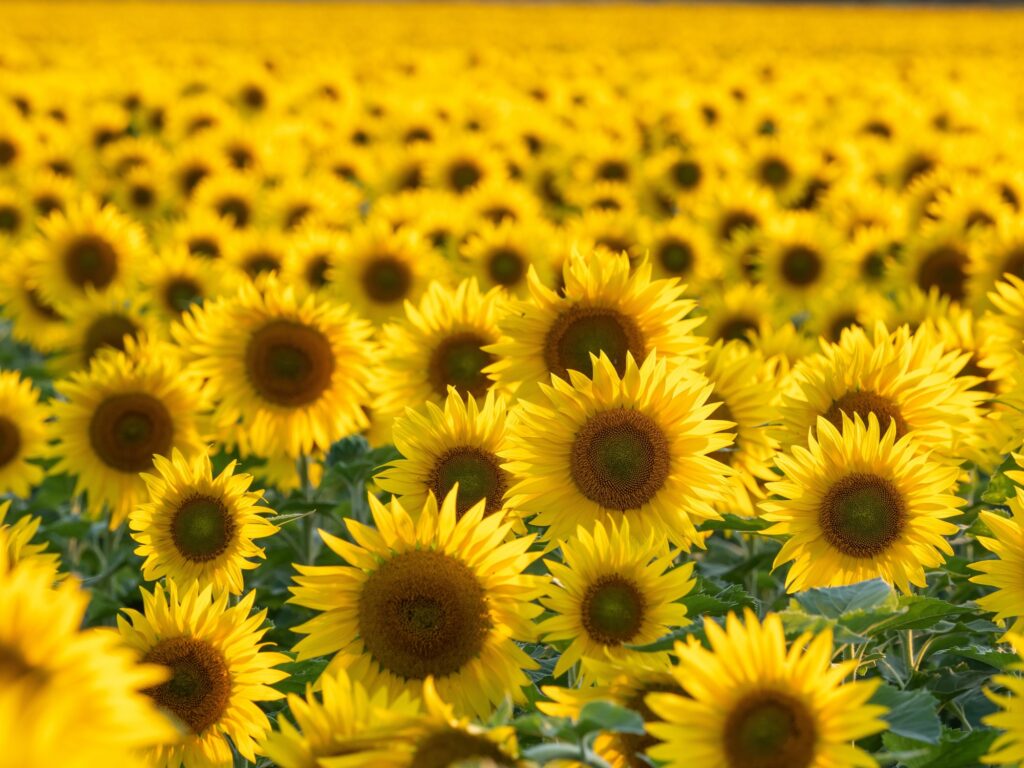
🌾 What Does a Field of Sunflowers Symbolize?
A field of sunflowers can carry a somewhat different emotional effect from a single flower.
Hundreds of plants oriented toward the light can suggest:
- Unity
- Collective hope
- Abundance
- Community
- Shared purpose
- Renewal
Their repetitive forms stretching toward the horizon also make sunflower fields powerful visual symbols in photography, painting, and film.
🌱 Sunflower Seeds and the Symbolism of Renewal
A sunflower’s symbolism does not end when the yellow petals disappear.
A mature flower head contains an extraordinary number of seeds capable of producing another generation of plants.
That makes sunflower seeds natural symbols of:
- Continuity
- Potential
- Renewal
- Future growth
- Legacy
- Abundance
Saving seeds from one year’s flowers and planting them the next provides an especially literal example of renewal.
♾️ Sunflowers and the Cycle of Life
A sunflower changes dramatically during a single season.
It begins as a small seed, develops into a tall plant, produces a brilliant flower, matures into a seed-filled head, and eventually dies.
Yet those seeds contain the possibility of future plants.
That cycle allows the sunflower to symbolize both vitality and mortality.
This dual meaning is part of what makes the flower artistically interesting. A fresh sunflower communicates life and energy, while a mature seed head can suggest time, aging, harvest, continuity, and renewal.
Van Gogh’s sunflower paintings capture several of these stages at once.
🌻 What Does a Sunflower Tattoo Mean?
Sunflower tattoos can carry many personal meanings.
Common interpretations include:
- Happiness
- Resilience
- Recovery
- Loyalty
- Self-confidence
- Hope
- Personal growth
- Remembrance
- Choosing light after hardship
Some people choose sunflower tattoos simply because they love the flower.
Personal symbolism does not need to conform to a traditional flower dictionary.
A sunflower associated with a particular person, place, or period of life can acquire a meaning unique to the person wearing it.
💛 What Does Sunflower Jewelry Symbolize?
Sunflower necklaces, bracelets, rings, and earrings often carry the same positive associations as the flower itself.
They can serve as reminders of:
- Optimism
- Strength
- Friendship
- Happiness
- Hope
- Resilience
Because jewelry can be kept for years, a sunflower design is often given as a symbolic reminder to keep moving toward brighter circumstances.
🌻 Are Sunflowers Good Luck?
Sunflowers are frequently associated with prosperity, abundance, happiness, and good fortune in modern symbolic use.
Their abundant seeds naturally reinforce ideas of plenty and future growth.
However, describing sunflowers universally as a traditional “good luck flower” would oversimplify many different cultural traditions.
It is more accurate to say that their modern associations with optimism, abundance, and success make them a natural flower for expressing good wishes.
🌻 What Is the Spiritual Meaning of a Sunflower?
Spiritual interpretations vary widely, but the sunflower’s relationship with light has made it a recurring symbol of devotion and spiritual focus.
Possible interpretations include:
- Turning toward divine light
- Faith
- Spiritual devotion
- Gratitude
- Hope
- Perseverance
- Seeking truth
European religious symbolism sometimes used the idea of a sun-following flower as an image of a believer orienting themselves toward God.
Someone does not need to interpret sunflowers religiously, however. The same image can represent a secular decision to seek hope, truth, or positive direction.
🌿 What Do Sunflowers Represent in the Garden?
Sunflowers have practical meaning in a garden as well as symbolic meaning.
They can represent a garden designed for:
- Pollinators
- Birds
- Seed saving
- Cut flowers
- Children’s gardening
- Wildlife
- Food production
- Summer color
Their large flower heads attract bees, while mature seeds can feed birds.
Tall cultivars also bring dramatic vertical structure to a planting.
For complete growing instructions, see our Sunflower Care guide.
🌱 Why Sunflowers Remain Such Powerful Symbols
The most enduring flower symbols usually connect human imagination with something visible in the plant itself.
Sunflowers are particularly effective because nearly every part of their life cycle suggests a metaphor.
They begin as tiny seeds and become towering plants. Their young stems track the sun. Their mature flowers greet the morning facing east. Their golden petals resemble sunlight. Their centers become filled with seeds capable of creating the next generation.
That combination naturally invites interpretations involving happiness, growth, loyalty, abundance, resilience, hope, and renewal.
Their symbolic power does not depend on one legend or one culture.
It comes from the plant itself.
🌻 Final Thoughts
Sunflowers most commonly represent happiness, optimism, warmth, loyalty, devotion, friendship, gratitude, resilience, strength, abundance, and hope.
Their symbolism is strengthened by remarkable biology. Young sunflowers really do track the sun as they grow, while mature flower heads typically settle facing east, where morning warmth can benefit pollination.
Their history is equally compelling. The common sunflower was domesticated by Indigenous peoples in North America thousands of years ago and used as an important food and oil crop long before it reached European gardens. From there, the sunflower traveled internationally and eventually became both a major agricultural crop and one of the world’s most recognizable ornamental flowers.
Art added another layer. Vincent van Gogh transformed sunflowers into enduring images of color, friendship, gratitude, vitality, and the passage of time.
Perhaps that is why sunflower symbolism remains so flexible. A sunflower can celebrate a friendship, encourage someone through a difficult period, commemorate a loved one, mark a new beginning, or simply express happiness.
Whatever meaning we attach to it, the central image remains remarkably consistent: a strong, bright flower associated with turning toward the light.
🔗 Related Articles
- Sunflower Care
- Zinnia Care
- Cosmos Care
- Gaillardia Care
- Coreopsis Care
- Coneflower Care
- Butterfly Weed Care
- Marigold Care
📚 Sources & Further Reading
- Smithsonian Research Online — The Domestication of Helianthus annuus L. (Sunflower)
- USDA Natural Resources Conservation Service — Annual Sunflower Plant Guide
- USDA Agricultural Research Service — Sunflower History and Domestication
- UC Davis — Why Sunflowers Face East
- UC Davis — Sunflowers Move by the Clock
- UC Davis — How Sunflowers See the Sun
- The National Gallery — Vincent van Gogh’s Sunflowers
- The National Gallery — Sunflowers: Symbols of Happiness