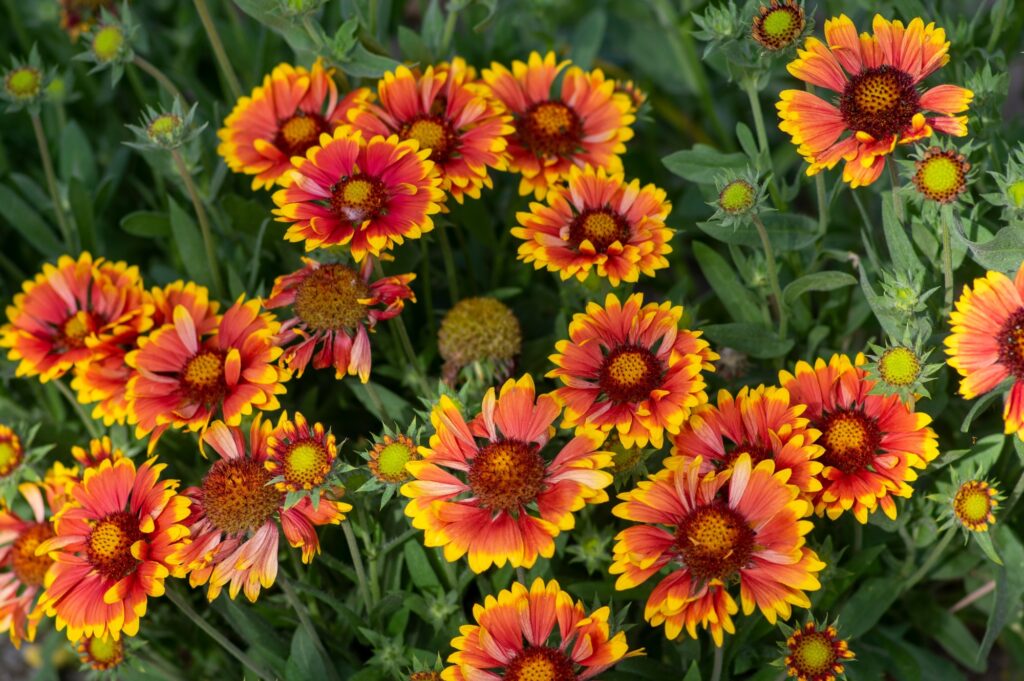
Gaillardia, commonly known as blanket flower, is a colorful, sun-loving plant prized for its long flowering season and bold daisy-like blooms in shades of red, orange, yellow, and burgundy. The warm colors often appear in striking combinations, with red or maroon centers surrounded by petals tipped in gold or yellow.
Several species and hybrids are grown in gardens, including perennial Gaillardia aristata, annual Gaillardia pulchella, and the popular hybrid Gaillardia × grandiflora. Although their longevity and growth habits vary, they generally share the same basic preferences: plenty of sunshine, soil that drains quickly, and relatively lean growing conditions.
Gaillardia is particularly well suited to pollinator gardens, cottage gardens, prairie-style landscapes, rock gardens, and other sunny areas where heat and occasional drought can make gardening difficult. Once established, plants require relatively little attention and can flower for an impressive portion of the growing season.
🌼 Gaillardia at a Glance
- Botanical name: Gaillardia spp.
- Common name: Blanket flower
- Plant family: Asteraceae
- Plant type: Annual, short-lived perennial, or perennial depending on species
- Mature height: About 1 to 3 feet
- Spread: About 1 to 2 feet
- Sun exposure: Full sun
- Soil: Well-drained, average to sandy soil
- Bloom time: Late spring or early summer through fall
- Flower colors: Red, orange, yellow, burgundy, and combinations
- Hardiness: Varies by species and cultivar
- Water needs: Low to moderate once established
- Wildlife value: Attracts bees, butterflies, and other pollinators
☀️ How Much Sun Does Gaillardia Need?
Gaillardia grows best in full sun, ideally receiving at least six hours of direct sunlight every day.
A sunny location encourages compact growth, sturdy flower stems, and abundant blooming. Plants grown in too much shade may become stretched or floppy and generally produce fewer flowers.
Full sun is also helpful because it allows soil and foliage to dry more quickly after rain. That is important for gaillardia because poor drainage and excess moisture are among the most common causes of problems.
In particularly hot climates, plants can tolerate a little late-afternoon shade, but avoid locations where buildings, trees, or shrubs block sunlight for most of the day.
🌱 Best Soil for Gaillardia
Gaillardia is not especially demanding about soil fertility, but it is quite particular about drainage.
Plants perform well in average, sandy, rocky, or relatively lean garden soil. They are often more successful in modest soil than in extremely rich beds that have been heavily amended with fertilizer and organic matter.
The most important requirement is that excess water can drain away quickly.
Heavy clay that remains saturated after rain can cause the roots and crown to deteriorate. This problem is especially important for perennial blanket flowers, which may survive summer perfectly well but fail to return after spending the winter in wet soil.
If your garden has heavy clay, consider growing gaillardia in a raised bed, on a slope, or in another elevated location.
💧 How Often Should You Water Gaillardia?
Newly planted gaillardia needs consistent moisture while its roots become established.
Water deeply after planting and continue watering whenever the upper portion of the soil becomes noticeably dry. Avoid keeping the ground constantly wet.
Once established, blanket flower becomes fairly drought tolerant and usually prefers being slightly dry rather than excessively wet.
Established plants growing in the ground may need supplemental watering during extended periods without rain, especially during extreme summer heat. Deep, occasional watering is preferable to frequent shallow watering.
Always check the soil before reaching for the hose. If the ground is still moist beneath the surface, additional irrigation may not be necessary.
🌡️ Temperature and Climate
Gaillardia handles heat very well and is an excellent choice for sunny gardens where summer temperatures can become intense.
Cold tolerance depends on the particular type you are growing. Gaillardia aristata is a hardy perennial across a broad region, while Gaillardia pulchella is commonly grown as an annual. Many popular garden cultivars are hybrids known as Gaillardia × grandiflora and are often relatively short-lived perennials.
Cold itself is not always the greatest winter challenge. Poor drainage can be more damaging.
Perennial blanket flowers are much more likely to survive cold winters when their roots remain in reasonably dry, well-drained soil.
🌿 How to Plant Gaillardia
Choose a location that receives full sun and does not collect standing water.
Dig a planting hole approximately as deep as the plant’s root ball and somewhat wider. Remove the plant gently from its container and position it so that the crown remains at approximately the same level as the surrounding soil.
Do not bury the crown deeply.
Fill around the root ball, gently firm the soil, and water thoroughly.
Space plants approximately 12 to 18 inches apart, although larger cultivars may benefit from additional room. Adequate spacing improves air circulation and gives each plant room to develop its naturally rounded shape.
🌰 Growing Gaillardia From Seed
Gaillardia is relatively easy to grow from seed.
Annual blanket flower can often be direct-sown outdoors after the danger of severe frost has passed. Seeds can also be started indoors several weeks before the expected last frost and transplanted into the garden once conditions become suitable.
Perennial gaillardia can also be propagated from seed, although young plants may take longer to reach their full flowering potential.
Sow seeds shallowly because they do not need to be deeply buried. Keep the seed-starting medium lightly moist while germination occurs, but never allow it to become waterlogged.
Once seedlings are large enough to handle, gradually acclimate indoor-grown plants to outdoor conditions before transplanting them into the garden.
🌸 When Does Gaillardia Bloom?
One of gaillardia’s biggest attractions is its remarkably long flowering period.
Depending on climate, species, and cultivar, blooming can begin in late spring or early summer and continue well into fall.
Individual flowers resemble colorful daisies, often with a dark red or burgundy center surrounded by petals containing combinations of scarlet, orange, and yellow.
Regularly removing old flowers can help maintain a tidy appearance and encourage continued blooming.
Healthy plants growing in strong sunlight can produce flowers for months.
✂️ Should You Deadhead Gaillardia?
Deadheading is useful but not absolutely necessary.
Removing spent flowers before they develop seed encourages the plant to continue putting energy into new flower production. It also prevents tired-looking seed heads from dominating the plant during the middle of the season.
Snip faded flower stems back to a healthy set of leaves rather than simply removing the petals.
If you want gaillardia to reseed naturally, stop deadheading some flowers later in the growing season and allow the seed heads to mature.
Leaving a few seed heads can also provide food for birds.
✂️ Does Gaillardia Need Pruning?
Gaillardia generally requires very little pruning.
If plants become untidy or excessively stretched during midsummer, a light trim can encourage fresh growth and improve their shape.
Avoid severe pruning late in the season if you are growing perennial gaillardia in a cold climate. Leaving some foliage and stems until spring can help protect the crown and provide winter habitat for insects.
Dead or damaged stems can be removed whenever necessary.
For perennial plants, final cleanup can be done in late winter or early spring before new growth becomes active.
🌾 Does Gaillardia Need Fertilizer?
Gaillardia usually needs very little fertilizer.
Rich soil and heavy feeding can actually work against the plant by encouraging lush foliage and soft growth instead of abundant flowers.
In reasonably fertile garden soil, supplemental fertilizer may not be necessary at all.
If your soil is exceptionally poor, a small amount of compost or a light application of a balanced fertilizer in spring is generally sufficient.
Avoid repeated applications of high-nitrogen fertilizer.
For gaillardia, leaner growing conditions frequently produce sturdier plants and better flowering.
🍂 Should You Mulch Gaillardia?
A thin layer of mulch can help newly planted gaillardia conserve soil moisture and reduce weed competition.
However, do not pile mulch around the crown.
Excessive mulch can retain too much water and prevent the soil near the plant from drying properly. This increases the risk of crown and root problems.
Gravel or another fast-draining surface treatment can sometimes work particularly well around blanket flowers planted in rock gardens or xeric landscapes.
The goal is to suppress weeds without creating constantly damp conditions around the plant.
🦋 Gaillardia for Butterflies and Pollinators
Gaillardia is an excellent addition to a pollinator garden.
Its colorful flowers attract bees, butterflies, and numerous other beneficial insects throughout its long flowering period. Because some varieties continue blooming well into late summer or fall, they can provide nectar after many spring-flowering plants have finished.
Blanket flower works especially well when combined with other pollinator-friendly plants that bloom at different points throughout the growing season.
Avoid routine use of broad-spectrum insecticides on flowering plants. Insecticides can harm the same bees and butterflies the flowers are meant to support.
🌿 Best Companion Plants for Gaillardia
Gaillardia’s fiery red, orange, and yellow flowers pair beautifully with purple, blue, white, and yellow flowering perennials.
Good companion plants include:
- Butterfly Weed
- Blazing Star
- Bee Balm
- Coreopsis
- Salvia
- Yarrow
- Coneflower
- Shasta Daisy
- Black-eyed Susan
- Asters
- Little bluestem
- Prairie dropseed
Pairing gaillardia with plants that enjoy similar sunny, well-drained conditions makes the entire bed easier to maintain.
Its warm-colored flowers look particularly dramatic beside purple salvia, coneflowers, blazing star, and ornamental grasses.
🌱 Does Gaillardia Spread?
Gaillardia is not usually considered an aggressive spreading perennial.
Perennial plants generally form clumps that gradually become larger over time. They can also produce seedlings if mature flower heads are allowed to remain on the plant.
Annual blanket flower may reseed readily in suitable conditions.
If you want additional plants, allowing some seed heads to mature can encourage natural seedlings. If you would rather keep plants confined to a particular area, deadhead flowers before they develop mature seeds.
Young volunteer seedlings are generally easy to remove or transplant.
🔄 Dividing Gaillardia
Perennial gaillardia can be divided to create additional plants or rejuvenate older clumps.
Spring is usually a good time to divide plants as active growth begins.
Dig around the clump carefully and lift as much of the root system as possible. Separate it into several healthy sections, making sure each division contains roots and growing shoots.
Replant the divisions promptly and water them well while they become established.
Because many perennial blanket flowers are naturally fairly short-lived, occasional division can help maintain vigorous plants in the garden.
🪴 Can Gaillardia Grow in Containers?
Gaillardia grows very well in containers provided the pot has excellent drainage.
Choose a container with drainage holes and fill it with a loose, fast-draining potting mixture. Avoid heavy garden soil, which can compact inside containers and retain too much water.
Place the container where it receives at least six hours of sunlight.
Potted plants require more frequent watering than those growing directly in the ground because containers can dry rapidly during summer. Water thoroughly when the potting mixture begins drying, then allow excess water to drain completely.
Never leave the pot standing continuously in a saucer of water.
🌺 Annual vs. Perennial Gaillardia
The name “blanket flower” can describe several different plants, so it is worth checking the botanical name on the plant label.
Gaillardia aristata
Gaillardia aristata is a perennial native to parts of North America. It forms clumps and returns from its roots each year where it is winter hardy.
Gaillardia pulchella
Gaillardia pulchella is commonly known as Indian blanket or firewheel and is usually treated as an annual or short-lived plant. It is particularly well known for its red and yellow flowers.
Gaillardia × grandiflora
Gaillardia × grandiflora is a hybrid between G. aristata and G. pulchella. Many of the named blanket flower cultivars sold by garden centers belong to this group.
These hybrids are often treated as short-lived perennials. Even when conditions are good, an individual plant may not persist for as many years as longer-lived perennials such as peonies or daylilies.
Fortunately, gaillardia is easy to replace through seedlings, division, or new plants.
🌼 Popular Gaillardia Varieties
Gardeners can choose from numerous cultivars differing in height, flower color, and growth habit.
Some produce the traditional red-and-yellow pinwheel effect, while others may be almost entirely yellow, red, burgundy, or orange.
Compact cultivars are particularly useful near the front of flower beds or in containers. Taller varieties can be mixed into prairie gardens and informal perennial borders.
When choosing a cultivar, pay attention to mature height and winter hardiness rather than selecting solely by flower color.
💐 Is Gaillardia a Good Cut Flower?
Yes. Blanket flowers can be used in fresh arrangements.
Cut stems when the flowers are freshly open and place them immediately into clean water.
The intensely colored flowers combine particularly well with yellow coreopsis, purple salvia, coneflowers, ornamental grasses, and other informal garden flowers.
Regular harvesting can also serve the same purpose as deadheading by removing older flowers before the plant spends energy producing seed.
🐛 Common Gaillardia Pests
Blanket flower generally experiences few serious insect problems when grown under appropriate conditions.
Aphids may occasionally gather on tender stems or flower buds. Small populations usually cause little permanent damage and may be controlled naturally by predators such as lady beetles and lacewings.
Spider mites can sometimes become troublesome during very hot, dry conditions.
Avoid treating every insect on the plant as a pest. Gaillardia attracts a wide range of beneficial insects, and excessive pesticide use can disrupt the natural balance of the garden.
Healthy plants typically tolerate modest insect feeding without difficulty.
🍄 Common Gaillardia Diseases
Blanket flower can experience several disease problems, particularly when growing conditions are too wet or plants are overcrowded.
Potential problems include:
- Powdery mildew
- Leaf spots
- Root rot
- Crown rot
- Aster yellows
Excellent drainage is one of the best ways to prevent root and crown problems.
Proper spacing also improves air circulation around the foliage, helping leaves dry after rain.
Water near the soil rather than repeatedly wetting the foliage with overhead irrigation whenever practical.
Plants affected by aster yellows may develop distorted or unusually colored flowers and abnormal growth. Because there is no practical cure for infected plants, severely affected specimens are generally removed.
❓ Why Isn’t My Gaillardia Flowering?
A lack of flowers is often related to growing conditions.
Too Little Sun
Blanket flower needs abundant direct sunlight. Plants growing in shade frequently produce more foliage and fewer flowers.
Too Much Fertilizer
Excess nitrogen encourages leafy growth rather than flower production.
Poor Drainage
Roots struggling in constantly wet soil may not support vigorous flowering.
Young Plants
Seed-grown perennial plants may simply need more time to mature.
Moving the plant to a sunnier location and reducing fertilizer frequently improves blooming.
❓ Why Is My Gaillardia Floppy?
Gaillardia can become floppy when growing in rich soil, excessive shade, or conditions that encourage unusually soft growth.
First, check the amount of sunlight the plant receives. Six or more hours of direct sun typically results in sturdier growth.
Avoid excessive fertilizer as well.
If plants still become loose and sprawling by midsummer, lightly trimming them can encourage a more compact flush of growth.
Providing adequate spacing also prevents neighboring plants from forcing the stems to stretch toward the light.
❓ Why Is My Gaillardia Dying?
The first thing to investigate is drainage.
Gaillardia is much more tolerant of temporarily dry soil than consistently saturated conditions. Plants that suddenly collapse despite receiving plenty of water may actually be suffering from damaged roots.
Check whether the planting area remains soggy after rain.
If it does, reduce irrigation and improve drainage before replacing the plant.
Remember that perennial gaillardias can also be relatively short-lived. An older plant disappearing after several growing seasons does not necessarily indicate that you did anything wrong.
Allowing some seedlings to develop can help maintain a continuous population in the garden.
❓ Why Didn’t My Gaillardia Return After Winter?
Winter wetness is a common reason perennial gaillardia fails to return.
A plant may tolerate freezing temperatures but struggle when its crown remains saturated during winter.
Good drainage becomes especially important during dormancy.
Avoid covering the crown with thick layers of moisture-retaining mulch, and never plant blanket flower in a low spot that collects winter rain or melting snow.
It is also worth checking the variety you purchased. Some gaillardias sold as perennial flowers are relatively short-lived, while annual forms are not expected to return from the same root system.
🐦 Should You Leave Gaillardia Seed Heads for Birds?
Leaving several flower heads on the plant at the end of the season can benefit wildlife.
Birds may feed on the mature seeds, while the standing stems provide additional structure and habitat during winter.
You do not need to leave every spent flower.
A practical approach is to deadhead regularly throughout most of the summer to encourage continued flowering, then allow some late-season flowers to mature naturally.
This provides both prolonged blooms and wildlife value.
🏡 Where to Plant Gaillardia
Blanket flower works especially well in sunny landscapes designed around heat- and drought-tolerant plants.
Good locations include:
- Pollinator gardens
- Butterfly gardens
- Cottage gardens
- Native plant gardens
- Prairie gardens
- Rock gardens
- Sunny borders
- Cutting gardens
- Containers
- Meadow-style plantings
- Drought-tolerant landscapes
The flowers have an informal appearance that makes them particularly effective when planted in groups rather than isolated as individual specimens.
Combine several plants with ornamental grasses and other summer-flowering perennials for a naturalistic display.
🌾 Is Gaillardia Deer Resistant?
Gaillardia is often described as resistant to deer and rabbit browsing, although no ornamental plant is completely immune when animals are hungry.
Its hairy foliage may make it less appealing than many softer-leaved garden plants.
That can make blanket flower a useful choice in landscapes where browsing pressure is moderate.
However, young plants should still be monitored after planting, particularly in gardens with heavy deer populations.
🌱 Is Gaillardia Easy to Grow?
Gaillardia is a very easy plant to grow when the location matches its needs.
The essentials are straightforward: give it plenty of sunshine, plant it in soil that drains well, avoid excessive fertilizer, and do not overwater established plants.
Deadheading encourages additional flowers, but even that chore can be reduced if you prefer a more natural garden and want plants to develop seeds.
The combination of heat tolerance, drought tolerance, long-lasting flowers, and pollinator value makes blanket flower particularly useful for gardeners looking for attractive plants that do not need constant attention.
🌼 Final Thoughts
Gaillardia brings months of fiery color to sunny gardens without demanding rich soil or complicated maintenance. Its red, orange, yellow, and burgundy flowers fit beautifully into cottage gardens, pollinator gardens, prairie plantings, and drought-tolerant landscapes.
The most important rule for growing blanket flower is to avoid loving it too much. Excessive water and fertilizer can cause more trouble than modest neglect. Give the plant full sun, excellent drainage, and enough water to become established, then allow it to grow under relatively lean conditions.
Whether you grow perennial Gaillardia aristata, annual Gaillardia pulchella, or one of the many colorful hybrid cultivars, blanket flower provides an easy way to add a long season of color while supporting butterflies, bees, and other garden wildlife.
🔗 Related Articles
- Flower Gardening
- Top 100 Garden Flowers for North American Gardens: A Year-Round Guide
- Coneflower Care
- Cosmos Care
- Marigold Care
- Phlox Care