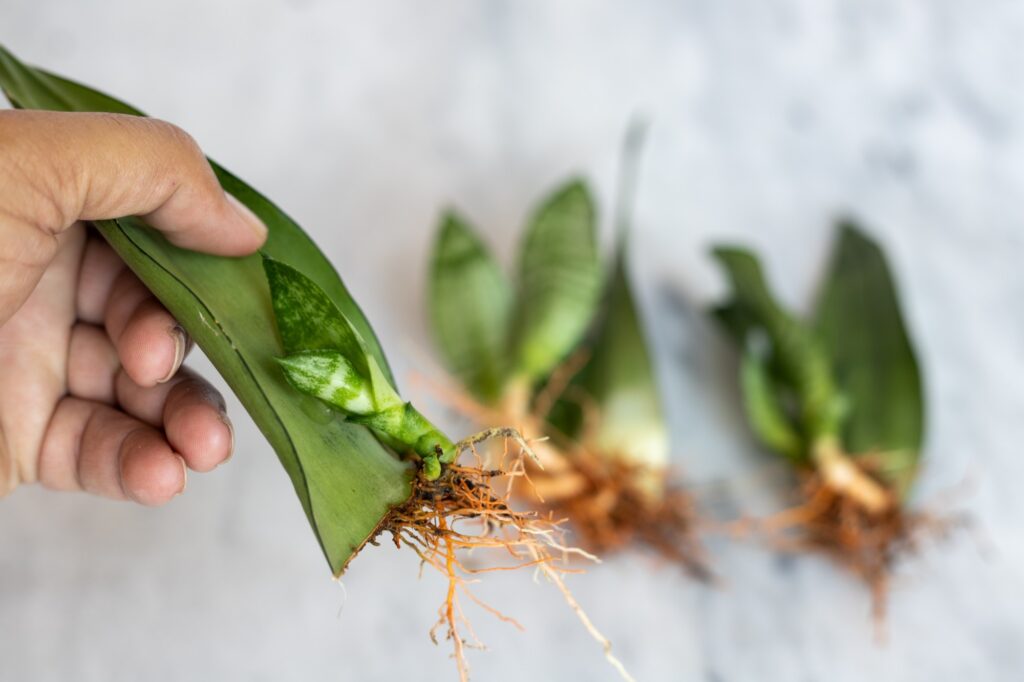
Snake plants are among the easiest houseplants to propagate, but the best method depends on the type of plant you have and whether you want the new plant to look exactly like its parent. Mature snake plants naturally spread through underground rhizomes, producing new shoots or pups that can be separated and replanted. They can also be propagated from sections of healthy leaves.
Botanically, the common snake plant is now generally classified as Dracaena trifasciata, although the older name Sansevieria trifasciata is still widely used. Its thick, upright leaves store water efficiently, while sturdy underground rhizomes allow established plants to gradually form dense clumps.
Division and pup separation are the most reliable propagation methods because they preserve the characteristics of the parent plant. Leaf cuttings are easy and fascinating, but variegated cultivars may lose their distinctive yellow or pale striping when propagated this way.
Whether you root snake plant cuttings in water or directly in soil, patience is important. Snake plants propagate much more slowly than spider plants or pothos, and it can take weeks or even months before new growth appears.
🌿 Snake Plant Propagation at a Glance
- Botanical name: Dracaena trifasciata
- Older botanical name: Sansevieria trifasciata
- Common names: Snake plant, mother-in-law’s tongue
- Easiest propagation method: Division or separating pups
- Other methods: Leaf cuttings in soil or water
- Best time to propagate: Spring through summer
- Light: Bright indirect light
- Rooting medium: Very well-drained potting mix
- Water propagation: Yes
- Propagation speed: Slow
- Variegation from leaf cuttings: May be lost
- Pet safety: Toxic if eaten
🌱 What Is a Snake Plant?
Snake plants are succulent-like tropical plants known for their thick upright leaves and exceptional tolerance of indoor conditions.
The leaves may be:
- Dark green
- Gray-green
- Banded
- Silver
- Yellow-edged
- Cream-variegated
Different cultivars vary dramatically in height and appearance.
Although snake plants tolerate neglect exceptionally well, they grow from fleshy underground stems called rhizomes.
These rhizomes spread horizontally and produce new shoots.
That natural growth habit makes division particularly easy.
🌿 What Are Snake Plant Pups?
Snake plant pups are new shoots that emerge from the soil near the parent plant.
They are connected underground by a rhizome.
Over time, one snake plant can develop into a dense colony containing many separate leaf clusters.
Each established pup can potentially become an independent plant.
Pup propagation is especially useful because it preserves the parent’s exact characteristics, including variegation.
🌱 What Is the Best Way to Propagate a Snake Plant?
For most gardeners, the best methods are:
- Separate existing pups
- Divide a mature plant
- Root leaf sections in soil
- Root leaf sections in water
If preserving a variegated cultivar is important, choose division or pup separation.
Leaf propagation works beautifully for solid-green snake plants but may produce green offspring from variegated parents.
📅 When Is the Best Time to Propagate Snake Plants?
Spring and summer are ideal.
Warmer temperatures and longer days encourage:
- Root development
- Rhizome growth
- New shoots
- Faster recovery after division
Indoor snake plants can technically be propagated at any time of year, but winter propagation is slower.
During winter, cuttings may remain unchanged for weeks because growth naturally slows.
If possible, wait until active growth resumes.
🌱 Method 1: Propagating Snake Plant Pups
Separating pups is one of the easiest and most reliable propagation methods.
Choose a pup that has developed:
- Several healthy leaves
- A visible connection to the parent
- Some roots of its own
Remove the entire plant from its container if necessary.
Gently brush away enough soil to locate the rhizome connecting the pup to the parent plant.
Use a clean knife or pruning tool to cut through the rhizome.
Make sure the pup retains roots.
Pot the pup separately in fresh, well-drained soil.
🌿 How Large Should a Snake Plant Pup Be Before Separating It?
Allow pups to develop enough roots to survive independently.
Very tiny shoots are best left attached for a while longer.
A pup several inches tall with visible roots is generally easier to establish than one that has only recently emerged.
There is no need to rush.
The parent plant continues supporting the pup while it remains attached.
✂️ How to Cut a Snake Plant Rhizome
Snake plant rhizomes are thick, pale underground stems connecting different leaf clusters.
When dividing:
- Remove enough soil to expose the rhizome.
- Identify where the pup joins the parent.
- Use a sterile sharp knife.
- Cut cleanly through the rhizome.
- Preserve as many roots as possible on both sections.
Allowing the cut surface to dry briefly before repotting can help reduce the risk of rot.
🌿 Method 2: Dividing a Mature Snake Plant
Division is excellent for a large, crowded snake plant.
It provides instant mature-looking plants rather than waiting months for leaf cuttings to produce shoots.
Remove the snake plant from its pot and inspect the root system.
Look for natural clusters of leaves connected by rhizomes.
Separate these sections by hand where possible.
If the rhizomes are thick and tightly connected, use a clean knife.
Each division should contain:
- Healthy leaves
- A section of rhizome
- Roots
Pot each section separately.
🪴 When Should You Divide a Snake Plant?
Division is useful when the plant:
- Has several distinct clusters
- Has filled its pot
- Is pushing against the container
- Has become difficult to water
- Is producing numerous pups
- Needs rejuvenation
Snake plants tolerate relatively tight pots, so being slightly root-bound is not necessarily a problem.
Divide only when you want additional plants or the specimen has genuinely outgrown its container.
🌱 Method 3: Propagating Snake Plants From Leaf Cuttings
Snake plants can also grow from pieces of mature leaves.
Choose a healthy, firm leaf without severe damage.
Cut the leaf near its base with a clean knife.
Then divide the leaf into sections approximately 2 to 4 inches long.
Each section can potentially produce roots and eventually new shoots.
However, orientation matters.
⬆️ Keep Leaf Cuttings Facing the Right Direction
A snake plant leaf cutting needs to be planted with the bottom end down.
If a section is accidentally planted upside down, it may fail to root properly.
One easy technique is to make the bottom cut straight and the top cut at an angle.
That way, you can tell which end belongs in the soil even after the sections have been sitting out to dry.
🌵 Should Snake Plant Cuttings Callus Before Planting?
Yes.
Allow cut leaf sections to dry for approximately one to several days before planting.
The cut ends should become dry and slightly callused.
This reduces the chance that freshly cut tissue will rot in moist soil.
Larger or thicker leaves may benefit from a slightly longer drying period.
Keep cuttings in a dry location away from intense direct sun while they callus.
🌱 How to Root Snake Plant Cuttings in Soil
Once the leaf sections have callused, fill a small container with very well-drained potting mix.
Insert the bottom end of each cutting approximately ½ to 1 inch into the soil.
Firm the mix gently around it.
Water lightly.
Place the pot in bright indirect light.
Then be patient.
Snake plant cuttings may take several weeks to develop roots and considerably longer to produce visible new shoots.
🪨 Best Soil for Snake Plant Cuttings
Snake plants are very susceptible to rot when kept too wet.
Use a porous, fast-draining growing medium.
Good options include:
- Cactus and succulent mix
- Houseplant mix amended with perlite
- Potting mix with pumice
- A blend containing coarse mineral material
Dense moisture-retentive garden soil is not suitable for indoor propagation.
Drainage holes are essential.
💧 How Often Should You Water Snake Plant Cuttings?
Water very sparingly.
The cutting has no substantial root system at first, so it cannot use large amounts of water.
Allow the potting mix to dry substantially between waterings.
Constantly moist soil is much more dangerous than allowing the cutting to become somewhat dry.
If the cutting begins becoming soft and mushy at the base, overwatering or rot is likely.
💧 Method 4: Propagating Snake Plants in Water
Snake plant leaf cuttings can also be rooted in water.
Cut and divide the leaf as you would for soil propagation.
Allow the sections to callus briefly.
Then place the bottom end of each cutting into a container containing a shallow amount of clean water.
Only the lower portion needs to be submerged.
Keep most of the cutting above the waterline.
🫙 How Much Water Should You Use?
Do not submerge half the leaf.
An inch or two of water around the bottom is sufficient.
Too much submerged tissue increases the amount of leaf exposed to conditions that can encourage rot.
Use a clean glass or jar so you can inspect the base regularly.
🚿 How Often Should You Change the Water?
Refresh the water approximately once a week or whenever it becomes cloudy.
Rinse the container if algae or residue develops.
Clean water provides better conditions for root formation.
Place the container in bright indirect light rather than direct sun.
Strong sun can heat the water and stress the cutting.
🌱 How Long Does a Snake Plant Take to Root in Water?
Snake plants are slow.
Roots may begin forming in several weeks, but some cuttings take considerably longer.
New pups usually take longer still.
It is entirely possible for a cutting to have healthy roots for months before a new shoot appears.
As long as the cutting remains firm and healthy, patience is usually the correct response.
🪴 When Should You Move Water-Rooted Snake Plants Into Soil?
Transfer the cutting once it has developed several healthy roots.
Roots approximately 1 to 2 inches long are generally sufficient.
Use a small pot filled with very well-drained potting mix.
Plant gently so the delicate water-grown roots are not broken.
Water lightly after potting.
Then allow the soil to dry considerably before watering again.
🌿 Soil vs. Water Propagation
Both methods work, but they have different advantages.
Soil Propagation
Advantages:
- Roots develop directly in their permanent environment
- No later transition from water
- Lower maintenance
- Lower risk of water stagnation
Water Propagation
Advantages:
- Easy to observe root development
- Interesting for beginners
- Lets you monitor rot quickly
- Makes the propagation process visible
For long-term simplicity, soil propagation is often easiest.
For the experience of watching roots develop, water propagation is more satisfying.
🌿 Why Variegated Snake Plants May Lose Their Variegation
This is one of the most important things to know before propagating.
Certain variegated snake plants, including the popular yellow-edged ‘Laurentii’, may not reproduce their variegation when grown from leaf cuttings.
Instead, new plants may revert to plain green foliage.
That happens because the distinctive variegation is not necessarily reproduced through leaf tissue in the same way it is preserved through division.
If you want an identical copy of a variegated plant, use:
- Pup separation
- Rhizome division
These methods clone the entire growth point and preserve the parent’s pattern much more reliably.
🌱 Can You Propagate ‘Laurentii’ From a Leaf?
Yes, but the resulting plant will often lose the characteristic yellow margins.
It may grow as a standard green snake plant instead.
If preserving the yellow-edged appearance is important, divide the parent or separate a variegated pup.
Leaf propagation is still worthwhile if you simply want more snake plants and do not care whether the new plants remain variegated.
🌿 Can You Propagate Moonshine Snake Plant?
Yes.
‘Moonshine’ can be propagated by division or leaf cuttings.
However, divisions are generally the best choice when you want to preserve the exact silver-green appearance of the parent plant.
Leaf-grown offspring may show variation.
As with other distinctive cultivars, division provides the most predictable result.
🌵 Can You Propagate Cylindrical Snake Plants?
Plants commonly sold as cylindrical snake plants, such as Dracaena angolensis and related forms, can also be divided or propagated from cut sections.
The same basic principles apply:
- Keep orientation correct
- Let cut surfaces callus
- Use fast-draining soil
- Water sparingly
Division is still the fastest method when established offsets are available.
☀️ Best Light for Propagating Snake Plants
Provide bright indirect light.
Although mature snake plants tolerate low light, propagation is much faster when adequate light is available.
Avoid intense direct afternoon sun on freshly cut leaves.
Too much sun can:
- Scorch tissue
- Increase water loss
- Heat propagation containers
Very dim conditions may keep the cutting alive but dramatically slow root and shoot development.
🌡️ Best Temperature for Snake Plant Propagation
Warm conditions encourage rooting.
Normal indoor temperatures around 65°F to 80°F work well.
Avoid:
- Cold windowsills
- Freezing drafts
- Unheated rooms
- Air-conditioning vents
Cold and wet conditions are especially dangerous because they encourage rot while slowing root growth.
💦 Do Snake Plant Cuttings Need High Humidity?
No.
Snake plants do not require a humidity dome.
Their thick leaves already store substantial moisture.
Excessively humid enclosed conditions may actually increase the risk of fungal growth and rot.
Ordinary household humidity is generally sufficient.
🪴 What Size Pot Should You Use?
Use a relatively small pot.
A leaf cutting or small pup does not need a huge container.
An oversized pot contains more wet soil than the small root system can use.
This dramatically increases the risk of overwatering.
Choose a container only slightly larger than the roots or cutting.
Move the plant into a larger pot later if necessary.
🕳️ Do Snake Plant Pots Need Drainage Holes?
Yes.
Drainage holes are strongly recommended.
Snake plants are highly sensitive to waterlogged soil.
If you want to use a decorative container without drainage, place the plant in a separate nursery pot inside it.
After watering, empty any excess water that collects in the outer container.
Never allow the root ball to sit continuously in water.
💧 When Should You Water Newly Divided Snake Plants?
After division, allow damaged root or rhizome surfaces to dry briefly when practical.
Then pot the divisions into dry or lightly moist soil.
You can wait several days before watering heavily, particularly if substantial rhizome cuts were made.
Once established, water only after the potting mix has dried significantly.
Snake plants recover from slight dryness much more easily than from rot.
🌿 How Do You Know a Snake Plant Cutting Has Rooted?
There are several signs.
The cutting may:
- Feel firmly anchored
- Resist a gentle tug
- Develop visible roots
- Remain plump and upright
- Eventually produce a new pup
The appearance of a new shoot beside the original cutting is the clearest indication of success.
Do not repeatedly pull the cutting out of the pot to check the roots.
This damages delicate new growth.
⏳ How Long Before New Snake Plant Leaves Appear?
This is where patience matters most.
New shoots may appear within a couple of months, but they can also take several months.
Leaf cuttings generally take longer to produce new plants than divisions or established pups.
Variables include:
- Temperature
- Season
- Light
- Cultivar
- Cutting size
- Root development
A healthy cutting that appears to be doing nothing may actually be building roots and rhizomes beneath the soil.
❓ Why Is My Snake Plant Cutting Rotting?
Rot is the most common propagation failure.
Causes include:
- Soil staying too wet
- Cutting not allowed to callus
- Pot without drainage
- Cold conditions
- Leaf planted too deeply
- Water propagation container becoming stagnant
If only the bottom section has rotted, cut above the damaged tissue with a sterile knife.
Allow the healthy section to callus again.
Then restart propagation.
❓ Why Is My Snake Plant Cutting Soft and Mushy?
Soft, translucent, or mushy tissue usually indicates rot.
Healthy snake plant leaves should remain firm.
Remove the cutting immediately from wet soil or water.
Cut away all soft tissue until only healthy firm tissue remains.
Sterilize the cutting tool between cuts.
If healthy leaf remains, allow it to dry thoroughly and try again.
❓ Why Is My Snake Plant Cutting Wrinkled?
Wrinkling usually indicates water loss.
A slight amount can occur before roots form because the cutting cannot yet absorb much water.
However, severe shriveling may indicate:
- Cutting is failing to root
- Excessive heat
- Too much sunlight
- Extremely dry conditions
- Root damage
Do not respond by soaking the soil continuously.
That can turn dehydration into rot.
Provide bright indirect light and modest moisture while giving the cutting time to root.
❓ Why Is My Snake Plant Cutting Turning Yellow?
Yellowing can result from:
- Overwatering
- Rot
- Cold temperatures
- Stress
- Natural deterioration of the original cutting
Inspect the base.
If it remains firm, the cutting may still survive.
If the yellow tissue becomes soft or translucent, remove the affected section.
❓ Why Isn’t My Snake Plant Cutting Growing?
Snake plant propagation is slow.
A cutting may spend months producing:
- Roots
- Rhizomes
- Underground growth points
before sending up a visible new leaf.
Slow growth is especially common during winter.
As long as the leaf is firm and free from rot, continue providing warmth and bright indirect light.
Do not try to force growth with excessive fertilizer or watering.
🌾 Should You Fertilize Snake Plant Cuttings?
Not initially.
A fresh cutting has few or no roots and cannot make good use of fertilizer.
Wait until new growth appears and the plant has clearly established.
Then use a diluted balanced houseplant or succulent fertilizer during the active growing season.
Snake plants are not heavy feeders.
Too much fertilizer can damage roots and encourage salt accumulation in the soil.
🌿 Can You Propagate a Damaged Snake Plant Leaf?
Yes, as long as healthy firm tissue remains.
A leaf broken accidentally can be divided into several sections and propagated.
Trim away damaged or rotting areas.
Remember to keep track of which end is the bottom.
Allow each section to callus before planting.
A broken leaf can potentially become several new plants rather than going to waste.
✂️ Can One Snake Plant Leaf Make Several Plants?
Yes.
A long leaf can be divided into multiple sections.
Each section may eventually produce one or more pups.
For example, a 2-foot leaf divided into 3-inch sections could theoretically produce several new plants.
Not every cutting will necessarily succeed, so propagating several pieces improves the odds.
🌱 Can You Root a Whole Snake Plant Leaf?
Yes.
Instead of cutting a leaf into sections, you can remove the entire leaf and root the base.
This often works well.
A whole leaf contains more stored energy than a small section, although it also occupies more space.
Let the cut end callus first.
Then place the lower portion in water or well-drained potting mix.
🌿 Should You Remove the Original Leaf After a New Pup Appears?
Not immediately.
The original cutting can continue supporting the developing pup.
Allow the new plant to produce several leaves and establish its own roots.
Later, if the old cutting becomes unattractive or naturally deteriorates, it can be trimmed away.
There is no rush.
🌱 Can Snake Plants Be Propagated From Roots Alone?
A plain root without a viable piece of rhizome or growth point generally will not produce a new snake plant reliably.
When dividing, make sure each section includes actual rhizome tissue and a growing point or established shoot.
Roots support the plant, but the rhizome carries the structures needed for new growth.
🐾 Are Snake Plants Safe for Pets?
No.
Snake plants are considered toxic to cats and dogs if eaten.
They contain saponins that can cause symptoms such as:
- Nausea
- Vomiting
- Diarrhea
Keep plants and loose propagation cuttings away from pets that chew foliage.
If a pet eats a significant amount or develops symptoms, contact a veterinarian.
🧼 Clean Your Propagation Tools
Use clean knives or pruning tools whenever cutting rhizomes or leaves.
Dirty tools can transfer bacteria or fungi into fresh wounds.
Before propagating:
- Wash the blade
- Disinfect it appropriately
- Allow it to dry
- Make clean cuts
Clean cuts heal more efficiently than ragged, crushed tissue.
🌿 Which Snake Plant Propagation Method Is Best?
The best method depends on your goal.
Best for Variegated Plants: Division
Preserves the parent’s appearance.
Best for Fast Results: Pup Separation
Provides a plant that already has leaves and roots.
Best for Producing Many Plants: Leaf Cuttings
One leaf can create several cuttings.
Best for Watching Root Growth: Water Propagation
Clear jars allow you to see the roots develop.
For most mature snake plants, division or pup separation is the simplest and most reliable approach.
🌱 Is Snake Plant Propagation Easy?
Yes.
The key is avoiding excessive moisture.
For the easiest propagation:
- Choose a healthy pup.
- Remove the plant from its pot.
- Locate the connecting rhizome.
- Cut the pup away while preserving roots.
- Pot in well-drained soil.
- Provide bright indirect light.
- Water sparingly.
For leaf propagation:
- Choose a healthy leaf.
- Cut it into 2- to 4-inch sections.
- Mark the bottom of each section.
- Allow the pieces to callus.
- Plant bottom-end down in well-drained mix.
- Water lightly.
- Keep warm.
- Wait patiently for roots and pups.
The biggest mistakes are overwatering, using a large pot, forgetting cutting orientation, and expecting new growth too quickly.
🌿 Final Thoughts
Snake plants are easy to multiply once you understand how they grow. Their underground rhizomes naturally produce pups that can be separated and repotted, making division the fastest and most dependable propagation technique.
If you have a large mature plant, divide it into several sections so each piece retains leaves, rhizome, and roots. Smaller pups can be cut from the parent once they develop a reasonable root system.
Leaf cuttings provide another excellent option. One healthy leaf can be divided into several sections and rooted directly in soil or water. Just remember to keep each piece oriented correctly and allow fresh cuts to callus before planting.
For variegated cultivars, division is particularly important because plants grown from leaf cuttings may lose their distinctive coloring and revert to green.
Most importantly, resist the urge to overwater. Snake plant cuttings root slowly and need far less moisture than many houseplant propagations. Warm temperatures, bright indirect light, excellent drainage, and patience usually produce the best results.
A single established snake plant can eventually provide enough pups and leaf cuttings to fill several pots — making Dracaena trifasciata one of the easiest houseplants to share and propagate at home.
🔗 Related Articles
- How to Successfully Propagate Spider Plants
- How to Plant a Tree
- Lavender Care
- Dill Care
- How to Plant Strawberries
- How to Plant Tomatoes