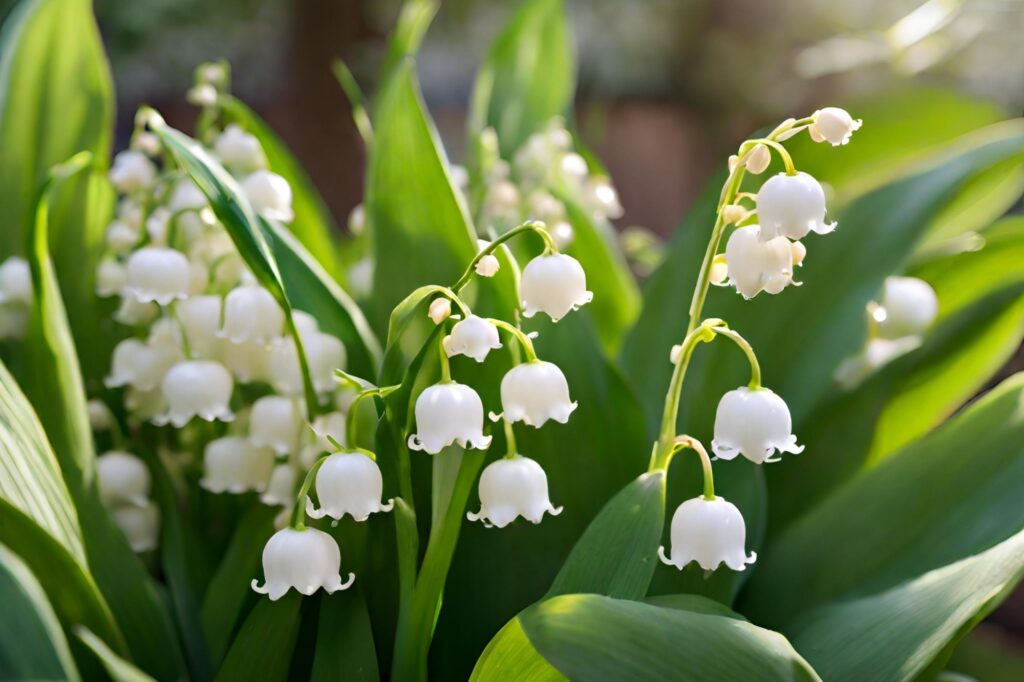
Lily of the valley is a classic shade-loving perennial known for its arching stems of tiny white bells and remarkably powerful fragrance. Although the flowers are small, a mature colony can perfume an entire section of the garden during spring.
The familiar garden species is Convallaria majalis, a rhizomatous perennial native to Eurasia. It belongs to the asparagus family, Asparagaceae, despite its common name and its resemblance to some true lilies.
Lily of the valley is especially useful in places where many flowering plants struggle. It tolerates partial to deep shade, grows beneath deciduous trees and shrubs, and can form a dense groundcover once established.
That vigor is also its biggest drawback.
The plant spreads through underground rhizomes and can gradually form extensive colonies. In a contained woodland bed or beneath established shrubs, that can be exactly what a gardener wants. In a small mixed perennial border, however, lily of the valley may eventually crowd neighboring plants. It has also escaped cultivation in parts of North America and can behave invasively in natural areas, so regional guidance should be checked before planting it near woodlands or other sensitive habitats.
There is another important consideration: lily of the valley is poisonous if eaten. All parts should be treated as toxic, including the flowers, leaves, roots, and attractive red berries. It is also toxic to dogs, cats, and horses.
If you have an appropriate contained location, however, Convallaria majalis is remarkably easy to grow. Give it shade, humus-rich soil, moderate moisture, and room to spread, and it can return for decades with very little maintenance.
⚡ Lily of the Valley Quick Care Guide
Botanical name: Convallaria majalis
Common name: Lily of the valley, lily-of-the-valley, May bells
Family: Asparagaceae
Plant type: Rhizomatous herbaceous perennial groundcover
Native range: Eurasia
Height: Usually about 6 to 10 inches
Spread: Individual plants remain small, but rhizomes can form broad colonies
Light: Partial shade, dappled shade, or full shade
Soil: Moist, humus-rich soil; adaptable once established
Soil pH: Acidic, neutral, or alkaline soils can be tolerated
Hardiness: Approximately USDA Zones 3–7
Bloom season: Mid- to late spring into early summer depending on climate
Flower color: Primarily white; pink-flowered forms also exist
Fragrance: Strongly fragrant
Water: Consistent moisture during establishment and spring growth; established colonies tolerate some summer dryness
Planting depth: Approximately 3 inches to the base of the rhizome or crown
Propagation: Division of rhizomes or rooted “pips”
Pruning: Little required
Spread: Vigorous through underground rhizomes
Wildlife resistance: Generally resistant to deer and rabbits
Main problems: Excessive spreading, gray mold, leaf spots, occasional caterpillar damage, and root problems in unsuitable soil
Safety: Poisonous if eaten; toxic to people and pets
🌿 What Is Lily of the Valley?
Lily of the valley is a low-growing woodland perennial.
Instead of producing a conventional upright stem with branches, the plant grows from underground rhizomes.
Each shoot generally produces broad green leaves that emerge directly from near ground level.
A slender flowering stalk develops between them.
Several small white flowers hang from one side of the stem.
The entire plant remains relatively short, usually under a foot tall.
Over time, however, the underground rhizomes travel outward and send up new shoots.
This allows an individual planting to become a broad colony rather than remaining a single clump.
🌸 What Do Lily of the Valley Flowers Look Like?
The flowers are tiny, nodding bells.
Each has:
- Fused white petals
- Six small outward-curving lobes
- A waxy appearance
- A remarkably strong fragrance
Flowers are arranged along a slender arching raceme.
A single flowering stem may carry several bells.
Although individual flowers are small, a large colony can produce hundreds of them simultaneously.
That combination of delicate appearance and intense fragrance is responsible for much of the plant’s enduring popularity.
👃 Why Does Lily of the Valley Smell So Strong?
Lily of the valley is one of the most strongly scented spring perennials.
The fragrance is generally described as:
- Sweet
- Fresh
- Floral
- Clean
- Slightly green
Even a relatively small patch can perfume the surrounding garden.
For that reason, it works particularly well near places where people walk or pause.
Consider planting it beside:
- Shaded paths
- Woodland walks
- Benches
- Garden gates
- Covered patios
Just remember that the rhizomes may eventually travel beyond the original planting area.
📅 When Does Lily of the Valley Bloom?
Lily of the valley primarily flowers during spring.
Depending on climate, flowering may extend into early summer.
In colder regions, blooms may appear relatively late in spring.
In milder climates, flowering begins sooner.
The individual bloom season lasts only a few weeks, but the foliage remains after the flowers disappear.
🌿 What Does Lily of the Valley Foliage Look Like?
The leaves are broad, smooth, and bright to medium green.
They are generally:
- Elliptical
- Oval
- Upright
- Strongly veined
Leaves commonly reach several inches long and create a dense ground-level canopy.
The foliage is attractive enough to function as a shade groundcover even after flowering ends.
Later in the growing season, leaves eventually yellow and disappear as the plant becomes dormant.
🔴 Does Lily of the Valley Produce Berries?
Yes, although fruit formation is not always abundant.
After successful pollination, flowers may develop into small red or orange-red berries.
These berries can be particularly noticeable against the green leaves.
They are ornamental—but they are not edible.
Keep children and pets from handling or eating them.
Because the bright berries may appear tempting, lily of the valley deserves particular caution in gardens frequently used by young children.
☠️ Lily of the Valley Is Poisonous
This is one of the most important facts about the plant.
Lily of the valley contains cardiac glycosides, also called cardenolides.
These compounds can affect the heart.
All parts of the plant should be treated as poisonous, including:
- Leaves
- Flowers
- Stems
- Rhizomes
- Roots
- Berries
Never use lily of the valley as an edible flower, herbal remedy, or garnish.
Historical medicinal uses do not make the plant safe for home consumption.
🐕 Is Lily of the Valley Toxic to Dogs?
Yes.
Lily of the valley is toxic to dogs.
Possible signs of poisoning include:
- Vomiting
- Abnormal heart rhythm
- Low blood pressure
- Weakness
- Disorientation
- Seizures in severe cases
The attractive berries and underground rhizomes can both present risks.
If a dog eats any part of the plant, contact a veterinarian or animal poison-control service promptly.
🐈 Is Lily of the Valley Toxic to Cats?
Yes.
The plant is also toxic to cats.
Cats may encounter cut lily of the valley flowers indoors as well as plants growing outdoors.
Keep bouquets and garden plants away from pets prone to chewing vegetation.
If ingestion is suspected, seek veterinary advice rather than waiting for symptoms to develop.
🐴 Lily of the Valley and Horses
Lily of the valley is also considered toxic to horses.
It should not be intentionally planted in or immediately beside grazing areas.
Although horses may avoid many unfamiliar plants when other forage is available, toxicity makes prevention the safer approach.
🌎 Is Lily of the Valley Native to North America?
The familiar garden species, Convallaria majalis, is native to Eurasia.
It has been cultivated extensively in North America and has escaped into natural areas in some regions.
Its rapid underground spread can allow it to form dense colonies outside gardens.
North America also has a native relative commonly known as American lily of the valley, Convallaria pseudomajalis.
The two should not be confused.
🌿 American Lily of the Valley
Convallaria pseudomajalis is native to portions of the southern Appalachian region.
It has previously been treated under names including:
- Convallaria majalis var. majuscula
- Convallaria majuscula
It resembles European lily of the valley but differs in important ways.
American lily of the valley generally:
- Has somewhat larger leaves
- Occurs naturally in mountain forests
- Forms smaller colonies
- Is less aggressively spreading than Convallaria majalis
Gardeners interested in native woodland plants should investigate whether this species is appropriate and available in their region.
Do not collect plants from wild populations.
⚠️ Can Lily of the Valley Become Invasive?
Yes.
European lily of the valley spreads vigorously through underground rhizomes.
In a garden, this may create a dense weed-suppressing groundcover.
Outside the garden, the same growth habit can allow the plant to displace other vegetation.
It has escaped cultivation and is considered invasive or problematic in parts of North America.
Before planting near:
- Native woodland
- Natural areas
- Stream corridors
- Parks
- Property boundaries
check local invasive-plant guidance.
A contained urban or suburban bed is very different from planting beside a natural woodland.
🌱 How Does Lily of the Valley Spread?
The primary mechanism is underground rhizomes.
Rhizomes extend horizontally through the soil.
New growing points develop along them.
Those shoots emerge at the surface and gradually expand the colony.
Gardeners often call the rooted growing pieces pips.
A few planted pips can eventually become a substantial patch.
Seed can also be produced, but vegetative spread is generally much more important in garden colonies.
🌿 Is Lily of the Valley a Good Groundcover?
In the right place, yes.
It can form an attractive low carpet beneath trees and shrubs.
Advantages include:
- Shade tolerance
- Fragrant flowers
- Dense foliage
- Deer resistance
- Ability to grow where lawn grass struggles
The disadvantage is control.
Once established, the rhizomes may move into neighboring beds.
Use lily of the valley where a broad colony is acceptable rather than expecting it to remain in a tiny, precisely defined clump.
🚧 Where Should You NOT Plant Lily of the Valley?
Avoid planting beside:
- Small delicate perennials
- Rare woodland plants
- Rock gardens
- Tiny formal borders
- Natural forests where escape is possible
- Property boundaries where rhizomes can spread into neighboring gardens
It is much better suited to a contained bed beneath established shrubs or trees.
Think of it as a groundcover capable of claiming territory rather than a polite specimen perennial.
☀️ How Much Sun Does Lily of the Valley Need?
Lily of the valley is primarily a shade plant.
It performs well in:
- Dappled shade
- Partial shade
- Full shade
Some morning sun is fine.
In cool climates, plants may tolerate more direct sunlight if soil remains moist.
In hot climates, strong afternoon sun can scorch leaves and dry the root zone.
For help understanding different garden exposures, visit Gardening Basics.
🌳 Lily of the Valley Beneath Trees
Woodland-style conditions suit the plant extremely well.
Deciduous trees provide:
- Spring light
- Summer shade
- Leaf litter
- Cooler soil
Lily of the valley can gradually fill the soil beneath trees where many lawn grasses struggle.
However, large trees may create intense root competition.
Water newly planted pips until they establish rather than assuming a shaded site automatically remains moist.
🌑 Can Lily of the Valley Grow in Deep Shade?
Yes.
Few flowering perennials tolerate deep shade as successfully.
Flowering may be somewhat better with dappled light or partial shade, but the plant can survive in very shaded conditions.
This makes it useful on:
- North sides of buildings
- Woodland interiors
- Beneath dense shrubs
If a site receives almost no useful light and is also extremely dry, establishment may still be slow.
Shade tolerance does not eliminate the need for water.
🌞 Can Lily of the Valley Grow in Full Sun?
It can tolerate more sun in cool climates when soil remains moist.
Full hot afternoon sun is generally less suitable.
Excessive exposure may cause:
- Leaf scorch
- Faster soil drying
- Early foliage decline
If you are planting in a region with hot summers, partial shade is much safer.
🌎 Best Soil for Lily of the Valley
Lily of the valley prefers fertile, humus-rich, moist soil.
Woodland-style soil enriched by decomposing leaves is ideal.
Once established, however, the plant can tolerate a surprising range of conditions.
It may grow in:
- Loam
- Clay
- Organic-rich woodland soil
- Occasionally dry ground
- Seasonally moist soil
For help improving soil structure and understanding drainage, visit the Garden Soil Guide.
🧪 Soil pH for Lily of the Valley
Lily of the valley is adaptable.
It can grow in:
- Acidic soil
- Neutral soil
- Alkaline soil
There is little reason to alter soil pH specifically for this plant unless a soil test reveals an extreme condition affecting the entire garden.
Shade, moisture, organic matter, and competition are usually more important considerations.
💧 How Much Water Does Lily of the Valley Need?
Newly planted lily of the valley appreciates consistent moisture.
Keep the soil from becoming severely dry while roots and rhizomes establish.
Established colonies become substantially tougher.
NC State Extension notes that established plants can tolerate periods of summer drought.
They may become dormant or look less attractive during severe dryness, but healthy rhizomes can survive underground.
For the best foliage, maintain moderate soil moisture through spring and early summer.
🌧️ Can Lily of the Valley Grow in Wet Soil?
It tolerates moist and occasionally wet soil reasonably well.
That does not make it an aquatic or bog plant.
Persistently stagnant soil can still create root problems.
A moisture-retentive woodland loam is preferable to a permanently flooded location.
🍂 Mulching Lily of the Valley
An autumn top-dressing of organic material suits the plant very well.
Good choices include:
- Leaf mold
- Shredded leaves
- Finished compost
These materials mimic the natural accumulation of organic matter on a woodland floor.
Mulch helps:
- Maintain soil moisture
- Moderate temperature
- Add organic matter
- Suppress competing weeds
Avoid piling a very thick layer directly over newly planted pips.
📅 When Should You Plant Lily of the Valley?
Spring and fall are both suitable.
Bare-root pips are frequently sold during dormancy.
Plant them promptly rather than allowing the roots to dry completely.
Fall planting gives the roots time to settle before spring growth.
Spring planting can also be successful when soil remains moist.
Container-grown plants can be installed whenever conditions are cool and soil can be worked.
🌱 What Is a Lily of the Valley Pip?
A pip is a rooted growing point or crown attached to part of the underground rhizome.
Nurseries often sell lily of the valley as bare-root pips rather than as large container plants.
Each healthy pip can produce new leaves and eventually flowers.
Once planted, rhizomes extend outward and create additional pips.
This is how a small planting gradually develops into a colony.
📏 How Deep Should Lily of the Valley Be Planted?
Planting depth depends somewhat on the form in which you purchase the plant.
NC State Extension recommends planting approximately 3 inches deep to the base of the rhizome.
When planting pips, position the growing point relatively close to the soil surface rather than burying it excessively deeply.
Spread the roots gently.
Backfill.
Water thoroughly.
📏 How Far Apart Should Lily of the Valley Be Planted?
For quick groundcover, pips can be planted relatively close together.
However, remember that the plant spreads vigorously once established.
You do not need to purchase enough plants to fill every inch immediately.
A modest group can expand considerably over several years.
If containment is important, leave space between the initial planting and neighboring perennials so you can identify and remove wandering rhizomes.
🌱 Lily of the Valley Can Be Slow at First
A new planting may seem surprisingly modest during its first season.
The underground rhizomes need time to establish.
Growth may then accelerate dramatically.
A common pattern is:
Year 1: Small patch
Year 2: Noticeably stronger
Later years: Colony begins moving outward
Do not overplant simply because new pips initially look sparse.
✂️ Does Lily of the Valley Need Pruning?
Very little.
No formal pruning is required.
After foliage turns yellow and dies naturally, it can be removed.
During the growing season, remove:
- Damaged leaves
- Diseased foliage
- Unwanted shoots beyond the colony boundary
The most important maintenance is generally controlling spread rather than pruning the top growth.
🌸 Should You Deadhead Lily of the Valley?
Deadheading is optional.
Removing faded flower stems can:
- Improve appearance
- Prevent berry formation
- Reduce potential seed production
If you enjoy the red berries and can ensure children and pets will not eat them, flower stems may be left in place.
Remember that berries are poisonous.
Removing them is sensible in high-traffic family gardens.
✂️ How to Control Lily of the Valley
The easiest approach is early intervention.
When shoots appear outside the intended area:
- Trace them back toward the colony.
- Dig beneath them.
- Remove the associated rhizome.
- Check the area for remaining pieces.
Simply cutting the leaves off does not eliminate the underground plant.
Persistent rhizomes can send up replacement shoots.
Repeated digging may be necessary where an old colony has escaped its intended boundaries.
🚧 Can You Use a Root Barrier?
A physical barrier may help contain a small planting.
The barrier needs to extend deeply enough to intercept spreading rhizomes.
Even then, inspect the perimeter periodically.
Rhizomatous plants have an impressive ability to find:
- Gaps
- Edges
- Openings
Container planting is a more reliable option when complete containment is essential.
🌱 Dividing Lily of the Valley
Division is easy.
Autumn is an excellent time.
Lift a section of the colony.
Separate healthy rooted rhizomes or pips.
Replant them immediately in prepared soil.
Water thoroughly.
Division can be used to:
- Reduce an overcrowded patch
- Move plants
- Start a new colony
- Share plants with another gardener
Before sharing, make sure the recipient understands how vigorously European lily of the valley spreads.
🌱 Growing Lily of the Valley From Seed
Seed propagation is possible but considerably slower than division.
Seeds may require a lengthy natural or artificial stratification process before successful germination.
Named cultivars may not produce identical seedlings.
Because rhizome division is so easy, seed propagation is rarely necessary for ordinary garden use.
🌸 Pink Lily of the Valley
White is the traditional flower color, but pink-flowered forms are available.
Convallaria majalis ‘Rosea’ produces pale pink bells.
The color is generally soft rather than intensely bright.
Pink forms work beautifully in woodland gardens with:
- Ferns
- Heucheras
- Lungwort
- Other shade foliage
Their care and spreading behavior are similar to those of ordinary white lily of the valley.
🌿 Variegated Lily of the Valley
Variegated forms are also available.
Their green foliage may carry:
- Cream stripes
- Yellow striping
- Pale margins
Variegation adds interest after the flowers fade.
Some variegated cultivars grow somewhat less aggressively than the plain green species, although gardeners should still monitor their spread.
🐝 Lily of the Valley and Pollinators
Lily of the valley flowers can attract insect pollinators.
However, it should not be considered the foundation of a pollinator garden.
In North America, the familiar European species is non-native and can escape from cultivation.
Where wildlife value is the primary goal, combine or replace it with regionally native woodland flowers.
For broader habitat-friendly gardening ideas, visit Eco-Friendly Gardening.
🦌 Is Lily of the Valley Deer Resistant?
Yes.
Lily of the valley is generally resistant to deer browsing.
Its toxic compounds make it unappealing to many animals.
This is one reason it can thrive beneath trees and shrubs in areas where more palatable groundcovers are repeatedly eaten.
Deer resistance does not mean the plant is ecologically harmless, however.
Its ability to spread should still be considered before planting.
🐇 Do Rabbits Eat Lily of the Valley?
Rabbits generally avoid it as well.
NC State Extension lists lily of the valley as resistant to both deer and rabbits.
That makes it useful in difficult shaded gardens with heavy browsing pressure.
The plant’s toxicity is the reason for much of this resistance.
🐌 Slugs and Snails
Lily of the valley is not usually plagued by serious slug or snail damage.
Occasional chewing may occur in damp shade.
Established colonies generally tolerate minor leaf damage easily.
Avoid treating a few imperfect leaves as a major pest problem.
🌫️ Gray Mold
RHS lists gray mold as a possible disease.
Problems are more likely when plants grow in:
- Dense colonies
- Damp stagnant air
- Persistently wet foliage
Symptoms may include damaged leaves or flowers covered by gray fungal growth.
Remove severely affected material.
Improving airflow and avoiding unnecessary overhead watering can help.
🍃 Leaf Spots
Leaf spots may also occur.
Affected foliage can develop:
- Brown spots
- Dark lesions
- Yellow areas
- Premature decline
A few spots late in the growing season are generally not serious.
Remove heavily diseased foliage, particularly when a colony has become extremely dense.
🌿 Why Are Lily of the Valley Leaves Turning Yellow?
Yellow foliage can have several explanations.
Natural Dormancy
Leaves naturally yellow as the season progresses.
Drought
Very dry summer soil can cause earlier decline.
Excessive Sun
Strong heat and sunlight can scorch foliage.
Root Stress
Disturbed or poorly established plants may yellow.
Disease
Leaf spots and other problems can cause localized discoloration.
Consider the timing before assuming the plant is unhealthy.
Late-season yellowing is normal.
🌼 Why Isn’t My Lily of the Valley Flowering?
Possible causes include:
Plants Are Newly Established
Young pips may need time to settle.
Too Much Deep Shade
Although the plant tolerates shade, some light encourages stronger flowering.
Excessive Dryness
Severe spring drought can reduce bloom.
Dense Competition
Tree roots and neighboring plants may compete for moisture.
Plants Were Recently Divided
They may require time to re-establish.
Lily of the valley can survive in darker conditions than are ideal for abundant flowers.
🌿 Why Is My Lily of the Valley Spreading Everywhere?
Because spreading is part of its natural growth habit.
The rhizomes grow horizontally underground.
New shoots then appear at intervals.
Once a mature colony is established, it can expand quickly.
Do not wait several years to address unwanted spread.
Removing young advancing rhizomes is far easier than reclaiming a bed after lily of the valley has completely filled it.
🌿 Lily of the Valley With Ferns
Ferns are natural companions.
Both appreciate woodland-style conditions.
Ferns provide taller foliage above the low lily of the valley colony.
The combination works well beneath:
- Deciduous trees
- Large shrubs
- Woodland edges
Choose non-aggressive ferns capable of holding their own against the spreading rhizomes.
🌿 Lily of the Valley With Heuchera
Heuchera provides strong foliage color in partial shade.
Possible combinations include:
White lily of the valley + burgundy Heuchera
Pink lily of the valley + silver Heuchera
White lily of the valley + lime Heuchera
Keep some distance between them.
Lily of the valley can eventually invade a Heuchera crown if allowed to spread unchecked.
💙 Lily of the Valley With Lungwort
Lungwort is another attractive spring shade plant.
Its blue, violet, or pink flowers and silver-spotted leaves contrast beautifully with lily of the valley.
Both appreciate moist, humus-rich soil.
However, lily of the valley is the more aggressive spreader.
Use it in a separate patch or maintain a clear boundary so it does not overwhelm the lungwort.
🌼 Lily of the Valley With Primrose
Primrose flowers earlier and can provide bright yellow, pink, purple, or white color before lily of the valley reaches peak bloom.
Both appreciate cool, shaded conditions.
Again, containment matters.
Primroses are relatively small plants and can be swallowed by an expanding lily of the valley colony.
Keep them in neighboring rather than intermingled patches.
🌸 Lily of the Valley With Lenten Rose
Lenten Rose provides larger late-winter and early-spring flowers.
Lily of the valley follows later.
Hellebores create permanent structural clumps while lily of the valley fills nearby ground.
Do not allow rhizomes to crowd directly into the hellebore crown.
🌸 Lily of the Valley With Columbine
Columbine provides taller flowers above low shade plantings.
Columbines can tolerate some woodland-edge conditions and may overlap with lily of the valley bloom.
Because columbines are often short-lived and self-seeding, allow them open soil where seedlings can establish rather than letting lily of the valley form an uninterrupted carpet everywhere.
🌺 Lily of the Valley With Toad Lily
Toad Lily provides a late-season counterpart.
Lily of the valley flowers in spring.
Toad lily flowers in late summer and fall.
Both appreciate partial shade and organic-rich soil.
Place them in separate neighboring areas so the vigorous lily of the valley does not invade the toad lily clump.
🌳 Lily of the Valley Beneath Lilacs
A mature Lilac may create enough light shade beneath its outer branches for lily of the valley.
The combination offers fragrance at two levels.
Lilacs provide spring flowers above.
Lily of the valley creates a fragrant ground layer below.
Make sure the area receives enough moisture because mature shrubs can create strong root competition.
🌹 Lily of the Valley Beneath Roses
RHS recommends lily of the valley for underplanting roses and shrubs.
The low foliage can fill shaded soil near established woody plants.
However, roses need significant sunlight, while lily of the valley prefers more shade.
The combination works best near the edges of large rose plantings where lily of the valley receives protection from intense afternoon sun.
For rose-growing advice, visit Rose Care.
🌳 Lily of the Valley in a Woodland Garden
A contained woodland-style bed is one of the plant’s best uses.
It can provide:
- Spring fragrance
- White flowers
- Dense green foliage
- Groundcover beneath trees
The key word is contained.
Avoid allowing European lily of the valley to escape into adjacent natural woodland.
In a native woodland garden, investigate native alternatives—including American lily of the valley where appropriate—rather than automatically choosing Convallaria majalis.
🪴 Can Lily of the Valley Grow in Containers?
Yes.
Containers can actually be an excellent way to enjoy the plant while controlling its spread.
Choose a broad pot with drainage holes.
Use a moisture-retentive but well-drained potting mix.
Place the container in:
- Partial shade
- Dappled shade
- Morning sun
Keep it watered during active growth.
A container also makes it easier to keep poisonous berries and spreading rhizomes away from other parts of the garden.
🪴 Lily of the Valley in Patio Containers
Because flowers are small, place containers where they can be appreciated at close range.
Good locations include:
- Shaded porches
- Patio edges
- Entry paths
- Garden benches
The fragrance is often more noticeable than the flowers from a distance.
After flowering, the leaves provide a simple green foliage display.
❄️ Winter Care in Containers
Lily of the valley is very cold hardy in the ground.
Containers expose roots and rhizomes to more severe temperature fluctuations.
In extremely cold climates, protect pots by:
- Moving them to a sheltered outdoor location
- Insulating the container
- Sinking the pot into the ground temporarily
Do not bring hardy plants into a warm house for the entire winter.
They benefit from natural dormancy.
🏠 Can Lily of the Valley Grow Indoors?
Lily of the valley can be forced into bloom indoors, although it is not typically maintained as a permanent houseplant.
Dormant pips can be prepared and brought into warmer conditions to encourage early flowers.
Once flowering is finished, plants are better returned to suitable outdoor growing conditions rather than treated as conventional houseplants.
The strong fragrance can be surprisingly intense indoors.
💐 Is Lily of the Valley a Good Cut Flower?
Yes.
The small flowering stems are famously fragrant and have long been used in delicate bouquets.
Harvest when several bells have opened.
Place the stems into clean water promptly.
Keep cut flowers away from:
- Children
- Pets
- Food-preparation areas
because all parts remain toxic after cutting.
Wash your hands after handling stems, especially before eating.
💍 Lily of the Valley in Wedding Flowers
Lily of the valley has a long tradition as a wedding flower.
Its small white bells and fragrance make it particularly suitable for:
- Bridal bouquets
- Boutonnieres
- Small arrangements
The flowers are relatively delicate and can be expensive because they are seasonal and difficult to handle commercially.
Again, ornamental use does not mean the plant is edible.
Keep flower stems away from food and drink.
🌱 Spring Lily of the Valley Care
Spring is the main period of active growth.
As leaves emerge:
- Clear away heavy debris
- Maintain soil moisture
- Add a light layer of compost or leaf mold
- Watch colony boundaries
- Enjoy the flowers
If unwanted shoots appear outside the intended planting, remove them early before rhizomes extend farther.
☀️ Summer Lily of the Valley Care
During summer, foliage remains green for a period and then gradually declines.
Established plants tolerate some dryness.
During prolonged drought:
- Water if you want foliage to remain attractive
- Do not panic if leaves begin entering dormancy
Avoid heavy fertilizer.
There is little reason to force lush growth from a woodland perennial naturally approaching dormancy.
🍂 Fall Lily of the Valley Care
Fall is an excellent time to:
- Divide colonies
- Plant new pips
- Remove wandering rhizomes
- Top-dress with leaf mold
- Refresh organic mulch
Once foliage has died, it can be removed.
Mark the boundaries of a contained bed if the dormant colony becomes difficult to see.
❄️ Winter Lily of the Valley Care
Little care is required.
The plant is dormant underground.
Within its normal hardiness range, cold winter temperatures are not a problem.
Avoid waterlogged conditions.
Do not dig repeatedly through a dormant bed because rhizome fragments can be spread unintentionally into surrounding areas.
🌱 A Simple Shade Garden With Lily of the Valley
For a woodland-style bed, consider:
Early-season layer: Snowdrops, Winter Aconite, and Primroses
Spring ground layer: Lily of the Valley
Spring foliage and flowers: Lungwort and Heuchera
Mid-height layer: Columbine and Ferns
Late-season layer: Toad Lily and Japanese Anemone
Keep lily of the valley in a clearly defined section rather than mixing it evenly among every other perennial.
That allows you to enjoy its groundcover qualities without sacrificing slower-growing companions.
⚠️ Common Lily of the Valley Care Mistakes
Planting Without Considering Its Spread
The rhizomes can form large colonies.
Planting Beside Delicate Perennials
Lily of the valley may eventually overwhelm them.
Allowing It to Escape Into Natural Woodland
European lily of the valley can behave invasively.
Assuming Shade Means the Soil Is Moist
Tree roots can create extremely dry shade.
Planting in Hot Full Sun
Leaves can scorch and plants may decline early.
Removing New Shoots Without Removing Rhizomes
The underground plant simply sends up replacements.
Assuming the Red Berries Are Edible
They are poisonous.
Planting Where Pets Regularly Chew Plants
Lily of the valley contains cardiac glycosides.
Confusing European and American Lily of the Valley
They are different species with different ecological implications.
Expecting It to Behave Like a Neat Clumping Perennial
This is a spreading groundcover.
🌸 Is Lily of the Valley Easy to Grow?
Very easy—sometimes too easy.
Once established in a suitable shaded site, it requires little maintenance.
The basic routine is straightforward:
Plant in partial to full shade.
Provide humus-rich soil.
Keep new plants moist.
Allow the colony to establish.
Top-dress with organic matter.
Divide when necessary.
Remove unwanted rhizomes before they travel too far.
And choose the planting location carefully before the first pip ever goes into the ground.
The challenge is rarely getting lily of the valley to survive.
The challenge is deciding where you are willing to let it spread.
🤍 A Small Flower With a Powerful Presence
Lily of the valley is easy to underestimate.
The plant grows only a few inches tall.
Its flowers are tiny.
Its leaves are simple.
Then spring arrives.
Dozens of white bells open beneath the trees.
Their fragrance moves through the shade.
What looked like an ordinary patch of green foliage suddenly becomes one of the most memorable areas of the garden.
A few weeks later, the flowers disappear.
The colony returns to green.
Underground, however, the rhizomes continue extending.
That ability to persist and expand is both the plant’s greatest strength and its greatest weakness.
In the right place, lily of the valley can create a durable, deer-resistant, fragrant groundcover that flowers reliably for decades.
In the wrong place, it can become an aggressive plant that crowds neighboring perennials and escapes beyond the garden.
Choose the site before choosing the plant.
Keep Convallaria majalis contained.
Respect its toxicity.
And where its vigorous growth is appropriate, lily of the valley can remain one of the most distinctive flowers of the spring shade garden.
🔗 Related Articles
- Flower Gardening
- Gardening Basics
- Garden Soil Guide: Soil Types, Testing, pH & How to Improve It
- Eco-Friendly Gardening
- Seasonal Gardening
- Primrose Care
- Lungwort Care
- Heuchera Care
- Columbine Care
- Lenten Rose Care
- Toad Lily Care
- Japanese Anemone Care
- Lilac Care
- Rose Care
📚 Sources & Further Reading
- NC State Extension — Lily of the Valley (Convallaria majalis)
- NC State Extension — American Lily of the Valley (Convallaria pseudomajalis)
- Royal Horticultural Society — Lily of the Valley (Convallaria majalis)
- ASPCA — Lily of the Valley Toxicity
- Invasive Plant Atlas of the United States — Lily of the Valley