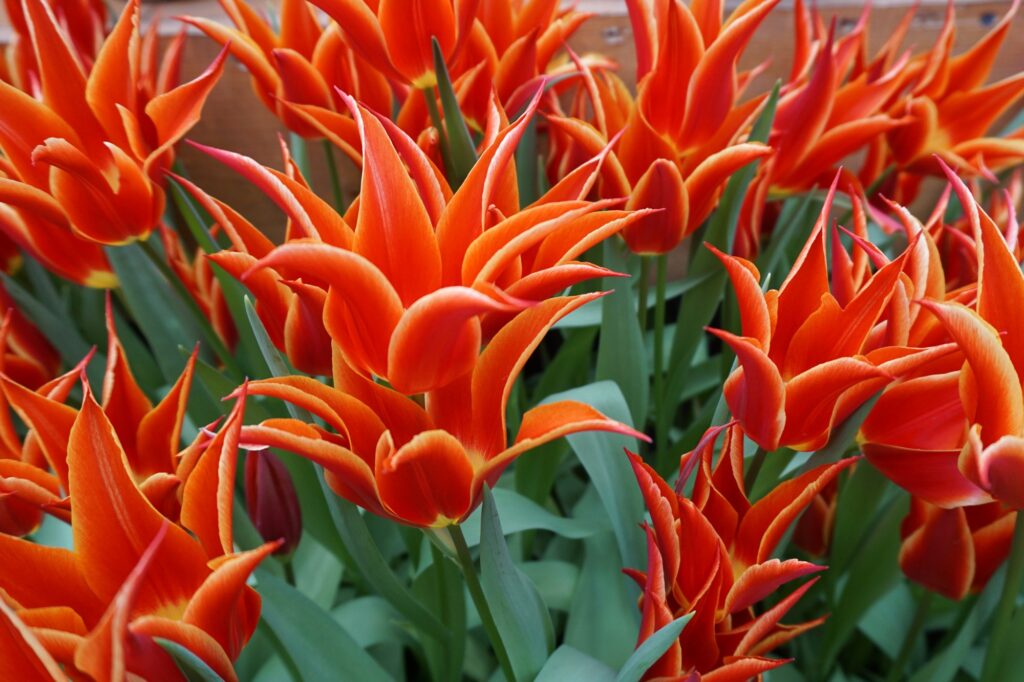
Tulips are among the most recognizable spring flowers, but the familiar cup-shaped red tulip represents only a small part of the genus. Garden tulips range from tiny species plants only a few inches tall to towering late-season cultivars with large blooms. Flowers may be single, double, fringed, ruffled, lily-shaped, striped, or marked with flashes of green.
Color choices are just as varied. Tulips are available in white, cream, yellow, orange, apricot, pink, red, burgundy, purple, green, and combinations of several colors. There are also exceptionally dark purple cultivars that appear almost black from a distance.
Understanding the major tulip varieties makes it much easier to plan a spring garden. Some types bloom early, others extend the show into late spring, and certain groups are more likely than others to return and flower well in future years.
This guide explores the main types of tulips, their colors, flowering times, and some of the most popular cultivars to consider for beds, borders, containers, and cut-flower gardens.
🌷 Tulip Varieties at a Glance
Tulips are commonly divided into 15 horticultural groups, based largely on flower form, origin, and growth characteristics.
| Tulip Group | Typical Bloom Period | Main Characteristic |
|---|---|---|
| Single Early | Early spring | Classic single cups on shorter stems |
| Double Early | Early spring | Full, peony-like flowers |
| Triumph | Mid-spring | Strong stems and classic flower shape |
| Darwin Hybrid | Mid-spring | Large blooms and strong perennial potential |
| Single Late | Late spring | Tall plants with large flowers |
| Lily-Flowered | Late spring | Pointed, outward-curving petals |
| Fringed | Mid to late spring | Petal edges with crystal-like fringe |
| Viridiflora | Late spring | Distinctive green markings |
| Rembrandt | Varies | Streaked or feathered color patterns |
| Parrot | Late spring | Ruffled, twisted, feather-like petals |
| Double Late | Late spring | Large, densely layered flowers |
| Kaufmanniana | Early spring | Low-growing, star-like open flowers |
| Fosteriana | Early spring | Large flowers and strong perennial performance |
| Greigii | Early to mid-spring | Short plants with decorative foliage |
| Species & Miscellaneous | Early to late spring | Wild and closely related botanical tulips |
By combining several groups, gardeners can create a tulip display that begins early in spring and continues for many weeks.
🌷 Single Early Tulips
Single Early tulips are among the first traditional garden tulips to bloom. They usually produce one classic cup-shaped flower on each sturdy stem.
Because they tend to be shorter than many later tulips, Single Early cultivars work especially well toward the front of flower beds and in containers. Their comparatively compact stems also make them less likely to flop in spring wind.
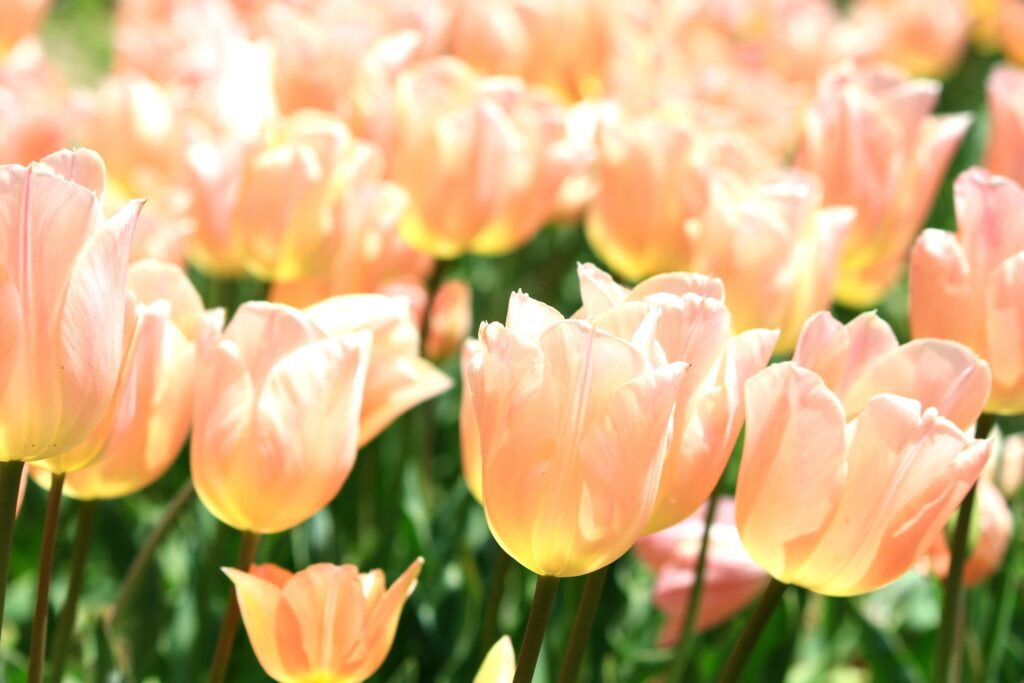
Popular cultivars include ‘Apricot Beauty’, with soft apricot-pink flowers, and ‘Couleur Cardinal’, known for rich crimson-red blooms.
Single Early tulips are a good choice when you want traditional tulip form combined with early-season color.
🌸 Double Early Tulips
Double Early tulips produce far more petals than standard tulips, giving their flowers a rounded, almost peony-like appearance.
They generally bloom early in the tulip season and grow on relatively short stems. Their compact size can be an advantage because the heavy, densely petaled flowers are less exposed to wind than taller double varieties.
Colors range from white and yellow to pink, orange, and deep red.
These tulips look particularly attractive in containers, near walkways, and toward the front of borders where their elaborate flowers can be appreciated up close.
🌈 Triumph Tulips
Triumph tulips are one of the largest and most versatile groups. They combine the classic tulip shape with strong stems and an enormous selection of colors.
Most flower in mid-spring, making them useful for bridging the gap between early species tulips and later Darwin, Parrot, and Single Late varieties.
Triumph tulips are available in nearly every common tulip color, including white, yellow, orange, salmon, pink, red, burgundy, and purple. Numerous bicolored selections are also available.
Their relatively strong stems make them useful for formal beds, mass plantings, containers, and cut-flower gardens.
Popular choices include cultivars such as ‘Negrita’, which produces rich purple flowers, and ‘Don Quichotte’, known for deep rose-pink blooms.
🌺 Darwin Hybrid Tulips
Darwin Hybrids are among the most impressive tulips for gardeners who want large flowers, tall stems, and a better chance of repeat flowering.
The blooms are substantial and usually have a classic rounded or egg-shaped form. Many plants grow considerably taller than early tulips, making them excellent choices for the middle or back of spring borders.
Darwin Hybrids are especially well represented in shades of red, orange, yellow, and pink.
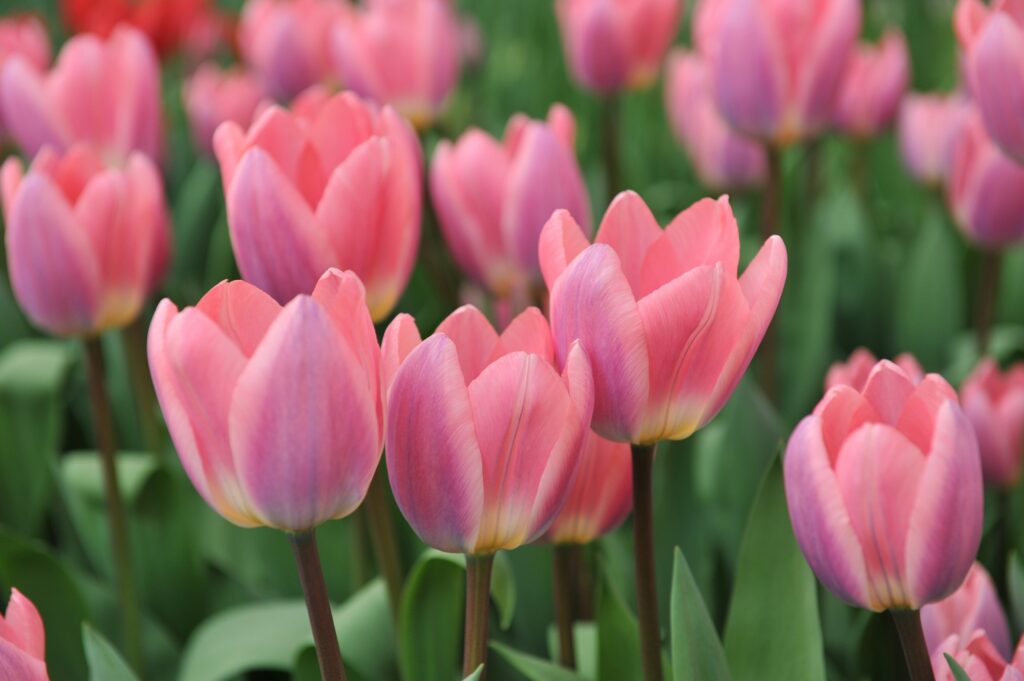
Popular cultivars include ‘Golden Apeldoorn’, ‘Pink Impression’, ‘Red Impression’, and ‘Daydream’.
You can read more about one classic selection in our guide to Golden Apeldoorn Tulips.
Darwin Hybrids are also among the better choices for gardeners who would like tulips to return for several years instead of treating them strictly as annual bedding plants.
🌷 Single Late Tulips
Single Late tulips bloom near the end of the main tulip season and are often among the tallest varieties in the garden.
Their large, elegant flowers stand on long stems that make them particularly useful for cut-flower arrangements. They are also excellent for extending spring color after many early tulips have finished flowering.
One of the most famous Single Late cultivars is ‘Queen of Night’, a dramatic tulip with extremely dark maroon-purple petals that can look nearly black.
Other selections come in white, pink, red, orange, yellow, and various bicolored combinations.
Planting Single Late tulips alongside earlier varieties can significantly extend the overall tulip season.
🤍 Lily-Flowered Tulips
Lily-Flowered tulips are immediately recognizable by their long, pointed petals, which curve outward as the flowers open.
Rather than forming the rounded cup associated with traditional tulips, these varieties develop a graceful, almost star-like silhouette. Their flowers look especially elegant when illuminated from behind or allowed to sway among perennial foliage.
Most bloom during the later part of the tulip season.
Popular cultivars include ‘White Triumphator’, with slender white flowers, and ‘Ballade’, which combines purple-pink petals with lighter edges.
Lily-Flowered tulips work especially well in cottage gardens, borders, and cutting gardens where their unusual shape can contrast with more conventional tulip forms.
✨ Fringed Tulips
Fringed tulips have finely cut edges along their petals, creating a crystalline or frosted appearance.
The fringe can be subtle or extremely pronounced depending on the cultivar. In some flowers, the fringe matches the main petal color; in others, it provides a contrasting edge.
These tulips are sometimes called Crispa tulips.
They are available in numerous colors, including white, yellow, pink, red, purple, and multicolored forms.
Fringed tulips are particularly effective when planted near patios, paths, and entrances where their unusual petal texture can be seen at close range.
💚 Viridiflora Tulips
Viridiflora tulips are distinguished by prominent green streaks running through their petals.
The green markings remain visible as the flowers mature, often creating beautiful combinations with pink, white, yellow, purple, or red.
‘Spring Green’ is one of the best-known examples, producing creamy white petals marked with fresh green. ‘Groenland’ combines green with rose-pink tones.
Viridiflora tulips typically bloom late and can remain attractive for an extended period, making them useful for stretching the tulip display toward the end of spring.
Their unusual coloring also makes them excellent flowers for contemporary or naturalistic garden designs.
🎨 Rembrandt Tulips
Rembrandt tulips are associated with the spectacular streaked and feathered flowers depicted in Dutch paintings from the era of tulip mania.
Historically, many of those dramatic color breaks were caused by tulip-breaking viruses. Because the virus weakened the plants, the historic infected strains are not the same as the healthy commercial tulips gardeners generally buy today.
Modern Rembrandt-type tulips are bred to recreate the striped, flamed, or feathered appearance without deliberately introducing the damaging virus.
They are an interesting choice for gardeners who enjoy dramatic bicolored flowers and the historical connection between tulips, art, and Dutch horticulture.
🦜 Parrot Tulips
Parrot tulips are among the most flamboyant tulip varieties.
Their petals may be curled, twisted, waved, deeply cut, or feathered, creating flowers that sometimes look almost tropical. Many cultivars also display vivid color combinations.
‘Flaming Parrot’ is a classic example, with bright yellow petals streaked and flamed with red.
Parrot tulips tend to bloom late in spring. Because their flowers can be large and heavy, they perform best in locations protected from strong winds and pounding rain.
Plant them where their unusual form can be appreciated individually rather than disappearing in a large mixed bed.
🌸 Double Late Tulips
Double Late tulips produce large flowers packed with layers of petals. They are often called peony-flowered tulips because mature blooms can resemble small peonies.
These are among the most luxurious-looking tulips available.
‘Angelique’ is a particularly popular Double Late cultivar, producing soft pink flowers with a romantic, almost rose-like appearance.
‘Black Hero’ offers a much darker effect with deeply colored burgundy-purple blooms.
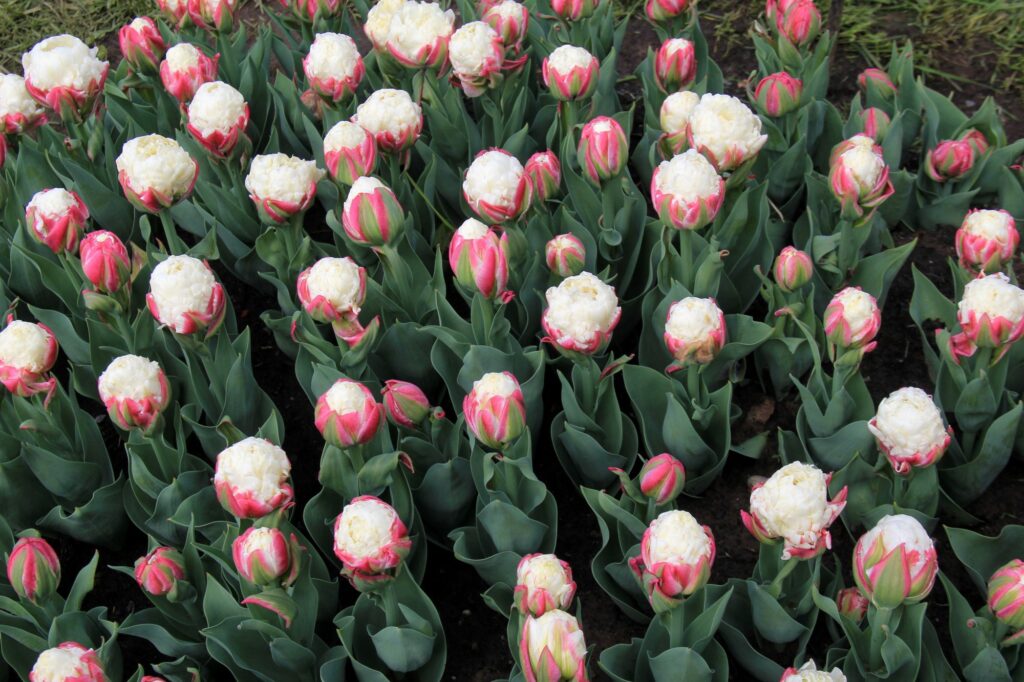
Another unusual cultivar is ‘Ice Cream’, whose dense white center rises above pink and green outer petals. You can see more in our guide to Ice Cream Tulips.
Because Double Late blooms are large and heavy, sheltered locations are preferable when possible.
🌟 Kaufmanniana Tulips
Kaufmanniana tulips are compact, early-flowering plants sometimes called waterlily tulips.
When sunlight reaches the flowers, the petals can open widely into a star-shaped or waterlily-like form. Many cultivars remain quite short, making them excellent for rock gardens, border edges, and containers.
Their low growth habit also makes them particularly useful in windy locations where taller tulips may struggle.
Kaufmanniana tulips are among the varieties with good potential to return in future seasons when grown in suitable conditions.
🌺 Fosteriana Tulips
Fosteriana tulips, often called Emperor tulips, produce exceptionally large flowers early in the spring season.
They typically combine strong stems with elongated blooms and are among the more dependable tulips for repeat flowering.
Colors commonly include white, yellow, orange, red, and pink.
One striking example is ‘Yellow Purissima’, which produces bright yellow blooms. You can explore it in more detail in our guide to Yellow Purissima Tulips.
Other well-known Fosteriana cultivars include ‘Orange Emperor’, ‘Purissima’, and ‘Madame Lefeber’.
Gardeners who want large traditional tulip flowers but also hope for better long-term performance should give this group serious consideration.
🍃 Greigii Tulips
Greigii tulips offer interest even before their flowers open.
Their leaves are often marked or mottled with reddish-purple streaks, making the foliage much more decorative than that of most tulips.
The plants generally remain relatively compact and produce large flowers in proportion to their size.
One classic cultivar is ‘Red Riding Hood’, known for its bright red flowers and beautifully patterned foliage.
Greigii tulips work well along paths, at the fronts of borders, in containers, and in rock gardens.
They also tend to be more dependable repeat bloomers than many large-flowered modern tulips.
🌱 Species and Botanical Tulips
Species tulips are closely related to the wild tulips from which modern garden varieties ultimately originated.
They are generally smaller and more delicate than large bedding tulips, but they offer an important advantage: many can return reliably and gradually multiply when grown in favorable conditions.
Popular species include Tulipa tarda, Tulipa clusiana, Tulipa linifolia, and Tulipa sylvestris.
Many open widely in sunshine, revealing striking centers and contrasting petal colors.
Species tulips are particularly attractive in rock gardens, gravel gardens, border edges, and naturalistic plantings. Their smaller flowers look best when several bulbs are planted together.
🎨 What Colors Do Tulips Come In?
Tulips provide one of the broadest color ranges among spring bulbs.
Common colors include:
- White
- Cream
- Yellow
- Gold
- Orange
- Apricot
- Coral
- Salmon
- Pale pink
- Rose
- Magenta
- Red
- Burgundy
- Lavender
- Purple
- Green
- Near-black purple
Numerous cultivars combine two or more colors through stripes, flames, contrasting edges, or green markings.
Although flowers are sometimes marketed using names that suggest blue or black, tulips do not produce a true clear blue. So-called black tulips are generally extremely dark shades of burgundy or purple.
💜 Purple and Near-Black Tulips
Purple tulips range from soft lavender to deep violet.
They combine particularly well with pale pink, white, apricot, and yellow flowers and can give a spring border a more sophisticated appearance.
Cultivars such as ‘Negrita’ offer rich purple coloring, while ‘Queen of Night’ is famous for blooms so dark they can appear almost black.
Double forms such as ‘Black Hero’ provide an even more dramatic look.
For more ideas, see our guide to Purple Tulips.
🌸 Pink Tulip Varieties
Pink tulips range from nearly white blush tones to vivid hot pink.
For romantic pastel gardens, ‘Angelique’ is one of the most recognizable choices. Its many soft pink petals create a lush late-spring display.
‘Pink Impression’ is a taller Darwin Hybrid with large, strong blooms, while ‘Apricot Beauty’ offers softer salmon-pink and apricot coloring.
Pink tulips pair beautifully with white narcissus, blue grape hyacinths, purple alliums, and other spring bulbs.
❤️ Red Tulip Varieties
Red is the classic tulip color and remains one of the easiest shades to find.
Choices range from clear scarlet to dark crimson and burgundy.
Darwin Hybrids such as ‘Red Impression’ are particularly useful where large, bold flowers are wanted, while Fosteriana tulips can provide red color much earlier in the season.
Red tulips create maximum impact when massed together or planted alongside contrasting yellow, white, or purple selections.
💛 Yellow and Orange Tulips
Yellow tulips can bring an exceptionally bright effect to early spring gardens.
Popular choices include ‘Golden Apeldoorn’, a Darwin Hybrid with large golden flowers, and ‘Yellow Purissima’, an early-flowering Fosteriana cultivar.
Orange varieties range from soft apricot to fiery tangerine and copper.
Warm-colored tulips look particularly attractive when planted with burgundy foliage, blue spring flowers, or fresh green perennials emerging around them.
🤍 White Tulip Varieties
White tulips can make a garden feel brighter and more spacious, particularly when planted in large groups.
‘White Triumphator’ is a graceful Lily-Flowered cultivar, while ‘Purissima’ is a classic Fosteriana tulip.
White varieties also combine easily with virtually every other tulip color.
For a restrained garden design, mix several white tulip types with different shapes and bloom times rather than introducing numerous colors.
🌿 Green Tulips
Viridiflora tulips provide the most obvious green coloring.
Rather than producing completely green flowers, they usually have pronounced green bands or flames running through petals of another color.
‘Spring Green’ combines green and creamy white, while ‘Groenland’ blends green with pink.
These cultivars are particularly effective in gardens where foliage texture and subtle color combinations matter as much as bright flowers.
⏰ Choosing Tulips by Bloom Time
One of the best ways to plan a tulip garden is to select bulbs by flowering period rather than choosing entirely by color.
For the beginning of the season, consider:
- Kaufmanniana
- Fosteriana
- Greigii
- Single Early
- Double Early
For the middle of the tulip season, add:
- Triumph
- Darwin Hybrid
For later flowers, include:
- Single Late
- Lily-Flowered
- Fringed
- Viridiflora
- Parrot
- Double Late
Weather conditions affect exact flowering times, but combining groups from different parts of the season can provide a much longer display than planting only one type.
🌱 Which Tulips Come Back Every Year?
Tulips are botanically perennial bulbs, but not every modern cultivar performs like a dependable garden perennial.
Many highly bred bedding tulips put on their strongest show during the first spring after planting and may decline over subsequent years.
If repeat flowering is important, some of the better choices include:
- Darwin Hybrid tulips
- Fosteriana tulips
- Kaufmanniana tulips
- Greigii tulips
- Species tulips
Well-drained soil and plenty of sunlight improve the chances of successful return.
Species tulips are particularly useful for naturalizing because some selections can slowly multiply and spread when conditions suit them.
🌷 Best Tulips for Containers
Shorter tulip groups tend to be especially easy to use in pots.
Good options include:
- Single Early
- Double Early
- Kaufmanniana
- Greigii
- Smaller species tulips
Tall varieties can also be grown successfully in substantial containers, especially when the pots are heavy enough to remain stable in spring winds.
Mixing several tulip types with staggered flowering times can produce a container that remains colorful for much longer than one planted with a single cultivar.
✂️ Best Tulips for Cut Flowers
Tulips with tall stems are excellent for cutting.
Particularly useful groups include:
- Triumph
- Darwin Hybrid
- Single Late
- Lily-Flowered
- Parrot
- Double Late
For a cutting garden, consider planting bulbs in groups or rows where individual stems can be harvested without leaving obvious gaps in an ornamental flower bed.
Cultivars with strong stems and large blooms can make dramatic arrangements even when only a handful are used.
🌬️ Best Tulips for Windy Gardens
Tall tulips with large flowers can bend or suffer damage in exposed locations.
For windy sites, shorter groups are often easier to manage. Consider:
- Kaufmanniana
- Greigii
- Single Early
- Double Early
- Species tulips
Parrot and Double Late tulips are especially worth protecting because their large, elaborate flowers can become heavy when wet.
🌱 How to Choose Tulip Varieties for Your Garden
Begin by deciding what role you want the tulips to play.
If you want a bold temporary spring display, Triumph, Single Late, Parrot, and Double Late varieties offer tremendous color and flower size.
For a planting that has a better chance of returning for several seasons, focus more heavily on Darwin Hybrids, Fosteriana, Greigii, Kaufmanniana, and species tulips.
Garden size also matters. Tall tulips can disappear awkwardly at the front of a border, while tiny species tulips may be overwhelmed at the back. Use compact varieties near paths and borders and taller cultivars among established perennials.
Finally, think in terms of groups rather than individual bulbs. Tulips generally create a much stronger garden effect when several bulbs of the same cultivar are planted together.
🌷 A Few Popular Tulip Cultivars to Know
If the number of available varieties feels overwhelming, these well-known cultivars provide a useful starting point:
- ‘Apricot Beauty’ — soft apricot-pink Single Early tulip
- ‘Angelique’ — pale pink Double Late tulip
- ‘Black Hero’ — very dark Double Late tulip
- ‘Flaming Parrot’ — yellow-and-red Parrot tulip
- ‘Golden Apeldoorn’ — golden-yellow Darwin Hybrid
- ‘Groenland’ — pink-and-green Viridiflora tulip
- ‘Ice Cream’ — unusual Double Late tulip with a white center
- ‘Negrita’ — rich purple Triumph tulip
- ‘Pink Impression’ — large pink Darwin Hybrid
- ‘Queen of Night’ — very dark Single Late tulip
- ‘Red Riding Hood’ — compact Greigii tulip
- ‘Spring Green’ — white-and-green Viridiflora tulip
- ‘White Triumphator’ — elegant white Lily-Flowered tulip
- ‘Yellow Purissima’ — bright yellow Fosteriana tulip
You do not need dozens of different cultivars to create an impressive garden. A few carefully chosen varieties repeated throughout the landscape often create a more cohesive display.
❓ Tulip Variety FAQ
How many types of tulips are there?
Garden tulips are commonly divided into 15 horticultural groups, encompassing everything from Single Early and Triumph tulips to Parrot, Greigii, Fosteriana, and species types.
Which tulips bloom first?
Kaufmanniana, Fosteriana, Greigii, Single Early, and Double Early tulips are among the earlier-flowering groups.
Which tulips bloom latest?
Single Late, Lily-Flowered, Viridiflora, Parrot, and Double Late tulips generally extend the display into the later part of spring.
Which tulips are best for returning every year?
Darwin Hybrid, Fosteriana, Kaufmanniana, Greigii, and many species tulips tend to have better perennial performance than heavily bred bedding types.
What are the biggest tulips?
Darwin Hybrids and Fosteriana tulips are known for particularly large flowers. Double Late and Parrot varieties can also produce very substantial blooms.
What are the shortest tulips?
Many species tulips, Kaufmanniana tulips, and Greigii tulips remain relatively short and are excellent for rock gardens and border fronts.
Are there black tulips?
There are no truly jet-black tulips. Cultivars such as ‘Queen of Night’ and ‘Black Hero’ have extremely dark purple or burgundy flowers that can appear black under certain lighting conditions.
Are there blue tulips?
Tulips do not naturally produce true blue flowers. Cultivars marketed with blue-inspired names generally fall somewhere within the lavender or purple range.
Which tulips look like peonies?
Double Early and Double Late tulips have many extra petals and can strongly resemble peonies. Double Late varieties such as ‘Angelique’ are especially known for this effect.
🌷 Creating a Tulip Collection
The extraordinary diversity of tulips makes it possible to design a spring garden around almost any combination of color, height, flower shape, and bloom time.
Gardeners who love classic flowers may prefer Triumph and Darwin Hybrid tulips. Those seeking something more unusual can explore fringed, Parrot, Viridiflora, or Double Late varieties. For smaller spaces and dependable repeat flowering, species, Kaufmanniana, Greigii, and Fosteriana tulips deserve special attention.
The most effective approach is often to mix tulip groups rather than relying on a single variety. Combine early, middle, and late bloomers, repeat several favorite colors throughout the garden, and use different flower forms to add texture.
With thoughtful selection, tulips can provide far more than a brief burst of spring color. They can create a succession of flowers stretching across much of the season, from the first compact botanical tulips to the towering late varieties that bloom as spring begins giving way to summer.
🔗 Related Articles
- Tulip Care
- Golden Apeldoorn Tulips
- Yellow Purissima Tulips
- Ice Cream Tulips
- Purple Tulips: Varieties, Meaning & Growing Tips
- Hyacinth Care
- Top 100 Garden Flowers for North American Gardens
📚 Sources & Further Reading
- Iowa State University Extension — Types of Tulips for Home Gardens
- Iowa State University Extension — All About Tulips
- Iowa State University Extension — The Best Perennial Tulips for the Home Garden
- Royal Horticultural Society — How to Grow Tulips
- Royal Horticultural Society — Tulip
- Missouri Botanical Garden — Are There Any Tulips That Will Come Back Year After Year?