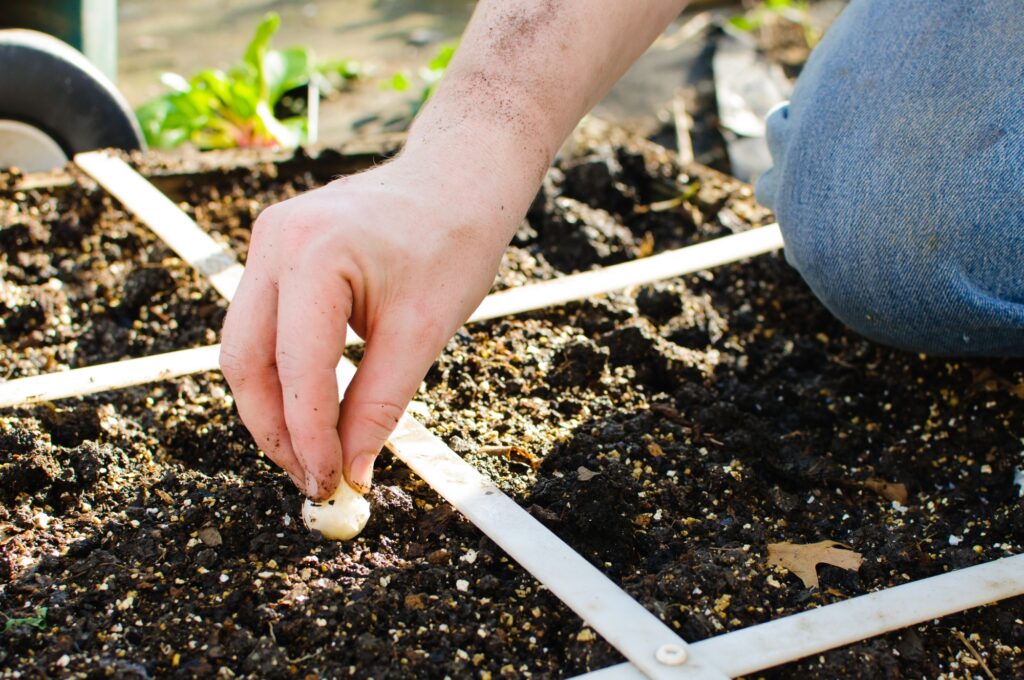
A productive square foot garden starts below the plants. Because vegetables are grown closely together in a relatively small raised bed, the growing mix needs to hold moisture, drain well, provide nutrients, and remain loose enough for roots to spread easily.
The traditional square foot gardening soil recipe was developed specifically for this style of intensive raised-bed gardening. Rather than filling the box with ordinary garden soil, the method uses a lightweight growing medium made from compost, peat moss or coconut coir, and coarse vermiculite.
The recipe is simple, but choosing good ingredients and measuring them correctly makes a noticeable difference. Here is how to make square foot gardening soil, how much you need, what each ingredient does, and how to keep the mix productive from season to season.
🌱 What Is the Best Soil Mix for Square Foot Gardening?
The classic square foot gardening mixture, commonly known as Mel’s Mix, uses three ingredients in equal proportions by volume:
- 1/3 blended compost
- 1/3 peat moss or coconut coir
- 1/3 coarse vermiculite
For example, if you need 9 cubic feet of growing mix, you would combine approximately 3 cubic feet of compost, 3 cubic feet of fluffed peat moss or prepared coir, and 3 cubic feet of coarse vermiculite.
Unlike ordinary garden soil, this mixture contains no topsoil. The compost supplies organic matter and nutrients, peat moss or coir helps retain moisture, and vermiculite improves the mixture’s structure while also holding water.
The result is a lightweight growing medium that works especially well in the shallow, intensively planted beds associated with square foot gardening.
🪴 Square Foot Gardening Soil Recipe
For the traditional recipe, measure the ingredients by volume rather than weight.
| Ingredient | Amount | Main Purpose |
|---|---|---|
| Blended compost | 1/3 | Organic matter and plant nutrients |
| Peat moss or coconut coir | 1/3 | Moisture retention and structure |
| Coarse vermiculite | 1/3 | Aeration and moisture retention |
You can mix the ingredients on a large tarp, in a wheelbarrow, or directly beside the raised bed.
If you’re using compressed peat moss, loosen and fluff it before measuring. A compressed bale expands substantially once opened, so measuring the compressed material can throw off the proportions.
Coconut coir is often sold as compressed bricks or blocks. Hydrate it according to the package directions, allow it to expand, and then measure the prepared material by volume.
🍂 Why Compost Is So Important
Compost is arguably the most important part of a square foot gardening soil mix because it supplies organic matter and many of the nutrients plants need.
Whenever possible, use finished, mature compost made from a variety of organic materials rather than relying entirely on one source. A diverse compost blend may contain materials derived from leaves, garden debris, food scraps, plant material, aged manure, or other compostable ingredients.
You can combine several commercial composts, mix purchased compost with homemade compost, or use a high-quality finished compost that already contains a diverse mixture of ingredients.
The finished compost should smell earthy rather than sour or strongly of ammonia. Avoid filling a bed with unfinished compost because decomposition can continue after planting and interfere with normal root growth.
Be especially cautious about using large quantities of manure-based compost. Manure compost can contribute substantial amounts of phosphorus and salts, so more is not automatically better.
🌿 Peat Moss for Square Foot Gardens
Peat moss helps create the light, moisture-retentive texture associated with the traditional square foot gardening mix.
Dry peat moss can initially resist water, which is another reason it helps to mix the ingredients thoroughly and moisten the finished bed gradually before planting.
When buying compressed peat, pay attention to the expanded volume, not simply the dimensions of the bale. Fluff the peat thoroughly before measuring it against your other ingredients.
Peat moss contains relatively few nutrients, so its role is primarily physical. It helps manage moisture and keeps the growing mix light rather than serving as the main source of fertility.
🥥 Can You Use Coconut Coir Instead of Peat Moss?
Yes. Coconut coir can be used as an alternative to peat moss in a square foot garden.
Coir is produced from coconut husks and is commonly sold as compressed blocks or loose material. Like peat moss, it helps hold moisture while maintaining a lightweight growing medium.
Before using compressed coir, soak it until it has fully expanded. Break apart any remaining clumps and measure it after hydration.
Coir products vary considerably in quality. Garden-grade coir that has been properly processed and rinsed is preferable because poorly processed material may contain excessive salts.
You generally do not need both peat moss and coir. Either can fill the moisture-retention portion of the recipe.
💧 Why Use Coarse Vermiculite?
Vermiculite is a lightweight mineral product that expands when heated. Horticultural vermiculite creates spaces within the growing mix while also absorbing and holding moisture.
For square foot gardening, coarse or super-coarse horticultural vermiculite is generally preferred. Fine vermiculite does not provide the same chunky structure.
The vermiculite helps prevent the mixture from becoming dense and compacted. This is particularly useful in an intensively planted raised bed where a large number of roots occupy a relatively small area.
Make sure you purchase horticultural vermiculite intended for gardening rather than construction materials.
🌱 Can You Substitute Perlite for Vermiculite?
Perlite and vermiculite are sometimes treated as interchangeable, but they behave somewhat differently.
Both improve aeration. However, vermiculite generally retains more moisture, while perlite promotes drainage and tends to dry more quickly.
That moisture-holding ability is why coarse vermiculite is preferred in the traditional square foot gardening recipe.
If vermiculite is unavailable or prohibitively expensive, perlite can still help create a lighter raised-bed mixture. Just be aware that a perlite-heavy bed may dry faster, particularly during hot or windy weather.
🧮 How Much Square Foot Gardening Soil Do You Need?
Calculating the volume of a rectangular raised bed is straightforward:
Length × width × depth = volume
When the measurements are in feet, the result is cubic feet.
For example, a traditional 4-foot-by-4-foot bed filled to a depth of 6 inches requires:
4 × 4 × 0.5 = 8 cubic feet
Using the equal-parts recipe, you would need approximately:
- 2⅔ cubic feet compost
- 2⅔ cubic feet peat moss or coir
- 2⅔ cubic feet coarse vermiculite
A 4-foot-by-8-foot bed filled 6 inches deep requires:
4 × 8 × 0.5 = 16 cubic feet
That works out to roughly 5⅓ cubic feet of each ingredient.
Here are several common bed sizes:
| Raised Bed Size | Fill Depth | Total Mix Needed |
|---|---|---|
| 4 × 4 feet | 6 inches | 8 cu. ft. |
| 4 × 8 feet | 6 inches | 16 cu. ft. |
| 3 × 6 feet | 6 inches | 9 cu. ft. |
| 4 × 4 feet | 12 inches | 16 cu. ft. |
| 4 × 8 feet | 12 inches | 32 cu. ft. |
It is useful to purchase a little extra material because the finished mix can settle after watering.
🪣 How to Mix Square Foot Gardening Soil
Choose a calm day if possible. Peat moss and vermiculite are lightweight and can become dusty or blow around while you’re working.
Spread a large tarp on the ground and add the measured ingredients.
Start with the compost, followed by the peat moss or prepared coir and vermiculite. Fold the tarp from one side toward the other several times to mix the materials together. You can also use a shovel or garden fork to turn everything thoroughly.
Do not expect the mixture to look completely uniform after only a few turns. Continue mixing until compost, vermiculite, and peat or coir are distributed throughout the pile.
Transfer the mixture to your raised bed a little at a time.
Moisten each layer lightly as you go. This is generally easier than filling the entire bed with a bone-dry mixture and attempting to soak it afterward.
The finished material should feel moist but fluffy rather than muddy or waterlogged.
🥕 Do You Need Topsoil in a Square Foot Garden?
Not if you are following the traditional Square Foot Gardening method.
The original style uses a soilless mixture of compost, peat moss or coir, and vermiculite rather than topsoil.
That does not mean topsoil is inappropriate for every raised garden bed. University Extension recommendations for conventional raised beds frequently use mixtures containing approximately one-half to two-thirds quality topsoil combined with compost.
These are simply two different approaches.
If you want to follow the traditional square foot gardening system closely, use the equal-parts soilless recipe. If your goal is simply to create a productive raised vegetable bed at lower cost, a quality topsoil-and-compost blend can also work very well.
💰 A Less Expensive Alternative for Large Raised Beds
The traditional mixture can become expensive when filling several large or deep beds, especially when coarse vermiculite is difficult to find.
For conventional raised beds, a practical alternative is approximately:
- 1/2 to 2/3 quality topsoil
- 1/3 to 1/2 finished plant-based compost
The exact proportions can be adjusted depending on the texture of the topsoil.
Look for loam or sandy loam rather than extremely heavy clay or very sandy material. The finished mixture should drain freely while still holding enough moisture to support vegetables between waterings.
This alternative is not technically the classic square foot gardening mix, but the square-foot grid and intensive planting principles can still be used in a raised bed filled with quality soil.
🌾 Should You Add Fertilizer?
A freshly prepared traditional square foot mix contains a substantial amount of compost, so additional fertilizer may not be necessary immediately.
However, nutrient levels depend heavily on the compost used and on how intensively the garden is planted.
Instead of automatically adding large quantities of fertilizer every season, watch plant growth and consider having the growing medium tested if you repeatedly experience nutrient problems.
This is especially important in established raised beds. Continually adding compost, manure, and fertilizer without knowing what is already present can lead to excessive nutrient levels.
A soil test provides a much better foundation for fertilizer decisions than simply applying more nutrients every year.
🌿 How to Refresh Square Foot Gardening Soil
You normally do not need to empty the raised bed and replace the entire mixture every growing season.
After harvesting a square, remove old plant debris and add some finished compost before replanting. This replenishes organic matter and nutrients removed by the previous crop.
Over time, the level of the bed will gradually drop as organic material decomposes. Top it up with additional compost and, when necessary, small amounts of the other components to maintain a loose texture.
If an older bed begins becoming dense, drains poorly, or behaves very differently than it did when new, inspect the structure of the growing medium rather than automatically adding more fertilizer.
Adding organic matter and gently loosening the upper layers can help restore good growing conditions without completely rebuilding the bed.
🍅 What Can You Grow in Square Foot Garden Soil?
A well-prepared square foot gardening mix can support a wide range of vegetables, herbs, and flowers.
Compact crops such as lettuce, radishes, spinach, beets, onions, carrots, and herbs are particularly well suited to square foot beds because several plants can be grown within individual squares.
Larger plants such as tomatoes, peppers, cucumbers, squash, and climbing beans can also be grown, although they require more space and may benefit from vertical supports.
If you’re planning your vegetable squares, our guides to Radish Care, Beet Care, Carrot Care, Kale Care, and Spinach Care can help you decide what to plant.
Deep-rooted vegetables may benefit from additional soil depth even if you are otherwise following square foot gardening techniques.
💧 Watering a Square Foot Garden
A good growing mix makes watering easier, but raised beds can still dry more quickly than surrounding garden soil.
Check moisture with your finger rather than relying entirely on a watering schedule. If the upper portion of the mix is dry, water deeply enough to moisten the root zone.
Seedlings and freshly planted seeds may need more frequent, gentle watering because their roots are concentrated near the surface.
Once plants become established, deeper watering encourages roots to explore a larger portion of the bed.
Mulching around established plants can also reduce evaporation, moderate soil temperature, and help keep moisture levels more consistent during hot weather.
⚠️ Common Square Foot Gardening Soil Mistakes
One common mistake is filling a square foot bed with ordinary garden soil. Soil dug directly from the yard can become dense inside a raised bed, especially when it contains a high percentage of clay.
Another mistake is using poor-quality or unfinished compost. Because compost makes up one-third of the traditional mixture, its quality has a major influence on the entire bed.
Using fine vermiculite instead of coarse horticultural vermiculite can also alter the texture of the mixture.
Avoid measuring compressed peat moss directly from the bale. Fluff it first so that your one-third proportion represents its expanded volume.
Finally, don’t assume that more compost is always better. Excessive compost can produce growing media with overly high nutrient levels, particularly phosphorus. Maintaining balanced proportions is usually preferable to continually adding large volumes of rich amendments.
🌎 Peat Moss vs. Coconut Coir
Gardeners sometimes choose coconut coir because they prefer an alternative to peat.
Both materials can successfully perform the moisture-retention role in a square foot gardening mixture, but neither is completely impact-free. Peat is harvested from peatlands, while coir must be processed and, in many regions, transported considerable distances from coconut-producing areas.
From a practical gardening standpoint, choose a clean, horticultural-quality product that is readily available to you.
Whichever material you choose, remember that compost supplies most of the nutritional value. Peat moss and coir are primarily there to improve the physical characteristics of the growing medium.
❓ Square Foot Gardening Soil FAQ
What is the traditional square foot gardening soil recipe?
The traditional mixture uses equal parts by volume of blended compost, peat moss or coconut coir, and coarse vermiculite.
Does square foot gardening soil contain topsoil?
The traditional recipe does not. It is a soilless growing mixture. Conventional raised beds, however, are often successfully filled with mixtures of quality topsoil and compost.
Can I use potting soil in a square foot garden?
Bagged potting mix can grow vegetables, but filling an entire raised bed with it is usually unnecessary and may be expensive. The traditional square foot gardening recipe or a quality raised-bed soil blend is generally a better choice.
Can I use perlite instead of vermiculite?
You can, but the materials are not identical. Perlite primarily improves aeration and drainage, while vermiculite also holds a considerable amount of moisture. Coarse vermiculite is the preferred ingredient in the traditional recipe.
Can I use coconut coir instead of peat moss?
Yes. Coconut coir is an accepted alternative to peat moss. Hydrate compressed coir completely before measuring it.
How deep should square foot gardening soil be?
The traditional square foot gardening system commonly uses about 6 inches of growing mix for many crops. Deeper beds can certainly be used, and crops with large or deep root systems may benefit from additional growing depth.
Do I need to replace the soil every year?
No. Refresh the bed with finished compost as crops are harvested and replace lost volume as the organic material gradually decomposes.
Should I add compost every year?
Yes, but modest additions are usually sufficient. In a square foot garden, compost can be added to individual squares as crops are harvested and replanted instead of replacing the entire growing medium.
🌱 Building Better Soil for a Square Foot Garden
The success of a square foot garden depends as much on the growing medium as it does on the familiar grid placed across the top of the bed.
For gardeners following the traditional method, the starting point remains simple: one-third blended compost, one-third peat moss or coconut coir, and one-third coarse vermiculite by volume.
Each ingredient has a purpose. Compost contributes organic matter and nutrients, peat or coir holds moisture and maintains structure, and coarse vermiculite keeps the mixture airy while storing additional water.
Measure carefully, start with quality ingredients, and continue replenishing the bed with compost as crops are harvested. With proper maintenance, the same raised-bed growing medium can support season after season of vegetables, herbs, and flowers without needing to be completely replaced.
🔗 Related Articles
- Radish Care: How to Plant, Grow & Harvest Radishes
- Beet Care: How to Plant, Grow & Harvest Beets
- Carrot Care: How to Plant, Grow & Harvest Carrots
- Kale Care: How to Plant, Grow & Harvest Kale
- Spinach Care: How to Plant, Grow & Harvest Spinach
- Pea Care: How to Plant, Grow & Harvest Peas
📚 Sources & Further Reading
- Square Foot Gardening Foundation — Mel’s Mix Resources
- Square Foot Gardening Foundation — The Science of Mel’s Mix
- Square Foot Gardening Foundation — Square Foot Gardening Soil Calculator
- University of Minnesota Extension — Raised Bed Gardens
- Oklahoma State University Extension — Raised Bed Gardening
- Utah State University Extension — Raised Bed Gardening
- Iowa State University Extension — What Would Be a Good Soil Mix for a Raised Bed?