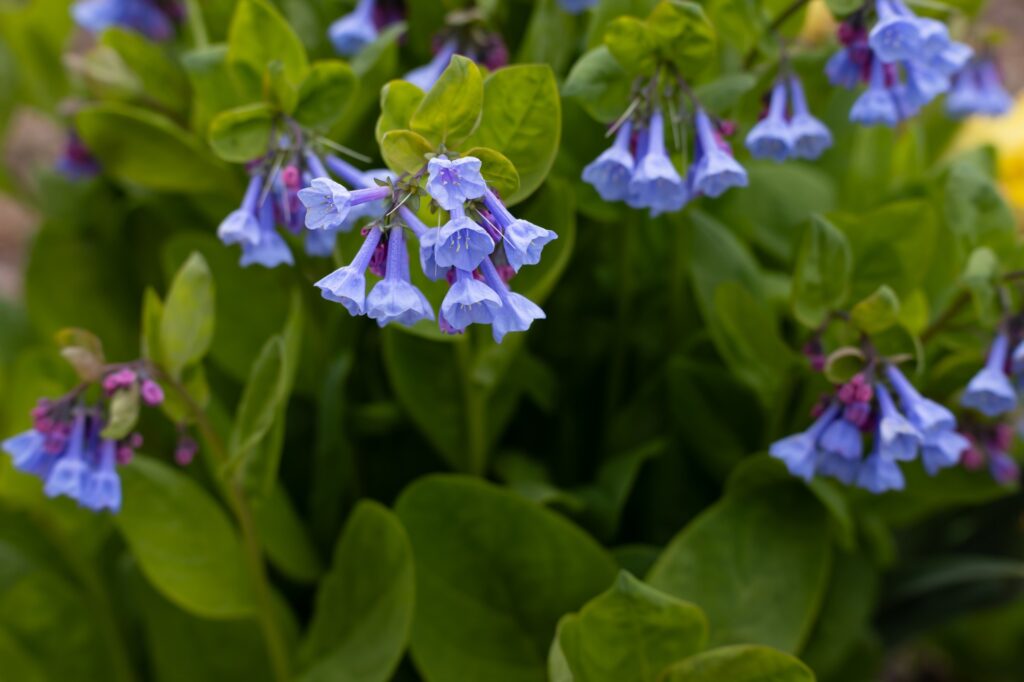
Virginia bluebells are among the most beautiful native wildflowers for a spring shade garden. Their soft pink flower buds gradually open into nodding sky-blue bells, creating a two-tone display that can turn a moist woodland floor into a sea of blue for several weeks each spring.
The botanical name is Mertensia virginica. A member of the borage family, Boraginaceae, Virginia bluebells are native to eastern Canada and a broad area of the central and eastern United States. In the wild, they are most closely associated with moist floodplain forests, rich woodlands, stream corridors, and shaded thickets where the soil contains abundant organic matter.
Virginia bluebells are spring ephemerals, which means most of their visible life takes place during a relatively short period. Purple-tinted shoots emerge early in spring, foliage quickly becomes blue-green, flowers open during mid-spring, seeds develop, and then the entire plant gradually disappears as summer approaches.
That disappearance is completely normal.
The roots remain alive underground throughout summer, fall, and winter. The plants return the following spring, often somewhat larger than the year before. Under good conditions, Virginia bluebells can also self-seed and eventually form broad colonies.
The secret to growing them successfully is to imitate their natural habitat: provide partial to full shade, fertile humus-rich soil, reliable spring moisture, and room to naturalize. Then surround them with later-emerging shade plants that will cover the space once the bluebells enter dormancy.
⚡ Virginia Bluebell Quick Care Guide
Botanical name: Mertensia virginica
Common names: Virginia bluebells, Eastern bluebells, Virginia cowslip, blue and pink ladies, smooth lungwort
Family: Boraginaceae
Plant type: Native herbaceous perennial and spring ephemeral
Native range: Eastern Canada and the central and eastern United States
Height: Approximately 1½ to 2 feet
Spread: Approximately 1 to 1½ feet per mature clump, eventually forming colonies
Light: Partial shade to full shade
Soil: Fertile, humus-rich, moist but well-drained
Soil pH: Adaptable to acidic, neutral, and alkaline soils
Hardiness: Approximately USDA Zones 3–8, with some references extending to Zone 9
Bloom season: Spring, generally March through May depending on climate
Bloom period: About three weeks in many gardens
Flower color: Pink buds opening to lavender-blue or sky-blue flowers; occasional pink or white forms occur
Water: Consistent moisture during spring growth
Summer habit: Goes completely dormant by early to midsummer
Spacing: Approximately 10 to 18 inches
Propagation: Seed, division, or root cuttings
Naturalizing: Excellent; can self-seed and form colonies where conditions are favorable
Pollinators: Bumblebees, other long-tongued bees, butterflies, skippers, moths, flower flies, and hummingbirds may visit the flowers
Deer: Generally not favored by deer, though no woodland plant is completely deer-proof
Main pests: Slugs and snails
Diseases: Generally trouble-free
💙 What Are Virginia Bluebells?
Virginia bluebells are clump-forming woodland perennials.
In early spring, emerging shoots often have a deep purple cast. As the leaves unfold, the foliage quickly changes to soft green, blue-green, or gray-green.
The leaves are smooth and oval, with the largest leaves growing toward the lower part of the plant. Mature leaves may reach several inches long and give the plant a lush, almost succulent appearance during its brief growing season.
Flower stems rise above the foliage and curve gracefully beneath loose clusters of blossoms.
The stems are relatively soft and somewhat fragile, which is one reason Virginia bluebells are better admired in the garden than harvested extensively for bouquets.
🌸 What Do Virginia Bluebell Flowers Look Like?
Virginia bluebell flowers are pendulous, tubular bells approximately an inch long.
The buds begin:
- Pink
- Purplish pink
- Occasionally deeper rose-purple
As they open, the blossoms become:
- Lavender-blue
- Soft blue
- Sky blue
It is common for one flowering stem to display both pink buds and blue open flowers simultaneously.
The flowers hang in loose clusters at the ends of arching stems, giving the plant a relaxed and distinctly woodland character rather than the formal appearance of an upright flower spike.
💗 Why Are Virginia Bluebell Buds Pink?
The pink-to-blue transition is one of the plant’s most distinctive features.
Closed buds are generally rosy pink.
As the flowers mature and open, they gradually shift toward violet-blue or sky blue.
Because different flowers mature at slightly different times, an established colony can appear to contain several flower colors at once.
The combination is especially beautiful beside white, yellow, or pale-pink spring flowers.
🤍 Are There White or Pink Virginia Bluebells?
Yes.
Although blue is overwhelmingly the most familiar flower color, naturally occurring and cultivated variations with:
- Pale pink flowers
- White flowers
can occasionally be found.
These forms are less common than the ordinary blue-flowered species.
For a naturalistic native planting, the standard pink-budded, blue-flowered Mertensia virginica remains an excellent choice.
📅 When Do Virginia Bluebells Bloom?
Virginia bluebells flower during spring.
Depending on climate and latitude, flowering may begin as early as March or continue into May.
In cooler northern areas, peak flowering often occurs around April into May.
Individual colonies generally remain in good flower for around three weeks, although weather can shorten or extend the display.
Cool spring weather usually helps the flowers last longer.
🌱 What Does Virginia Bluebell Look Like When It Emerges?
One of the plant’s less familiar features appears before the flowers.
New growth often pushes through the soil in shades of:
- Deep purple
- Violet
- Purple-green
The color quickly fades as the foliage expands.
Within a short period, the plant develops its characteristic smooth blue-green leaves.
Gardeners unfamiliar with Virginia bluebells sometimes fail to recognize these early purple shoots as the beginning of the bluebell colony.
🌿 Virginia Bluebells Are Spring Ephemerals
Virginia bluebells complete most of their annual above-ground life in spring.
Their basic cycle is:
Early spring: Purple shoots emerge.
Spring: Leaves expand and flower buds form.
Mid-spring: Blue flowers open.
Late spring: Seeds begin developing.
Early to midsummer: Foliage yellows and disappears.
Summer through winter: Plants remain dormant underground.
This natural cycle should guide both garden care and garden design.
☀️ How Much Sun Do Virginia Bluebells Need?
Virginia bluebells prefer partial shade to full shade.
They are especially well adapted to deciduous woodland conditions.
During early spring, bare branches allow abundant light to reach the ground.
As trees develop their leaves, increasing shade protects the bluebells while they complete flowering, seed production, and their transition into dormancy.
A site with bright spring light and summer shade is therefore nearly ideal.
For help understanding different garden exposures, visit Gardening Basics.
🌳 Virginia Bluebells Beneath Deciduous Trees
Planting beneath deciduous trees recreates their natural habitat beautifully.
Good locations include the outer canopy of:
- Dogwoods
- Magnolias
- Maples
- Oaks
- Other deciduous shade trees
The trees provide changing light throughout the season.
Fallen leaves also contribute organic matter to the soil.
The main challenge is competition from mature tree roots.
Avoid planting directly against large trunks where soil becomes extremely dry.
🌑 Can Virginia Bluebells Grow in Full Shade?
Yes.
NC State Extension lists Virginia bluebells as suitable for deep shade as well as partial shade.
They can therefore succeed in places where many spring-flowering perennials struggle.
Very dense, dry shade is less suitable.
The plant still requires dependable soil moisture while actively growing.
A deeply shaded location with rich, moist soil is much better than dark, dry ground beneath highly competitive tree roots.
🌞 Can Virginia Bluebells Grow in Full Sun?
Virginia bluebells are primarily woodland plants and are not ideal for exposed full-sun borders.
They can tolerate substantial early-spring sunlight beneath deciduous trees because temperatures are cool and soil moisture is generally abundant.
Hot afternoon sun later in spring can cause the foliage to decline more rapidly.
Partial shade provides more dependable conditions in most gardens.
🌎 Best Soil for Virginia Bluebells
Virginia bluebells perform best in fertile, humus-rich, moist but well-drained soil.
Their natural habitats frequently include floodplains and rich bottomland forests where organic material accumulates year after year.
A suitable garden soil should contain plenty of:
- Compost
- Leaf mold
- Decomposed leaves
- Natural organic matter
The soil should hold moisture without becoming permanently stagnant.
For help creating richer woodland soil, visit the Garden Soil Guide.
🧪 Soil pH for Virginia Bluebells
Virginia bluebells are surprisingly adaptable regarding pH.
Current horticultural guidance lists them as capable of growing in:
- Acidic soil
- Neutral soil
- Alkaline soil
That means gardeners generally do not need to alter soil pH specifically for this plant.
Moisture, organic matter, shade, and drainage are much more important.
💧 Virginia Bluebells Need Spring Moisture
Virginia bluebells should not be treated as drought-loving shade plants.
They naturally occur in moist habitats and perform best when water is abundant during their active growth period.
Newly planted bluebells especially benefit from consistently moist soil.
During a dry spring, provide supplemental water.
Lack of moisture can cause:
- Weak growth
- Early foliage decline
- Reduced flowering
- Poor establishment
Established colonies are more resilient, but they still look best when spring conditions remain moist.
🌧️ Can Virginia Bluebells Grow in Wet Soil?
Virginia bluebells tolerate moist conditions very well.
They are even used in appropriately designed rain gardens.
However, they are generally described as preferring moist but well-drained soil rather than permanent standing water.
A seasonally moist floodplain-style garden is ideal.
A permanently stagnant bog is not.
🍂 Mulching Virginia Bluebells
Woodland-style organic mulch is excellent for bluebells.
Good materials include:
- Shredded deciduous leaves
- Leaf mold
- Finished compost
- Fine shredded bark
A natural layer helps:
- Retain moisture
- Reduce weeds
- Add organic matter
- Moderate soil temperature
Avoid burying emerging spring shoots beneath an extremely thick compacted mulch.
A loose leaf layer closely resembles the conditions in which the plants naturally grow.
🌱 Do Virginia Bluebells Need Fertilizer?
Usually not much.
Virginia bluebells growing in organically rich soil rarely need routine heavy feeding.
Adding:
- Compost
- Leaf mold
- Decomposing autumn leaves
is generally more useful than applying strong fertilizer.
Excess fertilizer is unlikely to compensate for:
- Dry soil
- Too much sun
- Root competition
- Poor drainage
Create the right woodland environment first.
📅 When Should You Plant Virginia Bluebells?
Potted Virginia bluebells can be planted in:
- Fall
- Spring after severe freezing conditions have passed
Cool conditions and abundant soil moisture make establishment easier.
Bare-root plants may also be available.
Because the plant develops a substantial root system and prefers not to be disturbed once established, choose the location carefully before planting.
📏 How Far Apart Should Virginia Bluebells Be Planted?
Space plants approximately 10 to 18 inches apart.
That may look relatively open when plants are young.
Give them time.
Under favorable conditions, Virginia bluebells:
- Increase in clump size
- Self-seed
- Gradually form colonies
Planting too densely is unnecessary if your long-term goal is a naturalized woodland drift.
🌱 How to Plant Virginia Bluebells
Prepare the site with rich organic soil.
Dig a hole wide enough for the root system.
For potted plants, place the crown at approximately the same depth it was growing in the nursery container.
Backfill gently.
Water thoroughly.
Mulch with a light layer of organic material.
Continue checking moisture throughout the first spring.
Avoid repeatedly digging around the plant afterward.
🌿 Virginia Bluebells Develop Deep Roots
One reason established Virginia bluebells dislike disturbance is their root system.
University of Wisconsin Extension notes that established plants develop a long taproot and are generally best left undisturbed.
This means they are much easier to manage if you decide on their permanent location from the beginning.
Avoid placing them in a bed that you expect to:
- Dig annually
- Redesign frequently
- Cultivate deeply
A stable woodland garden is much better.
🌱 Do Virginia Bluebells Spread?
Yes.
Under suitable conditions, Virginia bluebells can gradually naturalize into substantial colonies.
They spread primarily through:
- Seed
- Slow expansion of established plants
They are not usually aggressive in the sense of a running groundcover that immediately takes over neighboring beds.
Instead, a colony becomes larger gradually when the site remains:
- Moist
- Shaded
- Undisturbed
This makes them excellent for informal woodland gardens.
🌱 Virginia Bluebells Self-Seed
Allowing the flowers to produce seed can eventually result in seedlings around the parent plants.
Where growing conditions are favorable, this can create the broad sweeps of blue for which the species is famous.
Seedlings require patience.
They may take several years before producing flowers.
For gardeners seeking a naturalized colony, however, that slow self-seeding process is worth encouraging.
✂️ Should You Deadhead Virginia Bluebells?
Usually not.
If naturalizing is your goal, leave spent flowers in place so seeds can develop.
The plant’s seed production helps build future colonies.
Deadheading may be useful when:
- You do not want seedlings
- A particular planting needs to remain tightly controlled
Otherwise, there is little reason to remove the flowers.
🌿 Don’t Cut Virginia Bluebell Leaves Too Early
After flowering, the foliage still has an important job.
The leaves continue producing and storing energy in the roots.
Allow them to remain until they naturally:
- Yellow
- Collapse
- Disappear
Do not cut green foliage immediately after flowering.
Premature removal can weaken the plant and reduce its ability to return strongly the following year.
☀️ Summer Dormancy
By early or midsummer, the entire plant may disappear.
This is normal dormancy, not plant death.
Once the foliage is gone, very little remains to show where the colony is located.
That creates one of the biggest practical challenges of growing spring ephemerals.
Gardeners sometimes accidentally:
- Dig through dormant roots
- Plant another perennial directly on top
- Assume the plant died
- Cultivate the area
Mark the planting area or use permanent companion plants as visual guides.
🪧 Mark the Location After Dormancy
A small garden marker is extremely useful.
You can also use long-lasting neighboring perennials to indicate where the bluebell colony rests.
This is particularly helpful when planting:
- Fall bulbs
- New shade perennials
- Shrubs
later in the year.
Avoid unnecessary digging through established bluebell roots.
✂️ Dividing Virginia Bluebells
Division is possible, although established plants generally prefer to remain undisturbed.
NC State Extension suggests division in spring as one propagation option.
If division is necessary:
Dig carefully.
Preserve as much root as possible.
Separate substantial sections.
Replant immediately.
Maintain abundant moisture during re-establishment.
Do not routinely divide a healthy naturalizing colony simply because several years have passed.
🌱 Root Cuttings
Virginia bluebells can also be propagated from root cuttings.
RHS recommends taking root cuttings during autumn or early winter.
This is useful when you want to propagate an established plant without depending entirely on seed.
For most home gardeners, however, purchasing nursery-grown plants and allowing them to self-seed naturally is considerably simpler.
🌱 Growing Virginia Bluebells From Seed
Seed propagation works, but it requires patience.
Fresh seeds experience natural seasonal temperature changes outdoors before germinating.
Even after seedlings emerge, they may need several years before becoming mature flowering plants.
For a naturalistic woodland garden, simply allowing established plants to self-sow is often the easiest strategy.
Avoid repeatedly disturbing the soil around developing seedlings.
🌸 Why Aren’t My Virginia Bluebells Flowering?
Several factors can reduce flowering.
Plants Are Young
Seedlings can require several years to mature.
Plants Were Recently Transplanted
Root disturbance may delay flowering.
Soil Is Too Dry
Virginia bluebells depend on abundant spring moisture.
Conditions Are Too Hot and Sunny
Woodland shade is much more suitable.
Plants Were Cut Back Too Early the Previous Year
Healthy foliage needs time to replenish the roots.
Heavy Root Competition
Large established trees may take most available moisture.
The solution is usually improving growing conditions and allowing more time rather than adding heavy fertilizer.
🌱 Why Did My Virginia Bluebells Disappear?
Look at the calendar before assuming anything is wrong.
If the plants disappear around early or midsummer, they are probably simply dormant.
They should reappear the following spring.
If they fail to return, possible causes include:
- Severe drought
- Root disturbance
- Poor establishment
- Excessive waterlogging
- Accidental digging
Wait until the next normal emergence period before deciding a dormant plant is gone.
🐌 Slugs and Snails
Virginia bluebells have relatively few serious pest problems.
Slugs and snails are among the pests most commonly mentioned.
They may feed on:
- Emerging shoots
- Young leaves
- Tender stems
Damage is most likely during wet spring conditions.
A well-established colony generally tolerates limited feeding.
Control becomes more useful when slugs repeatedly destroy new shoots before the plants can develop.
🍃 Virginia Bluebell Diseases
Virginia bluebells are generally considered largely disease-free.
This is one reason they are such useful native woodland plants.
When plants decline, investigate environmental conditions first.
Problems are more likely to involve:
- Excessive dryness
- Poor drainage
- Root disturbance
- Heat
than a serious disease outbreak.
🦌 Are Virginia Bluebells Deer Resistant?
Virginia bluebells are generally not favored by deer, and Extension sources often describe them as deer resistant or somewhat deer resistant.
That does not mean they are completely deer-proof.
Hungry deer can sample almost any garden plant.
Still, Virginia bluebells are generally less vulnerable than woodland favorites such as hostas.
This makes them a useful choice where deer pressure is moderate.
🐇 Are Virginia Bluebells Rabbit Resistant?
Penn State Extension describes Virginia bluebells as rabbit resistant.
Young plants can never be guaranteed protection from wildlife, but established colonies are not generally considered highly attractive to rabbits.
This adds to their usefulness as a low-maintenance native shade plant.
🐝 Virginia Bluebells and Pollinators
Virginia bluebells are particularly valuable during spring because their flowers appear early in the gardening year.
Visitors can include:
- Bumblebees
- Long-tongued bees
- Butterflies
- Skippers
- Hummingbird moths
- Flower flies
- Bee flies
- Hummingbirds
The tubular flowers are especially suited to long-tongued pollinators.
A broad colony can provide a substantial seasonal food source.
For additional habitat-friendly planting ideas, visit Eco-Friendly Gardening.
🐝 Bumblebees and Virginia Bluebells
Bumblebees are particularly important visitors.
Their ability to forage during cool spring conditions makes them well suited to woodland ephemerals.
Virginia bluebells also flower at a time when bumblebee queens may be establishing new colonies and searching actively for floral resources.
Growing several spring-flowering native species together helps create a more dependable succession of food.
💐 Are Virginia Bluebells Good Cut Flowers?
Not particularly.
Although the flowers are beautiful, the stems are relatively soft, fragile, and nearly hollow.
They can break easily and generally do not perform as well in arrangements as sturdier garden flowers.
Virginia bluebells are much more impressive when left growing as a colony in the garden.
If you do cut a few stems, avoid harvesting heavily from a small planting.
🌿 Plan for the Summer Gap
This may be the most important design consideration.
Virginia bluebells look magnificent in spring and then disappear.
Rather than seeing this as a flaw, design the planting so later perennials occupy the same visual space.
Excellent companions include:
- Ferns
- Heuchera
- Hostas
- Astilbe
- Solomon’s seal
- Other later-emerging woodland perennials
The best companions develop after the bluebells have finished most of their active growth.
🌿 Virginia Bluebells With Trillium
Trillium is one of the most natural companions.
Both are native woodland spring flowers.
Great white trillium provides large white blossoms.
Virginia bluebells provide clouds of blue beneath and around them.
Both appreciate:
- Rich woodland soil
- Spring moisture
- Partial shade
- Minimal disturbance
The combination can create an exceptionally natural-looking eastern woodland planting.
💗 Virginia Bluebells With Bleeding Heart
Bleeding Heart is another classic companion.
Pink bleeding heart flowers echo the rosy bluebell buds.
The bluebell flowers then add cool blue beneath the taller arching bleeding heart stems.
Both plants may retreat underground during summer, so pair them with longer-lasting foliage plants as well.
💙 Virginia Bluebells With Lungwort
Lungwort offers a similar blue-pink spring color palette but remains visible much longer.
Lungwort foliage can be:
- Green
- Silver-spotted
- Almost completely silver
Once the bluebells disappear, the lungwort leaves continue providing interest.
This makes it one of the more practical companions for a designed shade border.
🌸 Virginia Bluebells With Hellebores
Hellebores begin the flowering season earlier.
Hellebores can bloom during winter and very early spring.
Virginia bluebells follow.
The hellebore foliage remains after flowering, helping maintain structure once the bluebells become dormant.
Use this combination beneath deciduous trees for an especially long woodland season.
🌼 Virginia Bluebells With Primroses
Primroses provide low-growing spring color.
Yellow primroses are especially beautiful beside bluebells because yellow and blue create strong contrast.
Pink or white primroses produce a softer effect.
Both plants appreciate cool soil and dependable spring moisture.
🌿 Virginia Bluebells With Heuchera
Heuchera is one of the best plants for covering the summer gap.
Its foliage remains after the bluebells disappear.
Try:
Bluebells + burgundy Heuchera
Bluebells + lime Heuchera
Bluebells + silver Heuchera
Allow enough room that the Heuchera crowns do not grow directly over dormant bluebell roots.
🌸 Virginia Bluebells With Columbine
Columbine provides a slightly later flowering layer.
Virginia bluebells begin the spring display.
Columbine stems then rise above them.
Native eastern red columbine is especially appropriate in a North American woodland garden.
Its red and yellow flowers create a dramatic contrast against soft blue bells.
🌱 Virginia Bluebells With Springbeauty
Springbeauty is another eastern North American spring ephemeral.
It flowers earlier and remains lower to the ground.
Both plants follow similar seasonal rhythms.
Their foliage eventually disappears, so a planting composed only of bluebells and springbeauties will become very open during summer.
Combine them with permanent woodland foliage.
🌼 Virginia Bluebells With Daffodils
Daffodils create one of the strongest spring color combinations.
Yellow daffodils rise through a sea of bluebells.
Both bloom during spring, although exact overlap depends on cultivar and climate.
Daffodil foliage also declines later, so add summer perennials to carry the bed once both spring plants begin disappearing.
🌷 Virginia Bluebells With Tulips
Tulips can add pink, white, burgundy, or purple above a bluebell colony.
Pink tulips work especially well because they repeat the color of unopened bluebell buds.
Unlike bluebells, most tulips need more sunlight.
Use this combination at bright woodland edges rather than in deep shade.
🌳 Virginia Bluebells Beneath Dogwoods
Dogwoods provide an almost ideal overhead canopy.
Before dogwood leaves develop, bluebells receive abundant spring light.
As temperatures rise, the tree produces increasing shade.
White or pink dogwood flowers above blue Virginia bluebells can create one of the most beautiful combinations in a spring woodland garden.
🌳 Virginia Bluebells Beneath Magnolias
Deciduous Magnolias provide a similar seasonal canopy.
Magnolia flowers appear overhead.
Bluebells create a lower blue layer.
Later, magnolia foliage shades the ground while bluebells become dormant.
Plant the woodland perennials while the magnolia is relatively young whenever possible so its established roots do not have to be disturbed later.
🌸 Virginia Bluebells With Azaleas
Azaleas create a flowering shrub layer above bluebells.
Pink azaleas can echo the pink bluebell buds.
White azaleas allow the blue flowers to become the dominant lower layer.
Both appreciate:
- Organic soil
- Moisture
- Partial shade
Avoid digging deeply through established azalea roots when maintaining the bluebell colony.
🌳 Virginia Bluebells in a Woodland Garden
Virginia bluebells are at their best in a layered woodland.
A planting might include:
Small trees: Dogwood and Magnolia
Shrubs: Azalea
Early spring flowers: Hellebore, Springbeauty, Trillium, and Virginia Bluebells
Mid-spring flowers: Bleeding Heart, Primrose, Lungwort, and Columbine
Summer foliage: Ferns and Heuchera
Late-season flowers: Toad Lily and Japanese Anemone
The goal is succession.
Virginia bluebells do not need to look attractive for twelve months.
They simply need companion plants ready to take over when their season ends.
🌿 Virginia Bluebells in a Native Garden
Virginia bluebells are especially appropriate for native plantings in regions where the species occurs naturally.
They work beautifully in:
- Woodland gardens
- Shaded rain gardens
- Naturalized areas
- Streamside-style plantings
- Native shade borders
Purchase plants from reputable nurseries rather than removing them from wild populations.
Habitat loss has reduced native populations in portions of the species’ range, making responsible sourcing important.
🌧️ Virginia Bluebells in Rain Gardens
Virginia bluebells can work well in shaded or partially shaded rain gardens.
The best location is one that receives extra moisture but drains between major rainfall events.
Their natural association with floodplain forests makes them especially well adapted to seasonally moist soil.
Pair them with other plants capable of handling similar moisture levels after the bluebells become dormant.
🪴 Can Virginia Bluebells Grow in Containers?
They can be grown in pots, but containers are not their ideal long-term home.
Virginia bluebells prefer:
- Stable soil temperatures
- Dependable moisture
- Deep root space
- Minimal disturbance
Containers heat up and dry more quickly than woodland soil.
If container growing is necessary, use a deep pot with drainage holes and a rich, moisture-retentive potting medium.
Place it in shade and monitor water carefully.
For long-term naturalizing, the ground is much better.
🌱 Spring Virginia Bluebell Care
Spring is the main active season.
As growth emerges:
- Maintain soil moisture
- Keep heavy mulch away from developing shoots
- Watch for slugs
- Avoid digging around roots
- Enjoy the flowers
After flowering, continue watering during dry weather while foliage remains green.
Do not cut the plant back simply because the flowers have faded.
☀️ Summer Virginia Bluebell Care
During early summer, leaves begin declining naturally.
Allow them to yellow.
Once foliage has completely disappeared, the plant requires little active care.
Mark the area.
Avoid digging through it.
Allow later-emerging companions to cover the space.
During extreme prolonged drought, maintaining reasonable moisture across the woodland bed can still benefit the dormant root system and neighboring plants.
🍂 Fall Virginia Bluebell Care
Fall is an excellent time to improve the surrounding woodland soil.
Add:
- Shredded leaves
- Leaf mold
- Finished compost
over the bed.
Avoid deep cultivation.
If you are planting new bluebells or moving dormant established plants, cool fall conditions can be useful.
The roots will remain hidden until growth resumes in spring.
❄️ Winter Virginia Bluebell Care
Virginia bluebells are extremely cold hardy.
The entire visible plant is absent during winter.
Little protection is required within the plant’s normal hardiness range.
A natural layer of fallen leaves provides excellent insulation.
There is no need for a thick artificial winter covering.
Simply leave the dormant garden relatively undisturbed until spring.
⚠️ Common Virginia Bluebell Care Mistakes
Planting in Hot Full Sun
Virginia bluebells are woodland plants.
Letting the Soil Become Extremely Dry in Spring
Consistent active-season moisture is important.
Assuming Dormancy Means the Plant Died
Foliage normally disappears by early or midsummer.
Cutting Green Leaves After Flowering
Let foliage replenish the roots first.
Digging Into the Dormant Bed
Mark the location after foliage disappears.
Planting Only Other Spring Ephemerals Around Them
The entire area may look empty by summer.
Using Aggressive Groundcovers
Choose companion plants that cover the summer gap without overwhelming dormant roots.
Moving Established Plants Repeatedly
Their substantial root system prefers minimal disturbance.
Expecting Seedlings to Flower Immediately
Seed-grown plants need several years to mature.
Overfertilizing
Organic-rich soil matters more than heavy feeding.
Assuming Shade Automatically Means Moist Soil
Large tree roots can create very dry shade.
Digging Plants From Wild Colonies
Purchase nursery-propagated plants instead.
💙 Are Virginia Bluebells Easy to Grow?
Yes, when the garden provides the conditions they naturally prefer.
Their basic requirements are uncomplicated:
Give them partial or full shade.
Provide rich woodland soil.
Keep the ground moist during spring.
Allow flowers to produce seed if you want naturalization.
Leave green foliage intact.
Accept summer dormancy.
Plant later-emerging perennials around the colony.
Avoid disturbing established roots.
Once settled, Virginia bluebells require relatively little direct maintenance.
Their greatest challenge is not keeping them alive.
It is remembering that a plant can disappear completely for most of the year and still be thriving.
💙 A Spring Woodland Worth Waiting For
For most of the year, a Virginia bluebell garden gives little indication of what is waiting beneath the soil.
Then spring arrives.
Purple shoots push through fallen leaves.
The foliage turns green.
Pink flower buds begin forming above the clumps.
One by one, those buds open into blue bells.
Soon the entire planting can look different.
What was brown woodland soil only weeks earlier becomes a broad sweep of blue, pink, and green.
Bumblebees move between the flowers.
Trilliums open nearby.
Daffodils rise through the colony.
Dogwoods and magnolias flower overhead.
Then the woodland canopy closes.
The bluebells fade.
Leaves yellow.
Within weeks, the entire plant disappears underground again.
That short season is not a weakness. It is the reason Virginia bluebells fit so beautifully into a layered woodland garden.
They occupy the spring before summer plants need the space.
Ferns, Heucheras, and other shade perennials then take over while the bluebells rest below ground.
Give Mertensia virginica rich soil, spring moisture, shade, and enough time to naturalize, and a few plants can eventually become one of the most memorable spring displays in the garden.
🔗 Related Articles
- Flower Gardening
- Gardening Basics
- Garden Soil Guide: Soil Types, Testing, pH & How to Improve It
- Eco-Friendly Gardening
- Seasonal Gardening
- Trillium Care
- Springbeauty Care
- Hellebore Care
- Bleeding Heart Care
- Lungwort Care
- Primrose Care
- Columbine Care
- Heuchera Care
- Daffodil Care
- Tulip Care
- Azalea Care
- Dogwood Care
- Magnolia Care
📚 Sources & Further Reading
- NC State Extension — Virginia Bluebells
- University of Wisconsin–Madison Extension — Virginia Bluebells, Mertensia virginica
- Penn State Extension — Rain Garden Plants: Virginia Bluebells
- Penn State Extension — Spring Ephemerals for Residential Gardens
- Illinois Extension — A Plant of Many Colors: Virginia Bluebell
- Royal Horticultural Society — Mertensia virginica