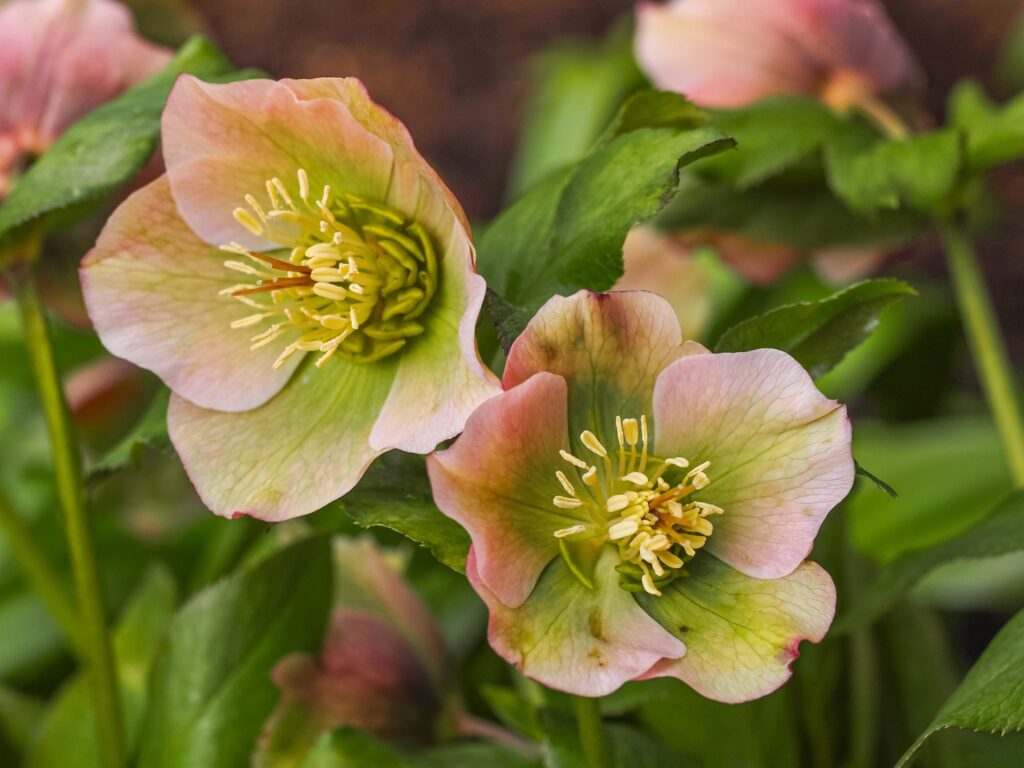
Hellebores are among the most valuable flowers for the winter and early-spring garden. At a time when many perennials are dormant and deciduous shrubs are still bare, hellebores produce nodding flowers in shades of white, cream, green, pink, rose, burgundy, purple, and almost black.
The genus Helleborus belongs to the buttercup family, Ranunculaceae. Most species are native to Europe and western Asia, where many grow naturally along woodland edges, in open forests, and on rocky slopes.
The name hellebore covers several plants with somewhat different growth habits. The popular Lenten roses, usually sold as Helleborus × hybridus, form low clumps of leaves and flowers. The Christmas rose, Helleborus niger, produces white flowers and requires particularly good winter drainage. Stinking hellebore, Helleborus foetidus, and Corsican hellebore, Helleborus argutifolius, develop upright leafy stems and should not be pruned exactly like Lenten roses.
Fortunately, most commonly sold hellebores share similar basic requirements. They thrive in partial or dappled shade, fertile humus-rich soil, consistent moisture, and good drainage. Once established, many tolerate dry summer conditions surprisingly well.
Hellebores are also remarkably long-lived when placed correctly. Established clumps may return for many years, gradually becoming larger and producing increasingly impressive winter and spring flower displays.
The greatest maintenance mistake is treating every hellebore exactly the same. Learn whether yours is a clump-forming Lenten rose or a stemmed species such as H. foetidus or H. argutifolius, and the rest of its care becomes much easier.
⚡ Hellebore Quick Care Guide
Botanical genus: Helleborus
Common names: Hellebore, Lenten rose, Christmas rose, winter rose
Family: Ranunculaceae
Plant type: Herbaceous, evergreen, semi-evergreen, or occasionally deciduous perennial depending on species
Height: Approximately 9 inches to 3 feet depending on species
Spread: Approximately 1 to 3 feet depending on type
Light: Partial shade or dappled shade is ideal for most
Soil: Fertile, humus-rich, moisture-retentive but well-drained
Soil pH: Many common hellebores perform especially well in neutral to alkaline soil, but they tolerate a range of garden conditions
Hardiness: Roughly USDA Zones 4–9 depending on species and cultivar
Bloom season: Winter through spring
Flower colors: White, cream, pale green, yellow-green, pink, rose, burgundy, purple, and near-black
Water: Regular moisture during establishment; established plants benefit from water during prolonged drought
Mulch: Organic compost, leaf mold, or shredded leaves
Planting season: Fall through spring
Planting depth: Plant at the same level the plant was growing in its container; do not bury the crown deeply
Spacing: About 14 to 18 inches for many Lenten roses; larger stemmed species need more room
Pruning: Depends on species; old Lenten rose foliage can be removed before flowering, while stemmed species require a different approach
Propagation: Division or seed
Pollinators: Important early-season nectar source, particularly for bumblebees
Deer and rabbits: Generally resistant
Main problems: Hellebore leaf spot, aphids, slugs, snails, crown rot, gray mold, and hellebore black death
Safety: Toxic if eaten; can irritate sensitive skin, so gloves are advisable when handling or dividing plants
🌿 What Is a Hellebore?
Hellebores are perennial plants best known for flowering during the coldest portion of the gardening year.
Many develop leathery, divided leaves arranged in low clumps.
Their flowers rise on sturdy stems from winter through spring.
Although people often refer to the colorful structures as petals, much of what we see is actually composed of persistent sepals.
The true petals have evolved into small nectary structures near the center of the flower.
This unusual construction explains one reason hellebore flowers seem to last so long.
The colorful sepals remain attractive even after pollination, gradually fading rather than dropping immediately.
🌹 Hellebores Are Not Roses
The names:
- Lenten rose
- Christmas rose
- Winter rose
can be misleading.
Hellebores are not roses at all.
True roses belong to the genus Rosa in the family Rosaceae.
Hellebores belong to the family Ranunculaceae, alongside plants such as:
- Columbines
- Delphiniums
- Clematis
- Buttercups
The word “rose” in their common names refers to their attractive flowers, not their botanical relationship.
🌸 Lenten Rose — Helleborus × hybridus
The most popular garden hellebores are the plants collectively known as Lenten roses.
They are usually classified horticulturally as Helleborus × hybridus.
These plants represent a complex group of hybrids involving Helleborus orientalis and related species.
They produce flowers in an enormous variety of colors and patterns, including:
- White
- Cream
- Pale yellow
- Blush
- Pink
- Rose
- Burgundy
- Plum
- Deep purple
- Near-black
Flowers may also be:
- Spotted
- Speckled
- Veined
- Picotee-edged
- Single
- Semi-double
- Double
For detailed guidance specifically about this group, visit Lenten Rose Care.
🤍 Christmas Rose — Helleborus niger
Helleborus niger is commonly called the Christmas rose.
It produces white bowl-shaped flowers with prominent yellow stamens.
In mild climates, flowering can begin around the holiday season.
In colder areas, flowers may not appear until late winter or early spring.
Christmas rose generally remains smaller than many Lenten rose hybrids, often reaching only about 9 to 12 inches tall.
It can also be slightly more demanding.
Excellent drainage—particularly during winter—is important.
Cold, wet soil can cause plants to decline even though the species itself is quite cold hardy.
🌿 Stinking Hellebore — Helleborus foetidus
Helleborus foetidus is very different in appearance from a typical Lenten rose.
It develops upright evergreen stems carrying finely divided dark-green leaves.
Clusters of small pale green or chartreuse flowers appear at the tops of those stems during winter and early spring.
Some forms have reddish or purple margins around the flowers.
The common name stinking hellebore sounds alarming, but an undisturbed plant does not normally make the garden smell unpleasant.
The odor is most noticeable when the foliage is crushed or bruised.
Stinking hellebore is particularly useful because it tolerates deeper shade than many other hellebores.
🌿 Corsican Hellebore — Helleborus argutifolius
Helleborus argutifolius is also known as:
- Corsican hellebore
- Holly-leaved hellebore
It is a larger, architectural hellebore capable of reaching roughly 2 to 3 feet tall.
The foliage is:
- Evergreen
- Leathery
- Toothed
- Blue-green to gray-green
Large clusters of pale green flowers appear during winter and spring.
Unlike Lenten rose, its flowers and leaves grow on substantial leafy stems.
This distinction affects pruning.
Do not remove all of its foliage in late winter as you might with Helleborus × hybridus.
🌿 Stemless and Stemmed Hellebores
Understanding these two basic growth habits makes hellebore maintenance much easier.
Clump-Forming Hellebores
Examples include many Helleborus × hybridus plants.
Flower stems rise separately from the old foliage.
This allows old leaves to be cut away before flowering.
Stemmed Hellebores
Examples include:
- Helleborus foetidus
- Helleborus argutifolius
Flowers develop at the tops of leafy stems.
Cutting all those stems before bloom would remove the flowers.
Instead, wait until flowering has finished and remove old flowering stems as fresh basal growth develops.
🌸 When Do Hellebores Bloom?
Most garden hellebores bloom sometime between winter and spring.
Exact timing depends on:
- Species
- Cultivar
- Climate
- Winter weather
- Exposure
Christmas roses can begin particularly early.
Lenten roses often reach peak flowering from late winter through early spring.
Because flowers remain attractive for a long period, a mature hellebore may provide color for several weeks or even months.
❄️ Hellebore Flowers and Frost
Hellebores are remarkably adapted to cold-season flowering.
On frosty mornings, flowering stems may bend dramatically toward the ground.
The flowers can appear ruined.
As temperatures rise, however, the stems commonly stand upright again.
This temporary wilting helps protect tissues from freezing conditions.
Do not assume a drooping hellebore after one cold night has died.
Give the plant time to recover as temperatures rise.
🌸 What Colors Do Hellebores Come In?
Modern hellebore breeding has created an extraordinary color range.
You can find flowers in shades of:
- Pure white
- Ivory
- Cream
- Pale green
- Yellow
- Blush
- Pink
- Rose
- Raspberry
- Burgundy
- Plum
- Purple
- Smoky gray-purple
- Almost black
Many cultivars also have contrasting:
- Spots
- Veins
- Edges
- Centers
A single mixed planting can create tremendous variation.
🌸 Single Hellebores
Single flowers retain a simple open form.
Their visible stamens make the flowers especially useful to pollinating insects.
Single-flowered hellebores often have a natural woodland appearance and combine beautifully with:
- Snowdrops
- Crocuses
- Primroses
- Lungwort
They are also often vigorous and prolific self-seeders.
🌺 Double Hellebores
Double hellebores have additional layers of petal-like structures.
They can resemble miniature roses when fully open.
Double forms are available in:
- White
- Pink
- Purple
- Spotted
- Picotee
- Dark burgundy
They make spectacular specimen plants but may offer less accessible pollen and nectar than simpler flower forms.
A mixed planting can provide both ornamental variety and wildlife value.
☀️ How Much Sun Do Hellebores Need?
Most hellebores prefer partial shade or dappled shade.
An excellent location receives:
- Winter and spring sunlight
- Summer protection
- Filtered light beneath deciduous trees
Morning sun followed by afternoon shade also works very well.
Too much hot summer sun can scorch foliage and dry the soil excessively.
Deep shade is tolerated by some species, especially Helleborus foetidus, but extremely dark locations may produce fewer flowers.
For help assessing your garden light, visit Gardening Basics.
🌳 Hellebores Beneath Deciduous Trees
Deciduous trees create nearly ideal conditions.
During winter and early spring, bare branches allow light to reach the plants while they are flowering.
As temperatures rise, leaves emerge overhead.
The canopy then provides:
- Cooling shade
- Reduced evaporation
- Protection from intense summer sunlight
Fallen leaves also contribute organic matter to the soil.
Avoid planting directly beside massive tree trunks where root competition is extreme.
The outer canopy is generally better.
🌑 Can Hellebores Grow in Deep Shade?
Some can.
Stinking hellebore is particularly tolerant of deep shade.
Hybrid Lenten roses can also grow in substantial shade.
Flowering may become less abundant as light decreases, however.
Aim for bright woodland shade rather than complete darkness whenever possible.
🌞 Can Hellebores Grow in Full Sun?
Yes, in the right climate.
Hellebores can tolerate more sunlight where:
- Summers are cool
- Soil remains moist
- Roots are protected with mulch
In hot regions, full afternoon sun can result in:
- Scorched leaves
- Early drying
- Reduced vigor
Morning sun and afternoon shade is a safer choice.
🌎 Best Soil for Hellebores
Most hellebores prefer fertile, humus-rich, moisture-retentive soil with good drainage.
The balance between moisture and drainage is important.
They dislike both:
Severe drought
and
Waterlogged soil.
A woodland-style loam enriched with compost or leaf mold is excellent.
For help with soil structure, organic matter, and drainage, visit the Garden Soil Guide.
🧪 Soil pH for Hellebores
Many popular hellebores grow especially well in neutral to alkaline soil.
This includes many hybrid Lenten roses and Helleborus foetidus.
They can still perform well in mildly acidic garden soils.
Hellebores are therefore quite different from acid-loving shrubs such as Azaleas.
There is usually no reason to adjust pH without a soil test.
Good drainage and organic matter matter more than chasing a precise number.
🌧️ Good Drainage Is Essential
Hellebores like moisture, but cold saturated soil can cause serious problems.
Winter drainage is particularly important for Christmas rose.
Waterlogged soil can contribute to:
- Root decline
- Crown rot
- Weak growth
- Plant death
If your soil remains wet throughout winter, consider:
- Raised beds
- Sloped planting areas
- Containers
- Improving the entire bed’s drainage
Do not simply dig one deep hole in heavy clay and fill it with loose compost, since that can create a basin that collects water.
💧 How Much Water Do Hellebores Need?
Newly planted hellebores require regular water during their first growing season.
Do not allow their roots to dry severely while becoming established.
Mature plants become more tolerant of temporary dry spells.
During prolonged summer drought, however, watering helps maintain:
- Healthy foliage
- Strong crowns
- Future flower development
A deep watering is more useful than repeatedly wetting only the surface.
☀️ Summer Dryness
Many established hellebores tolerate dry summer conditions surprisingly well once they develop strong root systems.
Plants beneath mature trees may nevertheless experience intense root competition.
If foliage begins wilting repeatedly or developing dry brown edges during drought, provide supplemental water.
Summer shade and organic mulch greatly reduce stress.
🍂 Mulching Hellebores
Hellebores benefit from an annual organic mulch.
Excellent materials include:
- Finished compost
- Leaf mold
- Shredded leaves
- Fine bark
Mulch helps:
- Conserve moisture
- Moderate soil temperature
- Suppress weeds
- Increase organic matter
Keep mulch away from the crown rather than piling it directly over the center of the plant.
🌱 Do Hellebores Need Fertilizer?
Hellebores growing in fertile garden soil generally require little supplemental fertilizer.
RHS notes that poor growth is often more closely connected to:
- Dry soil
- Waterlogging
than to a shortage of nutrients.
An annual application of compost is often sufficient.
If plants genuinely appear nutrient deficient, a modest spring application of general-purpose fertilizer can be used.
Avoid excessive feeding.
📅 When Should You Plant Hellebores?
Fall through spring is the best period.
Hellebores are frequently sold while flowering in winter or early spring, which makes it easier to choose a particular flower color.
Avoid planting during severe summer heat when possible.
If summer planting is unavoidable, monitor moisture closely until roots establish.
🌱 How to Plant a Hellebore
Choose a partially shaded location.
Dig a hole somewhat wider than the root ball.
Remove the plant carefully.
Position it at the same depth it was growing in its container.
Do not bury the crown deeply.
Backfill gently.
Water thoroughly.
Add organic mulch around—but not directly over—the crown.
📏 How Far Apart Should Hellebores Be Planted?
Most hybrid Lenten roses can be spaced approximately 14 to 18 inches apart.
They gradually develop broad clumps.
Larger stemmed species require more space.
Stinking hellebore may need around 2 feet.
Corsican hellebore can eventually need 2 to 4 feet, depending on cultivar and growing conditions.
Do not judge spacing according to the size of a young nursery plant.
🌿 Hellebores Don’t Like Deep Planting
Hellebores often struggle when their crowns are buried deeply.
Keep the original soil line visible when transplanting.
Repeatedly piling compost and mulch over the plant can also gradually bury it.
Apply organic material around the clump while leaving its center exposed.
✂️ Should You Cut Hellebore Leaves Off?
Sometimes—but the answer depends on the type.
For Helleborus × hybridus, removing old foliage is extremely useful.
For stemmed hellebores, removing all foliage before flowering can destroy the season’s flowers.
Identify the plant before pruning.
✂️ Pruning Lenten Roses
Old leaves on Helleborus × hybridus can be removed in late winter or very early spring, just as flower stems begin emerging.
Cut old leaves close to the base.
This has several advantages.
It:
- Reveals the flowers
- Removes battered winter foliage
- Reduces hellebore leaf spot inoculum
- Allows new foliage to emerge cleanly afterward
Be careful not to cut developing flower stems hidden among the leaves.
🌿 Don’t Cut Every Hellebore to the Ground
Species such as:
- Helleborus argutifolius
- Helleborus foetidus
carry their flowers on leafy stems.
Those stems should remain until flowering is finished.
Removing them during winter would remove both:
- Foliage
- Flower buds
After flowering, old stems can be cut near the base as fresh replacement shoots develop.
✂️ Pruning Christmas Rose
Christmas rose can carry flowers and leaves on closely associated stems.
Rather than removing all foliage automatically before flowering, concentrate on:
- Diseased leaves
- Damaged foliage
- Old leaves that can be removed without affecting flowers
After flowering, additional aging foliage can be cleaned away as fresh growth appears.
🌸 Should You Deadhead Hellebores?
Deadheading is optional.
Leave faded flowers if you want plants to:
- Develop decorative seedheads
- Self-seed
- Produce new seedlings
Remove flower stems before seed ripens if you want to:
- Prevent self-seeding
- Keep named plants from being surrounded by seedlings
- Maintain a tidier border
Cut the entire flower stem near the base rather than merely snipping off individual blooms.
🌱 Do Hellebores Self-Seed?
Yes.
Hybrid Lenten roses can self-seed readily.
Small seedlings often appear beneath established plants.
Seedlings may differ significantly from the parent.
A seedling from a dark-purple double hellebore might eventually produce:
- Pink flowers
- Single flowers
- Spotted flowers
- White flowers
That genetic variation can be exciting if you enjoy surprises.
If preserving an exact garden design matters more, remove unwanted seedlings while small.
🌱 Growing Hellebores From Seed
Fresh hellebore seed is generally easiest to germinate.
The seed naturally experiences warm and cold periods before germinating.
Seedlings can take several years to reach flowering size.
This makes seed growing a slow process, but it can produce unique plants.
Named cultivars and hybrids do not reliably come true from seed.
For an exact copy of the parent plant, division is preferable.
✂️ Dividing Hellebores
Mature Helleborus × hybridus clumps can be divided.
Early fall is an excellent time.
Spring division is also possible.
Dig carefully around the plant.
Lift the clump.
Separate it into substantial pieces containing:
- Roots
- Crown tissue
- Healthy growing points
Replant promptly.
Water divisions thoroughly until re-established.
Do not divide healthy plants routinely if they are still flowering well.
Hellebores generally prefer to remain undisturbed.
🌿 Hellebores Can Be Long-Lived
Hybrid Lenten roses can persist for many years.
A well-established plant may become increasingly impressive as the clump expands.
This makes careful initial placement worthwhile.
Avoid planting where you expect to redesign or dig frequently.
One good location can support the same hellebore for decades.
🌸 Why Isn’t My Hellebore Blooming?
Several conditions can reduce flowering.
The Plant Is Young
Seed-grown hellebores may need several years to reach maturity.
Too Much Deep Shade
Some shade is desirable, but almost no light can reduce flowering.
Recent Division or Transplanting
Plants may need time to settle.
Severe Drought
Summer stress can weaken the crown.
Poor Drainage
Waterlogged roots cannot support healthy growth.
Crown Is Buried Too Deeply
Incorrect planting can weaken the plant.
Excessive Crowding
Older congested clumps may eventually benefit from division.
🌿 Why Are My Hellebore Leaves Turning Brown?
Several explanations are possible.
Normal Aging
Old leaves deteriorate naturally as new growth develops.
Winter Damage
Cold wind can leave evergreen foliage tattered or browned.
Summer Scorch
Too much hot sun can burn leaves.
Drought
Dry soil can brown leaf margins.
Leaf Spot
Fungal infection can create distinct brown lesions.
Look at the pattern of damage and time of year before deciding treatment is necessary.
🍃 Hellebore Leaf Spot
Hellebore leaf spot is one of the most common hellebore diseases.
It is caused by the fungus Microsphaeropsis hellebori.
Symptoms can include:
- Round brown spots
- Enlarging dead patches
- Damaged stems
- Spots on flowers
- Stem collapse in severe cases
Wet conditions help spread fungal spores.
✂️ Managing Hellebore Leaf Spot
Good sanitation is very useful.
Remove infected leaves promptly.
Do not leave heavily diseased material lying beneath the plant.
For Lenten rose hybrids, routinely removing the previous year’s foliage before flowering also helps reduce the amount of infected tissue that carries disease into the new season.
Avoid splashing infected debris repeatedly during irrigation.
🖤 Hellebore Black Death
Hellebore black death is much more serious.
The disease is associated with Helleborus net necrosis virus, commonly abbreviated HeNNV.
Symptoms may include:
- Stunted growth
- Distorted leaves
- Black streaks
- Black rings
- Dark net-like patterns
- Black marks on flower stems
- Deformed flowers
Symptoms typically become more obvious as new growth develops.
⚠️ There Is No Cure for Hellebore Black Death
A plant strongly showing characteristic black death symptoms should be removed and destroyed.
Do not divide or propagate it.
There is no chemical treatment that cures a plant virus.
Because blackened tissue can also result from:
- Frost
- Leaf spot
- Botrytis
identify symptoms carefully before removing a valuable plant.
True black death typically involves progressive distortion combined with distinctive black streaking or netting.
🪲 Hellebore Aphids
Aphids can gather on:
- Young leaves
- Flower stems
- Buds
Small infestations are generally easy to manage.
They can often be:
- Rubbed away
- Washed off
- Left for beneficial insects
Avoid broad-spectrum insecticide use unless damage becomes substantial.
Aphids may also be associated with virus transmission, another reason to inspect plants periodically.
🐌 Slugs and Snails
Slugs and snails may damage:
- Young foliage
- Emerging flowers
- New seedlings
Established leathery leaves are less appealing than soft young growth.
Damage is usually greatest during damp winter and spring weather.
A mature plant generally tolerates modest chewing without difficulty.
🪰 Hellebore Leaf Miner
Hellebore leaf miner is primarily associated with Helleborus foetidus.
Larvae tunnel inside the leaves, creating:
- Dark lines
- Brownish patches
- Blotches
Affected foliage can be removed during winter if the damage is objectionable.
It is not generally a problem on ordinary Lenten roses.
🌫️ Gray Mold
Botrytis or gray mold can affect hellebores during damp conditions.
Flowers and leaves may develop:
- Brown tissue
- Rotting areas
- Gray fuzzy growth
Remove badly affected material.
Improve air movement around crowded plants.
Avoid keeping foliage needlessly wet through overhead irrigation.
🖤 Crown Rot
Crown and root problems occur most readily when soil remains excessively wet.
A plant may:
- Wilt
- Yellow
- Collapse
- Develop soft crown tissue
Prevention is far easier than recovery.
If a garden remains waterlogged all winter, improve drainage before planting hellebores.
🐝 Hellebores and Pollinators
Winter and early-spring flowers make hellebores especially valuable to early pollinating insects.
Bumblebee queens emerging during mild winter or spring weather may visit the flowers.
Single and semi-double varieties generally provide easier access to floral resources than highly double forms.
A hellebore planting works particularly well alongside other early flowers such as:
- Snowdrops
- Winter Aconite
- Crocuses
- Primroses
Together they create a much longer early-season food supply.
For more wildlife-friendly gardening ideas, visit Eco-Friendly Gardening.
🦌 Are Hellebores Deer Resistant?
Generally, yes.
Hybrid Lenten roses are widely regarded as resistant to deer browsing.
Their tough foliage and toxic compounds make them less attractive than many woodland perennials.
No plant is completely deer-proof, particularly where animals are extremely hungry.
Still, hellebores are excellent choices for shade gardens where hostas and other plants are repeatedly browsed.
🐇 Are Hellebores Rabbit Resistant?
Hellebores are generally resistant to rabbits as well.
This combination of:
- Shade tolerance
- Deer resistance
- Rabbit resistance
- Winter flowers
makes them unusually useful garden plants.
☠️ Are Hellebores Poisonous?
Yes.
Hellebores should be treated as ornamental plants rather than food.
Different species contain biologically active compounds including:
- Glycosides
- Saponins
- Protoanemonin-related compounds
NC State Extension classifies several common hellebores as having medium-severity poison characteristics.
Ingestion may cause illness.
Do not eat:
- Leaves
- Flowers
- Roots
- Seeds
and do not use garden hellebores for homemade herbal preparations.
🧤 Can Hellebores Irritate Skin?
Yes, some people can develop skin irritation after handling hellebores.
Wear gloves when:
- Dividing plants
- Pruning foliage
- Cutting flower stems
- Handling roots
Wash your hands afterward.
This is particularly useful when working with large numbers of plants.
🐕 Are Hellebores Toxic to Dogs?
Yes.
The ASPCA lists Helleborus niger as toxic to dogs.
Possible symptoms include:
- Drooling
- Abdominal discomfort
- Diarrhea
- Depression
Other hellebore species are also treated as poisonous ornamentals.
Keep pets from chewing leaves, flowers, roots, or discarded plant material.
If significant ingestion occurs, contact a veterinarian or animal poison-control service.
🐈 Are Hellebores Toxic to Cats?
Yes.
ASPCA guidance also lists hellebore as toxic to cats.
Outdoor cats may ignore established plants, but cut flowers brought indoors can make foliage and stems more accessible.
Keep arrangements away from pets known to chew plants.
🐴 Are Hellebores Toxic to Horses?
Yes.
Hellebores should not be planted where horses or livestock are likely to graze them.
Do not dispose of hellebore clippings in:
- Pastures
- Paddocks
- Livestock feeding areas
Compost or dispose of garden debris where animals cannot eat it.
🪴 Can Hellebores Grow in Containers?
Yes, but many common hellebores ultimately perform better in the ground.
Containers are particularly useful for:
- Winter displays
- Christmas roses
- Tender or drainage-sensitive species
- Patios and entrances
Use a pot with excellent drainage.
Choose a free-draining but moisture-retentive potting medium.
Do not use a container that is dramatically oversized.
💧 Watering Container Hellebores
Container hellebores need more regular watering than those growing in garden soil.
Check pots throughout:
- Spring
- Summer
- Dry winter periods
Do not allow the root ball to become completely dry.
At the same time, never leave the container permanently sitting in water.
Move pots away from intense summer sun if they begin drying extremely quickly.
❄️ Christmas Rose in Containers
Christmas rose is particularly useful in winter containers.
Good drainage is critical.
A sheltered position near a wall or beneath an overhang can help protect the plant from:
- Excessive winter rain
- Severe wind
After flowering, plants can often be transferred to an appropriate garden bed.
🌿 Hellebores With Snowdrops
Snowdrops are among the best hellebore companions.
Both flower early.
Snowdrops produce low white bells.
Hellebores rise above them with larger flowers.
The combination looks especially natural beneath deciduous trees.
💛 Hellebores With Winter Aconite
Winter Aconite creates a bright yellow ground layer beneath hellebores.
The two often bloom at similar times.
Try:
White hellebores + yellow winter aconite
or
Deep-purple hellebores + yellow winter aconite
The color contrast can be striking during late winter.
💜 Hellebores With Crocuses
Crocuses provide another low early-season layer.
Purple, white, and yellow crocuses can emerge between established hellebore clumps.
Plant corms carefully so you do not damage mature hellebore crowns.
🌼 Hellebores With Daffodils
Daffodils carry the display from late winter into spring.
Early daffodils may overlap with peak hellebore flowering.
Later daffodils take over as hellebore flowers begin fading.
Their taller upright leaves also contrast nicely with the broad divided hellebore foliage.
🌸 Hellebores With Primroses
Primroses are excellent woodland companions.
Both appreciate:
- Cool temperatures
- Partial shade
- Organic-rich soil
- Spring moisture
Bright primrose flowers create small pockets of color beneath larger hellebore clumps.
💙 Hellebores With Lungwort
Lungwort follows naturally in the spring sequence.
Its blue, pink, or violet flowers work beautifully with:
- White hellebores
- Burgundy hellebores
- Pink hellebores
The silver-patterned foliage remains ornamental after flowering.
🌿 Hellebores With Heuchera
Heuchera provides colorful foliage through much of the year.
Try:
White hellebores + burgundy Heuchera
Pink hellebores + lime Heuchera
Deep-purple hellebores + silver Heuchera
Both plants thrive in partial shade when soil remains well drained.
💗 Hellebores With Bleeding Heart
Bleeding Heart extends the shade-garden flower season.
Hellebores bloom first.
Bleeding heart follows during spring.
As summer approaches, bleeding heart may become dormant while hellebore foliage remains.
The seasonal transition works exceptionally well beneath deciduous shrubs and trees.
🌸 Hellebores With Columbine
Columbine provides height and movement after hellebore flowers begin fading.
Its slender flowering stems rise above the lower evergreen foliage.
Allow some open soil if you want columbines to self-seed naturally.
🌺 Hellebores With Toad Lily
Toad Lily provides the opposite end of the shade-garden season.
Hellebores flower in winter and early spring.
Toad lilies flower in late summer and fall.
Both thrive in humus-rich partial shade.
Growing them together can create flowering interest at two widely separated times of year.
🌸 Hellebores With Azaleas
Azaleas add a flowering shrub layer above hellebores.
Hellebores generally begin first.
Azaleas follow during spring.
Be mindful of soil differences.
Azaleas strongly favor acidic conditions, whereas many hellebores are comfortable in neutral or alkaline soil.
Where they are grown together successfully, mildly acidic to near-neutral woodland soil may provide a workable compromise.
🌳 Hellebores Beneath Dogwoods
Dogwoods create a nearly ideal overhead canopy.
During winter and early spring, bare dogwood branches allow sunlight to reach hellebores.
As summer approaches, the leaves develop and shade the plants.
This resembles the natural woodland-edge conditions in which many hellebores thrive.
🌳 Hellebores Beneath Magnolias
Deciduous Magnolias can provide a similar seasonal shade pattern.
Hellebores flower at ground level.
Magnolia flowers appear overhead.
Later, the magnolia canopy protects hellebore foliage from harsh summer sun.
Plant hellebores while the tree is relatively young when possible so you do not repeatedly disturb established magnolia roots.
🌿 Hellebores in Woodland Gardens
Hellebores are nearly ideal woodland-garden perennials.
A layered planting might include:
Small trees: Dogwood or Magnolia
Shrubs: Azaleas
Winter and early-spring flowers: Hellebores, Snowdrops, Winter Aconite, and Crocuses
Spring perennials: Lungwort, Primroses, and Bleeding Heart
Summer foliage: Ferns and Heuchera
Late-season flowers: Toad Lily and Japanese Anemone
The hellebores provide color during a part of the year when many of those other plants are still dormant.
🏡 Hellebores in Cottage Gardens
Hellebores fit beautifully into informal cottage plantings.
Rather than planting one isolated specimen, consider groups of several different colors.
Allow them to mingle with:
- Primroses
- Daffodils
- Lungwort
- Columbines
- Ferns
Seedlings can be allowed to appear naturally if you enjoy a looser garden style.
Over time, each seedling may produce a slightly different flower.
🌸 Hellebores as Cut Flowers
Hellebores can be used as cut flowers, although very young blooms may wilt quickly.
Flowers tend to last better once their reproductive structures have matured and the sepals have become slightly firmer.
Cut stems early in the day.
Place them immediately into clean water.
Wear gloves if your skin is sensitive.
Keep cut hellebores away from children and pets because the plant remains toxic after cutting.
🌱 Spring Hellebore Care
Spring is a major growth period.
During spring:
- Remove fading flowers if you do not want seed
- Monitor new foliage for leaf spot
- Water during dry weather
- Add organic mulch
- Divide mature Lenten rose clumps if necessary
For stemmed species, remove old flowering stems after their display ends and fresh basal growth becomes established.
☀️ Summer Hellebore Care
Summer is relatively quiet.
Established plants appreciate shade and may tolerate some dryness.
During prolonged drought:
- Water deeply
- Maintain mulch
- Avoid excessive fertilizer
Seedlings may appear around parent plants.
Move or remove them while small if necessary.
🍂 Fall Hellebore Care
Fall is an excellent time to:
- Plant new hellebores
- Divide mature Lenten roses
- Remove diseased foliage
- Apply compost or leaf mold
- Move self-sown seedlings
Avoid cutting healthy flowering stems on H. foetidus or H. argutifolius simply for tidiness.
Their future winter flowers may already be developing.
❄️ Winter Hellebore Care
Winter is when hellebores begin becoming stars of the garden.
For Lenten rose hybrids:
- Remove old foliage as flower stems emerge
- Watch for leaf spot
- Avoid damaging new buds
For Christmas rose:
- Pay particular attention to drainage
For stemmed hellebores:
- Leave healthy flowering stems intact
Do not worry when flowers temporarily droop during freezing weather.
Many recover as soon as temperatures rise.
🌸 A Simple Hellebore Garden Plan
For a small winter-to-spring shade border, consider:
Back layer: Azalea or small Dogwood
Permanent foliage: Ferns and Heuchera
Main winter feature: Hellebores
Low winter flowers: Snowdrops and Winter Aconite
Early spring: Crocuses and Primroses
Mid-spring: Lungwort and Bleeding Heart
Late spring: Columbine
Late summer and fall: Toad Lily
The result is a bed that begins flowering before winter is completely finished and continues changing throughout the growing season.
⚠️ Common Hellebore Care Mistakes
Planting in Hot Full Sun
Most hellebores prefer some summer shade.
Planting in Waterlogged Soil
Good drainage is essential, particularly during winter.
Allowing New Plants to Dry Out
Regular water is important during establishment.
Planting the Crown Too Deeply
Keep plants at approximately their original nursery depth.
Removing All Hellebore Foliage Without Identifying the Species
Stemmed hellebores carry flowers on leafy stems.
Leaving Diseased Lenten Rose Leaves All Winter
Removing old foliage helps reduce hellebore leaf spot.
Assuming Every Black Mark Is Black Death
Leaf spot, Botrytis, and frost can also cause darkened tissue.
Ignoring Distorted Growth With Black Veins or Streaks
True hellebore black death has no cure and infected plants should be removed.
Overfertilizing
Healthy border plants generally require little supplemental feeding.
Expecting Seedlings to Match Their Parents
Hybrid hellebores produce genetically variable offspring.
Continually Dividing Healthy Plants
Hellebores generally prefer to remain undisturbed.
Treating Hellebores as Edible or Medicinal Garden Plants
All parts should be regarded as toxic ornamentals.
🌸 Are Hellebores Easy to Grow?
Yes.
The common garden hellebores are remarkably dependable when planted in suitable conditions.
The basic routine is simple:
Give them partial or dappled shade.
Provide humus-rich soil.
Maintain good drainage.
Water while they establish.
Mulch annually.
Avoid burying their crowns.
Remove old Lenten rose foliage before flowering.
Prune stemmed species only after they flower.
Monitor for leaf spot.
Remove any plant showing convincing symptoms of hellebore black death.
Then allow established clumps to remain largely undisturbed.
They require far less attention than their elaborate flowers suggest.
🌸 Flowers for the Quietest Part of the Garden Year
Hellebores become most valuable when the rest of the garden is quiet.
Trees are bare.
Summer perennials have disappeared.
Spring bulbs may only just be beginning to push through the soil.
Then flower stems rise from a clump of dark foliage.
The buds open slowly.
White, green, pink, burgundy, or purple flowers nod above the ground while frost still appears in the mornings.
Weeks pass, and the flowers remain.
Snowdrops open beneath them.
Crocuses follow.
Then daffodils, primroses, lungwort, and bleeding hearts gradually join the display.
By the time spring is firmly established, the hellebores are no longer alone.
That ability to bridge winter and spring is what makes Helleborus so useful.
They do not need rich summer color or towering height to command attention. They bloom precisely when flowers feel most valuable.
Give hellebores woodland shade, organic soil, dependable drainage, and the correct pruning for their particular growth habit, and they can become some of the longest-lived and most dependable plants in the shade garden.
🔗 Related Articles
- Flower Gardening
- Gardening Basics
- Garden Soil Guide: Soil Types, Testing, pH & How to Improve It
- Seasonal Gardening
- Eco-Friendly Gardening
- Lenten Rose Care
- Snowdrop Care
- Winter Aconite Care
- Crocus Care
- Daffodil Care
- Primrose Care
- Lungwort Care
- Heuchera Care
- Bleeding Heart Care
- Columbine Care
- Toad Lily Care
- Azalea Care
- Dogwood Care
- Magnolia Care
📚 Sources & Further Reading
- Royal Horticultural Society — How to Grow Hellebores
- Royal Horticultural Society — Hellebore
- Royal Horticultural Society — Hellebore Leaf Spot
- Royal Horticultural Society — Hellebore Black Death
- NC State Extension — Hybrid Lenten Rose
- NC State Extension — Christmas Rose
- NC State Extension — Stinking Hellebore
- NC State Extension — Corsican Hellebore
- ASPCA — Hellebore Toxicity