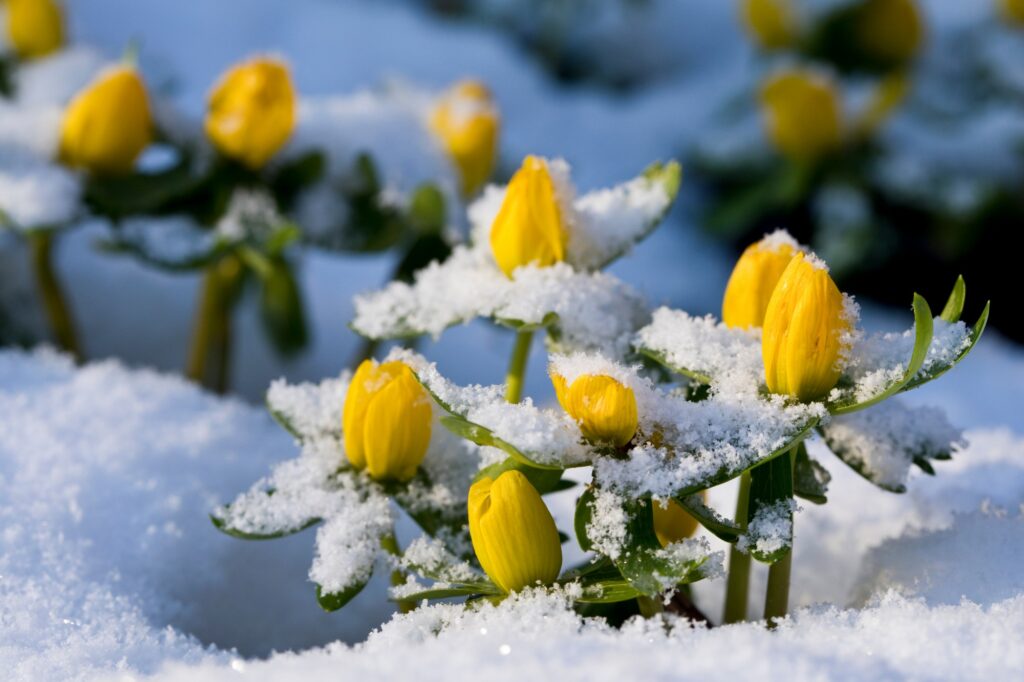
Winter aconite is one of the earliest flowers to appear in the garden, sometimes opening its bright yellow blooms while snow still lies nearby. The plants are tiny—usually only a few inches tall—but a mature colony can transform otherwise bare late-winter ground into a carpet of golden flowers surrounded by fresh green foliage.
The botanical name is Eranthis hyemalis. Winter aconite belongs to the buttercup family, Ranunculaceae, and grows from small underground tubers rather than true bulbs.
Its growing season is remarkably short. Flowers appear in late winter or very early spring, foliage develops around and after flowering, and the entire plant usually disappears underground again by late spring or early summer.
That makes winter aconite an excellent companion for deciduous trees, shrubs, hellebores, and later-emerging perennials. It completes much of its annual growth before those larger plants fill the garden with foliage.
Once established in conditions it likes, winter aconite can naturalize freely, gradually turning a small group of tubers into broad colonies.
The biggest challenges occur at planting time. The small tubers can dry out in storage and may establish slowly, so purchasing fresh tubers and planting them promptly in fall gives you the best chance of success.
⚡ Winter Aconite Quick Care Guide
Botanical name: Eranthis hyemalis
Common name: Winter aconite
Plant type: Tuberous herbaceous perennial
Family: Ranunculaceae
Height: Approximately 3 to 6 inches
Spread: Approximately 3 to 6 inches per plant, eventually forming colonies
Light: Full sun to partial shade during active growth
Soil: Humus-rich, moist but well-drained soil
Soil pH: Neutral to alkaline conditions are often preferred
Planting time: Late summer through fall
Planting depth: Approximately 2 to 3 inches
Spacing: Approximately 1 to 3 inches apart for naturalized plantings
Bloom time: Late winter to early spring
Flower color: Bright golden yellow
Water: Keep reasonably moist during active growth
Summer habit: Completely dormant
Propagation: Seed and division
Wildlife: Early flowers may attract bees
Deer resistance: Generally good
Important: Winter aconite is poisonous if eaten, with the tuber particularly toxic. Keep it away from children and pets that may dig or chew plants.
💛 What Is Winter Aconite?
Winter aconite is a small perennial native to parts of Europe and western Asia.
It grows from irregular brown tubers hidden beneath the soil.
Each plant produces a brilliant yellow, cup-shaped flower surrounded by a ruff of deeply divided green bracts.
The combination makes the flower look almost like a tiny buttercup sitting inside a green collar.
After flowering, divided green leaves continue growing for several weeks before yellowing and disappearing.
By summer, there may be no visible evidence that winter aconite is present at all.
The plant spends the remainder of the year dormant underground.
🌼 What Do Winter Aconite Flowers Look Like?
Winter aconite flowers are small but intensely colored.
Each flower is approximately an inch across and usually faces upward when open.
The yellow outer structures resemble petals, while numerous stamens fill the center.
Immediately beneath each flower is a distinctive circle of divided green bracts.
From a distance, an established planting can look like hundreds of little yellow suns scattered across the soil.
Individual plants are easy to overlook.
Colonies are not.
That is why winter aconite is usually more effective planted in groups than as isolated specimens.
❄️ How Early Does Winter Aconite Bloom?
Very early.
Winter aconite can begin flowering in late winter, often before crocuses and around the time the earliest snowdrops appear.
In some climates, flowers emerge during February.
Farther north, they may wait until March.
Weather influences the timing considerably.
A mild late winter can bring flowers earlier than expected, while prolonged snow cover may delay them.
The plant is nevertheless built for cold-season flowering and can emerge while the surrounding landscape still looks unmistakably wintery.
🌨️ Can Winter Aconite Bloom Through Snow?
It can emerge while snow remains on the ground and is often associated with the transition between winter and spring.
A light snowfall does not automatically destroy the flowers.
Like snowdrops and other very early plants, winter aconite is adapted to cold conditions.
Severe temperature extremes can still damage flowers and foliage, but ordinary late-winter fluctuations are part of the plant’s natural growing season.
🌱 Is Winter Aconite a Bulb?
Not technically.
Winter aconite grows from a small tuber.
Garden centers and bulb catalogs may still group it with “spring bulbs” because gardeners buy and plant the dormant tubers in much the same way they plant crocuses and other fall-planted spring flowers.
The distinction matters most at planting time.
Winter aconite tubers are small and irregularly shaped and can dry out more easily than large, fleshy bulbs.
Fresh planting material usually establishes more readily.
🌿 Winter Aconite vs. Monkshood
The common name aconite can cause confusion.
Winter aconite is Eranthis hyemalis.
Monkshood or wolfsbane belongs to the genus Aconitum.
Both belong to the buttercup family, Ranunculaceae, but they are different plants.
Monkshood is a much taller perennial with distinctive hooded flowers, often blue or purple.
Winter aconite remains only a few inches tall and produces yellow cup-shaped flowers.
Both groups contain toxic compounds, so the similarity of their common names should never be interpreted as meaning either is edible.
☀️ How Much Sun Does Winter Aconite Need?
Winter aconite grows in full sun to partial shade.
The ideal situation often changes naturally through the season.
During late winter and early spring, the plants benefit from abundant sunlight.
Later, increasing shade is perfectly acceptable because winter aconite is already approaching dormancy.
This makes sites beneath deciduous trees particularly suitable.
The bare winter canopy lets sunlight reach the ground during flowering.
As the trees leaf out, shade increases just as the aconite’s growing season is ending.
For help understanding the changing light in your garden, visit Gardening Basics.
🌳 Winter Aconite Beneath Trees
One of the best uses for winter aconite is naturalizing beneath deciduous trees and shrubs.
Plant tubers between major tree roots rather than digging deeply through the entire root zone.
The plants need enough spring moisture to complete their growth, so very dry soil beneath mature trees can still be challenging.
Sites with leaf-rich soil and moderate spring moisture are ideal.
Once the trees develop their summer canopy, the winter aconite disappears underground and no longer competes visually with later plants.
🌲 Can Winter Aconite Grow Under Evergreens?
Dense evergreen shade is more difficult.
Unlike deciduous trees, evergreens block sunlight throughout winter and spring.
The soil beneath large conifers can also be extremely dry because of root competition and intercepted rainfall.
Winter aconite may grow around the outer edge of an evergreen canopy where enough early light reaches the soil, but deep permanent shade directly beneath dense branches is generally less suitable.
🌎 Best Soil for Winter Aconite
Winter aconite prefers humus-rich, moist, well-drained soil.
Woodland-like soil enriched with decomposed leaves is excellent.
The plant tolerates several soil textures, but water should not remain stagnant around the tubers.
Winter aconite also tends to prefer neutral to alkaline soil rather than strongly acidic conditions.
You do not need to add lime automatically.
If soil pH is uncertain, test it before making significant changes.
Our Garden Soil Guide: Soil Types, Testing, pH & How to Improve It explains pH, drainage, soil texture, organic matter, and testing in more detail.
🍂 Leaf-Rich Soil Is Ideal
Winter aconite naturally fits into woodland-style conditions where fallen leaves decompose into the upper soil layer.
Leaf mold and finished compost can help maintain the loose, organic-rich soil these plants appreciate.
You do not need to create an extremely rich planting pocket.
A moderate amount of organic matter worked through the broader bed is more useful than burying the tubers in pure compost.
💧 Winter Aconite Likes Moisture During Growth
The plants need adequate moisture while flowering and producing foliage.
Spring rainfall often provides everything required.
During an unusually dry late winter or spring, supplemental watering may help.
The soil should remain moist but not waterlogged.
By the time summer arrives and the foliage disappears, the tubers are dormant and tolerate much drier conditions.
🌧️ Avoid Soggy Soil
Moist woodland soil and waterlogged soil are not the same thing.
Winter aconite requires reasonable drainage.
Tubers sitting in stagnant wet soil are vulnerable to rot.
If a potential planting site remains flooded for days after normal rain, choose another location or improve the drainage.
For persistently damp sites, Snowflake Flower may offer a better fit, particularly summer snowflake.
📅 When Should You Plant Winter Aconite?
Plant dormant winter aconite tubers in late summer or fall.
Early planting is useful because freshly harvested tubers are less likely to have dried excessively.
If you purchase them later in fall, plant them as soon as practical.
Do not leave the packet forgotten in a warm garage for months.
The small tubers can become extremely dry and difficult to establish.
💧 Should You Soak Winter Aconite Tubers Before Planting?
Dry winter aconite tubers benefit from rehydration before planting.
Some horticultural guidance recommends soaking the tubers overnight in water.
Wisconsin Extension suggests placing badly shriveled tubers in moist peat or sand for a few days to rehydrate them more gradually.
Either way, the goal is the same: restore some moisture to tubers that have become excessively dry in storage.
Fresh, firm tubers may need little preparation.
Plant them promptly rather than intentionally letting them dry.
🌱 How Deep Should You Plant Winter Aconite?
Plant tubers approximately 2 to 3 inches deep.
In heavy soil, slightly shallower planting may be appropriate.
The small irregular tubers often do not have an obvious top and bottom.
Do not worry excessively about orientation.
Place them reasonably flat in the planting hole and cover with soil.
The emerging shoots can usually find their way upward.
📏 How Far Apart Should Winter Aconite Be Planted?
Spacing of approximately 1 to 3 inches works well when you want a naturalized display.
These are tiny plants.
Large empty spaces between individual tubers make the planting look sparse.
Plant generously.
Groups of 20, 50, or more tubers can create a far stronger effect than six widely scattered plants.
Once established, the colony can gradually spread beyond the original planting.
🌼 Plant Winter Aconite in Drifts
Naturalistic planting suits winter aconite far better than formal rows.
Scatter tubers loosely across the planting area and install them approximately where they land.
This creates irregular spacing that resembles a natural colony.
Good locations include:
- Beneath deciduous trees
- Woodland edges
- Beneath large shrubs
- Along walkways
- Rock gardens
- Fronts of perennial borders
- Informal lawns
Remember that the flowers are only a few inches tall.
Plant them where you can actually see them.
🌱 Does Winter Aconite Naturalize?
Yes—and very successfully under favorable conditions.
Established plants can spread through both tuber growth and seed.
Over time, small groups may form extensive colonies.
Wisconsin Extension notes that winter aconite can spread so successfully that it may become almost invasive in ideal conditions.
For many gardeners, this is precisely the desired effect.
A broad carpet of yellow flowers in February or March is far more impressive than one isolated plant.
⚠️ Can Winter Aconite Spread Too Much?
It can.
Winter aconite is best planted where naturalizing is welcome.
A woodland garden, broad perennial border, or informal lawn provides plenty of room.
A tiny carefully controlled rock garden may require more management.
If a colony expands beyond the desired area, lift unwanted plants while they are still in active green growth.
Preventing seed production can also reduce further spreading.
🌱 How Does Winter Aconite Spread?
Winter aconite spreads in two main ways.
Tubers
Established plants produce additional underground growth and gradually expand into larger clumps.
Seed
Flowers develop seed pods after pollination.
Mature seeds fall around the parent plants and can establish new seedlings.
Seedlings may appear beyond the original clump, eventually creating the broad scattered colonies that make winter aconite so attractive.
🌱 Can You Grow Winter Aconite From Seed?
Yes.
In fact, seed can be an excellent way to establish larger colonies if you are patient.
Allow seed capsules to mature.
Fresh seed can be sown outdoors where natural seasonal temperature changes help satisfy germination requirements.
Seedlings require time before reaching flowering size.
This is not an instant method.
But in a naturalized planting, letting the plants sow themselves is often the easiest strategy of all.
✂️ Dividing Winter Aconite
Established clumps can be divided after flowering.
Unlike dormant dry tubers, actively growing plants are easier to locate and transplant.
Lift clumps carefully while foliage remains green.
Separate sections with healthy tubers and replant them promptly at the same general depth.
Water after transplanting.
Division is useful when:
- A colony has become overly dense
- Plants are spreading into unwanted areas
- You want to establish winter aconite elsewhere
- You want faster expansion than seed alone can provide
🌿 Moving Winter Aconite “In the Green”
Gardeners sometimes transplant winter aconite while it is still in leaf, often described as moving plants in the green.
This avoids some of the establishment difficulty associated with very dry dormant tubers.
After flowering, carefully lift a small clump with soil around the roots and transplant it promptly.
Do not allow the roots and tubers to dry while moving them.
Water the new planting afterward and allow the foliage to complete its natural cycle.
🌿 What Happens After Winter Aconite Flowers?
Once flowers fade, green foliage continues growing.
These leaves manufacture energy that is stored underground for the next growing season.
Seed pods may also begin developing.
Over the following weeks, foliage turns yellow and disappears.
By late spring or early summer, the plant is completely dormant.
Do not interpret its disappearance as death.
That is the normal winter aconite life cycle.
🚫 Don’t Remove Winter Aconite Foliage Too Early
As with Daffodils, Crocuses, and Glory of the Snow, foliage needs time to complete photosynthesis after flowering.
Do not mow or cut winter aconite leaves while they remain green.
Allow them to yellow naturally.
The process does not take especially long because the plants enter dormancy relatively early.
Once foliage has disappeared, later perennials can completely take over the area.
🌾 Winter Aconite in a Lawn
Winter aconite can naturalize beautifully through informal turf.
The yellow flowers appear before spring lawn growth becomes vigorous.
That timing makes them particularly suited to lawns where mowing can be delayed.
Do not mow immediately after flowering.
Allow the foliage to ripen and die back first.
If your lawn must be kept closely mowed from the earliest part of spring, naturalizing winter aconite there may create unnecessary conflict.
Use a woodland edge or perennial bed instead.
🌳 Winter Aconite in a Woodland Garden
Woodland gardens are nearly ideal.
Winter aconite completes much of its annual life cycle before deciduous trees leaf out.
Combine it with other plants that use the same garden space at different times of year.
Possible companions include:
- Lenten roses
- Ferns
- Heucheras
- Hostas
- Snowdrops
- Crocuses
- Glory of the snow
- Snowflake flowers
By summer, larger shade plants hide the empty areas left by dormant winter aconite.
🌸 Winter Aconite With Lenten Roses
This is one of the best late-winter combinations.
Lenten roses produce substantial flowers in shades of white, pink, burgundy, purple, green, and yellow.
Winter aconite forms a much lower golden carpet beneath them.
Both plants belong to the buttercup family and naturally suit woodland-style conditions.
Because hellebores remain visible much longer, they also disguise the aconite’s disappearance later in spring.
💙 Winter Aconite With Glory of the Snow
Blue and yellow create an especially strong early-spring combination.
Glory of the Snow produces small blue star-shaped flowers at approximately the same point in the season.
Mixing broad drifts of blue glory of the snow with yellow winter aconite can create one of the brightest color displays possible before the main spring bulb season.
Both plants eventually disappear underground and leave the area open for summer perennials.
💜 Winter Aconite With Crocuses
Purple crocuses and yellow winter aconite make natural companions.
Both remain close to the soil.
Both bloom extremely early.
And both can naturalize in suitable areas.
Their flower shapes are different enough to remain visually distinct even when mixed together.
Our Crocus Care guide covers crocus planting and naturalizing in more detail.
🤍 Winter Aconite With Snowdrops
Snowdrops are among the classic companions for winter aconite.
The snowdrop’s nodding white flowers contrast with the upward-facing yellow aconite blooms.
Both can emerge during very cold conditions.
Wisconsin Extension notes that winter aconite may begin flowering just before the earliest snowdrops.
Planting the two together creates a white-and-gold display at the very beginning of the gardening year.
🤍 Winter Aconite With Snowflake Flowers
Snowflake Flowers bloom somewhat later and generally grow taller than winter aconite.
That difference can help extend the spring sequence.
Winter aconite starts near ground level.
Snowflake flowers then rise above the planting with white, green-tipped bells.
Add daffodils, and a single area can move through several waves of spring bloom.
🌼 Winter Aconite With Daffodils
Daffodils usually flower after the first winter aconite display has begun.
Their greater height creates another layer.
Yellow daffodils can reinforce the golden color scheme, while white daffodils add contrast.
Because both need their foliage left in place after flowering, design the surrounding bed with later-emerging plants that can hide the fading leaves naturally.
See Daffodil Care: How to Plant, Grow & Care for Daffodils for complete daffodil guidance.
🌿 Winter Aconite With Heucheras
Heucheras can provide excellent later-season foliage around winter aconite.
Depending on climate, heuchera leaves may already be visible when aconite flowers.
As spring progresses, the perennial foliage expands while aconite disappears.
Dark burgundy heucheras create particularly dramatic contrast with golden yellow flowers.
🪨 Winter Aconite in a Rock Garden
The tiny size of winter aconite makes it well suited to rock gardens.
Plant tubers in humus-rich pockets where the soil remains reasonably moist during spring without becoming waterlogged.
Use clusters rather than individual plants.
A low rock or wall behind the flowers can also make them easier to see.
Avoid extremely hot, dry rock-garden locations that bake during the brief spring growing season.
🪴 Can Winter Aconite Grow in Containers?
It can, although winter aconite is generally more satisfying as a naturalized in-ground plant.
Use a container with excellent drainage and enough depth for the tubers.
Plant several together because individual flowers are tiny.
The biggest challenge is long-term management.
Containers experience more extreme winter temperatures and can become much wetter or drier than surrounding garden soil.
If your goal is a permanent colony, the ground is usually easier.
🌼 Does Winter Aconite Need Fertilizer?
Not usually.
Plants growing in humus-rich garden soil generally need little supplemental feeding.
A layer of decomposed leaves or modest addition of finished compost can help maintain soil organic matter.
Heavy fertilizer is unnecessary.
If an established planting declines, first investigate:
- Light
- Soil moisture
- Drainage
- Premature foliage removal
- Competition from other plants
Do not assume fertilizer is the answer.
🐝 Is Winter Aconite Good for Pollinators?
Winter aconite can be valuable to early-active bees because it flowers at a time when relatively few other garden plants are available.
The open yellow flowers expose their reproductive structures and nectar sources.
On a warm late-winter day, pollinating insects may visit a colony even while much of the garden is still dormant.
For greater ecological value, combine winter aconite with plants flowering later in spring, summer, and fall.
Our Eco-Friendly Gardening hub provides additional ideas for extending bloom and supporting garden wildlife.
🦌 Do Deer Eat Winter Aconite?
Winter aconite is generally considered deer resistant.
The plant contains toxic compounds, making it less attractive to browsing animals.
Missouri Botanical Garden includes winter aconite among hardy bulbs generally avoided by deer.
No plant is guaranteed to escape browsing during extreme food shortages, but winter aconite is usually a much safer choice than highly palatable garden plants.
🐇 Do Rabbits Eat Winter Aconite?
Rabbit browsing is also generally limited.
The plant’s toxicity makes it an undesirable food source.
As with deer, local behavior can vary, but winter aconite is not normally planted with rabbit protection as a primary concern.
🐿️ Do Squirrels Dig Up Winter Aconite?
Squirrels may investigate freshly disturbed soil even when they are not especially interested in eating the tubers.
Planting promptly, replacing the soil firmly, and using a normal mulch layer can help make the area less conspicuous.
Where squirrels repeatedly excavate bulb beds, temporary mesh protection over the soil may help until it settles.
🐛 Winter Aconite Pests
Winter aconite has very few serious insect problems.
Its extremely early growing season also means the plant completes much of its annual cycle before many common garden pests become active.
Minor damage is rarely significant in a mature colony.
Avoid treating the area unnecessarily with insecticides, especially during bloom when early bees may be visiting the flowers.
🦠 Winter Aconite Diseases
Serious disease problems are uncommon.
Occasional fungal problems can occur, particularly when plants grow in unsuitable wet conditions.
Good drainage is the most important preventive measure.
If tubers repeatedly rot in one location, reconsider the site rather than continuously replacing them.
🌱 Why Isn’t My Winter Aconite Flowering?
Several factors can contribute.
Newly Planted Tubers
Dry purchased tubers can be slow to establish and may require time before producing a substantial display.
Too Much Deep Shade
Winter aconite appreciates light during its brief growing season.
Foliage Was Removed Early
The leaves need time to replenish the tuber.
Poor Drainage
Rotting tubers cannot produce healthy flowers.
Overcrowding
A very old dense clump may occasionally benefit from division.
Drought During Growth
Plants need adequate moisture while active.
If the site is otherwise appropriate, patience may be the best solution.
🌿 Why Did My Winter Aconite Disappear?
If it is late spring or summer, nothing is wrong.
Winter aconite is a spring ephemeral.
The entire above-ground plant naturally disappears after its growing season.
Mark the location if you plan to dig or plant nearby later in the year.
Otherwise, you may accidentally disturb dormant tubers because the ground appears empty.
📍 Mark Large Colonies Before Summer
Garden markers can be surprisingly helpful.
Once winter aconite disappears, it is easy to forget exactly where the colony is located.
A subtle label, photograph, or garden map can prevent you from digging into the tubers while installing summer plants.
This is particularly useful in densely planted perennial borders.
🌎 Is Winter Aconite Native to North America?
No.
Eranthis hyemalis is native to Europe and western Asia.
It is grown in North America as an ornamental spring ephemeral.
In favorable conditions, it can naturalize well beyond the original planting.
If you are creating a strictly native woodland garden, choose regional native spring ephemerals instead.
In a mixed ornamental landscape, winter aconite can provide extremely early color and floral resources.
⚠️ Is Winter Aconite Invasive?
Winter aconite is not universally classified as a major invasive plant, but it can spread enthusiastically in suitable gardens.
Wisconsin Extension notes that colonies can become extensive and may spread almost to the point of invasiveness.
This behavior is generally most noticeable around established gardens rather than as an aggressive landscape problem everywhere.
Monitor the colony.
If seedlings begin appearing where they are unwanted, remove them before the population expands further.
☠️ Is Winter Aconite Poisonous?
Yes—and this deserves particular emphasis.
Winter aconite is poisonous if eaten.
All portions of the plant contain toxic compounds, with the underground tuber presenting particular concern.
NC State Extension classifies the plant as having high-severity poison characteristics.
Ingestion can cause symptoms including:
- Stomach pain
- Nausea
- Vomiting
- Diarrhea
- Visual disturbances
- Abnormal heart rhythm
- Breathing problems
- Severe poisoning in substantial exposures
Winter aconite should be treated strictly as an ornamental plant.
🐕 Is Winter Aconite Toxic to Dogs and Cats?
Yes.
Dogs, cats, horses, and other animals should not be allowed to eat winter aconite.
The tubers deserve particular caution because pets that dig may expose them.
If your dog routinely digs up bulbs and eats underground plant material, winter aconite may not be a sensible choice for an accessible part of the yard.
If you suspect ingestion, contact a veterinarian or animal poison-control service promptly.
👶 Winter Aconite and Children
The plant also deserves caution in gardens used by young children.
Because tubers are underground, they are unlikely to attract attention during ordinary play.
The risk increases when children help plant bulbs or dig in garden beds.
Keep dormant tubers in clearly labeled packages.
Do not store them near edible bulbs or vegetables.
Supervise planting and wash hands afterward.
🧤 Should You Wear Gloves?
Wearing gardening gloves while handling winter aconite tubers is a sensible precaution.
The most important safety rule is preventing ingestion, but gloves also reduce direct contact with plant juices and keep soil away from your hands.
Wash your hands after planting or dividing the tubers.
Never handle food while working with toxic ornamental plants.
🌱 Winter Aconite in a Low-Maintenance Garden
Once established, winter aconite needs remarkably little work.
You generally do not need to:
- Stake it
- Prune it
- Fertilize it heavily
- Dig it each year
- Deadhead every flower
- Protect it from deer
- Provide summer irrigation once it is dormant
The main job is restraint.
Let it grow.
Let the leaves remain until they naturally disappear.
Allow the colony to spread where appropriate.
Sometimes low-maintenance gardening is simply knowing when not to interfere.
🎨 Designing With Winter Aconite
Because the plants are so small, put them where they can be appreciated.
Good locations include:
- Near a walkway
- Beneath a frequently viewed tree
- Outside a window
- Along the front of a woodland border
- Around winter-blooming hellebores
- Beside steps
- On a slight slope viewed from below
The flowers can disappear visually when planted behind tall evergreen groundcovers.
Give them a clear stage during their short season.
💛 Create a Yellow Winter Garden
Winter aconite can be part of a broader yellow late-winter theme.
Combine it with appropriately placed:
- Witch hazel
- Forsythia
- Yellow hellebores
- Yellow Mahonia
- Early daffodils
The plants will not necessarily flower simultaneously in every climate, but their overlapping seasonal sequence can carry yellow through the transition from winter into spring.
Mahonia can provide evergreen structure above the much smaller aconite plants.
🌸 A Simple Early-Spring Planting
For a compact late-winter garden, try layering:
Lowest level: Winter aconite and crocuses
Next layer: Glory of the snow and snowdrops
Mid-height layer: Lenten roses
Later spring: Daffodils and snowflake flowers
Background: Mahonia, paperbush, or another suitable shrub
Each plant takes over as the previous one fades.
By the time the aconite disappears, the garden looks completely different.
That kind of seasonal layering is one of the best ways to make a small garden interesting for much longer than a single month.
⚠️ Common Winter Aconite Care Mistakes
Planting Dried-Out Tubers Without Rehydrating Them
Very dry tubers can establish poorly.
Planting Too Few
Tiny flowers have much greater impact in groups.
Planting in Permanently Soggy Soil
Winter aconite likes moisture but still needs drainage.
Planting in Deep Year-Round Shade
The plants need useful light during their brief spring growth period.
Cutting Foliage Too Early
Green leaves need time to replenish the tuber.
Assuming the Plants Died When They Disappear in Summer
Summer dormancy is completely normal.
Digging the Bed After Dormancy
The invisible tubers are easy to damage.
Ignoring Their Toxicity
Winter aconite is a poisonous ornamental and should never be eaten.
Planting Where Uncontrolled Spreading Is Unwelcome
Healthy colonies can naturalize enthusiastically.
💛 Is Winter Aconite Easy to Grow?
Yes—once established.
The first season can require patience because dormant tubers do not always establish as quickly as larger spring bulbs.
Give them the right start:
Plant fresh tubers in fall.
Rehydrate very dry tubers before planting.
Place them 2 to 3 inches deep in humus-rich, well-drained soil.
Give them sunlight during their late-winter growing season.
Maintain reasonable spring moisture.
Leave the foliage untouched until it disappears.
Then forget about them until next winter.
As the colony matures, the plants increasingly take care of themselves.
❄️ One of the First Signs the Garden Is Waking Up
Winter aconite does not wait for comfortable gardening weather.
That is its greatest charm.
The garden may still look brown and dormant.
Snow may remain beneath the trees.
Then a few green shoots appear close to the soil.
Small golden flowers open.
A few days later, there are dozens.
Given enough years, there may be hundreds.
By the time the rest of the garden fully awakens, winter aconite has already finished flowering and begun preparing to disappear.
It asks for almost nothing during summer because it is no longer visible.
Then the following winter, just when the garden feels as though it has been asleep forever, the yellow flowers return.
For such a tiny plant, winter aconite can become one of the most anticipated events of the gardening year.
🔗 Related Articles
- Flower Gardening
- Gardening Basics
- Garden Soil Guide: Soil Types, Testing, pH & How to Improve It
- Seasonal Gardening
- Eco-Friendly Gardening
- Lenten Rose Care
- Mahonia Care
- Paperbush Care
- Daffodil Care: How to Plant, Grow & Care for Daffodils
- Crocus Care
- Glory of the Snow Care
- Snowflake Flower Care