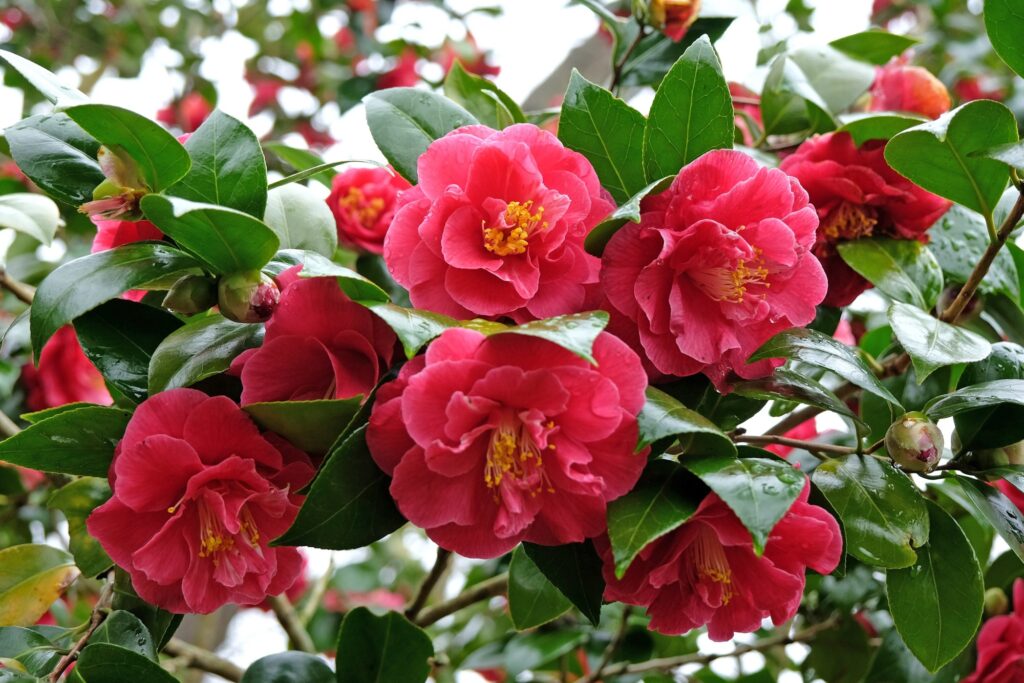
Camellias bring something unusual to the garden: large, rose-like flowers during the months when many other shrubs are dormant. Depending on the species and cultivar, a camellia may begin flowering in fall, continue through winter, or wait until late winter and early spring.
Even when they are not blooming, camellias remain attractive. Their glossy evergreen foliage creates year-round structure, making them useful as specimen shrubs, screens, informal hedges, foundation plants, and woodland-edge evergreens.
Two types dominate home gardens: Japanese camellia (Camellia japonica) and sasanqua camellia (Camellia sasanqua). They look similar at first glance, but there are important differences. Japanese camellias generally have larger leaves and flowers and tend to bloom later, while sasanquas usually flower in fall or early winter, have somewhat smaller foliage and flowers, and tolerate more sun.
Both prefer acidic, organic-rich soil with good drainage. They also appreciate protection from harsh winter wind and, particularly in warm climates, intense afternoon sun.
Camellias are not fast-growing shrubs, but that slow pace comes with an advantage: a well-sited plant can remain part of the landscape for generations.
⚡ Camellia Quick Care Guide
Botanical genus: Camellia
Family: Theaceae
Plant type: Broadleaf evergreen shrub or small tree
Most common garden types: Japanese camellia (Camellia japonica) and sasanqua camellia (Camellia sasanqua)
Light: Partial shade is ideal for many camellias; sasanqua tolerates more sun
Soil: Moist, organic-rich, acidic, and well drained
Preferred soil pH: Approximately 5.5 to 6.5 for many garden camellias
Water: Consistent moisture, especially during establishment and flower-bud development
Bloom season: Fall through spring depending on species and cultivar
Flower colors: White, pink, red, rose, variegated, and occasionally cream or pale yellow tones
Foliage: Evergreen, glossy, and leathery
Mature size: Roughly 4 to 15 feet or more depending on species and cultivar
Pruning: Usually minimal; prune after flowering when necessary
Hardiness: Many commonly grown Japanese and sasanqua camellias perform best around USDA Zones 7–9, though cold-hardy hybrids extend the range
Common concerns: Tea scale, petal blight, canker and dieback, root rot, leaf gall, chlorosis, and cold damage to buds and flowers
🌿 What Is a Camellia?
Camellias are evergreen woody plants in the tea family, Theaceae.
The genus contains more than 200 accepted species native primarily to eastern and southeastern Asia.
Gardeners grow camellias primarily for their flowers and glossy evergreen foliage, but the genus has another famous member: Camellia sinensis, the plant whose leaves are used to produce black, green, white, and oolong tea.
The large ornamental camellias growing around homes are usually different species.
Japanese camellia and sasanqua camellia dominate ornamental landscapes in much of the southeastern United States and other mild temperate regions.
🌸 Japanese Camellia vs. Sasanqua Camellia
Knowing which type you have makes care much easier.
Japanese Camellia — Camellia japonica
Japanese camellias generally have larger, thicker leaves and larger flowers.
Individual blooms can reach several inches across and may be single, semi-double, formal double, rose form, or peony-like.
Many cultivars flower from winter through early spring.
Plants commonly mature around 6 to 12 feet tall in landscapes, although old specimens can become considerably larger.
Japanese camellias generally appreciate partial shade and protection from harsh afternoon sun.
Sasanqua Camellia — Camellia sasanqua
Sasanquas usually have smaller leaves and somewhat smaller flowers.
Their blooms are often single or semi-double and may be fragrant.
Sasanquas tend to flower earlier—commonly during fall and early winter.
They also tolerate more sunlight than Japanese camellias and often grow somewhat faster.
Their range of sizes is enormous, with cultivars available as low spreading shrubs, compact foundation plants, large hedges, and small trees.
🍁 Which Camellia Blooms in Fall?
Sasanqua camellias are the classic fall-flowering group.
Depending on cultivar and climate, their flowers can begin opening while many deciduous plants are only starting to change color.
That makes them valuable for extending the ornamental season beyond summer.
A sasanqua planted near ornamental grasses, autumn foliage, and later-blooming perennials can bridge the garden from fall into winter.
Popular red-flowering types such as ‘Yuletide’ are especially effective around the holiday season when bloom timing cooperates.
❄️ Which Camellia Blooms in Winter and Spring?
Japanese camellias are better known for winter and early-spring flowers.
Bloom timing varies dramatically among cultivars.
Some start surprisingly early, while others wait until late winter or early spring.
That variation can be used deliberately.
Instead of planting several camellias that all flower for the same three weeks, choose early-, mid-, and late-season cultivars.
A small collection can then provide flowers over several months.
🌺 Camellia Flower Forms
Camellia breeding has produced an extraordinary range of flower structures.
You may encounter:
- Single
- Semi-double
- Anemone form
- Peony form
- Rose-form double
- Formal double
Single flowers expose a conspicuous center of yellow stamens.
Formal doubles contain many precisely arranged petals and often hide the stamens completely.
Peony forms are much fuller and less symmetrical.
The choice is largely aesthetic, although simpler flowers tend to offer easier access for pollinating insects.
🎨 Camellia Colors
The classic camellia palette includes:
- Pure white
- Creamy white
- Pale pink
- Medium pink
- Rose
- Deep pink
- Red
- Crimson
- Burgundy-red
- Variegated pink and white
- Red and white combinations
True blue camellias do not exist, and most so-called yellow camellias are better described as cream or pale yellow unless they involve specialized species or breeding lines.
Color can also vary slightly with weather and flower age.
🌹 Camellias Look Like Roses—but Aren’t Roses
The layered flowers of certain camellias can strongly resemble roses.
Botanically, however, the plants are unrelated.
Camellias belong to the tea family.
True roses belong to the family Rosaceae.
Their care requirements differ as well.
Many roses thrive in abundant full sun, while Japanese camellias often prefer filtered light or partial shade.
If your sunny garden is better suited to roses, our How to Grow a New Rose Garden guide covers those plants separately.
☀️ How Much Sun Do Camellias Need?
Most camellias perform beautifully in partial shade.
A location receiving morning sun followed by protection from intense afternoon heat is excellent in many climates.
Filtered light beneath high-branched trees can also work.
Japanese camellias generally appreciate greater protection from direct sunlight than sasanquas.
Sasanqua camellias tolerate substantial sun, especially after establishment, as long as the root zone does not become excessively hot and dry.
Climate matters.
A plant receiving six hours of direct sun in a mild coastal climate experiences something very different from a camellia exposed to six hours of intense midsummer sun beside a south-facing brick wall.
🌞 Can Camellias Grow in Full Sun?
Sasanqua camellias can often grow in full sun.
Mature plants tolerate brighter conditions particularly well when their roots remain cool and adequately moist.
Japanese camellias are less forgiving.
They may tolerate full sun in cooler areas, but strong afternoon exposure can scorch foliage and stress the plant in hotter regions.
If your garden is very sunny, choose a sasanqua or another cultivar specifically recommended for brighter conditions.
🌳 Camellias in Partial Shade
Partial shade is the safest general recommendation for Japanese camellias.
Morning sun provides energy for strong flowering while afternoon protection reduces heat stress.
This is also useful for preserving flowers.
Strong sunlight combined with warm temperatures can shorten the life of delicate blooms.
Partial shade can keep both foliage and flowers looking better.
🌑 Can Camellias Grow in Deep Shade?
Camellias tolerate shade, but extremely deep shade can reduce flowering.
A shrub may produce attractive dark-green foliage yet very few buds.
Dense shade can also increase humidity around leaves and flowers.
Aim for bright filtered light rather than permanent darkness.
If the site receives virtually no direct or filtered sun, consider whether a more shade-adapted plant would perform better.
🌬️ Protect Camellias From Cold, Dry Wind
Winter wind can be particularly damaging to evergreen camellias.
Leaves continue losing moisture during winter even when root activity is reduced.
Cold wind can also damage flower buds and open blossoms.
A protected site can make a substantial difference, especially near the cold edge of the plant’s hardiness range.
Useful locations include:
- Woodland edges
- Courtyards
- Protected garden walls
- The sheltered side of a home
- Areas buffered by other evergreen shrubs
Avoid exposed hilltops and wind tunnels between buildings when possible.
🌎 Best Soil for Camellias
Camellias prefer moist, organic-rich, acidic soil with good drainage.
A pH around 5.5 to 6.5 works well for many types.
They can grow in clay, loam, or sandy soil when the physical conditions are appropriate.
Good drainage is particularly important.
Camellias have relatively shallow root systems and can decline rapidly when roots remain in waterlogged soil.
Before planting, observe the location after heavy rainfall.
If water stands for long periods, address the problem first.
Our Garden Soil Guide: Soil Types, Testing, pH & How to Improve It covers drainage, pH, compost, organic matter, and soil testing in more detail.
🧪 Camellias Prefer Acidic Soil
Camellias belong to a group of plants that genuinely care about soil pH.
When soil becomes too alkaline, leaves may develop chlorosis.
Typical symptoms include yellowing between the veins while the veins themselves remain greener.
This occurs because certain nutrients become less available at inappropriate pH levels.
Adding ordinary fertilizer may not solve the problem.
If repeated yellowing occurs, test the soil.
Correcting pH according to actual test results is much better than repeatedly applying products based on guesswork.
💧 Good Drainage Is Critical
Camellias like moisture.
They do not like suffocating roots.
Persistent saturation can encourage destructive root diseases, including Phytophthora root rot.
This is one of the most serious reasons a camellia can decline.
Choose a naturally well-drained site whenever possible.
If your soil remains wet for long periods, improving drainage or using an elevated planting area may be necessary.
Sasanquas generally have better resistance to Phytophthora root rot than Japanese camellias, but no camellia should be treated as an aquatic plant.
🌿 Add Organic Matter Thoughtfully
Camellias appreciate soil containing organic matter.
Finished compost, decomposed leaf material, and similar amendments can improve many garden soils.
When planting, improve a broad area rather than digging a tiny hole and filling it with radically different material.
Roots need to expand into the surrounding soil.
A planting hole functioning like an underground pot can discourage healthy root development.
📅 When Should You Plant Camellias?
Fall and early spring are excellent planting periods in many climates.
Fall is particularly useful in mild regions because roots can establish during cooler weather before summer heat arrives.
Spring also works well, especially toward the colder end of the camellia’s range.
Avoid planting during extreme heat if possible.
A newly installed camellia has a limited root system and is much more vulnerable to drought than an established shrub.
🌱 How to Plant a Camellia
Camellias should be planted carefully because they are relatively shallow rooted.
Dig a hole much wider than the root ball but no deeper than necessary.
Remove the plant from its container and inspect the roots.
Loosen densely circling roots gently.
Position the shrub so the top of the root ball sits slightly above or level with the surrounding soil, rather than burying it deeply.
Backfill with the surrounding soil.
Water thoroughly.
Apply mulch over the broader root zone but keep it away from direct contact with the trunk.
Planting too deeply is a common and avoidable mistake.
📏 How Much Space Do Camellias Need?
Check the cultivar.
Camellia size varies enormously.
A compact cultivar might mature around 4 feet high.
A large Japanese camellia can reach 10 to 15 feet or considerably more with age.
Sasanqua cultivars can range from low spreading forms to shrubs large enough for screening.
Do not plant according to the size of the nursery pot.
Think about what the shrub may look like ten or twenty years later.
Adequate spacing improves airflow, plant shape, access for maintenance, and long-term health.
💦 How Often Should You Water Camellias?
New camellias require consistent moisture while establishing.
Their root balls should not be allowed to dry severely.
Established plants become more tolerant of short dry periods, but consistent moisture remains important, particularly during hot weather and while flower buds are developing.
Water needs depend on:
- Soil type
- Rainfall
- Temperature
- Exposure
- Mulch
- Plant size
- Root competition
Check the soil instead of using a rigid watering schedule.
🌻 Summer Water Matters for Future Flowers
Camellias begin developing flower buds well before those buds open.
Severe drought during late summer can reduce the following flower display.
A Japanese camellia that looks reasonably healthy in September may still lose developing buds after prolonged water stress.
This is why irrigation matters even when the shrub is several months away from blooming.
Do not forget evergreen shrubs simply because the main flower season has passed.
🍂 Mulch Camellias
A 2- to 3-inch layer of organic mulch can be extremely useful.
Mulch helps:
- Conserve moisture
- Moderate root-zone temperatures
- Reduce weeds
- Protect shallow roots
- Add organic material gradually
Suitable materials include:
- Pine bark
- Pine needles
- Shredded leaves
- Wood chips
- Other appropriate organic mulches
Keep mulch slightly away from the trunk.
Do not build a deep mound against the stem.
🌲 Pine Needles Around Camellias
Pine needles make an excellent mulch for camellias.
They create a loose, breathable layer and fit naturally into woodland-style plantings.
Despite common claims, ordinary pine-needle mulch does not dramatically acidify garden soil simply by being placed on the surface.
Use it because it protects the soil, not because you expect it to replace proper pH management.
If soil needs acidification, test first and use an appropriate amendment according to recommendations.
🌱 Do Camellias Need Fertilizer?
Camellias growing in good soil may need relatively little supplemental fertilizer.
If fertilization is appropriate, spring applications of a product formulated for acid-loving plants can be used according to label directions.
Avoid the common assumption that more fertilizer creates more flowers.
Overfertilization can burn roots and foliage and may contribute to excessive tender growth.
Brown leaf edges and unusual leaf drop can sometimes follow excessive feeding.
A soil test is especially useful when established plants repeatedly appear nutrient deficient.
🚫 Don’t Fertilize a Sick Camellia Automatically
A yellowing or declining camellia may have:
- Root rot
- Alkaline soil
- Drought stress
- Waterlogging
- Scale insects
- Cold damage
- Canker
- Planting-depth problems
Fertilizer will not correct those conditions.
Diagnose first.
Treat second.
This simple habit prevents a surprising amount of unnecessary garden intervention.
🌸 When Do Camellias Form Flower Buds?
Camellias develop next season’s flower buds months before bloom.
That is why summer care and pruning timing matter.
If you prune heavily after buds have formed, you may remove a significant portion of the coming display.
Likewise, severe summer drought can interfere with bud development or contribute to bud drop.
A camellia’s flowering season may occur in winter, but the work that produces those flowers begins much earlier.
✂️ Does Camellia Need Pruning?
Usually very little.
Camellias naturally develop attractive forms when given enough room.
Pruning may be useful for:
- Removing dead branches
- Removing damaged wood
- Correcting crossing branches
- Shortening an excessively long shoot
- Improving structure
- Rejuvenating an old plant
- Training a specimen into a small tree
Avoid automatically shearing camellias every year.
Their natural evergreen form is generally more attractive.
✂️ When Should You Prune Camellias?
The safest general rule is:
Prune shortly after flowering.
That allows the shrub time to produce new growth and develop next season’s flower buds.
For a Japanese camellia flowering in late winter or spring, prune after the spring display.
For fall-flowering sasanqua, pruning can follow its earlier bloom period.
Avoid major late-summer and fall pruning because you may remove developing buds.
Dead, damaged, or diseased branches can be removed whenever necessary.
🌳 Can You Prune Camellia Into a Tree?
Yes.
Camellias can be trained into attractive small multi-stemmed or single-trunk trees.
Sasanquas work particularly well for this because many have naturally open growth and respond well to selective removal of lower branches.
Do the work gradually.
Do not strip all lower growth from a young shrub at once.
Develop the trunk structure over several seasons while allowing enough foliage to support healthy growth.
🌿 Camellia Hedges
Camellias can form excellent evergreen screens and informal hedges.
Sasanquas are particularly useful because of their relatively vigorous growth and sun tolerance.
Japanese camellias make elegant large evergreen shrubs when more shade is available.
For a natural-looking hedge, allow individual plants enough room to develop rather than clipping them tightly into a narrow box.
Selective pruning preserves flowers and the attractive foliage much better than constant shearing.
🏡 Camellias as Foundation Plants
Compact and medium-sized camellias can work beautifully around homes.
Their evergreen foliage provides year-round structure, while winter or spring flowers add seasonal interest.
The biggest mistake is choosing a cultivar far too large for the available space.
A 12-foot camellia beneath a 4-foot window will eventually require constant pruning.
Choose the plant according to the space instead.
Allow enough room between the shrub and building for airflow and maintenance.
🌸 Why Are My Camellia Buds Falling Off?
Camellia bud drop can be partly natural.
Plants sometimes produce more buds than they can successfully open.
However, heavy bud drop can also result from stress.
Possible causes include:
- Drought
- Excessive water
- Sudden environmental changes
- Severe cold
- Root stress
- Poor drainage
Water management is particularly important during bud development.
If a mature plant suddenly drops an unusually large proportion of its buds, investigate the soil and recent weather before reaching for fertilizer.
❄️ Camellia Flowers and Frost
Open camellia flowers can be damaged by freezing temperatures.
White and pale-colored flowers may show brown damage particularly clearly.
Buds are somewhat more protected, although severe cold can damage them too.
A shrub may survive temperatures that destroy its current flowers.
Do not confuse flower damage with plant death.
When selecting cultivars near the cold edge of the range, look for types bred specifically for improved cold hardiness.
🌬️ Avoid Early Morning Winter Sun in Cold Climates
An east-facing location can sometimes create problems where winters are cold.
Frozen buds and flowers exposed suddenly to bright morning sunlight may thaw too quickly and suffer damage.
A location protected from early morning winter sun and cold winds can help preserve flowers.
This concern is less important in mild climates but worth considering near the colder limit for camellias.
❄️ How Cold Hardy Are Camellias?
Hardiness depends on species and cultivar.
Many traditional Japanese camellias are best suited to approximately USDA Zones 7–9.
Sasanquas also commonly grow within roughly Zones 7–9, with some selections performing in warmer areas.
Cold-hardy hybrids developed from species such as Camellia oleifera can survive farther north.
Do not rely on the word “camellia” alone when determining hardiness.
Check the cultivar’s individual rating.
🌸 Cold-Hardy Camellia Hybrids
Breeding has expanded camellia culture beyond the traditional Deep South.
Certain hybrids have been selected specifically for improved cold tolerance.
These can allow gardeners in colder Zone 6 locations—and occasionally protected sites beyond the traditional range—to grow camellias successfully.
Even cold-hardy cultivars benefit from a protected location.
Winter hardiness describes survival, not a guarantee that every exposed flower bud will emerge untouched after severe weather.
🪴 Can Camellias Grow in Containers?
Yes, particularly compact cultivars.
Container camellias need:
- A sufficiently large pot
- Excellent drainage
- Acidic, high-quality container mix
- Consistent moisture
- Protection from extreme root temperatures
Containers dry faster than in-ground beds.
They also expose roots to colder winter temperatures.
A camellia that is perfectly hardy in the ground may suffer in an unprotected pot during the same winter.
In cold climates, container plants may need a sheltered but cool overwintering location.
🌼 Why Isn’t My Camellia Blooming?
Several factors can reduce flowering.
Too Much Shade
Camellias tolerate shade, but extremely low light can reduce bud production.
Excessive Sun Stress
On the other hand, intense heat and sun can also weaken Japanese camellias.
Incorrect Pruning
Late pruning can remove flower buds.
Summer Drought
Water stress while buds are developing can reduce flowering.
Excessive Nitrogen
Heavy feeding may encourage foliage instead of flowers.
Cold Damage
Severe winter temperatures can destroy buds before they open.
Young Plant
Recently planted camellias may need time to establish.
🍃 Why Are Camellia Leaves Turning Yellow?
Several problems can cause yellow leaves.
Alkaline Soil
Camellias prefer acidic conditions and can develop chlorosis when pH is too high.
Poor Drainage
Damaged roots cannot absorb nutrients normally.
Root Rot
Widespread yellowing combined with decline can indicate a serious root problem.
Nutrient Deficiency
A genuine nutrient deficiency is possible.
Normal Leaf Replacement
Evergreen does not mean immortal foliage. Individual older leaves eventually yellow and fall.
Look at the overall pattern and condition of the shrub before deciding how to respond.
🌿 Why Are Camellia Leaves Yellow With Green Veins?
This pattern strongly suggests chlorosis.
High soil pH is a common reason.
When pH becomes too alkaline, iron and certain other nutrients may become less available even when they are physically present in the soil.
Adding more ordinary fertilizer is not necessarily helpful.
Test the soil.
Correct the pH problem appropriately and use iron treatments only where they are actually indicated.
🍂 Why Is My Camellia Dropping Leaves?
Some leaf drop is normal.
Camellias replace older evergreen foliage periodically.
Heavy or sudden leaf loss can indicate:
- Drought
- Waterlogging
- Root rot
- Overfertilization
- Transplant stress
- Severe cold
- Pest infestations
Check the plant carefully.
The timing of leaf loss often provides valuable clues.
🐛 Tea Scale
Tea scale is one of the most important camellia pests.
These tiny sap-feeding insects commonly infest the undersides of leaves.
The upper surface may develop yellow blotches.
A severe infestation can make foliage look unhealthy and reduce plant vigor.
Examine the underside of suspicious leaves rather than diagnosing based solely on yellow spotting.
Horticultural oils can be useful in management when applied according to label directions and appropriate timing.
Large old camellias can be difficult to treat thoroughly, so early detection is valuable.
🐜 Aphids and Spider Mites
Aphids may gather on tender new growth.
Spider mites can become troublesome during hot, dry conditions.
Minor infestations may not require intervention.
Encourage plant health, inspect regularly, and use the least disruptive effective treatment when necessary.
Broad-spectrum pesticide applications can kill beneficial organisms while doing little to correct the cultural conditions that encouraged the pest problem.
🌺 Camellia Petal Blight
Petal blight is one of the most conspicuous camellia diseases.
Affected flowers develop brown spots that expand rapidly through the petals.
Eventually, entire blooms may turn brown and fall.
The disease can be confused with ordinary frost damage, but petal blight often begins as distinct spots on otherwise fresh flowers.
Sanitation is important.
Remove affected flowers from the plant and ground rather than allowing large numbers of infected blossoms to accumulate beneath the shrub.
🍃 Camellia Leaf Gall
Leaf gall is particularly common on sasanqua camellias.
New leaves and shoots become unusually enlarged, fleshy, and distorted.
They may turn pale green, white, or pink before eventually becoming brown.
The disease is caused by a fungus.
Remove affected growth early, before the gall matures and releases spores.
Leaf gall looks alarming but usually causes limited long-term damage to otherwise healthy shrubs.
🦠 Camellia Canker and Dieback
Camellia canker and dieback can cause branches to wilt and die.
Affected stems may develop sunken areas or cankers.
Prune diseased branches back into healthy wood.
Dispose of infected material appropriately.
Keep pruning tools clean when moving among diseased plants.
A severely affected shrub may require more extensive management, particularly if the disease repeatedly progresses into major stems.
🌧️ Phytophthora Root Rot
Root rot is among the most serious camellia problems.
Symptoms can include:
- Yellowing leaves
- Poor growth
- General decline
- Wilting
- Root deterioration
- Eventual plant death
Poorly drained sites greatly increase the risk.
Japanese camellia is particularly susceptible.
Sasanqua camellias have greater resistance.
Once severe root rot develops, saving the plant can be difficult.
Proper drainage is therefore much more valuable than trying to treat an established infection later.
🌱 Sasanqua Can Be a Better Choice for Difficult Sites
If your garden is somewhat sunnier or has a history of Phytophthora root-rot problems, sasanqua camellias may be the stronger choice.
They generally tolerate more sunlight and have better resistance to this particular root disease than Japanese camellias.
That does not mean they tolerate standing water.
They still need appropriate drainage.
Think of resistance as an advantage, not permission to plant in unsuitable soil.
🦌 Are Camellias Deer Resistant?
Camellias are generally considered relatively resistant to deer compared with many other landscape shrubs.
Their leathery evergreen foliage is not typically a first-choice food.
Browsing behavior can vary dramatically, however.
Hungry deer sometimes eat plants they normally ignore.
Young plants are also more vulnerable simply because all their growth is within easy reach.
In areas with intense deer pressure, temporary protection may still be worthwhile.
🐝 Do Camellias Help Pollinators?
Single and semi-double camellias can provide pollen and nectar for insects during a season when relatively few shrubs are flowering.
Fall-blooming sasanquas and winter-to-spring Japanese camellias can therefore contribute to an extended garden bloom sequence.
Highly formal double flowers may offer less accessible food because the reproductive structures are hidden or modified.
If supporting pollinators is important, include simpler-flowered camellias alongside a diversity of other plants.
Our Eco-Friendly Gardening hub provides additional ideas for creating a garden that supports wildlife throughout the year.
🌎 Are Camellias Native to North America?
No.
Camellias are native to Asia.
They have nevertheless become deeply associated with gardens across the southeastern United States, where the climate suits them particularly well.
If your goal is a strictly native landscape, choose regionally native evergreen and flowering shrubs instead.
In a mixed ornamental garden, camellias provide exceptional evergreen structure and cool-season flowers.
🍵 Is Camellia the Tea Plant?
Yes—and no.
The tea people drink comes from Camellia sinensis.
Green tea, black tea, white tea, and oolong all come from the same species, with differences created largely through harvesting and processing.
The ornamental Japanese and sasanqua camellias growing in most flower gardens are different species.
Do not pick leaves from an unidentified ornamental camellia and assume they are appropriate for brewing tea.
Grow Camellia sinensis specifically if tea production interests you.
🌳 Camellias in a Woodland Garden
Camellias fit naturally into woodland-style landscapes.
Their evergreen leaves provide substantial structure beneath taller deciduous trees.
Surround them with lower-growing plants that appreciate similar conditions.
Good companions can include:
- Hellebores
- Heucheras
- Ferns
- Shade-tolerant bulbs
- Woodland perennials
- Appropriate groundcovers
Avoid planting so close to large tree trunks that roots face overwhelming competition for moisture.
Our Lenten Rose Care and Heuchera Care guides cover two excellent understory companions.
🌸 Camellias With Lenten Roses
This is an especially good combination for late winter and early spring.
Camellias provide evergreen height and large flowers.
Lenten roses remain lower and fill the ground with pink, burgundy, white, green, and purple flowers.
Both appreciate partial shade, organic-rich soil, and good drainage.
Spring bulbs can be layered between them to create an even longer cool-season display.
🌼 Camellias With Paperbush
Paperbush and camellias can create a particularly fragrant winter garden in mild climates.
Paperbush loses its leaves and flowers on bare stems.
Camellia stays evergreen.
The contrast between those two forms prevents the planting from feeling monotonous.
Both appreciate sheltered positions and soil that retains moisture without becoming waterlogged.
💛 Camellias With Mahonia
Mahonia offers yellow flowers and evergreen foliage that can contrast beautifully with pink, white, or red camellias.
Depending on the Mahonia species, bloom times may overlap.
Be careful with spacing.
Both plants can become substantial shrubs.
Also verify that the Mahonia species is appropriate and non-invasive in your region before planting.
🌷 Camellias With Spring Bulbs
Spring-flowering Japanese camellias can be surrounded by bulbs that occupy the ground layer.
Good choices include:
Choose bulbs according to the actual moisture and drainage conditions beneath the shrub.
The combination can produce several layers of flowers without requiring much additional summer space.
🎨 Designing With Camellias
Camellias can fill several different landscape roles.
Use one specimen camellia where its flowers can be appreciated closely.
Plant several as an evergreen screen.
Train a sasanqua into a small tree.
Use a compact cultivar near a patio.
Place white-flowered Japanese camellias against a darker evergreen background.
Repeat one cultivar along a walkway for a more formal effect.
The glossy foliage gives camellias enough visual weight to function as structural plants even when they are not blooming.
🤍 White Camellias
White-flowered camellias can be spectacular in shaded gardens.
The flowers remain highly visible against glossy dark-green foliage, especially during overcast winter weather.
They can also illuminate woodland edges and darker foundation beds.
The disadvantage is that frost damage and petal blight tend to be especially visible on white petals.
Remove badly damaged blooms to keep the plant looking fresh.
💗 Pink Camellias
Pink is one of the broadest camellia color groups.
Cultivars range from almost-white blush through shell pink, rose, and vivid deep pink.
Pink camellias combine particularly well with:
- White flowers
- Burgundy hellebores
- Blue spring bulbs
- Yellow Mahonia
- Fresh green foliage
Repeating similar pink shades elsewhere in the garden can tie a large landscape together.
❤️ Red Camellias
Red camellias make excellent winter focal points.
Their color is particularly strong against dark evergreen foliage and pale winter backgrounds.
Deep red Japanese camellias can look almost formal, while single red sasanquas have a lighter, more open character.
If using several red-flowering cultivars together, compare their exact tones before planting.
Some lean toward clear red while others appear crimson, rose-red, or burgundy.
🌸 Popular Japanese Camellias
Hundreds of cultivars exist.
Examples commonly encountered in gardens include:
- ‘Kramer’s Supreme’
- ‘Professor Sargent’
- ‘Greensboro Red’
- ‘White by the Gate’
- ‘Lady Clare’
- ‘Nuccio’s Gem’
- ‘Debutante’
Cultivar availability varies by region.
Instead of selecting entirely by flower photograph, consider:
- Hardiness
- Mature size
- Bloom season
- Growth habit
- Disease performance
- Flower form
- Sun tolerance
A cultivar that performs reliably in your climate is more valuable than a spectacular flower on a struggling shrub.
🌸 Popular Sasanqua Camellias
Sasanqua and closely related garden types include selections such as:
- ‘Yuletide’
- ‘Shishi-Gashira’
- ‘Setsugekka’
- ‘Kanjiro’
- ‘Jean May’
- ‘Pink Snow’
Some remain relatively compact.
Others grow into large shrubs.
‘Yuletide’ is particularly recognizable for its single red flowers with conspicuous yellow stamens.
‘Shishi-Gashira’ is a useful lower-growing form.
Always check the label because the word “sasanqua” does not guarantee a particular mature size.
🌱 Why Is My Camellia Growing Slowly?
Camellias are naturally slow to moderate growers, particularly Japanese camellias.
New plants may appear to make little progress while their roots establish.
This is not necessarily a problem.
If foliage remains healthy, the shrub is producing some new growth, and conditions are appropriate, patience may be all that is needed.
Investigate further if slow growth occurs alongside:
- Yellow leaves
- Wilting
- Dead branches
- Severe leaf drop
- Root problems
- No new growth at all
Healthy slow growth is very different from decline.
✂️ Can an Old Camellia Be Rejuvenated?
Yes.
Old camellias can often recover from substantial pruning.
However, renovation should be undertaken thoughtfully.
If possible, gradually remove poorly positioned, dead, weak, or excessively tall growth rather than cutting everything back indiscriminately.
Severe rejuvenation can be done when necessary, but flowering may be reduced temporarily while the plant rebuilds its canopy.
An old camellia can be valuable.
Before removing a large mature specimen, consider whether selective restoration could preserve decades of growth.
🪴 Moving an Established Camellia
Camellias become harder to transplant as they mature.
Their shallow roots can spread well beyond the original root ball.
If relocation is necessary, move the plant during cool weather rather than summer heat.
Prepare the new site first.
Preserve as large a root ball as practical.
Replant promptly and maintain consistent moisture while the roots recover.
For a valuable old specimen, professional help may be worthwhile.
🌱 Propagating Camellias
Camellias can be propagated through:
- Stem cuttings
- Layering
- Grafting
- Seed
Named cultivars need vegetative propagation if you want an identical copy.
Seedlings can differ substantially from the parent plants and may take years to flower.
Stem cuttings and layering are more practical for home gardeners interested in duplicating a favorite cultivar.
Commercial growers also use grafting extensively.
🌱 Growing Camellias From Seed
Camellia seed develops inside woody capsules.
Seed propagation is slow and unpredictable.
A seedling may not reproduce the flower color, form, or growth characteristics of its parent.
That genetic variation is useful for plant breeding but frustrating if your goal is another identical ‘Kramer’s Supreme’.
Grow from seed for experimentation.
Use cuttings, layering, or grafting when maintaining cultivar identity matters.
🍂 Camellia Care in Fall
Fall is the beginning of the main show for sasanquas.
During this season:
- Monitor soil moisture
- Enjoy fall-blooming varieties
- Avoid major pruning
- Maintain mulch
- Watch for pest problems
- Protect developing Japanese camellia buds from severe drought
Do not apply heavy late-season nitrogen fertilizer.
Tender new growth produced too late can be more vulnerable to cold.
❄️ Camellia Care in Winter
Winter care is primarily about protecting the plant from extremes.
Maintain soil moisture during prolonged dry periods when the ground is not frozen.
Avoid piling deicing salt near roots.
Protect young plants from drying wind if your location is exposed.
Enjoy flowers from winter-blooming cultivars.
After freezes, resist the urge to prune immediately.
Wait until the extent of cold damage becomes clear.
🌸 Camellia Care in Spring
Spring is an important transition period.
Japanese camellias may still be flowering.
Once blooming ends:
- Prune if necessary
- Remove dead wood
- Refresh mulch
- Fertilize if appropriate
- Monitor tea scale
- Watch for leaf gall
- Maintain moisture
Spring is also an excellent planting season where winters are colder.
☀️ Camellia Care in Summer
Summer is less dramatic but crucial for future bloom.
Focus on:
- Watering during drought
- Protecting roots with mulch
- Avoiding excessive fertilizer
- Watching for mites and scale
- Preventing severe heat stress
- Leaving developing flower buds intact
A camellia’s winter flowers depend partly on how well the plant was cared for during the previous summer.
⚠️ Common Camellia Care Mistakes
Planting Too Deeply
Camellias have shallow root systems and should not be buried deeply.
Choosing the Wrong Light
Japanese camellias generally need more protection from intense sun than sasanquas.
Planting in Poorly Drained Soil
Root rot can be devastating.
Allowing New Plants to Dry Out
Establishment is slow and requires consistent moisture.
Ignoring Summer Drought
Future flower buds can be affected.
Pruning Too Late
Late pruning can remove the next season’s flowers.
Overfertilizing
Excess fertilizer can damage roots and foliage.
Assuming Yellow Leaves Always Need Fertilizer
High soil pH or root problems may be responsible.
Ignoring Tea Scale
Check the undersides of leaves when yellow spotting appears.
Underestimating Mature Size
Many camellias become substantial shrubs or small trees.
🌸 Is Camellia Easy to Grow?
Camellias are quite manageable when their basic site requirements are met.
Choose the right species and cultivar.
Plant it shallowly in acidic, organic-rich soil.
Make sure the site drains well.
Provide partial shade for Japanese camellias and somewhat brighter conditions for sasanquas.
Water consistently while plants establish.
Mulch the shallow root system.
Prune only when necessary and do it after flowering.
Then give the shrub time.
Camellias are plants for gardeners who appreciate longevity more than speed.
🌺 A Shrub That Can Outlive the Garden Around It
Young camellias can be deceptively modest.
They grow slowly.
A small plant may take years to become substantial.
But camellias are not temporary landscape plants.
Old Japanese camellias can become large evergreen specimens that flower for generation after generation.
Their glossy foliage remains when deciduous shrubs are bare.
Sasanquas begin the flower season in fall.
Japanese camellias carry it through winter and into spring.
Then the rest of the garden wakes up.
That makes camellias more than beautiful flowering shrubs.
They can become part of the permanent structure of a garden.
Choose their location carefully, give their shallow roots good soil and dependable moisture, protect them from the harshest exposure, and resist the urge to overmanage them.
A mature camellia will do much of the rest itself.
🔗 Related Articles
- Flower Gardening
- Gardening Basics
- Garden Soil Guide: Soil Types, Testing, pH & How to Improve It
- Seasonal Gardening
- Eco-Friendly Gardening
- Lenten Rose Care
- Paperbush Care
- Mahonia Care
- Daffodil Care: How to Plant, Grow & Care for Daffodils
- Crocus Care
- Glory of the Snow Care
- Snowflake Flower Care