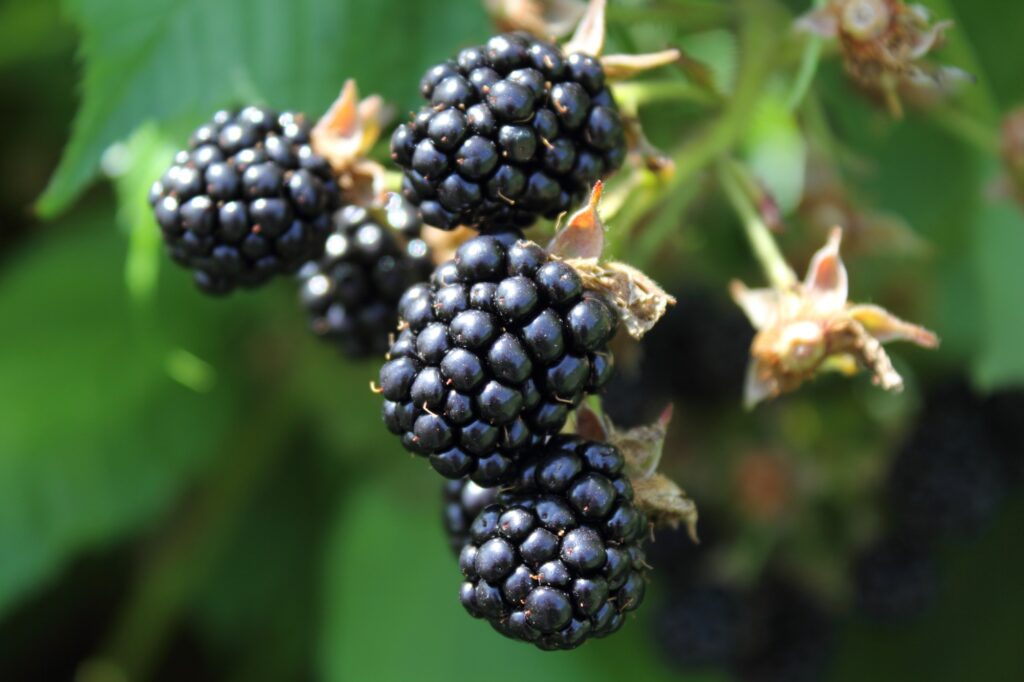
Blackberries are one of the most rewarding fruits to grow at home. Once established, a healthy planting can produce bowls of deeply colored berries for fresh eating, baking, preserves, smoothies, and freezing — often from a relatively small section of garden.
They are also more varied than they first appear. Blackberry plants may be erect, semi-erect, or trailing, and cultivars may be thorny or thornless. Traditional blackberries generally produce fruit on second-year canes called floricanes, while newer primocane-fruiting cultivars can also produce a crop on first-year growth.
Understanding that cane cycle is the key to successful blackberry care. Individual canes do not live indefinitely. New canes grow from the crown and roots, produce fruit according to the cultivar’s fruiting habit, and eventually die. Pruning out the correct canes keeps the planting productive and manageable.
With full sun, well-drained soil, consistent moisture, thoughtful pruning, and the right support system, blackberries can produce abundantly for many years.
🫐 Blackberries at a Glance
- Botanical genus: Rubus
- Plant type: Perennial bramble with biennial canes
- Family: Rosaceae
- Sun: Full sun
- Soil: Fertile, well-drained soil
- Soil pH: Generally about 5.5 to 6.5
- Planting time: Early spring in many climates
- Water: Consistent moisture, especially during flowering and fruit development
- Fruit season: Summer into fall, depending on cultivar and fruiting type
- Cane types: Primocanes and floricanes
- Growth habits: Erect, semi-erect, or trailing
- Support: Some cultivars stand alone; others need trellising
- Pruning: Essential for long-term productivity
- Pollination: Most cultivated blackberries are self-fertile
- Harvest: Pick when fully colored, plump, and easily detached
- Propagation: Suckers, tip layering, root cuttings, or division depending on type
🌱 How Blackberry Plants Grow
A blackberry planting has a perennial root system and crown, but individual canes usually live only two years.
The first-year cane is called a primocane.
During its first season, a traditional summer-bearing blackberry primocane mainly produces vegetative growth.
The following year, that same cane becomes a floricane.
Floricanes flower, produce berries, and then die.
At the same time, new primocanes are emerging to create the following year’s crop.
Once you understand this cycle, blackberry pruning becomes much less confusing.
🌿 What Is a Primocane?
A primocane is a blackberry cane in its first year of growth.
It is usually:
- Vigorous
- Green or reddish-green
- Fast growing
- Primarily vegetative in traditional cultivars
Primocanes become next year’s fruiting canes in standard summer-bearing blackberries.
Do not accidentally remove all healthy primocanes after harvest.
They represent your future crop.
🍇 What Is a Floricane?
A floricane is a second-year cane.
It flowers and fruits, then naturally dies.
After harvest, spent floricanes should usually be removed near ground level.
Leaving them in place creates:
- Crowding
- Reduced airflow
- Confusion during pruning
- Potential disease habitat
Once a floricane has finished fruiting, it will not produce another crop the following year.
🍓 What Are Primocane-Fruiting Blackberries?
Primocane-fruiting, sometimes called fall-bearing blackberries, can produce berries on the upper portions of first-year canes.
Depending on climate and pruning method, they may provide:
- A late-summer or fall crop on primocanes
- A second crop the following summer from lower portions of those same canes
Alternatively, growers can mow all canes to the ground during dormancy and manage the planting for a single fall crop.
This can dramatically simplify pruning.
🌿 Erect Blackberries
Erect blackberries produce relatively upright canes.
Many can support themselves once established, although trellising can still improve:
- Cane organization
- Harvesting
- Air circulation
- Fruit cleanliness
Some erect cultivars are thornless.
They are particularly convenient for smaller home gardens because they generally occupy less horizontal space than trailing types.
🌱 Semi-Erect Blackberries
Semi-erect blackberries produce long arching canes.
These are frequently thornless and highly productive.
They usually benefit from a trellis.
Without support, long canes can:
- Flop onto the ground
- Root at their tips
- Become tangled
- Make harvesting difficult
A trellis keeps the planting much easier to manage.
🌿 Trailing Blackberries
Trailing blackberries have long flexible canes that naturally grow along the ground unless supported.
They are particularly associated with milder climates.
Trailing types generally require a trellis.
Their canes may also be more vulnerable to winter cold than those of many erect cultivars.
Choose a trailing blackberry only if it is well suited to your climate.
🌵 Thorny vs. Thornless Blackberries
Traditional blackberry plants are famous for sharp thorns.
Modern thornless cultivars have made backyard growing much easier.
Thornless blackberries offer obvious advantages:
- Easier harvesting
- Easier pruning
- Safer gardening around children
- Fewer scratched arms
Thorny varieties can still be excellent and sometimes offer exceptional flavor or regional adaptation.
Choose according to your priorities.
☀️ How Much Sun Do Blackberries Need?
Blackberries perform best in full sun.
Aim for at least 6 to 8 hours of direct sunlight each day.
Good sunlight helps produce:
- Strong cane growth
- Abundant flowers
- Better fruit set
- Sweeter berries
- Faster drying after rain
Blackberries can tolerate some partial shade, but yields and fruit quality generally decline as shade increases.
🌱 Best Soil for Blackberries
Blackberries prefer fertile, well-drained soil with plenty of organic matter.
Ideal soil should:
- Drain freely
- Retain moderate moisture
- Be loose enough for root development
- Contain organic matter
Sandy loam and loamy soils are particularly suitable.
Heavy clay can work if drainage is good, but persistently wet ground can damage roots.
🧪 What Soil pH Do Blackberries Prefer?
Blackberries generally perform well at a pH of approximately 5.5 to 6.5.
That is moderately acidic.
If you are establishing a new planting, a soil test can tell you whether pH or fertility needs adjustment.
Do not automatically add lime.
Blackberries naturally prefer soil somewhat more acidic than many vegetable crops.
💧 Avoid Waterlogged Soil
Blackberries need moisture, but their roots also require oxygen.
Poor drainage can contribute to:
- Root decline
- Phytophthora root rot
- Weak cane growth
- Plant death
Avoid planting in low areas where water collects after rain.
Raised beds or broad berms can help where native soil remains wet.
📅 When Should You Plant Blackberries?
Early spring is an excellent time in many climates.
Bare-root plants are commonly planted while dormant.
Container-grown blackberries can be planted later, but cooler weather usually reduces transplant stress.
Fall planting may work in mild climates.
Avoid planting immediately before severe winter cold if plants will not have enough time to establish.
🌱 Bare-Root vs. Potted Blackberry Plants
Both can work well.
Bare-Root Blackberries
Bare-root plants are usually inexpensive and easy to establish in early spring.
Keep roots moist before planting.
Never allow them to dry completely.
Container-Grown Blackberries
Container plants offer more flexibility.
Inspect the roots before planting.
If roots circle tightly around the pot, loosen them gently so they can grow outward.
📏 How Far Apart Should Blackberries Be Planted?
Spacing depends heavily on growth habit.
A broad starting point is:
Erect Types
Approximately 2 to 4 feet apart within the row.
Semi-Erect Types
Often 4 to 6 feet apart.
Trailing Types
Often 4 to 8 feet apart, depending on cultivar and trellis system.
Rows may require 8 to 10 feet or more between them where equipment access or vigorous growth is expected.
Always check the mature habit of the cultivar you purchase.
🌱 How Deep Should You Plant Blackberries?
Plant blackberries at approximately the same depth they were growing at the nursery.
Bare-root crowns may be planted with the crown just at or slightly below the soil surface.
Avoid burying stems deeply.
Spread the roots naturally and backfill carefully.
Firm the soil gently.
🌿 Step 1: Choose the Right Site
Select a sunny location with excellent drainage.
Avoid places where tomatoes, peppers, eggplants, potatoes, or other susceptible crops have recently experienced serious Verticillium wilt problems.
A blackberry patch can remain in place for years, so site selection deserves careful thought.
🌱 Step 2: Prepare the Soil
Remove perennial weeds before planting.
Blackberry roots and crowns make future weed removal more difficult.
Work finished compost into poor soil if additional organic matter is needed.
A soil test can guide pH and nutrient corrections before plants become established.
🕳️ Step 3: Dig the Planting Hole
Dig a hole wide enough for the root system to spread comfortably.
The hole should not force roots upward or bend them sharply.
For bare-root plants, arrange roots naturally.
For container-grown plants, place the root ball so its surface sits level with the surrounding ground.
🌿 Step 4: Backfill and Firm Gently
Replace the soil around the roots.
Firm it enough to remove large air pockets without compacting the root zone.
Do not create a dense layer of compressed soil.
💧 Step 5: Water Thoroughly
Water immediately after planting.
Keep soil consistently moist during establishment.
New blackberry plants cannot tolerate prolonged drought as well as established plants with larger root systems.
🍂 Step 6: Mulch the Planting
Apply organic mulch around the plants.
Suitable materials include:
- Straw
- Shredded leaves
- Wood chips
- Shredded bark
Mulch can help:
- Suppress weeds
- Conserve soil moisture
- Moderate soil temperature
- Add organic matter over time
Keep a little space around the crown to reduce excessively wet conditions.
💧 How Often Should You Water Blackberries?
Blackberries need steady moisture, particularly during:
- Establishment
- Flowering
- Fruit development
A broad target of about 1 to 2 inches of water per week can be useful during active growth, adjusting for soil type, rainfall, heat, and plant size.
Do not treat that number as rigid.
Check soil moisture.
The root zone should remain moderately moist without staying saturated.
🍇 Water Matters During Berry Development
Irregular moisture can reduce fruit size and quality.
Drought during berry development may lead to:
- Small berries
- Poor drupelet development
- Reduced yields
- Cane stress
Drip irrigation or soaker hoses are particularly useful because they deliver water to the root zone while keeping foliage relatively dry.
🌿 Mulch Helps Maintain Even Moisture
Blackberry roots tend to remain fairly close to the soil surface.
Mulch protects them from rapid drying.
Maintain several inches of organic mulch, replacing it as it decomposes.
Do not pile thick mulch directly against the crown.
🌾 Do Blackberries Need Fertilizer?
Blackberries benefit from adequate fertility, particularly nitrogen, but excessive fertilizer can cause overly vigorous vegetative growth.
A soil test is the best starting point.
Established blackberries may benefit from a spring fertilizer application according to local recommendations.
Avoid heavy late-season nitrogen applications.
They can encourage tender growth that may not harden properly before winter.
🌱 Healthy Growth vs. Too Much Growth
A productive blackberry plant should produce strong primocanes.
However, excessive nitrogen can create:
- Huge tangled plants
- Excessive leaf growth
- More pruning work
- Potentially reduced winter hardiness
The goal is strong but manageable growth.
🪵 Do Blackberries Need a Trellis?
Many do.
Trailing and semi-erect types almost always benefit from support.
Even erect blackberries can be easier to manage with a simple trellis.
A trellis can:
- Keep fruit off the ground
- Improve airflow
- Make harvesting easier
- Separate fruiting and new canes
- Reduce tangling
A simple system may consist of sturdy posts with one or more horizontal wires.
🪴 A Simple Blackberry Trellis
For a home planting, install strong end posts at each end of the row.
Stretch wires between them at heights such as:
- Roughly 3 feet
- Roughly 5 feet
Exact designs vary.
Tie canes loosely to the wires.
Do not use tight material that cuts into the stems as they grow.
✂️ Why Blackberry Pruning Matters
Blackberries produce vigorous new canes every year.
Without pruning, the planting quickly becomes a dense thicket of:
- Live primocanes
- Fruiting floricanes
- Dead floricanes
- Side branches
This reduces airflow and makes harvest unpleasant.
Annual pruning keeps the planting productive.
✂️ Pruning Summer-Bearing Blackberries After Harvest
After the crop is finished, identify the floricanes that produced fruit.
Cut those canes to the ground.
They are finished permanently.
Leave strong new primocanes in place because they will produce next year’s crop.
This single task dramatically improves the planting.
🌿 How Can You Tell Old and New Blackberry Canes Apart?
New primocanes are usually:
- Green
- Smooth
- Vigorous
Old floricanes after fruiting become:
- Browner
- Woodier
- Drier
- Less vigorous
You can also follow the branches that held fruit clusters.
Once you become familiar with the plant, distinguishing them becomes much easier.
✂️ Winter Pruning for Erect Blackberries
During dormancy, thin the remaining primocanes.
Remove weak or damaged ones.
Keep a manageable number of the strongest canes for each plant or linear foot of row.
Lateral branches may also be shortened according to the cultivar and training system.
This concentrates production and improves airflow.
✂️ Tipping Primocanes
Many erect blackberry cultivars benefit from tipping.
When primocanes reach a certain height, the soft growing tip is removed.
This encourages lateral branching.
Those lateral branches can produce fruit the following year.
The exact tipping height varies by cultivar and regional recommendations, often somewhere around 3 to 4 feet for erect types.
Check cultivar-specific guidance rather than using one number for every blackberry.
🌿 Pruning Trailing Blackberries
Trailing blackberries need a somewhat different approach.
New primocanes may be trained along the trellis separately from fruiting floricanes.
After harvest:
- Remove old fruiting canes.
- Train new primocanes into their place.
- Secure them to the trellis.
- Remove weak or excessive growth.
Keeping generations of canes separated makes management much easier.
🍇 How Do You Prune Primocane-Fruiting Blackberries?
You have two broad options.
One-Crop System
Cut every cane to the ground during winter or very early spring.
New primocanes emerge and produce a fall crop.
This is extremely simple.
Two-Crop System
Allow the primocanes that fruited in fall to remain.
The lower portions can produce another crop the following summer.
After that second crop, remove those floricanes.
This produces a longer harvest but requires more complicated pruning.
🍇 Do Blackberries Need Pollination Partners?
Most cultivated blackberries are self-fertile.
That means you can generally produce fruit from a single cultivar.
However, bees and other insects still play an important role in moving pollen among flowers.
Poor pollination can reduce berry quality.
🐝 Blackberry Flowers Support Pollinators
Blackberry flowers provide nectar and pollen for:
- Honeybees
- Bumblebees
- Solitary bees
- Other insects
Good pollination produces more fully developed berries.
A blackberry fruit consists of many small sections called drupelets.
Each needs successful pollination for the berry to develop evenly.
🫐 Why Are Some Blackberry Drupelets Missing?
A berry with undeveloped sections may have experienced incomplete pollination.
Possible causes include:
- Cold weather
- Rain
- Low bee activity
- Heat
- Plant stress
Not every imperfect berry indicates disease.
☀️ What Is White Drupelet Disorder?
Sometimes individual drupelets on blackberries turn white or tan while the rest of the fruit remains dark.
This is commonly called white drupelet disorder.
It is often associated with:
- Intense sunlight
- High heat
- Sudden weather changes
It is largely a cosmetic problem.
Affected berries are generally still usable if otherwise sound.
🌸 When Do Blackberries Flower?
Flowering time varies according to:
- Cultivar
- Climate
- Fruiting type
Traditional summer-bearing blackberries usually flower in spring or early summer on floricanes.
Fruit then ripens several weeks later.
Primocane-fruiting varieties flower later on current-season canes and can continue producing into late summer or fall.
🍇 When Will Blackberry Plants Produce Fruit?
Bare-root or young nursery blackberries may produce a small crop relatively quickly, but the planting usually becomes substantially more productive after a couple of seasons.
Traditional cultivars need first-year primocanes before those canes can become fruiting floricanes.
Do not be concerned if the first year is mainly vegetative growth.
The plant is building the canes needed for future harvests.
🍇 When Are Blackberries Ready to Harvest?
Blackberries should generally be harvested when they are:
- Fully dark
- Plump
- Glossy to slightly dull, depending on cultivar
- Easily released from the plant
A berry that must be tugged firmly is probably not fully ripe.
Color alone can be misleading.
A blackberry may turn black before it reaches peak sweetness.
🍇 Do Blackberries Get Sweeter After Picking?
No, not significantly.
Blackberries are non-climacteric fruit, meaning they do not continue ripening substantially after harvest.
Pick them when fully ripe.
An underripe sour blackberry will not become beautifully sweet after sitting on the kitchen counter for several days.
✋ How to Pick Blackberries
Gently grasp a fully ripe berry and pull.
It should release easily.
Avoid squeezing.
Blackberries are delicate and bruise readily.
Use shallow containers so the weight of berries on top does not crush those underneath.
🌅 When Is the Best Time to Pick Blackberries?
Cool morning conditions are ideal once dew has dried.
Avoid harvesting berries while wet.
Wet fruit deteriorates faster and is more vulnerable to mold.
Pick every few days during peak season because ripe berries can accumulate quickly.
🧺 How to Store Fresh Blackberries
Blackberries are highly perishable.
Refrigerate them soon after harvest.
Do not wash berries until shortly before eating or using them.
Excess moisture encourages mold.
For best quality, use fresh berries within a few days.
❄️ Can You Freeze Blackberries?
Yes.
Freezing is one of the easiest ways to preserve a large crop.
Gently wash and dry the berries.
Spread them in a single layer on a baking sheet and freeze until firm.
Then transfer them to freezer containers.
Freezing individually first prevents them from becoming one solid block.
🍯 Ways to Use Blackberries
Fresh blackberries are excellent in:
- Smoothies
- Yogurt
- Oatmeal
- Fruit salads
- Cakes
- Pies
- Cobblers
- Muffins
They can also be preserved as:
- Jam
- Jelly
- Sauce
- Syrup
- Frozen fruit
For canning, use tested food-preservation recipes.
🐦 Birds Love Blackberries Too
Birds may discover ripening fruit before you do.
If losses become serious, netting can help.
Install netting carefully.
It should be taut enough that birds cannot become tangled.
Check it regularly.
Harvesting berries promptly also reduces wildlife losses.
🦌 Do Deer Eat Blackberry Plants?
Yes.
Deer may browse:
- Young shoots
- Leaves
- Fruit
Thorny blackberries may deter some feeding, but hungry deer can still browse them.
Fencing is the most dependable protection where deer pressure is high.
🐇 Do Rabbits Eat Blackberries?
Rabbits may damage young plants and tender canes.
Newly planted blackberries are particularly vulnerable.
Temporary fencing or protective mesh can help until plants become larger.
🐛 Common Blackberry Pests
Potential pests include:
- Spotted-wing drosophila
- Japanese beetles
- Aphids
- Mites
- Cane borers
- Raspberry crown borer
- Stink bugs
Regional pest pressure varies considerably.
Regular harvesting and observation are extremely important.
🪰 Spotted-Wing Drosophila
Spotted-wing drosophila is a small vinegar fly capable of laying eggs in ripening soft fruit.
Blackberries can be particularly vulnerable.
Larvae may develop inside apparently ripe berries.
Management practices can include:
- Frequent harvesting
- Refrigerating fruit promptly
- Removing overripe and fallen berries
- Monitoring local pest activity
Because control recommendations vary by location and season, local Extension guidance is particularly useful.
🪲 Japanese Beetles
Japanese beetles may feed on blackberry leaves and ripe fruit.
In small plantings, hand-picking can be effective.
Drop beetles into a container of soapy water.
Avoid automatically using broad-spectrum insecticides while blackberry flowers are attracting bees.
🐛 Blackberry Cane Borers
Several insects can damage blackberry canes.
Symptoms may include:
- Swollen stems
- Wilted shoot tips
- Cane dieback
- Holes in stems
Prune and remove heavily infested canes.
Good pruning and sanitation reduce the amount of old cane material available to pests.
🍄 Common Blackberry Diseases
Potential diseases include:
- Anthracnose
- Cane blight
- Spur blight
- Botrytis gray mold
- Orange rust
- Rosette or double blossom
- Phytophthora root rot
Not every disease occurs everywhere.
Good airflow, drainage, pruning, and sanitation form the foundation of prevention.
🟠 What Is Orange Rust?
Orange rust can be a serious disease of blackberries.
Affected plants may develop bright orange spores on the undersides of leaves.
The disease is systemic, meaning it infects the entire plant rather than only individual leaves.
Infected plants generally should be removed entirely, including as much root material as practical.
Do not propagate from a plant showing orange rust.
🌧️ Gray Mold on Blackberries
Botrytis gray mold can attack flowers and fruit, especially during cool, wet conditions.
Affected berries may develop fuzzy gray growth and rot rapidly.
Reduce risk by:
- Improving airflow
- Harvesting regularly
- Avoiding overhead watering when practical
- Removing rotten fruit
- Refrigerating harvested berries promptly
Dense, neglected plantings are especially susceptible.
🌿 Cane Blight
Cane blight can enter through wounds.
Symptoms may include:
- Dark lesions
- Wilted side branches
- Cane dieback
Avoid unnecessary cane injury.
When pruning, use clean sharp tools.
Remove affected canes.
💧 Phytophthora Root Rot
Phytophthora root rot is strongly associated with poor drainage.
Symptoms may include:
- Weak growth
- Wilt
- Yellow foliage
- Cane collapse
- Root discoloration
Prevention is much easier than treatment.
Do not establish blackberry plants in persistently saturated soil.
❓ Why Are My Blackberries Small?
Possible causes include:
- Drought
- Poor pollination
- Too much shade
- Excessive number of canes
- Poor fertility
- Disease
- Variety characteristics
Proper cane thinning and consistent water during fruit development can improve berry size.
❓ Why Are My Blackberries Sour?
A common reason is simply harvesting too early.
Blackberries often become dark before they reach peak flavor.
Leave them on the plant until they detach easily and taste sweet.
Other influences include:
- Cultivar
- Shade
- Cool weather
- Plant stress
❓ Why Aren’t My Blackberry Plants Producing Fruit?
Possible reasons include:
- Plants are still too young.
- First-year canes have not reached their fruiting year.
- Floricanes were accidentally removed.
- Winter cold damaged canes.
- Flowering conditions were poor.
- Disease weakened the planting.
Understanding whether your cultivar fruits on floricanes or primocanes is essential.
❓ Why Are Blackberry Canes Dying?
Some cane death is completely normal.
Floricanes die after producing their crop.
If first-year primocanes are dying, investigate:
- Root rot
- Cane disease
- Borers
- Severe drought
- Winter injury
- Mechanical damage
Do not confuse normal post-fruiting cane death with plant failure.
❓ Why Are Blackberry Leaves Turning Yellow?
Possible causes include:
- Overwatering
- Drought
- Nutrient problems
- Root disease
- Natural aging
- Soil pH problems
Look at the entire planting.
Widespread yellowing combined with weak cane growth may indicate a root-zone problem.
❓ Why Are Blackberry Leaves Turning Red or Purple?
Some red or purple coloration can occur due to:
- Cool weather
- Nutrient stress
- Natural seasonal changes
- Disease
- Cultivar characteristics
If the planting otherwise looks vigorous, temporary coloration may not be serious.
Persistent symptoms combined with weak growth deserve closer investigation.
🌱 Do Blackberries Spread?
Yes.
How aggressively depends on the type.
Erect blackberries can spread through root suckers.
Trailing varieties may root where cane tips touch the soil.
An unmanaged planting can expand beyond its original boundaries.
Remove unwanted suckers promptly.
🌿 Tip Layering
Trailing and semi-erect blackberries can often propagate naturally by tip layering.
When the tip of a long cane touches soil, it may develop roots.
To deliberately propagate:
- Bend a healthy cane tip to the ground.
- Bury the tip lightly in soil.
- Keep it moist.
- Allow roots to develop.
- Separate the new plant from the parent later.
This is an easy way to multiply compatible cultivars.
🌱 Propagating Blackberries From Suckers
Some erect blackberries send up new shoots from their roots.
These suckers can sometimes be dug while dormant and moved.
Choose healthy shoots with attached roots.
Do not propagate from plants showing signs of viral disease, orange rust, or other serious problems.
🚫 Control Blackberry Spread
Cultivated blackberries can become unruly if neglected.
Keep them inside their designated area by:
- Removing distant suckers
- Pruning regularly
- Trellising long canes
- Preventing unwanted tip rooting
This is especially important near property boundaries and natural areas.
Some Rubus species can be invasive in particular regions, so avoid planting cultivars or species known to be problematic locally.
🪴 Can Blackberries Grow in Containers?
Yes, particularly compact and primocane-fruiting cultivars.
Use a large container with:
- Good drainage
- Plenty of potting mix
- Stable support
A container holding at least 15 to 20 gallons is much more practical than a small patio pot for many cultivars.
Larger containers dry out more slowly and provide more room for roots.
💧 Container Blackberries Need Extra Water
Potted blackberry plants dry faster than those growing in the ground.
Check moisture frequently during:
- Hot weather
- Flowering
- Fruit development
Do not allow the container to remain waterlogged.
Drainage holes are essential.
❄️ Protect Container Blackberries in Winter
Roots in containers experience colder temperatures than roots surrounded by garden soil.
In cold climates, move pots to a protected location or insulate them appropriately.
The best approach depends on the cultivar’s hardiness and local winter temperatures.
🌿 Blackberries in Raised Beds
Raised beds can be excellent where native soil drains poorly.
They provide:
- Improved drainage
- Better soil control
- Easier weed management
However, blackberries are perennial and can remain for years.
Build the bed with that long-term use in mind.
Do not crowd them into a small annual vegetable bed unless you are willing to dedicate that space permanently.
🌸 Companion Plants for Blackberries
Blackberries do not need special companion plants to fruit.
However, nearby flowering plants can increase garden diversity and provide food for beneficial insects.
Potential additions include:
Keep vigorous perennials far enough away that they do not compete directly with blackberry crowns.
🌿 Keep Weeds Under Control
Blackberries do not perform well when surrounded by aggressive perennial weeds.
Weeds compete for:
- Moisture
- Nutrients
- Root space
Mulch is useful.
Hand weed carefully around shallow roots.
Avoid deep cultivation that damages blackberry roots and encourages additional suckering.
🌱 Can Blackberries Be Grown Near Raspberries?
They can, but separating them is often helpful.
Blackberries and raspberries share some pests and diseases.
Planting them in separate areas can:
- Simplify management
- Reduce disease spread
- Make pruning easier
If possible, keep nursery-certified plants and avoid transplanting unknown wild brambles into the garden.
⚠️ Don’t Plant Wild Blackberries Beside Cultivated Ones
Wild blackberry plants can harbor:
- Viral diseases
- Rust
- Insects
They may also be extremely aggressive.
If wild brambles grow immediately beside a new planting, disease and pest management can become more difficult.
Use healthy nursery stock rather than digging unknown plants from roadsides or wild areas.
🌿 Blackberry Care in Fall
After the final harvest:
- Remove spent floricanes.
- Remove diseased canes.
- Clean up rotting fruit.
- Continue watering during severe drought.
- Train new canes to the trellis.
- Avoid heavy nitrogen fertilization.
Healthy primocanes need time to harden before winter.
❄️ Blackberry Care in Winter
Winter care depends on blackberry type and climate.
Tasks may include:
- Dormant pruning
- Cane thinning
- Trellis repairs
- Removing damaged wood
- Mulching root zones
Trailing cultivars in cold regions may require additional winter protection.
Some growers lower canes toward the ground and cover them where temperatures threaten winter survival.
🌱 Blackberry Care in Spring
As growth begins:
- Remove winter-damaged cane tips.
- Finish pruning before heavy new growth.
- Secure fruiting canes to supports.
- Apply fertilizer if needed.
- Refresh mulch.
- Check irrigation.
- Remove emerging weeds.
New primocanes will soon begin emerging from the crown or roots.
☀️ Blackberry Care in Summer
Summer is the busiest season.
Focus on:
- Watering
- Cane training
- Pest inspection
- Harvesting
- Removing overripe fruit
- Primocane tipping where appropriate
Once floricane crops finish, remove the spent canes rather than leaving them until the following spring.
🍇 How Long Do Blackberry Plants Live?
Although individual canes live only about two years, the root system and crown can remain productive for many years.
A well-managed planting may continue producing for a decade or longer.
Eventually, disease, declining vigor, or overcrowding may justify replacing the planting.
Using disease-free stock and rotating to a new location can improve long-term success.
🫐 Are Blackberries Easy to Grow?
Yes.
Once their cane cycle makes sense, blackberry care is relatively straightforward.
The basic process is:
- Choose a cultivar suited to your climate.
- Decide whether you want erect, semi-erect, or trailing growth.
- Plant in full sun.
- Use fertile, well-drained soil.
- Space plants according to growth habit.
- Install a trellis where needed.
- Water consistently while plants establish.
- Mulch to control weeds and conserve moisture.
- Identify primocanes and floricanes.
- Remove floricanes after fruiting.
- Thin and train new canes.
- Maintain steady moisture during berry development.
- Pick only fully ripe berries.
- Harvest frequently.
- Remove diseased and overripe fruit.
- Watch for spotted-wing drosophila, cane diseases, and root problems.
The biggest mistakes are poor drainage, neglecting pruning, letting canes become tangled, removing the wrong generation of canes, and harvesting berries before they are truly ripe.
🫐 Final Thoughts
Blackberries combine the best qualities of an edible garden plant: vigorous growth, attractive flowers, wildlife value, and fruit that tastes dramatically better when eaten fully ripe from the garden.
Success starts with choosing a blackberry suited to your climate and available space. Erect types are convenient for compact gardens, while semi-erect and trailing varieties usually perform best with sturdy trellising. Thornless cultivars make pruning and harvesting considerably easier, especially where children regularly visit the garden.
Once planted, focus on good drainage, full sun, mulch, and consistent moisture.
Most importantly, learn the difference between primocanes and floricanes. New primocanes create future crops. Floricanes fruit and then die. Removing the old canes after harvest while preserving strong new growth keeps the planting open, healthy, and productive.
Pick berries only when they are fully dark, plump, and easy to remove. Unlike some tree fruits, blackberries do not become significantly sweeter after harvest, so patience makes a noticeable difference in flavor.
With regular pruning and a little seasonal attention, a few blackberry plants can produce an impressive harvest year after year — often enough for fresh bowls of berries in summer with plenty left over for pies, jams, and the freezer.
🔗 Related Articles
- Strawberry Planting Guide
- Apple Tree Care: How to Plant, Grow & Harvest Apples
- Pear Tree Care: How to Plant, Grow & Harvest Pears
- Plum Tree Care: How to Plant, Grow & Harvest Plums
- Bee Balm Care
- Coneflower Care
- Coreopsis Care
- Yarrow Care
📚 Sources & Further Reading
- University of Minnesota Extension — Growing Raspberries and Blackberries in the Home Garden
- Penn State Extension — Raspberry and Blackberry Production Guide for the Northeast, Midwest, and Eastern Canada
- North Carolina State Extension — Growing Blackberries in North Carolina
- University of Arkansas Cooperative Extension — Growing Blackberries in the Home Garden
- Oregon State University Extension — Growing Blackberries in Your Home Garden