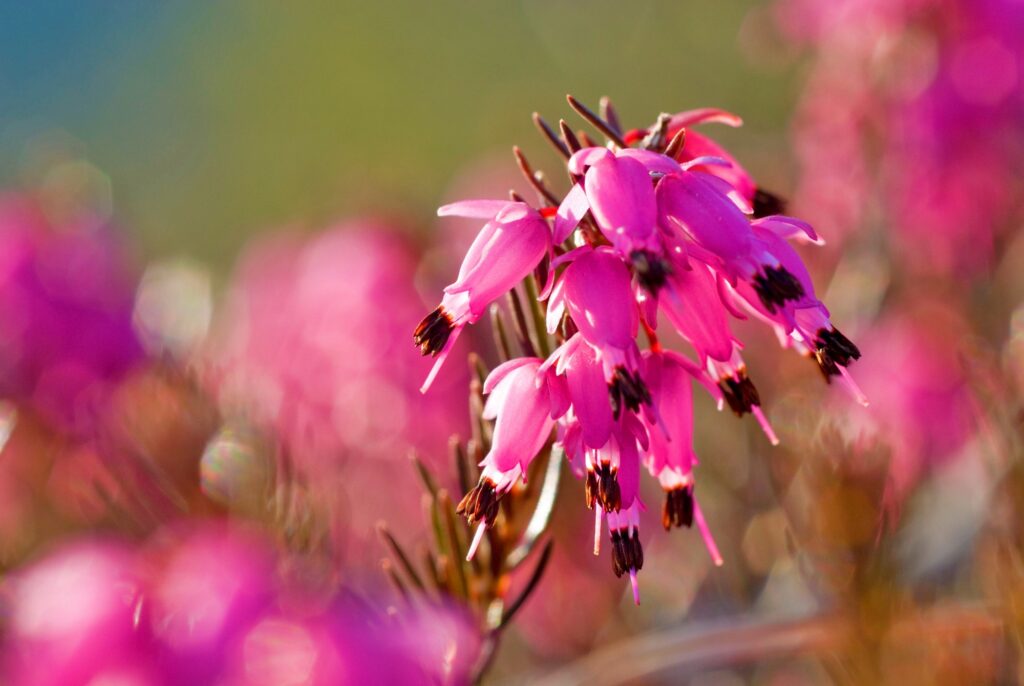
Winter heath is a low-growing evergreen shrub that provides something especially valuable in the garden: flowers in the middle of winter. While many perennial beds are dormant, Erica carnea can produce masses of tiny bell-shaped flowers in shades of pink, magenta, red, or white, often beginning in winter and continuing into early spring.
Also known as spring heath or alpine heath, Erica carnea is native to mountainous parts of central and southern Europe. Its natural habitat helps explain many of its garden preferences. Winter heath likes cool conditions, excellent drainage, relatively lean soil, and plenty of light. Once established in the right location, it forms a dense evergreen mat that can remain attractive throughout the year.
Winter heath is especially useful in rock gardens, winter gardens, slopes, low borders, and mass plantings. It also makes an excellent companion for hellebores, hardy cyclamen, witch hazel, and early spring bulbs, creating color across several levels of the winter landscape.
🌸 Winter Heath at a Glance
- Botanical name: Erica carnea
- Common names: Winter heath, spring heath, alpine heath
- Plant family: Ericaceae
- Plant type: Low-growing evergreen shrub
- Mature height: About 6 to 12 inches
- Mature spread: About 12 to 24 inches, sometimes wider
- Sun exposure: Full sun to partial shade
- Soil: Well-drained soil; acidic, neutral, and some alkaline soils are tolerated
- Bloom time: Winter through early spring
- Flower colors: White, pink, rose, magenta, purple-red, and red
- Foliage: Evergreen, fine, needle-like leaves
- Water needs: Moderate during establishment; relatively low afterward
- Growth habit: Dense, spreading, mat-forming
- Wildlife value: Winter and early-spring flowers can attract bees
🌿 What Is Winter Heath?
Winter heath is a compact evergreen member of the heath family.
Plants form spreading cushions of slender stems covered with tiny needle-like leaves. During winter and early spring, small urn-shaped or bell-shaped flowers develop along short stems, sometimes covering so much of the plant that the foliage is nearly hidden.
Unlike herbaceous perennials, winter heath does not disappear underground during winter. Its evergreen foliage remains visible year-round.
This makes it particularly useful near paths and entrances where gardeners want permanent low-level structure rather than an empty winter bed.
Individual plants are relatively small, but several winter heaths planted together can eventually form an attractive flowering carpet.
🌸 Winter Heath vs. Heather
Winter heath and heather are closely related, but they are not the same plant.
Winter heath is Erica carnea.
The familiar Scottish heather is Calluna vulgaris.
One easy way to distinguish them is by their foliage. Winter heath has slender, needle-like leaves arranged around its stems, while Calluna has much smaller scale-like leaves.
Their flowering seasons also differ.
Many traditional Calluna heathers bloom primarily during summer and fall, while winter heath is valued specifically for flowers during winter and early spring.
There is another important gardening difference: winter heath is generally more tolerant of neutral and somewhat alkaline soil than many traditional heathers.
That makes Erica carnea easier to grow in gardens that do not have strongly acidic soil.
☀️ How Much Sun Does Winter Heath Need?
Winter heath performs best in full sun to partial shade.
In cool climates, full sun usually encourages dense growth and abundant flowering.
Aim for at least six hours of direct sunlight where summers are moderate.
In areas with hot summers, some afternoon shade can be beneficial. Erica carnea is adapted to cool mountainous environments and may struggle where roots are subjected to intense heat and drying conditions.
A location receiving morning sun followed by light afternoon shade can provide an excellent compromise in warmer regions.
Avoid deep shade.
Plants growing with insufficient light may become loose, produce fewer flowers, and lose the compact mat-forming habit that makes winter heath so attractive.
🌱 Best Soil for Winter Heath
Winter heath requires excellent drainage.
This is more important than providing extremely rich soil.
Ideal conditions include:
- Sandy loam
- Gritty soil
- Rocky soil
- Well-drained garden loam
- Soil with moderate organic matter
- Raised beds where native soil is heavy
Winter heath is often associated with acid-loving plants, but Erica carnea is more adaptable than many other heathers. It can grow in acidic, neutral, and even mildly alkaline soil.
If your garden has heavy clay that remains saturated for long periods, improve drainage before planting.
A raised bed or sloping location may be preferable to attempting to grow winter heath in a low, waterlogged area.
🧪 Does Winter Heath Need Acidic Soil?
Not necessarily.
This is one of the major advantages of Erica carnea compared with many other members of the heath family.
It grows well in acidic soil but can also tolerate neutral and mildly alkaline conditions.
Gardeners should therefore avoid assuming that winter heath automatically needs large quantities of peat or acidifying products.
Good drainage matters far more.
If the plant grows vigorously, remains green, and flowers well, there is no reason to adjust the soil pH simply because it is a heath.
💧 How Often Should You Water Winter Heath?
Newly planted winter heath needs regular watering until its root system becomes established.
Because the plant has fine roots near the soil surface, young specimens can dry out more quickly than expected.
Water deeply whenever the soil begins drying during the first growing season.
Once established, winter heath becomes more tolerant of occasional dry conditions.
Mature plants still benefit from watering during extended summer drought, particularly in hot climates.
Avoid frequent shallow sprinkling.
A thorough watering followed by a period in which the soil drains is generally better than keeping the ground permanently wet.
⚠️ Can You Overwater Winter Heath?
Yes.
Poor drainage and excessive moisture are much more dangerous to established winter heath than moderately dry soil.
Roots sitting in stagnant water can deteriorate, and plants growing in excessively wet soil may develop root rot.
Warning signs can include:
- Yellow or brown foliage
- Weak growth
- Sudden branch dieback
- Wilting despite moist soil
- Entire sections of the plant turning brown
Before watering an established plant, check the soil below the surface.
If it is still damp, wait.
Winter is a particularly important time to avoid saturated conditions because plants use water slowly during cold weather.
🌡️ Temperature and Climate
Winter heath is remarkably cold hardy.
Its natural habitat includes mountainous regions of Europe, and the plant is capable of tolerating significant winter cold once established.
The flowers can appear while snow and freezing temperatures are still part of the landscape.
Summer heat can be more challenging than winter cold.
In regions with very hot summers, provide some afternoon shade and make sure roots do not become excessively dry.
A gravel or light organic mulch can help moderate soil conditions without holding too much moisture against the crown.
❄️ Does Winter Heath Really Bloom in Winter?
Yes.
Winter flowering is one of the main reasons gardeners grow Erica carnea.
Depending on cultivar, climate, and weather, flowers may begin appearing from late fall or early winter and continue through early spring.
Some plants bloom during January and February, while others reach their peak closer to March.
Cold weather may temporarily slow flower development, but the plants can resume flowering when temperatures moderate.
The tiny flowers are surprisingly effective when produced in large numbers across an established mat.
🌼 What Do Winter Heath Flowers Look Like?
The flowers are small and usually bell-shaped or urn-shaped.
They develop densely along short flower spikes and may be:
- White
- Pale pink
- Bright pink
- Rose
- Magenta
- Purple-red
- Red
Individual flowers are modest, but dozens or hundreds may appear on a mature plant.
Their color is particularly noticeable because so few other low-growing shrubs are blooming during winter.
Flowers may persist for an extended period in cool weather.
🍃 Winter Heath Foliage
Winter heath remains evergreen.
The leaves are very small, narrow, and needle-like, giving the plant a fine texture.
Foliage is usually green, although some cultivars develop bronze, gold, or other seasonal coloration.
Because the plant remains leafy all year, it works well as a permanent edging or ground-cover element.
Its foliage also provides a useful background for spring bulbs that emerge through or around the plants.
🌿 How to Plant Winter Heath
Spring or fall are both good times to plant winter heath.
Choose a site with abundant light and excellent drainage.
Dig a hole approximately the same depth as the root ball and somewhat wider.
Carefully remove the plant from its container.
Heaths can develop dense root systems in nursery pots, so gently loosen tightly circling outer roots without tearing the root ball apart.
Position the plant at the same depth it was growing in the container.
Do not bury the crown deeply.
Backfill with soil, water thoroughly, and continue providing moisture until new growth indicates that the plant is establishing.
📏 How Far Apart Should You Plant Winter Heath?
Spacing depends on how quickly you want the plants to create a continuous carpet.
Most winter heaths can be spaced approximately 12 to 18 inches apart.
Compact cultivars may be planted somewhat closer, while vigorous spreading varieties can be given more room.
For a mass planting, stagger plants rather than arranging them in rigid rows.
As stems gradually spread, the individual plants will begin to meet and create a more natural-looking evergreen mat.
🌱 How Fast Does Winter Heath Grow?
Winter heath is not an exceptionally fast-growing shrub.
Plants gradually spread outward to form increasingly broad mats.
A young specimen may take several years to reach its mature width.
This slower growth is actually useful in small garden spaces because winter heath does not usually overwhelm neighboring plants rapidly.
Once mature, however, a group of winter heaths can create substantial ground coverage and suppress some weed growth through its dense evergreen canopy.
✂️ When Should You Prune Winter Heath?
Prune winter heath immediately after flowering.
This is the safest time because the plant can then produce fresh growth during the remainder of spring and summer.
Light annual trimming keeps the shrub dense and prevents the center from becoming woody or bare.
Remove faded flower spikes and lightly shorten leafy stems.
Avoid waiting until late fall or winter to perform major pruning because you may remove developing flower growth.
✂️ How Hard Can You Prune Winter Heath?
Winter heath does not respond well to severe pruning into old, leafless wood.
This is one of the most important rules of heath care.
When trimming, leave green foliage on the stems.
Cutting far below the leafy growth into old woody sections may leave portions of the plant unable to produce fresh shoots.
A light trim every year is much better than allowing the shrub to become overgrown for many years and then attempting drastic rejuvenation.
Regular maintenance keeps the plant compact while preserving healthy foliage.
🌾 Does Winter Heath Need Fertilizer?
Very little.
Winter heath evolved in relatively lean environments and generally does not need heavily fertilized soil.
Excess nutrients can encourage soft growth while reducing the compact character of the plant.
In average garden soil, routine fertilizer may be unnecessary.
If growth is poor because the soil is exceptionally depleted, a small amount of suitable slow-release fertilizer can be applied according to label directions.
Avoid heavy applications of nitrogen.
Adding a modest amount of organic matter around the planting area is usually more beneficial than regular feeding.
🍂 Should You Mulch Winter Heath?
A light mulch can be helpful, but avoid burying the plant beneath thick organic material.
Winter heath needs excellent drainage and good airflow around its stems.
Fine gravel makes an especially useful mulch around heath because it:
- Suppresses weeds
- Allows water to drain
- Reduces mud around low stems
- Complements rock-garden plantings
Light organic mulch can also be used, but keep it away from the center of the plant.
Avoid deep layers of moisture-retentive mulch directly against the stems.
🪨 Winter Heath in Rock Gardens
Winter heath is exceptionally well suited to rock gardens.
Its compact growth habit fits naturally between rocks, while sloping or gritty conditions usually provide the drainage it requires.
The evergreen foliage softens hard stone surfaces throughout the year.
During winter, colorful flower clusters can transform an otherwise dormant rock garden.
Good companions include small spring bulbs, dwarf conifers, hardy cyclamen, and other low-growing plants suited to free-draining soil.
Avoid placing winter heath beside plants that require consistently wet ground.
🌱 Winter Heath as Ground Cover
Winter heath can make an effective evergreen ground cover in appropriate climates.
Plants remain low while gradually spreading sideways.
Several specimens planted together can eventually create a dense mat.
Winter heath is particularly useful on:
- Sunny banks
- Slopes
- Rock gardens
- Raised beds
- Edges of shrub borders
- Winter gardens
- Cottage gardens
Its spreading roots can also help stabilize exposed slopes.
The plant is less appropriate for heavily trafficked locations because its woody stems do not tolerate being walked on repeatedly.
🏔️ Winter Heath on Slopes
Slopes provide several advantages for winter heath.
Excess water naturally drains away, reducing the risk of root rot.
The spreading growth habit also helps cover bare ground.
Plant several cultivars together for a mixture of pink, red, and white winter flowers.
A south- or east-facing slope can work particularly well in cool climates.
In hotter areas, an east-facing slope receiving morning sun but some afternoon protection may be preferable.
🪴 Can Winter Heath Grow in Containers?
Yes.
Its compact size makes winter heath an excellent outdoor container plant.
Choose a pot with generous drainage holes.
Use a loose, free-draining potting mixture.
Place the container in full sun or partial shade according to the local climate.
Container plants need closer attention to watering than those growing in the ground because the limited root zone can dry quickly.
Water when the upper potting mixture begins to dry, then allow excess moisture to drain completely.
Do not leave the container standing in water.
❄️ Overwintering Winter Heath in Containers
Winter heath itself is cold hardy, but plants growing in containers experience more extreme root temperatures than plants growing in the ground.
Use a reasonably large frost-resistant container rather than a tiny pot.
During severe winter weather, move the container to a sheltered location near a building or protect the pot with insulation.
Do not bring winter heath into a heated house.
It is an outdoor evergreen shrub and benefits from normal winter dormancy and cold temperatures.
Continue checking moisture occasionally because evergreen plants can still lose water during winter.
🌺 Popular Winter Heath Varieties
Winter heath has been cultivated extensively, and numerous varieties are available.
🌸 ‘Springwood Pink’
‘Springwood Pink’ is a spreading cultivar with clear pink flowers.
Its low habit makes it particularly useful for ground cover and slopes.
🤍 ‘Springwood White’
‘Springwood White’ produces masses of white flowers above green foliage.
The white blossoms can be particularly striking against dark stone, evergreen shrubs, or bare winter soil.
💗 ‘King George’
‘King George’ is a compact cultivar with deep pink flowers.
Its relatively dense form makes it a good option for smaller borders and rock gardens.
❤️ ‘December Red’
‘December Red’ is valued for rich reddish flowers and an early flowering season.
As the name suggests, it can begin adding color remarkably early in the winter garden.
💜 ‘Myretoun Ruby’
‘Myretoun Ruby’ produces deep magenta to reddish flowers.
Its intense flower color makes it particularly dramatic when planted beside white-flowered varieties.
🌿 Winter Heath vs. Erica × darleyensis
Gardeners may also encounter Darley Dale heath (Erica × darleyensis).
This hybrid is closely related in appearance and garden use to Erica carnea.
Both can flower during winter and early spring and are relatively tolerant of soil conditions compared with many traditional heathers.
Erica × darleyensis selections are often somewhat taller and more vigorous.
When buying winter-flowering heath, check the plant label carefully so you know the mature size of the specific cultivar.
🌼 Winter Heath vs. Summer Heather
Winter heath can be combined with summer-flowering heathers to provide color over a much longer part of the year.
Erica carnea provides flowers during winter and early spring.
Many cultivars of Calluna vulgaris begin flowering later in summer or fall.
Their care overlaps in some ways — both appreciate sun and good drainage — but winter heath is generally more tolerant of neutral or mildly alkaline soil.
If your soil is not strongly acidic, winter heath is often the easier choice.
🐝 Is Winter Heath Good for Bees?
Yes.
One of winter heath’s greatest ecological benefits is its unusual flowering time.
On mild winter and early-spring days, bees and other insects may become active even though few garden plants are blooming.
Winter heath can provide nectar during these periods.
Large plantings are particularly useful because they produce many small flowers in a concentrated area.
Combine winter heath with other early bloomers to extend the season further.
Good choices include hellebores, crocuses, hardy cyclamen, and witch hazel.
🌿 Best Companion Plants for Winter Heath
Winter heath combines particularly well with plants that provide winter and early-spring interest.
Good companions include:
- Christmas Rose Care
- Hellebore Care
- Cyclamen Care
- Witch Hazel Care
- Winter Jasmine Care
- Forsythia Care
- Snowdrops
- Crocuses
- Daffodils
- Dwarf conifers
- Ornamental grasses
The combination of winter heath, Christmas roses, and hardy cyclamen is particularly effective because all three provide flowers close to ground level while the rest of the garden remains relatively dormant.
A larger witch hazel planted behind them can add another flowering layer.
🌲 Winter Heath in a Winter Garden
Winter heath is one of the best foundation plants for a dedicated winter garden.
Because it remains evergreen, it provides structure even before the flowers appear.
Plant it where it can be seen easily from:
- A front walkway
- A driveway
- A patio
- A kitchen window
- A garden entrance
- A frequently used winter path
Mass several plants together rather than scattering isolated specimens across a large bed.
The concentrated color will have much greater visual impact during winter.
🐛 Common Winter Heath Pests
Winter heath is generally resistant to serious pest problems.
Healthy established plants often require no pesticide treatment.
Occasional insect problems may appear, but environmental conditions are usually more important than pests.
Plants struggling in hot, wet, or poorly drained locations are much more likely to decline.
Before treating a browning winter heath for insects, inspect the roots, drainage, and soil moisture carefully.
🍄 Common Winter Heath Diseases
Poorly drained soil creates the greatest disease risk.
Potential problems include:
- Phytophthora root rot
- Other root rots
- Powdery mildew
- Rust
- Wilt
- Honey fungus in some situations
Root disease can cause individual branches or entire plants to turn brown relatively quickly.
Prevention is much easier than treatment.
Choose a free-draining site from the beginning and avoid routinely saturating the root zone.
❓ Why Isn’t My Winter Heath Flowering?
Several factors can reduce flowering.
Too Much Shade
Winter heath generally flowers more heavily with abundant light.
Pruning at the Wrong Time
Late pruning may remove growth associated with the next flowering display.
Trim immediately after flowering instead.
Excess Fertilizer
Too much nitrogen can encourage foliage and stem growth rather than flowers.
Poor Growing Conditions
Waterlogged roots or extreme summer heat can weaken the plant enough to reduce future flowering.
If an established plant stops blooming well, evaluate sunlight and drainage first.
❓ Why Is My Winter Heath Turning Brown?
Browning is one of the most common signs that winter heath is stressed.
Possible causes include:
- Root rot
- Poor drainage
- Severe drought
- Hot, drying conditions
- Winter desiccation
- Pruning too deeply into old wood
Check whether the affected stems are brittle and dead or still flexible.
Also inspect soil moisture.
A plant turning brown in continuously wet soil is more likely to have root problems than to need additional water.
❓ Why Is the Center of My Winter Heath Bare?
Older winter heath can become woody and bare in the center if it is never trimmed.
This is why light annual pruning is valuable.
After flowering, trim the leafy growth enough to encourage new branching while avoiding old leafless wood.
Once a plant becomes severely woody, rejuvenating it can be difficult because heath does not reliably produce new shoots from old bare stems.
Regular light maintenance prevents the problem far more effectively than severe corrective pruning.
❓ Why Is My Winter Heath Dying After Planting?
New winter heath can dry out surprisingly quickly before its root system becomes established.
Even though mature plants tolerate some drought, newly planted specimens need reliable moisture.
Other possible causes include:
- Waterlogged soil
- Planting too deeply
- Severe summer heat
- Damaged roots
- Heavy clay
- Excess fertilizer
Keep young plants evenly moist but never saturated.
A raised or sloping planting area can dramatically improve survival in gardens with heavy soil.
❓ Why Isn’t My Winter Heath Spreading?
Winter heath is naturally slow growing.
Young plants may remain relatively compact while establishing roots.
Growth can also be reduced by:
- Too much shade
- Severe drought
- Root competition
- Poor drainage
- Unsuitable climate
Avoid attempting to force faster growth with heavy fertilizer.
Given appropriate light and soil, the plant should gradually increase in width over several years.
🦌 Is Winter Heath Deer Resistant?
Winter heath is generally considered resistant to deer browsing.
Its fine evergreen foliage is less appealing than many softer garden plants.
However, no plant is completely deer-proof.
Hungry animals may sample unfamiliar plants when preferred foods are unavailable.
Newly planted shrubs may need protection in gardens experiencing unusually heavy deer pressure.
Once established, winter heath usually requires little special protection.
🏡 Where to Plant Winter Heath
Winter heath performs best where its low spreading growth and winter flowers can be appreciated.
Good locations include:
- Winter gardens
- Rock gardens
- Slopes
- Banks
- Raised beds
- Cottage gardens
- Pollinator gardens
- Sunny borders
- Garden edging
- Mass plantings
- Outdoor containers
Avoid locations with heavy, stagnant soil.
Winter heath is also a poor choice for hot, deeply shaded beds where air movement is limited.
A bright, cool, well-drained location produces the best combination of compact foliage and flowers.
🌱 Is Winter Heath Easy to Grow?
Winter heath is relatively easy when planted in suitable soil and climate.
Its care requirements are straightforward:
- Provide full sun or partial shade.
- Give plants excellent drainage.
- Water regularly while they establish.
- Avoid permanently wet soil.
- Use relatively lean soil rather than heavy fertilizer.
- Trim lightly after flowering.
- Never prune deeply into old leafless wood.
- Give afternoon shade where summers are particularly hot.
- Plant several together for the strongest winter display.
- Allow enough room for plants to spread gradually.
Most failures occur because winter heath is planted in heavy wet soil or subjected to excessive heat rather than because the plant requires complicated maintenance.
🌸 Final Thoughts
Winter heath is one of the most useful small evergreen shrubs for adding color to the garden during the quietest part of the year. Its dense green foliage remains attractive through every season, while tiny pink, red, magenta, or white flowers can cover established plants from winter into early spring.
Successful winter heath care begins with drainage. Give Erica carnea a sunny or lightly shaded location with soil that allows excess water to escape freely. Water young plants carefully while they establish, but avoid keeping mature roots permanently wet.
Light pruning immediately after flowering keeps the shrub dense and prevents bare woody centers. Avoid cutting deeply into old wood, and resist the temptation to encourage growth with heavy fertilizer.
Planted alongside Christmas Roses, Cyclamen, Witch Hazel, and early spring bulbs, winter heath can help turn a dormant winter landscape into a garden filled with color long before the traditional growing season begins.
🔗 Related Articles
- Christmas Rose Care
- Hellebore Care
- Cyclamen Care
- Witch Hazel Care
- Winter Jasmine Care
- Forsythia Care
- Hardy Begonia Care
- Beautyberry Care