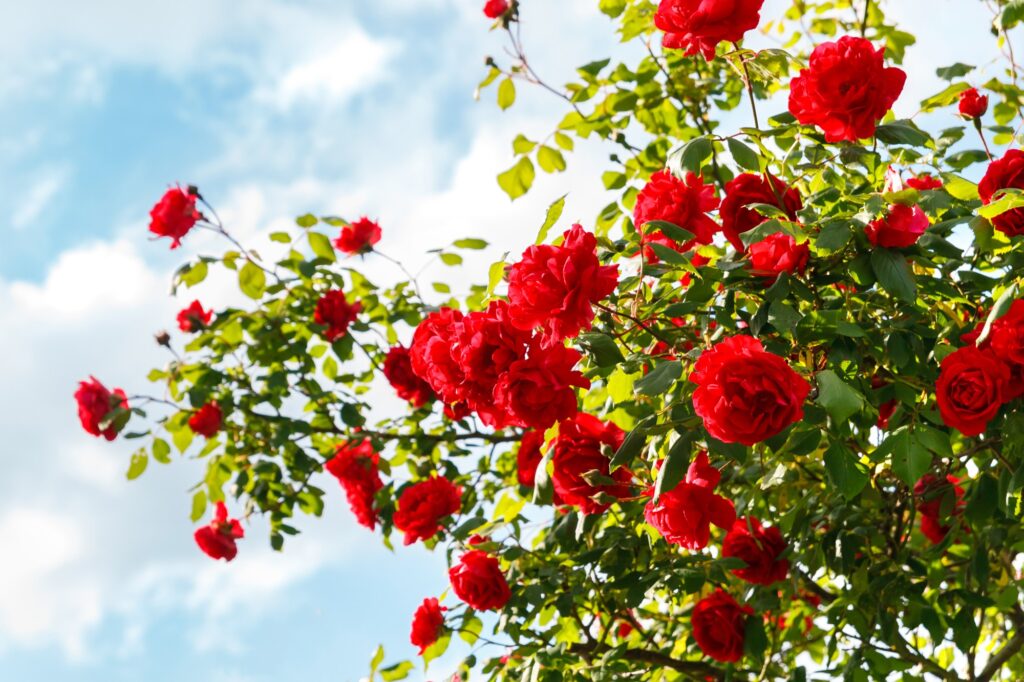
Red roses have an unmistakable presence in the garden.
Whether the flowers are deep burgundy, velvety crimson, clear scarlet, dark cherry, or bright true red, they naturally draw the eye. A single red rose can become a focal point, while several plants grouped together can create one of the strongest color displays in a flower garden.
Growing beautiful red roses, however, is not really about the color red.
Red-flowered roses need the same fundamentals as other roses: abundant sunlight, good drainage, adequate moisture, enough room for air circulation, appropriate pruning, and a cultivar suited to your climate. The biggest difference lies in choosing the right red rose for the effect you want.
Some red roses produce classic florist-style blooms on long stems. Others grow as durable landscape shrubs covered with clusters of flowers. Climbing varieties can cover an arbor or fence, while compact roses can bring red flowers to patios and containers.
The best red rose garden begins with the right plant in the right place.
Choose a healthy, disease-resistant cultivar with the mature size and growth habit your garden can accommodate. Give it good growing conditions, learn how that particular rose flowers, and allow the plant time to mature.
⚡ Red Rose Quick Care Guide
Plant type: Woody flowering shrub or climber
Botanical genus: Rosa
Light: Full sun; at least six hours of direct sunlight is ideal for most roses
Soil: Fertile, well-drained soil
Preferred pH: Approximately 6.0 to 7.0 for many garden roses
Water: Consistent moisture without waterlogged soil
Bloom season: Late spring through fall for repeat-flowering varieties; once-blooming roses generally flower during a shorter seasonal period
Fertilizer: According to soil conditions, rose type, and regional recommendations
Pruning: Depends on rose class and flowering habit
Best uses: Rose beds, mixed borders, cutting gardens, hedges, foundation plantings, containers, arches, fences, and focal plantings
Common concerns: Black spot, powdery mildew, aphids, Japanese beetles, rose sawflies, and rose rosette disease in affected regions
🌹 Red Roses Are Not All the Same
A red flower does not tell you how a rose will grow.
Two roses that appear almost identical in photographs may have completely different garden habits.
One could be a 3-foot floribunda that produces clusters of flowers throughout summer.
Another might be a 6-foot hybrid tea with large individual blooms.
A climbing rose could send out canes more than 10 feet long.
An old garden rose might flower only once each year but produce an extraordinary display and intense fragrance.
When choosing a red rose, look beyond color.
Consider:
- Mature height
- Mature width
- Hardiness
- Disease resistance
- Fragrance
- Repeat flowering
- Stem length
- Flower size
- Growth habit
- Thorniness
- Whether the plant is own-root or grafted
Those characteristics will determine how easy the rose is to grow and where it belongs in the landscape.
🌺 Choosing the Right Shade of Red
“Red rose” describes a surprisingly broad color range.
Some cultivars are bright scarlet.
Others have blue-purple undertones that create a deep crimson appearance.
Some become nearly burgundy in cool weather.
Others fade toward raspberry or pink as flowers age.
Flower color can also change with temperature, sunlight, flower age, and climate.
This means a rose shown as dark crimson in a catalog may look somewhat different in your garden.
If exact color matters, viewing mature plants locally can be useful.
Botanical gardens, rose societies, public gardens, and nearby nurseries can show you how different cultivars perform and look in your region.
🌹 Hybrid Tea Red Roses
Hybrid tea roses are ideal when your vision of a red rose includes large, elegantly shaped flowers on individual stems.
These are the roses most closely associated with traditional florist bouquets.
They are particularly useful in cutting gardens.
Hybrid teas typically have a more upright growth habit and may require greater attention to pruning, feeding, disease management, and winter protection than some modern landscape roses.
If you enjoy caring for roses and want dramatic individual blooms, that extra maintenance may be completely worthwhile.
Choose a cultivar with good disease resistance whenever possible.
🌸 Floribunda Red Roses
Floribundas generally produce flowers in clusters.
Instead of one enormous bloom standing alone on a long stem, several flowers may open together and create a mass of color.
This makes floribundas particularly useful in landscape beds where overall visual impact matters more than individual exhibition-style flowers.
Many repeat bloom through much of the growing season.
A group of three or five red floribundas can create a much larger color statement than the same number of widely scattered plants.
🌿 Shrub and Landscape Roses
For gardeners who want red roses with relatively straightforward care, modern shrub and landscape roses are worth serious consideration.
Many have been bred for repeat flowering, landscape performance, disease resistance, and broad adaptability.
Their flowers may not always have the classic high-centered hybrid tea form, but the plants can provide substantial color with less intervention.
Shrub roses work especially well in:
- Mixed borders
- Foundation beds
- Informal hedges
- Cottage gardens
- Mass plantings
- Pollinator-friendly landscapes
If your priority is a healthy red-flowering shrub rather than a perfect florist-style bloom, this category often makes the most sense.
🧗 Red Climbing Roses
A red climbing rose can transform a fence, arbor, pergola, or wall.
Climbing roses produce long canes rather than attaching themselves directly to structures.
Those canes need to be tied and trained onto suitable support.
Install the support before the rose becomes large.
A mature climbing rose can become heavy, particularly when wet or covered with flowers.
Lightweight decorative trellises may eventually bend or collapse.
For better flower production, major canes can often be trained more horizontally or diagonally, encouraging flowering lateral shoots along their length.
🌿 Old Red Roses
Historic and old garden roses can offer qualities that modern varieties sometimes emphasize less heavily.
You may find:
- Rich fragrance
- Unusual crimson shades
- Dense flower forms
- Large shrubs
- Rose hips
- Historical interest
- Excellent cold hardiness in certain classes
Some old roses bloom only once each year.
That may sound like a disadvantage until you see a mature plant covered with hundreds of flowers.
If season-long flowering is essential, choose repeat-blooming cultivars.
If fragrance and character matter more, once-blooming roses can be extraordinary garden plants.
☀️ Give Red Roses Plenty of Sun
Most roses perform best with at least six hours of direct sunlight.
Full sun encourages strong growth and abundant flowering.
Morning sun is particularly valuable because it helps dry foliage after dew or rainfall.
That can reduce the amount of time leaves remain wet, which may help limit certain fungal diseases.
Afternoon shade can sometimes preserve flower quality in extremely hot climates.
Deep shade is generally a poor location for roses.
Plants may become weak, stretch toward available light, flower poorly, and experience greater disease pressure when foliage remains damp.
Before planting, observe the location during several parts of the day.
💨 Air Circulation Matters
A rose needs room to breathe.
Crowded plants remain damp longer after rain and irrigation and can become harder to prune or inspect.
Always check the expected mature width before planting.
A rose that looks tiny in a nursery container may eventually occupy several feet of space.
Good spacing improves:
- Air circulation
- Light penetration
- Access for pruning
- Disease management
- Watering
- Overall plant shape
Avoid squeezing several roses into a space simply because you want immediate fullness.
Young roses grow.
🌎 Best Soil for Red Roses
Red roses do not need a special soil because of their flower color.
Like other roses, they generally perform best in fertile, well-drained soil with adequate organic matter.
A useful pH range for many garden roses is approximately 6.0 to 7.0.
Before making major changes, have the soil tested.
Do not automatically add lime, sulfur, bone meal, phosphorus, or large quantities of fertilizer because an old gardening recipe recommends them.
Your garden may not need them.
Our Garden Soil Guide: Soil Types, Testing, pH & How to Improve It explains soil testing, pH, compost, organic matter, drainage, and amendments in more detail.
💧 Drainage Is Essential
Roses appreciate moisture, but they do not generally tolerate constantly saturated roots.
Avoid planting in low areas where water remains for long periods after rain.
Persistent wetness can damage roots and weaken plants.
If drainage is questionable, address the cause before planting.
That might involve improving soil structure, redirecting runoff, or creating an elevated bed.
A raised planting area can help in some difficult locations. See Raised Bed Gardening for Beginners for more information.
🌳 Avoid Heavy Tree-Root Competition
Large trees compete with roses for both sunlight and soil resources.
A bed that appears open may still contain an extensive network of tree roots.
Whenever possible, locate roses away from mature trees and large established shrubs.
This makes watering, fertilizing, and maintaining appropriate soil moisture much easier.
If the only available location lies directly beneath mature trees, consider whether a shade-tolerant plant would suit the site better.
A rose should not require constant rescue simply because it was planted in the wrong place.
📅 When to Plant Red Roses
Planting time depends on climate and whether the rose is bare-root or container-grown.
Bare-root roses are normally planted while dormant or as they begin emerging from dormancy, according to regional timing.
Container roses can be planted through a broader part of the growing season.
Spring is excellent in many climates because the rose receives an entire season to establish before winter.
Fall can also work well where enough time remains for root establishment.
Avoid planting during extreme heat whenever possible.
A rose planted during hot summer weather requires much closer attention to moisture.
🌱 How to Plant a Container Red Rose
Water the rose before planting if the root ball is dry.
Dig a hole wide enough to accommodate the root system comfortably.
Remove the plant from its container and examine the roots.
If roots circle tightly around the outside of the root ball, loosen them gently so they can move into the surrounding soil.
Set the rose at the correct depth for the type of plant and climate.
Grafted rose planting depths vary somewhat by region, particularly because cold-climate gardeners may position the bud union differently from gardeners in warmer climates.
Backfill with the garden soil and water thoroughly.
Avoid creating a tiny pocket of extremely rich material surrounded by completely different native soil.
Roots should be encouraged to spread outward.
🌱 Planting Bare-Root Red Roses
Bare-root roses may look unimpressive when they arrive, but healthy dormant plants can establish rapidly.
Protect roots from drying.
Rehydrate according to supplier or regional recommendations before planting.
Remove badly damaged roots and spread the remaining roots comfortably within a sufficiently wide planting hole.
Do not cram them into a narrow vertical hole.
Water thoroughly as soil is replaced around the roots.
Avoid heavily stomping the soil into place because that compacts it.
Once planted, maintain appropriate moisture as growth begins.
📏 How Far Apart Should Red Roses Be?
Spacing depends on the rose rather than the flower color.
Compact roses may need only modest space.
Large shrub roses and climbers may need several feet.
A useful rule is to base spacing on the expected mature width of the cultivar.
Do not rely on a universal “two feet apart” recommendation when one rose matures at 30 inches wide and another at 8 feet.
If you are grouping several roses of the same cultivar for visual impact, allow their mature canopies to approach one another without packing the centers of the plants into a dense, poorly ventilated mass.
💦 How Often Should You Water Red Roses?
New roses need regular moisture while their roots establish.
Established roses still require water during dry weather, particularly repeat-flowering cultivars producing large amounts of new growth.
There is no universal schedule.
Water needs depend on:
- Soil type
- Rainfall
- Temperature
- Wind
- Mulch
- Plant size
- Root establishment
Check the soil.
When irrigation is needed, water thoroughly enough to moisten the root zone.
Repeated shallow sprinkling can encourage roots to remain concentrated near the soil surface.
🚿 Water the Root Zone
Whenever practical, direct water toward the soil rather than spraying the entire plant.
Drip irrigation and soaker hoses can work particularly well in rose beds.
The leaves will obviously become wet during rain, and that is normal.
The goal is simply to avoid extending leaf wetness unnecessarily, particularly late in the day.
Black spot and other fungal diseases often become more troublesome under conditions that keep foliage wet for prolonged periods.
Morning watering is therefore preferable when overhead irrigation must be used.
🍂 Mulch Red Roses
Organic mulch can make rose care easier.
Mulch helps:
- Conserve soil moisture
- Suppress many weeds
- Protect soil structure
- Moderate temperature fluctuations
- Reduce soil splashing onto lower foliage
Wood chips, shredded bark, and other appropriate organic materials can work well.
Keep mulch slightly away from the base of the canes.
Do not build a large mulch volcano around the plant.
A moderate layer over the surrounding soil is enough.
🌱 Do Red Roses Need Fertilizer?
Repeat-flowering roses may benefit from fertilization when the soil requires additional nutrients, but fertilizer should not be applied blindly.
Begin with a soil test.
Fertilizer schedules vary depending on rose class, climate, soil fertility, and the product being used.
Species and low-maintenance shrub roses may require less supplemental feeding than heavily blooming hybrid teas.
Follow the label and regional recommendations.
Do not continue fertilizing late into the season in cold climates when tender new growth is unlikely to harden before winter.
More fertilizer is not a substitute for good soil, sunlight, drainage, and water.
🌺 How to Get More Red Rose Blooms
If a healthy repeat-flowering rose produces fewer blooms than expected, consider the fundamentals first.
Ask:
- Does it receive enough sunlight?
- Is the rose still young?
- Has it become overcrowded?
- Is excessive nitrogen encouraging foliage instead of flowers?
- Is the plant severely drought stressed?
- Does the cultivar naturally repeat bloom heavily?
- Is pruning appropriate for that rose class?
Cultivar selection has an enormous influence.
A once-blooming rose will never flower continuously simply because you feed it more.
Choose repeat-flowering varieties when a long season of red flowers is a major goal.
✂️ Deadheading Red Roses
Deadheading means removing faded flowers before mature seed develops.
Many repeat-flowering roses respond by producing additional flowering growth.
For vigorous repeat bloomers, spent flowers can usually be removed back to an outward-facing bud above a healthy compound leaf.
Weaker or young plants may need lighter deadheading so you do not remove excessive foliage.
Not every rose needs deadheading.
If you want rose hips for fall and winter interest, allow some flowers to remain.
Some modern landscape roses also rebloom well without meticulous removal of every spent flower.
✂️ When to Prune Red Roses
Pruning time depends on rose type.
Many modern repeat-flowering roses are pruned during late winter or early spring as growth begins.
Gardeners often use blooming forsythia as a rough seasonal indicator.
Once-blooming old garden roses are different because they often flower on older wood.
Pruning them heavily before flowering could remove much of the year’s display.
Climbers and ramblers also require different timing and techniques.
Do not prune a rose simply because it is red.
Know the class and flowering habit.
🌹 How to Prune a Repeat-Blooming Red Rose
Begin by removing:
- Dead canes
- Damaged canes
- Diseased canes
- Weak growth
- Crossing stems causing problems
- Suckers from below the graft on grafted plants
Then shape the rose appropriately for its class.
Clean, sharp bypass pruners make the job easier.
Aim to maintain an open structure that permits light and air to move through the plant.
Do not reduce every rose to the same height.
A hybrid tea and large shrub rose should not be pruned as though they are identical plants.
🧗 Pruning Red Climbing Roses
Climbing roses are managed differently.
Young climbers often need relatively little pruning beyond removing damaged material.
The first priority is developing strong main canes.
Train those canes along the structure, often at more horizontal or diagonal angles when practical.
Flowering lateral shoots develop from them.
Repeat-blooming climbers can generally be pruned during the appropriate early-season period, while once-blooming ramblers are commonly pruned after flowering.
Preserving the main framework prevents accidentally removing years of growth.
🔪 Use Good Pruning Tools
A sharp pair of bypass pruners is one of the most useful tools for rose gardeners.
Dull blades crush stems and require unnecessary force.
Use loppers or a pruning saw for canes too thick for ordinary hand pruners.
Keep tools clean, especially when working around diseased plants.
Our Garden Tools & Products hub covers pruners, gloves, watering tools, and other gardening equipment.
🌺 Growing Red Roses for Cut Flowers
Red roses are classic cut flowers.
If bouquets are a priority, choose varieties known for:
- Long stems
- Good vase life
- Attractive bud shape
- Repeat flowering
- Strong stems
- Fragrance if desired
Hybrid teas remain particularly useful for traditional long-stemmed arrangements.
Harvest with clean, sharp tools.
Try not to remove excessive foliage from young or weak plants.
Leaves remaining on the rose continue producing energy needed for future growth.
For a mature vigorous plant, regular harvesting can become part of normal pruning and deadheading.
💐 When to Cut Roses for a Vase
Cutting stage depends somewhat on the rose.
For many large-flowered varieties, harvesting when the outer petals have loosened but the flower is not fully open can provide good vase life.
Cut during the cooler part of the day when possible.
Place stems in water promptly.
Use clean containers.
Remove foliage that would sit below the water line.
Changing vase water and keeping arrangements away from extreme heat can also extend their appearance indoors.
🌹 Why Do Red Roses Sometimes Fade?
Red flowers do not always remain the exact same shade from opening until they fall.
Sunlight, heat, flower age, and genetics can all influence color.
Some deep red roses become brighter as they age.
Others develop purple or blue-red undertones.
Extreme heat may cause flowers to fade more quickly.
Petal edges can also darken after weather damage.
If stable dark color is important, choose a cultivar known for maintaining its shade well in your climate.
☀️ Can Red Roses Get Sunburned?
Rose flowers can be damaged by intense heat and sunlight, particularly during extreme weather.
Dark red petals absorb substantial solar radiation and may show scorching or darkened edges under severe conditions.
This does not mean roses should generally be planted in shade.
They still need abundant sunlight.
In extremely hot climates, a location receiving morning sun with some protection from the most intense late-afternoon heat can sometimes preserve flower quality.
🌸 Companion Plants for Red Roses
Red roses combine particularly well with flowers that create contrast.
Possible companions include:
- Catmint
- Lavender where soil conditions suit both plants
- Salvia
- Hardy geraniums
- White flowering perennials
- Blue or purple flowers
- Silver foliage plants
- Ornamental grasses
- Spring bulbs
- Lilies
The goal is not simply color.
Companions should also have compatible light, soil, and moisture requirements and should not crowd the rose canopy.
Our Flower Gardening hub offers more ideas for creating mixed ornamental beds.
💜 Red Roses With Purple and Blue Flowers
Purple and blue create some of the strongest combinations with red roses.
Catmint and blue-flowering salvias can soften the boldness of deep red flowers.
Lavender may also provide an attractive visual combination where both plants can be given suitable drainage and sunlight.
Do not choose a companion solely because the colors look good in a photograph.
It still needs to thrive under the same garden conditions.
🤍 Red Roses With White Flowers
White companions make red roses appear even more dramatic.
White annuals, spring bulbs, lilies, and perennials can brighten the planting and provide contrast without competing heavily for attention.
White flowers are particularly effective when repeated throughout the border rather than placed as isolated accents.
The combination can look formal, romantic, or contemporary depending on the plants and layout.
🌷 Add Spring Bulbs Around Red Roses
Rose beds can look relatively empty early in spring before the shrubs produce substantial foliage.
Fall-planted bulbs can fill that seasonal gap.
Daffodils, Crocuses, and other spring bulbs can flower before roses dominate the bed.
As the bulb foliage begins declining, expanding rose and perennial growth helps disguise it.
This is an easy way to make the same garden bed interesting across several seasons.
🌸 Red Roses With Lilies
Lilies make particularly dramatic companions for roses.
Their tall upright stems occupy relatively little ground space, while their large flowers appear above and between rose shrubs.
White lilies create strong contrast with deep red roses.
Pink lilies create a softer palette.
Choose lily heights carefully so they complement rather than overwhelm the roses.
Our Lily Care: How to Plant, Grow & Care for Lilies guide covers planting, maintenance, and cultivar groups.
🐝 Red Roses and Pollinators
Not every red rose provides the same value to pollinating insects.
Highly double flowers can make pollen and nectar harder for insects to access.
Single and semi-double roses with exposed centers are generally easier for pollinators to use.
Species roses and many simpler-flowered shrub roses can be especially valuable.
A garden can contain both elaborate double roses and pollinator-friendly flowers.
Surround traditional red roses with accessible nectar and pollen sources so the overall landscape supports insects throughout the growing season.
Our Eco-Friendly Gardening hub provides additional pollinator and wildlife-gardening ideas.
🐛 Aphids on Red Roses
Aphids often gather on tender new growth and flower buds.
Small infestations may cause little lasting damage.
Natural predators such as lady beetles and lacewing larvae can reduce populations.
A strong stream of water can dislodge aphids when treatment is necessary.
Insecticidal soap may also be an option for appropriate situations when label directions are followed.
Avoid automatically applying broad-spectrum insecticides because a few aphids appear.
Those products can also harm beneficial insects.
🪲 Japanese Beetles
Japanese beetles can damage rose flowers and leaves in areas where the pest occurs.
Adults may arrive in large numbers and chew petals and foliage.
Hand-picking into soapy water can be practical for small gardens.
Be cautious about placing Japanese beetle traps beside roses because the attractants can draw additional beetles toward the area.
Management recommendations vary by region and severity.
Use local Extension guidance when infestations become serious.
🍃 Black Spot on Red Roses
Black spot is one of the most common rose diseases.
Symptoms generally include dark spots on foliage followed by yellowing and premature leaf drop.
Some cultivars are far more susceptible than others.
This makes disease resistance one of the most valuable characteristics to consider when purchasing a red rose.
Good cultural practices can help:
- Plant in abundant sunlight
- Provide enough spacing
- Encourage airflow
- Water near the soil
- Avoid prolonged unnecessary leaf wetness
- Remove badly infected fallen foliage
- Choose resistant cultivars
A rose requiring constant treatment simply to retain its leaves may not be the best cultivar for a low-maintenance garden.
🌫️ Powdery Mildew
Powdery mildew can create a pale, powdery coating on rose leaves and young growth.
It can become especially troublesome when environmental conditions favor the fungus.
Improve air circulation and avoid unnecessary crowding.
Select resistant roses where available.
Repeated disease problems can sometimes be reduced more effectively by replacing a highly susceptible cultivar than by maintaining a permanent spray program.
🌹 Rose Rosette Disease
Rose rosette disease is a serious problem in regions where it occurs.
Potential symptoms include distorted growth, unusual proliferation of shoots, excessive thorn development, abnormal red growth, and eventual decline.
Normal new rose growth can also emerge red, so red color alone is not evidence of disease.
This distinction is particularly important with red-flowered roses because gardeners may naturally pay more attention to red pigmentation.
If several suspicious symptoms appear together, seek reliable identification guidance.
There is no cure for an infected rose.
🍂 Remove Serious Disease Problems During Cleanup
Diseased fallen foliage can contribute to recurring problems with certain rose diseases.
Where black spot or another disease has been severe, remove heavily affected leaves and debris.
Replace badly contaminated mulch when appropriate.
Healthy garden soil does not need to be sterilized, and you do not need to remove every fallen leaf from an entire landscape.
Focus cleanup where a specific disease gives you a reason.
🌱 Why Is My Red Rose Not Blooming?
Several factors can reduce flowering.
Too Little Sun
Most roses need abundant light.
Excessive Nitrogen
Too much nitrogen can produce foliage at the expense of flowers.
Incorrect Pruning
Pruning a once-blooming rose at the wrong time may remove flower-producing wood.
Young Plant
Newly planted roses sometimes prioritize root establishment.
Stress
Severe drought, saturated soil, pests, disease, or root competition can reduce flowering.
Cultivar Habit
Some roses naturally bloom once rather than repeatedly.
Before feeding the plant more fertilizer, determine what type of rose it is and whether the growing conditions suit it.
🌿 Why Is My Red Rose Growing Tall and Leggy?
Insufficient sunlight can cause elongated, weak growth.
Heavy nitrogen fertilization can also contribute.
Some climbing and shrub roses naturally produce long canes, so what looks leggy may simply be normal growth for the cultivar.
Check the plant label or cultivar description.
Do not continually cut a climbing rose down because you expected it to behave like a compact floribunda.
Understanding the growth habit prevents many unnecessary pruning problems.
🍃 Why Are Rose Leaves Turning Yellow?
Yellow foliage has many possible causes.
These include:
- Black spot
- Excessive water
- Drought
- Root stress
- Nutrient imbalance
- Natural aging
- Transplant shock
- Poor drainage
Look closely at the pattern.
Yellow leaves covered with characteristic black lesions suggest a very different problem from a rose whose entire root system has been sitting in saturated soil.
Treating every yellow leaf with fertilizer is unlikely to solve the underlying cause.
🌹 Why Are Red Rose Buds Not Opening?
Rose buds may fail to open normally because of weather, disease, insect damage, severe stress, or a condition sometimes called balling, where outer petals become wet and stick together.
Large densely petaled flowers can be particularly vulnerable during cool, rainy weather.
Good airflow can help flowers dry.
Remove badly damaged blooms.
If the problem occurs only after prolonged rain, the plant may return to normal flowering as weather improves.
🌧️ Protecting Roses During Heavy Rain
You cannot realistically keep an outdoor rose dry.
However, proper spacing and an open planting site help plants dry more quickly after storms.
Avoid planting roses beneath rooflines that dump concentrated water directly onto them.
Mulch can also reduce soil splashing.
If flowers are damaged by severe rain, deadhead the worst ones and allow the plant to produce another flush.
Repeat-blooming roses often recover quickly.
❄️ Winter Care for Red Roses
Winter requirements depend on hardiness and rose class.
Cold-hardy shrub roses may need little additional protection.
Tender hybrid teas and other less-hardy roses may benefit from additional winter protection in colder climates.
Stop encouraging tender growth late in the season.
Allow plants to enter dormancy naturally.
Once consistently cold weather arrives, appropriate material can be mounded around vulnerable crowns according to regional recommendations.
Do not cover the plant too early while the weather remains warm.
Choose cultivars that are genuinely hardy for your region whenever possible.
🍂 Don’t Heavily Prune Red Roses in Fall
Fall is not the time to reduce every rose to a short bundle of canes merely because winter is approaching.
Heavy pruning can stimulate growth or remove useful wood before the appropriate pruning season.
You may shorten extremely long canes that would whip violently in winter winds.
Dead, broken, or badly diseased wood can also be addressed as appropriate.
Major structural pruning can generally wait until the recommended time for that rose class.
🌱 Spring Red Rose Care
As winter ends, inspect roses carefully.
Remove winter protection at the appropriate time.
Look for dead or damaged canes.
Prune according to the rose’s flowering habit.
Refresh mulch without piling it against the crown.
Begin monitoring soil moisture as growth accelerates.
Spring is also a good time to evaluate whether surrounding plants have begun crowding the rose.
A garden changes from year to year, and adequate spacing can disappear gradually.
☀️ Summer Red Rose Care
During summer, focus on:
- Consistent watering
- Deadheading repeat bloomers
- Monitoring pests
- Watching for disease
- Cutting flowers
- Maintaining mulch
- Removing weeds
- Supporting climbing canes
- Enjoying the roses
Avoid turning rose care into a daily search for imperfections.
A healthy rose can tolerate an occasional chewed leaf or blemished flower.
Look for patterns and significant problems rather than expecting exhibition-quality perfection from every plant in an outdoor landscape.
🍁 Fall Red Rose Care
Fall care is primarily about helping the rose transition toward dormancy in cold climates.
Reduce practices that stimulate excessive tender growth.
Continue watering during dry weather while the ground remains unfrozen.
Allow some hips to develop if you enjoy their appearance.
Clean up serious disease problems.
Avoid major late-season pruning.
Then let the plant respond naturally to shortening days and cooling temperatures.
Our Seasonal Gardening hub provides more guidance for coordinating rose care with the rest of the garden.
🪴 Can Red Roses Grow in Containers?
Yes.
Compact red roses and some hybrid teas or small shrub roses can grow successfully in containers.
Choose a pot large enough to support the mature root system and make sure it has drainage holes.
Use a high-quality container potting medium rather than dense garden soil.
Container roses dry more quickly than roses growing in the ground, so moisture requires closer attention.
Winter is often the greatest challenge.
Roots in above-ground containers experience colder temperatures than those protected by surrounding soil.
Choose a cultivar and winter strategy appropriate to your climate.
🌹 Growing a Red Rose Hedge
Shrub roses can create an informal flowering hedge.
For this purpose, look for cultivars with:
- Dense growth
- Similar mature heights
- Strong disease resistance
- Repeat blooming
- Reliable hardiness
- Attractive foliage
Spacing should allow mature plants to form a continuous visual mass without becoming severely overcrowded.
A rose hedge can define a property boundary, line a walkway, or separate garden areas while providing far more seasonal interest than a conventional clipped hedge.
🧱 Growing Red Roses Along a Fence
A fence can create an excellent backdrop for red roses.
Climbers can be trained directly onto suitable support installed in front of the fence.
Shrub roses can be planted along the base where their flowers stand out against the background.
Leave enough space for maintenance and airflow.
Do not trap mature thorny roses so tightly against a fence that pruning becomes impossible.
Think about access before the plants become large.
🪑 Put Fragrant Red Roses Where You Can Enjoy Them
If you choose a fragrant red rose, plant it where people will actually encounter the scent.
Good locations include:
- Beside patios
- Near benches
- Along frequently used paths
- Near garden entrances
- Outside windows
- Around seating areas
A heavily perfumed rose hidden at the farthest corner of the property wastes one of its best features.
Fragrance strength varies enormously among cultivars, so check descriptions carefully if scent is important.
🎨 Designing With Red Roses
Red is visually powerful.
A large number of bright red roses can dominate a garden, which may be exactly the effect you want.
For a dramatic formal look, repeat one red cultivar.
For a softer design, combine red roses with white, lavender, blue, pale pink, and silver foliage.
For a warm garden, mix deep reds with orange, apricot, gold, and bronze.
Avoid buying one red rose of every possible shade unless an eclectic collection is the goal.
Repetition often creates a stronger landscape than variety for variety’s sake.
🌹 A Simple Red Rose Garden for Beginners
A beginner-friendly red rose bed does not need to contain a dozen varieties.
Start with three disease-resistant shrub or floribunda roses that mature at a manageable size.
Plant them in full sun with adequate spacing.
Add a few companion perennials around them, perhaps blue salvia, catmint, coneflowers, or white flowers.
Include spring bulbs for early-season interest.
Mulch the bed and install simple drip irrigation or a soaker hose if convenient.
Then observe the planting for a full year before expanding it.
You will learn how the roses respond to your soil, weather, winter, and local disease pressure.
That information makes every future rose purchase easier.
⚠️ Common Red Rose Care Mistakes
Choosing by Color Alone
Disease resistance, mature size, hardiness, and flowering habit matter just as much as flower color.
Planting in Too Much Shade
Red roses still need the same sunlight as roses of other colors.
Overcrowding
Poor airflow increases disease pressure and makes maintenance harder.
Overwatering
Roses like consistent moisture, not saturated soil.
Overfertilizing
Excessive feeding can create weak growth and does not guarantee additional flowers.
Pruning Every Rose the Same Way
Different rose classes require different pruning strategies.
Ignoring the Cultivar Name
Knowing exactly what you are growing makes care much easier.
Expecting Perfect Leaves All Summer
Outdoor roses experience weather, insects, and disease pressure. A few imperfect leaves do not mean the plant is failing.
🌹 Red Roses Are Only as Difficult as the Rose You Choose
The color red does not make a rose demanding.
Plant selection does.
A disease-resistant red shrub rose planted in full sun and appropriate soil may be one of the easier flowering shrubs in your landscape.
A highly susceptible hybrid tea planted in shade and poorly drained soil may require constant intervention.
Choose the cultivar first.
Then create conditions in which it can succeed.
When you do that, red rose care becomes much less mysterious.
❤️ Grow the Red Rose That Fits Your Garden
There is no single best red rose.
The best cultivar is the one that combines the flower you love with the growth habit your garden can support.
Choose a hybrid tea if long-stemmed cutting flowers are your priority.
Choose a floribunda for clusters of color.
Choose a disease-resistant shrub rose for a lower-maintenance landscape.
Choose a climber if you want red flowers covering an arbor or fence.
Then give the plant enough sunlight, room, water, drainage, and appropriate seasonal care.
A healthy red rose does not need to be flawless.
It simply needs to grow strongly enough that an occasional spotted leaf or chewed petal disappears into the larger display.
When a mature plant is covered in deep red flowers, those small imperfections become very easy to overlook.
🔗 Related Articles
- How to Grow a New Rose Garden
- Flower Gardening
- Gardening Basics
- Garden Soil Guide: Soil Types, Testing, pH & How to Improve It
- Seasonal Gardening
- Eco-Friendly Gardening
- Garden Tools & Products
- Lily Care: How to Plant, Grow & Care for Lilies
- Coneflower Care: How to Grow Echinacea
- Black-Eyed Susan Care
- Daffodil Care: How to Plant, Grow & Care for Daffodils
📚 Sources & Further Reading
- University of Illinois Extension — Roses
- University of Illinois Extension — Preparing a Site for Roses
- University of Illinois Extension — Planting Roses
- University of Illinois Extension — Rose Care
- University of Illinois Extension — Pruning Roses
- Clemson Cooperative Extension — Rose Diseases
- USDA — Plant Hardiness Zone Map