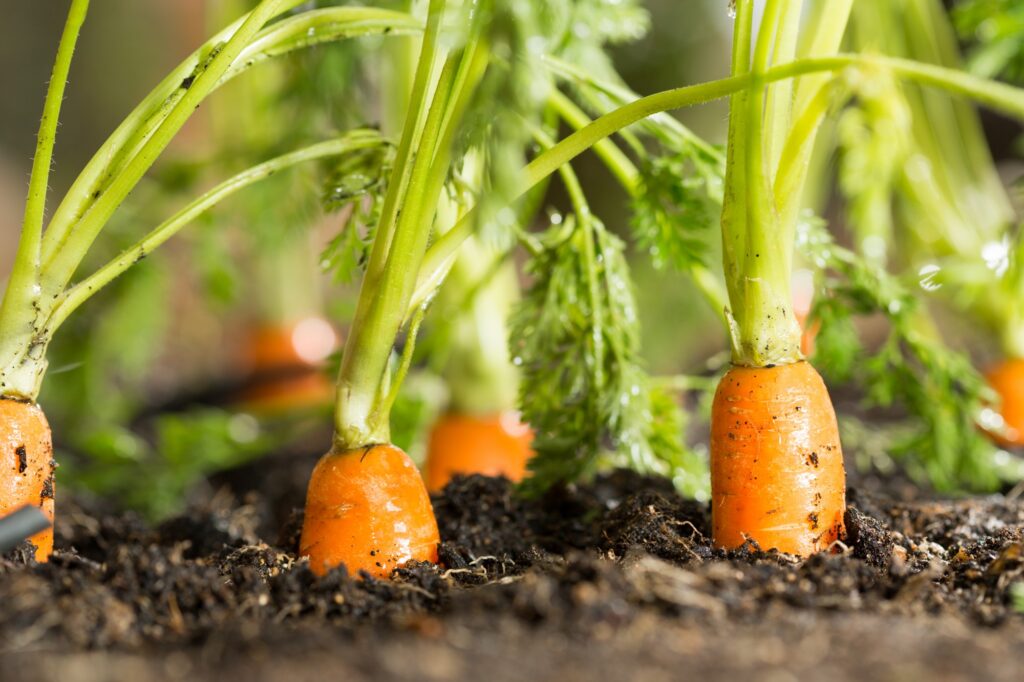
Carrots are one of the most familiar vegetables in the garden, but producing long, smooth, sweet roots depends on getting a few important details right. They need loose soil, consistent moisture, careful thinning, and patience during germination. When those conditions come together, carrots are remarkably productive and can be grown through much of the year in many climates.
They are also far more diverse than the standard orange supermarket carrot. Gardeners can grow carrots in shades of purple, yellow, white, red, and cream, as well as orange. Some varieties produce long tapered roots, while others are short, blunt, cylindrical, or almost round.
Carrots are a cool-season crop, making them especially useful in spring and fall gardens. Mature roots tolerate cool weather well, and many gardeners find that carrots harvested after chilly autumn conditions develop particularly sweet flavor.
The biggest challenges usually happen early. Carrot seed is tiny, slow to germinate, and planted close to the soil surface, so the seedbed must remain evenly moist. Once seedlings emerge, thinning becomes essential. Crowded carrots may produce plenty of leaves while developing thin, twisted, or undersized roots.
Give them deep, loose soil, steady moisture, and enough space, and carrots can become one of the most reliable root crops in the garden.
🥕 Carrots at a Glance
- Botanical name: Daucus carota subsp. sativus
- Plant family: Apiaceae
- Plant type: Biennial grown as an annual vegetable
- Sun: Full sun
- Soil: Deep, loose, well-drained soil
- Soil pH: Roughly 6.0 to 7.0
- Planting method: Direct sow
- Seed depth: About ¼ inch
- Final spacing: Roughly 2 to 3 inches apart
- Row spacing: About 12 to 18 inches
- Germination: Often 1 to 3 weeks
- Water: Consistent moisture
- Harvest: Often 60 to 80 days, depending on variety
- Best seasons: Spring and fall
- Cold tolerance: Good once established
- Main challenges: Slow germination, crusted soil, crowding, carrot rust fly, root-knot nematodes, forked roots, and splitting
🌿 What Are Carrots?
Carrots belong to the parsley family, Apiaceae.
Their relatives include:
- Parsley
- Dill
- Cilantro
- Fennel
- Celery
- Parsnips
The edible carrot is an enlarged taproot where the plant stores energy.
If left in the ground through winter, the carrot can flower during its second year.
Gardeners usually harvest the root during the first season, long before flowering occurs.
🧡 Orange Carrots
Orange carrots are the most familiar modern type.
Their color comes largely from carotenoid pigments, including beta-carotene.
Orange cultivars vary dramatically in shape.
Some are:
- Long and tapered
- Thick and cylindrical
- Short and blunt
- Small and rounded
Choosing the right shape for your soil can make carrot growing much easier.
💜 Purple Carrots
Purple carrots are among the oldest color forms.
Many contain anthocyanin pigments in their outer tissues.
Some varieties are purple all the way through, while others have:
- Purple exteriors
- Orange or yellow centers
They add striking color to salads and roasted vegetable dishes.
💛 Yellow Carrots
Yellow carrots contain different proportions of carotenoid pigments than orange carrots.
Their flavor is often mild and sweet.
They can be particularly attractive in mixed-color harvests.
❤️ Red Carrots
Red carrots are less common in North American gardens but are widely grown in parts of Asia.
Their color may come partly from lycopene and other pigments.
They often develop their best color and flavor under suitable cool-season conditions.
🤍 White Carrots
White carrots lack much of the intense pigmentation found in orange, purple, and red varieties.
They still have a characteristic carrot flavor.
Do not confuse them with parsnips, which are a different crop.
🌈 Rainbow Carrot Mixes
Seed companies often sell blends containing several colors.
A rainbow row might include:
- Orange
- Purple
- Yellow
- White
- Red
Mixed carrots can make the garden more interesting, but different varieties may mature at slightly different rates.
Harvest based on root size rather than expecting every color to be ready simultaneously.
📏 Different Carrot Shapes
Carrot varieties are often grouped according to root shape.
Imperator
Long, slender carrots similar to many supermarket types.
They perform best in deep, loose soil.
Nantes
Cylindrical roots with relatively blunt tips.
These are excellent for many home gardens.
Danvers
Sturdy tapered roots that can tolerate somewhat heavier soil.
Chantenay
Shorter, broad-shouldered carrots.
They are useful in shallow or heavier soils.
Parisian and Round Types
Small, nearly round roots.
These can perform well in:
- Containers
- Shallow raised beds
- Heavy soil
Matching root type to soil conditions is often easier than trying to completely rebuild difficult soil.
❄️ Carrots Are Cool-Season Vegetables
Carrots grow best during cool to mild weather.
Their foliage tolerates cool temperatures well, while established roots can handle light frosts.
Warm weather does not necessarily kill carrots, but excessive heat can reduce:
- Root quality
- Color
- Sweetness
- Germination success
Spring and fall are usually the best seasons.
📅 When Should You Plant Carrots?
Carrots can usually be sown several weeks before the average last spring frost, as soon as soil is workable.
Continue sowing while weather remains relatively cool.
For a fall crop, sow in midsummer or late summer early enough for roots to mature before severe winter weather.
Because germination and growth slow as days shorten, fall crops should be planted with some extra time beyond the seed packet’s listed days to maturity.
🌱 Direct Sow Carrots
Carrots should normally be sown directly where they will grow.
Transplanting can damage or bend the developing taproot.
That may cause:
- Forking
- Crooked roots
- Short roots
Direct sowing is simpler and usually produces the best-shaped carrots.
☀️ How Much Sun Do Carrots Need?
Carrots perform best in full sun.
Aim for at least 6 hours of direct sunlight per day.
They can tolerate some light shade, especially in warm climates, but heavier shade can slow root development.
Too little sun may produce:
- Large foliage
- Thin roots
- Slow growth
🌱 Best Soil for Carrots
Soil structure is one of the most important parts of carrot care.
Carrots prefer soil that is:
- Loose
- Deep
- Well drained
- Free from large stones
- Moderately fertile
- Rich in well-decomposed organic matter
Long carrots need the deepest preparation.
Shorter varieties are much more forgiving.
🪨 Remove Stones and Hard Clods
Anything that blocks the downward-growing root can cause distortion.
Obstacles may produce:
- Forked carrots
- Bent carrots
- Knobby roots
- Short roots
Remove large stones and break apart compacted clods before sowing.
You do not need perfectly sifted soil, but the upper root zone should be reasonably loose.
🧱 Growing Carrots in Clay Soil
Carrots can grow in clay, but long narrow cultivars may struggle.
If your soil is heavy, consider:
- Raised beds
- Adding finished compost over time
- Avoiding working clay while wet
- Choosing shorter Chantenay or round varieties
Trying to grow an 8-inch Imperator carrot in dense compacted clay creates unnecessary frustration.
Choose a root shape suited to the soil you actually have.
🧪 What Soil pH Do Carrots Prefer?
Carrots generally perform well around pH 6.0 to 7.0.
Slightly acidic to neutral soil is suitable.
A soil test is more useful than guessing.
Correct major pH problems before planting if necessary.
🌾 Avoid Excess Nitrogen
Carrots need nutrients, but heavy nitrogen fertilization can encourage excessive foliage at the expense of root quality.
Too much nitrogen may contribute to:
- Large tops
- Small roots
- Excessive branching
Balanced fertility is better.
If soil is already fertile, carrots may need little additional fertilizer.
💩 Avoid Fresh Manure
Fresh manure is not ideal immediately before planting carrots.
It can contribute to:
- Excess nitrogen
- Uneven nutrient availability
- Forked or misshapen roots
- Weed problems
Use well-finished compost or manure that has been thoroughly composted.
🌱 Preparing a Carrot Bed
Before sowing:
- Remove weeds.
- Loosen the soil deeply enough for the cultivar.
- Remove major stones.
- Break apart large clods.
- Incorporate finished compost if needed.
- Rake the surface smooth.
A fine surface is especially useful because carrot seeds are tiny and planted shallowly.
🌱 How to Plant Carrot Seeds
Create a shallow furrow about ¼ inch deep.
Scatter seeds thinly along the row.
Because carrot seed is tiny, perfectly even spacing is difficult.
After sowing:
- Cover lightly with fine soil.
- Firm gently.
- Water carefully.
- Keep the seedbed continuously moist until germination.
Do not bury seeds deeply.
🌧️ Keep the Seedbed Moist
Carrot seeds are especially vulnerable to drying out because they germinate slowly and sit close to the soil surface.
The upper layer of soil may dry long before deeper soil does.
During germination, frequent light watering may be needed.
Once plants establish, switch toward deeper, less frequent watering.
📰 Covering Carrot Seed During Germination
Some gardeners place a light board, burlap, cardboard, or similar temporary cover over the row to help retain moisture.
If you use this method:
- Check underneath every day.
- Remove the covering immediately when seedlings begin emerging.
Leaving it too long can block light and damage young plants.
A very light layer of fine mulch can also help, but do not bury the seedlings.
⏳ How Long Do Carrots Take to Germinate?
Carrots are slower than radishes.
Germination commonly takes 10 to 21 days, sometimes longer in cold soil.
This creates two challenges:
- The soil must remain moist for an extended period.
- Weeds may emerge before the carrots do.
Do not assume the seed has failed after only a week.
🌱 Plant Radishes With Carrots as Row Markers
A traditional trick is to mix a few radish seeds into the carrot row.
Radishes germinate quickly and mark the location before carrots emerge.
The radishes can be harvested early, leaving more room for the slower-growing carrots.
Use only a modest number so they do not crowd the carrot seedlings.
📏 How Far Apart Should Carrots Be?
Final spacing depends on mature root size.
A useful general target is about:
- 2 to 3 inches apart
Baby carrots can grow more closely.
Very large storage varieties may benefit from slightly wider spacing.
Check the seed packet for cultivar-specific recommendations.
✂️ Thin Carrots Carefully
Thinning is essential.
Crowded carrots compete for physical space and often develop:
- Tiny roots
- Twisted roots
- Crooked growth
When seedlings are a few inches tall, thin them.
It is often safest to:
- Snip unwanted seedlings at soil level
rather than pulling them.
Pulling can disturb the roots of neighboring carrots.
✂️ Thin More Than Once if Needed
Carrots often emerge unevenly.
You may first thin them lightly, then return later and create final spacing.
This approach works especially well when germination was dense.
Some gardeners also harvest small baby carrots during the second thinning.
🌿 Can You Eat Carrot Thinnings?
Tiny carrot roots and young greens may be edible, but carrot-family foliage deserves more caution than beet or radish greens because related wild plants include dangerous species.
Only eat foliage from correctly identified cultivated carrots that have not been treated with unsuitable chemicals.
Carrot greens have a strong herbal flavor and can be used sparingly in sauces or pesto.
💧 How Often Should You Water Carrots?
Carrots need consistent moisture.
A general target of roughly 1 inch of water per week is useful in many gardens, but rainfall, temperature, and soil type matter more than any fixed schedule.
During germination, water lightly and often enough to keep the surface moist.
After establishment, water more deeply.
Avoid repeated severe drying.
⚠️ Irregular Watering Can Cause Splitting
Carrots may split when dry soil is followed by abundant moisture.
The root absorbs water quickly and expands.
Its outer tissues may crack.
You can reduce splitting by:
- Watering consistently
- Mulching
- Harvesting mature roots promptly
🍂 Should You Mulch Carrots?
Yes, once seedlings are established.
A light organic mulch can:
- Conserve moisture
- Reduce weeds
- Keep soil cooler
- Protect root shoulders
Suitable materials include:
- Straw
- Shredded leaves
- Fine grass clippings from untreated lawns
- Finished compost
Do not bury tiny seedlings under heavy mulch.
🌞 Protect Exposed Carrot Shoulders
Sometimes the upper portion of a carrot emerges above the soil.
Sunlight can cause exposed shoulders to turn green.
Unlike green potatoes, green carrot shoulders are not known for the same solanine issue, but they may develop a bitter flavor.
Gently pull soil or mulch around exposed shoulders.
🌿 Weed Carrot Beds Carefully
Carrots compete poorly with weeds during their early growth.
Because seedlings are small and slow, weeds can easily overwhelm them.
Remove weeds regularly.
Use shallow cultivation because deep hoeing may damage carrot roots.
Hand weeding is often safest once roots begin developing.
📆 Succession Planting Carrots
Instead of planting your entire year’s supply at once, sow smaller batches every few weeks during suitable weather.
Succession planting can provide:
- Young carrots over a longer season
- Reduced storage pressure
- More consistent harvests
Stop sowing when extreme summer heat makes germination unreliable.
Resume when conditions improve for fall crops.
🌱 Can You Plant Carrots Near Onions?
Yes.
Carrots and onions can share a garden bed if both have enough space.
Their root systems and growth habits differ enough that they can coexist.
However, the popular claim that onions reliably repel carrot flies should not be treated as guaranteed pest control.
Use physical exclusion and crop-management practices where carrot fly is a serious problem.
🌱 Companion Plants for Carrots
Carrots can grow near many vegetables.
Possible neighbors include:
- Onions
- Garlic
- Lettuce
- Peas
- Beans
- Radishes
The most important consideration is avoiding excessive competition.
Do not crowd carrots beneath vegetables that create heavy shade.
🪴 Can Carrots Grow in Containers?
Yes.
Containers can be one of the easiest ways to grow carrots because you control the soil texture.
Choose container depth according to the variety.
Short Carrots
A container around 8 to 10 inches deep may be sufficient.
Long Carrots
Use a container 12 inches deep or more.
The pot must have drainage holes.
🌱 Best Carrots for Containers
Short and medium-length varieties are easiest.
Look for types described as:
- Parisian
- Mini
- Chantenay
- Short Nantes
Round carrots are particularly well suited to shallow containers.
Long Imperator types require much deeper pots.
💧 Watering Container Carrots
Containers dry faster than garden soil.
Maintain even moisture without keeping the pot saturated.
Small containers fluctuate more dramatically between wet and dry conditions.
Larger pots generally produce more consistent results.
🌱 Can Carrots Grow in Raised Beds?
Yes.
Raised beds are excellent for carrots because they often provide:
- Loose soil
- Good drainage
- Greater rooting depth
- Fewer stones
A raised bed filled with good soil is especially helpful for long-rooted varieties.
Avoid stepping into the bed and compacting the soil.
🌡️ Can Carrots Grow in Summer?
In cooler climates, yes.
In hot climates, midsummer can be difficult.
High soil temperatures may reduce germination.
If you must sow during warm weather:
- Provide temporary shade.
- Keep soil consistently moist.
- Mulch after emergence.
- Sow where afternoon shade helps cool the soil.
Often, waiting for late summer is easier.
🍂 Growing Fall Carrots
Fall carrots can be excellent.
Sow early enough that roots develop before very short days slow growth.
As autumn temperatures cool, carrots may become noticeably sweeter.
Mature carrots tolerate considerable cold.
A mulch layer can extend the harvest into early winter in many regions.
❄️ Why Do Carrots Taste Sweeter After Frost?
Cold temperatures encourage carrots to convert some stored starches into sugars.
These sugars can help protect plant tissues against freezing.
For the gardener, this often means sweeter roots.
This is one reason fall and early-winter carrots are so highly prized.
❄️ Can Carrots Stay in the Ground During Winter?
Sometimes.
In climates where the soil does not freeze deeply, carrots may be left in the ground and harvested as needed.
Apply a substantial insulating mulch such as:
- Straw
- Leaves
However, this strategy has risks.
Roots can be damaged by:
- Hard freezes
- Rodents
- Excess moisture
- Rot
In very cold regions, harvesting and storing roots indoors may be safer.
🐛 Common Carrot Pests
Potential pests include:
- Carrot rust fly
- Carrot weevil
- Wireworms
- Root-knot nematodes
- Aphids
- Cutworms
Pest pressure varies greatly by region.
Healthy soil and crop rotation help, but some insects require more specific management.
🪰 Carrot Rust Fly
Carrot rust fly larvae tunnel into carrot roots.
Damage may appear as:
- Dark winding tunnels
- Rust-colored scars
- Bitter or damaged root tissue
Fine insect netting or floating row cover can be extremely useful because it prevents adult flies from reaching the plants.
Install the barrier before flies lay eggs and seal the edges carefully.
🪲 Carrot Weevil
Carrot weevils can damage roots by laying eggs near plants.
Larvae tunnel into carrot tissues.
Crop rotation and sanitation can help reduce pressure.
Where this pest is common, follow regional monitoring recommendations.
🪱 Wireworms
Wireworms are larvae of click beetles.
They can chew holes or tunnels through roots.
They are often troublesome in land recently converted from:
- Lawn
- Pasture
- Grassy areas
Heavy infestations may take time to reduce.
🪱 Root-Knot Nematodes
Root-knot nematodes can cause:
- Knobby roots
- Forking
- Swelling
- Stunted plants
Because the problem occurs underground, it may not become obvious until harvest.
Crop rotation, resistant crops, soil management, and local Extension recommendations can help.
🐛 Parsleyworms on Carrot Foliage
The caterpillar of the black swallowtail butterfly sometimes feeds on carrot-family plants.
It may eat:
- Carrot foliage
- Dill
- Parsley
- Fennel
A few caterpillars rarely destroy an established carrot crop.
If you enjoy supporting butterflies, you may choose to tolerate some foliage loss or move caterpillars to extra dill plants.
🍄 Common Carrot Diseases
Possible diseases include:
- Alternaria leaf blight
- Cercospora leaf blight
- Powdery mildew
- Pythium root dieback
- Various storage rots
Good practices include:
- Crop rotation
- Clean seed
- Proper spacing
- Avoiding prolonged foliage wetness
- Removing diseased debris
🍃 Alternaria Leaf Blight
Alternaria can produce dark lesions on carrot leaves.
Severe infection may cause foliage to brown and die.
This is particularly troublesome because healthy tops are needed both for root development and easy harvesting.
Rotate crops and remove badly diseased material.
🌫️ Powdery Mildew
Powdery mildew appears as a white or gray powdery coating.
It is usually more noticeable late in the season.
Improve airflow and avoid excessive nitrogen.
Mild infections do not always ruin the roots.
🔄 Rotate Carrot-Family Crops
Carrots share certain pests and diseases with other Apiaceae crops such as:
- Parsley
- Celery
- Parsnips
- Dill
Avoid repeatedly planting carrots and close relatives in the same bed if pest or disease pressure is developing.
A multi-year crop rotation can reduce buildup of certain problems.
❓ Why Are My Carrots Forked?
Forking can result from:
- Stones
- Compacted soil
- Root injury
- Transplanting
- Excessive fresh manure
- Root-feeding pests or nematodes
One forked carrot is not alarming.
If nearly the entire crop is distorted, investigate soil conditions.
❓ Why Are My Carrots Short and Fat?
The cultivar may naturally have that shape.
If you expected long roots, possible causes include:
- Shallow soil
- Compaction
- Heavy clay
- Rocks
Choose a shorter cultivar if deep soil preparation is difficult.
❓ Why Are My Carrots Thin?
Common causes include:
- Crowding
- Insufficient light
- Poor fertility
- Drought
- Harvesting too early
Final spacing is particularly important.
Carrots cannot enlarge properly when packed tightly together.
❓ Why Do My Carrots Have Lots of Leaves but Tiny Roots?
Possible reasons include:
- Too much nitrogen
- Crowding
- Insufficient sunlight
- Roots are still immature
Do not judge root size based entirely on foliage.
Check the shoulder of one carrot before assuming the crop has failed.
❓ Why Are My Carrots Cracking?
Rapid moisture changes are a common reason.
A mature carrot growing in dry soil may split after heavy rain.
Reduce the risk through:
- Consistent watering
- Mulch
- Prompt harvesting
❓ Why Are My Carrots Hairy?
Numerous fine side roots may develop due to stress.
Possible causes include:
- Excess nitrogen
- Poor drainage
- Root injury
- Nematodes
- Leaving mature carrots in the ground too long
A small number of side roots is normal.
Extreme hairiness suggests the plants experienced stress.
❓ Why Are My Carrot Tops Turning Yellow?
Possible causes include:
- Natural aging
- Excess moisture
- Nutrient problems
- Root disease
- Pest damage
If older lower leaves yellow while the center remains healthy, some aging is normal.
Widespread yellowing combined with wilt requires closer investigation.
❓ Why Are My Carrots Bitter?
Bitterness can be associated with:
- Heat
- Plant stress
- Green exposed shoulders
- Overmaturity
Growing carrots during cooler weather and keeping the root shoulders covered usually improves flavor.
❓ Why Didn’t My Carrot Seeds Germinate?
Carrot germination fails most often because the soil surface dried out.
Other possibilities include:
- Seed planted too deeply
- Crusted soil
- Old seed
- Very hot conditions
- Excessively cold soil
Because germination is slow, consistent moisture for the full germination period is essential.
❓ Why Are My Carrot Seedlings Falling Over?
Potential causes include:
- Damping-off
- Overwatering
- Weak growth caused by insufficient light
- Physical disturbance
- Insect damage
Outdoor direct-sown carrots generally avoid the low-light problems associated with indoor seedlings.
Good drainage and avoiding constantly saturated soil help reduce damping-off.
🌸 What Happens if You Don’t Harvest a Carrot?
Carrots are biennials.
If a root survives winter, it may produce a tall flower stalk during its second year.
The plant then develops broad clusters of small white flowers.
Eventually it produces seed.
The root generally becomes tough and unsuitable for eating once the plant enters flowering mode.
🌼 Carrot Flowers
Carrot flower clusters are called umbels.
They resemble the flowers of related plants such as:
- Dill
- Parsley
- Queen Anne’s lace
Carrot flowers can attract numerous beneficial insects.
If you allow carrots to flower, remember that wild carrot relatives may be nearby and cross-pollination can complicate seed saving.
⚠️ Be Careful With Wild Carrot Relatives
The carrot family includes several poisonous wild plants.
Never eat or handle an unidentified wild plant simply because it resembles a carrot.
Dangerous relatives include poison hemlock.
For food, use positively identified cultivated carrots.
🌱 Can You Save Carrot Seeds?
Yes, but seed saving requires two growing seasons.
Carrots are biennial.
To save seed:
- Select healthy first-year roots.
- Overwinter them in the ground or storage.
- Replant stored roots if necessary.
- Allow them to flower during the second year.
- Let seed heads mature.
- Collect dry seed.
Different carrot varieties can cross-pollinate.
Wild carrot can also cross with cultivated carrots.
Isolation is important if you want true-to-type seed.
🌱 Can You Regrow Carrots From Tops?
A carrot top placed in water may produce new leaves.
It will not grow another complete carrot root.
The original storage root is already harvested.
Regrowing carrot tops can be a fun experiment, but if you want more carrots, plant seeds.
🥕 When Are Carrots Ready to Harvest?
Timing varies considerably by cultivar.
Many carrots mature in approximately 60 to 80 days, while baby types may be harvested sooner and storage varieties can take longer.
Look at the exposed root shoulder.
Many mature carrots are approximately:
- ½ to 1 inch across for smaller varieties
- 1 inch or more across for larger types
The seed packet is the best guide for expected size.
🥕 Can You Harvest Carrots Early?
Yes.
Baby carrots are simply young carrots harvested before full maturity.
They tend to be:
- Tender
- Mild
- Small
Harvesting some roots early can also thin the row and leave additional room for neighboring carrots.
🍂 When to Harvest Fall Carrots
Fall carrots can remain in the garden after light frosts.
Cool temperatures often improve flavor.
Harvest before:
- The ground freezes solid
- Rodent damage becomes serious
- Prolonged wet conditions encourage rot
In mild climates, you may continue harvesting through much of winter.
✋ How to Harvest Carrots
Small carrots growing in loose soil may pull easily.
For larger roots:
- Water dry soil if necessary.
- Loosen soil beside the row with a garden fork.
- Lift carefully.
- Pull by the base of the tops.
Do not yank hard if the root resists.
Long carrots can snap.
✂️ Remove Tops After Harvest
Carrot tops continue losing moisture after harvest.
Remove foliage soon after digging.
Leave approximately ½ inch of stem if desired.
This helps the roots remain firm during storage.
Use healthy greens separately if you wish.
🚿 Should You Wash Carrots Before Storage?
For long-term storage, carrots often keep better when excess soil is gently brushed away rather than scrubbed aggressively.
If you wash them:
- Dry thoroughly.
- Avoid damaging the skin.
- Refrigerate promptly.
For short-term kitchen storage, washing is fine.
❄️ How to Store Carrots
Carrots prefer cold, humid storage conditions.
For refrigerator storage:
- Remove the tops.
- Place roots in a perforated bag or suitable container.
- Keep them cold.
- Prevent excessive drying.
Under good conditions, healthy mature carrots can keep for weeks or even months.
📦 Long-Term Carrot Storage
Traditional root-cellar storage uses cool temperatures and high humidity.
Carrots may be packed in materials such as:
- Slightly damp sand
- Sawdust
- Other suitable moisture-retaining media
The goal is to prevent both:
- Drying
- Rotting
Inspect stored roots periodically and remove any that begin deteriorating.
🧊 Can You Freeze Carrots?
Yes.
For best quality, carrots are generally blanched before freezing.
Typical steps include:
- Wash.
- Peel if desired.
- Slice or dice.
- Blanch briefly.
- Cool rapidly.
- Drain.
- Freeze.
Blanching helps preserve quality during frozen storage.
🫙 Can You Can Carrots?
Yes, but plain carrots are a low-acid food and require pressure canning for safe shelf-stable preservation.
Do not process plain carrots in a boiling-water bath.
If making pickled carrots, use a tested recipe with sufficient acidity.
Follow an authoritative home-preservation recipe rather than improvising processing times.
🥕 Ways to Use Fresh Carrots
Carrots are exceptionally versatile.
Use them:
- Raw
- Roasted
- Steamed
- Grilled
- Braised
- In soups
- In stews
- In salads
- In cakes
- In quick breads
Roasting concentrates their natural sweetness.
Different colors can create particularly attractive dishes.
🌿 Carrot Care in Spring
Spring is a primary planting season.
Focus on:
- Preparing loose soil
- Direct sowing
- Maintaining surface moisture
- Thinning seedlings
- Controlling weeds
- Making succession sowings
Once spring heat intensifies, harvest mature roots promptly.
☀️ Carrot Care in Summer
In cooler climates, continue normal care.
In hot climates:
- Keep soil moist.
- Mulch established rows.
- Harvest spring carrots.
- Prepare for fall sowing.
Late summer can be challenging for germination because the soil surface dries rapidly.
Shade and frequent light irrigation can help establish fall seedlings.
🍂 Carrot Care in Fall
Fall is one of the best carrot seasons.
Continue:
- Watering when needed
- Weeding
- Harvesting mature roots
Light frosts may improve sweetness.
Apply mulch if you plan to extend harvest into cold weather.
❄️ Carrot Care in Winter
In mild climates, carrots may remain in the ground.
In cold climates:
- Harvest before soil freezes solid
- Or insulate the bed heavily with mulch
Stored carrots should be kept cold and humid but not wet.
Check them periodically for decay.
🥕 Are Carrots Easy to Grow?
Yes, but their slow germination requires more patience than radishes or beets.
The basic process is:
- Plant during cool weather.
- Choose a sunny site.
- Prepare loose, deep soil.
- Direct sow seeds about ¼ inch deep.
- Keep the soil surface continuously moist during germination.
- Be patient — germination may take two or three weeks.
- Thin seedlings to about 2 to 3 inches apart.
- Maintain steady moisture.
- Avoid excessive nitrogen.
- Mulch once seedlings are established.
- Keep weeds under control.
- Cover exposed root shoulders.
- Watch for carrot rust fly and other regional pests.
- Harvest roots when they reach the expected size.
- Leave fall carrots through light frosts if conditions permit.
- Remove tops before storage.
The most common mistakes are allowing the seedbed to dry during germination, failing to thin seedlings, planting long varieties in compacted soil, and allowing moisture to fluctuate dramatically.
🥕 Final Thoughts
Carrots are simple plants, but successful carrot growing rewards attention to the details beneath the soil surface.
The first challenge is germination. Carrot seeds are small and slow, so keeping the shallow seedbed consistently moist is essential. Once seedlings appear, thinning becomes the next priority. It may be difficult to remove healthy young plants, but crowded carrots rarely develop into good-sized roots.
Soil matters just as much. Long carrots need deep, loose ground, while short Chantenay and round varieties offer a much easier alternative where soil is heavy or shallow. Choosing the right cultivar for your garden can eliminate many of the problems gardeners mistakenly blame on poor care.
After establishment, carrots need surprisingly little attention. Keep weeds from competing with the young plants, maintain fairly even moisture, and avoid excessive fertilizer.
Spring crops provide an early harvest, but fall carrots may be even better. Cooler weather can enhance their sweetness, and mature roots tolerate enough cold that the harvest can continue long after many summer vegetables have disappeared.
From tiny round container carrots to long storage varieties and colorful purple, yellow, red, and white roots, carrots offer far more variety than the supermarket produce aisle suggests. With a well-prepared bed and a little patience, they can be one of the most satisfying vegetables to pull from the garden.
🔗 Related Articles
- Radish Care: How to Plant, Grow & Harvest Radishes
- Beet Care: How to Plant, Grow & Harvest Beets
- How to Plant Onions
- How to Plant Garlic
- How to Plant Potatoes
- How to Plant Sweet Potatoes
- Dill Care
- Marigold Care