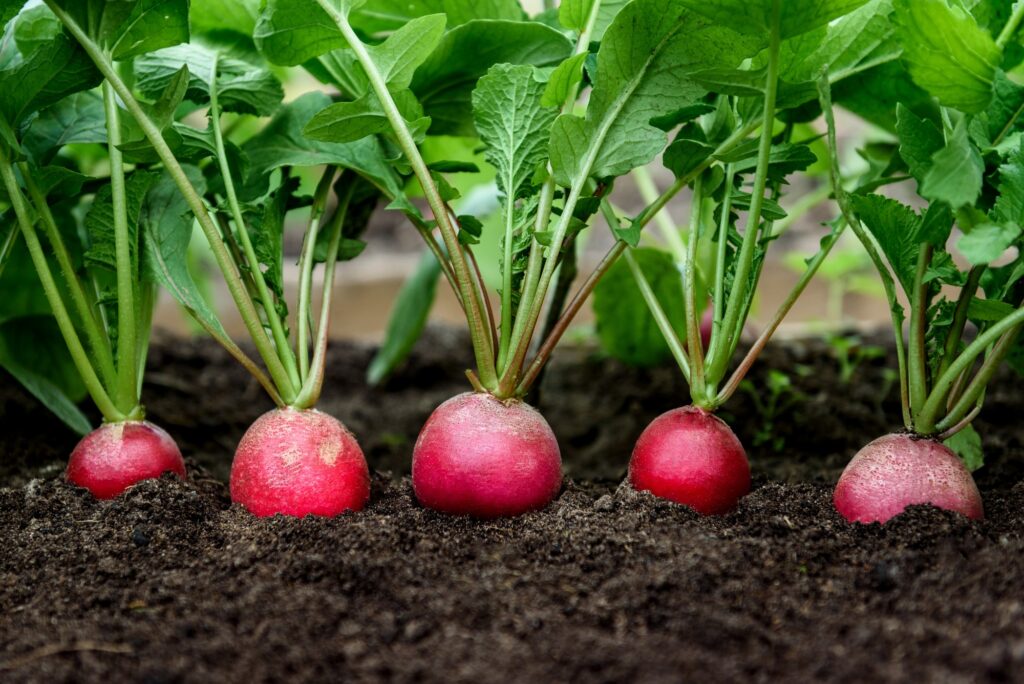
Radishes are one of the fastest vegetables a gardener can grow. Some small spring varieties can go from seed to harvest in little more than a month, making them ideal for beginners, children’s gardens, succession planting, and filling temporary gaps between slower-growing crops.
Their speed does not mean they are impossible to get wrong, however. Radishes produce their crispest, mildest roots when they grow quickly during cool weather with consistent moisture. Crowding, drought, hot temperatures, compacted soil, or simply leaving them in the ground too long can turn potentially tender roots into tough, woody, hollow, or excessively spicy vegetables.
Radishes also offer far more variety than the familiar small round red type. Gardeners can grow elongated French breakfast radishes, white icicle types, multicolored Easter egg mixtures, large Asian daikon radishes, and winter storage radishes with black, white, green, pink, or purple skins.
The secret is matching the type to the season. Small spring radishes thrive during the cool weeks of spring and fall, while larger winter radishes such as daikon are usually planted later for an autumn harvest.
🌱 Radishes at a Glance
- Botanical name: Raphanus sativus
- Plant family: Brassicaceae
- Plant type: Cool-season annual vegetable
- Sun: Full sun to light partial shade
- Soil: Loose, fertile, well-drained soil
- Soil pH: About 6.0 to 7.0
- Planting method: Direct sowing
- Seed depth: About ¼ to ½ inch for most small radishes; larger types may be planted somewhat deeper
- Spacing: About 1 to 2 inches for small radishes after thinning
- Spacing for daikon/winter types: Usually 4 to 6 inches
- Germination: Often within 5 to 10 days
- Spring radish harvest: Frequently about 3 to 5 weeks after planting
- Winter radishes: Take considerably longer
- Water: Consistent moisture
- Best temperatures: Cool weather
- Main problems: Heat, crowding, drought, flea beetles, root maggots, splitting, bolting, and pithy roots
🌿 What Are Radishes?
Radishes are members of the cabbage family, Brassicaceae.
They are related to vegetables such as:
- Broccoli
- Cabbage
- Kale
- Turnips
- Mustard greens
The part most gardeners harvest is an enlarged root and stem structure that develops just below and partly above the soil.
But almost the entire plant is useful.
Young radish leaves are edible, as are flowers and immature seedpods.
🔴 Spring Radishes
Spring radishes are the familiar small, fast-growing types.
They may be:
- Round
- Oval
- Cylindrical
- Elongated
Colors include:
- Red
- Pink
- Purple
- White
- Yellow
- Bicolored
These radishes mature rapidly and are best grown during cool spring and fall weather.
Because they have a short harvest window, they need to be checked frequently once the roots begin swelling.
⚪ Daikon Radishes
Daikon radishes are large Asian radishes that typically develop long white roots, although colored varieties also exist.
They tend to be:
- Larger
- Slower growing
- Milder than some small spring radishes
- Better suited to late-summer planting for fall harvest
Some daikon varieties develop roots more than a foot long under good conditions.
Deep, loose soil is especially important if you want long, straight roots.
⚫ Winter Radishes
Winter radishes are generally larger and slower-growing than spring types.
They may have:
- Black skin
- White skin
- Green skin
- Rose or purple coloring
Winter radishes are often planted in midsummer or late summer and harvested during cool fall weather.
Unlike small spring radishes, many winter types can remain in good condition for a longer period and may store well after harvest.
🌈 Popular Types of Radishes
Gardeners have dozens of choices.
Common types include:
Cherry Belle
A classic round red radish with white flesh.
French Breakfast
An elongated red-and-white radish with crisp flesh.
Easter Egg
Usually sold as a colorful mixture containing red, pink, purple, and white roots.
White Icicle
A long, slender white type.
Daikon
A broad category of large Asian radishes.
Watermelon Radish
Usually pale on the outside with striking pink or reddish flesh inside.
Black Spanish
A winter radish with dark skin and pale flesh.
Choosing several types can extend the season and make the crop much more interesting.
❄️ Radishes Are Cool-Season Vegetables
Temperature is one of the most important parts of radish care.
Radishes grow best during cool weather.
Small spring radishes are happiest when they can develop quickly before summer heat arrives.
Hot weather can cause plants to:
- Bolt
- Become excessively spicy
- Develop woody roots
- Become hollow or pithy
- Produce poor-quality roots
This makes radishes ideal for spring and fall rather than the hottest part of summer.
📅 When Should You Plant Radishes?
In many climates, begin sowing radishes several weeks before the average last spring frost.
The soil does not need to be warm like it does for tomatoes or corn.
Radish seeds can germinate in relatively cool soil.
Continue sowing small amounts every week or two through the cool part of spring.
Once regular hot weather arrives, stop.
Begin planting again in late summer as temperatures start heading downward.
🍂 Fall Radishes Can Be Excellent
Fall is sometimes an even better radish season than spring.
The soil is already warm enough for rapid germination, while the plants mature as air temperatures become progressively cooler.
Fall crops may experience:
- Less bolting
- Better root quality
- Longer harvest windows
Larger winter radishes and daikon are particularly well suited to late-summer sowing for autumn harvest.
🌱 Should You Start Radishes Indoors?
Usually, no.
Radishes are best direct sown where they will grow.
They develop quickly, and transplanting can disturb the root that you are trying to harvest.
There is little advantage to starting them indoors.
Save indoor seed-starting space for crops that genuinely benefit from transplanting.
☀️ How Much Sun Do Radishes Need?
Radishes generally grow best in full sun.
Aim for at least 6 hours of direct sunlight.
During warmer parts of the season, light afternoon shade can sometimes help keep conditions cooler.
However, too much shade may result in:
- Large leafy tops
- Small roots
- Slow development
Fast growth is important for good texture and flavor.
🌱 Best Soil for Radishes
Loose soil is one of the keys to well-shaped radishes.
The best soil is:
- Well drained
- Loose
- Relatively stone-free
- Moderately fertile
- Rich in organic matter
Small round radishes are relatively forgiving.
Long daikon types need deeper preparation.
For ordinary spring radishes, loosen at least the upper 6 inches of soil.
For long daikon varieties, preparing 12 inches or more can produce straighter roots and make harvest much easier.
🪨 Remove Stones and Hard Clods
Roots growing into stones or dense clods may:
- Fork
- Bend
- Become misshapen
You do not need perfectly sifted soil, but breaking up compaction produces a better crop.
If your soil is extremely heavy, consider:
- Raised beds
- Shorter round radish varieties
- Adding finished compost over time
Long daikon radishes are especially difficult in hard, rocky soil.
🧪 What Soil pH Do Radishes Prefer?
A slightly acidic to neutral soil works well.
A range of approximately pH 6.0 to 7.0 is suitable for most radishes.
A soil test is worthwhile if vegetable crops consistently perform poorly.
Do not automatically add lime or fertilizer simply because you are planting radishes.
🌿 Should You Add Compost?
Finished compost can improve poor soil.
It may help with:
- Soil structure
- Organic matter
- Moisture management
- Nutrient availability
Avoid large amounts of fresh manure immediately before planting.
High nitrogen availability can encourage excessive leafy growth, while fresh manure can introduce weeds and other problems.
Use well-decomposed compost instead.
🌱 How to Plant Radish Seeds
Radishes are wonderfully straightforward to sow.
Prepare a smooth seedbed, then create a shallow furrow.
For most small spring radishes:
- Sow seeds about ¼ to ½ inch deep.
- Place seeds roughly 1 inch apart.
- Cover lightly with soil.
- Water gently.
- Keep the surface moist until germination.
Seedlings often appear within about a week under favorable conditions.
📏 How Far Apart Should Radishes Be?
Spacing depends on the type.
Small Spring Radishes
Thin to roughly 1 to 2 inches apart.
Larger Radishes
Give them additional room.
Daikon and Winter Radishes
Spacing of approximately 4 to 6 inches may be appropriate.
Always check the seed packet because mature root size varies dramatically.
Crowding is one of the most common reasons radishes produce lots of leaves without useful roots.
✂️ Thin Radish Seedlings Early
It can feel wasteful to remove healthy seedlings, but thinning is essential.
When plants are crowded, they compete for:
- Light
- Moisture
- Nutrients
- Physical root space
The roots may never swell properly.
Thin while seedlings are young.
You can often eat the tiny thinnings as microgreens or salad greens.
🥗 Radish Leaves Are Edible
Young radish tops can be eaten.
They have a slightly peppery flavor and may be used in:
- Salads
- Soups
- Pesto
- Stir-fries
Older leaves can become rough or hairy depending on the variety.
Use only healthy foliage that has not been treated with products unsuitable for edible crops.
📆 Succession Planting Radishes
Because radishes mature so quickly, planting an entire seed packet at once can create more radishes than you can eat in a single week.
Instead, sow a short row every 7 to 14 days during cool weather.
This creates a continuous sequence of harvests.
Succession planting also prevents dozens of roots from becoming overmature simultaneously.
🥕 Use Radishes as a Fast Gap Crop
Radishes can occupy garden space temporarily before slower or warm-season vegetables need it.
For example, spring radishes may be harvested before it is time to plant:
This makes radishes excellent for gardeners trying to maximize a small vegetable bed.
🌿 Can You Interplant Radishes?
Yes.
Because they grow quickly, radishes can be sown between slower crops while those plants are still small.
Possible neighbors include:
- Onions
- Garlic
- Lettuce
- Peas
- Carrots
- Young brassicas
The radishes are harvested before the neighboring plants need the extra space.
Avoid sowing so densely that the companion crop itself becomes crowded.
💧 How Often Should You Water Radishes?
Consistent moisture is crucial.
Radishes grow quickly and should not repeatedly experience drought.
A general target is around 1 inch of water per week, adjusted for:
- Rainfall
- Soil type
- Temperature
- Plant size
Sandy soils may need more frequent watering.
The important goal is even moisture rather than following a rigid schedule.
⚠️ Irregular Watering Can Cause Splitting
One of the classic radish problems occurs when dry soil is suddenly followed by abundant water.
The inside of the root expands more quickly than the outer tissues can accommodate.
The radish splits.
Consistent moisture reduces this risk.
Harvesting promptly also helps because overmature radishes are more likely to crack.
🌶️ Why Do Radishes Become Too Hot?
The spicy bite of a radish is normal.
But excessively pungent roots often develop when plants grow under stress.
Contributing factors include:
- Hot weather
- Drought
- Slow growth
- Old age
Radishes generally have their best flavor when they grow quickly in cool, moist conditions.
🪵 Why Do Radishes Become Woody?
Woody or fibrous radishes are usually overmature or stressed.
Common causes include:
- Heat
- Drought
- Waiting too long to harvest
- Slow development
Small spring radishes have a particularly short window of peak quality.
Once roots reach harvestable size, do not leave them in the ground for weeks hoping they will simply become larger.
🕳️ What Causes Hollow Radishes?
Older or heat-stressed radishes may become hollow or pithy inside.
This is especially common when spring radishes are allowed to mature during hot weather.
Harvest promptly and choose the right season.
Winter radishes are better suited to producing large roots over a longer period.
🌸 What Does It Mean When a Radish Bolts?
Bolting occurs when the plant changes from producing leaves and roots to producing a flower stalk.
A bolting radish may develop:
- Tall stems
- Flowers
- Seedpods
Once this happens, root quality declines dramatically.
Warm temperatures and long days are major triggers.
You cannot reverse bolting.
Harvest usable roots immediately or allow the plant to flower and produce seedpods.
🌸 Radish Flowers Can Be Attractive
A bolted radish is not necessarily useless.
The flowers may be:
- White
- Pink
- Lavender
- Pale purple
They can attract bees and other insects.
If you have extra garden space, leaving a few bolted plants can be interesting.
They will eventually produce edible seedpods.
🌱 Radish Seedpods Are Edible
Immature radish pods can be eaten while they are still tender.
They have a crisp texture and peppery flavor.
Use them:
- Raw
- Pickled
- Stir-fried
There are even radish varieties grown primarily for their pods rather than roots.
Once pods become mature and fibrous, they are less enjoyable to eat.
🌾 Do Radishes Need Fertilizer?
Usually, radishes do not require heavy feeding in reasonably fertile garden soil.
A soil test can guide fertilization.
Too much nitrogen may create:
- Large leafy tops
- Poor root development
The crop grows so quickly that balanced soil fertility established before planting is often sufficient.
Avoid repeatedly feeding radishes simply because you want faster growth.
🍂 Should You Mulch Radishes?
A light organic mulch can help larger or longer-season radishes by:
- Conserving moisture
- Suppressing weeds
- Moderating soil temperature
Potential materials include:
- Fine straw
- Grass clippings from untreated lawns
- Finished compost
- Shredded leaves
For tiny spring radishes harvested in only a few weeks, mulch may not be necessary.
🌿 Weed Control
Radishes grow so quickly that weeds often have little time to become a serious issue.
Keep young seedlings free from competition.
Hoe shallowly.
Avoid deep cultivation because radish roots are close to the soil surface.
Daikon and winter radishes remain in the garden longer and benefit more from regular weed management.
🪴 Can You Grow Radishes in Containers?
Absolutely.
Small radishes are excellent container vegetables.
Choose a pot at least around 6 inches deep for small round types.
Long radishes need substantially deeper containers.
The pot must have drainage holes.
Fill with a loose potting mix rather than heavy garden soil.
🌱 Growing Radishes in Window Boxes
Small radishes can grow beautifully in window boxes.
Because they remain compact, many plants fit into a modest space.
Make sure the container receives:
- Several hours of sunlight
- Consistent water
- Good drainage
Container soil dries more quickly than garden soil, so check it frequently.
🥕 Growing Daikon in Containers
Daikon requires much more depth.
Choose a deep container, preferably 12 inches or more, depending on the variety.
Shorter daikon cultivars are easier for container gardening.
Use a loose mix that allows roots to penetrate without becoming distorted.
🌱 Can Radishes Grow in Raised Beds?
Yes.
Raised beds are particularly good for radishes because the soil is often:
- Loose
- Deep
- Easy to amend
- Well drained
They are also convenient for succession planting.
You can sow a small section every week or two rather than dedicating the entire bed at once.
🌞 Can You Grow Radishes in Summer?
Sometimes, but ordinary spring radishes frequently perform poorly in hot weather.
If summers are mild, heat-tolerant cultivars may continue producing.
In hot climates, it is usually more productive to stop sowing spring radishes and wait until late summer or fall.
Shade cloth may reduce heat somewhat, but it cannot transform midsummer into ideal radish weather.
❄️ Can Radishes Handle Frost?
Yes.
Radishes tolerate light frost and cool temperatures well.
That is one reason they can be planted before many warm-season vegetables.
Severe freezing may damage exposed roots and foliage.
Harvest mature crops before prolonged hard freezes unless you are growing a hardy winter type and using suitable protection.
🐛 Common Radish Pests
Potential pests include:
- Flea beetles
- Cabbage root maggots
- Wireworms
- Aphids
- Slugs
Because radishes mature so quickly, pest management often focuses on preventing damage during the first few weeks of growth.
🪲 Flea Beetles
Flea beetles are tiny jumping beetles that chew numerous small holes in leaves.
Young radish seedlings can look as though they were peppered with tiny shot holes.
Mature plants often tolerate some damage.
Young seedlings can be weakened when infestations are severe.
Fine insect netting or floating row cover can protect seedlings if installed before pests reach the crop.
🐛 Cabbage Root Maggots
Root maggots tunnel into radish roots.
Affected roots may contain:
- Brown tunnels
- Larvae
- Rot
Because the edible root itself is damaged, even modest infestations can ruin the crop.
Crop rotation and insect-exclusion covers can help where root maggots are a recurring problem.
Row covers must be placed before adult flies lay eggs.
🪱 Wireworms
Wireworms can tunnel into radish roots.
They are more likely in some soils, particularly where beds were recently converted from grassy areas.
Damage appears as holes or tunnels through the root.
Crop rotation and site preparation may reduce problems over time.
🐌 Slugs
Slugs may feed on radish seedlings and exposed roots.
They are more common in:
- Damp weather
- Heavily mulched areas
- Shady gardens
Reduce unnecessary hiding places and inspect plants after rain.
🍄 Common Radish Diseases
Potential diseases include:
- Alternaria leaf spot
- Black rot
- Clubroot
- Downy mildew
- Damping-off
Most home radish crops mature so quickly that serious diseases are less common than insect or environmental problems.
Crop rotation, good drainage, and healthy seed remain useful precautions.
🌱 Clubroot
Clubroot affects members of the cabbage family.
It causes swollen and distorted roots and can severely stunt plants.
Because the pathogen can remain in soil for years, prevention is important.
If clubroot is confirmed, avoid moving contaminated soil to unaffected parts of the garden.
Soil pH management and crop rotation may form part of regional control recommendations.
🔄 Rotate Radishes With Other Crops
Radishes belong to the same family as:
- Cabbage
- Broccoli
- Cauliflower
- Kale
- Turnips
These crops share certain diseases and pests.
Avoid growing brassicas in the exact same area continuously if you experience recurring pest or disease problems.
Crop rotation is particularly valuable for longer-lived soilborne problems.
❓ Why Do My Radishes Have Leaves but No Roots?
This is one of the most common questions.
Possible reasons include:
- Crowding
- Hot weather
- Excessive shade
- Excess nitrogen
- Planting the wrong variety for the season
Start by checking spacing.
Radishes packed tightly together simply do not have room to swell properly.
Heat can also prevent good root formation.
❓ Why Are My Radishes Long and Thin?
Possible causes include:
- Overcrowding
- Insufficient light
- Slow growth
- Variety characteristics
Thin seedlings promptly and make sure the planting receives enough light.
Remember that some cultivars naturally produce elongated roots.
❓ Why Are My Radishes Splitting?
The two most common causes are:
- Waiting too long to harvest
- Sudden heavy watering after a dry period
Maintain even soil moisture and harvest as soon as the roots reach good eating size.
❓ Why Are My Radishes Soft or Spongy?
They may be overmature.
Small spring radishes can quickly become pithy after reaching maturity.
Heat speeds the process.
Check roots frequently during the final week or two of growth.
❓ Why Are My Radishes Bitter?
Heat and stress often intensify flavor.
Other causes include:
- Old roots
- Slow growth
- Drought
Cool conditions and steady moisture produce the mildest, crispiest roots.
❓ Why Did My Radishes Go Straight to Seed?
They bolted.
Likely triggers include:
- Warm temperatures
- Long days
- Delayed planting
- Plant stress
Once a flower stalk begins, root quality will not recover.
Plant the next crop during cooler weather.
❓ Why Did My Radish Seeds Not Germinate?
Possible causes include:
- Soil dried out
- Seeds were planted too deeply
- Soil crusted after heavy rain
- Old seed
- Extreme temperatures
Keep the upper layer of soil gently moist until seedlings emerge.
A hard soil crust can prevent small seedlings from reaching the surface.
🌱 Can You Grow Radishes From Radish Tops?
A cut radish top may produce some leaves under favorable conditions, but it will not regenerate into a new full-size edible root.
For a proper crop, start with seed.
Radishes are so quick and inexpensive to grow from seed that regrowing kitchen scraps offers little advantage.
🌸 Can You Save Radish Seeds?
Yes.
Radishes are generally biennial in their natural life cycle but can flower during their first season under long-day or warm conditions.
Allow selected healthy plants to:
- Flower.
- Produce seedpods.
- Let the pods mature and dry.
- Collect the seeds.
Be aware that radish varieties can cross-pollinate.
Seed saved from several cultivars blooming together may not reproduce the parent variety exactly.
🌱 Are Radishes Good for Beginner Gardeners?
Yes.
They are among the best crops for learning basic gardening skills because they:
- Germinate quickly
- Grow rapidly
- Need little space
- Provide fast feedback
- Work in containers
- Tolerate cool weather
If a crop fails, you can often plant another one immediately without losing an entire season.
👧 Radishes Are Excellent for Children’s Gardens
Children do not have to wait months to see results.
Seeds may germinate within days, and roots can sometimes be harvested only a few weeks later.
Colorful varieties make the process even more interesting.
Try mixtures containing:
- Red
- Purple
- White
- Pink
The fast growth cycle provides an easy introduction to how seeds become food.
🥕 When Are Radishes Ready to Harvest?
Small spring radishes are often ready three to five weeks after planting.
Do not rely entirely on the number of days.
Look at the top of the root where it emerges from the soil.
For round varieties, the shoulder often becomes visible.
Harvest once roots reach the expected size for the cultivar.
✋ How to Harvest Small Radishes
Grasp the foliage close to the crown and pull upward.
In loose soil, roots should come out easily.
If soil is dry and hard, water beforehand or gently loosen it.
Do not leave mature roots in the ground simply because you are not ready to eat them.
Harvest first and refrigerate them.
⛏️ How to Harvest Daikon
Long daikon roots can break if simply pulled from compacted soil.
Use a garden fork or spade alongside the row.
Loosen soil deeply around the root.
Then lift carefully.
This is another reason loose soil and raised beds work particularly well for long radishes.
🍂 When to Harvest Winter Radishes
Winter radishes can usually remain in cool autumn soil longer than small spring types.
Harvest before the ground freezes hard.
They may become quite large while remaining crisp.
Cultivar recommendations are important because mature sizes differ dramatically.
🥬 Remove the Leaves After Harvest
Radish leaves continue losing moisture after harvest.
If left attached, they can draw moisture from the roots and cause them to soften more quickly.
For storage:
- Cut or twist off the greens.
- Leave a small amount of stem if desired.
- Clean the roots.
- Refrigerate promptly.
Use edible greens separately.
🚿 Should You Wash Radishes Before Storage?
For short-term refrigerator storage, radishes can be washed and dried thoroughly.
The most important thing is preventing them from sitting wet.
Excess surface moisture encourages decay.
If you prefer, brush off loose soil and wash shortly before use.
❄️ How to Store Radishes
Small garden radishes store best under cold, humid conditions.
Place trimmed roots in:
- A perforated plastic bag
- A container designed to retain humidity
and refrigerate.
Spring radishes generally have a relatively short storage life compared with winter types.
Large winter radishes and daikon may store substantially longer under proper cold conditions.
🧊 Can You Freeze Radishes?
Raw radishes lose much of their crisp texture after freezing.
If you have an excess harvest, better options include:
- Pickling
- Roasting
- Fermenting
- Cooking them in soups or braises
Freezing cooked radishes is more practical than freezing them for later use as a crisp salad vegetable.
🍳 Can You Cook Radishes?
Yes.
Cooking transforms radishes.
Roasting, sautéing, or braising reduces much of their sharp bite and brings out a milder flavor.
Try them:
- Roasted with root vegetables
- Sautéed in butter or olive oil
- Added to soups
- Pickled
- Thinly sliced in salads
Even gardeners who dislike raw radishes may enjoy them cooked.
🥗 Don’t Forget the Greens
Fresh radish greens can also be cooked.
Young leaves work in:
- Pesto
- Soups
- Sautés
- Mixed greens
They are best used soon after harvest because they wilt more quickly than the roots.
🌱 Radish Care by Season
Radish care changes very little because the crop grows so quickly, but timing is everything.
Spring
Sow as soon as workable soil and regional temperatures allow.
Make repeated sowings during cool weather.
Summer
Stop growing ordinary spring radishes when heat consistently reduces quality.
Plant other crops instead.
Late Summer
Begin sowing fall radishes and larger winter varieties.
Fall
Harvest spring-type radishes promptly and let winter radishes mature in the cool weather.
🌱 Are Radishes Easy to Grow?
Yes.
The basic process is:
- Choose a spring or winter radish suited to the season.
- Plant directly from seed.
- Choose full sun.
- Prepare loose, well-drained soil.
- Sow small radishes about ¼ to ½ inch deep.
- Keep soil moist during germination.
- Thin seedlings promptly.
- Maintain consistent moisture.
- Avoid excessive fertilizer.
- Stop planting spring radishes before severe summer heat.
- Watch for flea beetles and root maggots.
- Harvest small radishes as soon as they reach usable size.
- Dig long daikon carefully.
- Remove the greens before storage.
- Sow another short row for a continuous harvest.
The biggest mistakes are planting during hot weather, failing to thin seedlings, inconsistent watering, and leaving mature radishes in the soil too long.
🌿 Final Thoughts
Radishes are proof that a garden does not need months to produce something satisfying.
A small handful of seeds can become a harvest in only a few weeks, making radishes perfect for beginners, experienced vegetable gardeners looking to maximize space, and anyone who enjoys seeing quick results.
The key is speed.
Radishes should germinate quickly, grow without interruption, and reach harvest before heat or stress slows them down. Give them loose soil, plenty of light, adequate spacing, and consistent moisture.
Thin them even when it feels wasteful. Crowded plants may produce lots of leaves but disappointingly small roots.
And once those roots reach harvestable size, pull them.
Small spring radishes do not improve indefinitely underground. A crisp, mild root can become tough, hollow, or intensely spicy surprisingly quickly.
For a longer season, sow short rows every week or two in spring, pause during summer heat, then begin again as autumn approaches. Add daikon and other winter radishes to the fall garden for larger roots and a completely different harvest.
Few vegetables offer such a quick journey from seed packet to plate — and that makes radishes one of the easiest crops to find room for in almost any garden.
🔗 Related Articles
- How to Plant Onions
- How to Plant Garlic
- How to Plant Potatoes
- How to Plant Tomatoes
- How to Plant Corn
- How to Plant Sweet Potatoes
- Dill Care
- Marigold Care