Kale is one of the most dependable cool-season vegetables a home gardener can grow. It tolerates chilly weather, produces leaves over a long harvest period, grows equally well in traditional vegetable beds and containers, and can often remain productive long after summer vegetables have disappeared.
It is also much more diverse than the curly green bunches found in supermarkets. Gardeners can grow blue-green curly kale, deeply textured Lacinato kale, tender Red Russian types, compact dwarf varieties, and colorful purple cultivars. Some plants are grown for full-size cooking greens, while others can be planted densely and harvested young for salads.
Unlike cabbage, kale does not form a head. The plant continually produces new leaves from its central growing point, which means you can harvest mature outer leaves while allowing younger leaves to remain and continue growing. With this cut-and-come-again approach, a single plant can provide many harvests.
Kale’s greatest strength is its love of cool weather. Spring crops can be planted well before warm-season vegetables, while fall-grown kale may continue producing through frosts and into winter in suitable climates. Cool conditions can also improve its flavor.
Give kale fertile, well-drained soil, consistent moisture, enough space, and protection from cabbage-family pests, and it can become one of the longest-producing crops in the vegetable garden.
🥬 Kale at a Glance
- Botanical name: Brassica oleracea Acephala Group
- Plant family: Brassicaceae
- Plant type: Biennial usually grown as an annual vegetable
- Sun: Full sun to partial shade
- Soil: Fertile, well-drained soil
- Soil pH: Roughly 6.0 to 7.5
- Planting method: Direct seed or transplant
- Seed depth: About ¼ to ½ inch
- Full-size spacing: Usually about 12 to 18 inches apart
- Baby-leaf spacing: Much closer
- Water: Consistent moisture
- Best seasons: Spring and fall
- Cold tolerance: Excellent compared with many vegetables
- Harvest: Individual outer leaves or entire plants
- Edible parts: Primarily leaves and tender stems
- Containers: Excellent
- Main challenges: Cabbage worms, cabbage loopers, aphids, flea beetles, heat, clubroot, and leaf diseases
🌿 What Is Kale?
Kale is a non-heading form of Brassica oleracea, the same species that humans have developed into several remarkably different vegetables.
Its close relatives include:
- Broccoli
- Brussels sprouts
- Cabbage
- Cauliflower
- Collard greens
- Kohlrabi
Kale was selected primarily for its leaves rather than a head, flower buds, swollen stem, or enlarged side buds.
That leafy growth habit is what makes it so useful for repeated harvesting.
🥬 Curly Kale
Curly kale is perhaps the most familiar type.
It usually produces:
- Deeply ruffled leaves
- Green to blue-green coloring
- A sturdy texture
Curly varieties work particularly well for:
- Soups
- Sautés
- Kale chips
- Smoothies
- Cooked greens
Compact varieties are also excellent for containers.
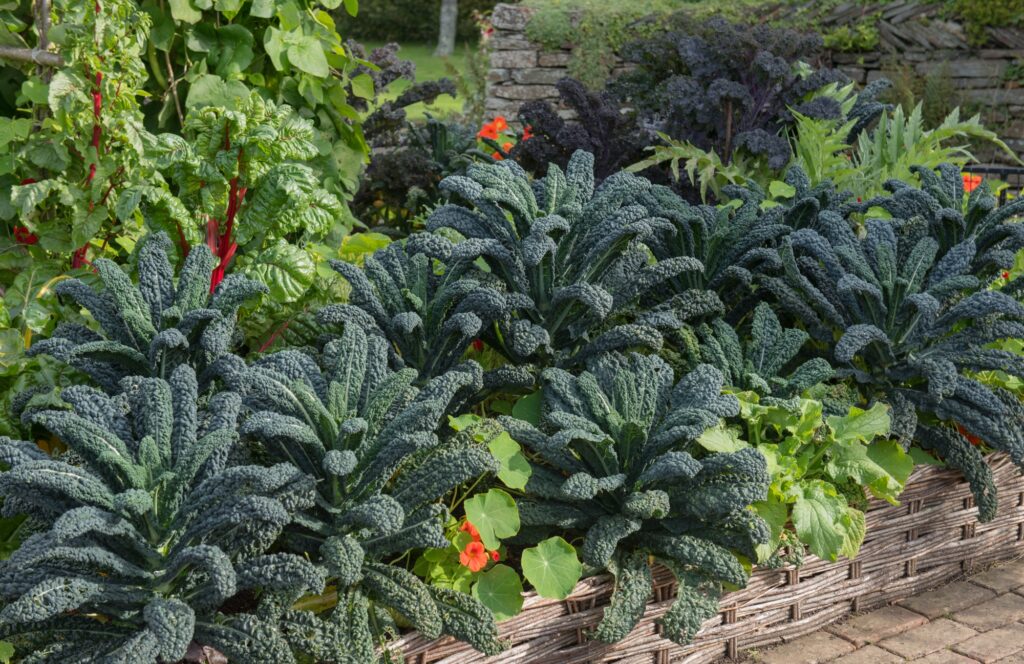
🌿 Lacinato Kale
Lacinato kale is also known as:
- Dinosaur kale
- Tuscan kale
- Cavolo nero
Its leaves are:
- Long
- Narrow
- Dark blue-green
- Heavily puckered
The leaves have a distinctive texture that looks almost reptilian, which explains the “dinosaur kale” nickname.
Lacinato is widely used in Italian cooking and works particularly well in soups, stews, and sautés.
❤️ Red Russian Kale
Red Russian kale generally produces flatter, more tender leaves than heavily curled types.
Plants often have:
- Gray-green foliage
- Purple or reddish stems
- Jagged leaf edges
Young leaves are excellent for salads.
Mature leaves can be cooked like other kale.
💜 Purple and Red Kale
Several cultivars develop purple, burgundy, or reddish foliage.
Their color often becomes more intense in cool weather.
These plants can be both productive vegetables and attractive additions to ornamental edible gardens.
🌈 Ornamental Kale vs. Edible Kale
Ornamental kale is closely related to vegetable kale and is technically edible.
However, it has generally been selected for:
- Color
- Leaf shape
- Decorative value
rather than flavor or tenderness.
Plants sold strictly as ornamentals may also have been treated with pesticides not labeled for edible crops.
If you intend to eat kale, purchase plants or seed specifically sold for vegetable production.
❄️ Kale Loves Cool Weather
Kale is a cool-season crop.
It grows particularly well when daytime temperatures are mild and nights are cool.
Cool conditions encourage:
- Tender leaves
- Good color
- Steady growth
- Mild flavor
Hot summer weather can make plants:
- Tougher
- More bitter
- Slower growing
- More vulnerable to some pests
That makes spring and fall the prime kale seasons in many regions.
🍂 Does Frost Make Kale Sweeter?
Cool weather can improve the flavor of kale.
As the plant responds to cold conditions, changes in the carbohydrates within its tissues can make the leaves taste sweeter and less harsh.
This is why fall-grown kale is so highly valued.
You do not have to wait for frost to eat it, however. Properly grown kale can be tender and flavorful throughout its cool-season growth.
❄️ How Cold Can Kale Survive?
Kale is considerably more cold tolerant than many garden vegetables.
Young plants can tolerate light frost, while established plants of cold-hardy cultivars may survive temperatures well below freezing.
Actual survival depends on:
- Cultivar
- Plant maturity
- Wind
- Snow cover
- Duration of cold
- Acclimation
- Protective structures
A sudden severe freeze can cause more damage than gradually declining temperatures.
📅 When Should You Plant Kale?
Kale can be planted for both spring and fall harvests.
Spring Kale
Seeds or transplants can go into the garden several weeks before the average last frost.
Starting plants indoors can provide an earlier harvest.
Fall Kale
Start seeds in midsummer or late summer so plants mature as temperatures cool.
Fall kale often provides the best combination of:
- Vigorous growth
- Fewer heat problems
- Excellent flavor
Count backward from your expected fall weather using the variety’s maturity period.
🌱 Growing Kale From Seed
Kale is easy to grow from seed.
You can:
- Direct sow outdoors
- Start seedlings indoors
- Sow densely for baby greens
For full-size plants, sow seeds roughly ¼ to ½ inch deep.
Keep the seedbed moderately moist until germination.
Once seedlings emerge, thin them to the appropriate spacing.
🪴 Starting Kale Indoors
Starting kale indoors is useful for both early spring and fall crops.
For spring planting, begin seeds roughly 4 to 6 weeks before you plan to transplant outdoors.
Use:
- Seed-starting mix
- Containers with drainage
- Strong light
Weak indoor light produces tall, floppy seedlings.
Once seedlings have several true leaves and a healthy root system, they can be hardened off for outdoor planting.
🌱 Hardening Off Kale Seedlings
Even though kale tolerates cold weather, indoor-grown plants should still be hardened off.
Over approximately a week:
- Move seedlings outdoors for a few hours.
- Begin in a sheltered location.
- Gradually increase exposure to sun and wind.
- Extend the amount of time outdoors each day.
- Protect seedlings from unusually severe weather at first.
This prepares leaves and stems for outdoor conditions.
☀️ How Much Sun Does Kale Need?
Kale grows best in full sun.
Aim for at least 6 hours of direct sunlight per day.
However, kale tolerates partial shade better than many fruiting vegetables.
In warm climates, afternoon shade may actually help plants remain productive longer by reducing heat stress.
Too much shade can result in:
- Thin growth
- Smaller leaves
- Reduced productivity
🌱 Best Soil for Kale
Kale prefers fertile, well-drained soil with plenty of organic matter.
Ideal soil should:
- Drain freely
- Hold moderate moisture
- Contain organic matter
- Support steady growth
Unlike root crops such as Carrots, kale does not require exceptionally loose or stone-free soil.
Its main requirement is a healthy root zone that does not remain waterlogged.
🧪 What Soil pH Does Kale Prefer?
Kale generally grows well in soil around pH 6.0 to 7.5.
A slightly acidic to neutral range is excellent.
Soil pH becomes particularly relevant where clubroot is a recurring problem because very acidic soil can favor the disease.
However, do not apply lime blindly.
Test the soil first and follow local recommendations.
🌿 Preparing the Kale Bed
Before planting:
- Remove perennial weeds.
- Loosen compacted soil.
- Incorporate finished compost if needed.
- Test the soil if fertility is uncertain.
- Correct major drainage issues.
- Level the planting area.
Kale can remain in the garden for months, so good preparation is worthwhile.
🌾 Does Kale Need Rich Soil?
Kale is a leafy vegetable and needs sufficient nitrogen to keep producing healthy leaves.
However, “more fertilizer” is not automatically better.
Overfertilized plants may become:
- Excessively soft
- Overly lush
- More attractive to some pests
Use soil-test recommendations whenever possible.
Finished compost can contribute organic matter and nutrients without turning the bed into an excessively rich environment.
🌱 How to Plant Kale Seeds Outdoors
Create shallow furrows.
Plant seeds approximately:
- ¼ to ½ inch deep
Sow somewhat closer than the final spacing.
After seedlings emerge and establish several true leaves, thin them.
Water gently so seeds are not washed out of the row.
📏 How Far Apart Should Kale Be Planted?
For large mature plants, space kale roughly 12 to 18 inches apart.
Very large cultivars may appreciate more space.
Closer spacing produces:
- Smaller plants
- Smaller individual leaves
Wider spacing produces:
- Larger plants
- Larger leaves
- Better airflow
If you are growing baby kale, plants can be spaced much more densely because they will be harvested while young.
🌱 Growing Baby Kale
Baby kale is simply young kale harvested before the leaves become large and tough.
Seeds can be sown relatively densely.
Harvest leaves when they are several inches long.
Baby kale is useful for:
- Salads
- Sandwiches
- Smoothies
Because the crop is harvested young, you can grow considerably more plants in a small area than you would for mature kale.
✂️ Thin Kale Seedlings
If direct-sown plants emerge too close together, thin them.
Do not allow a dense patch to become overcrowded.
Poor spacing encourages:
- Reduced airflow
- Competition
- Smaller plants
- Increased disease pressure
Young thinnings are edible and can go directly into salads.
💧 How Often Should You Water Kale?
Kale produces the best leaves when soil moisture remains relatively consistent.
A broad guideline of around 1 to 1½ inches of water per week can be useful, adjusted for:
- Rainfall
- Soil type
- Temperature
- Mulch
- Plant size
Rather than watering on a rigid calendar, check the soil.
Water deeply when needed.
🚿 Consistent Water Produces Better Leaves
Drought-stressed kale may develop:
- Tough leaves
- Stronger flavor
- Slower growth
Consistent moisture encourages tender new foliage.
Avoid the opposite extreme as well.
Kale should not sit in constantly saturated soil.
🍂 Should You Mulch Kale?
Yes.
A layer of organic mulch can help:
- Conserve moisture
- Keep roots cool
- Suppress weeds
- Moderate temperature fluctuations
Good choices include:
- Straw
- Shredded leaves
- Fine bark
- Grass clippings from untreated lawns
- Finished compost
Keep thick mulch from piling tightly against the stem.
🌾 Does Kale Need Fertilizer During the Season?
Kale may benefit from supplemental nitrogen where soil fertility is low.
This is especially useful if you plan to harvest from the same plant repeatedly for several months.
Before fertilizing, consider:
- Existing soil fertility
- Compost already applied
- Plant color
- Growth rate
- Soil-test results
Healthy kale should produce strong new foliage without excessive soft growth.
🌿 Why Is Nitrogen Important for Kale?
Unlike carrots, radishes, and beets, kale is grown primarily for leaves.
Nitrogen supports leafy vegetative growth.
A genuine nitrogen deficiency can produce:
- Pale plants
- Slow growth
- Older leaves yellowing prematurely
But not every yellow leaf indicates nitrogen deficiency.
Overwatering, disease, old age, and root problems can produce similar symptoms.
🌱 Can Kale Grow With Other Vegetables?
Yes.
Kale can share a garden with many crops.
Possible neighbors include:
Companion planting does not eliminate kale pests, so do not rely on neighboring plants as a substitute for monitoring.
🌸 Flowers Near Kale
Flowers can provide nectar and pollen for predatory insects and parasitoid wasps that help regulate garden pests.
Useful garden plants may include:
Grow them because they increase garden diversity rather than expecting any single plant to create an invisible pest barrier around your kale.
🪴 Can Kale Grow in Containers?
Yes.
Kale is one of the best vegetables for container gardens.
For one mature plant, use a container approximately 5 gallons or larger if possible.
Large containers:
- Hold moisture longer
- Provide more root space
- Tip over less easily
- Buffer temperature changes
Compact cultivars can succeed in somewhat smaller pots.
🪴 Best Kale for Containers
Compact curly kale varieties are especially convenient.
You can also grow:
- Lacinato
- Red Russian
- Dwarf types
- Baby kale mixes
If the container is relatively small, harvest leaves regularly so the plant does not become excessively top-heavy.
💧 Water Container Kale Carefully
Pots dry out faster than garden soil.
Check moisture regularly during warm or windy conditions.
Water thoroughly enough that excess drains from the bottom.
Do not keep the container sitting permanently in a tray of water.
Drainage is essential.
🌱 Kale in Raised Beds
Raised beds are ideal for kale.
They provide:
- Good drainage
- Easy soil improvement
- Convenient harvesting
- Better weed control
Because kale can occupy its space for several months, position it so large mature plants do not shade shorter vegetables.
🌿 How Big Does Kale Get?
Size varies considerably.
Compact cultivars may remain under 2 feet tall.
Large vigorous plants can reach:
- 2 to 3 feet
- Sometimes considerably taller over a long season
Older plants that have been harvested repeatedly can develop tall bare stems topped by clusters of leaves, giving them a miniature palm-tree appearance.
That is normal.
✂️ Should You Prune Kale?
Kale does not require pruning in the traditional sense.
Harvesting serves much the same purpose.
Remove:
- Mature outer leaves
- Yellow leaves
- Damaged foliage
- Diseased leaves
Leave the central growing point intact.
The plant will continue producing new foliage from the top.
🥬 How to Harvest Kale Without Killing the Plant
The easiest method is to harvest from the bottom upward.
Choose mature outer leaves.
Then:
- Hold the leaf near its base.
- Snap or cut it cleanly.
- Leave younger central leaves untouched.
Never cut through the central growing point unless you intend to harvest the entire plant.
As long as the center remains healthy, new leaves can continue developing.
✂️ How Many Kale Leaves Can You Harvest at Once?
Avoid stripping the plant bare.
A good rule is to leave plenty of healthy foliage so the plant can continue photosynthesizing.
Take a few mature outer leaves from each plant rather than removing almost everything from one.
Large established plants tolerate heavier harvesting than small young plants.
🌱 Harvesting Baby Kale
Baby kale can be harvested when leaves are only a few inches long.
You can:
- Snip individual leaves
- Cut groups of seedlings
If using a cut-and-come-again method, avoid cutting below the growing points.
A dense patch may produce more than one baby-leaf harvest.
🥬 When Is Kale Ready to Harvest?
Baby leaves can be harvested relatively quickly.
Full-size kale is often ready in roughly 50 to 70 days, depending on:
- Variety
- Whether it was transplanted or direct sown
- Temperature
- Desired leaf size
You do not need to wait for the plant to reach a particular “mature” moment.
Once leaves are large enough for your intended use, begin picking.
🌅 Best Time of Day to Harvest Kale
Morning is an excellent time to harvest.
Leaves tend to be:
- Cool
- Firm
- Well hydrated
However, kale can be picked whenever you need it.
During hot weather, avoid leaving freshly harvested leaves sitting in direct sunlight.
🍂 Harvest Kale After Frost
If you have fall kale, try harvesting after cool nights or light frost.
Many gardeners notice improved flavor.
Do not assume that frost makes every damaged leaf better, however.
Leaves injured by severe freezing should be inspected and discarded if they become soft or decayed.
🥬 Can You Harvest Kale All Winter?
In some climates, yes.
With suitable cultivars and protection, kale may continue producing through much of winter.
Potential protection includes:
- Cold frames
- Low tunnels
- Row cover
- Mulch around roots
In severe winter climates, plants may stop actively growing but remain alive until temperatures moderate.
❄️ Snow Can Protect Kale
Snow acts as insulation.
A plant beneath snow may experience less severe temperature fluctuation than one exposed directly to icy wind.
Once snow melts, healthy foliage can sometimes be harvested again.
Hardiness still depends heavily on cultivar and actual conditions.
☀️ Can Kale Grow During Summer?
Yes, but quality often declines when weather becomes very hot.
Summer kale may become:
- Tougher
- More bitter
- Pest-prone
In regions with cool summers, plants can continue producing.
In hot climates, consider giving plants afternoon shade or simply treating kale primarily as a spring-and-fall vegetable.
🌡️ Why Does Kale Taste Bitter?
Some bitterness is natural.
It can become stronger because of:
- Hot weather
- Drought
- Plant stress
- Older leaves
Younger leaves generally taste milder.
Cool-weather kale usually has a sweeter flavor than heat-stressed summer kale.
🌸 Does Kale Bolt?
Yes.
Kale is a biennial plant.
After experiencing the appropriate cold conditions, surviving plants may respond to longer spring days by producing a tall flowering stalk.
Once bolting begins:
- Leaves become smaller.
- Stems become tougher.
- The plant focuses on flowers and seeds.
The crop is approaching the end of its leafy production cycle.
🌼 Are Kale Flowers Edible?
Yes.
Kale flower buds and flowers are edible when produced by correctly identified, untreated plants.
The tender flowering shoots can be cooked somewhat like broccoli raab.
They offer one final harvest from overwintered kale before the plant completes its life cycle.
🐝 Kale Flowers and Pollinators
If you leave some bolting plants in the garden, their yellow flowers can attract:
- Bees
- Hoverflies
- Other insects
Flowering kale can become a useful early-season insect resource.
If you want to save seed, allow selected plants to continue flowering.
🌱 Can You Save Kale Seeds?
Yes.
Because kale is normally biennial, seed production usually occurs during the second growing season.
Allow plants to:
- Overwinter.
- Flower.
- Develop elongated seedpods.
- Allow the pods to mature.
- Collect them before they shatter extensively.
Dry the seed thoroughly before storage.
⚠️ Kale Cross-Pollinates With Other Brassicas
Seed saving becomes complicated because kale can cross with other Brassica oleracea crops.
These include:
- Broccoli
- Cabbage
- Brussels sprouts
- Cauliflower
- Collards
- Kohlrabi
If they flower together, the resulting seed may not reproduce your kale cultivar true to type.
For most home gardeners, buying fresh seed is easier.
🐛 Common Kale Pests
Because kale belongs to the cabbage family, it attracts many of the same pests as cabbage and broccoli.
Important pests include:
- Imported cabbageworms
- Cabbage loopers
- Diamondback moth caterpillars
- Aphids
- Flea beetles
- Harlequin bugs
- Slugs
Regular inspection is one of the best defenses.
🦋 Imported Cabbageworms
Those familiar small white butterflies fluttering around brassica beds can be adult imported cabbageworms.
The green caterpillars feed on kale foliage and may create:
- Holes
- Ragged leaves
- Dark droppings
Inspect leaf undersides regularly.
Small caterpillars can be removed by hand.
🐛 Cabbage Loopers
Cabbage loopers are green caterpillars that move with a distinctive looping motion.
They can chew large irregular holes in leaves.
Look along:
- Leaf veins
- Undersides
- Curled portions of foliage
Hand-picking is practical in a small garden.
🐛 Diamondback Moth Caterpillars
These small green larvae also feed on cabbage-family vegetables.
Young caterpillars may create small window-like areas in leaves before chewing complete holes.
Because several green caterpillars can occur simultaneously, identifying the exact species is less important than noticing damage early.
🕸️ Use Row Cover Before Pests Arrive
Fine insect netting or floating row cover can be one of the most effective ways to protect kale.
Cover plants soon after planting.
Secure the edges so flying insects cannot enter.
If eggs or caterpillars are already underneath the cover, the fabric will simply protect the pests along with the kale.
Inspect plants before covering.
🐜 Aphids on Kale
Aphids frequently cluster in tightly curled kale leaves.
They may appear:
- Green
- Gray
- Blackish
Large colonies can be difficult to wash out once they become established.
Check plants frequently, especially the newest leaves.
A firm stream of water can dislodge small infestations.
Natural predators also help control aphids.
🪲 Flea Beetles
Flea beetles are particularly troublesome on young seedlings.
They create many tiny holes that give leaves a shot-hole appearance.
Large established kale often tolerates modest damage.
Seedlings may be severely weakened.
Row covers provide useful protection during establishment.
🐞 Harlequin Bugs
Harlequin bugs are brightly patterned stink bugs that feed on brassicas.
Heavy feeding can cause:
- Pale spots
- Wilted leaves
- Plant decline
They can become especially troublesome as weather warms.
Remove adults and egg masses where practical.
🐌 Slugs and Snails
Slugs and snails may chew irregular holes in kale leaves.
They thrive in:
- Damp conditions
- Dense mulch
- Shaded gardens
Inspect plants after rain or at night.
Remove unnecessary hiding places if populations become high.
🍄 Common Kale Diseases
Potential diseases include:
- Black rot
- Clubroot
- Alternaria leaf spot
- Downy mildew
- Powdery mildew
- Damping-off
- Various root rots
Prevention is particularly important because many brassica diseases can affect several related vegetables.
⚫ Black Rot
Black rot is a bacterial disease that can affect kale and other brassicas.
A characteristic symptom is yellowing that begins at the leaf margin and progresses inward, sometimes forming a V-shaped area.
Darkened veins may also occur.
Management emphasizes:
- Clean seed or transplants
- Crop rotation
- Sanitation
- Avoiding unnecessary movement through wet plants
Remove severely affected plants.
🌱 Clubroot
Clubroot is a serious soilborne disease of cabbage-family crops.
Affected roots become:
- Swollen
- Club-shaped
- Distorted
Above ground, plants may:
- Wilt during warm weather
- Grow poorly
- Yellow
- Remain stunted
Once established, clubroot can persist in soil for many years.
Prevention is therefore extremely important.
🔄 Rotate Kale and Other Brassicas
Do not treat kale, broccoli, cabbage, cauliflower, Brussels sprouts, and related vegetables as different crops for rotation purposes.
They belong to the same family and share many problems.
Where disease pressure exists, rotate the entire brassica group away from the affected bed for several years.
A three- to four-year interval is a useful goal for many problems where garden space permits.
🌧️ Downy Mildew
Downy mildew tends to develop during cool, moist conditions.
Leaves may show:
- Yellow areas
- Brown lesions
- Grayish growth underneath
Good spacing and airflow help foliage dry.
Avoid unnecessary overhead irrigation late in the day.
🍃 Alternaria Leaf Spot
Alternaria can create dark circular spots on leaves.
Older leaves may become heavily damaged.
Remove affected debris and avoid planting brassicas repeatedly in the same location.
🌱 Damping-Off
Damping-off primarily affects seedlings.
Young plants may:
- Fail to emerge
- Collapse at soil level
- Develop rotted stems
Avoid:
- Waterlogged seed-starting mix
- Dirty containers
- Excessively dense sowing
Provide airflow after seedlings emerge.
❓ Why Are My Kale Leaves Turning Yellow?
Several things can cause yellow leaves.
Possibilities include:
- Normal aging of old leaves
- Nitrogen deficiency
- Overwatering
- Poor drainage
- Root disease
- Pest pressure
If only the lowest leaves yellow while the center continues growing vigorously, simply remove the old foliage.
If the entire plant becomes pale, investigate the root zone and fertility.
❓ Why Does My Kale Have Holes?
Caterpillars and flea beetles are the most likely suspects.
Look carefully at the leaves.
Large irregular holes often suggest caterpillars.
Numerous tiny holes frequently indicate flea beetles.
Check leaf undersides before deciding that the pest has disappeared.
❓ Why Is My Kale Curling?
Possible causes include:
- Aphids
- Heat stress
- Drought
- Variety characteristics
- Disease
Some kale cultivars are naturally extremely curly.
If new foliage suddenly becomes distorted, inspect for aphids.
❓ Why Is My Kale Not Growing?
Possible causes include:
- Poor soil fertility
- Root damage
- Excessive heat
- Drought
- Crowding
- Too little light
- Clubroot
- Cold soil slowing growth
Young spring kale may grow slowly during cold weather and accelerate once temperatures become milder.
❓ Why Is My Kale Tough?
Leaves may become tough because of:
- Heat
- Drought
- Age
- Slow growth
Harvest younger leaves and maintain consistent moisture.
For mature leaves, remove the thick central rib before cooking.
❓ Why Is My Kale Turning Purple?
Purple coloration may be completely normal depending on the variety.
Cold weather can intensify purple pigments.
In green cultivars, unusual purpling combined with poor growth can sometimes indicate stress or nutrient problems.
Consider the cultivar and overall plant health before assuming something is wrong.
❓ Why Is My Kale Flowering?
The plant is bolting.
Overwintered kale naturally flowers as days lengthen during its second season.
Heat and other stresses may accelerate flowering in some situations.
Once the plant commits to flowering, normal large-leaf production will not fully resume.
Harvest the tender shoots or replace the plant.
❓ Can Kale Grow Back After Cutting?
Yes, provided you do not remove or damage the central growing point.
Harvest outer leaves and allow the center to remain.
The plant will continue producing new leaves.
If you cut the entire plant off below its active growth point, regrowth is much less reliable.
❓ Can You Eat Kale After It Flowers?
Yes.
Tender leaves, buds, and young flower stalks remain edible.
Older foliage may become tougher or stronger tasting.
The flowering shoots themselves can be a useful final harvest.
🥬 How to Store Fresh Kale
After harvest:
- Remove badly damaged leaves.
- Keep the kale cool.
- Refrigerate promptly.
Do not leave harvested kale sitting in the sun.
Kale stores best in a humid refrigerator environment without being soaking wet.
A perforated bag or produce container can help prevent excessive drying.
🚿 Should You Wash Kale Before Storing It?
You can, but the leaves should be thoroughly dried afterward.
Moisture trapped on foliage encourages deterioration.
For maximum storage life, many gardeners prefer to:
- Harvest
- Refrigerate unwashed leaves
- Wash shortly before use
Always wash garden kale carefully before eating, particularly the curled areas where soil and insects can hide.
❄️ Can Kale Be Frozen?
Yes.
Freezing is one of the easiest ways to preserve a large kale harvest.
For best long-term quality, kale is typically blanched before freezing.
After blanching:
- Cool quickly in ice water.
- Drain thoroughly.
- Remove excess moisture.
- Package for freezing.
Frozen kale works well in cooked dishes and smoothies.
🥗 Can You Eat Kale Raw?
Yes.
Young tender leaves are especially good raw.
For mature curly kale:
- Remove thick stems.
- Chop the leaves.
- Add a small amount of dressing.
- Massage the leaves briefly.
Massaging softens the texture and makes mature kale easier to eat in salads.
🍳 Ways to Cook Kale
Kale can be:
- Steamed
- Sautéed
- Roasted
- Baked into chips
- Added to soup
- Added to stew
- Mixed into pasta
- Stir-fried
- Blended into sauces
Longer cooking softens mature leaves.
Tender young leaves need much less time.
🌿 Can You Eat Kale Stems?
Yes.
The thick stems are edible but take longer to cook than leaves.
Rather than discarding them, you can:
- Chop them finely.
- Sauté them first.
- Add them to soups.
- Stir-fry them.
Very woody older stems may be less pleasant.
🌱 Kale Care in Spring
Spring is an excellent time to grow kale.
Focus on:
- Direct sowing or transplanting
- Keeping young plants watered
- Protecting seedlings from flea beetles
- Covering plants before cabbage butterflies arrive
- Thinning crowded seedlings
Harvest outer leaves as soon as they become large enough to use.
☀️ Kale Care in Summer
Summer conditions vary dramatically.
In cool climates, plants may continue producing well.
In hot climates:
- Provide consistent water.
- Mulch the soil.
- Consider afternoon shade.
- Watch for aphids and caterpillars.
- Harvest leaves while young.
If plants become extremely tough and bitter, replacing them with a new fall crop may be easier.
🍂 Kale Care in Fall
Fall is arguably kale’s best season.
As temperatures fall:
- Growth remains productive.
- Pest pressure may decrease.
- Flavor often improves.
Continue harvesting lower leaves.
Leave healthy central growth intact.
Fall plants can frequently continue well beyond the first frost.
❄️ Kale Care in Winter
Winter care depends on climate.
In mild regions, continue harvesting normally.
In colder areas, add:
- Row cover
- Low tunnels
- Cold frames
Mulching around roots can moderate soil-temperature fluctuations.
During deeply frozen periods, plants may stop growing even if they remain alive.
Harvest again when conditions moderate.
🌱 Kale Care in the Second Spring
If kale survives winter, it may begin growing rapidly as temperatures rise.
Harvest tender new leaves and flower shoots.
Eventually the plant will bolt and flower.
At that stage you can:
- Harvest the flowers
- Leave them for insects
- Save seed
- Remove the plant
Use the vacated space for a new crop.
🥬 How Long Will One Kale Plant Produce?
Under good conditions, kale can produce leaves for many months.
A spring-planted plant may continue into summer in a cool climate.
A fall plant may survive winter and continue into the following spring.
Eventually, however, kale completes its biennial life cycle by flowering and producing seed.
For the highest-quality leaves, most gardeners simply grow new plants each season.
🥬 Is Kale Easy to Grow?
Yes.
The basic process is:
- Plant during cool weather.
- Choose full sun or partial shade.
- Use fertile, well-drained soil.
- Sow seeds about ¼ to ½ inch deep or use transplants.
- Space full-size plants roughly 12 to 18 inches apart.
- Maintain consistent moisture.
- Mulch to conserve water.
- Provide moderate fertility.
- Protect young plants from flea beetles.
- Watch for cabbage worms and loopers.
- Harvest mature outer leaves first.
- Leave the central growing point intact.
- Remove yellow or diseased foliage.
- Plant another crop for fall.
- Leave cold-hardy plants in the garden as long as conditions permit.
- Rotate kale and other brassicas to reduce pest and disease problems.
The biggest mistakes are planting too densely, allowing plants to become drought-stressed, overlooking caterpillars hidden beneath the leaves, and accidentally cutting out the growing center during harvest.
🥬 Final Thoughts
Kale earns its reputation as one of the most dependable vegetables in the garden.
It does not demand perfect weather, it can withstand cold conditions that stop many other crops, and you do not need to harvest an entire plant at once. Pick the mature outer leaves and the center simply keeps growing.
Timing makes an enormous difference.
Spring kale can provide some of the year’s earliest substantial greens, but fall kale is often even better. Plants mature as temperatures decline, frost can improve flavor, and cold-hardy cultivars may continue producing into winter.
Good kale care is mostly about keeping the plant growing steadily. Give it fertile, well-drained soil, enough water to prevent drought stress, and adequate room for air to move between plants. Check the leaves frequently for cabbage worms, loopers, aphids, and flea beetles rather than waiting until damage becomes severe.
When harvesting, work from the bottom upward. Take the large outer leaves and leave the small central leaves untouched. A healthy plant will replace what you remove, allowing the same kale plant to feed you repeatedly rather than providing a single harvest.
Whether you grow compact curly kale in a patio container, rows of Lacinato in a raised bed, tender Red Russian leaves for salads, or a cold-hardy fall crop beneath a low tunnel, kale offers an unusually long harvest from a relatively small amount of garden space.
🔗 Related Articles
- Carrot Care: How to Plant, Grow & Harvest Carrots
- Beet Care: How to Plant, Grow & Harvest Beets
- Radish Care: How to Plant, Grow & Harvest Radishes
- How to Plant Onions
- How to Plant Garlic
- Dill Care
- Yarrow Care
- Marigold Care