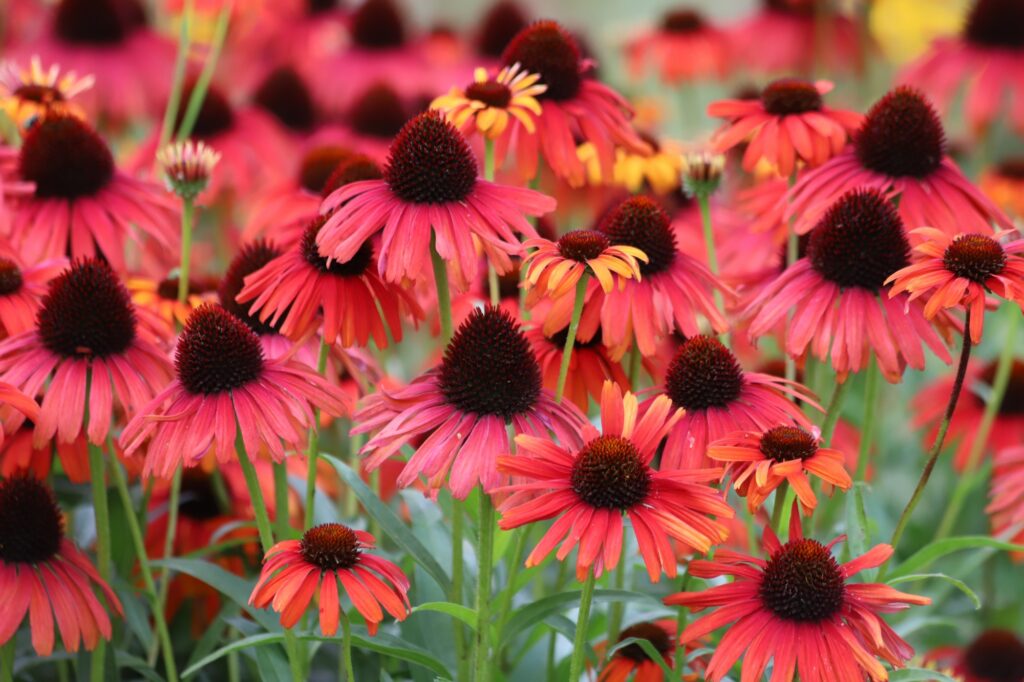
Coneflowers are among the most dependable flowering perennials for a sunny garden. Their distinctive raised centers and daisy-like petals provide weeks of summer color while attracting bees, butterflies, and other pollinators. After flowering ends, the seed heads can remain standing to provide food for birds and texture in the fall and winter garden.
The familiar purple coneflower, Echinacea purpurea, is native to parts of the central and eastern United States, but modern gardeners can choose from an extraordinary range of Echinacea cultivars. Flowers now come in purple, pink, white, yellow, orange, red, coral, and greenish tones, with plant sizes ranging from compact varieties suited to smaller spaces to substantial perennials several feet tall.
Coneflowers are also relatively forgiving. Once established, many tolerate heat, humidity, periods of drought, and ordinary garden soil. They do not require elaborate fertilizing or constant attention, making them particularly valuable for gardeners who want a long-lasting flower display without creating a high-maintenance perennial bed.
Give Echinacea plenty of sunlight, good drainage, and enough space to mature, and these sturdy plants can become a reliable part of the garden for years.
⚡ Coneflower Quick Care Guide
Botanical genus: Echinacea
Plant type: Herbaceous perennial
Common name: Coneflower, purple coneflower
Light: Full sun is best; partial shade is tolerated by many types
Soil: Well-drained soil; adaptable to clay, loam, sandy, and rocky conditions depending on species
Water: Regular moisture while establishing; moderately drought tolerant once established
Bloom time: Generally summer into early fall
Flower colors: Purple, pink, white, yellow, orange, red, coral, and other shades depending on cultivar
Height: Often around 2 to 4 feet, although compact and taller varieties are available
Wildlife value: Attracts bees, butterflies, and other pollinators; mature seeds can feed birds
Maintenance: Low to moderate
Best uses: Perennial borders, pollinator gardens, native gardens, cottage gardens, meadows, cutting gardens, and naturalized plantings
🌸 What Is a Coneflower?
True Echinacea coneflowers belong to the daisy family, Asteraceae.
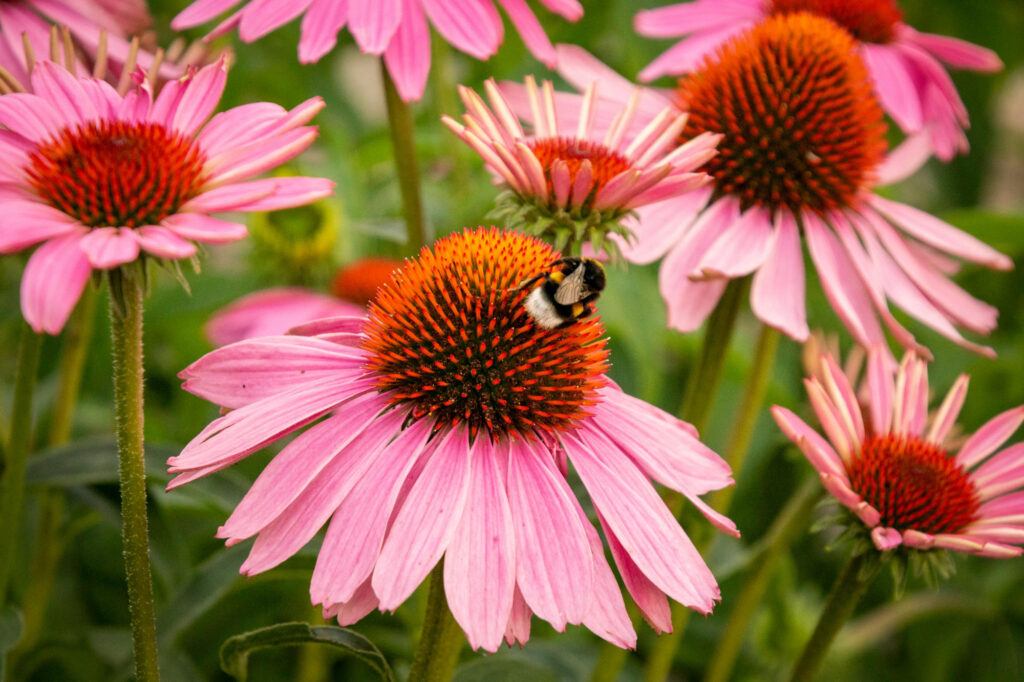
Their familiar flower structure consists of colorful ray florets surrounding a raised central disk. That prominent, often prickly-looking cone gives the plant its common name.
The botanical name Echinacea comes from a Greek word associated with a hedgehog or sea urchin, referring to the spiny appearance of the central flower cone.
Several Echinacea species are native to North America.
The one most familiar in ornamental gardens is purple coneflower (Echinacea purpurea), but gardeners may also encounter narrow-leaved coneflower (Echinacea angustifolia), pale purple coneflower (Echinacea pallida), yellow coneflower (Echinacea paradoxa), Tennessee coneflower (Echinacea tennesseensis), and numerous modern hybrids.
This diversity helps explain why not every coneflower behaves exactly the same way.
🌿 Purple Coneflower: Echinacea purpurea
Echinacea purpurea is the species most people picture when they hear the word coneflower.
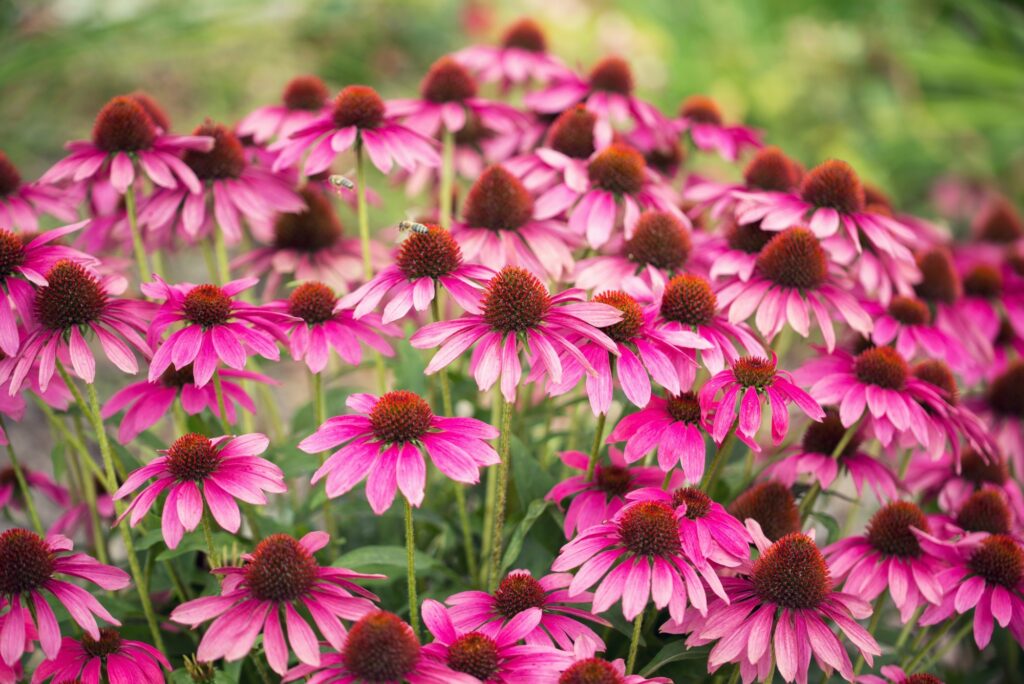
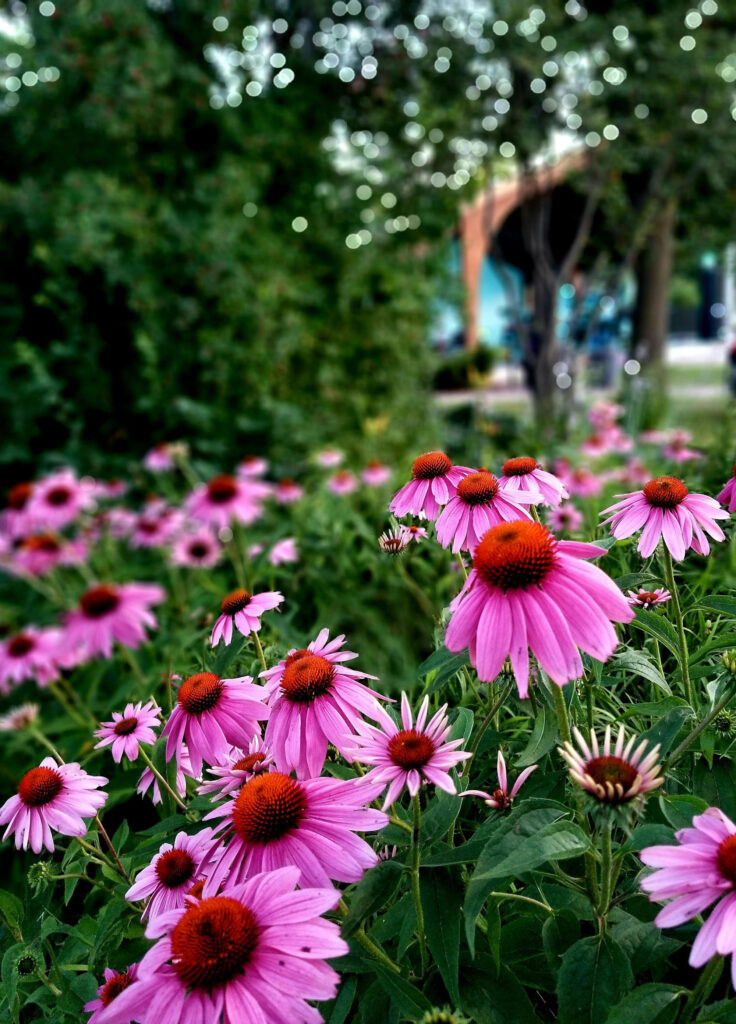
The plant typically develops upright stems topped with large pinkish-purple flowers surrounding orange-brown to dark central cones.
Established plants commonly reach several feet tall and work beautifully in the middle or back of perennial borders.
Purple coneflower is valued for its adaptability. It can tolerate several soil types as long as drainage is adequate, handles summer heat well, and becomes reasonably drought tolerant after establishment.
It also has substantial wildlife value.
The flowers attract pollinators during summer, while mature seed heads can provide food for birds later in the year.
☀️ How Much Sun Do Coneflowers Need?
Coneflowers perform best in full sun.
Aim for at least six hours of direct sunlight per day. Plants receiving abundant light usually develop stronger stems, more compact growth, and a heavier flower display.
Many Echinacea plants will tolerate partial shade, but flowering may become less impressive and stems may stretch toward the available light.
Some afternoon shade can be useful in exceptionally hot climates, but coneflowers should not generally be treated as shade-garden plants.
If an established coneflower produces lots of foliage but very few flowers, evaluate the amount of light before assuming that the plant needs fertilizer.
For help understanding sunlight and other basic growing conditions, visit our Gardening Basics hub.
🌎 Best Soil for Coneflowers
Coneflowers are relatively adaptable when it comes to soil.
Purple coneflower can grow in clay, loam, sandy soil, and even somewhat rocky conditions, provided excess water can drain away.
The ideal garden soil does not need to be extraordinarily rich.
In fact, coneflowers growing in excessively fertile soil can sometimes become taller and floppier than plants growing in more moderate conditions.
If you are preparing a new bed, improving poor soil with a reasonable amount of finished compost can be useful, but avoid creating an extremely rich planting pocket.
Roots eventually need to move outward into the surrounding ground.
The goal is healthy, well-structured soil rather than an enormous supply of fertilizer.
For a deeper look at garden soil, visit Gardening Soil 101.
💧 Drainage Matters
Coneflowers tolerate dry spells much better than they tolerate constantly waterlogged roots.
Avoid planting them in low areas where water stands for long periods after rain.
Soil can be moist without being saturated. Ideally, the root zone receives moisture and then drains sufficiently for air to return to the soil.
If the garden remains soggy for days after rainfall, consider improving drainage or choosing a plant better adapted to wet conditions.
A raised bed may help in certain difficult landscapes. See our Raised Bed Gardening for Beginners guide if poor soil or drainage makes conventional planting difficult.
🧪 What Soil pH Do Coneflowers Prefer?
Purple coneflower adapts to a useful range of garden conditions and does not normally require gardeners to obsess over small pH differences.
Before trying to change your soil pH, have the soil tested.
Adding lime, sulfur, or other amendments without knowing the starting conditions can create problems that did not previously exist.
A laboratory soil test can also reveal whether nutrients are actually deficient.
Coneflowers generally perform well without intensive soil modification when planted in reasonably healthy, well-drained garden soil.
📅 When to Plant Coneflowers
Spring is an excellent time to plant coneflowers in many regions.
Spring planting provides an entire growing season for roots to become established before winter.
Early fall can also be an appropriate planting period for perennial Echinacea when sufficient time remains for roots to establish before the ground freezes.
Avoid transplanting during extreme heat whenever possible.
A coneflower moved into the garden during hot, dry midsummer weather requires considerably more attention to watering than the same plant installed during mild spring conditions.
If you purchase a plant during summer, you can still plant it successfully—just monitor moisture carefully until the root system expands into the surrounding soil.
🌱 How to Plant Coneflowers
Choose a location with plenty of sunlight and well-drained soil.
Dig a hole approximately as deep as the root ball and somewhat wider.
Remove the plant from its nursery container and inspect the roots. If roots are tightly circling the pot, loosen them gently so they are encouraged to move outward.
Position the plant so its crown sits approximately at the same soil level it occupied in the container.
Backfill with the surrounding garden soil and water thoroughly.
Do not bury the crown deeply beneath soil or mulch.
Continue checking soil moisture regularly during the plant’s establishment period.
📏 How Far Apart Should Coneflowers Be Planted?
Spacing depends on the variety.
A compact cultivar may need substantially less room than a traditional Echinacea purpurea capable of reaching several feet tall.
Many standard coneflowers mature somewhere around 1 to 2 feet wide, but cultivar dimensions vary considerably.
Check the plant label and plan according to mature width rather than nursery-pot size.
Appropriate spacing helps provide airflow and prevents mature plants from becoming unnecessarily crowded.
It also creates a better visual display.
Three properly spaced coneflowers will eventually produce a much more attractive group than six plants crammed together simply because the garden looked empty during the first season.
💦 How Often Should You Water Coneflowers?
Newly planted coneflowers need consistent moisture while they become established.
Water thoroughly after planting and continue checking the root zone during dry weather.
Do not interpret “drought tolerant” as meaning a new transplant does not need water.
Drought tolerance develops as roots expand and the plant becomes established.
Mature coneflowers can handle periods of dry weather, but prolonged drought may still reduce flowering and stress the plants.
Instead of watering according to a fixed schedule, check the soil.
Temperature, rainfall, wind, mulch, soil texture, and plant size all influence how quickly the root zone dries.
🚿 Water Deeply Rather Than Constantly
When established coneflowers need irrigation, thorough watering is generally preferable to frequent light sprinkling.
Moistening a larger portion of the root zone encourages roots to explore deeper and wider areas of soil.
Repeated surface watering can keep only the upper layer damp.
Direct water toward the soil whenever practical.
Drip irrigation, soaker hoses, or careful hand watering can limit unnecessary leaf wetness and deliver moisture directly where roots can use it.
If overhead irrigation is the only practical option, watering earlier in the day gives foliage more time to dry.
🍂 Should You Mulch Coneflowers?
Mulch can be helpful around coneflowers.
An appropriate layer of organic mulch helps conserve soil moisture, suppress many weeds, moderate soil-temperature changes, and protect the soil surface.
Shredded leaves, wood chips, bark, and similar materials can work well in perennial beds.
Do not pile mulch tightly around the crown.
Keep the material slightly away from the base of the stems so the plant is not buried.
More mulch is not automatically better. A moderate layer is enough to provide the benefits without smothering the crown.
🌱 Do Coneflowers Need Fertilizer?
Usually not much.
Coneflowers evolved as relatively resilient plants and generally do not require an aggressive feeding program.
A garden bed with reasonable fertility may support excellent plants with little supplemental fertilizer.
Excessive feeding—particularly large amounts of nitrogen—can encourage lush, floppy growth.
If your plants are performing poorly, consider sunlight, water, drainage, crowding, root condition, pests, and disease before reaching for fertilizer.
When nutrient problems are suspected, a soil test can provide much more useful guidance than guessing.
🌸 When Do Coneflowers Bloom?
Purple coneflowers typically bloom during summer and may continue producing flowers into early fall.
The exact timing depends on climate, cultivar, plant maturity, and weather.
A mature group can provide many weeks of flowers because buds open over an extended period rather than all at once.
This long flowering season makes Echinacea particularly useful in perennial borders.
As spring flowers and early-summer plants begin fading, coneflowers can take over much of the visual display.
Later-blooming plants such as Helenium can then help extend garden color farther toward autumn.
✂️ Should You Deadhead Coneflowers?
Deadheading can encourage additional flowering on many coneflowers.
Remove faded flowers by cutting the spent stem back to a healthy leaf or lateral flower bud.
You do not have to remove every old flower.
A useful approach is to deadhead earlier blooms during summer and then allow some later flower heads to mature.
This gives you the possibility of additional flowers while still leaving seeds for birds and winter interest.
If you want coneflowers to self-seed, leaving mature flower heads is especially important.
🐦 Leave Some Coneflower Seed Heads
A coneflower does not stop being useful when its petals fall.
The raised central cones mature into seed heads that can remain standing through fall and winter.
American goldfinches and other seed-eating birds may visit them.
The dark seed heads also create attractive structure after many other perennials have disappeared.
For this reason, healthy coneflowers do not need to be cut to the ground during autumn cleanup.
Allow at least some stems and seed heads to remain.
They can be cut down later, usually in late winter or early spring before new growth becomes vigorous.
🐝 Coneflowers for Pollinators
Coneflowers are excellent additions to pollinator gardens.
Their flowers provide nectar and pollen used by bees, butterflies, and other insects.
Planting several coneflowers together creates a larger and more visible resource than scattering individual plants randomly through a large landscape.
For an even better pollinator garden, combine Echinacea with plants that flower at different times.
The goal is not merely to create one spectacular month of flowers but to maintain blooms through as much of the growing season as possible.
Our Eco-Friendly Gardening hub covers pollinator gardening, beneficial insects, native plants, reduced pesticide use, and other wildlife-friendly practices.
🐝 Leave Some Stems for Native Bees
Coneflower stems can provide more than visual winter interest.
Some native bees use hollow or pithy dead plant stems as nesting locations.
Instead of cutting every old stem flush with the ground during fall, consider leaving some standing.
A tidier compromise is to cut stems partway down rather than removing them entirely, leaving portions available for stem-nesting insects.
You can still maintain paths and visible garden edges while preserving useful habitat within the bed.
This is one example of how a slightly less aggressive cleanup can increase the ecological value of a flower garden.
🦋 Coneflowers in a Butterfly Garden
Coneflowers are frequently visited by butterflies and fit naturally into butterfly and pollinator plantings.
Combine them with regionally appropriate plants such as:
- Black-eyed Susans
- Bee balm
- Blazing star
- Asters
- Goldenrods
- Milkweeds
- Salvias
- Native grasses
Our Black-Eyed Susan Care guide covers one of the easiest companions to combine with Echinacea.
The purple-pink flowers of traditional coneflowers and golden-yellow black-eyed Susans create a classic midsummer combination.
Both also remain useful after flowering when seed heads are allowed to mature.
🌼 Coneflowers in a Flower Garden
Coneflowers work beautifully in informal flower beds because their shape provides strong structure without appearing overly formal.
Use them in groups rather than planting a single specimen whenever space permits.
They can serve as the middle layer in a perennial border, with shorter plants in front and ornamental grasses or taller late-season flowers behind.
Traditional purple varieties combine particularly well with yellow, blue, white, and orange flowers.
Modern cultivars make even more color combinations possible.
For additional ideas, explore the Flower Gardening hub.
🌻 Companion Plants for Coneflowers
Good coneflower companions enjoy similar sunny conditions and do not require constantly wet soil.
Possible partners include:
- Black-eyed Susans
- Helenium
- Asters
- Bee balm
- Blazing star
- Little bluestem
- Switchgrass
- Salvia
- Catmint
- Coreopsis
- Yarrow
- Ornamental grasses
Think about flowering time as well as color.
Spring bulbs can provide color before coneflowers emerge strongly. Early-summer perennials can fill the transition into Echinacea season, while asters, goldenrods, and ornamental grasses can carry the garden farther into fall.
A strong perennial garden changes throughout the year rather than trying to make every plant bloom simultaneously.
🌈 Coneflowers Come in More Than Purple
Traditional purple Echinacea remains beautiful, but modern breeding has greatly expanded the available palette.
Gardeners can now find cultivars with flowers in shades of:
- Pink
- White
- Cream
- Yellow
- Gold
- Orange
- Coral
- Red
- Green
- Purple
Some varieties retain the familiar single-flowered daisy form, while others produce unusual double or pom-pom-like centers.
Colorful cultivars make it possible to use coneflowers in many different garden designs without abandoning the recognizable Echinacea silhouette.
🌸 Cheyenne Spirit Coneflower
‘Cheyenne Spirit’ is a particularly interesting choice for gardeners who want several colors rather than a uniform stand of purple.
Plants grown in a grouping can produce flowers in shades that include yellow, orange, red, cream, purple, and gold.
The variety retains the general growing qualities gardeners value in Echinacea while creating a much warmer, more varied palette.
It works particularly well in cottage gardens and informal mixed borders where small variations between individual plants add character rather than disrupting a formal design.
💛 Yellow Coneflowers
Yellow-flowered Echinacea deserves special mention.
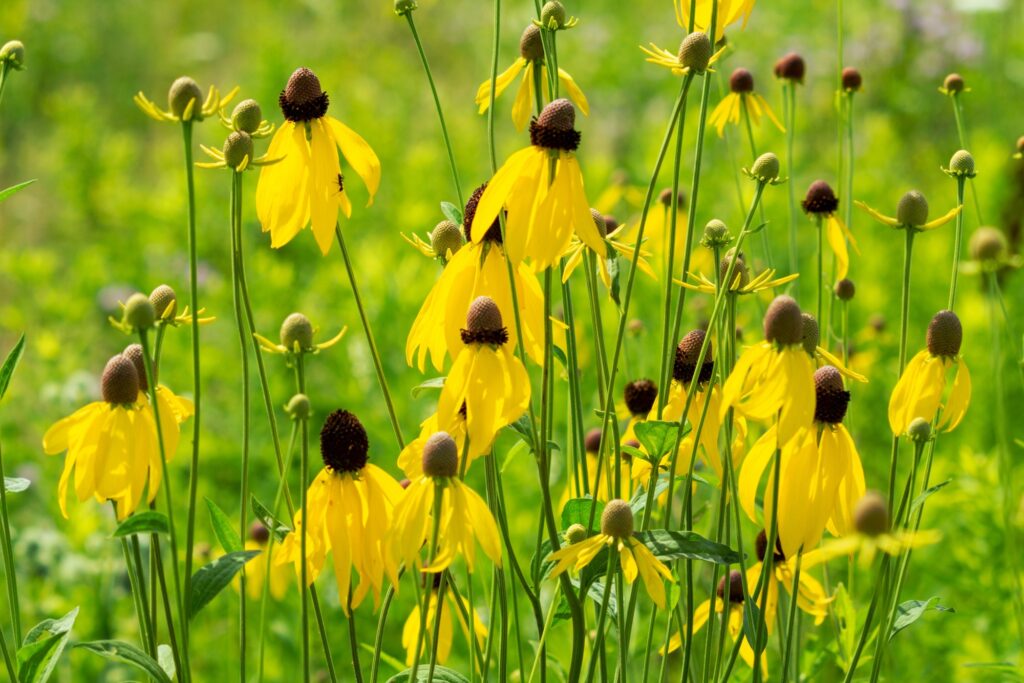
Echinacea paradoxa, commonly called yellow coneflower or Ozark coneflower, is unusual because it is a naturally yellow-flowered Echinacea species.
It played an important role in the breeding of many modern yellow, orange, and red Echinacea hybrids.
Yellow coneflower prefers full sun and well-drained conditions and becomes drought tolerant after establishment.
Its drooping yellow petals surrounding a dark cone provide a different appearance from traditional purple coneflower while retaining the characteristic Echinacea form.
🪴 Compact Coneflowers for Small Gardens
Not every coneflower grows 3 or 4 feet tall.
Plant breeders have developed numerous compact cultivars that fit much more comfortably into small flower beds and containers.
Before purchasing, check both height and mature width.
A compact cultivar can be useful:
- Along the front of a border
- Beside a walkway
- In a patio garden
- In a container
- In a small pollinator garden
- Between larger perennials
Compact plants can also make the flower heads feel proportionally more prominent because blooms are carried on shorter stems.
🪴 Can You Grow Coneflowers in Pots?
Yes.
Coneflowers can grow successfully in containers when given enough root space, drainage, sunlight, and water.
Choose a substantial container with drainage holes.
A small decorative pot may dry much too quickly and leave insufficient room for a perennial root system.
Use a high-quality container potting mix rather than ordinary garden soil.
Place the container where it receives abundant sunlight.
Container-grown Echinacea may need more frequent watering than plants growing in the ground because the limited volume of potting mix dries faster.
Avoid allowing the pot to remain continuously saturated.
❄️ Overwintering Coneflowers in Containers
Perennial coneflowers grown in containers deserve extra consideration during winter.
Roots growing above ground experience colder conditions than roots protected by the surrounding earth.
A plant that is reliably winter hardy in an in-ground garden may therefore be less dependable when left in an exposed container.
Gardeners in cold climates can use several strategies depending on the plant and local conditions, including moving containers to a protected location or providing additional insulation.
Do not bring a hardy perennial into a warm house simply to prevent winter dormancy unless you have a specific reason.
Echinacea naturally benefits from its normal seasonal cycle.
🌱 How to Grow Coneflowers From Seed
Growing coneflowers from seed is an inexpensive way to establish a larger planting.
However, germination requirements vary among Echinacea species.
Many benefit from a period of cold, moist stratification, which mimics the winter conditions seeds would experience outdoors.
This can be achieved by fall or winter sowing outdoors or by providing an appropriate controlled cold treatment before indoor sowing.
Follow the instructions for the particular species and seed supplier rather than assuming every hybrid Echinacea seed requires exactly the same treatment.
Once seedlings emerge, provide strong light and avoid constantly saturated potting mix.
❄️ Winter Sowing Coneflowers
Winter sowing is especially useful for perennial native flowers whose seeds benefit from natural cold.
Seeds can be sown in suitable ventilated containers and placed outdoors, where they experience normal winter temperature fluctuations.
When spring conditions become suitable, germination begins naturally.
This method can reduce the need to recreate cold stratification in a refrigerator.
Young seedlings can later be transplanted into the garden once they are large enough and weather conditions are appropriate.
Winter sowing also provides an inexpensive way to grow many plants for larger pollinator or naturalized gardens.
🌱 Will Coneflowers Bloom the First Year From Seed?
Possibly, but not always.
Some modern cultivars have been selected to flower relatively quickly, while certain species may require more time to develop before producing their best display.
Do not assume a seed-grown coneflower has failed simply because it spends much of its first season producing roots and leaves.
Perennials often become increasingly impressive over several growing seasons.
A small first-year plant can develop into a substantial flowering clump once established.
Gardening with perennials requires a little patience.
🌱 Do Coneflowers Self-Seed?
Many coneflowers can reseed if mature flower heads remain on the plant.
Young seedlings may appear around established plants the following season.
Whether this is desirable depends on your garden style.
In a cottage, meadow, native, or naturalized planting, self-seeding can gradually create an attractive drift of flowers.
In a formal border, you may prefer to remove seedlings that appear outside the intended area.
Keep in mind that seedlings from named hybrid cultivars may not look identical to the parent plant.
If maintaining an exact cultivar is important, division or another appropriate vegetative propagation method is more dependable than seed.
🌿 How to Divide Coneflowers
Established coneflowers can sometimes be divided to produce additional plants or rejuvenate mature clumps.
Division is generally most useful after plants have grown for several seasons and developed a substantial root system.
Spring is a convenient division period in many regions because plants are beginning active growth but are not yet dealing with summer heat.
Dig around the clump carefully and lift it from the soil.
Separate it into sections with healthy roots and growing points, then replant promptly.
Water divisions thoroughly while they establish.
Do not divide coneflowers constantly. If a plant is healthy and flowering well, there may be no reason to disturb it.
🌺 Coneflowers as Cut Flowers
Coneflowers make excellent cut flowers.
Their strong stems and distinctive centers provide texture in summer bouquets and combine beautifully with black-eyed Susans, cosmos, grasses, herbs, zinnias, and other seasonal flowers.
Use clean, sharp pruners and harvest during the cooler portion of the day when possible.
Place stems in clean water promptly.
Cutting some flowers effectively serves the same function as deadheading.
If you want seeds for birds or self-sowing, simply leave other flower heads on the plant to mature.
✂️ Should Coneflowers Be Cut Back in Fall?
Healthy coneflowers do not have to be cut to the ground in fall.
Leaving stems and seed heads provides winter interest, food for birds, and potential habitat for beneficial insects.
There are exceptions.
Plants affected by significant disease may benefit from removal of infected foliage and debris.
Stems blocking pathways or flopping badly can also be shortened.
But routine autumn cleanup does not require reducing every healthy Echinacea plant to ground level.
Waiting until late winter or spring is often both easier for the gardener and more useful to wildlife.
🌱 Spring Coneflower Care
Late winter or early spring is a good time to remove old stems left from the previous season.
As new growth begins emerging around the crown, trim away the old material without damaging fresh shoots.
Spring is also a useful time to:
- Divide overcrowded clumps
- Remove aggressive weeds
- Refresh mulch
- Evaluate winter damage
- Transplant unwanted seedlings
- Add new plants
- Check whether surrounding perennials are crowding the Echinacea
Avoid burying the emerging crown beneath fresh mulch.
The plant should be able to grow freely into the new season.
🌡️ Are Coneflowers Drought Tolerant?
Established coneflowers have useful drought tolerance.
That trait makes them excellent candidates for sunny perennial gardens where plants need to withstand occasional dry periods.
Drought tolerance does not mean immunity to severe drought.
A long period of hot, dry weather can stress even an established plant.
If leaves remain wilted, flowers decline rapidly, and the root zone is extremely dry, irrigation may be necessary.
Mulch can help preserve soil moisture and reduce the frequency with which supplemental watering is required.
🔥 Can Coneflowers Handle Heat?
Purple coneflower generally tolerates summer heat and humidity well.
This adaptability is one reason the plant is grown across such a broad region.
Heat becomes more problematic when it is combined with newly planted roots, extremely dry soil, or containers that heat and dry rapidly.
Provide consistent moisture during establishment and use mulch to moderate conditions around the root zone.
Do not respond to every hot afternoon by flooding the bed. Check actual soil moisture first.
🌻 Why Aren’t My Coneflowers Blooming?
Poor flowering can have several causes.
Too Little Sun
Coneflowers generally produce the best display in full sun.
Plant Is Too Young
Seed-grown or recently divided plants may devote much of their energy to root establishment before flowering heavily.
Excessive Fertilizer
Too much nitrogen can encourage abundant foliage and weak growth without producing a corresponding increase in flowers.
Overcrowding
Plants competing heavily for light, water, and root space may decline in vigor.
Stress
Severe drought, saturated soil, damaged roots, pests, disease, or recent transplanting can reduce flowering.
Look at the whole plant and its environment before applying fertilizer.
🌿 Why Are My Coneflowers Flopping?
Traditional coneflowers usually develop sturdy stems, but plants can occasionally become floppy.
Too much shade is one possible cause. Plants may stretch toward the available light and develop weaker stems.
Excessive fertility can also produce soft, lanky growth.
Wind and heavy rain can flatten tall flowers, particularly when plants are in exposed locations.
Choose an appropriately sized cultivar for the location and avoid overfeeding.
If a particularly tall variety needs support, add discreet stakes or plant supports before the stems fall over rather than trying to reconstruct the plant afterward.
🍃 Why Are Coneflower Leaves Turning Yellow?
Yellow foliage can have several causes, which is why diagnosis matters.
Possible explanations include:
- Excessive soil moisture
- Severe drought
- Root problems
- Natural aging of older foliage
- Disease
- Nutrient imbalance
- Transplant stress
Check the soil first.
If it remains constantly wet, improving drainage may matter much more than adding fertilizer.
If only the oldest lower leaves are yellowing late in the growing season while the rest of the plant remains healthy, normal seasonal aging may be involved.
Treat the cause, not simply the color of the leaf.
🌫️ Powdery Mildew on Coneflowers
Powdery mildew can appear as a pale or white powder-like growth on leaves.
Crowded plants and conditions that favor the disease can make problems worse.
Provide appropriate spacing and good airflow.
Avoid unnecessary overhead irrigation late in the day.
If mildew repeatedly becomes severe, evaluate whether the plant is growing under appropriate conditions.
Minor late-season cosmetic damage does not always require treatment, particularly when plants are approaching dormancy anyway.
🍂 Coneflower Leaf Spots
Several leaf-spot diseases can affect Echinacea.
Spots may begin as small discolored lesions and become increasingly visible as the season progresses.
Good spacing, sanitation, and appropriate watering practices can reduce disease pressure.
Remove badly diseased material when necessary, particularly at the end of the growing season.
Not every spotted leaf needs to trigger aggressive treatment.
An established perennial can tolerate some cosmetic damage, especially late in summer.
🦠 Aster Yellows and Coneflowers
Aster yellows is a more serious problem that can affect Echinacea and many other members of the daisy family.
The disease is caused by a phytoplasma transmitted primarily by leafhoppers.
Symptoms can include distorted growth, abnormal green flower parts, unusual branching, and flowers that develop incorrectly.
There is no treatment that cures an infected plant.
Plants strongly suspected of having aster yellows should be removed rather than composted so they do not remain as a source from which leafhoppers may acquire the pathogen.
Because herbicide injury and other plant problems can sometimes resemble aster yellows, correct identification is important before removing valuable plants.
🪲 Japanese Beetles on Coneflowers
Japanese beetles may feed on Echinacea in regions where these insects occur.
Adults chew flowers and leaves and can become conspicuous during outbreaks.
When numbers are modest, hand-picking beetles into a container of soapy water can reduce damage.
Be cautious about locating Japanese beetle traps beside plants you want to protect because attractants can draw additional beetles toward the general area.
Healthy coneflowers can tolerate some feeding without serious long-term harm.
🐛 Aphids and Other Insects
Aphids may occasionally gather on tender coneflower growth.
Small populations often cause little meaningful damage and may attract predators such as lady beetles and lacewing larvae.
A strong stream of water can sometimes dislodge aphids when intervention is necessary.
Before spraying, inspect the plant carefully.
Echinacea flowers attract many beneficial insects, so indiscriminate treatment can affect organisms you actually want in the garden.
The Eco-Friendly Gardening hub explains a broader integrated approach to managing garden pests.
🦌 Are Coneflowers Deer Resistant?
Reports vary, and local browsing pressure matters enormously.
Coneflowers are sometimes listed as relatively resistant to deer, but no flowering perennial should be considered absolutely deer-proof.
Hungry deer can eat plants they normally ignore.
Young growth may also be more attractive than mature coarse foliage.
If deer routinely devastate your landscape, fencing or another physical barrier provides more dependable protection than relying exclusively on plant-selection lists.
🐇 Do Rabbits Eat Coneflowers?
Rabbits may browse young coneflower plants, particularly tender new growth.
Established plants often tolerate minor feeding, but repeated browsing can prevent young plants from becoming established.
Temporary fencing or another barrier can help protect new transplants until they develop more substantial growth.
As with deer, browsing varies tremendously between gardens.
A plant untouched for years in one neighborhood may be eaten regularly in another.
🌱 Do Coneflowers Spread?
Coneflowers generally form manageable clumps rather than racing through the garden.
They may gradually increase in size, and seedlings can appear when mature seed heads remain.
This usually makes Echinacea easy to incorporate into mixed perennial beds.
If seedlings appear where you do not want them, they can be moved or removed while small.
If you want a naturalized planting, allow some to remain.
Over several seasons, a few initial plants can develop into a much more substantial group without becoming difficult to manage.
🌻 Are Coneflowers Invasive?
Echinacea species native to North America should not be confused with introduced invasive plants simply because they can self-seed in a garden.
However, native range varies between species and regions.
If ecological restoration or strictly local native planting is your goal, determine which Echinacea species are genuinely native to your particular area rather than assuming every North American species is locally native everywhere on the continent.
Garden cultivars and hybrids can still be useful ornamental and pollinator plants even when they are not locally native ecotypes.
Match your plant choice to your gardening goal.
🌼 Are Coneflowers Perennials?
Yes. True Echinacea coneflowers are herbaceous perennials.
Their above-ground stems generally die back after the growing season in climates with cold winters, while the crown and root system survive underground.
Fresh shoots emerge again during spring.
Cold hardiness varies by species and cultivar, but purple coneflower is widely grown across cold and temperate regions of North America.
Always check the hardiness information for a specific cultivar before planting, especially when purchasing unusual modern hybrids.
❄️ Coneflower Winter Care
Established coneflowers planted in an appropriate hardiness zone generally need little special winter care.
Allow plants to enter dormancy naturally.
Healthy stems and seed heads can remain standing through winter.
Mulch around the plants can help moderate soil-temperature fluctuations, particularly with newer plantings, but avoid covering the crown with a deep mound.
In areas with wet winters, good drainage remains especially important.
Cold soil combined with excessive moisture can create more problems than cold alone for many perennials.
🌱 How Long Do Coneflowers Live?
Coneflower longevity varies by species, cultivar, climate, and growing conditions.
Traditional purple coneflowers can become dependable perennial residents of a garden, especially when planted in suitable soil and sunlight.
Some modern hybrids may be shorter-lived.
Good drainage is particularly important to long-term persistence.
A plant that repeatedly spends winter in saturated soil may decline much more rapidly than one growing in appropriate conditions.
Allowing plants to self-seed or occasionally dividing successful clumps can also help maintain an Echinacea planting over many years.
🌸 Coneflowers vs. Black-Eyed Susans
Coneflowers and black-eyed Susans are related members of the daisy family and are frequently planted together, but they belong to different genera.
True Echinacea coneflowers have the botanical genus Echinacea.
Black-eyed Susans belong to Rudbeckia.
The confusion is understandable because some Rudbeckia species are also commonly described as coneflowers.
Fortunately, their garden requirements overlap nicely.
Both generally enjoy sunny conditions and well-drained soil, flower through much of summer, provide resources for pollinators, and produce attractive seed heads.
That makes them exceptionally good garden companions.
Read our complete Black-Eyed Susan Care guide if you would like to grow both.
🎨 Designing a Garden With Coneflowers
Coneflowers have enough presence to serve as focal flowers but enough informality to work well in large groups.
For a traditional summer border, combine purple Echinacea with golden black-eyed Susans.
For something softer, pair pink coneflowers with white flowers, ornamental grasses, and silver foliage.
Orange and red modern cultivars can create a warmer palette with heleniums and golden grasses.
Repeated groups tend to look stronger than isolated plants.
Instead of planting one coneflower in six different colors across a large bed, consider repeating several plants of one or two cultivars and allowing companion plants to provide additional color.
🌾 Coneflowers in a Prairie-Style Garden
Echinacea fits especially naturally into prairie-inspired designs.
Combine coneflowers with ornamental grasses and upright flowering perennials so the garden contains contrasting shapes and textures.
Possible combinations include:
- Coneflowers
- Black-eyed Susans
- Blazing star
- Asters
- Goldenrods
- Little bluestem
- Switchgrass
- Coreopsis
Allow some plants to reseed and leave much of the garden standing through winter.
The result can provide summer flowers, fall seed heads, winter structure, and valuable wildlife habitat.
🏡 Coneflowers in a Cottage Garden
Coneflowers are equally at home in a cottage-style border.
Their straightforward flower shape helps balance more elaborate plants such as roses and heavily petaled annuals.
Plant them among herbs, ornamental grasses, cosmos, catmint, salvias, and other relaxed garden favorites.
Our How to Grow a New Rose Garden guide can help if you want to create a mixed rose-and-perennial border where Echinacea contributes summer color and pollinator activity.
🌻 Common Coneflower Care Mistakes
Coneflowers are forgiving, but several mistakes can make them harder to grow than necessary.
Planting in Too Much Shade
Some shade is tolerated, but abundant sunlight generally produces stronger flowering.
Poor Drainage
Constantly wet soil can cause root and crown problems.
Overwatering Established Plants
Mature Echinacea generally does not need the constant irrigation required by moisture-loving plants.
Overfertilizing
Excessively rich conditions can produce floppy growth.
Crowding Plants
Give mature plants enough room for airflow and healthy development.
Expecting Instant Results From Seed
Perennials often take time to mature.
Removing Every Flower Head
Doing so eliminates seeds that could feed birds or produce seedlings.
Cutting Everything Down in Fall
Healthy stems can have wildlife value and provide winter structure.
Assuming Every Coneflower Is Identical
Different Echinacea species and modern hybrids may vary in height, longevity, hardiness, color, and growth habit.
🌿 Are Coneflowers Easy to Grow?
Yes. In the right location, Echinacea is one of the more approachable flowering perennials.
Most of the work happens when choosing the site.
Give coneflowers abundant sunlight, well-drained soil, adequate water while they establish, and enough space to mature.
After that, maintenance is relatively light.
Deadhead some flowers if you want to encourage more blooms. Leave others for birds. Divide established plants when there is a genuine reason. Monitor pests and diseases without worrying about every imperfect leaf.
That straightforward care is part of what has made coneflowers such enduring garden favorites.
🌸 Give Coneflowers a Permanent Place in the Garden
Coneflowers offer an unusually useful combination of beauty, resilience, and wildlife value.
They produce colorful flowers for weeks, tolerate difficult summer weather once established, provide nectar and pollen for insects, and continue contributing to the garden after flowering through their distinctive seed heads.
Traditional purple coneflowers work beautifully in native and naturalistic plantings, while modern cultivars make it possible to incorporate Echinacea into almost any sunny flower-garden palette.
Start with a few plants in a sunny, well-drained location.
Give them time to establish.
Before long, those small nursery plants can become substantial summer clumps covered with flowers, butterflies, and bees—and eventually seed heads busy with birds.
That is a lot of garden value from a perennial that asks for remarkably little in return.
🔗 Related Articles
- Flower Gardening
- Gardening Basics
- Eco-Friendly Gardening
- Seasonal Gardening
- Black-Eyed Susan Care
- Helenium Care
- Cosmos Care
- How to Grow a New Rose Garden
- Gardening Soil 101: Enhancing Your Garden’s Growth and Vitality