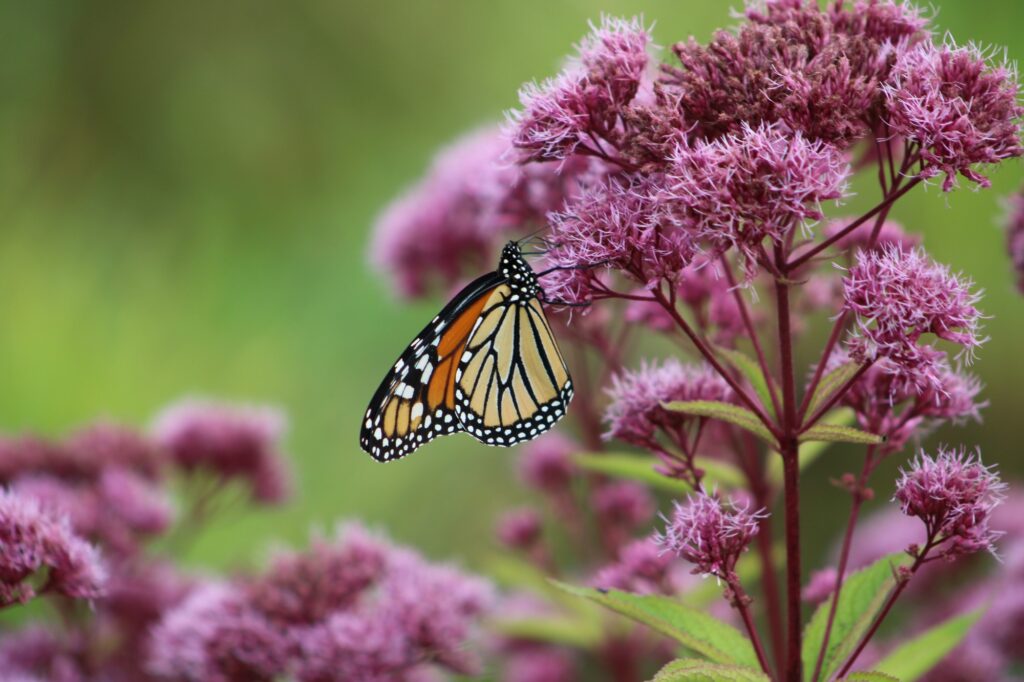
Joe-Pye weed is one of the most impressive native perennials for a late-summer garden. Tall stems topped with enormous domes of dusty pink, mauve, or purple flowers can rise well above surrounding plants, creating a dramatic display while attracting bees, butterflies, moths, and other pollinators.
Rather than referring to a single species, Joe-Pye weed is a common name used for several closely related plants in the genus Eutrochium. Familiar garden species include spotted Joe-Pye weed (Eutrochium maculatum), sweet Joe-Pye weed (Eutrochium purpureum), hollow Joe-Pye weed (Eutrochium fistulosum), and coastal plain Joe-Pye weed (Eutrochium dubium).
Older references may place these plants in the genus Eupatorium, and you may still see names such as Eupatorium purpureum or Eupatorium maculatum on older plant labels. They are now generally classified within Eutrochium.
Most Joe-Pye weeds are substantial plants. Depending on species and cultivar, they may grow from about 3 feet to more than 7 feet tall. Their size makes them especially useful at the back of perennial borders, in native gardens, meadow plantings, pollinator gardens, rain gardens, and around ponds or other consistently moist areas.
Their care is surprisingly straightforward. Give them sun, dependable moisture, and enough room to mature. If a full-sized Joe-Pye weed is simply too enormous for your garden, choose a compact cultivar rather than trying to force a naturally towering plant into a tiny space.
⚡ Joe-Pye Weed Quick Care Guide
Botanical genus: Eutrochium
Common name: Joe-Pye weed
Plant type: Herbaceous perennial
Family: Asteraceae
Native range: Species are native to different portions of eastern and central North America
Height: Approximately 3 to 7+ feet depending on species and cultivar
Spread: Commonly about 2 to 4 feet
Light: Full sun to partial shade
Soil: Moist, humus-rich soil; many species tolerate periodically wet conditions
Water: Moderate to high; avoid prolonged drought
Bloom season: Midsummer through early fall
Flower colors: Pink, mauve, dusty purple, or purplish pink
Wildlife: Excellent for bees, butterflies, skippers, moths, and other pollinators; seeds may also be used by birds
Pruning: Optional early-summer cutback for shorter, sturdier plants; cut dead stems down in late winter or early spring
Propagation: Division and seed; some species can also be propagated from cuttings
Best uses: Native gardens, pollinator gardens, rain gardens, meadow plantings, cottage gardens, pond edges, moist borders, and naturalized areas
🌿 What Is Joe-Pye Weed?
Joe-Pye weeds are tall North American perennials belonging to the daisy family.
They grow as upright clumps of sturdy stems surrounded by large leaves. The leaves often appear in distinctive whorls around the stems rather than alternating individually from side to side.
During midsummer, branching flower clusters begin forming near the stem tips.
By late summer, those clusters can become enormous.
Rather than producing a few large flowers, Joe-Pye weed produces countless tiny tubular flowers packed together into broad domes.
From a distance, a mature plant can look like a large pink or purple cloud above the surrounding garden.
After flowering, the plant produces dry seed heads before dying back for winter.
Fresh shoots return from the perennial crown the following spring.
🌸 Why Is It Called Joe-Pye Weed?
The origin of the name is surrounded by a mixture of historical tradition and uncertain details.
The common story associates the plant with a Native American healer named Joe Pye who was said to have used plants medicinally in New England.
The historical specifics are difficult to establish with certainty, so it is better to treat that story as part of the plant’s traditional naming history rather than a fully documented biography.
Today, “Joe-Pye weed” is firmly established as the common name for several species of Eutrochium.
And despite the word weed, these plants are highly valued native wildflowers and ornamental perennials.
🌺 What Do Joe-Pye Weed Flowers Look Like?
Individual flowers are tiny and tubular.
Hundreds of them are grouped into large terminal clusters.
Depending on species and cultivar, flower color ranges through:
- Pale dusty pink
- Rose pink
- Mauve
- Pinkish purple
- Deep purplish pink
The flower clusters can be extraordinarily large.
Sweet and hollow Joe-Pye weeds may produce domes approaching a foot or more across on mature plants.
Many flowers also have a light vanilla-like fragrance.
The combination of scent, color, and abundant nectar makes the plants magnets for insects.
🐝 Joe-Pye Weed Is a Pollinator Powerhouse
Few late-summer perennials attract as much activity as Joe-Pye weed.
The flowers are visited by:
- Bumblebees
- Honey bees
- Native bees
- Butterflies
- Skippers
- Moths
- Bee flies
- Other nectar-feeding insects
Large flower clusters function almost like feeding platforms.
A butterfly can land and move from flower to flower without leaving the same cluster.
Because Joe-Pye weed flowers from midsummer into fall, it provides nectar during an important part of the season when pollinators are preparing for migration or winter.
For broader ideas on supporting garden wildlife, visit Eco-Friendly Gardening.
🦋 Joe-Pye Weed and Butterflies
Joe-Pye weed is particularly famous as a butterfly plant.
On a warm late-summer afternoon, one flowering clump may host several butterfly species at once.
Depending on region, visitors may include:
- Swallowtails
- Fritillaries
- Skippers
- Monarchs
- Painted ladies
- Other native butterflies
If butterflies are one of your main gardening goals, position Joe-Pye weed where you can actually watch it from a path, patio, or window.
The plant may become as interesting for its visitors as for its flowers.
🌎 Is Joe-Pye Weed Native?
Yes.
The different Eutrochium species called Joe-Pye weed are native to North America, although their individual ranges differ.
Some occur across broad areas of the eastern and central United States.
Others have narrower distributions.
If you are creating a strictly regional native garden, identify which Eutrochium species naturally occurs in your area rather than assuming every Joe-Pye weed is locally native.
Garden cultivars also may differ genetically from local wild populations.
🌿 Types of Joe-Pye Weed
Several species share the common name.
Understanding their differences can help you choose the right plant for the site.
🌸 Spotted Joe-Pye Weed — Eutrochium maculatum
Eutrochium maculatum is commonly called spotted Joe-Pye weed.
It typically grows about 4 to 7 feet tall.
The species thrives in moist to wet soil and performs best in full sun, although some light shade is tolerated.
Its stems commonly show purple spotting or coloring, helping explain the name maculatum, which refers to spotted markings.
Spotted Joe-Pye weed spreads through a fibrous, rhizomatous root system and may gradually form small colonies.
It is an especially good choice for:
- Rain gardens
- Pond edges
- Moist meadows
- Native gardens
- Pollinator borders
The flowers appear from summer into fall.
🌿 Sweet Joe-Pye Weed — Eutrochium purpureum
Eutrochium purpureum is often called sweet Joe-Pye weed or purple Joe-Pye weed.
Plants commonly reach around 5 to 7 feet tall and 2 to 4 feet wide.
Large domed clusters of pinkish-purple flowers may have a pleasant vanilla-like scent.
Sweet Joe-Pye weed is often found naturally around woodland borders, moist thickets, roadsides, riverbanks, and similar habitats.
It tolerates somewhat more shade than some of the wet-meadow species.
However, plants grown with too little light may become leggy and lean.
This can be a particularly good Joe-Pye weed for a bright woodland edge where the soil remains reasonably moist.
🌿 Hollow Joe-Pye Weed — Eutrochium fistulosum
Eutrochium fistulosum is commonly called hollow Joe-Pye weed or hollow-stemmed Joe-Pye weed.
It generally grows around 4 to 7 feet tall, although large plants can be extremely impressive.
The common name comes from the stem structure.
The lower portions of the stem are hollow, unlike spotted Joe-Pye weed, which has solid pith.
Hollow Joe-Pye weed naturally inhabits moist meadows, low woodlands, fields, and similar damp areas.
It appreciates rich, moist to wet soil and works beautifully near:
- Ponds
- Streams
- Rain gardens
- Wet meadows
- Naturalized areas
The flowers attract bees and butterflies, while mature seed heads can provide food for songbirds.
🌿 Coastal Plain Joe-Pye Weed — Eutrochium dubium
Eutrochium dubium is called coastal plain Joe-Pye weed.
It is native primarily to coastal plain wetlands of eastern North America.
Plants generally grow about 3 to 6 feet tall.
Like other Joe-Pye weeds, it prefers moist soil and produces large pink-to-purple flower clusters from summer into fall.
This species is particularly useful because some popular compact cultivars have been selected from it.
If you like Joe-Pye weed but have limited space, Eutrochium dubium cultivars deserve special attention.
🌱 How to Tell Spotted and Hollow Joe-Pye Weed Apart
Spotted and hollow Joe-Pye weeds can look very similar.
One useful identifying feature is inside the stem.
Spotted Joe-Pye weed (E. maculatum) has solid pith through the lower stem.
Hollow Joe-Pye weed (E. fistulosum) is hollow toward the base.
Stem coloration can also help.
Spotted Joe-Pye weed commonly has purplish spotting.
Hollow Joe-Pye weed can have dark purple to pale purple stems but is characterized most reliably by the hollow lower stem.
For ordinary garden care, however, both appreciate substantial moisture and room to grow.
📏 How Tall Does Joe-Pye Weed Grow?
Full-size Joe-Pye weeds are large perennials.
Depending on species and conditions, plants may grow:
- 4 feet
- 5 feet
- 6 feet
- 7 feet
- Occasionally taller
This is not a plant to squeeze between tiny edging perennials.
Full-sized plants belong:
- At the back of borders
- In meadow gardens
- Around ponds
- Along fences
- In rain gardens
- In broad native plantings
If the garden cannot accommodate a 6-foot perennial, choose a compact cultivar.
☀️ How Much Sun Does Joe-Pye Weed Need?
Most Joe-Pye weeds perform best in full sun to partial shade.
Full sun generally produces:
- Stronger stems
- More flowers
- Denser growth
- Less flopping
Partial shade is tolerated, particularly by species naturally associated with woodland margins.
Too much shade can cause tall stems to stretch toward the light.
This may leave the plant leggy and more likely to fall over.
For more help evaluating garden exposure, visit Gardening Basics.
🌤️ Can Joe-Pye Weed Grow in Partial Shade?
Yes.
Sweet Joe-Pye weed in particular naturally occurs around woodland edges and partly shaded habitats.
The plant still needs enough light to flower well.
A bright location with several hours of direct sun is much better than deep permanent shade.
If stems repeatedly lean or flop despite adequate moisture, insufficient sunlight may be contributing to the problem.
🌎 Best Soil for Joe-Pye Weed
Most Joe-Pye weeds prefer moist, fertile soil containing plenty of organic matter.
They are naturally associated with habitats such as:
- Wet meadows
- Streambanks
- River edges
- Marsh margins
- Moist prairies
- Low woodlands
Unlike plants such as Autumn Joy Sedum or Caryopteris, Joe-Pye weed does not prefer lean, dry ground.
It is much happier where dependable moisture is available.
Our Garden Soil Guide: Soil Types, Testing, pH & How to Improve It covers soil texture, organic matter, drainage, and moisture management in greater detail.
💧 Joe-Pye Weed Loves Moisture
If you have a naturally damp section of the yard where many conventional flowers struggle, Joe-Pye weed may be exactly the plant you need.
It can thrive where soil remains:
- Consistently moist
- Seasonally wet
- Occasionally flooded
That makes it exceptionally useful in rain gardens and near drainage areas.
The species are not aquatic plants, however.
They should not remain permanently submerged beneath standing water.
🌧️ Joe-Pye Weed in Wet Soil
Spotted, hollow, and coastal plain Joe-Pye weeds are particularly well suited to moist or wet environments.
They can handle soil conditions that would quickly damage many drought-tolerant perennials.
This does not mean the soil needs to be swampy.
Ordinary moisture-retentive garden loam can produce excellent plants.
A naturally damp site simply reduces the amount of supplemental irrigation you will need to provide.
🏜️ Can Joe-Pye Weed Tolerate Dry Soil?
Joe-Pye weed is not a good choice for chronically dry ground.
Sweet Joe-Pye weed and related species may tolerate ordinary short dry periods once established, but extended drought often causes:
- Scorched leaves
- Reduced flowering
- Stunted growth
- Premature foliage decline
The larger wetland-associated species are especially unhappy when soil becomes severely dry.
If your garden is naturally hot and dry, choose another pollinator perennial rather than trying to keep Joe-Pye weed alive through constant irrigation.
🧱 Can Joe-Pye Weed Grow in Clay?
Yes.
Several Eutrochium species tolerate clay well.
In fact, moisture-retentive clay can be an advantage if it is not severely compacted.
Healthy clay soil may support large vigorous plants.
The key is not to confuse moist clay with stagnant, oxygen-starved mud.
For rain gardens and other periodically wet areas, Joe-Pye weed can be particularly useful.
🌧️ Joe-Pye Weed in a Rain Garden
Joe-Pye weed is almost made for rain gardens.
Its advantages include:
- Moisture tolerance
- Tall upright growth
- Late flowers
- Strong pollinator value
- Native species options
- Ability to form substantial clumps
Place it toward the middle or wetter portion of a rain garden according to the species and site’s drainage pattern.
Its height makes it useful as a background layer behind shorter plants.
Combine it with other moisture-loving native perennials rather than forcing drought-tolerant species into the same irrigation zone.
🌊 Joe-Pye Weed Near a Pond
Pond margins are another excellent location.
Plant above the permanent water line where the root zone remains moist.
The tall pink flower clusters create beautiful reflections over water.
Potential companions can include moisture-loving grasses, sedges, swamp milkweed, cardinal flower, and other plants suited to your region.
Give mature Joe-Pye weed enough room so it does not overwhelm smaller pond-edge plants.
📅 When Should You Plant Joe-Pye Weed?
Spring and early fall are both good planting periods.
Spring
Spring planting gives the perennial a full season to establish a substantial root system before winter.
Fall
Early fall also works well as long as plants have enough time to root before hard freezes.
Summer planting is possible for container-grown specimens, but regular watering becomes essential.
A young Joe-Pye weed should never be allowed to dry severely during establishment.
🌱 How to Plant Joe-Pye Weed
Choose the location based on mature size, not the size of the nursery pot.
Dig a hole approximately as deep as the root ball and wider than the root system.
Remove the plant from its container.
Loosen badly circling roots if necessary.
Position the crown at approximately the same depth it grew in the pot.
Backfill with the surrounding soil.
Water deeply.
Apply a moderate organic mulch over the surrounding ground while leaving the immediate crown area open.
📏 How Far Apart Should Joe-Pye Weed Be Planted?
Large species may need 2 to 4 feet of space depending on mature size.
Compact cultivars can be planted closer.
Remember that many Joe-Pye weeds gradually expand into substantial clumps.
Crowding may eventually:
- Reduce airflow
- Make division difficult
- Increase competition
- Obscure neighboring plants
A young planting may initially look sparse.
Give it time.
Joe-Pye weed fills space quickly once established.
🌱 Does Joe-Pye Weed Spread?
Yes, but the growth habit depends somewhat on species.
Plants expand from their crowns and underground root systems.
Spotted Joe-Pye weed has fibrous, rhizomatous roots and can form small clonal colonies.
Self-seeding can also occur when mature flowers are allowed to produce seed.
In a meadow or naturalized planting, this is usually desirable.
In a tightly controlled perennial border, occasional division or seedling removal may be necessary.
⚠️ Is Joe-Pye Weed Invasive?
Native Joe-Pye weeds should not automatically be described as invasive simply because they are vigorous.
Within their native range, they are valuable members of natural plant communities.
In garden conditions, they may spread.
That is different from ecological invasiveness.
The practical question is whether the growth habit fits your landscape.
A tall spreading native perennial is excellent in a meadow.
The same growth can feel excessive in a small formal bed.
💦 How Often Should You Water Joe-Pye Weed?
Newly planted specimens require regular water.
Established plants growing in naturally moist ground may need almost no supplemental irrigation.
Plants in conventional borders need water during dry weather.
A useful rule is to avoid allowing the root zone to dry completely for long periods.
Deep watering is preferable to sprinkling small quantities over the surface every day.
Mulch can help maintain more consistent soil moisture.
🍂 Mulching Joe-Pye Weed
Organic mulch works well around Joe-Pye weed.
Suitable materials include:
- Shredded leaves
- Wood chips
- Shredded bark
- Finished compost used appropriately
Mulch helps:
- Conserve moisture
- Suppress weeds
- Protect soil structure
- Moderate root temperatures
Keep thick mulch away from direct contact with the crown.
A mature planting eventually shades much of its own soil.
🌱 Does Joe-Pye Weed Need Fertilizer?
Usually not much.
Joe-Pye weed grows vigorously in naturally fertile, moist soil.
Heavy fertilization can create extremely tall, lush plants that become more likely to flop.
If a mature plant is already 7 feet tall, more nitrogen is rarely the solution to anything.
Use a soil test if growth genuinely suggests a nutrient problem.
Otherwise, organic matter and normal garden soil fertility are generally enough.
🌿 Why Is My Joe-Pye Weed Flopping?
Several factors can contribute.
Too Much Shade
Stems stretch toward available light.
Excessively Rich Soil
Heavy fertility encourages oversized growth.
Too Much Nitrogen
High-nitrogen fertilizers can produce soft stems.
Mature Height
A 7-foot perennial naturally catches wind.
Heavy Rain
Large wet flower clusters add significant weight to tall stems.
Fortunately, Joe-Pye weed responds well to an early cutback.
✂️ Cut Joe-Pye Weed Back for a Shorter Plant
If a full-size plant becomes too tall, cut stems back during late spring or early summer.
An early-June cutback is a useful general guideline in many climates.
Reducing the plant’s height at that stage encourages:
- More branching
- Shorter mature stems
- A sturdier plant
- More flowering tips
Bloom may occur a little later.
Stop cutting well before late summer so the new branches have enough time to form flowers.
✂️ How Much Can You Cut Joe-Pye Weed Back?
Tall plants can be reduced by approximately one-third to one-half while they are still in active early growth.
You do not need to be mathematically precise.
The goal is to shorten the stems before flowering growth begins.
You can also cut only the front half of a large clump.
The shorter front stems can help disguise the lower portions of taller stems behind them.
This creates a more layered, natural appearance.
🪵 Does Joe-Pye Weed Need Staking?
Not always.
Plants in full sun with sufficient moisture usually develop sturdy stems.
Joe-Pye weed growing in partial shade or excessively fertile soil may need support.
Install supports early.
Options include:
- Grow-through supports
- Sturdy stakes
- Twine between hidden supports
- Tall neighboring perennials and grasses
Naturalistic gardens can use surrounding vegetation to help hold stems upright.
🌺 When Does Joe-Pye Weed Bloom?
Most species flower from midsummer through early fall.
July through September is typical, with some species and climates extending into October.
This timing is one of the main reasons the plant is so valuable for pollinators.
Joe-Pye weed reaches peak bloom just as the number of flowering spring and early-summer plants begins declining.
✂️ Should You Deadhead Joe-Pye Weed?
Deadheading is optional.
Removing fading flowers can:
- Reduce self-seeding
- Make formal gardens look tidier
- Prevent the plant from directing energy into seeds
However, leaving seed heads has benefits too.
The dried structures provide winter texture, and some birds may feed on the seeds.
In a wildlife-focused garden, there is little need to deadhead every flower.
🐦 Joe-Pye Weed and Birds
After flowering, Joe-Pye weed develops dry seeds equipped for wind dispersal.
Birds may feed on the seeds.
Standing stems and seed heads also contribute structure to the winter garden.
If wildlife habitat is a priority, leave the plant standing after frost rather than immediately cutting everything to the ground.
Spring cleanup is perfectly acceptable.
❄️ Should Joe-Pye Weed Be Cut Back in Fall?
It can be, but it does not have to be.
Leaving stems through winter offers several advantages:
- Seed for wildlife
- Winter structure
- Habitat
- Easy identification of the dormant crown
Cut old stems down before new growth becomes tall in spring.
If disease has been a serious problem, earlier cleanup may be appropriate.
Otherwise, there is no urgent reason for a fall cutback.
🌱 Spring Joe-Pye Weed Care
Spring is a good time to:
- Remove dead stems
- Divide overgrown clumps
- Transplant divisions
- Refresh mulch
- Remove unwanted seedlings
- Check moisture
New growth emerges from the crown and begins gaining height quickly.
If you intend to control the plant’s eventual height, plan the cutback before early summer.
☀️ Summer Joe-Pye Weed Care
During summer:
- Keep soil adequately moist
- Avoid unnecessary fertilizer
- Finish height-control pruning early
- Watch for drought stress
- Install support before stems become enormous
Flower buds begin developing toward the upper stems.
Once those buds are forming, let the plant grow without further major pruning.
🍂 Fall Joe-Pye Weed Care
Fall is primarily a season for enjoying the plant.
Flowers may continue into early autumn.
Pollinator activity can remain intense.
As flowers fade:
- Leave seeds for birds if desired
- Collect seed if propagating
- Continue watering during unusual drought
- Avoid late fertilizer
After frost, allow the stems to stand or cut them down according to your preferred garden style.
✂️ Dividing Joe-Pye Weed
Joe-Pye weed can be propagated and rejuvenated through division.
Spring and fall are both suitable times for several species.
Spring division is especially easy because the emerging shoots make the crown visible while stems are still short.
Dig around the clump.
Lift a portion or the entire crown.
Separate healthy sections containing roots and shoots.
Replant immediately and water thoroughly.
📅 How Often Should Joe-Pye Weed Be Divided?
There is no strict schedule.
Consider division when:
- The clump has grown too large
- You want additional plants
- Neighboring perennials are being crowded
- The plant’s center has weakened
- You need to restrict spreading
A healthy plant with plenty of room does not need to be divided merely because several years have passed.
🌱 Growing Joe-Pye Weed From Seed
Joe-Pye weeds can also be grown from seed.
Many seeds benefit from exposure to cold, moist winter conditions before germination.
For naturalistic plantings, one of the simplest approaches is to allow plants to self-sow.
Seed-grown plants may vary genetically.
That is desirable in ecological plantings but means seedlings from named cultivars may not reproduce the exact appearance or size of the parent.
Use division if you want a clone of a particular cultivar.
🌿 Propagating Joe-Pye Weed From Cuttings
Some Joe-Pye weeds can be propagated using stem cuttings.
Soft or actively growing shoots taken during late spring can root under appropriate propagation conditions.
For most home gardeners, division is simpler.
Cuttings are useful when you want several new plants without digging into a mature clump.
🌸 ‘Gateway’ Joe-Pye Weed
‘Gateway’ is one of the best-known spotted Joe-Pye weed cultivars.
It is generally associated with Eutrochium maculatum.
Plants remain substantial but are valued for:
- Strong stems
- Large mauve-pink flower clusters
- Dark reddish-purple stems
- Excellent pollinator appeal
‘Gateway’ is a good choice for large perennial borders where you want the dramatic scale of Joe-Pye weed but a more garden-selected form.
It still needs room.
This is not a dwarf plant.
🌸 ‘Little Joe’ Joe-Pye Weed
‘Little Joe’ is a compact cultivar associated with Eutrochium dubium.
The name is relative.
It is smaller than a 7-foot wild Joe-Pye weed but still forms a substantial perennial.
‘Little Joe’ generally works much better in average home borders where the full-sized species would dominate everything around them.
It retains the familiar pink-purple flower clusters and strong pollinator value while offering a more manageable size.
🌿 Choose the Species or Cultivar to Fit the Space
For a large naturalistic planting, a full-sized species may be ideal.
Choose tall Joe-Pye weed when you have:
- A large meadow
- A pond edge
- A rain garden
- A back border
- A broad native planting
Choose a compact cultivar when you have:
- A conventional perennial bed
- A smaller property
- Limited width
- A desire for easier maintenance
Matching the plant to the space is much easier than repeatedly chopping a giant perennial down because it was planted in the wrong location.
🌧️ Joe-Pye Weed With New England Aster
New England Aster is one of the best companions.
Both are North American native perennials with outstanding late-season pollinator value.
Joe-Pye weed provides:
- Large pink-purple flower domes
- Coarse foliage
- Strong vertical height
New England aster provides:
- Numerous purple or pink daisy-like flowers
- A lighter branching texture
- Late-summer and fall color
Both appreciate reasonably moist soil.
In a large garden, they can create a spectacular late-season native border.
🤍 Joe-Pye Weed With Boltonia
Boltonia is another excellent choice for moist sunny soil.
Boltonia’s small white flowers create a cloud-like effect around the much larger pink Joe-Pye flower clusters.
Both can become tall.
Give the combination plenty of room and use shorter plants along the front.
💛 Joe-Pye Weed With Black-Eyed Susans
Black-Eyed Susans provide golden yellow flowers below the taller Joe-Pye weed.
Yellow and mauve-purple form a strong color contrast.
Different Rudbeckia species have somewhat different moisture preferences, so choose a type suitable for the site.
The combination works particularly well in meadow-style gardens.
💜 Joe-Pye Weed With Coneflowers
Coneflowers provide another layer below Joe-Pye weed.
The two flower seasons overlap well.
Coneflowers contribute:
- Larger individual daisy-like flowers
- Lower height
- Strong seed heads
Joe-Pye weed rises above them with enormous clustered blooms.
Coneflowers tolerate drier soil better, so this combination works best in an ordinary moderately moist border rather than the wettest portion of a rain garden.
🍂 Joe-Pye Weed With Autumn Joy Sedum
Autumn Joy Sedum can create beautiful color contrast, but the two have very different moisture preferences.
Autumn Joy wants:
- Sharp drainage
- Drier conditions
- Leaner soil
Joe-Pye weed prefers:
- Consistent moisture
- Richer soil
- Greater access to water
They can still share a large border if the soil changes from wetter to drier across the planting.
Do not overwater Autumn Joy simply because Joe-Pye weed is nearby.
🌾 Joe-Pye Weed With Ornamental Grasses
Tall grasses make excellent companions.
Their narrow leaves provide contrast with the Joe-Pye weed’s broad foliage and massive flower clusters.
By fall, grass seed heads add:
- Gold
- Tan
- Bronze
- Silver
Choose grasses appropriate to your region and soil moisture.
Moisture-tolerant native grasses are especially useful in rain gardens and meadow plantings.
🌸 Joe-Pye Weed in a Cottage Garden
Joe-Pye weed can work surprisingly well in a cottage garden if you have enough room.
Use it as a tall background behind:
- Coneflowers
- Rudbeckias
- Asters
- Phlox
- Grasses
- Other substantial perennials
The flowers give the border an informal, abundant appearance.
Compact cultivars are usually easier to integrate into smaller cottage gardens than the towering wild species.
🌿 Joe-Pye Weed in a Native Garden
Within its native range, Joe-Pye weed is an outstanding ecological garden plant.
It provides:
- Nectar
- Pollen
- Late-season flowers
- Seeds
- Shelter
- Tall structural growth
Choose a species that naturally occurs in your region if local native provenance is important.
Combine it with other native plants that flower earlier so pollinators have food from spring through autumn.
🦌 Is Joe-Pye Weed Deer Resistant?
Joe-Pye weed is generally considered resistant to deer browsing, although no plant is guaranteed to be ignored.
Spotted and coastal plain Joe-Pye weeds are commonly listed as deer resistant, while hollow Joe-Pye weed is considered moderately resistant.
Young shoots may still be sampled.
Deer behavior varies significantly between locations and seasons.
🐇 Do Rabbits Eat Joe-Pye Weed?
Rabbit browsing is not generally one of the plant’s major problems.
Large established Joe-Pye weeds are capable of tolerating modest damage.
Young spring growth may occasionally be sampled.
If wildlife pressure is severe, protect newly planted specimens until the clump is established.
🐛 Joe-Pye Weed Pests
Joe-Pye weed has relatively few serious insect problems.
The plant evolved as part of North American ecosystems, so seeing insects use the foliage is not automatically a sign that treatment is needed.
Minor chewing is usually harmless.
Avoid spraying flowering plants indiscriminately.
One of the main reasons to grow Joe-Pye weed is its value to insects.
🌫️ Powdery Mildew
Powdery mildew may occasionally develop, particularly on sweet Joe-Pye weed and related species.
The foliage develops a pale powdery coating.
Risk can increase with:
- Crowding
- Poor airflow
- Shade
- Plant stress
Good spacing and sufficient sunlight help.
Mildew appearing very late in the season is often primarily cosmetic.
Coastal plain Joe-Pye weed is noted for good resistance to powdery mildew.
🍂 Rust
Rust may also occur occasionally.
Leaves can develop colored spots or pustules.
Remove seriously affected foliage when appropriate.
Maintain reasonable plant spacing.
A small amount of leaf disease near the end of the season does not necessarily threaten a large established perennial.
☀️ Leaf Scorch
Brown or crispy leaf edges are often caused by dry soil, particularly during hot weather.
Joe-Pye weed is moisture-loving.
Before treating scorched leaves as a mysterious disease, check the root zone.
If the soil has become very dry, provide a thorough watering.
Mulch can help prevent rapid moisture loss.
🌿 Why Isn’t My Joe-Pye Weed Flowering?
Possible reasons include:
Too Much Shade
Plants may grow but produce fewer flowers.
Severe Drought
Dry soil reduces vigor.
Late Pruning
Cutting stems too late can remove developing flowers.
Newly Planted
A young perennial may need time to establish.
Excessive Nitrogen
Heavy feeding can encourage foliage and overly tall stems.
Improve the growing conditions before adding fertilizer.
🍃 Why Is My Joe-Pye Weed Turning Brown?
If the foliage browns during hot summer weather, drought is one of the first things to investigate.
Other possibilities include:
- Natural late-season decline
- Root stress
- Disease
- Transplant shock
- Severe heat
Check soil moisture several inches below the surface.
A light sprinkling may leave deeper roots much drier than expected.
🌿 Why Is My Joe-Pye Weed Too Tall?
A full-size Joe-Pye weed may simply be behaving normally.
Seven feet is not unusual for several species.
Your options are:
- Cut stems back in late spring or early summer.
- Move neighboring plants rather than the Joe-Pye weed if the site can accommodate it.
- Divide and reduce the clump.
- Replace it with a compact cultivar such as ‘Little Joe’.
Long-term, choosing a smaller cultivar is easier than repeatedly trying to turn a naturally giant perennial into a dwarf.
🌱 Why Is Joe-Pye Weed Spreading?
Spreading is natural.
Depending on species, expansion occurs through:
- Enlarging crowns
- Rhizomes
- Self-seeding
Control unwanted growth by:
- Dividing clumps
- Digging unwanted shoots
- Deadheading before seeds mature
- Removing seedlings while small
In a meadow, you may prefer to allow the colony to expand naturally.
🪴 Can Joe-Pye Weed Grow in Containers?
Compact cultivars can be grown in large containers.
Full-sized species are much less practical because of their height, water requirements, and substantial root systems.
For container culture:
- Choose a large pot
- Provide drainage holes
- Use quality potting mix
- Keep soil consistently moist
- Choose a compact cultivar
- Protect roots appropriately during winter
Containers dry much faster than garden soil, so watering becomes especially important.
💐 Is Joe-Pye Weed a Good Cut Flower?
Yes.
The large flower clusters can make dramatic additions to late-summer arrangements.
Because the heads are substantial, only a few stems may be needed.
Cut when a good portion of the tiny flowers are open but the cluster still looks fresh.
Use clean pruning shears.
Place stems into water promptly.
The plant’s tall growth makes it particularly useful for large arrangements.
🌱 A Simple Joe-Pye Weed Pollinator Garden
For a large sunny, moisture-retentive border, consider:
Back layer: Joe-Pye weed and tall ornamental grasses
Middle layer: New England asters and Boltonia
Lower layer: Coneflowers and Black-Eyed Susans
Add locally appropriate spring and early-summer flowers elsewhere in the planting.
By late summer, the Joe-Pye weed becomes the tallest feature while butterflies and bees move among several layers of flowers.
This type of planting is both ornamental and ecologically useful.
⚠️ Common Joe-Pye Weed Care Mistakes
Planting a Full-Size Species in a Tiny Garden
Many Joe-Pye weeds reach 6 or 7 feet tall.
Allowing the Soil to Become Chronically Dry
These are moisture-loving perennials.
Giving Tall Plants Too Much Shade
Reduced light encourages leggy, weaker stems.
Overfertilizing
Rich soil already produces vigorous growth.
Cutting Back Too Late
Perform height-control pruning before flower development begins.
Assuming “Weed” Means an Undesirable Plant
Joe-Pye weeds are valuable native wildflowers.
Assuming Every Joe-Pye Weed Is the Same Species
Several different Eutrochium species share the name.
Putting Drought-Tolerant Plants in the Same Irrigation Zone
Joe-Pye weed needs more moisture than sedums, Caryopteris, and other dry-garden plants.
Deadheading Everything Automatically
Leaving seed heads can benefit birds and the winter garden.
Choosing by Flower Color Alone
Mature height and moisture requirements matter just as much.
🌸 Is Joe-Pye Weed Easy to Grow?
Yes, particularly if you already have the kind of soil it likes.
The simplest care is:
Give it sun or bright partial shade.
Provide moist soil.
Water new plants while they establish.
Avoid unnecessary fertilizer.
Give the plant enough room.
Cut it back in early summer if you want a shorter specimen.
Divide it when the clump becomes too large.
Leave some flowers for pollinators and seeds for wildlife.
That is most of what Joe-Pye weed needs.
🦋 A Giant Wildflower Worth Making Room For
Joe-Pye weed does not apologize for being large.
Its stems rise above the garden.
The leaves form broad whorls.
Flower heads expand until they seem almost too big for the plant carrying them.
Then the butterflies arrive.
A swallowtail can settle onto one cluster while bumblebees work through another.
Skippers move between tiny flowers.
The entire top of the plant seems alive.
That spectacle happens just as the growing season begins edging toward fall.
For a large garden, moist native planting, rain garden, or pollinator landscape, few perennials can create the same combination of height and wildlife activity.
And if a 7-foot wildflower is too much, modern compact cultivars make the same general effect possible in smaller spaces.
Choose the right Joe-Pye weed for the garden you actually have.
Give it moisture.
Give it sunlight.
Give it room.
Then let one of North America’s great late-season wildflowers become the towering centerpiece it was built to be.
🔗 Related Articles
- Flower Gardening
- Gardening Basics
- Garden Soil Guide: Soil Types, Testing, pH & How to Improve It
- Eco-Friendly Gardening
- Seasonal Gardening
- New England Aster Care
- Boltonia Care
- Coneflower Care: How to Grow Echinacea
- Black-Eyed Susan Care
- Autumn Joy Sedum Care
- Helenium Care
📚 Sources & Further Reading
- NC State Extension — Sweet Joe-Pye Weed (Eutrochium purpureum)
- NC State Extension — Spotted Joe-Pye Weed (Eutrochium maculatum)
- NC State Extension — Hollow Joe-Pye Weed (Eutrochium fistulosum)
- NC State Extension — Coastal Plain Joe-Pye Weed (Eutrochium dubium)
- Illinois Extension — Joe-Pye Weed
- Illinois Extension — Plant a Pollinator Garden
- Missouri Botanical Garden — Long-Blooming Perennials
- Missouri Botanical Garden — Native Plants to Attract Bees and Native Pollinators