Pieris is a broadleaf evergreen shrub valued for its graceful clusters of bell-shaped spring flowers, glossy foliage, and brilliantly colored new growth. Japanese pieris, Pieris japonica, is the species most commonly grown in ornamental gardens, where cultivars may produce fresh leaves in vivid shades of red, bronze, copper, or pink before the foliage matures to green.
Also known as Japanese andromeda or lily-of-the-valley shrub, pieris belongs to the heath family, Ericaceae. That relationship provides an important clue to its care: like rhododendrons, azaleas, and blueberries, pieris prefers acidic soil rich in organic matter. It can struggle badly in alkaline ground, particularly where the soil is also heavy or poorly drained.
Pieris grows relatively slowly and usually requires little pruning. Give it acidic, moisture-retentive but well-drained soil, shelter from harsh drying winds, and sun or partial shade, and it can provide year-round evergreen structure along with one of the prettiest displays of early spring flowers in the shrub garden.
🌸 Pieris at a Glance
- Botanical name: Pieris japonica
- Common names: Japanese pieris, Japanese andromeda, lily-of-the-valley shrub
- Plant family: Ericaceae
- Plant type: Broadleaf evergreen shrub
- Mature height: Commonly about 6 to 10 feet, although cultivars vary considerably
- Mature spread: About 5 to 8 feet for many full-sized selections
- Sun exposure: Full sun to partial shade
- Soil: Moist, organically rich, well-drained acidic soil
- Bloom time: Late winter through spring, depending on climate and cultivar
- Flower colors: Primarily white, with pink and reddish selections available
- Foliage: Evergreen
- New growth: Often bronze, copper, pink, or vivid red
- Water needs: Moderate and consistent
- Growth rate: Slow
- Important caution: Pieris is poisonous if eaten
🌿 What Is Pieris?
The genus Pieris contains evergreen shrubs belonging to the same plant family as heathers, rhododendrons, and blueberries.
Japanese pieris, Pieris japonica, originates in parts of eastern Asia, including Japan, China, and Taiwan. It naturally grows in mountainous environments and develops into an upright, rounded evergreen shrub.
The glossy leaves remain on the plant throughout the year, but the most spectacular foliage often appears in spring. Many cultivars send out brilliantly colored new leaves that can be crimson, scarlet, bronze, copper, or pink before gradually turning green.
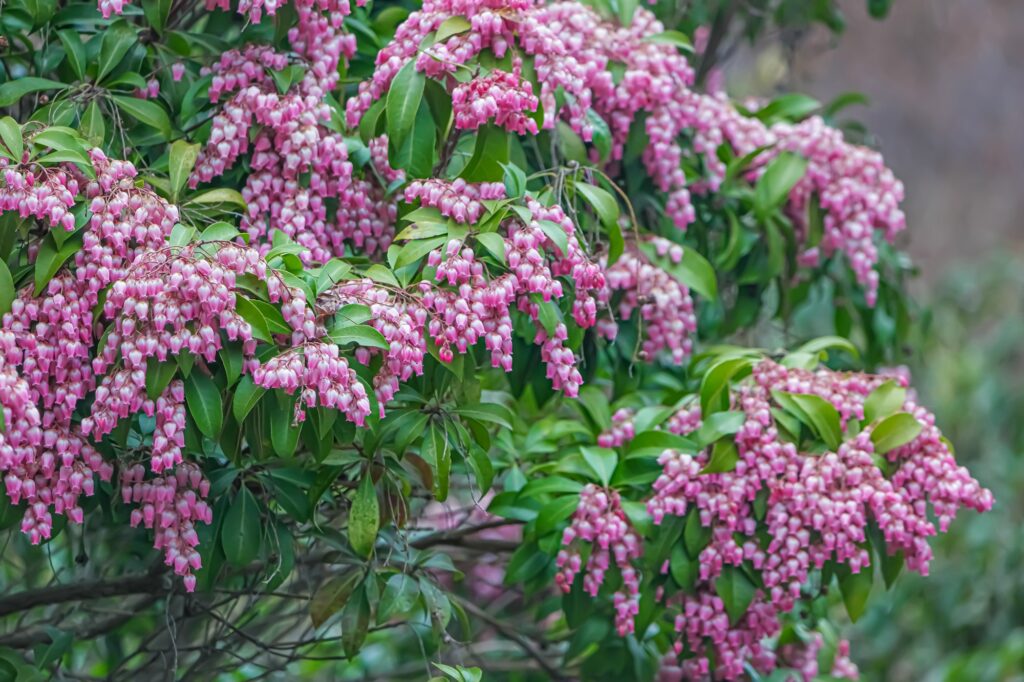
Clusters of small urn-shaped flowers hang from the branches in spring. Their appearance resembles lily-of-the-valley flowers, explaining the common name lily-of-the-valley shrub.
🌸 When Does Pieris Bloom?
Japanese pieris generally blooms from late winter into spring, with the precise timing depending on climate and cultivar.
Flower buds frequently become visible well before they actually open. They can remain decorative on the shrub through part of winter before developing into hanging clusters of flowers as temperatures begin to rise.
The blossoms are usually white, although several cultivars produce pink or reddish flowers.
Because the flowers appear relatively early in the year, pieris can provide valuable color between the winter garden and the main spring flowering season.
🔔 What Do Pieris Flowers Look Like?
Pieris produces clusters of small, hanging, bell- or urn-shaped flowers.
The individual blossoms resemble those of lily-of-the-valley, but they are carried on a woody evergreen shrub rather than a low-growing perennial.
Flower clusters may hang several inches from the ends of the branches.
Depending on the cultivar, blossoms can be:
- White
- Cream
- Pale pink
- Rose-pink
- Reddish pink
The flowers may also have a light fragrance.
Their delicate appearance contrasts beautifully with the shrub’s leathery evergreen leaves and colorful new spring growth.
🔥 Why Does Pieris Have Red Leaves?
The red leaves that appear on many Japanese pieris cultivars are normal new growth, not necessarily a sign that something is wrong.
Fresh foliage may emerge in shades of:
- Scarlet
- Burgundy
- Pink
- Bronze
- Copper
- Orange-red
As the leaves mature, they gradually turn green.
Some cultivars have been selected specifically for especially vivid spring foliage.
This dramatic color change is one reason pieris can remain interesting even after the flowers have faded.
If only the newest leaves are red while older foliage remains healthy and green, the color is generally part of the plant’s normal growth cycle.
☀️ How Much Sun Does Pieris Need?
Pieris grows in full sun to partial shade, but the ideal exposure depends on climate.
In cooler regions, plants can tolerate substantial direct sunlight as long as the soil remains consistently moist.
In warmer climates, partial shade is usually preferable.
Morning sunlight followed by afternoon shade provides an excellent combination in many gardens.
Too much intense afternoon sun can stress the foliage, especially when accompanied by dry soil.
Very deep shade is not ideal either. Plants may become thin and produce fewer flowers.
Bright filtered light or several hours of gentle direct sun usually creates the best balance of flowering, foliage color, and plant health.
🌳 Can Pieris Grow in Shade?
Yes, pieris tolerates partial shade quite well.
In fact, some shade can be beneficial in hot climates.
A woodland-edge location beneath high-branched deciduous trees can provide suitable conditions as long as enough light reaches the shrub.
Avoid planting beneath an extremely dense evergreen canopy where both light and moisture are limited.
Very heavy shade may reduce flowering and produce less colorful new foliage.
Remember that tree roots can also compete aggressively for water, so newly planted pieris beneath mature trees may need additional irrigation.
🌱 Best Soil for Pieris
Pieris has fairly specific soil preferences.
It grows best in acidic, organically rich, moist but well-drained soil.
Ideal conditions are similar to those enjoyed by azaleas and rhododendrons.
Good soil should contain plenty of organic matter while still allowing excess water to drain away.
Suitable amendments can include:
- Compost
- Leaf mold
- Composted pine bark
- Other acidic organic material
Heavy clay may require improvement before planting, particularly if it remains saturated after rainfall.
Pieris does not tolerate waterlogging well.
🧪 Does Pieris Need Acidic Soil?
Yes.
Soil acidity is one of the most important requirements for healthy pieris.
Japanese pieris generally performs best when the soil is acidic, typically below about pH 6.
In alkaline soil, the plant may become unable to absorb certain nutrients efficiently even when those nutrients are technically present.
This often produces chlorosis, characterized by yellow leaves with contrasting green veins.
If your garden soil is naturally alkaline, growing pieris in a container filled with ericaceous potting mix may be much easier than attempting to change the soil chemistry of an entire bed.
💛 Why Is My Pieris Turning Yellow?
Yellow leaves are a common problem on pieris, and soil pH should be one of the first things you investigate.
If leaves become yellow while the veins remain distinctly green, the plant may be experiencing chlorosis caused by alkaline soil.
Other causes can include:
- Waterlogged roots
- Severe drought
- Root disease
- Nutrient imbalance
- Normal aging of older leaves
Before applying fertilizer, test or investigate the soil conditions.
Adding more nutrients will not necessarily solve a problem caused by unsuitable pH.
Correcting the growing environment is usually more important.
💧 How Often Should You Water Pieris?
Newly planted pieris requires regular watering while its root system becomes established.
Keep the soil consistently moist but not saturated.
During dry periods, water deeply rather than applying small amounts every day.
Established shrubs are more resilient, but they still dislike prolonged drought.
Pieris has relatively shallow roots, so extended hot and dry weather can stress the plant more quickly than it would a deeply rooted shrub.
A layer of mulch helps reduce water loss and keeps the root zone cooler.
⚠️ Can You Overwater Pieris?
Yes.
Pieris needs moisture but is highly vulnerable to problems when soil remains waterlogged.
Poor drainage can contribute to root diseases, including Phytophthora root rot.
Warning signs may include:
- Yellow foliage
- Wilting despite moist soil
- Brown leaves
- Weak growth
- Branch dieback
- Sudden collapse of part or all of the shrub
If the plant is wilting while the soil remains wet, do not automatically give it additional water.
Inspect the drainage and root zone instead.
🌡️ Temperature and Climate
Japanese pieris performs best in temperate climates.
Many forms are hardy across approximately USDA Zones 5 through 8, although hardiness varies by cultivar and local conditions.
Plants appreciate protection from harsh winter winds, which can dry or scorch evergreen foliage.
A location near a building, fence, or larger shrubs can provide shelter without creating deep shade.
Hot summers can also stress pieris.
In warmer parts of its growing range, afternoon shade, consistent moisture, and organic mulch help protect the shrub.
💨 Protecting Pieris From Winter Wind
Because pieris retains its leaves through winter, it can continue losing moisture from its foliage even when cold soil limits the roots’ ability to replace that water.
Cold, dry winds can therefore cause winter burn.
Symptoms often include brown leaf edges or patches of scorched foliage.
A sheltered planting location is the best prevention.
Avoid placing pieris in an exposed area where winter winds sweep across the garden.
Mulching the root zone and watering adequately before the ground freezes can also help plants enter winter in good condition.
🌿 How to Plant Pieris
Spring or fall are generally good times to plant pieris.
Choose the location carefully because established plants prefer not to have their roots disturbed unnecessarily.
Dig a hole approximately as deep as the root ball and two to three times wider.
Do not plant the shrub deeply.
The upper surface of the root ball should remain approximately level with the surrounding soil.
Backfill gently and water thoroughly.
Apply a layer of organic mulch over the surrounding root zone, keeping the material away from the main stems.
Continue watering regularly while the shrub establishes.
📏 How Far Apart Should You Plant Pieris?
Spacing depends heavily on the cultivar.
Full-sized Japanese pieris may eventually reach 6 to 10 feet across, while dwarf cultivars can remain only a few feet wide.
Always check the expected mature dimensions of the specific variety.
For standard-sized plants, spacing them 5 to 8 feet apart may be appropriate.
Dwarf cultivars can be placed more closely.
Avoid planting full-sized pieris immediately against a house or narrow walkway simply because the nursery plant looks small.
Pieris grows slowly, but mature shrubs eventually need substantial space.
🌳 How Large Does Pieris Grow?
The species Pieris japonica can eventually reach approximately 8 to 10 feet tall and 6 to 8 feet wide under favorable conditions, with some specimens becoming larger.
The good news for smaller gardens is that many compact cultivars are available.
Dwarf selections may remain around 2 to 4 feet tall and wide.
Because pieris grows relatively slowly, it can take many years for a shrub to reach full size.
Choose the cultivar according to the available space rather than relying on repeated pruning to control a naturally large variety.
🌱 How Fast Does Pieris Grow?
Pieris is a slow-growing shrub.
Young plants may add only modest growth each season, especially during the first few years while establishing their roots.
Do not try to force rapid growth with heavy fertilizer.
Excessive feeding can create soft growth and may make the plant more vulnerable to environmental stress.
Given good acidic soil, appropriate moisture, and the right amount of light, pieris develops steadily into a dense evergreen specimen.
Its slow growth also means relatively little pruning is normally required.
🌾 Does Pieris Need Fertilizer?
Pieris generally needs only modest feeding.
Because it is an acid-loving plant, use a fertilizer formulated for plants such as:
- Rhododendrons
- Azaleas
- Camellias
- Blueberries
- Other ericaceous plants
Apply fertilizer according to the product directions, usually during spring as active growth begins.
Do not assume that more fertilizer will produce a healthier shrub.
Excess feeding can damage roots or encourage weak growth.
If your pieris is healthy and growing in fertile soil enriched with organic matter, routine heavy fertilizer applications are unnecessary.
🍂 Should You Mulch Pieris?
Yes.
Pieris benefits considerably from an organic mulch because its roots are relatively shallow.
Apply approximately 2 to 3 inches of material such as:
- Pine bark
- Pine needles
- Shredded leaves
- Leaf mold
- Wood chips
- Compost
Keep mulch a few inches away from the main stems.
Mulch reduces evaporation, keeps the root zone cooler, suppresses weeds, and gradually contributes organic matter to the soil.
Avoid cultivating deeply around the shrub because digging can damage shallow roots.
✂️ Does Pieris Need Pruning?
Very little.
Pieris naturally develops an attractive rounded shape and does not need routine shearing.
Pruning should generally be limited to:
- Dead branches
- Damaged wood
- Diseased stems
- Crossing branches
- Awkward shoots
- Minor shaping
Allowing the plant to develop naturally usually produces the best appearance.
If a pieris requires heavy pruning every year to fit its location, the shrub is probably too large for the space.
✂️ When Should You Prune Pieris?
If pruning is necessary, prune shortly after flowering.
Pieris develops flower buds for the following season well before the next spring, so pruning later in the year can reduce the next flower display.
Remove unwanted branches selectively rather than shearing the entire shrub.
Make cuts back to a healthy branch or growing point.
Dead or severely damaged wood can be removed whenever it becomes obvious.
✂️ Should You Deadhead Pieris?
Deadheading is optional.
After flowering, the spent clusters can be removed if you prefer a tidier appearance.
Cut old flower clusters carefully without removing large portions of new growth.
Leaving spent flowers on the plant generally does not cause serious harm.
On large mature shrubs, deadheading every flower cluster can be unnecessarily time-consuming.
Consider it an aesthetic task rather than an essential part of pieris care.
🌺 Popular Pieris Varieties
Japanese pieris is available in numerous cultivars selected for new foliage color, flower color, and mature size.
🔥 ‘Mountain Fire’
‘Mountain Fire’ is one of the best-known cultivars.
Its new foliage emerges brilliant red before gradually maturing to green.
The striking spring leaf color can be nearly as impressive as the white flower clusters.
It eventually develops into a substantial shrub and should be given enough room to grow.
❤️ ‘Forest Flame’
‘Forest Flame’ is particularly valued for dramatic foliage.
New leaves can emerge bright red, fade through shades of pink and cream, and eventually mature to green.
White spring flowers provide an additional seasonal display.
The changing leaf colors make this cultivar useful where year-round foliage interest is important.
🌸 ‘Valley Valentine’
‘Valley Valentine’ is known for deeper reddish-pink flowers rather than the white blossoms typical of many Japanese pieris cultivars.
It works well when gardeners want both colorful foliage and darker spring flowers.
🤍 ‘Cavatine’
‘Cavatine’ is a compact selection appropriate for smaller gardens.
It generally remains much shorter than the species and produces abundant white spring flowers.
Its size makes it useful in foundation beds, small borders, and containers.
🌿 ‘Little Heath’
‘Little Heath’ is another compact cultivar and is particularly distinctive because of its variegated foliage.
Cream-edged leaves give the plant interest even when it is not flowering.
Compact pieris varieties such as this can be easier to fit into smaller landscapes than full-sized forms.
🪴 Can Pieris Grow in Containers?
Yes.
Pieris is an excellent candidate for container growing, particularly dwarf cultivars.
Containers are also a useful solution for gardeners whose native soil is too alkaline.
Choose a pot with generous drainage holes and fill it with ericaceous or acid-loving plant potting mix.
Do not use highly alkaline garden soil.
Place the container in bright filtered light or morning sun with afternoon shade.
Check moisture frequently because pots dry much faster than garden beds.
The soil should remain moderately moist without staying saturated.
💧 Watering Pieris in Containers
Container-grown pieris deserves special attention to water quality as well as watering frequency.
If your tap water is very alkaline or hard, repeated irrigation may gradually increase the pH of the container mixture.
Rainwater can be particularly useful for acid-loving container plants where practical.
Water when the upper portion of the potting mix begins to dry.
Allow excess water to escape through the drainage holes.
Never allow the container to remain permanently submerged in a saucer of water.
❄️ Overwintering Pieris in Containers
Pieris is evergreen and remains outdoors through winter within its normal growing range.
Container plants, however, have less root protection than shrubs planted in the ground.
Use a substantial frost-resistant container.
Position the pot in a sheltered location protected from severe winter wind.
In very cold climates, insulating the sides of the container can provide additional protection.
Check soil moisture periodically during winter. Evergreen plants can still suffer from dehydration even when they are not actively producing new growth.
🔄 Can You Transplant Pieris?
Young pieris can be transplanted, but mature specimens are better left undisturbed whenever possible.
If moving becomes necessary, early spring or fall are generally the most practical times.
Prepare the new planting hole before digging up the shrub.
Retain as large a root ball as possible and minimize the amount of time the roots remain exposed.
Replant at the same depth and water thoroughly.
Maintain regular moisture during the following growing season while the root system reestablishes.
✂️ Propagating Pieris From Cuttings
Pieris can be propagated from stem cuttings.
Softwood cuttings can be taken from young growth, while semi-hardwood cuttings may be used later in the growing season.
Choose healthy nonflowering shoots.
Remove the lower leaves and insert the stems into a free-draining propagation medium.
Maintain consistent humidity and gentle moisture while roots develop.
Rooting can take time, so patience is required.
Named cultivars are best propagated vegetatively if you want the new plants to retain the characteristics of the parent.
🌰 Can You Grow Pieris From Seed?
Pieris can be grown from seed, but this method is slow and less predictable than propagation from cuttings.
Seed-grown plants can vary from the parent, particularly when seed comes from a named cultivar.
Seedlings may also require several years to develop into substantial flowering shrubs.
For most home gardeners, purchasing a nursery plant or rooting cuttings is more practical.
Seed propagation is better suited to gardeners interested in experimentation rather than producing an exact copy of a favorite cultivar.
🌿 Best Companion Plants for Pieris
Pieris combines naturally with other plants that appreciate acidic soil and partial shade.
Good companions include:
- Hydrangea Care
- Hellebore Care
- Christmas Rose Care
- Cyclamen Care
- Hardy Begonia Care
- Trillium Care
- Virginia Bluebell Care
- Ferns
- Rhododendrons
- Azaleas
- Camellias
The combination of pieris, rhododendrons, azaleas, and woodland perennials works especially well because the plants share similar preferences for acidic, organic-rich soil.
🌳 Pieris in a Woodland Garden
Pieris fits beautifully into a lightly shaded woodland garden.
Its evergreen foliage provides year-round structure among herbaceous woodland plants that disappear during winter.
Spring flowers and colorful new growth also arrive at a useful time, overlapping with many early woodland perennials.
Plant pieris beneath high deciduous trees rather than beneath an extremely dense canopy.
Allowing fallen leaves to decompose around the shrub can gradually add organic matter, although thick mats should not be left piled against the stems.
🏡 Pieris as a Foundation Plant
Compact pieris cultivars can make excellent foundation shrubs.
The evergreen foliage provides year-round structure while the spring flowers and colorful new leaves create seasonal change.
Pay close attention to mature size.
A full-sized Pieris japonica can eventually become much too large for the narrow space beneath a window.
For foundation beds, dwarf or compact cultivars are usually easier to manage.
Also make sure roof runoff does not leave the root zone permanently saturated.
🐝 Does Pieris Attract Pollinators?
Pieris flowers can attract bees and other insects during spring.
Its early bloom period can be useful because pollinator activity begins increasing before many summer perennials are flowering.
A diverse planting is still better than relying on one shrub.
Combine pieris with spring bulbs, woodland flowers, and later-blooming shrubs and perennials to provide a succession of flowers throughout the growing season.
Avoid spraying insecticides over open flowers.
🐛 Pieris Lace Bug
Pieris lace bug is one of the most important pests affecting Japanese pieris.
These small insects feed primarily on the undersides of leaves.
Damage often first appears as pale, stippled, or speckled areas across the upper leaf surface.
Severe infestations can make foliage appear bleached or unhealthy.
Plants growing in hot, sunny, stressful conditions may be particularly vulnerable.
Inspect the undersides of damaged leaves for insects and dark spotting.
Maintaining healthy growing conditions and avoiding excessive environmental stress can help plants tolerate pest pressure.
🐛 Other Common Pieris Pests
Besides lace bugs, pieris may occasionally experience:
- Scale insects
- Spider mites
- Weevils
- Caterpillars
Not every insect requires treatment.
Minor damage on an otherwise vigorous shrub can often be tolerated.
Regularly inspect foliage, particularly the undersides of leaves, so serious infestations can be identified early.
Avoid broad-spectrum insecticides whenever possible because they can also kill beneficial insects.
🍄 Common Pieris Diseases
Pieris can experience several disease problems, particularly when growing conditions are poor.
Potential issues include:
- Phytophthora root rot
- Fungal leaf spots
- Dieback
- Honey fungus in susceptible regions
Root rot is particularly concerning in poorly drained soil.
A plant with damaged roots may wilt even though the ground remains wet.
This is why proper site preparation is so important.
Healthy pieris in acidic, well-drained soil experiences far fewer problems than plants struggling in heavy, alkaline, or saturated ground.
❓ Why Is My Pieris Not Flowering?
Several factors can reduce flowering.
Too Much Shade
Pieris tolerates shade, but extremely low light can reduce the number of flowers.
Pruning Too Late
Pruning in summer, fall, or winter can remove developing flower buds.
Perform shaping immediately after flowering.
Excess Fertilizer
Heavy nitrogen feeding can encourage foliage rather than flowers.
Young Plant
A recently planted shrub may need time to establish.
Environmental Stress
Drought, root disease, alkaline soil, or severe winter damage can all weaken flowering.
Healthy established plants generally flower reliably when given adequate light.
❓ Why Are My Pieris Leaves Brown?
Brown leaves can result from several different forms of stress.
Possible causes include:
- Winter wind burn
- Severe drought
- Root rot
- Excessive sun
- Fertilizer damage
- Lace bug injury
- Transplant stress
Consider which part of the plant is affected.
Brown outer leaf edges after winter often suggest wind or moisture stress.
Entire branches turning brown while the soil stays wet can indicate root problems.
Speckled or bleached foliage should be inspected for lace bugs.
❓ Why Is My Pieris Wilting?
Check the soil before assuming the plant needs water.
If the soil is dry, a deep watering may solve the problem.
If the ground is already saturated, wilting can indicate damaged roots.
Root rot prevents a plant from absorbing water effectively even though plenty of moisture surrounds the roots.
Allow waterlogged soil to drain and investigate whether the planting location needs improvement.
Continually adding water to a wilting plant with diseased roots can accelerate its decline.
❓ Why Is My Pieris Losing Leaves?
Some shedding of older leaves is normal.
Widespread leaf loss can indicate environmental stress.
Possible causes include:
- Drought
- Waterlogged soil
- Root disease
- Winter damage
- Severe pest infestation
- Unsuitable soil pH
Look at the condition of the remaining foliage.
Yellow leaves with green veins suggest a different problem from leaves covered in pale stippling or foliage suddenly turning brown.
Correct diagnosis prevents unnecessary treatments.
🦌 Is Pieris Deer Resistant?
Pieris is generally considered resistant to deer browsing.
Its leathery foliage and toxic compounds make it less appealing than many common shrubs.
However, no plant is completely deer-proof.
Animals experiencing severe hunger may sample almost anything.
Newly planted shrubs can be protected temporarily where deer pressure is extreme.
Once established, pieris is often a useful evergreen option for landscapes where deer routinely damage more palatable plants.
☠️ Is Pieris Poisonous?
Yes. Pieris is poisonous if eaten.
The plant contains grayanotoxins, compounds also found in some other members of the heath family.
All parts should be treated as potentially harmful, including:
- Leaves
- Flowers
- Stems
- Nectar
- Plant debris
Pieris should never be treated as an edible or medicinal plant.
Wear gloves when performing extensive pruning or handling large quantities of cut material, particularly if you have sensitive skin.
Keep discarded branches where children and animals cannot eat them.
🐾 Is Pieris Toxic to Dogs and Cats?
Yes.
Dogs, cats, horses, livestock, and other animals should not be allowed to eat pieris.
Ingestion of grayanotoxin-containing plants can cause significant poisoning.
Possible symptoms may include:
- Drooling
- Vomiting
- Diarrhea
- Weakness
- Abnormal heart activity
- Neurological signs
If you suspect a pet has eaten pieris, contact a veterinarian or animal poison-control service promptly.
Households with pets that habitually chew shrubs may prefer to select a different evergreen plant.
👶 Should You Plant Pieris Around Children?
Pieris can be grown in ordinary ornamental landscapes, but children should be taught that its leaves and flowers are not edible.
For very young children who regularly pick and taste garden plants, placing pieris away from play areas may be sensible.
Do not plant it directly beside edible berry shrubs or vegetables where plant material might be confused or accidentally mixed with food.
Pieris is an ornamental shrub and should remain clearly separated from edible plantings.
❓ Why Is My Pieris New Growth Red?
If the newest leaves are red, pink, bronze, or copper and otherwise look healthy, there is probably no problem at all.
Colorful young foliage is one of Japanese pieris’s signature ornamental features.
Many cultivars have been specifically selected to intensify it.
The leaves gradually change color as they mature.
For example, a flush may begin bright scarlet, become bronze, and ultimately turn deep green.
This changing foliage can provide several weeks of color after the spring flowers finish.
❓ Why Does My Pieris Have Spotted Leaves?
Pale stippling across the leaves may indicate pieris lace bug.
Examine the undersides of affected leaves carefully.
Brown or black circular spots may instead indicate fungal leaf spot.
Environmental stress can also produce irregular leaf discoloration.
Avoid diagnosing the problem based only on the presence of “spots.”
Consider their shape, distribution, and whether insects are visible beneath the foliage.
Improving growing conditions is often an important part of preventing repeated problems.
🏡 Where to Plant Pieris
Pieris works well in landscapes where acidic soil and moderate shade are available.
Good locations include:
- Woodland gardens
- Acid-loving shrub borders
- Foundation beds with compact cultivars
- Cottage gardens
- Partially shaded borders
- Evergreen gardens
- Spring gardens
- Large containers
- Beneath open deciduous tree canopies
- Mixed rhododendron and azalea beds
Avoid highly alkaline soil, waterlogged locations, and extremely exposed windy sites.
Full-sized cultivars also need significantly more space than their small nursery size may suggest.
🌱 Is Pieris Easy to Grow?
Pieris is easy to maintain once its basic soil requirements are met.
The essential care guidelines are straightforward:
- Grow pieris in acidic soil.
- Provide full sun to partial shade.
- Give afternoon shade in hot climates.
- Keep the soil moderately moist.
- Make sure drainage is excellent.
- Mulch around the shallow root system.
- Protect the shrub from harsh drying winds.
- Feed lightly with fertilizer intended for acid-loving plants when necessary.
- Prune only minimally and preferably after flowering.
- Watch for pieris lace bug.
- Keep the plant away from animals or children likely to eat it.
The largest obstacle is unsuitable soil.
A pieris planted in acidic, organic-rich soil may thrive with relatively little attention, while the same shrub planted in alkaline, waterlogged ground can struggle continuously.
🌸 Final Thoughts
Pieris is one of the most useful evergreen shrubs for a partially shaded garden. Its glossy foliage provides structure throughout the year, while hanging clusters of white or pink flowers brighten early spring. Soon afterward, colorful new leaves in shades of scarlet, bronze, copper, or pink can create an entirely different display.
Successful pieris care largely comes down to soil. Give Pieris japonica acidic, humus-rich soil that remains moderately moist but drains freely. Provide sun or partial shade, protect the shrub from harsh winter winds, and avoid disturbing its shallow roots.
Pieris is also a shrub that rewards restraint. It needs little fertilizer and very little pruning. Choosing a cultivar that naturally fits the available space is much easier than repeatedly cutting back an oversized plant.
Combined with Hellebores, Christmas Roses, Cyclamen, hydrangeas, rhododendrons, and other woodland plants, pieris can provide evergreen structure and seasonal color for many years.
🔗 Related Articles
- Hydrangea Care
- Hellebore Care
- Christmas Rose Care
- Cyclamen Care
- Hardy Begonia Care
- Trillium Care
- Virginia Bluebell Care
- Witch Hazel Care
- Beautyberry Care
- Winter Heath Care