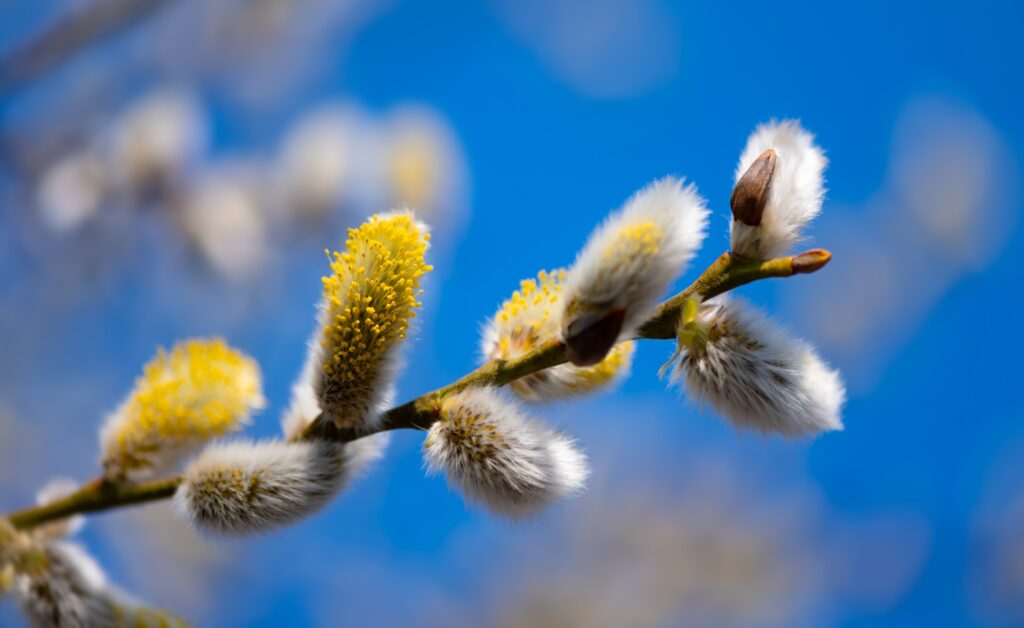
Pussy willow is a fast-growing deciduous shrub or small tree best known for the soft, silvery catkins that cover its bare branches in late winter and early spring. Botanically known as Salix discolor, the North American pussy willow is native across a large portion of Canada and the northern United States, where it naturally grows around wetlands, streambanks, wet meadows, and other places with reliably moist soil.
Those fuzzy catkins are among the earliest signs that winter is ending. They emerge before the leaves and are especially noticeable on male plants, where the pearl-gray catkins eventually develop yellow pollen-bearing stamens. Branches can also be cut and brought indoors for spring arrangements, making pussy willow a traditional favorite for seasonal decorating.
Pussy willow is easy to grow when given one thing it particularly appreciates: moisture. Unlike many ornamental shrubs that demand sharply drained ground, Salix discolor performs beautifully in damp areas and can even tolerate periodically wet soil. It also grows rapidly, however, and develops a wide-spreading shallow root system, so choosing the right planting location is important.
🌿 Pussy Willow at a Glance
- Botanical name: Salix discolor
- Common names: Pussy willow, American pussy willow, glaucous willow
- Plant family: Salicaceae
- Plant type: Deciduous shrub or small tree
- Native range: North America
- Mature height: Commonly about 10 to 20 feet
- Mature spread: About 8 to 12 feet
- Sun exposure: Full sun to partial shade
- Soil: Moist to wet soil with reasonable drainage
- Bloom time: Late winter to early spring
- Flower type: Silvery catkins
- Water needs: Moderate to high
- Growth rate: Fast
- Hardiness: Generally USDA Zones 2–7
- Growth habit: Multi-stemmed and upright
- Wildlife value: Important early pollen source and host plant for numerous insects
- Pruning: Tolerates heavy pruning and coppicing
🌱 What Is Pussy Willow?
Pussy willow is a member of the willow genus, Salix, which contains hundreds of trees and shrubs found primarily in temperate and cooler parts of the Northern Hemisphere.
The American pussy willow, Salix discolor, naturally develops as a large multi-stemmed shrub. Under favorable conditions, it can occasionally become a small tree.
Its most recognizable feature appears before the leaves emerge.
Flower buds along the bare stems open to expose silky gray catkins that resemble tiny pieces of soft fur. This resemblance is responsible for the common name “pussy willow.”
After flowering, narrow green leaves develop and remain throughout the growing season.
🌿 American Pussy Willow vs. European Pussy Willow
The name pussy willow is applied to more than one species.
In North America, it most commonly refers to American pussy willow (Salix discolor).
Another commonly grown species is European pussy willow or goat willow (Salix caprea), which is native to Europe and western and central Asia.
Both develop attractive spring catkins, but they are different species.
Salix discolor is generally the better choice for North American native and wildlife gardens within its natural range.
European pussy willow can also grow as a large shrub or small tree and tolerates heavy pruning, but gardeners interested in ecological value should consider the native species first.
🌸 What Are Pussy Willow Catkins?
The fuzzy structures commonly called pussy willow flowers are technically catkins.
Catkins are elongated flower clusters found on plants such as willows, birches, alders, and hazelnuts.
On pussy willow, they emerge before the leaves.
The familiar silky silver stage is actually an early developmental phase. As male catkins mature, yellow stamens become visible and begin releasing pollen.
Female catkins look different and are generally less ornamental.
This distinction is important when purchasing a pussy willow primarily for decorative branches.
♂️ Male vs. Female Pussy Willow
Pussy willow is dioecious, meaning male and female flowers occur on separate plants.
Male plants produce the classic large, silky catkins most gardeners associate with pussy willow.
As those catkins mature, they become yellow with pollen-bearing stamens.
Female plants produce smaller and generally less showy greenish catkins.
If the main goal is an ornamental display or harvesting decorative stems, choose a male plant.
Nurseries specializing in pussy willow may identify the sex of the plant.
🌼 When Does Pussy Willow Bloom?
Pussy willow blooms extremely early.
Catkins generally begin developing during late winter or early spring, before the leaves appear.
Depending on climate, this can occur from February through April.
Warm spells can encourage catkins to expand surprisingly early.
The silvery stage may persist for some time before the flowers mature completely.
Because pussy willow blooms so early, it is often one of the first conspicuous signs of spring in colder climates.
🐝 Pussy Willow and Early Pollinators
Pussy willow has much more ecological value than its ornamental appearance might suggest.
The flowers provide pollen and other resources for insects active very early in the season.
Willows as a group support specialized native bees as well as numerous butterfly and moth species.
American pussy willow is also associated with butterflies such as the viceroy, whose caterpillars can feed on willow foliage.
That makes Salix discolor an especially useful addition to a native pollinator or wildlife garden where enough space and moisture are available.
☀️ How Much Sun Does Pussy Willow Need?
Pussy willow grows in full sun to partial shade.
Full sun is generally best for:
- Dense growth
- Abundant catkins
- Strong stems
- Overall flowering performance
Aim for at least six hours of direct sunlight if possible.
Partial shade is tolerated, particularly in naturally moist locations.
Plants grown in substantial shade may develop a looser growth habit and produce fewer catkins.
🌱 Best Soil for Pussy Willow
Pussy willow is much more tolerant of wet soil than many conventional landscape shrubs.
It performs well in:
- Moist loam
- Wet meadow soil
- Streamside soil
- Rain garden conditions
- Clay with adequate oxygen and seasonal drainage
- Average garden soil kept consistently moist
The plant naturally occurs near wetlands and waterways.
It does not need constantly standing water, however.
A location that remains moist without becoming permanently stagnant is ideal.
💧 How Often Should You Water Pussy Willow?
Pussy willow appreciates more water than many ornamental shrubs.
Newly planted specimens should be watered regularly throughout their first growing season.
Do not allow the root ball to become completely dry.
Established plants growing in naturally moist ground may need little supplemental irrigation.
Plants in ordinary garden beds require more attention during summer drought.
Check the soil and provide a deep watering when it begins drying several inches below the surface.
☀️ Can Pussy Willow Tolerate Drought?
Pussy willow tolerates somewhat drier soil better than some willow species, but it is not an ideal drought-tolerant shrub.
Extended dry conditions can result in:
- Wilting
- Brown leaf edges
- Premature leaf drop
- Reduced growth
- Fewer strong stems
- Greater susceptibility to stress-related pests and diseases
If your landscape is naturally hot and dry and irrigation is limited, another shrub may be a better choice.
Pussy willow is most at home where water is naturally available.
💦 Can Pussy Willow Grow in Wet Soil?
Yes.
Wet soil tolerance is one of the plant’s greatest advantages.
Pussy willow can work well near:
- Ponds
- Streams
- Drainage swales
- Wet meadows
- Rain gardens
- Seasonally damp low areas
This makes it useful in places where many conventional shrubs struggle.
However, planting beside natural waterways should be done thoughtfully so the plant does not interfere with existing native vegetation or drainage infrastructure.
🌿 How to Plant Pussy Willow
Spring or fall are generally good planting times.
Choose a location with abundant sunlight and reliably moist soil.
Dig a planting hole approximately as deep as the root ball and two to three times wider.
Position the plant so the top of the root ball remains level with the surrounding ground.
Backfill with the original soil and water thoroughly.
Apply a layer of organic mulch around the root zone.
Because pussy willow grows quickly, make sure the site provides plenty of room before planting.
📏 How Far Apart Should You Plant Pussy Willows?
A mature American pussy willow can reach approximately 8 to 12 feet across.
For individual specimens, allow enough space for that mature spread.
When planting several for an informal screen, spacing of roughly 6 to 10 feet may be appropriate depending on how quickly you want the plants to fill together.
Pussy willow responds well to pruning, but it is still easier to give the shrub sufficient room than to fight its natural size every year.
🌳 How Large Does Pussy Willow Grow?
American pussy willow commonly grows about 10 to 20 feet tall with a spread of around 8 to 12 feet.
Some specimens can become larger under excellent conditions.
The plant naturally grows as a multi-stemmed shrub.
With selective pruning, it can sometimes be trained more like a small tree.
Most gardeners, however, allow pussy willow to retain its natural shrubby form because young stems produce the best ornamental catkins.
🌱 How Fast Does Pussy Willow Grow?
Pussy willow grows rapidly.
A well-established plant in moist soil and full sun can produce substantial new stems during a single growing season.
That vigorous growth is helpful when pussy willow is used for:
- Screening
- Wildlife habitat
- Cut branches
- Wet-area landscaping
- Informal hedges
It also means the shrub can quickly become too large for a confined location.
Regular pruning can maintain a smaller size.
⚠️ Pussy Willow Roots
Pussy willow develops an extensive, shallow, moisture-seeking root system.
These roots can create problems when the shrub is planted close to underground infrastructure.
Avoid planting pussy willow near:
- Sewer lines
- Septic systems
- Drainage pipes
- Underground water lines
- Building foundations
- Small paved areas
Willow roots naturally seek moisture and can exploit existing cracks or openings in pipes.
Give the plant a generous amount of open ground where the roots can expand without causing conflicts.
🏠 How Far Should Pussy Willow Be From a House?
There is no universal distance appropriate for every property, but pussy willow should not be planted immediately beside a house or underground utility system.
Its shallow spreading roots and large mature size make it much better suited to an open landscape.
A site at the edge of a large yard, beside a pond, or within a rain garden is generally preferable to a narrow foundation bed.
Before planting, also locate underground utilities and drainage systems.
✂️ When Should You Prune Pussy Willow?
Pussy willow tolerates heavy pruning exceptionally well.
For ornamental plants, pruning is commonly done after the spring catkin display.
This allows you to enjoy or harvest the catkin-covered branches first.
Cutting back older stems then encourages vigorous new shoots that can produce catkins in future seasons.
Dead, broken, or diseased branches can be removed whenever necessary.
✂️ How Hard Can You Prune Pussy Willow?
Very hard.
Pussy willow responds well to coppicing, a pruning technique in which stems are periodically cut close to the base.
Plants can be cut back severely every few years to maintain a smaller, bushier form and encourage long young stems.
This can be particularly useful when growing pussy willow primarily for floral arrangements.
A mature shrub can otherwise become large and woody.
Young replacement growth usually produces the most attractive stems.
🌱 What Is Coppicing?
Coppicing is a traditional pruning technique used with plants that readily regenerate from their base.
For pussy willow, it involves removing most or all older stems relatively close to ground level.
Fresh shoots emerge afterward.
These straight vigorous stems are useful for:
- Cut-flower arrangements
- Spring decorations
- Craft projects
- Maintaining a compact shrub
- Rejuvenating an old plant
Coppicing does not need to be performed every year.
Plants can often be cut back on a multi-year cycle.
✂️ How to Rejuvenate an Overgrown Pussy Willow
An old pussy willow can become congested with thick, aging stems.
Fortunately, it responds well to rejuvenation.
You can either cut the shrub down substantially or renovate it more gradually.
For gradual renovation, remove roughly one-third of the oldest stems at the base each year.
Repeat until the shrub consists primarily of younger vigorous growth.
This approach retains some structure while continually renewing the plant.
🌾 Does Pussy Willow Need Fertilizer?
Pussy willow generally does not require heavy fertilization.
In average garden soil, vigorous growth is usually easy to achieve with adequate moisture.
A layer of compost around the root zone in spring is often sufficient.
Avoid applying excessive nitrogen fertilizer.
Pussy willow already grows rapidly, and excessive feeding can create large amounts of soft growth without providing any meaningful benefit.
🍂 Should You Mulch Pussy Willow?
Yes.
A 2- to 3-inch layer of organic mulch can help young plants establish.
Suitable materials include:
- Wood chips
- Shredded bark
- Compost
- Shredded leaves
Keep mulch several inches away from the stems.
Mulch helps preserve the consistent soil moisture that willow prefers and reduces competition from nearby grass.
🌸 Cutting Pussy Willow Branches for Arrangements
Pussy willow stems make excellent indoor decorations.
Cut branches when the catkins have expanded to the desired stage.
Choose strong straight stems and make clean cuts with sharp pruners.
Branches can be placed in water if you want the catkins and flowers to continue developing.
If you want to preserve the soft gray catkins at a particular stage, branches can instead be dried.
Harvesting branches can conveniently be combined with the shrub’s annual pruning.
🌿 How to Dry Pussy Willow Branches
For dried arrangements, harvest branches when the silky gray catkins look their best.
Place them upright in an empty vase or container in a dry indoor location.
Avoid putting them in water if your goal is to preserve the catkins in their fuzzy stage.
Branches generally dry well and can remain decorative for a long period.
Keep dried arrangements away from excessive humidity.
🌸 Can You Force Pussy Willow Branches Indoors?
Yes.
Pussy willow is one of the easiest woody plants to force indoors.
Cut branches during late winter once the buds have experienced sufficient winter cold and begun swelling.
Bring the stems inside and place them in water in a bright location away from intense heat.
The warmer indoor conditions encourage the catkins to open earlier than they would outdoors.
Changing the water periodically helps keep the branches fresh.
✂️ Can You Grow Pussy Willow From Cuttings?
Yes, and willows are famously easy to propagate.
Take a healthy stem and place its lower portion in moist soil.
Under favorable conditions, roots can develop relatively quickly.
Hardwood cuttings can also be taken while the plant is dormant.
Keep newly planted cuttings consistently moist during establishment.
Because pussy willow roots readily, cuttings are generally a much easier propagation method than growing plants from seed.
💧 Can Pussy Willow Cuttings Root in Water?
Willow stems can form roots in water, and this often happens with branches being forced indoors.
However, roots that develop in water are adapted to aquatic conditions and may be delicate when moved into soil.
For landscape propagation, rooting stems directly in moist growing medium or prepared garden soil generally makes the transition easier.
Keep the new plant consistently watered until a substantial root system has developed.
🌰 Growing Pussy Willow From Seed
Pussy willow can grow from seed, but willow seeds remain viable for only a relatively short time and require appropriate moisture soon after dispersal.
Seed propagation is unnecessary for most gardeners.
Stem cuttings are far simpler, faster, and more reliable.
Cuttings also reproduce the sex and characteristics of the parent plant.
This is important if you specifically want a male pussy willow with showy silvery catkins.
🌿 Can Pussy Willow Be Grown as a Hedge?
Yes.
Pussy willow can form a fast-growing informal hedge or screen in moist soil.
Regular pruning keeps the planting relatively dense.
It works especially well where a conventional hedge would struggle because the ground remains seasonally wet.
Remember that pussy willow is deciduous.
It provides dense screening during the growing season but loses its leaves in fall.
The branching framework still offers some winter screening, but it will not provide the privacy of an evergreen hedge.
💦 Pussy Willow in a Rain Garden
Pussy willow is an excellent plant for larger rain gardens where its size can be accommodated.
It tolerates periodic wet conditions and can help stabilize moist soil.
Its roots also help absorb water from areas that experience temporary saturation after storms.
Do not plant it in a small residential rain garden without considering its mature size and root spread.
Smaller native wetland shrubs may be better where space is limited.
🏞️ Pussy Willow Near a Pond
The edge of a pond can provide ideal growing conditions.
Moist soil supports vigorous growth, while the open location often provides abundant sun.
Give the shrub enough room that mature branches do not interfere with paths or pond access.
Avoid placing it near artificial pond plumbing where aggressive moisture-seeking roots could eventually create problems.
For naturalistic ponds and wildlife gardens, American pussy willow can provide valuable habitat.
🐦 Is Pussy Willow Good for Wildlife?
Yes.
American pussy willow has considerable wildlife value.
Its early catkins support insects when relatively few other plants are providing spring resources.
Willow foliage can serve as food for caterpillars, including those of several butterfly species.
Birds benefit indirectly from the abundance of insects associated with willows and may use the dense branches for cover.
For a wildlife garden in North America, native Salix discolor generally provides more ecological relevance than nonnative ornamental pussy willow species.
🦋 Butterflies and Pussy Willow
Willows are important host plants for numerous butterflies and moths.
American pussy willow can support caterpillars of the viceroy butterfly, among others.
The broader genus Salix is associated with an impressive variety of native insects.
This makes pussy willow useful beyond its early flowers.
The leaves themselves contribute to the garden food web throughout the growing season.
🌿 Best Companion Plants for Pussy Willow
Because pussy willow likes moist soil, pair it with plants that appreciate similar conditions.
Good companions include:
- Turtlehead Care
- Virginia Bluebell Care
- Beautyberry Care
- Viburnum Care
- Witch Hazel Care
- Cornelian Cherry Dogwood Care
- Sneezeweed Care
- Aster Care
- Goldenrod Care
- Moisture-loving sedges and native grasses
Turtlehead is an especially useful perennial companion for damp sites because it extends flowering interest into late summer and fall.
🌸 Pussy Willow in an Early-Spring Garden
Pussy willow adds structure and texture to a garden during the transition from winter to spring.
Its silvery catkins combine beautifully with:
- Witch Hazel
- Cornelian Cherry Dogwood
- Winter Hazel
- Christmas Rose
- Cyclamen
- Snowdrops
- Crocuses
These plants can provide a succession of flowers and ornamental stems before most of the garden has begun active spring growth.
🐛 Common Pussy Willow Pests
Pussy willow can host a variety of insects.
Potential pests include:
- Aphids
- Scale insects
- Borers
- Lace bugs
- Caterpillars
- Sawflies
Not every caterpillar feeding on willow should automatically be regarded as a harmful pest.
Because willow is an important host plant, some leaf damage is a natural part of supporting wildlife.
Treatment is usually unnecessary unless a young or badly stressed plant is being severely damaged.
🍄 Common Pussy Willow Diseases
Pussy willow can experience several disease problems.
Potential issues include:
- Leaf spots
- Cankers
- Blights
- Powdery mildew
- Scab
Good airflow helps reduce some foliage diseases.
Remove severely diseased or dead branches and dispose of affected material appropriately.
Because the shrub tolerates hard pruning, badly damaged older stems can often be removed and replaced naturally by vigorous new growth.
❓ Why Isn’t My Pussy Willow Producing Catkins?
Several factors can reduce the catkin display.
The Plant Is Female
Female pussy willow catkins are considerably less ornamental than male ones.
Too Much Shade
Plants generally flower best in full sun.
Pruning at the Wrong Time
Repeatedly removing young flowering stems before they bloom eliminates the display.
Plant Is Young
Recently rooted cuttings may need additional time to mature.
Severe Stress
Drought, root damage, or serious disease can reduce flowering.
If ornamental catkins are your main goal, start with a known male plant.
❓ Why Are My Pussy Willow Leaves Turning Yellow?
Yellow leaves can result from:
- Drought
- Excessively stagnant soil
- Root damage
- Nutrient problems
- Natural autumn leaf drop
Pussy willow likes wet conditions, but that does not mean roots thrive indefinitely in stagnant, oxygen-poor water.
Check the growing conditions before applying fertilizer.
Yellowing during fall is normal because pussy willow is deciduous.
❓ Why Are My Pussy Willow Leaves Turning Brown?
Brown foliage often results from drought or heat stress.
Although willow is associated with wet areas, plants growing in ordinary garden soil can dry rapidly during hot summer weather.
Other possible causes include:
- Leaf disease
- Root damage
- Borers
- Chemical injury
- Transplant shock
Check soil moisture first.
A young pussy willow that has recently been planted may need significantly more water than an established shrub.
❓ Why Is My Pussy Willow Wilting?
Wilting usually indicates moisture stress.
If the soil is dry, water deeply.
Recently planted shrubs are especially prone to wilting because their roots have not yet spread into surrounding soil.
If the soil is already saturated and the plant continues wilting, investigate possible root damage.
Even moisture-loving shrubs require oxygen around their roots.
❓ Why Is My Pussy Willow Growing So Fast?
Rapid growth is normal.
Pussy willow is a vigorous woody plant adapted to colonizing moist, open habitats.
If the shrub is becoming larger than intended, prune after the catkin season or begin a regular coppicing schedule.
Do not try to control size by deliberately withholding water.
If the mature dimensions are fundamentally incompatible with the planting site, relocation while the plant is young may be the better solution.
❓ Why Are Branches Breaking?
Willow wood is relatively weak and flexible.
Heavy snow, ice, or storms can break branches.
Rapid growth can also produce long stems that bend under weight.
Remove broken wood with clean pruning cuts.
Regular renovation pruning helps maintain a younger framework and can reduce the amount of old, heavy wood within the shrub.
🦌 Is Pussy Willow Deer Resistant?
Pussy willow can tolerate some deer browsing, but it should not be considered completely deer-proof.
Tender young stems and buds may attract browsing animals.
Established shrubs generally recover well because they grow rapidly.
Where deer pressure is severe, protect recently planted specimens until their root systems and branch structure become well established.
🐾 Is Pussy Willow Safe Around Pets?
Pussy willow is not generally considered one of the most dangerously toxic landscape shrubs, but pets should still be discouraged from chewing branches, bark, or large quantities of foliage.
Willows contain naturally occurring salicylate-related compounds, and eating substantial amounts of unfamiliar plant material can cause problems.
If a pet consumes a significant quantity and develops vomiting, diarrhea, lethargy, or other symptoms, contact a veterinarian.
Decorative cut branches should also be placed where pets are unlikely to chew them.
🏡 Where to Plant Pussy Willow
Pussy willow works best in spacious locations with reliable moisture.
Good uses include:
- Rain gardens
- Pond edges
- Streamside plantings
- Wet meadows
- Wildlife gardens
- Pollinator gardens
- Informal hedges
- Large mixed shrub borders
- Naturalized landscapes
- Low moist areas
Avoid planting it:
- Beside sewer lines
- Near septic systems
- Directly beside foundations
- Over drainage pipes
- In tiny foundation beds
- In extremely dry landscapes
The right site allows you to enjoy its vigorous growth instead of constantly trying to control it.
🌱 Is Pussy Willow Easy to Grow?
Yes.
Pussy willow is one of the easier flowering shrubs when moisture and space are available.
Its essential care requirements are simple:
- Grow it in full sun or partial shade.
- Provide consistently moist soil.
- Water young plants regularly.
- Do not allow established plants to endure prolonged drought.
- Give the root system plenty of room.
- Keep the shrub away from sewer and drainage lines.
- Choose a male plant for the showiest catkins.
- Prune after the catkin display.
- Coppice periodically if you want abundant young decorative stems.
- Expect rapid growth.
- Allow some insect feeding in wildlife gardens.
- Use native Salix discolor where appropriate in North American landscapes.
The greatest mistake is usually not poor day-to-day care, but planting a vigorous moisture-seeking willow where its mature roots and branches do not have enough room.
🌸 Final Thoughts
Pussy willow is one of the classic signs that spring is approaching. Long before conventional flowering shrubs have leafed out, silky gray catkins emerge along its bare stems and bring texture and life back to the winter landscape.
American pussy willow, Salix discolor, has even more to offer than its ornamental branches. As a North American native shrub, it provides early resources for pollinating insects, supports butterfly and moth caterpillars, and thrives in moist areas where many traditional landscape plants struggle.
Give pussy willow full sun or partial shade, plenty of water, and generous room for its shallow spreading roots. Prune after flowering, and do not be afraid to cut older plants back hard when rejuvenation is necessary.
Combined with Witch Hazel, Cornelian Cherry Dogwood, Winter Hazel, and early spring bulbs, pussy willow can help transform the end of winter into the beginning of a new gardening season.
🔗 Related Articles
- Witch Hazel Care
- Winter Hazel Care
- Cornelian Cherry Dogwood Care
- Viburnum Care
- Turtlehead Care
- Virginia Bluebell Care
- Beautyberry Care
- Sneezeweed Care
- Aster Care
- Goldenrod Care