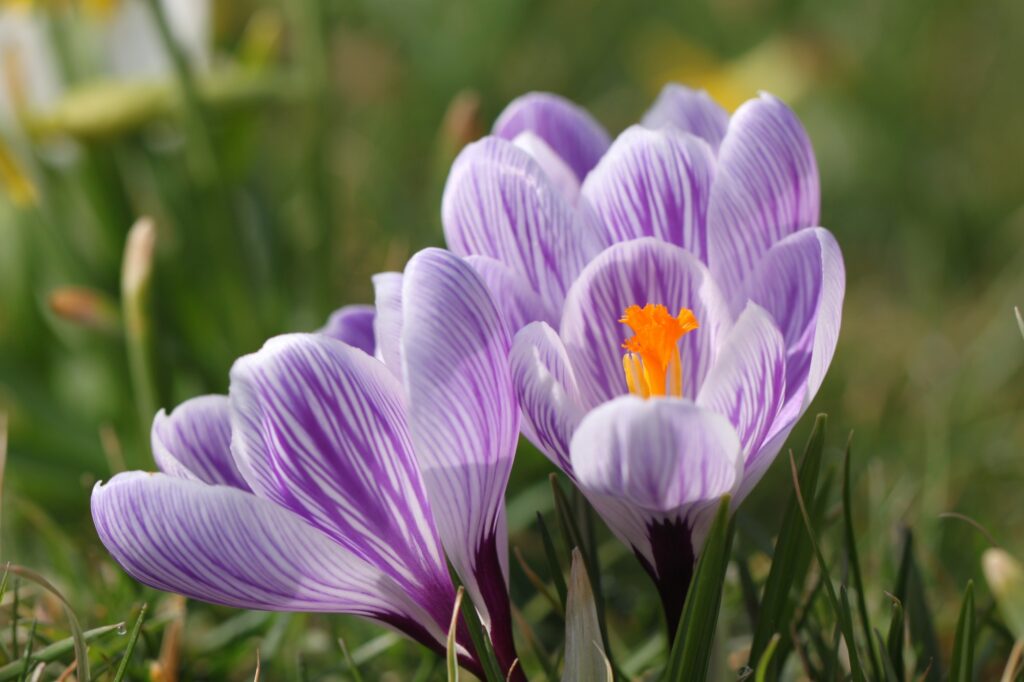
Crocuses are among the first flowers to announce that winter is finally loosening its grip. Their low-growing blooms can appear through cold soil, fallen leaves, and even patches of late snow, bringing flashes of purple, yellow, white, cream, and striped color to an otherwise dormant garden.
Although crocuses are often casually called spring bulbs, they actually grow from corms. A corm is a swollen underground stem used to store energy for future growth. That difference may seem minor, but understanding how crocuses grow makes planting, naturalizing, and long-term care much easier.
Most familiar garden crocuses bloom in late winter or early spring, although some species flower in autumn. Once established in a suitable location, many crocuses multiply gradually and return year after year with very little maintenance.
They are especially effective when planted in informal drifts beneath deciduous trees, along woodland edges, at the front of perennial beds, in rock gardens, or naturalized through areas of lawn where the grass can be left unmown until the crocus foliage matures.
🌸 Crocus at a Glance
- Botanical genus: Crocus
- Plant type: Perennial flowering corm
- Family: Iridaceae
- Bloom season: Late winter through spring for most garden types; some species bloom in autumn
- Height: Usually about 3 to 6 inches
- Sun: Full sun to partial shade
- Soil: Well-drained soil
- Planting time: Fall for spring-flowering crocuses
- Planting depth: Usually about 3 to 4 inches
- Spacing: Roughly 2 to 4 inches apart
- Water: Moderate during active growth; relatively dry during dormancy
- Hardiness: Varies by species and cultivar
- Wildlife value: Early nectar and pollen for bees and other insects
- Propagation: Offsets, division, and seed
- Special feature: Many species naturalize readily
🌱 Crocuses Grow From Corms, Not Bulbs
Crocuses are commonly sold alongside tulips, daffodils, and other spring-flowering bulbs, so it is easy to assume they grow from bulbs too.
Botanically, crocuses grow from corms.
A true bulb contains layers of fleshy scales surrounding a central bud. A corm is instead a compact, swollen stem covered by a papery outer layer.
Each year, the original crocus corm uses its stored energy to produce:
- Roots
- Leaves
- Flowers
As the growing season progresses, a new replacement corm develops above or around the old one.
Small cormlets may also form, allowing the plant to spread gradually into larger colonies.
🌷 Spring-Flowering vs. Autumn-Flowering Crocuses
Not all crocuses bloom at the same time.
Spring-Flowering Crocuses
These are the familiar crocuses that emerge near the end of winter.
Common groups include:
- Dutch crocus
- Snow crocus
- Species crocuses
They are normally planted in fall.
Autumn-Flowering Crocuses
Several true Crocus species flower in autumn.
The best-known is saffron crocus, Crocus sativus.
Autumn-flowering species are generally planted in late summer or early fall, depending on climate and species.
⚠️ Crocus vs. Autumn Crocus
This distinction is important.
Plants commonly called autumn crocus may actually belong to the genus Colchicum rather than Crocus.
Colchicum species are highly toxic if eaten.
Saffron crocus, Crocus sativus, is a true crocus and is the species from which culinary saffron is harvested.
Never harvest or eat stigmas from an unidentified plant simply because it resembles a saffron crocus.
Correct identification is essential.
💜 Popular Types of Crocus
There are many species and hybrids, but several groups are particularly common in gardens.
🌼 Dutch Crocus
Dutch crocuses are usually cultivars and hybrids derived largely from Crocus vernus.
They produce relatively large flowers and are available in colors including:
- Purple
- Lavender
- White
- Yellow
- Striped combinations
They are excellent for mass planting and naturalizing.
Because the flowers are larger than those of many species crocuses, they create a particularly noticeable early-spring display.
❄️ Snow Crocus
Snow crocuses, often associated with Crocus chrysanthus and related hybrids, tend to bloom earlier than large Dutch crocuses.
Their flowers are usually smaller but can be extremely numerous.
Colors include:
- Yellow
- Cream
- White
- Blue-purple
- Bicolors
- Striped varieties
These are especially attractive when planted in broad drifts.
🌿 Species Crocuses
Species crocuses tend to have smaller flowers and a more naturalistic appearance.
Many spread well when conditions suit them.
They are excellent choices for:
- Rock gardens
- Woodland edges
- Lawns
- Gravel gardens
- Informal borders
Some species bloom extremely early, occasionally appearing while snow is still nearby.
🌺 Saffron Crocus
Crocus sativus is the famous saffron crocus.
Unlike most commonly grown ornamental crocuses, it flowers in autumn.
The red stigmas inside each flower are harvested and dried to produce saffron.
Each flower produces only three stigmas, which explains why genuine saffron is so expensive.
Saffron crocus generally performs best in climates with:
- Dry summers
- Well-drained soil
- Plenty of sun
It dislikes waterlogged soil.
☀️ How Much Sun Do Crocuses Need?
Crocuses perform best in full sun to partial shade.
At least several hours of direct light encourages strong flowering.
Spring-flowering crocuses are especially well suited to planting beneath deciduous trees.
They receive abundant sunlight in late winter and early spring while the branches are still bare.
By the time the tree canopy fills in, the crocuses are already finishing their active growth cycle.
This seasonal pattern makes crocuses excellent woodland-edge plants.
🌳 Can Crocuses Grow Under Trees?
Yes.
Deciduous trees are often ideal companions.
Good locations include:
- Beneath maples
- Beneath ornamental trees
- Under open deciduous shrubs
- Along woodland edges
Avoid extremely dry sites beneath trees with dense surface roots unless the crocus species is adapted to those conditions.
Heavy evergreen shade is usually less suitable because the crocuses may not receive enough winter and spring sunlight.
🌱 Best Soil for Crocuses
Good drainage is one of the most important requirements.
Crocuses generally prefer soil that is:
- Loose
- Well drained
- Moderately fertile
- Moist during active growth
- Relatively dry during dormancy
Corms sitting in cold, saturated soil are vulnerable to rot.
If your garden has heavy clay, improve drainage before planting or consider a raised bed, rock garden, slope, or container.
🧪 What Soil pH Do Crocuses Prefer?
Crocuses tolerate a fairly broad pH range.
Slightly acidic to neutral soil works well for most garden types.
Rather than focusing excessively on a precise pH number, prioritize:
- Drainage
- Appropriate light
- Seasonal moisture
Those factors are usually more important for long-term survival.
🍂 When Should You Plant Crocus Corms?
Spring-flowering crocuses are generally planted in fall.
The corms need time to establish roots before winter and require a period of cold weather to complete their normal seasonal cycle.
Planting usually occurs after soil begins cooling but before it freezes solid.
In many climates, this means sometime from September through November.
The exact timing depends on local weather.
🌸 When Should You Plant Autumn-Flowering Crocuses?
Autumn-blooming crocuses are usually planted earlier.
Many are planted in late summer so they can establish before flowering.
Saffron crocus, for example, is often planted in late summer to early fall.
Always check the requirements of the particular species because autumn-flowering crocuses differ in their growth cycles.
📏 How Deep Should Crocus Corms Be Planted?
A good general guideline is about 3 to 4 inches deep.
Planting depth may vary somewhat depending on:
- Corm size
- Soil type
- Species
- Climate
Place the corm with the pointed or growing tip facing upward.
The flatter basal end goes down.
If orientation is unclear, planting the corm on its side is safer than planting it upside down. The shoot will usually orient itself toward the surface.
📐 How Far Apart Should Crocuses Be Planted?
For natural-looking displays, space corms about 2 to 4 inches apart.
You can plant them more closely for an immediate dense effect.
Crocuses look best in groups rather than isolated single plants.
Instead of planting one every foot, try clusters of:
- 10
- 20
- 50
- 100 or more
Large informal drifts produce the strongest visual impact.
🌱 Step 1: Choose a Well-Drained Location
Look for a location with good winter and spring sunlight.
Avoid low spots where water collects after rain or melting snow.
If water routinely sits on the surface, move the planting elsewhere or improve the drainage first.
🌿 Step 2: Loosen the Soil
Prepare the upper several inches of soil.
Remove:
- Perennial weeds
- Large rocks
- Compacted clods
Incorporate finished compost if the soil is poor.
Do not add large amounts of rich organic matter to already fertile soil.
The goal is good structure and drainage, not extremely rich conditions.
🌷 Step 3: Arrange the Corms Naturally
For an informal appearance, avoid perfectly straight rows.
One simple technique is to gently scatter the corms over the planting area and plant them approximately where they land.
This creates a more natural-looking pattern.
Keep enough space between them to allow multiplication over time.
🕳️ Step 4: Plant the Corms
Plant approximately 3 to 4 inches deep.
Place the growing tip upward.
Cover with soil and firm gently.
Do not compact the ground heavily.
💧 Step 5: Water After Planting
Water after planting if the soil is dry.
This helps settle the soil around the corms and encourages root development.
Fall rainfall may provide all the moisture needed after that.
Avoid keeping dormant corms continuously wet.
🍂 Step 6: Mulch Lightly
A light layer of mulch can help:
- Moderate soil temperature
- Reduce weeds
- Protect the soil surface
- Conserve moisture
Suitable materials include:
- Shredded leaves
- Fine bark
- Leaf mold
Avoid very thick mulch over tiny crocus shoots.
They need to reach the surface easily in spring.
🌱 What Happens After Fall Planting?
Crocus corms begin developing roots underground.
Aboveground growth may not appear until late winter or spring.
In mild weather, some foliage may occasionally emerge earlier.
This usually is not a serious problem.
The plant’s underground growing point is capable of surviving significant cold when the species is suited to the climate.
❄️ Can Crocuses Bloom Through Snow?
Yes.
Early crocuses are famous for appearing during very cold weather.
Flowers may open during sunny periods even when snow remains nearby.
Cold nights may cause blooms to close temporarily.
They reopen when temperatures rise and sunlight returns.
This ability makes crocus one of the most dramatic early signs of spring.
🐝 Crocuses Are Valuable Early Pollinator Flowers
Early spring can be a difficult time for pollinators.
Warm sunny days may bring bees out before many plants have begun blooming.
Crocuses can provide early sources of:
- Nectar
- Pollen
This makes them useful additions to pollinator gardens.
Planting several early-flowering species can help extend the floral season before later plants such as Bee Balm, Coneflower, and Goldenrod take over.
💧 How Often Should Crocuses Be Watered?
Crocuses typically need moisture during:
- Root development
- Leaf growth
- Flowering
Natural rainfall is often sufficient.
If spring conditions are unusually dry, supplemental watering may help.
Once the foliage dies back and the corms become dormant, reduce watering.
Many crocuses prefer relatively dry conditions during dormancy.
🚫 Avoid Waterlogged Soil
Too much water is more dangerous than brief dryness.
Waterlogged soil can cause:
- Corm rot
- Fungal disease
- Poor flowering
- Plant loss
If crocuses repeatedly disappear after one season, drainage is one of the first things to investigate.
🌾 Do Crocuses Need Fertilizer?
Established crocuses growing in reasonable garden soil usually need very little fertilizer.
A light application of compost can be sufficient.
If soil fertility is poor, a balanced bulb fertilizer may be applied according to product directions.
Avoid excessive nitrogen.
Too much nitrogen can encourage foliage at the expense of flowering.
🌿 Leave the Leaves After Flowering
This is one of the most important rules in crocus care.
After flowers fade, the narrow grasslike leaves continue photosynthesizing.
They use sunlight to rebuild energy reserves inside the replacement corm.
Do not remove healthy foliage immediately after flowering.
Wait until it:
- Turns yellow
- Begins drying
- Dies back naturally
Then it can be removed.
✂️ Should You Deadhead Crocuses?
Deadheading is optional.
Removing faded flowers can improve appearance.
However, it is not necessary for the health of most established crocuses.
If you want species crocuses to reproduce by seed, leave some flowers in place so seed capsules can develop.
Seed-grown plants may take several years to reach flowering size.
🌱 What Does Naturalizing Mean?
Naturalizing means allowing crocuses to establish, multiply, and spread so they appear increasingly natural over time.
A successfully naturalized colony may begin with a few dozen corms and gradually expand.
Plants multiply through:
- Corm offsets
- Cormlets
- Seed in some species
Over the years, isolated groups can develop into broad drifts.
🌿 Best Crocuses for Naturalizing
Smaller species crocuses often naturalize particularly well.
Good candidates include types associated with:
- Crocus tommasinianus
- Crocus chrysanthus
- Crocus vernus
The species commonly called Tommies, derived from Crocus tommasinianus, are especially popular for naturalizing.
They can spread effectively when conditions suit them.
🌱 How to Naturalize Crocuses in a Lawn
Crocuses can create a spectacular early-spring display in turf.
Choose an area where you can delay mowing.
Plant the corms beneath the grass in fall.
For a natural effect, scatter them loosely rather than arranging them in rows.
Individual holes can be made with a bulb planter, or sections of turf can be lifted temporarily for larger plantings.
After flowering, leave the foliage untouched until it naturally yellows.
🚜 When Can You Mow a Crocus Lawn?
Wait until the foliage has yellowed and begun dying naturally.
This may take roughly six weeks after flowering, although timing varies.
Mowing too early removes the leaves before they have replenished the corm.
Repeated premature mowing can eventually weaken the colony and reduce flowering.
If you want crocuses naturalized in lawn, choose a location where slightly longer spring grass will not bother you.
🌿 Can Crocuses Grow With Grass?
Yes, but turfgrass creates competition.
Crocuses generally perform best in relatively open lawns that are not heavily fertilized or treated with aggressive herbicides.
Dense, vigorous turf may eventually crowd them.
Informal lawns, orchard grass, and meadow-like areas often work especially well.
🪴 Can Crocuses Grow in Containers?
Yes.
Crocuses are excellent container plants.
Choose a pot with drainage holes.
Fill it with a well-drained potting mix and plant the corms fairly closely together.
For a dramatic spring display, several dozen corms can be packed into a large container without touching.
Container-grown crocuses still require winter chilling.
In cold climates, protect pots from severe freeze-thaw cycles while allowing them to remain cold enough to satisfy dormancy requirements.
🌷 Layering Crocuses in Containers
Crocuses are excellent candidates for layered bulb pots.
They can be planted above larger spring bulbs such as:
- Daffodils
- Tulips
- Hyacinths
The deeper bulbs emerge later, while crocuses occupy the upper soil layer.
This creates a longer sequence of spring flowers from one container.
🪴 How Deep Should Crocuses Be in Pots?
Plant them roughly 2 to 3 inches below the soil surface in many containers.
Because pots drain differently from garden soil, avoid burying them excessively deep.
Leave enough room below for roots.
Water after planting and allow excess water to drain freely.
🌿 Crocuses in Rock Gardens
Crocuses are excellent rock-garden plants.
Their small scale looks natural among:
- Stones
- Gravel
- Low perennials
- Alpine plants
A sloping rock garden also provides the sharp drainage many species prefer.
Smaller species crocuses are particularly effective in this setting.
🌸 Crocuses at the Front of Borders
Because crocuses remain low to the ground, plant them where they will remain visible.
Good locations include:
- Front edges of perennial beds
- Along pathways
- Beneath deciduous shrubs
- Between later-emerging perennials
By the time larger perennials grow tall, crocus foliage is usually disappearing.
This makes them ideal for layered seasonal planting.
🌱 Companion Plants for Crocuses
Crocuses pair especially well with plants that emerge later.
Potential companions include:
The crocuses flower first, then gradually disappear as neighboring woodland and perennial plants take over.
🐿️ Do Squirrels Eat Crocus Corms?
Yes.
Squirrels and other rodents can dig up freshly planted corms.
Crocuses are often more vulnerable than daffodils, which rodents generally avoid.
Possible protections include:
- Planting slightly deeper
- Firming soil after planting
- Laying wire mesh over newly planted areas
- Covering disturbed soil with mulch
- Planting large groups so some losses are tolerable
Avoid placing loose corm fragments or papery remains on the soil surface because their scent may attract curious animals.
🐭 Do Voles Eat Crocuses?
Yes.
Voles and other small rodents may feed on underground corms.
If losses are severe, consider planting crocuses in wire cages or beneath protective mesh.
Some gardeners also interplant crocuses near less palatable bulbs.
Physical protection is generally more dependable than scent-based repellents.
🐇 Do Rabbits Eat Crocus Flowers?
Rabbits may browse crocus foliage and flowers.
Damage is usually most noticeable where rabbits are abundant and alternative food is scarce.
Temporary fencing or protective mesh may be needed in vulnerable areas.
🦌 Are Crocuses Deer-Resistant?
Crocuses are not among the most dependable deer-resistant plants.
Deer may browse the flowers and foliage.
Where deer pressure is high, don’t assume early crocuses will be ignored.
Physical exclusion remains the most reliable control.
🍄 Common Crocus Diseases
Crocuses are generally low-maintenance, but problems can include:
- Corm rot
- Fungal diseases
- Viral infections
- Mold in poorly stored corms
The greatest prevention strategy is good drainage.
Plant only firm, healthy corms.
Discard corms that are:
- Soft
- Moldy
- Badly damaged
- Foul-smelling
❓ Why Didn’t My Crocuses Bloom?
Several conditions can prevent flowering.
Possible causes include:
- Poor-quality corms
- Planting too late
- Too much shade
- Waterlogged soil
- Rodent damage
- Immature plants
- Leaves removed too early the previous year
- Crowded colonies
- Warm winter conditions for varieties requiring chilling
If foliage appears but flowers do not, think about what happened during the previous season as well as current conditions.
❓ Why Do I Have Crocus Leaves but No Flowers?
This often means the corm is alive but does not have enough stored energy to flower.
Possible reasons include:
- Foliage was cut too soon
- The planting is overcrowded
- There is too little sunlight
- Soil fertility is poor
- Excessive shade developed as nearby plants matured
Allow the leaves to complete their entire growth cycle.
If the colony is extremely crowded, divide it after dormancy begins.
🌱 When Should Crocuses Be Divided?
Mature colonies can be divided when flowering declines or the clumps become overcrowded.
Wait until the foliage has naturally yellowed.
Then carefully lift the corms.
Separate:
- Large replacement corms
- Smaller offsets
Replant healthy corms immediately or store briefly in a cool, dry, airy place until planting time.
🌿 How Often Should Crocuses Be Divided?
There is no fixed schedule.
Healthy colonies may remain undisturbed for years.
Divide only when:
- Flowering decreases
- Plants become overly crowded
- You want to spread them elsewhere
- Construction or redesign requires moving them
Crocuses generally perform best when allowed to settle undisturbed.
🌱 Can You Grow Crocuses From Seed?
Yes.
Some species readily produce seed.
However, growing crocuses from seed requires patience.
Seedlings may take several years before reaching flowering size.
This approach is most useful for:
- Species collectors
- Naturalistic gardens
- Gardeners interested in long-term propagation
For faster results, plant corms or divide offsets.
🌱 Do Crocuses Self-Seed?
Some do.
Species crocuses are generally more likely to establish self-seeding colonies than highly bred hybrids.
Allow flowers to develop seed naturally.
Avoid disturbing the soil excessively.
Over time, seedlings may appear at varying distances from the original plants.
🐝 Should You Plant Crocuses for Bees?
Yes.
Early-flowering crocuses are especially useful because they bloom before many other garden plants.
Warm late-winter days may bring out:
- Honeybees
- Bumblebees
- Solitary bees
A large patch of crocus provides a much more useful food source than one or two isolated flowers.
Planting groups of early blooms can strengthen the garden’s seasonal pollinator resources.
🌸 Can Crocuses Be Forced Indoors?
Yes.
Crocuses can be forced into early bloom indoors.
Spring-flowering corms require a chilling period to mimic winter.
Plant them in pots, water lightly, and expose them to several weeks of cold temperatures.
Once shoots develop sufficiently, move the pot gradually into brighter, warmer conditions.
Forced crocuses are often difficult to return immediately to peak outdoor performance, but they can sometimes be planted in the garden afterward.
🌡️ Do Crocuses Need Winter Cold?
Most spring-flowering garden crocuses benefit from a period of cold dormancy.
That is one reason they perform particularly well in temperate climates.
In regions with very mild winters, some traditional spring crocuses may flower poorly.
Choose species and cultivars suited to local conditions.
🌿 Crocus Care After Flowering
Once flowering ends:
- Remove faded blooms if desired.
- Continue allowing the foliage to receive sunlight.
- Water during unusually dry conditions.
- Do not tie, braid, or cut the leaves.
- Wait until they turn yellow naturally.
- Stop supplemental watering as dormancy begins.
The foliage may look untidy for a few weeks, but that period is essential to next year’s flowers.
🚫 Don’t Tie Crocus Leaves Into Knots
Gardeners sometimes tie fading bulb foliage into bundles to make beds look tidier.
Avoid doing this.
The leaves need maximum exposure to sunlight.
Tying them reduces the surface area available for photosynthesis.
Let them remain open and natural until they die back.
🍂 What Happens to Crocuses in Summer?
After the leaves disappear, the plants enter dormancy underground.
During this period, spring-flowering crocuses generally prefer drier conditions.
You do not need to dig them up each year.
Leave them in place unless:
- Drainage is poor
- You need to divide them
- Rodent damage is severe
- You are redesigning the garden
Otherwise, they can remain underground until the next growing season.
🌺 What Happens to Autumn Crocuses?
Autumn-flowering crocuses follow different seasonal rhythms depending on species.
Some flower before their leaves become prominent.
Their foliage may develop at a different point in the year than spring-flowering species.
Do not assume that every crocus should be treated according to the exact same calendar.
Know which species you are growing.
🌸 How Long Do Crocus Flowers Last?
Individual blooms are relatively short-lived.
Cool weather can extend flowering, while warm temperatures shorten it.
A planting containing several species and cultivars with different bloom times can create a display lasting several weeks.
Mass planting also makes the overall bloom period feel longer because not every corm opens simultaneously.
🌦️ Do Crocus Flowers Close at Night?
Yes.
Crocus flowers often close:
- At night
- During cold weather
- Under heavy cloud cover
They reopen when sunlight and warmth return.
This protects delicate flower parts during unfavorable conditions.
🌈 What Colors Do Crocuses Come In?
Common colors include:
- Purple
- Lavender
- Lilac
- Yellow
- Gold
- White
- Cream
- Blue-violet
Many cultivars also have stripes or contrasting throats.
Combining several colors can create a cheerful mixed display, while mass planting one cultivar produces a more dramatic block of color.
🌷 How Many Crocuses Should You Plant?
More than you think.
Because individual plants are small, large groups create the strongest display.
For a small garden, start with:
- 25 to 50 corms
For naturalized lawn or woodland effects, consider:
- 100
- 250
- 500 or more
Corms can usually be planted relatively quickly with a bulb planter or small trowel.
🌱 Are Crocuses Easy to Grow?
Yes.
Crocuses are among the easiest spring-flowering corms when planted in appropriate conditions.
The basic formula is simple:
- Choose healthy corms.
- Plant in fall.
- Select a sunny or lightly shaded site.
- Make sure the soil drains well.
- Plant about 3 to 4 inches deep.
- Space about 2 to 4 inches apart.
- Water after planting.
- Allow foliage to remain after flowering.
- Reduce watering during dormancy.
- Divide overcrowded colonies only when necessary.
The biggest mistakes are poor drainage and removing foliage too soon.
🌸 Final Thoughts
Crocuses may be small, but few plants make a bigger impression at the end of winter.
Plant the corms in fall, give them good drainage and plenty of early-season sunlight, and they can return every year with remarkably little attention.
For the most natural effect, plant them in generous groups rather than isolated rows. Scatter them beneath deciduous trees, along garden paths, through rock gardens, or across informal areas of lawn.
After flowering, resist the temptation to tidy them immediately. Their narrow leaves are rebuilding the corm and storing the energy needed for next year’s display. Let that foliage remain until it yellows naturally.
With time, many crocuses multiply through offsets and seed, turning a small planting into a broad drift of flowers.
And because they bloom at a time when relatively little else is flowering, crocuses offer more than beauty. They can also provide valuable early pollen and nectar to bees emerging on the first warm days of the year.
For gardeners looking for a low-growing flower that rewards patience with years of increasingly impressive spring color, crocus is difficult to beat.
🔗 Related Articles
- Hellebore Care
- Virginia Bluebell Care
- Trillium Care
- Bloodroot Care
- Dutchman’s Breeches Care
- Jack-in-the-Pulpit Care
- Winter Heath Care
- Christmas Rose Care